Latest Entries »

TAXONOMY
Kingdom: Animalia
Phylum: Chordata
Class: Aves (Feathered, winged, bipedal, endothermic warm-blooded, egg-laying, vertebrates)
Order: Passeriformes (passerines or perching birds) Toes; three pointing forward and one back.
Family: Thraupidae (Tanagers)

Genus/species: Coereba flaveola

GENERAL CHARACTERISTICS: Feathers on the dorsal side are dark gray. There is a white eyebrow stripe, white wing spot, and yellow breast, belly and rump. The throat can vary from white to black and the bill is down-curved. Monomorphic (males and females look similar). Small honeycreeper (length 4-5 inches).
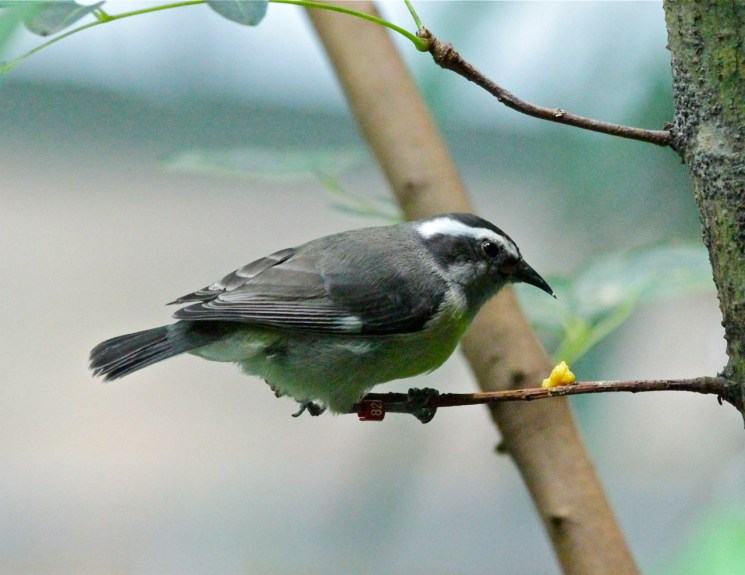


DISTRIBUTION/HABITAT: West Indies, Caribbean mainland from Southern Mexico south to southern Brazil and northeast Argentina. Most commonly found at low elevations and rarely in the high mountainous forests in settled districts and secondary growth.

DIET: Primary food is from flowers for nectar.  Although it does use its sharp beak to pierce flowers from the side to feed, much like some hummingbirds, the Bananaquit cannot hover like a hummingbird. Also while clinging head downward; gleans small insects and spiders from foliage, or creeps over trunks and limbs searching for them.  Pollinates at least three species of Bromelioideae.
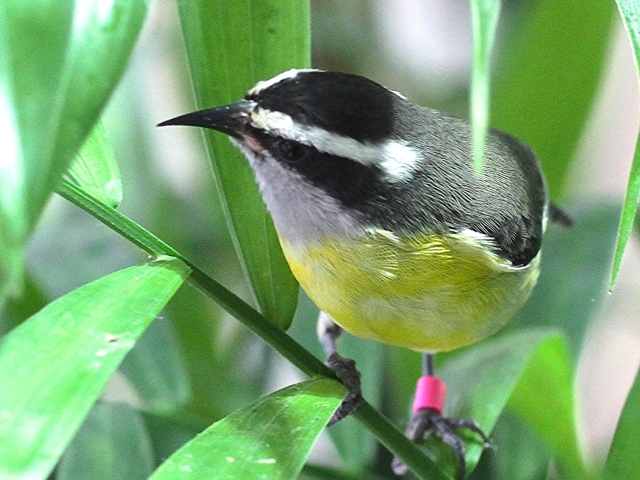
16669980639_1994ef2607_o

REPRODUCTION; The male and female build their own globe-shaped nests using leaves, grasses, and plant fibers from 5 to 30 feet above ground. Broods may contain from one to three white-cream color eggs.

LIFESPAN: 7 years in the wild.

CONSERVATION; IUCN RED LIST; Least Concern (LC)
Due to an extremely large range.
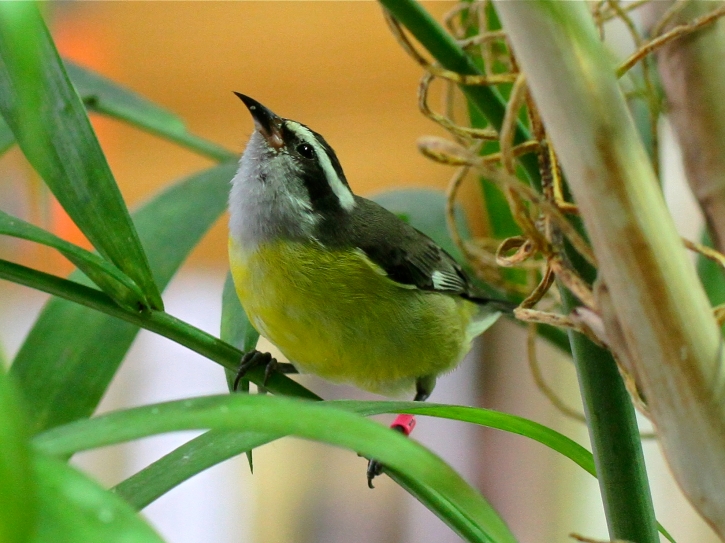
Bananaquit4329886077_48c1c841fd_o

REMARKS: The highly successful Bananaquit inhabits basically every island in the Caribbean except for Cuba. On some islands in the West Indies an entirely sooty color morph is frequent.

Peurto Rico has adopted the Bananaquit as its national bird, and many Caribbean and South American countries have featured the bird on their postage stamps.

References

Encyclopedia of Life http://eol.org/pages/1178271/details

IUCN Red List  www.iucnredlist.org/details/22722080/0

Cornell Lab of Ornithology neotropical.birds.cornell.edu/portal/species/overview?p_p…

Animal Diversity Web animaldiversity.org/accounts/Coereba_flaveola/

Ron’s WordPress Shortlink  wp.me/p1DZ4b-jv

Ron’s flickr https://www.flickr.com/photos/cas_docents/4041293060/in/album-72157608454346681/
 

TAXONOMY
Kingdom: Animalia
Phylum: Chordata
Class: Actinopterygii (ray-finned fishes)
Order: Cyprinodontiformes (Rivulines, killifishes and live bearers)                                                                                        Family: Poeciliidae

Genus/species: Alafro cultratus

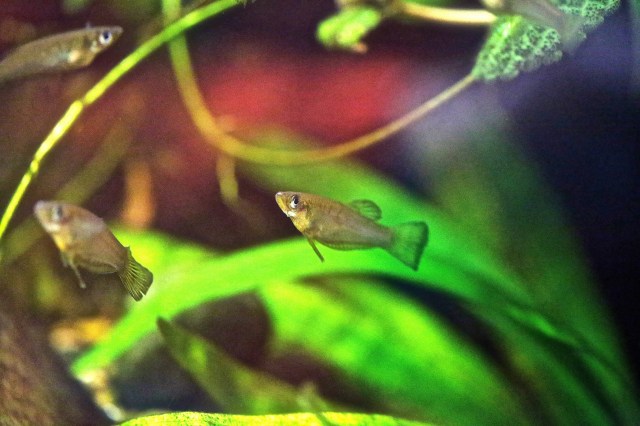
Alafro cultratus16167676782_36fa409f32_k

GENERAL CHARACTERISTICS: Max length : 7.5 cm.

DISTRIBUTION/HABITAT: Central America: Costa Rica, Panama and Nicaragua. Found in rapidly flowing rainforest streams.

DIET IN THE WILD: Insectivorous, aquatic and terrestrial insects.

REPRODUCTION: Internal live bearers. Gestation lasts for about 24 days. Produces 10 to 30, rarely more, young.

CONSERVATION: IUCN AND CITIES Not Evaluated

References

fishbase www.fishbase.gr/summary/46449

Encyclopedia of Life eol.org/pages/1157656/hierarchy_entries/44712641/details

Ron’s flickr https://www.flickr.com/photos/cas_docents/16167676782/in/set-72157620708938680

Ron’s WordPress Shortlink  http://wp.me/p1DZ4b-1tM

TAXONOMY
Kingdom: Animalia
Phylum: Arthropoda (insects, arachnids, and crustaceans)
Class: Insecta
Order: Blattodea (cockroaches and the termites)
Family: Blaberidae (giant cockroaches)

Genus/species: Blaberus giganteus 

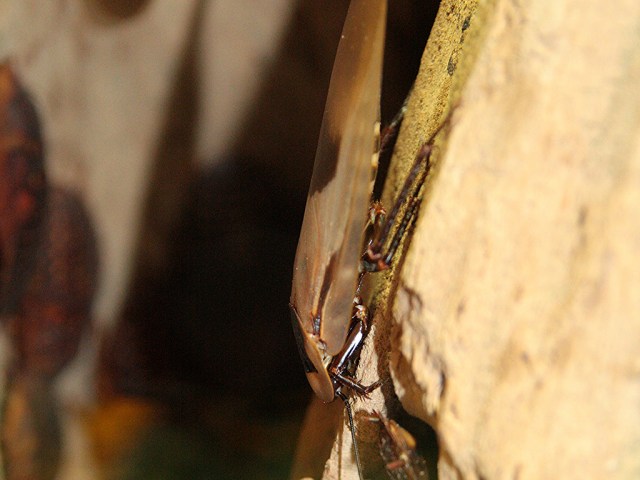
GENERAL CHARACTERISTICS: They have three pairs of legs, and two pairs of wings, the forewings being light brown in colour. Largest neotropical cockroach by weight. A giant cockroach has a flattened, oval body, about 9 cm (3.5 inches) long and 4 cm (1.5 inches) wide. Females are slightly larger than males. They commonly run along the ground, although the adults have wings that are rarely if ever used for flight. They have long, very slender antennae and two sensory organs, called cerci, at the tip of the abdomen.

Blaberus giganteus 3445478500_7a02fcb067_b

DISTRIBUTION/HABITAT: Central and South America. They prefer dark, damp locations such as caves, rock crevices, tree hollows, and spaces under loose tree bark.

Blaberus giganteus 3775296951_fd8e873273_b

DIET IN THE WILD: Cockroaches are omnivores and detritivores. Common diet includes bat guano, rotting wood, fruit, seeds, decomposing vegetation, dead insects, and other animals. They help recycle decaying matter on the ground into useful nutrients for plants. 

REPRODUCTION: Females emit a pheromone that induces males to mate. Male courtship rituals include raising wings at right angles to abdomen and making trembling movements with abdomen. After mating, the female B. giganteus will be pregnant for life producing eggs which turn into nymphs which later become adults.

Blaberus giganteus 3779077163_a2d1b493c7_b-2

MORTALITY/LONGEVITY: They can live about 20 months as adults.

PREDATORS:  Army ants kill and eat nymphs.

CONSERVATION:  IUCN: Not Listed; CITES: Not Listed  

Cockroaches dates back over 200-300 million years, and are very adaptable and resilient animals.

REMARKS:  The leg bristles and antennae are used for seeing and feeling, in their dark habitat, while their flat bodies enable them to hide in crevices and underneath rocks. Cockroaches do not have lungs to breathe, but instead they take air in through spiracles, which are tiny holes on the sides of their bodies, and are used to send oxygen to other parts of the body. This allows the cockroach to survive for a period of time without its head, until it dies of infection, starvation or dehydration. When threatened, the giant cockroach is able to produce a foul smell to ward off predators. 

Location: Rainforest Costa Rica CR04 

References: 

Toronto Zoo http://www.torontozoo.com/ExploretheZoo/AnimalDetails.asp?pg=445

Encyclopedia of Life  eol.org/pages/1075061/details

Sreng, L. 1993. Cockroach Mating Behaviours, Sex-Pheromones, and Abdominal Glands (Dictyoptera, Blaberidae). Journal of Insect Behaviour. 6: 715-735.

Ron’s WordPress shortlink  http://wp.me/p1DZ4b-1tE

Ron’s flickr https://www.flickr.com/photos/cas_docents/3776101942/in/set-72157620708938680

TAXONOMY
Kingdom: Animalia
Phylum: Arthropoda
Class: Arachnida
Order: Araneae
Suborder: Araneomorphae (fangs slope towards each other in a pinching action)
Family: Nephilidae

Genus/species; Nephila Clavipes

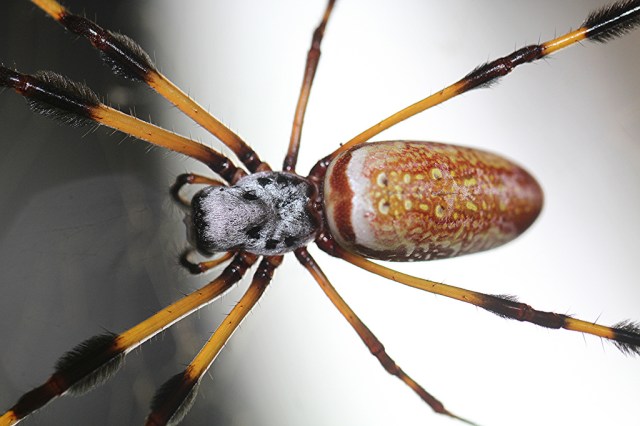
GENERAL CHARACTERISTICS; Orb-weavers are highly sexually dimorphic. Females grow up to 8 cm (3 in), and are 5 to 6 times larger than males. Adults are mostly yellow with elongated abdomen and long, hairy legs. This spider lives in hot places. The long cylindrical abdomen of the spider may be angled towards the sun to reduce the amount of exposed body surface and thus prevent overheating. The reflective silvery surface of much of the body serves the same purpose.

Nephila Clavipes   5389185249_24cf049f4f_b 

DISTRIBUTION/HABITAT: These spiders are found from the southeastern United States south through Argentina and Peru. They prefer areas of high humidity and forest areas along trails and clearing edges. N. clavipes is the only member of its genus known in the Western Hemisphere.

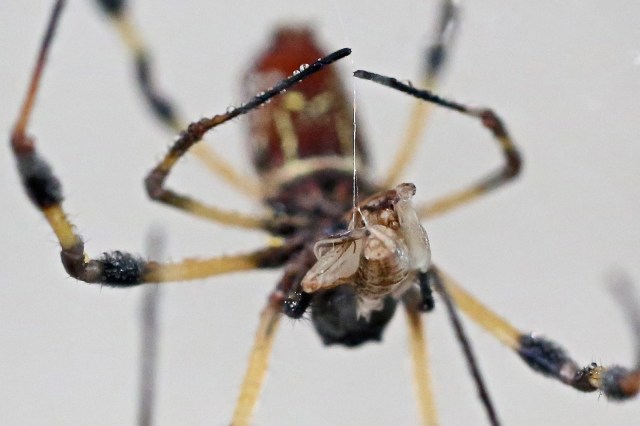
DIET IN THE WILD: They feed on small flying insects: beetles, flies, moths, etc., that are captured in their web. After prey is entangled in the web, the spider incapacitates it by biting and then encases it in silk.

9129006757_d402137e70_h

REPRODUCTION: Mating is a tricky proposition for orb weaving males. For successful reproduction, males must successfully stimulate females in order to prevent being a meal for their would-be mate, though this unfortunate ending is relatively rare with this species.

MORTALITY/LONGEVITY: Life span: a single season (1 year).

REMARKS: 

•Orb weavers construct webs for defense and capture of prey.

•The silk of the web usually has a golden color that is visible to the naked eye and is the source of the common name.

•The impressive web of most orb weavers is a semi-permanent structure, repaired and rebuilt daily as necessary.

•Spiders from the Nephilia species on display from Madagascar are sometimes released into the Rainforest exhibit. They have settled in a territory behind the exhibit and observable from the spiral ramp. Only females are released as 1) they are much larger than the males and so more visible and 2) the Rainforest biologists have no interest in the uncontrolled breeding of these spiders in the exhibit!

Rainforest Costa Rica CR03

References

California Academy of Sciences docent Rainforest Training Manual 2014

Animal Diversity Web animaldiversity.org/accounts/Nephila_clavipes/

Ron’s flickr  https://www.flickr.com/photos/cas_docents/5389185249/in/album-72157620708938680/

Ron’s WordPress shortlink  http://wp.me/p1DZ4b-1tf


TAXONOMY
Kingdom: Animalia
Phylum: Chordata
Class: Amphibia
Order: Anura
Family: Hylidae

Genus/species: Dendropsophus ebraccatus

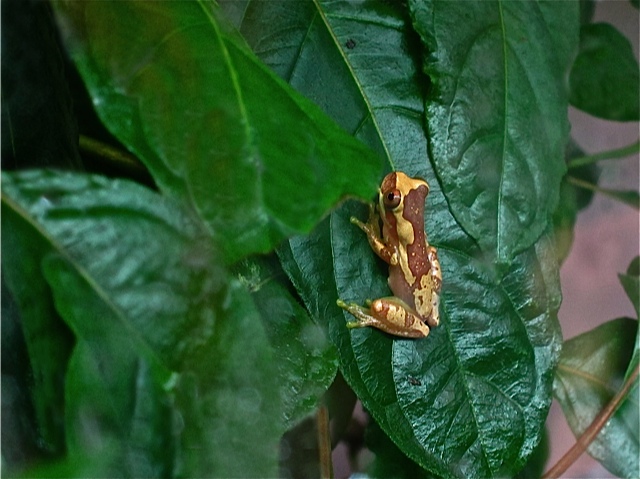
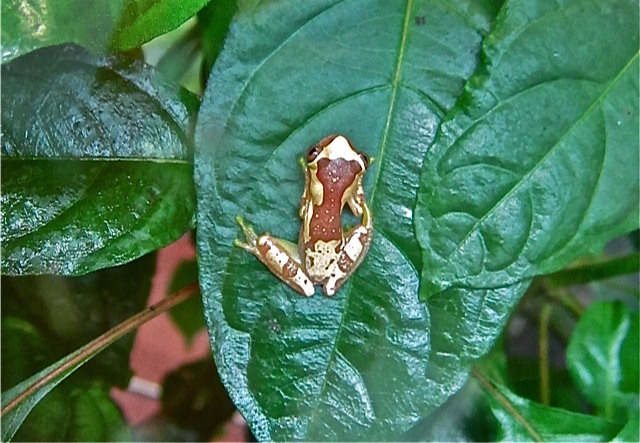
GENERAL CHARACTERISTICS: Gets its name from the hourglass shape that you can usually see on the frog’s back. Its translucent skin changes color depending on the time of day and the stress the frog is experiencing. Iris brown to reddish bronze, sometimes tan or yellow. Pupil horizontal. Foot moderately to extensively webbed. Toes with large terminal discs. Length  males to 28 mm (1.1 inches) ; females to 37 mm (1.5 inches).

DISTRIBUTION/HABITAT:  Native to Belize; Colombia; Costa Rica; Ecuador; Guatemala; Honduras; Mexico; Nicaragua; Panama.  Found in  humid tropical forest and in heavily disturbed areas where most of the forest has been removed. 

DIET IN THE WILD: Unknown but probably small arthropods.

REPRODUCTION: Eggs are placed on leaves overhanging  pools with the tadpoles developing in the water.

CONSERVATION: IUCN Red List (LC)
D. ebraccatus is very adaptable with the major threats deforestation for agricultural development, human settlement, and pollution resulting from the spraying of crops.

MORTALITY/LONGEVITY: Short lived, usually lasting less than 3 years.

LOCATION: CR06

References

IUCN Red List  www.iucnredlist.org/details/55470/0

Amphibiaweb amphibiaweb.org/cgi/amphib_query?where-genus=Dendropsophu…

Encyclopedia of Life  eol.org/pages/1038861/details

Ron’s WordPress shortlink:  http://wp.me/p1DZ4b-t6

Ron’s flickr http://www.flickr.com/photos/cas_docents/sets/72157620708938680

TAXONOMY
Kingdom: Animalia
Phylum: Chordata
Class: Amphibia
Order: Anura
Suborder: Neobatrachia
Family: Dendrobatidae

Genus/species: Dendrobates auratus

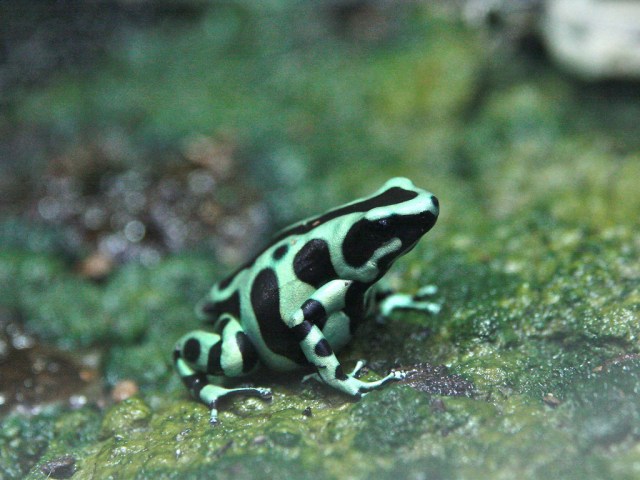
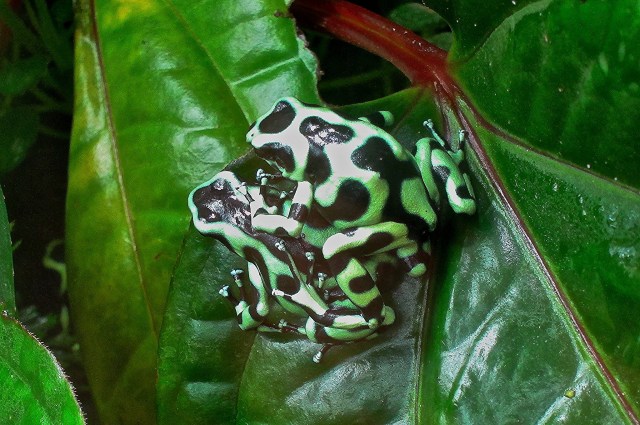
GENERAL CHARACTERISTICS:  Green marking on dark background. Color and pattern varies widely among populations of this species.  Aposematic (“warning”) coloration shies diurnal predators away from this bold frog An average species in size, toxicity, and coloration.  Males reach about three-quarters of an inch long; females are slightly larger.

3776076618_9b282b6eaf_b

DISTRIBUTION/HABITAT: Central America to Northwest Colombia lowland tropical rainforests. Common in cocoa (not coca) plantations. Introduced to Hawaii (1932 Oahu) to control non-native insect populations. The “success” of this experiment has yet to be proven. Terrestrial frogs, but will climb. Active diurnally.

DIET IN THE WILD : Ants and mites, also tiny beetles, flies and springtails. Often captures insects feeding on rotting fruit.

REPRODUCTION: Each individual male frog clears a small patch for himself. Females wander among the males, the latter then attempt to impress the former with their bird-like mating calls. the two then mate. The male grasps the female in a gentle embrace, and fertilizes each egg as it is produced. In approximately 2 weeks, these hatch into tadpoles which are carried to the canopy the tadpoles sticking to the mucus on their parents’ backs. The parents then deposit their tadpoles into the small pools of water that accumulate in the center of bromeliads protecting them until their development is complete.

Green and black poison dart frog16461015440_7dab815173_k

MORTALITY/LONGEVITY: Can live to 17 years.

CONSERVATION: Least Concern (IUCN Red List). Still reported to be locally common, they are at some risk due to habitat destruction. They are popular in the pet trade, but most are captive-born.

REMARKS: D. auratus produces pumiliotoxin, a potent nerve poison manufactured and stored in subcutaneous membranes and secreted through a modified layer of epidermis. The small amount of pumiliotoxin poison the frog possesses is enough to make humans seriously ill by interfering with muscle contraction in the heart and skeletal muscle.

D. auratus, as with all poison dart frogs, loses its toxicity in captivity due to a change in diet. This has led scientists to believe that the green-and-black poison frog actually takes its poison from the ants it feeds on.

Green & Black Poison Dart Frog Dendrobates auratus (Dendrobatidae) 2

Costa Rica Rainforest

References 

 Animal diversity Web animaldiversity.org/accounts/Dendrobates_auratus/

 California Academy of Sciences Docent Rainforest Training Manual 2014

 Dendrobates.org  www.dendrobates.org/auratus.html

Ron’s flickr  http://www.flickr.com/photos/cas_docents/sets/72157608456457315/

WordPress shortlink  http://wp.me/p1DZ4b-Ln

TAXONOMY
Kingdom: Animalia
Phylum: Chordata
Class: Reptilia
Order: Squamata
Suborder: Lacertilia
Family: Polychrotidae

Genus/species: Norops oxylophus

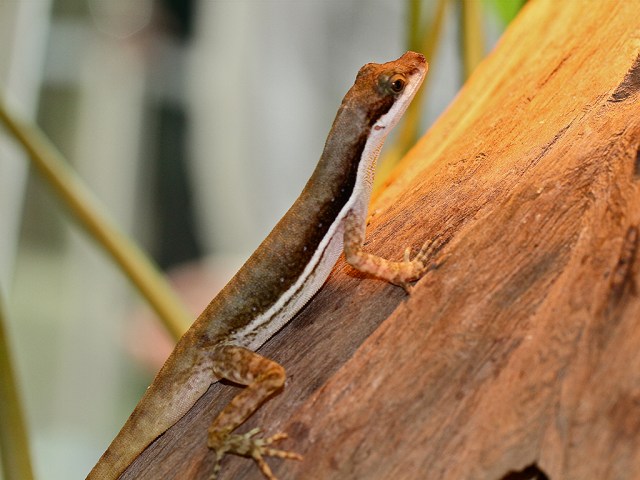
GENERAL CHARACTERISTICS: Stream anoles are moderately large, about 8 cm (3 in) snout to vent, short-legged lizards. Females are slightly smaller than males. They are chocolate-colored with a pair of cream-colored lateral stripes that run from the shoulder down about 2/3 the length of the body. The irises of their eyes are a coppery color. This is one of the characteristics that distinguish N. oxylophus from N. aquaticus, a blue-eyed anole that lives in the same area.

Norops oxylophus 5389062001_ef78684622_b

DISTRIBUTION/HABITAT: Honduras to northwestern Panama. Found in lowland forest and streams.

DIET IN THE WILD: Invertebrates. Anoles are visual lizards with excellent eyesight. They have color vision that includes ultraviolet wavelengths. Unlike many lizards, their sense of smell is poor, and they use their tongues to capture prey, rather than to sense them.

Norops oxylophus 5389664708_63b917acef_o

REMARKS: May dart across water to escape predators.

Rainforest Costa Rica CR04

References

California Academy of Sciences Docent Rainforest Training Manual 2014

Ron’s WordPress Shortlink http://wp.me/p1DZ4b-1sN

Ron’s flickr https://www.flickr.com/photos/cas_docents/5389062001/in/album-72157620708938680/

TAXONOMY
Kingdom: Animalia
Phylum: Chordata
Class; Reptilia
Order; Squamata (scaled reptiles, all lizards and snakes)
Suborder; Iguania
Family: Chamaeleonidae (Chameleons)

Genus/species: Brookesia stumpffi

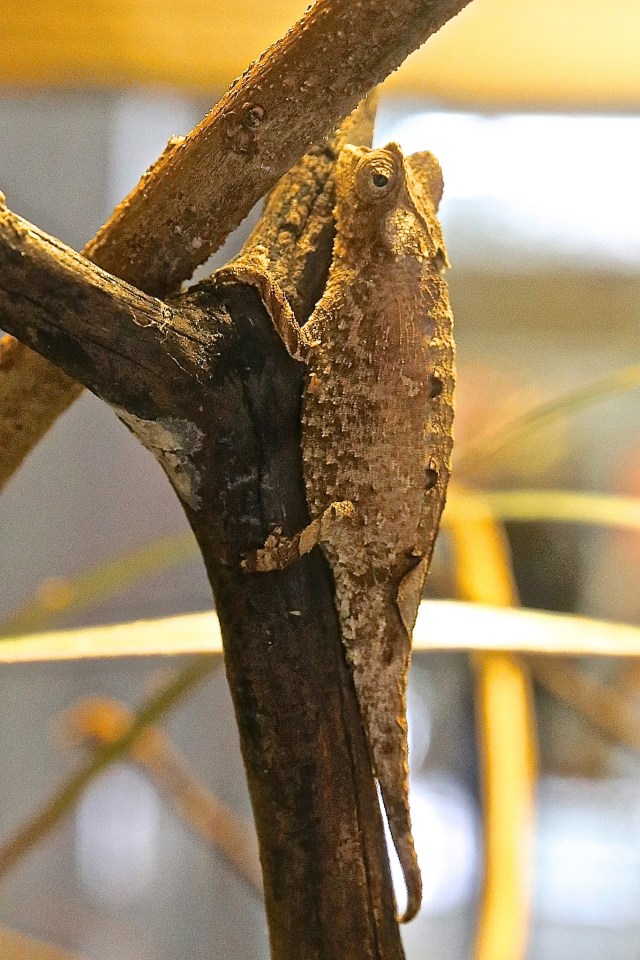
GENERAL CHARACTERISTICS: This small chameleon grows up to 9 cm (3.5 in).

16273325375_8e6da34af4_k

DISTRIBUTION/HABITAT: Northern Madagascar and on several offshore islands. Commonly found in primary rainforest, dry forests, and secondary vegetation.

DIET IN THE WILD: It hunts in the leaf litter of the forest floor during the day, where it feeds on insects such a crickets, cockroaches, grasshoppers, and moths. At night it sleeps on branches of small shrubs about 30–80 cm (1–3 ft) above the ground.

PREDATORS: Probably snakes, birds, small mammals.

REPRODUCTION: Females lay between 3 to 5 eggs in depressions under dead leaves on the forest floor. 

LIFE SPAN: About 3 years.

CONSERVATION: IUCN Red List) Least Concern (LC).   This chameleon occurs in a fairly large area and seems relatively adaptable to disturbed habitats; however, its popularity in the pet trade as well as pressure from slash and burn farming pose possible threats

REMARKS: Can rapidly change colors to blend with the forest leaf litter to avoid predators. 

When disturbed these chameleons will play dead, resembling a fallen leaf. The Brookesia species are often called “leaf chameleons” because their small body and morphology resembling a leaf makes them highly cryptic when on the ground. 

Madagascar MA14 

References

California Academy of Sciences Docent Rainforest Training Manual 2014

IUCN Red List  www.iucnredlist.org/details/176297/0

Encyclopedia of Life  eol.org/pages/1057220/details

Ron’s flickr  https://www.flickr.com/photos/cas_docents/16273325375/in/album-72157620708610230/

Ron’s WordPress shortlink   http://wp.me/p1DZ4b-1sE


TAXONOMY
Kingdom: Animalia
Phylum: Chordata
Subphylum: Vertebrata
Class: Reptilia
Order: Squamata
Suborder: Sauria
Infraorder: Gekkota
Family: Gekkonidae

Genus/species: Blaseodactylus salalava

14933388794_fa4df3c0d4_o

DISTRIBUTION: Southwest Madagascar.

DIET IN THE WILD: Insects.

Madagascar MA10

TAXONOMY
Kingdom: Animalia
Phylum: Chordata
Class: Amphibia
Order: Anura
Family: Hyperoliidae (African Tree Frogs)

Genus/species: Heterixalus madagascariensis

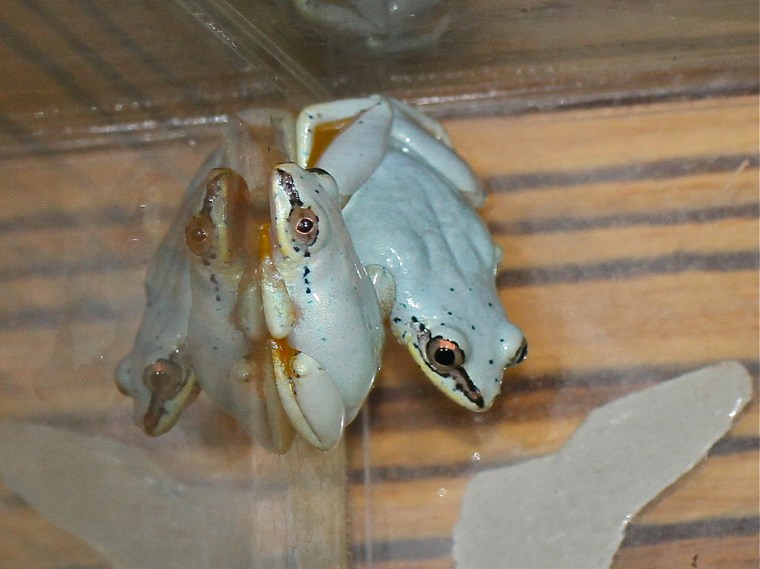
4813851121_62a99aa2a4_b

GENERAL CHARACTERISTICS: Though color can change depending on environmental conditions, the back is usually uniformly white, gray, or sometimes yellow. Thighs and the undersides of legs and feet are orange. A dark band extends between the nostril and eye. Males to 3.5 cm (1.35 inches) snout to vent; females to 4 cm (1.5 inches).

DISTRIBUTION/HABITAT: Endemic to Madagascar. Found along the northeast coast near rainforest edges, in dry forested areas, and coastal forests as well as deforested areas, crop lands, and even urban areas.

DIET IN THE WILD: A nocturnal and semi-arboreal hunter of insects, it readily eats insects as big as its own head.

REMARKS: All of the 11 known species of the genus Heterixalus are endemic to Madagascar. Reed frogs spend days resting or sleeping in the sun, frequently perched on emergent vegetation of swamps and ponds, thus the common name “reed frogs.”

Rainforest, Madagascar MA12

References

IUCN Red List www.iucnredlist.org/details/56102/0

Amphibia Web  http://amphibiaweb.org/cgi/amphib_query?where-genus=Heterixalus&where-species=madagascariensis

Ron’s flickr  https://www.flickr.com/photos/cas_docents/4813851121/in/set-72157620708610230

Ron’s WordPress shortlink   http://wp.me/p1DZ4b-MX