Tag Archive: tropical marine fishes


TAXONOMY
Kingdom: Animalia
Phylum: Chordata
Class: Actinopterygii (ray-finned fishes)
Order: Perciformes (Perch-likes)
Family: Acanthuridae (Surgeonfishes, tangs, unicornfishes)

Genus/species: Ctenochaetus strigosus

GENERAL CHARACTERISTICS: Brown as a juvenile and blue or burgundy as an adult with pale yellow spots on head and pale yellow pinstripes on body. Conspicuous, broad yellow ring around the eye.

Max. length: 15 cm (6 in).
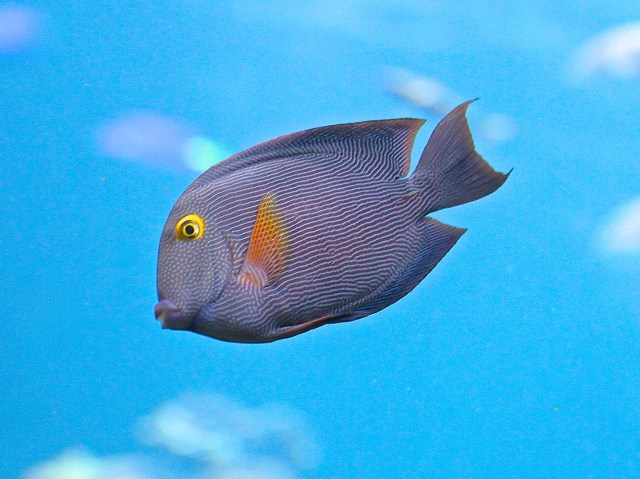
4295978629_a74cba2281_o

DISTRIBUTION/HABITAT: C. strigosus is found in the Central Pacific in coral-rich areas of deep lagoon and seaward reefs.

DIET IN THE WILD: Herbivore, grazing algae and detritus using its comb-like teeth. Their diet may contain high concentrations of the dinoflagellate that produces ciguatera toxin, and so bristletooths and their predators are known to sometimes concentrate sufficient toxin to cause illness in humans.

4770697730_79fe352a24_b

REPRODUCTION: Pelagic spawner. Lifespan 5 yrs or longer.
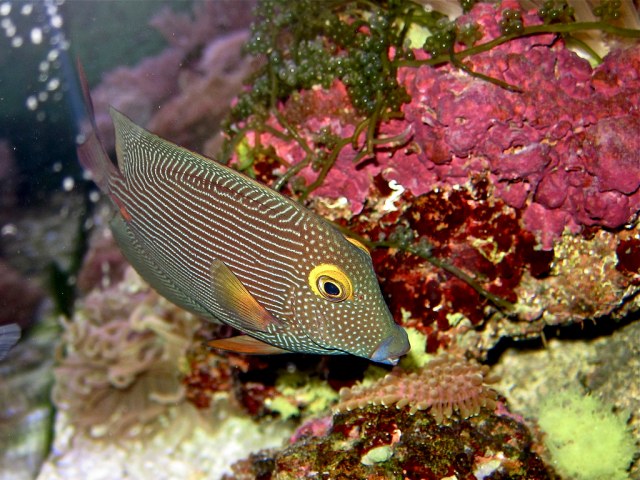
Goldring Bristletooth aka Spotted Surgeonfish (brown variant)13161055833_2f47ca36cb_b

CONSERVATION: IUCN Least concern

REMARKS: It has also been commonly observed to clean algal growths from the shells of sea turtles in Hawaiian waters.

References

California Academy of Sciences Steinhart Aquarium Philippine Coral Reef 2016

IUCN www.iucnredlist.org/details/177949/0

Ron’s flickr http://www.flickr.com/photos/cas_docents/8679225491/in/set-72157608332652056/  

EOL eol.org/pages/220815/details

fishbase www.fishbase.org/summary/6015

Ron’s WordPress Shortlink  http://wp.me/p1DZ4b-WG
TAXONOMY
Kingdom: Animalia
Phylum: Chordata
Class: Actinopterygii
Order: Perciformes
Family: Acanthuridae (Surgeonfishes, Tangs and Unicornfishes)

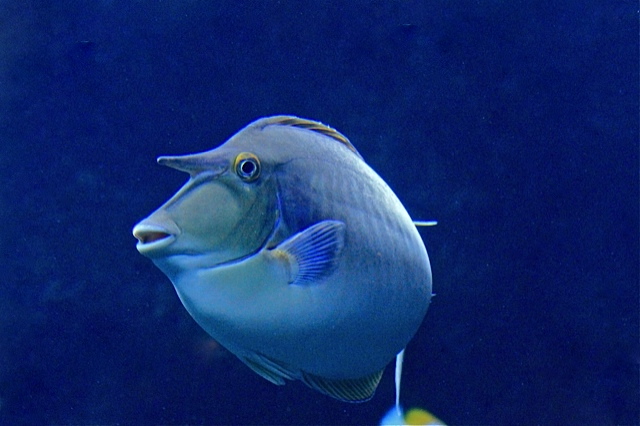
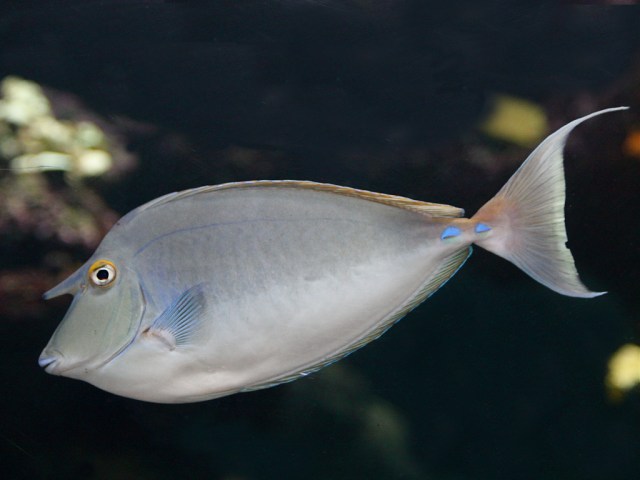
Genus/species: Naso unicornis

GENERAL CHARACTERISTICS: Naso unicornis is gray to olive with blue tail spines.  The short forehead horn does not project past mouth. The peduncular plates and spines are blue; dorsal and anal fins yellowish with narrow blue stripes. Adult males tend be larger and have a better developed horn, peduncular spines, and caudal filaments than females.

Length to 70 cm (27.5 in)

DISTRIBUTION/HABITAT: Indo-Pacific. The Bluespine Unicornfish inhabits channels, moats, lagoons and seaward reefs with strong surge. It typically occurs  in small groups at depths of 1–80 m (3-250 ft.).

DIET IN THE WILD: It is diurnal feeding on macro- and micr oalgae, including brown algae like Sargassum.

REPRODUCTION: External fertilization. Pair-spawning has been observed; pelagic larvae.

PREDATORS: An important food fish on most tropical islands. Long-lived, up to 35
years. Preyed upon by other fishes.

CONSERVATION: IUCN; least concern.

REMARKS: Rostral horn responsible for species’ common name. Surgeonfishes have a single scalpel-like peduncular spine which folds into a groove while unicornfishes have 1 or 2 sharp, fixed keel-like peduncular plates. The spines are used offensively and defensively.

References

California Academy of Sciences Steinhart Aquarium Philippine Coral Reef 2016

Ron’s flickr http://www.flickr.com/photos/cas_docents/sets/72157608332652056/with/3185901763/

Ron’s WordPress shortlink http://wp.me/p1DZ4b-Hx

fishbase http://www.fishbase.org/summary/1265

EOL  http://eol.org/pages/213498/details

TAXONOMY
Kingdom: Animalia
Phylum: Chordata
Class: Actinopterygii (ray-finned fishes)
Order: Perciformes (Perch-likes)
Family: Acanthuridae (Surgeonfishes, tangs, unicornfishes)

Genus/species: Acanthurus achilles

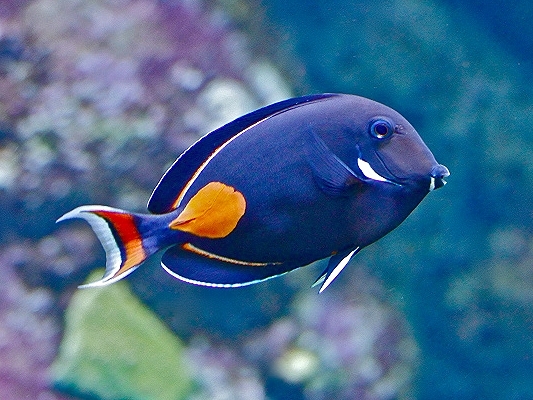
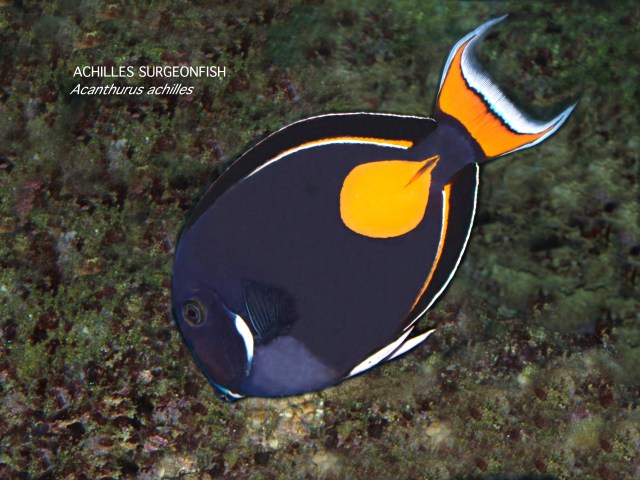
GENERAL CHARACTERISTICS: The Achilles Surgeonfish’s black body is ovate and compressed with a large orange caudal spot. The caudal fin has a broad vertical orange band. The spine in caudal peduncle may be venomous. Juveniles lack the orange spot.

Length to 24 cm (9.5 in)

Acanthurus achilles (Acanthuridae) Surgeonfishes, Tangs and Unicornfishes Distribution: Indo-Pacific. Habitat: Clear seaward reefs, primarily in the surf zone to 4 m. Usually in small groups. Appearance: Length to 24 cm. Ovate compressed body black with a large orange caudal spot. Caudal fin has a broad vertical orange band. Diet: Diurnal herbivores of filamentous and small fleshy algae. Reproduction and Development: Spawners. Juveniles lack the orange spot. Mortality/Longevity: An important food fish on tropical islands. Remarks: Highly territorial. “Tang” in British dialect means dagger or knife. Thus the common name refers to the caudal peduncle spines. Single scalpel-like peduncular spine folds into a groove on each side of the tail. Spines are used offensively or defensively, against conspecifics in struggles for dominance or against predators. Whether a fish has a common name of “surgeonfish” or “tang” seems to be a matter of convention, not substance.

DISTRIBUTION/HABITAT: Central Pacific: Micronesia, New Caledonia, Hawaii to Pitcairn and east to of French Polynesia Island. Found on clear seaward reefs, primarily in the surf zone to 4 m (12 ft). Usually in small groups.

DIET IN THE WILD: Diurnal herbivores of filamentous and small fleshy algae.

REPRODUCTION: Monogamous spawners

ACHILLES SURGEONFISH (Acanthurus achilles) .JPG

MORTALITY: An important food fish on tropical islands.

REMARKS: “Tang” in British dialect means dagger or knife. Thus the common name refers to the caudal peduncle spines. Single scalpel-like peduncular spine folds into a groove on each side of the tail. Spines are used offensively or defensively, against conspecifics in struggles for dominance or against predators. Whether a fish has a common name of “surgeonfish” or “tang” seems to be a matter of convention, not substance. The generic name comes from the Greek acantha (“thorn”) and oura (“tail”).

References

California Academy of Sciences Steinhart Aquarium Philippine Coral Reef 2016

fishbase  www.fishbase.org/summary/Acanthurus-achilles.html

IUCN Red List www.iucnredlist.org/details/177960/0

EOL eol.org/pages/210872/details

Ron’s flickr http://www.flickr.com/photos/cas_docents/4330628500/in/set-72157625992053826/

Ron’s WordPress shortlink http://wp.me/p1DZ4b-1ah


TAXONOMY
Kingdom: Animalia
Phylum:  Chordata
Class:  Actinopterygii (ray-finned fishes)
Order: Perciformes (Perch-likes)
Family: Chaetodontidae (Butterflyfishes)

Genus/species: Prognathodes aculeatus

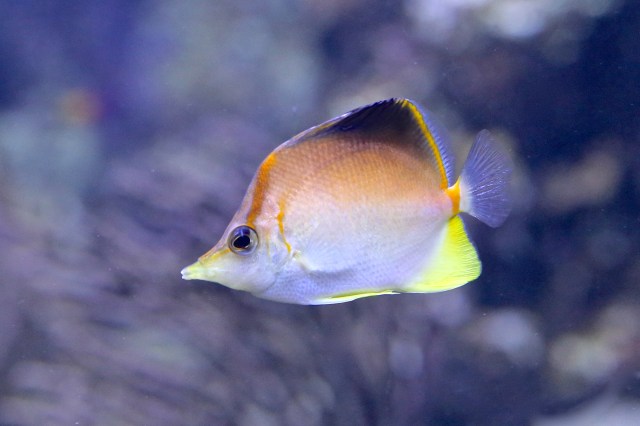
Caribbean Longnose Butterflyfish 8374253723_e84e62082c_o

GENERAL CHARACTERISTICS: Upper half of body yellow-orange, shading into blackish basally in dorsal fin; lower half of body white; orange bands on head and a narrow orange bar on caudal peduncle. Average of 2 to 3 inches long.

DISTRIBUTION/HABITAT: Found on natural and artificial reefs, usually 30 to 200 ft in-depth, off Florida, in the Gulf of Mexico, in the Caribbean Sea, and off the coast of Venezuela.

DIET IN THE WILD: Bristleworms, crustaceans, black coral polyps, sea urchin pedicellaria. Also known to eat the tube feet of sea urchins and tube worm tentacles.

REPRODUCTION: Oviparous

CONSERVATION: IUCN, Least Concern (LC)

REMARKS: When threatened, this butterflyfish erects its dorsal spines and points them at the threat.

References

California Academy of Sciences Steinhart Aquarium, Caribbean Reef 2016

Ron’s flickr www.flickr.com/photos/cas_docents/sets/72157625119200613/…

Ron’s WordPress shortlink wp.me/p1DZ4b-No

fishbase fishbase.us/summary/Prognathodes-aculeatus.html

reefguide.org/carib/longsnoutbutter.html

Fishes of the Gulf of Mexico, Volume 2: Scorpaeniformes to Tetraodontiformes
By John D. McEachran, Janice D. Fechhelm

Caribbean Reef PR36

TAXONOMY
Kingdom: Animalia
Phylum: Chordata
Class : Actinopterygii (ray-finned fishes)
Order: Pectiformes (Perch-likes)
Family : Pomacanthidae (Angelfishes)

Genus/species: Centropyge argi

GENERAL CHARACTERISTICS: Like their close relatives the butterflyfishes, they have a deep, laterally compressed body, a single, unnotched dorsal fin, and a small mouth with brushlike teeth. The most observable difference between the two families is the long spine at the corner of the preopercle common to angelfishes.

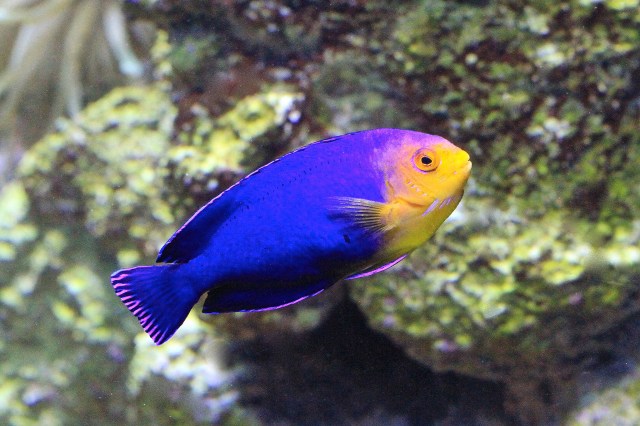
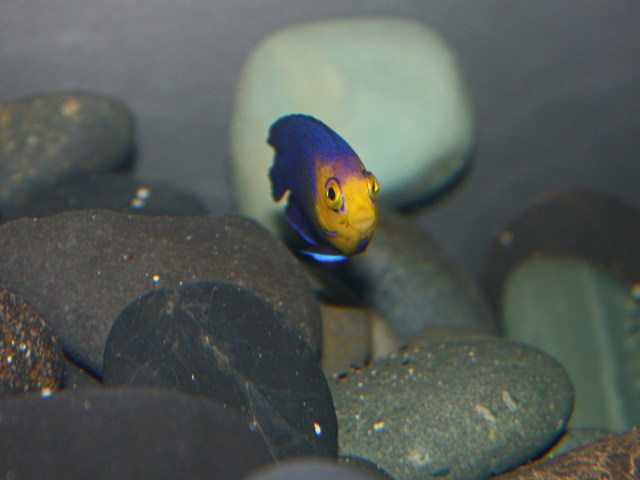
C. argi is a small, oval angelfish. The body is dark blue with a yellow-orange face and blue ring around the eye. Pectoral fins are pale yellowish; other fins deep blue with pale blue margins.
Length up to 8 cm (3.1 in)


Cherubfish7086483839_ef280bfe0f_k

DISTRIBUTION/ HABITAT: Bermuda, Florida, Bahamas, Yucatan and Central American coast to Guianas. Nocturnally active in pairs or small groups in rubble areas near rocky or coral reefs, occasionally walls. 

Depth 9–105 m (30-345 ft), commonly deeper than 30 m (100 ft)

DIET IN THE WILD: Omnivorous, feeds on algae, benthic inverts and detritus.

REPRODUCTION/DEVELOPMENT: Broadcast spawners. All Centropyge are born female. As they grow, the larger and more dominant fish will become male and the others will remain female. If the male dies, the next in command in the hierarchy will turn to male.

PREDATORS: Preyed on by other fish such as yellow-finned tunafish. This small angelfsh darts into crevices when frightened or pursued by predators.

Lifespan: Have been reported to live up to 5 years in captivity.

CONSERVATION: IUCN Least concern.

CaribbeanReef 

References

California Academy of Sciences, Steinhart Aquarium, Caribbean reef fishes 2015

Ron’s flickr http://www.flickr.com/photos/cas_docents/sets/72157606840726733/

Ron’s W0rdpress shortlink   http://wp.me/p1DZ4b-uJ

fishbase  http://www.fishbase.org/summary/3607

Book  Lieske, E. and R. Myers, 1994. Collins Pocket Guide. Coral reef fishes. Indo-Pacific & Caribbean including the Red Sea. Haper Collins Publishers, 400 p.

ADW  http://animaldiversity.ummz.umich.edu/accounts/Centropyge_argi/


TAXONOMY
Kingdom: Animalia
Phylum: Cordata
Class: Actinopterygii (ray-finned fishes
Order: Perciformes (Perch-likes)
Family: Zanclidae (Moorish idol)

Genus/species: Zanclus cornutus


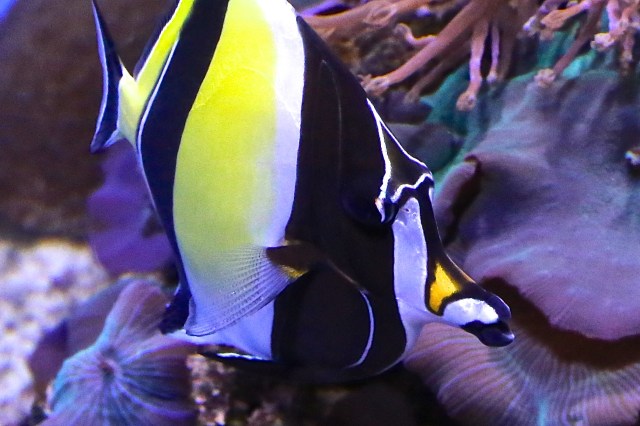
GENERAL CHARACTERISTICS: Discoid body, tubular snout, dorsal spines elongated into a very long white whip-like filament. Broad vertical white, black, white-yellow black, yellow banding. Tail black with white margin. Length to 23 cm (9 inches).

DISTRIBUTION/HABITAT: Indo-pan-Pacific. Southern Gulf of California found near hard substrates from turbid inner harbors and reef flats to clear seaward reefs as deep as 182 m (600 ft). Usually in small groups of conspecifics, occasionally in schools of more than 100.                 

 DIET IN THE WILD: Primarily sponges. Also consumes tunicates and algae.

 REPRODUCTION: It has a long larval phase and settles at a large size (6 cm or 2.4 in) resulting in its very wide geographic distribution.

 CONSERVATION: Not evaluated

REMARKS: The Moorish Idol was the icon of the Golden Gate Park Steinhart Aquarium.

Gill, was the leader of the tank fish in the movie Finding Nemo, with the voice of Willem Dafoe, is a Moorish idol.

Color of Life, Color on the Reef, Color Conceals, Hiding the eye.
Black stripes break up the body outline and hide the eye from predators.

IMG_3304

 Philippine Coral Reef  

 Ron’s flickr http://www.flickr.com/photos/cas_docents/sets/72157608440659805/

Ron’s  WordPress Shortlink  http://wp.me/p1DZ4b-Ax

fishbase: http://www.fishbase.org/summary/5950

EOL http://eol.org/pages/204516/hierarchy_entries/44696397/details

TAXONOMY
Kingdom:Animalia
Phylum: Chordata
Class Actinopterygii (ray-finned fishes)
Order Perciformes (Perch likes)
Family Chaetodontidae (Butterflyfishes)

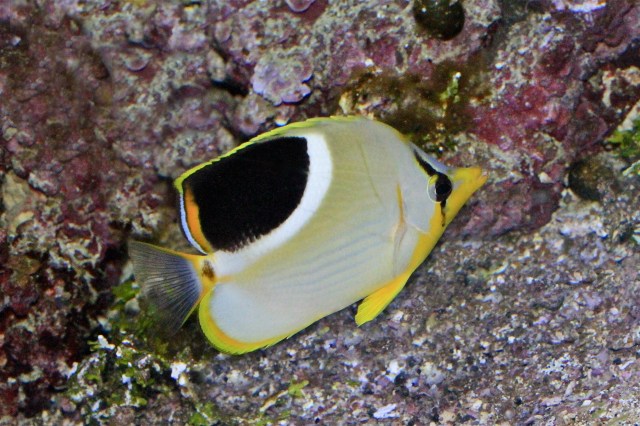
Genus/Species:  Chaetodon ephippium

Chaetodon ephippium 8410074954_fcdc073db2_h

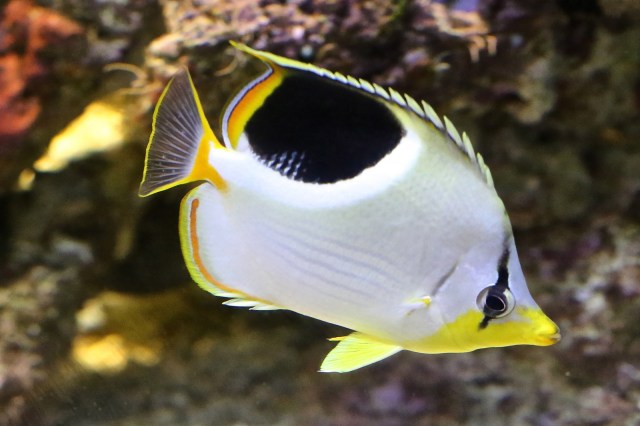
GENERAL CHARACTERISTICS: Yellowish grey with a large black spot on the upper rear sides bordered below by a broad white band; orange area from snout to ventral fins, wavy blue lines on the lower sides. The breast and snout are yellow. Adults have a filament extending from the back of the dorsal fin.
Length to 23 cm (9 inches) in length.

DISTRIBUTION/HABITAT: Indo-Pacific. in lagoons and seaward reefs to 30 m (98 feet) in coral rich, clear waters.

DIET IN THE WILD: Filamentous algae, small invertebrates, sponges, coral polyps, and fish eggs.

REPRODUCTION: Oviparous

CONSERVATION: IUCN Least Concern (LC)

Color of Life, Color Conceals.
This Saddleback Butterflyfish helps conceals its head by having a vertical line through the eye and a large eve-like spot on its upper posterior less vital portion of its body confusing  predators.

Color Cluster

References

California Academy of Sciences Color of life docent training 2015

Ron’s WordPress Shortlink   http://wp.me/p1DZ4b-vi

Ron’s flickr  http://www.flickr.com/photos/cas_docents/sets/72157625119200613/
fishbase www.fishbase.org/summary/5562

EOL eol.org/pages/1012777/details

Australia Museum australianmuseum.net.au/Saddle-Butterflyfish-Chaetodon-ep…

TAXONOMY
Kingdom : Animalia
Phylum: Chordata
Class: Actinopterygii (ray-finned fishes)
Order: Perciformes (Perch-likes)
Family: Gobiidae (Gobies)

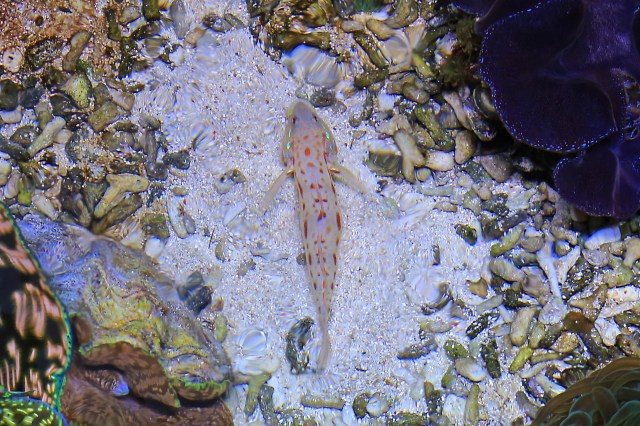
Genus/species: Valenciennea puellaris

Maiden GobyIMG_8532

GENERAL CHARACTERISTICS: Pale grey body color for Pacific fish with row of large orange spots on side, a series of dash-like markings below, oblong pale blue spots on cheek and opercle.  Length : 20.0 cm (7.8 inches).

DISTRIBUTION/HABITAT: Tropical marine Indo-Pacific: red Sea to Samoa, north to southern Japan, south to the Great Barrier Reef.
Inhabits sandy areas of clear lagoon and seaward reefs.

DIET IN THE WILD: Carnivore feedings off the bottom sifting through the sand. Once the fish has a mouthful of sand, it begins to slowly expel the sand out the gills for any small invertebrates.

REPRODUCTION: Monogamous

CONSERVATION: IUCN; Not evaluated

REMARKS: Occurs in pairs and use burrows as refuge.

References

WordPress shortlink  http://wp.me/p1DZ4b-1hc

flickr  https://www.flickr.com/photos/cas_docents/14047101767/

fishbase www.fishbase.org/summary/Valenciennea-puellaris.html

eol eol.org/pages/207103/details


TAXONOMY
Kingdom:Animalia
Phylum: Chordata
Class: Actinopterygii (ray-finned fishes)
Order: Perciformes (Perch-likes)
Family: Apogonidae (Cardinalfishes)

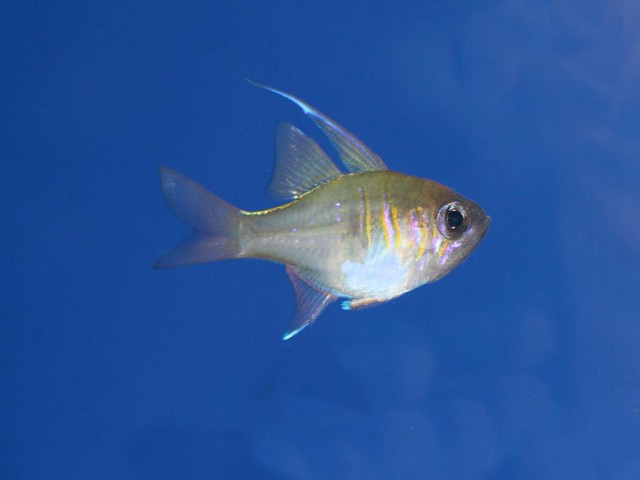
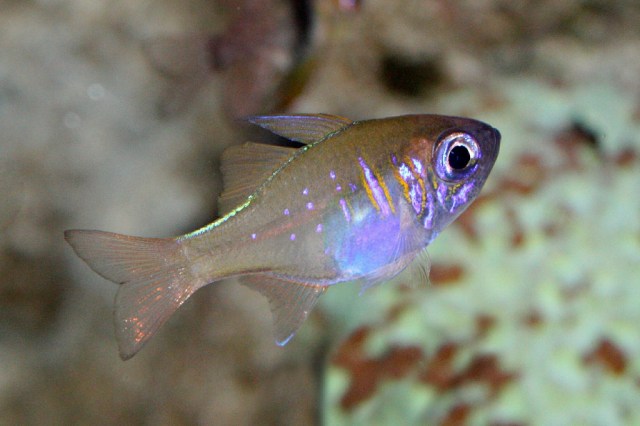
Genus/species: Zoramia leptacantha

ThreadfinCardinalfish4335618020_27ea998a8d_b

GENERAL CHARACTERISTICS: Elongate first dorsal fin. Whitish, semi-transparent with frosty iridescence on back; iris is luminous blue. Yellow-edged blue bands and bars on rear of head and front of body. Long first dorsal fin tip. Length to 6 cm (2.4 inches).

ThreadfinCardinalfish2990748320_4b0c6286dc_b

DISTRIBUTION/HABITAT: Tropical marine Indo-Pacific. Found in huge groups at 1–20 m (3.2 feet – 65 feet) depth in sheltered lagoons and protected reefs.

DIET IN THE WILD: Nocturnally feeds on benthic crustaceans.

REPRODUCTION: Mouth brooders; pair for courtship and spawning.

CONSERVATION: Not evaluated.

Philippine coral reef PR04

References

fishbase www.fishbase.org/summary/5773

eol eol.org/pages/211570/details

flickr www.flickr.com/photos/cas_docents/2990748320/in/set-72157…

WordPress shortlik http://wp.me/p1DZ4b-1h5

TAXONOMY
Kingdom:Animalia
Phylum: Chordata
Class:Actinopterygii (ray-finned fishes)
Order: Perciformes (Perch-likes)
Family: Apogonidae (Cardinalfishes)

Genus/species: Apogon cyanosoma

YellowstripedCardinalfish4184514661_35a0a5c254_b

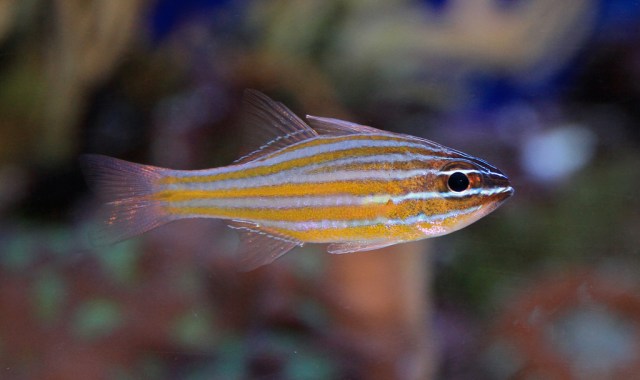
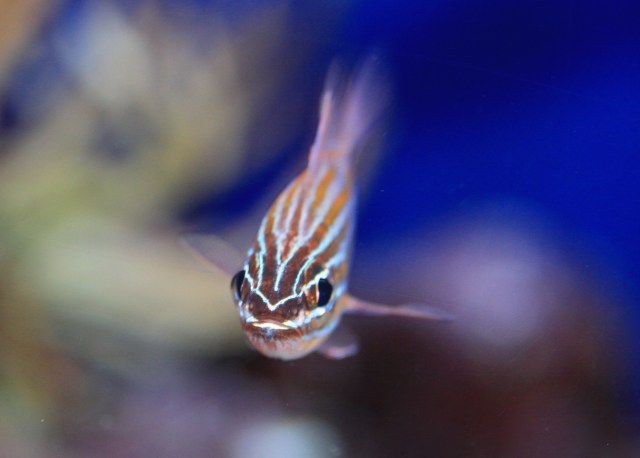
GENERAL CHARACTERISTICS : Silver body highlighted with 6 orange-gold horizontal stripes including a short post ocular stripe.. Pinkish to orange spot on base of caudal fin. Max. length: 8 cm.

YellowstripedCardinalfishApogon cyanosoma, PR24

DISTRIBUTION/HABITAT: Indo-west Pacific. Common from Australia to the Red Sea Inhabiting sheltered clear water areas of lagoon and seaward reefs. Associates in small to large aggregations under ledges, in holes, or even among long spines of sea urchins.

DIET IN THE WILD: Planktonic crustaceans and small invertebrates.

REPRODUCTION: Like all cardinalfishes, a paternal mouthbrooder.

CONSERVATION: IUCN; Not Evaluated.

REMARKS: Like all cardinalfishes, active at night, with large eyes adapted to gathering low light.


References:

fishbase http://www.fishbase.org/summary/4600

flickr https://www.flickr.com/photos/cas_docents/4184514661/in/set-72157…

eol eol.org/pages/985736/details