Tag Archive: rainforest


TAXONOMY
Kingdom: Animalia
Phylum: Chordata
Class Aves: (Feathered, winged, bipedal, endothermic or warm-blooded, egg-laying, vertebrates)
Order: Passeriformes (passerines or perching birds)
Family: Thraupidae (Tanagers).

Genus/species: Ramphocelus carbo

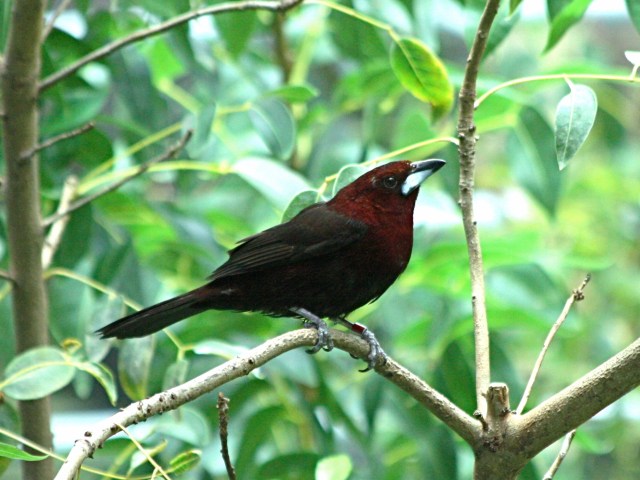
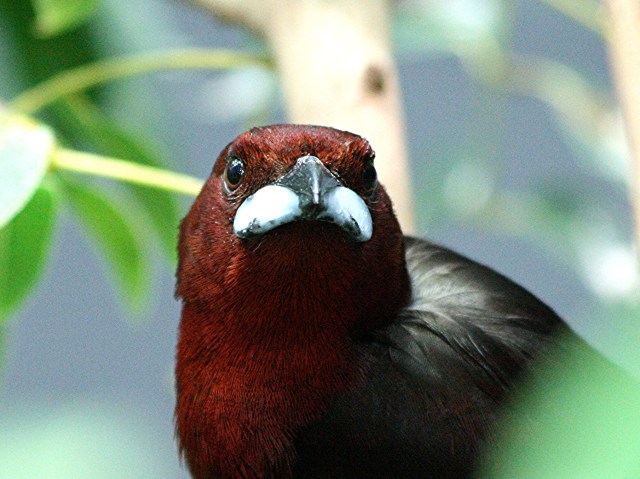
GENERAL CHARACTERISTICS: Adult male: velvety crimson back with deep crimson throat and breast; upper mandible black, lower mandible bright silver. Female: duller; brownish upper parts and reddish-brown underparts, throat, and breast.
Ramphocelus carbo3142853893_b630accb43_o


DISTRIBUTION/HABITAT:  The Silver-beaked Tanager is a resident breeder in South America from Columbia and Venezuela south to Paraguay and central Brazil as well as on Trinidad. It is found in light woodland and cultivated areas.
Ramphocelus carbo3186808944_6a7ba36a6e_o

DIET IN THE WILD: DIET: Mainly fruit as well as insects.

ACADEMY DIET: Like all of the passerines (all of the birds except the macaws), they receive pellets soaked in water or nectar, nectar cups, and plates with fruit. 

REPRODUCTION and DEVELOPMENT: R. carbo has a clutch of 2 green-blue eggs blotched with black-brown are laid in bulky cup nest usually built at lower forest level. Female incubates eggs for 11–12 days before they hatch. Chicks fledge 11–12 days later.
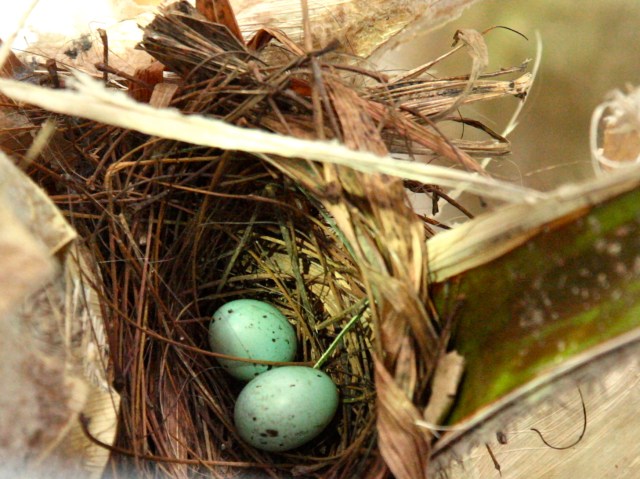
Silver-Beaked Tanager eggs
Our rainforest birds have already nested, hatched, and fledged.

CONSERVATION: IUCN: Red List Least Concern due to its extremely large range.
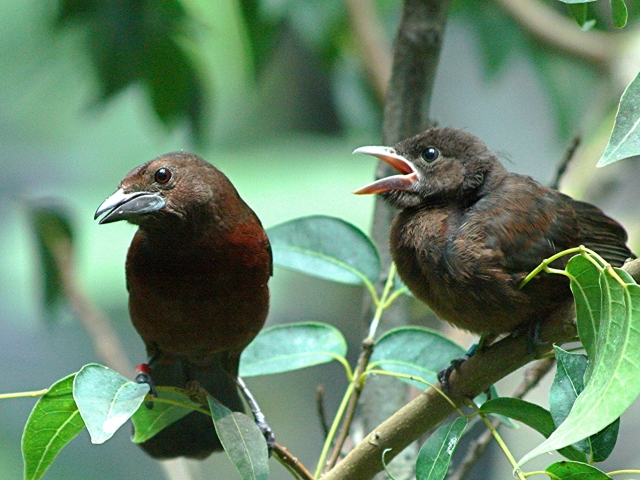
Ramphocelus carbo3142852689_c17ba4a031_o

REMARKS: These social birds tend to be noisy, traveling in groups of 4–8 in the wild.

References

California Academy of Sciences Docent Rainforest Training Manual 2014

Ron’s flickr http://www.flickr.com/photos/cas_docents/sets/72157608454346681/

Cornell neotropical.birds.cornell.edu/portal/species/overview?p_p…

Encyclopedia of Life  eol.org/pages/1052871/details

IUCN Red List www.iucnredlist.org/details/22722507/0

Ron’s WordPress Shortlink: http://wp.me/p1DZ4b-14I
TAXONOMY
Kingdom: Animalia
Phylum: Arthropoda
Class: Insecta
Order: Lepidoptera (moths and butterflies)
Family: Nymphalidae (Brush-footed Butterflies)

Genus/species: Morpho peleides

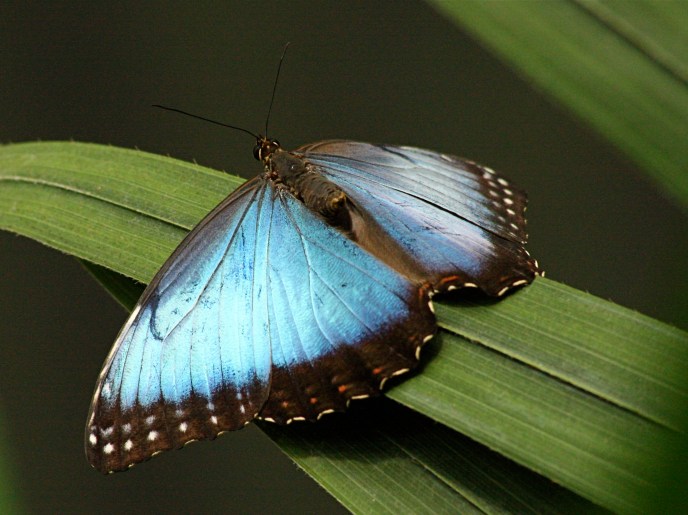
Top-side (dorsal)

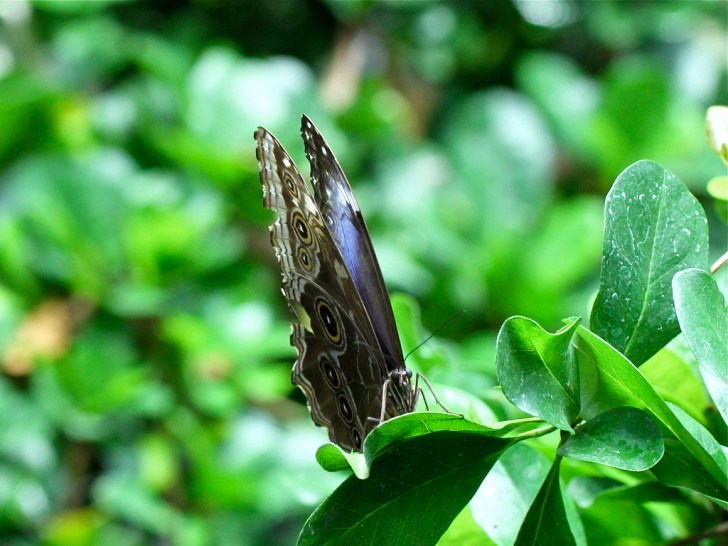
Blue Morpho 3175390675_70bdc9fe60_o

GENERAL CHARACTERISTICS: Among the largest butterflies in the world, wing span from five to eight inches.

Color of Life notation: Color Sources, structural color, iridescence.
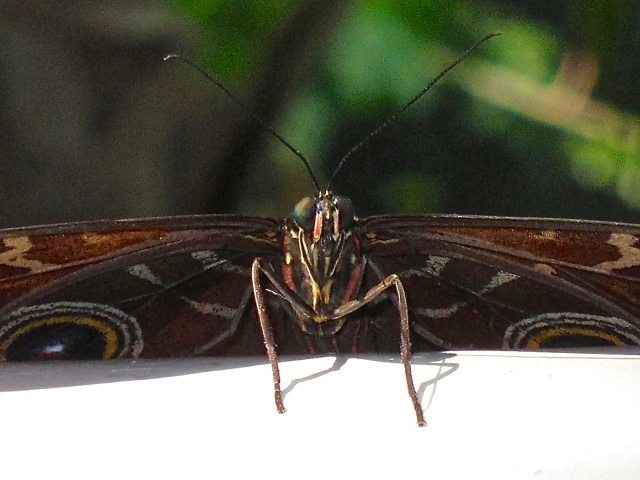
Wing tops are an iridescent blue, edged with black, caused not by a true color, such as the pigment dye of blue jeans, but by structural coloration resulting from tiny, overlapping scales that cover their wings. Because of the precise angle of the ridges they form, the scales which reflect blue light back to our eyes. The contrasting underside of the wing is brown with a confusion of eyespots that can startle a potential predator, thereby allowing the butterfly to escape predators. This is called deistic behavior.
Females less brilliantly colored.

Ref. California Academy of Sciences Color of Life Exhibit, May 2015

underside and topside

Blue Morpho Butterfly 4330619902_ec31e9c058_b

DISTRIBUTION/HABITAT: Tropics of Latin America from Mexico to Colombia. Feeds and sleeps on or near the forest floor, but when mating, they fly throughout forest layers.

DIET IN THE WILD: Caterpillar, it chews leaves but adults can’t chew so they drinks juices of rotting plants and animals, tree sap, and wet mud, sipping all with its straw-like proboscis.

Underside (ventral)

REPRODUCTION: Like most butterflies, males release pheromones to attract females. Fertilized eggs hatch in about 9 days. The caterpillar of  M. peleides is red-brown with patches of bright green.

Blue Morpho Butterfly 8677456846_7df05acbb0_oLONGEVITY: Total lifespan: egg to adult, about 4.5 months; adults (butterflies): about 1 month.
PREDATORS: Birds (jacamar and flycatcher) and large insects.

CONSERVATION: IUCN Not Evaluated, but under some pressure as trophies for collectors and deforestation of tropical forests..

REMARKS:  M. peleides brilliant reflection is so intense that pilots report seeing their flash of color as the butterflies warm themselves above the treetops. Different angles of view (and so different angles of reflecting ridges) produce variations in the shades of blue perceived.

References

California Academy of Sciences Rainforest 2017

California Academy of Sciences Color of Life Exhibit 2015

Ron’s flickr  http://www.flickr.com/photos/cas_docents/sets/72157608449327886/with/3175390675/

Ron’s WordPress shortlink  http://wp.me/p1DZ4b-12J

Encyclopedia of Life eol.org/pages/139904/details

WAZA  www.waza.org/en/zoo/choose-a-species/invertebrates/insect…

TAXONOMY
Kingdom: Animalia
Phylum: Arthropoda
Class: Insecta
Order: Lepidoptera (moths and butterflies)
Family: Papilionidae (Swallowtail butterflies)

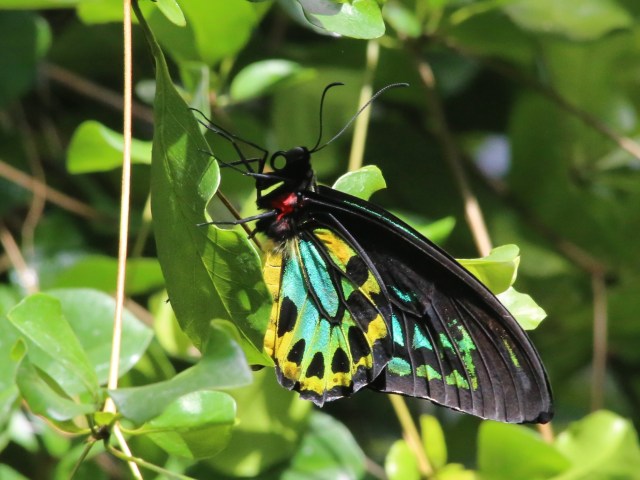
Genus/ species: Ornithoptera priamus

GENERAL CHARACTERISTICS: Variable between numerous subspecies.
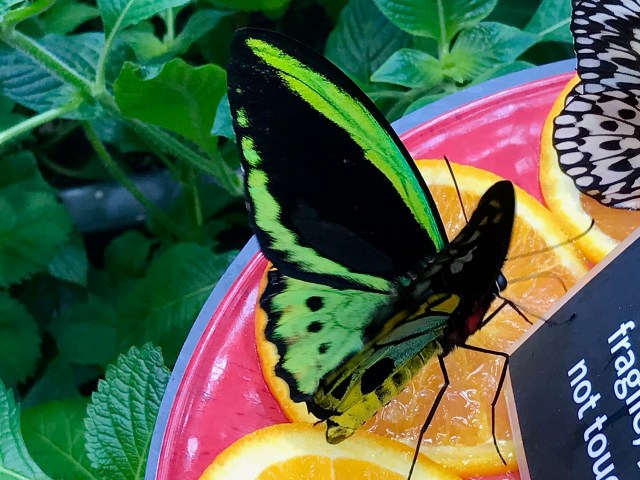
The top of the forewing is velvety black with a green subcostal and marginal stripe. The bottom of the forewing is black with a chain of bluish or green postdiscal spots.
The hindwings are green. At the wing’s leading edge there are yellow-gold spots with a postdiscal chain of black spots. The edge of the hindwing is black. The underside is dark green or bluish. The yellow-golden spots are transparent. The veins are partly black and the marginal edge of the wing is black. At the outer edge there is a postdiscal chain of black spots.

The body (abdomen) is yellow. Head and thorax are black. The underside of thorax has a red hair coat.
Wingspan: 5 in. (12.7 cm.)  Male below Topwing (dorsal)

Male bottom side (ventral)

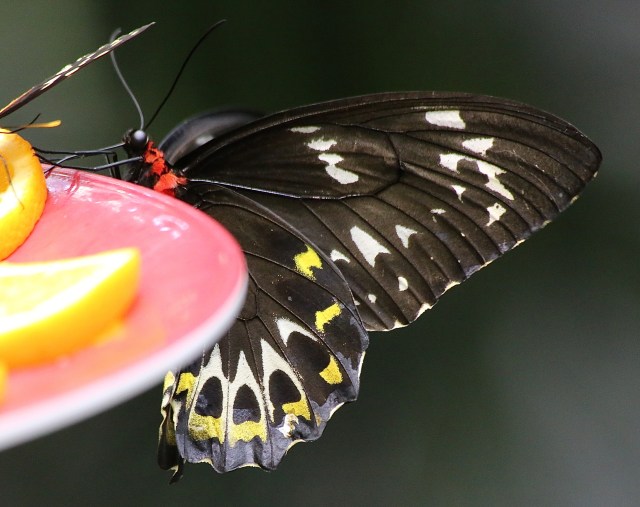
 O. priamus is sexually dimorphic. The basic color of the female is dark-brown with a chain of white postdiscal spots on the forewings and a chain of larger white postdiscal spots with dark centres on the hindwing. The underside is very similar to the upper.

The female is larger than the male and in the upper range of the wing-span.

Female below top wing (dorsal)

Female bottom wing (ventral)


DISTRIBUTION/HABITAT: Found in the Australasia / Indomalaya (Australia) ecozone.

References

California Academy of Sciences Rainforest 2017 Vetting Tim Wong

Ron’s WordPress Shortlink  http://wp.me/p1DZ4b-1Mz

Ron’s flickr  https://www.flickr.com/photos/cas_docents/33116609042/in/album-72157608449327886/

EOL eol.org/pages/130749/overview

www.nagypal.net/images/zzpriamu.htm

 Lewis Ginter Botanical Garden www.lewisginter.org/sexually-dimorphic-butterflies/

butterflycorner.net en.butterflycorner.net/Ornithoptera-priamus.952.0.html

insecta.pro  insecta.pro/taxonomy/15076


TAXONOMY
Kingdom: Animalia
Phylum: Arthropoda
Class: Insecta
Order: Lepidoptera (moths and butterflies)
Family: Nymphalidae (Brush-footed Butterflies)

Genus/species: Heliconius hewitsoni

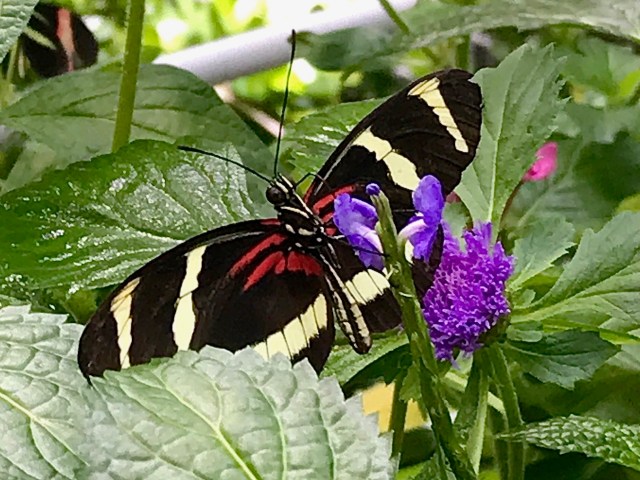
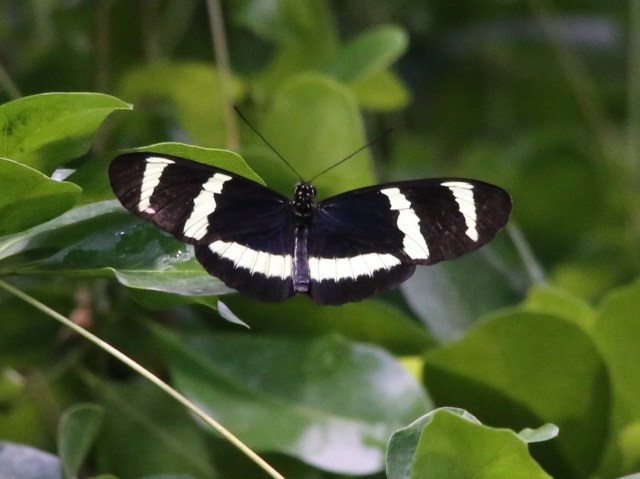
GENERAL CHARACTERISTICS: A distinctive black butterfly with yellow transverse bands on fore- and hindwings. H. hewitsoni is very similar in general appearance to its Müllerian mimic H.pachinus. (Species with strong defences evolve to resemble one another and deter predation).


DISTRIBUTION/HABITAT: Found in the province of Chiriqui (Panama) and the Pacific slopes of Costa Rica. Usually individuals fly rapidly and in the canopy.

REMARKS: Heliconius are recognized by their large eyes, long antennae, characteristic elongate wing-shape, teardrop-shaped hindwing discal (disc-like) cell, and distinctive color patterns.

Adult butterflies systematically collect pollen from flowers, which they masticate on the proboscis to dissolve out amino acids. This allows caterpillars to develop relatively rapidly (since they do not need to store nutrients for egg and sperm production), and allows adults to have a greatly extended lifespan – up to 8 months – in the wild.

A second unusual trait found in some Heliconius species is a unique mating behaviour known as pupal-mating. Males of certain species search larval food plants for female pupae. The males then sit on the pupae a day before emergence, and mating occurs the next morning, before the female has completely closed (insect emerging from the pupa stage.)

References

California Academy of Sciences Rainforest 2017 Photo vetted Tim Wong

EOL eol.org/pages/18499/details

tolweb.org/Heliconius_hewitsoni/72941

www.insectlifeforms.com/6050205531__236/Bow_Wings__Helico...

Ron’s flickr  https://www.flickr.com/photos/cas_docents/32471538194/in/album-72157608449327886/

Ron’s WordPress Shortlink http://wp.me/p1DZ4b-1N3

TAXONOMY
Kingdom: Animalia
Phylum: Chordata
Subphylum: Vertebrata
Class: Reptilia
Order: Squamata
Suborder: Serpentes
Family: Boidae

Genus/species: Boa constrictor constrictor

Red-tailed Boa IMG_0186

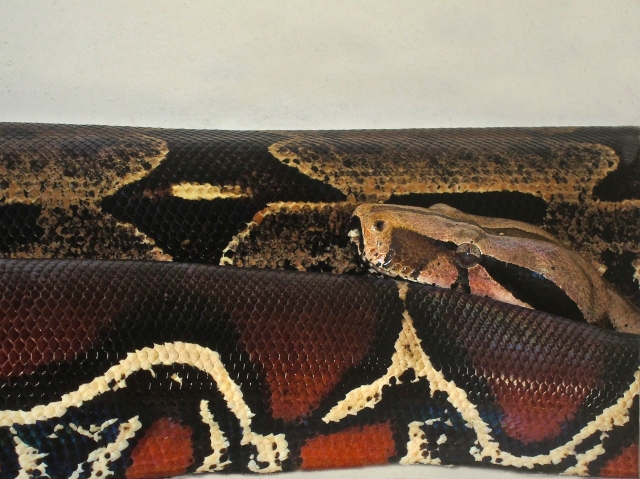
GENERAL CHARACTERISTICS: The background color is cream or brown that is marked with dark “saddle-shaped” bands. The head of a boa constrictor has 3 distinctive stripes. First is a line that runs dorsally from the snout to the back of the head. Second, there is a dark triangle between the snout and the eye. Third, this dark triangle is continued behind the eye, where it slants downward towards the jaw. However, there are many variations on appearance.
Length to 13 feet (3.9 m) as adults. Generally between 2 and 3 meters(6.5 – 10 feet) in length. Weigh 40 to 50 pounds.

DISTRIBUTION/HABITAT: Exclusive to the New World (Mexico to Argentina). Boa constrictors are both terrestrial and arboreal. They are found in deserts, wet tropical forests, open savanna, and cultivated fields, and from sea level to moderate elevation having the least need for water of all boas.

DIET IN THE WILD: They ate aglyphous, meaning they do not possess any elongated fangs. Instead, they have rows of long, recurved teeth of about the same size. Teeth are continuously replaced. They are carnivores eating small mammals, including bats, and birds or anything that fits in their mouths. Prey are killed by constriction and swollen whole taking 4-6 days to digest.

REPRODUCTION: Fertilization is internal. The male uses pelvic spurs (hind leg remnants found on either side of the cloacal opening) to aid the use of hemipenes (double penis) for cloacal insertion. Females give birth to live young (ave. 25 in number).

Red-tailed Boa 2775385563_c91e7827ff_o

MORTALITY: Lifespan, 25-30 years.

PREDATORS  Include humans, jaguars, and crocodile 

CONSERVATION : IUCN Red list; not evaluated.

REMARKS: In Mexico and South America, they are valued as destroyers of rodents. B. constrictor constrictor have been “domesticated” for this reason.

Color of Life Note: The Red-Tailed Boa demonstrates concealment with its beige and dark brown markings hiding it in the filtered light coming through tree branches and leaves.

References

California Academy of Sciences Flooded Amazon Exhibit 2015

Ron’s WordPress Shortlink  http://wp.me/p1DZ4b-VA

Ron’s flickr  http://www.flickr.com/photos/cas_docents/sets/72157608449603666/

U. of Michigan Animal Diversity Web animaldiversity.ummz.umich.edu/ site/ accounts/ information/ Boa_constrictor.html.

Smithsonian National Zoological Park  http://nationalzoo.si.edu/Animals/ReptilesAmphibians/Facts/FactSheets/Boaconstrictor.cfm

TAXONOMY
Kingdom: Animalia
Phylum: Arthropoda
Class: Insecta
Order: Mantodea
Family: Hymenopodidae
Subfamily: Epaphroditinae

Genus/species: Phyllocrania paradoxa

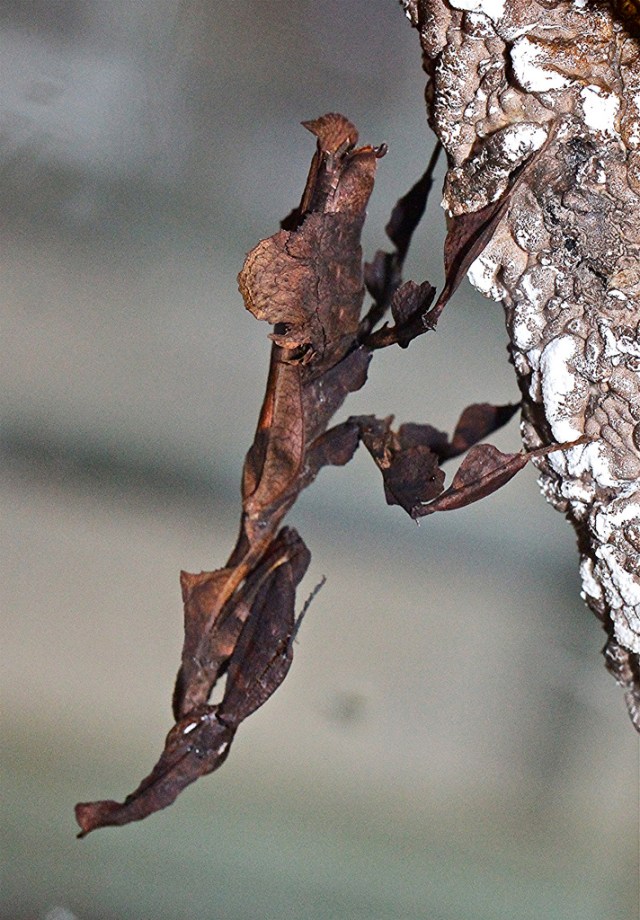
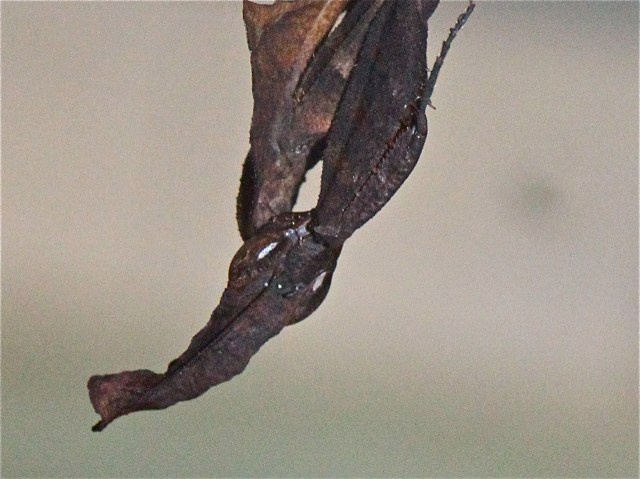
GENERAL CHARACTERISTICS: This is a miniature species of leaf mantis, growing to under 5 cm (2 in). Theses mantids exhibit sexual dimorphism with females being longer and having a wider abdomen than males. Colors can vary from grey/green to dark brown or almost black. Colors are dependent on humidity and light levels. Ghost mantids have leaf-like head and shoulder shields, and leaf-like protrusions hanging from their limbs. This “dead-leaf” appearance makes it very difficult to see. The scientific name is probably derived from Greek for “leaf “(phyllo) and Latin for “head” (crania).

Phyllocrania paradoxa6319511720_e34688f6b4_b

DISTRIBUTION/HABITAT: P. paradoxa are found in the warm, highly humid tropical forests of Tropical Africa including Madagascar, Mozambique, Namibia, and Somalia.

DIET IN THE WILD: This species will eat almost anything that moves, and it is very, very fast. When another insect comes within striking distance, the mantid flicks out the long front legs, and grabs it in a fraction of a second. They are remarkably patient, and will sit in the same position for weeks, just waiting for something to land near them.

DIET IN CAPTIVITY: Drosophila (fruit flies), houseflies, crickets, and flour worms.

MORTALITY and LONGEVITY: Generally a long-lived species.  Molt every 3–5 weeks, until the 4th and final molting.  Life span: up to 14 months in captivity.

REPRODUCTION: In general mantids reproductive organs are found at the tip of their abdomen. Females attract males with pheromones, there is a brief courtship dance, and the male alights on the female’s back. After delivering sperm, the male usually hurries away as females are known to consume their mates! After fertilization the female deposits batches of eggs, using an ovipositor at the tip of her abdomen. The eggs stick to stems and leaves, and each batch is housed in an egg case made from an abdominal secretion that hardens to protect the eggs from birds and other predators. After about a month the nymphs hatch and then molt several times, each time becoming more like the adult form. 

Juvenile below

Color of Life Note: Ghost mantids exhibit cryptic coloration (conceals or disguises an animal’s shape). They look like a vine draped on tree and bush branches.


LOCATION: Madagascar Rainforest

References

References. California Academy of Sciences Docent Rainforest Training Manual.

Ron’s flickr https://www.flickr.com/photos/cas_docents/4333501334/in/set-72157620708610230/

Ron’s WordPress shortlink  http://wp.me/p1DZ4b-eK

Encyclopedia of Life  http://eol.org/pages/3489690/details

ADW Animal Diversity Web animaldiversity.org/accounts/Phyllocrania_paradoxa/classi…


TAXONOMY
Kingdom: Animalia (animals) 
Phylum: Chordata (chordates) 
Subphylum: Vertebrata (vertebrates) 
Class: Amphibia (Amphibians) 
Order: Anura  (Frogs, Toads) 
Family: Bufonidae ( Bufonids, bufonidés, crapauds, Toads)

Genus/species:  Phrynoidis juxtaspera

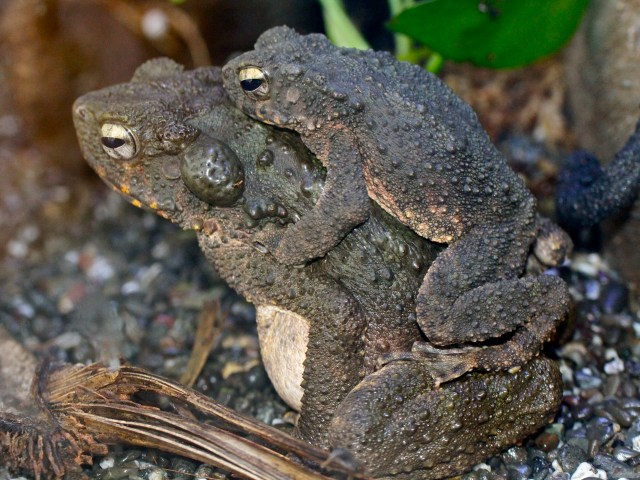
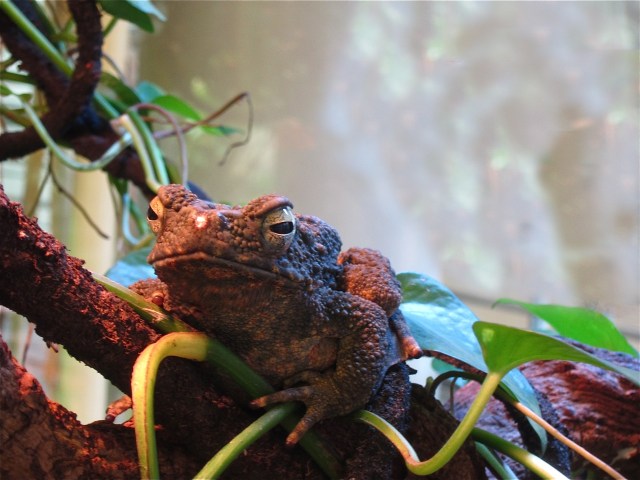
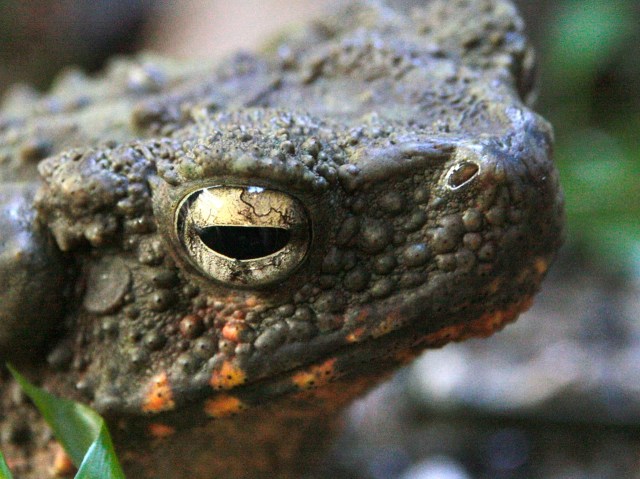
GENERAL CHARACTERISTICS: P. juxtaspera is one of the two river toads. It can get as big as a small rabbit. The toad has extensive webbing between toes and is a good swimmer; strong legs make it a good jumper as well.The warts have thoroughly keratinized apices. The warts behind the eyes (parotic glands) are thick and long (as opposed to Phrynoidis aspera). Males up to 120 mm (4.75 inches), females 215 mm (8.5 inches) snout-vent length).

DISTRIBUTION/ HABITAT: This species is widely distributed in Borneo and Sumatra. It probably occurs more widely than current records suggest, especially in areas between known sites. It occurs up to elevations of 1,600 meters. Found along rocky creeks and riverbanks. Breed in rocky-bottomed, strong flowing streams where the larvae also develop.

DIET IN THE WILD: Ants, other insects, spiders


REPRODUCTION: It breeds in rocky-bottomed, strong flowing streams where the larvae also develop.

CONSERVATION: IUCN Red list; least concern (LC) www.iucnredlist.org/details/biblio/54676/0

There are no threats to this relatively adaptable species.

REMARKS: P. juxtaspera secretes large amounts of highly toxic, milky poison from their warts when molested. Not only skin secretions of adults but also eggs and tadpoles are poisonous. However, large specimens are hunted for food in some areas: the toad is skinned, washed, and cooked. The heat denatures the toxins.

Color of Life Note: An example of cryptic coloration (coloring that conceals or disguises an animal’s shape) are the Borneo river toads. Their brownish-gray lumpy warty skin is similar to their rocky streams and riverbed habitats. Ref. California Academy of Sciences, Color of Life.

Rainforest, Borneo

References

Encyclopedia of life eol.org/pages/313980/details

Ron’s flickr http://www.flickr.com/photos/cas_docents/sets/72157608456457315/with/5355461537/

WordPress shortlink  http://wp.me/p1DZ4b-eh

Frogs of Borneo  http://www.frogsofborneo.org/index.php/bufonidae/143-bufonidae/phrynoidis/juxtaspera


TAXONOMY
Kingdom: Animalia
Phylum: Chordata
Subphylum: Vertebrata (chordates with backbones)
Class: Reptilia (turtles, crocodilians, snakes, lizards and tuatara
Order: Squamata (scaled reptiles)
Suborder: Serpentes (snakes)
Family: Boidae (boas)

Genus/species: Corallus caninus

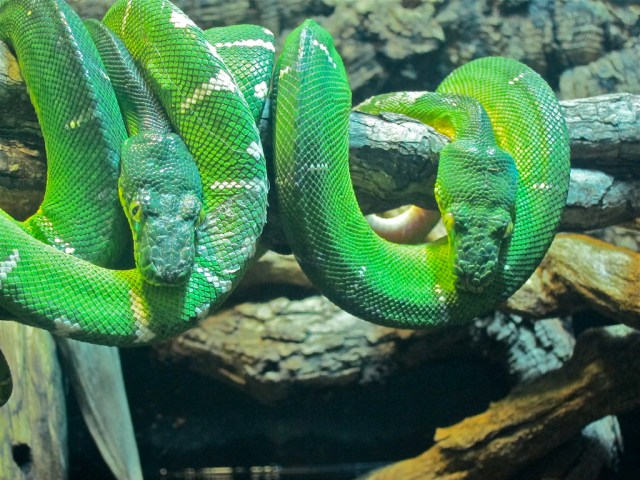
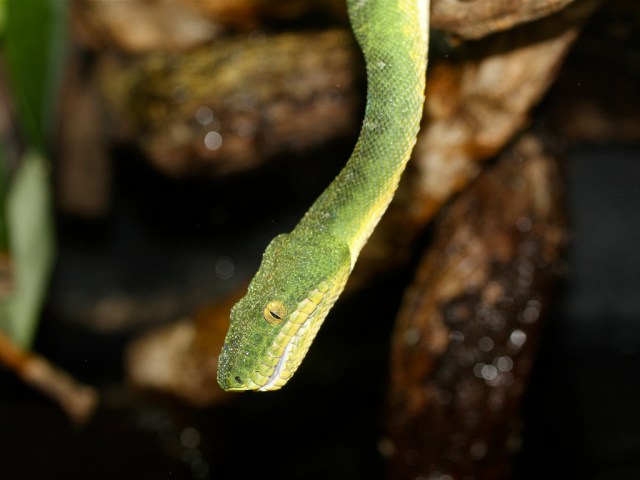
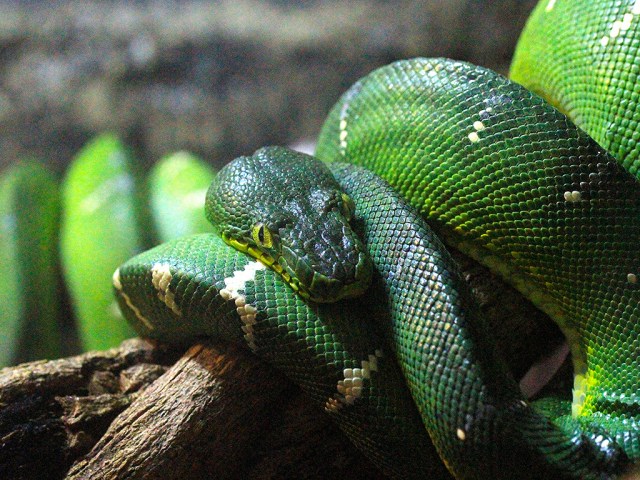
GENERAL CHARACTERISTICS: Adults are typically emerald-green, juveniles are yellow to orange to brown. This individual has striking white markings occurring along the dorsal midline, but some populations lack them. C. caninus has two tiny spurs on either side of its cloaca opening thought to be the evolutionary remnants of hind legs.

Length up to 2.2 m (7.2 feet).

2775389133_49be5f6ab9_o

DISTRIBUTION/HABITAT: C. caninus are found lowland tropical rainforests in the Amazonian and Guianan regions of South America.They are arboreal species that spend most of their time in the rainforest canopy foliage. 

They Use the “concertina” method of tree climbing. It holds on to the trunk with its tail and lower part of its body, reaches up with its head and hooks its neck around the trunk. Then it releases its hold with the tail and pulls the rear part of its body up to the level of the neck.

Corallus caninus5252794466_c85c5e40ef_b
DIET IN THE WILD: They perceive prey primarily through sight and infrared heat receptors located in the labial scales. Carnivore Nocturnal predators of rodents, lizards, marsupials and an occasional bird.
Nocturnally they remain coiled on its branch, but will extend its neck pointing beneath it, curled as if about to strike. It will then hold still in this position, waiting for prey to approach directly underneath it. Their highly developed front teeth that are proportionately larger than those of other non-venomous snakes.


Corallus caninus5099438187_af0d2a4e3b_b

REPRODUCTION; Viviparous with a gestation period of 6 to 7 months. They typically give birth 10 young at a time and by 4 months, they begin to develop their adult, green coloration.

LIFE EXPECTANCY: 15 years in captivity.

PREDATORS; Guianan crested eagles (Morphnus guianansis)

CONSERVATION: CITES; no special status.

Corallus caninus4770065279_923bce3efd_b

REMARKS: They are slow-moving but when collected in the wild have been described as making no effort to escape until seized, whereupon they strike viciously and apply constriction at full force.

References:

Animal diversity Web animaldiversity.org/accounts/Corallus_caninus/

Encyclopedia of life eol.org/pages/454883/details

Ron’s WordPress shortlink  http://wp.me/p1DZ4b-1×3

Ron’s flickr https://www.flickr.com/photos/cas_docents/18399138824/in/album-72157652559028013/

TAXONOMY
Kingdom: Animalia
Phylum: Arthropoda
Class: Arachnida
Order: Araneae
Suborder: Araneomorphae (fangs slope towards each other in a pinching action)
Family: Nephilidae

Genus/species; Nephila Clavipes

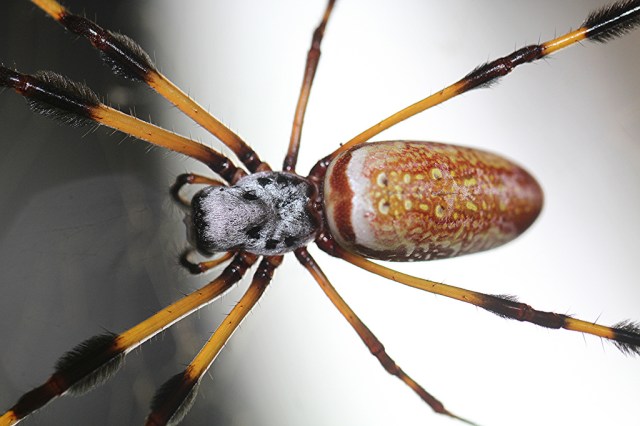
GENERAL CHARACTERISTICS; Orb-weavers are highly sexually dimorphic. Females grow up to 8 cm (3 in), and are 5 to 6 times larger than males. Adults are mostly yellow with elongated abdomen and long, hairy legs. This spider lives in hot places. The long cylindrical abdomen of the spider may be angled towards the sun to reduce the amount of exposed body surface and thus prevent overheating. The reflective silvery surface of much of the body serves the same purpose.

Nephila Clavipes   5389185249_24cf049f4f_b 

DISTRIBUTION/HABITAT: These spiders are found from the southeastern United States south through Argentina and Peru. They prefer areas of high humidity and forest areas along trails and clearing edges. N. clavipes is the only member of its genus known in the Western Hemisphere.

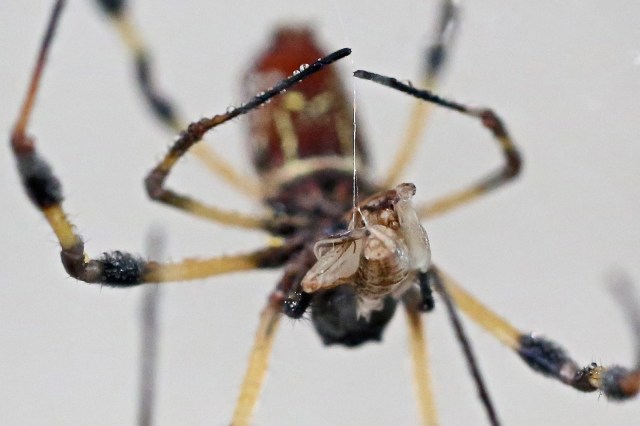
DIET IN THE WILD: They feed on small flying insects: beetles, flies, moths, etc., that are captured in their web. After prey is entangled in the web, the spider incapacitates it by biting and then encases it in silk.

9129006757_d402137e70_h

REPRODUCTION: Mating is a tricky proposition for orb weaving males. For successful reproduction, males must successfully stimulate females in order to prevent being a meal for their would-be mate, though this unfortunate ending is relatively rare with this species.

MORTALITY/LONGEVITY: Life span: a single season (1 year).

REMARKS: 

•Orb weavers construct webs for defense and capture of prey.

•The silk of the web usually has a golden color that is visible to the naked eye and is the source of the common name.

•The impressive web of most orb weavers is a semi-permanent structure, repaired and rebuilt daily as necessary.

•Spiders from the Nephilia species on display from Madagascar are sometimes released into the Rainforest exhibit. They have settled in a territory behind the exhibit and observable from the spiral ramp. Only females are released as 1) they are much larger than the males and so more visible and 2) the Rainforest biologists have no interest in the uncontrolled breeding of these spiders in the exhibit!

Rainforest Costa Rica CR03

References

California Academy of Sciences docent Rainforest Training Manual 2014

Animal Diversity Web animaldiversity.org/accounts/Nephila_clavipes/

Ron’s flickr  https://www.flickr.com/photos/cas_docents/5389185249/in/album-72157620708938680/

Ron’s WordPress shortlink  http://wp.me/p1DZ4b-1tf


TAXONOMY
Kingdom: Animalia
Phylum: Chordata
Class: Amphibia
Order: Anura
Family: Hylidae

Genus/species: Dendropsophus ebraccatus

GENERAL CHARACTERISTICS: Gets its name from the hourglass shape that you can usually see on the frog’s back. Its translucent skin changes color depending on the time of day and the stress the frog is experiencing. Iris brown to reddish bronze, sometimes tan or yellow. Pupil horizontal. Foot moderately to extensively webbed. Toes with large terminal discs. Length  males to 28 mm (1.1 inches) ; females to 37 mm (1.5 inches).

DISTRIBUTION/HABITAT:  Native to Belize; Colombia; Costa Rica; Ecuador; Guatemala; Honduras; Mexico; Nicaragua; Panama.  Found in  humid tropical forest and in heavily disturbed areas where most of the forest has been removed. 

DIET IN THE WILD: Unknown but probably small arthropods.

REPRODUCTION: Eggs are placed on leaves overhanging  pools with the tadpoles developing in the water.

CONSERVATION: IUCN Red List (LC)
D. ebraccatus is very adaptable with the major threats deforestation for agricultural development, human settlement, and pollution resulting from the spraying of crops.

MORTALITY/LONGEVITY: Short lived, usually lasting less than 3 years.

LOCATION: CR06

References

IUCN Red List  www.iucnredlist.org/details/55470/0

Amphibiaweb amphibiaweb.org/cgi/amphib_query?where-genus=Dendropsophu…

Encyclopedia of Life  eol.org/pages/1038861/details

Ron’s WordPress shortlink:  http://wp.me/p1DZ4b-t6

Ron’s flickr http://www.flickr.com/photos/cas_docents/sets/72157620708938680