Tag Archive: Philippine Coral Reef


TAXONOMY

Kingdom:Animalia
Phylum: Chordata
Class: Actinopterygii (ray-finned fishes)
Order: Perciformes (Perch-likes) 
Family: Acanthuridae (Surgeonfishes, tangs, unicornfishes)

Genus/species: Acanthurus dussumieri
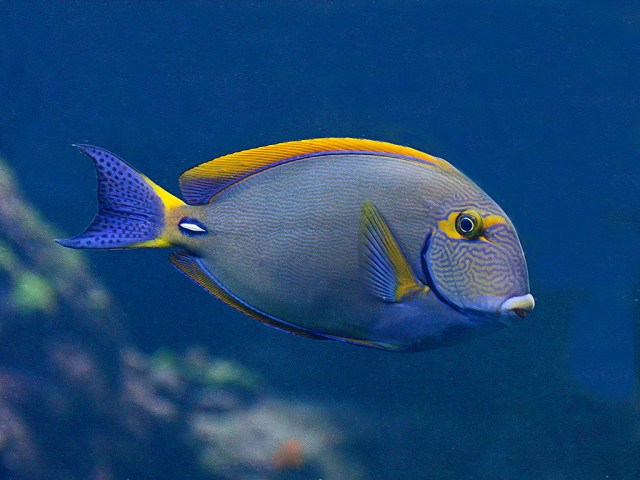
Eyestripsurgeonfish3161438409_067c34e458_b

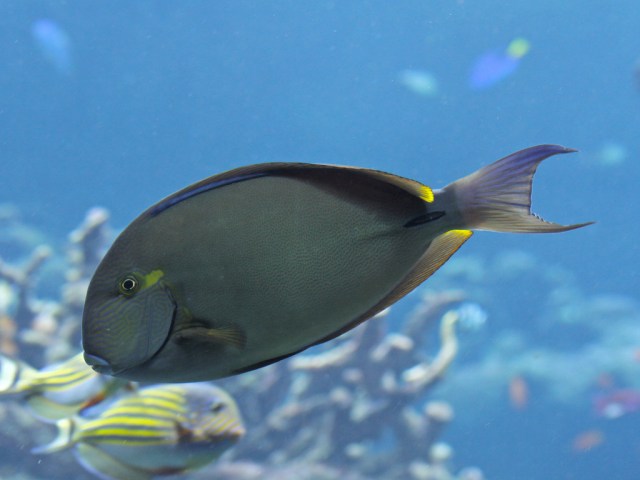
GENERAL CHARACTERISTICS: Bluish to brownish body with horizontal line markings; orange band between eyes, continued behind each eye to gill cover., blue tail with numerous black spots; white caudal spine with the socket edged in black. Typically seen as a solitary fish but may also occur in small groups.

Max. size: up to 50 cm (20 in).
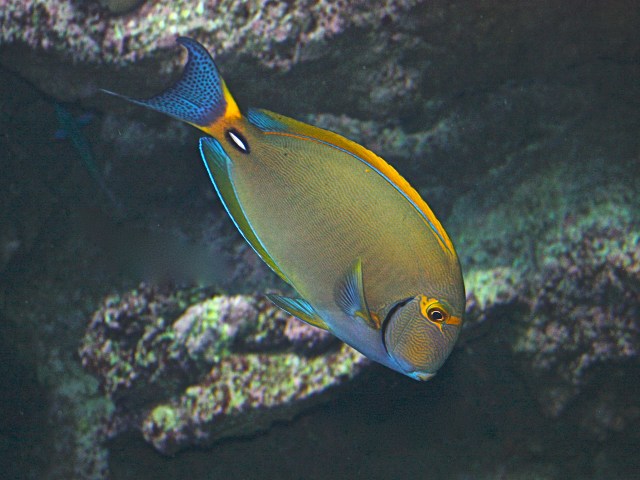
 

3119304093_7eeabb9447_o

DISTRIBUTION/HABITAT: Indo-Pacific: from East Africa to Hawaii and the eastern Central Pacific. Also from Southwest Japan to the Great Barrier Reef. Absent from most of the Central Pacific. Adults are found mainly on deep coastal reef slopes and outer reef walls.

Depth ranges from 4–131 m (12-430 ft) and are usually found below 30 ft.
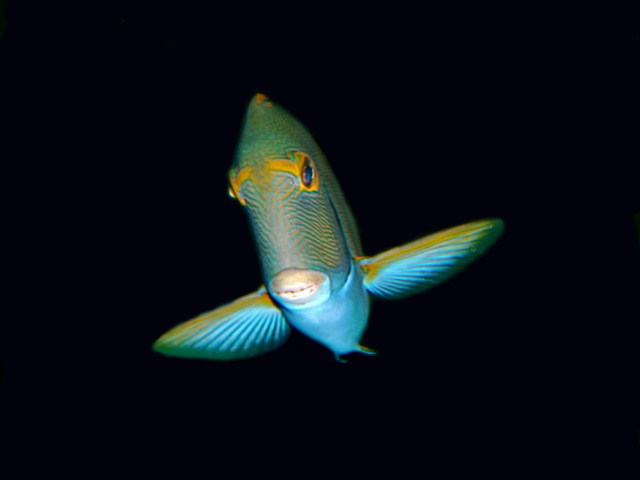
EYESTRIPE SURGEONFISH Acanthurus dussumieri

DIET IN THE WILD: Grazes algae from reefs and sand.

CONSERVATION: IUCN Least concern

REMARKS: The eyestripe surgeonfish reputedly has a strong odor when cooked. The Hawaiian name for this fish is palani and a Hawaiian riddle based on this name means “odor reaching to heaven.” This species can quickly change its coloration to a much darker shade that obscures the yellow and markings. 

References

California Academy of Sciences Steinhart Aquarium Philippine Coral Reef 2016

Ron’s WordPress shortlink  http://wp.me/p1DZ4b-1aY

Encyclopedia of life   eol.org/pages/206881/details
fishbase  www.fishbase.org/summary/1256

Ron’s WordPress Shortlink  https://fishoncomputer.wordpress.com/wp-admin/post-new.php

IUCN Red List  www.iucnredlist.org/details/177981/0

Australian Museum australianmuseum.net.au/eyestripe-surgeonfish-acanthurus-…

Ron’s flickr: http://www.flickr.com/photos/cas_docents/8375327580/in/set-72157608332652056/
TAXONOMY
Kingdom: Animalia
Phylum: Chordata
Class: Actinopterygii (ray-finned fishes)
Order: Perciformes (Perch-likes)
Family: Acanthuridae (Surgeonfishes, tangs, unicornfishes)

Genus/species: Acanthurus blochii

RingtailSurgeonfish8680230384_409ba2ee72_k

GENERAL CHARACTERISTICS


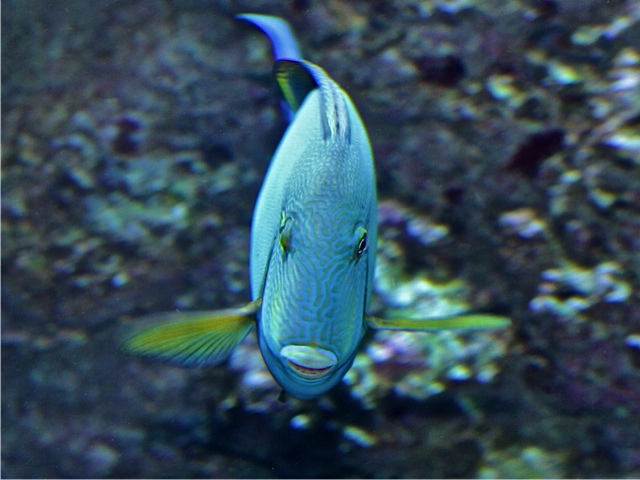
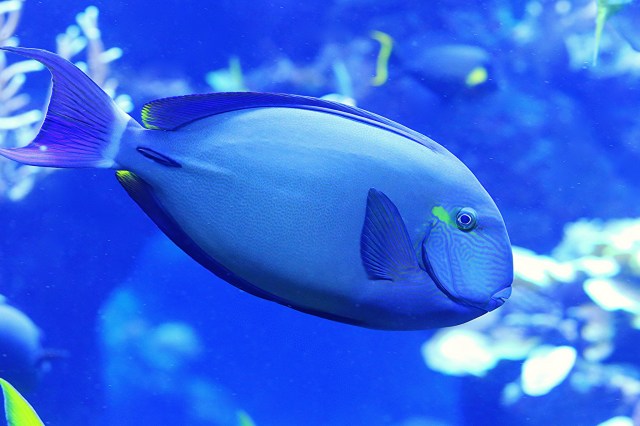
A. Bluish grey with numerous yellowish brown spots which tend to form irregular longitudinal lines.

B. Head with narrow irregular stripes

C. Behind eye a yellow spot

D. Brown pectoral fins

E. Base of caudal fin with white bar

F.  Caudal spine large.

Differs from A. dussumieri by having vertical stripes instead of spots on the blue central area of the caudal fin, from A. mata by having a lunate caudal fin, and from A. xanthopterus by having plain brown to blue-grey pectoral fins.

The white ring around the base of the tail varies in intensity and may occasionally be absent. 

Max size: up to 45 cm (18 in)

Ringtail Surgeonfish 4441603380_717ef654b8_b

DISTRIBUTION/HABITAT: Indo-Pacific: East Africa to the Hawaiian Islands, south to Australia in lagoons and shallow coral reefs.

Depth 2–15 m (6-50 ft)

DIET IN THE WILD: Graze on algae, diatoms and detritus

CONSERVATION; IUCN Red List Least Concern

References

California Academy of Sciences Steinhart Aquarium Philippine Coral Reef 2016

Ron’s flickr  http://www.flickr.com/photos/cas_docents/3320764840/in/set-72157625992053826

Ron’s WordPress shortlink  http://wp.me/p1DZ4b-C1

fishbase www.fishbase.se/summary/4750

Encyclopedia of life eol.org/pages/211484/details

IUCN www.iucnredlist.org/details/177971/0


TAXONOMY
Kingdom: Animalia
Phylum: Chordata
Class: Actinopterygii (ray-finned fishes)
Order: Perciformes (Perch-likes)
Family: Acanthuridae (Surgeonfishes, tangs, unicornfishes)

Genus/species: Ctenochaetus tominiensis

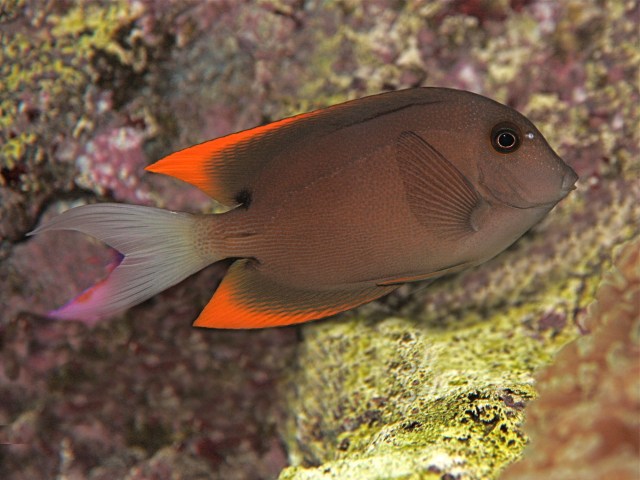
Acanthurus pyroferus (Acanthuridae)

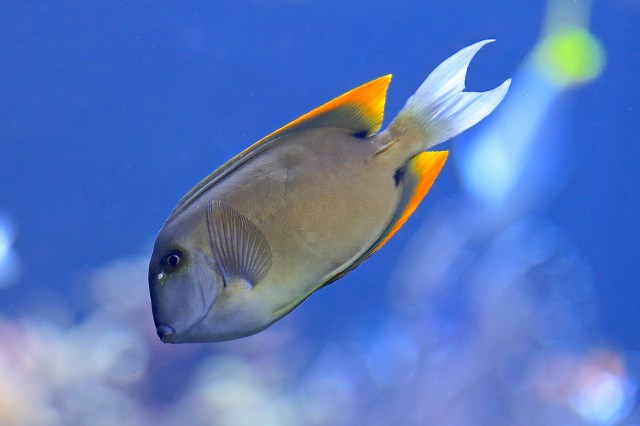
GENERAL CHARACTERISTICS: Brown with pale lower head. The only species of Ctenochaetus (bristletooths) with angular dorsal and anal fins; outer portion of these fins is a bright orange. Caudal fin white.

Max length: 15 cm. (6 inches).

Acanthurus pyroferus (Acanthuridae) IMG_0497

DISTRIBUTION/HABITAT: Western Central Pacific, including Indonesia, Philippines, to northern Great Barrier Reef. Found on steep coral drop-offs of sheltered coasts.

DIET IN THE WILD: The Orangetip Bristletooth Tang feeds on detritus using its comb-like teeth

TominiTang8749715662_50d2f33b0e_k

REPRODUCTION: Pelagic spawner.

CONSERVATION: IUCN, Least concern

References

California Academy of Sciences Steinhart Aquarium Philippine Coral Reef 2016

Ron’s WordPress shortlink  http://wp.me/p1DZ4b-1aJ

Ron’s flickr  http://www.flickr.com/photos/cas_docents/3708499036/in/set-72157608332652056/
EOL eol.org/pages/212379/details

fishbase  http://www.fishbase.org/summary/6016

IUCN Chttp://www.iucnredlist.org/details/177986


TAXONOMY
Kingdom: Animalia
Phylum: Chordata
Class: Actinopterygii (ray-finned fishes)
Order: Perciformes (Perch-likes)
Family: Acanthuridae (Surgeonfishes, tangs, unicornfishes)

Genus/species: Acanthurus japonicus

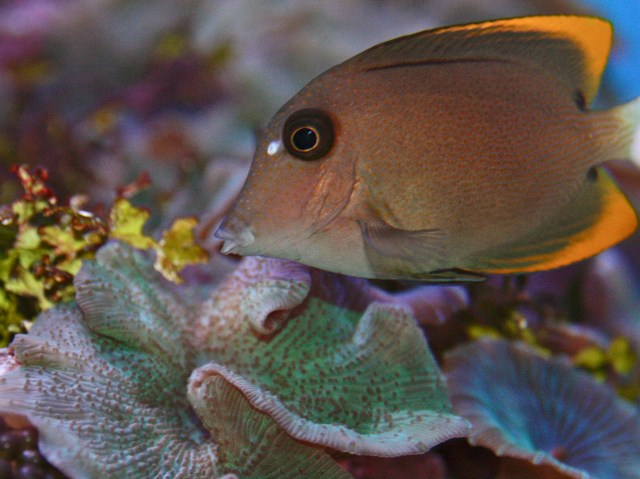
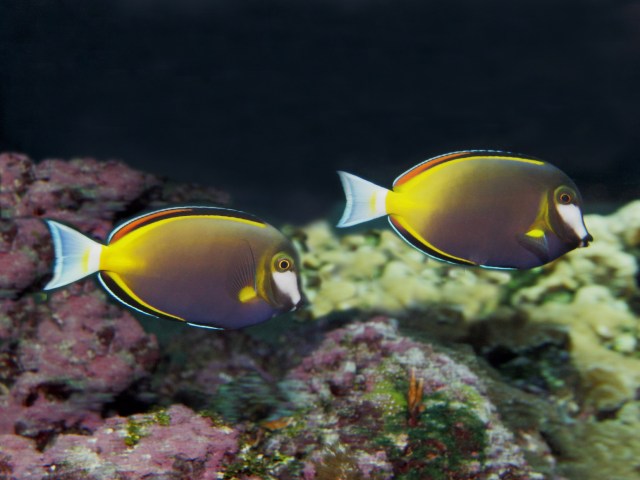
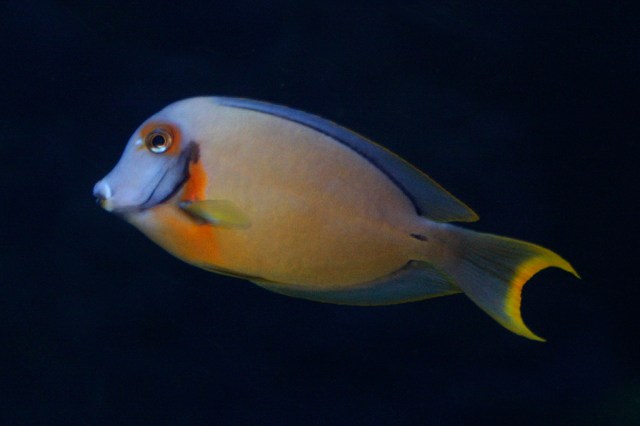
GENERAL CHARACTERISTICS: Like all surgeonfish, A. japonicus are colorful, thin-bodied, oval-shaped. They typically have long continuous dorsal and anal fins and crescent caudal fins. The body is brownish with a white patch on cheek between eyes and mouth; pectoral, anal, and dorsal fins brown with blue highlight at tip. An orange band is found on last third of dorsal fin. Yellow stripes are along base of dorsal and anal fins with a blue tail with yellow bar.  In addition like other surgeonfishes it has a (5)razor-sharp caudal spine located at the base of their caudal fin. 

Length up to 8.3 in.

powder brown tang8748590549_6ab4610498_k

DISTRIBUTION/HABITAT: Found in Asian-Pacific: Sulawesi to Philippines, SW Japan in clear lagoons and shallow (6–36 ft) seaward reefs.

Power Brown Tang

DIET IN THE WILD: Algae.

REPRODUCTION: Group spawner.

CONSERVATION: IUCN, Least concern

References

California Academy of Sciences Steinhart Aquarium Philippine Coral Reef 2016

Ron’s flickr http://www.flickr.com/photos/cas_docents/2779042635/in/set-72157608332652056/
Ron’s WordPress shortlink http://wp.me/p1DZ4b-1aA

fishbase  www.fishbase.org/summary/23375

IUCN  www.iucnredlist.org/details/177977/0

EOL eol.org/pages/225053/overview

TAXONOMY
Kingdom: Animalia
Phylum: Chordata
Class: Actinopterygii   (ray-finned fishes)
Order:  Perciformes      (Perch-likes)
Family: Acanthuridae  (Surgeonfishes, Tangs, and Unicornfishes)

Genus/species:   Paracanthurus hepatus


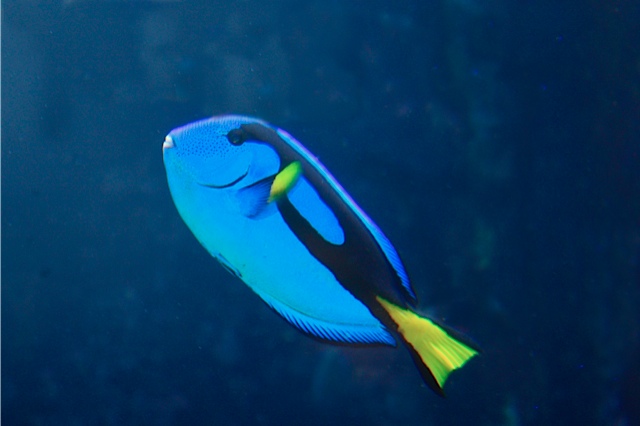
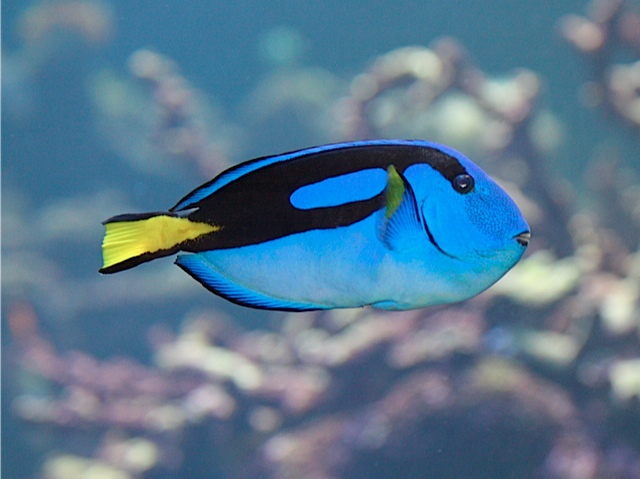
GENERAL CHARACTERISTICS: The color of their oval-shaped bodies is sky blue enhanced by reflective pigment cells called iridophores. The tail fin is yellow extending into a “V” shape from the caudal fin to a point just beyond the caudal spine. A black oval extends under dorsal fin to caudal peduncle. Color changes as they mature; juveniles are bright yellow with blue spots near their eyes, and their dorsal and anal fins are tipped in light blue. Their body becomes blue as they mature.

Length up to 31 cm (12 in)
Weigh on average 600 g. (1.3 pounds)

DISTRIBUTION/HABITAT: Indo-Pacific in clear, current-swept terraces of seaward reefs, 2–40 m (6-120ft). Typically in loose groups 1–3 m (3-9 ft) above substrate.  Shelters among branches of Procillopora corals or in crevices of rocks.  

DIET IN THE WILD: Zooplankton. 

REPRODUCTION: P. hepatus is oviparous with external fertilization.  They are open water egg scatterers on substrate and are nonguarders.        

CONSERVATION: IUCN Least concern         

REMARKS: P. hepatus like other surgeonfishes has a razor-sharp caudal spine located at the base of their caudal fin. This spine contains toxins that can cause a debilitating pain to small predators and uncomfortable irritation and pain in humans. This spine is in a groove below the surface of the skin and can be extended from the body for defensive purposes.

Dory, the co-star of Finding Nemo, with the voice of Ellen DeGeneres’ “spaced-out” fish, is a hepatus tang. Most kids now recognize this fish as Dory.  


References

California Academy of Sciences Steinhart Aquarium Philippine Coral reef 2016

Ron’s WordPress shortlink  wp.me/p1DZ4b-Ab

Ron’s flickr   http://www.flickr.com/photos/cas_docents/sets/72157608332652056/

Encyclopedia of Life   http://eol.org/pages/222042/details

Animal Diversity Web: http://animaldiversity.ummz.umich.edu/accounts/Paracanthurus_hepatus/

fishbase: http://www.fishbase.org/summary/6017

TAXONOMY
Kingdom: Animalia
Phylum: Cordata
Class: Actinopterygii (ray-finned fishes
Order: Perciformes (Perch-likes)
Family: Zanclidae (Moorish idol)

Genus/species: Zanclus cornutus


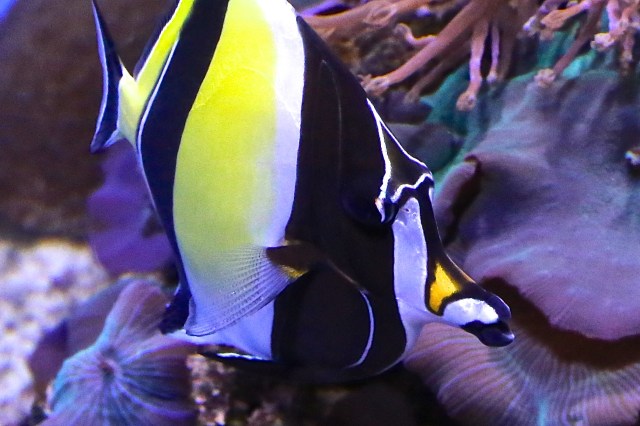
GENERAL CHARACTERISTICS: Discoid body, tubular snout, dorsal spines elongated into a very long white whip-like filament. Broad vertical white, black, white-yellow black, yellow banding. Tail black with white margin. Length to 23 cm (9 inches).

DISTRIBUTION/HABITAT: Indo-pan-Pacific. Southern Gulf of California found near hard substrates from turbid inner harbors and reef flats to clear seaward reefs as deep as 182 m (600 ft). Usually in small groups of conspecifics, occasionally in schools of more than 100.                 

 DIET IN THE WILD: Primarily sponges. Also consumes tunicates and algae.

 REPRODUCTION: It has a long larval phase and settles at a large size (6 cm or 2.4 in) resulting in its very wide geographic distribution.

 CONSERVATION: Not evaluated

REMARKS: The Moorish Idol was the icon of the Golden Gate Park Steinhart Aquarium.

Gill, was the leader of the tank fish in the movie Finding Nemo, with the voice of Willem Dafoe, is a Moorish idol.

Color of Life, Color on the Reef, Color Conceals, Hiding the eye.
Black stripes break up the body outline and hide the eye from predators.

IMG_3304

 Philippine Coral Reef  

 Ron’s flickr http://www.flickr.com/photos/cas_docents/sets/72157608440659805/

Ron’s  WordPress Shortlink  http://wp.me/p1DZ4b-Ax

fishbase: http://www.fishbase.org/summary/5950

EOL http://eol.org/pages/204516/hierarchy_entries/44696397/details

TAXONOMY
Kingdom: Animalia

Phylum: Chordata
Class: Actinopterygii (ray-finned fishes)
Order: Perciformes (Perch-likes)
Family: Acanthuridae (Surgeonfishes, tangs, unicornfishes)

Genus/species: Acanthurus pyroferus

Acanthurus pyroferus3161779234_fc0fccc624_b

GENERAL CHARACTERISTICS: Adults have a
purplish-black to brown body; curving black band from chin to upper edge of the operculum; orange patch above base of pectoral fin.
Length to 25 cm. (10 in).
Front of juvenile’s body (“face”) is gray; body is white anteriorly and dark posteriorly. Dark-colored caudal fin rounded in juveniles.

DISTRIBUTION/HABITAT: Indonesia, Philippines, Micronesia to Polynesia, Japan to New Caledonia and the Great Barrier Reef.  Found in lagoon and seaward reefs from 12–200 ft.

DIET IN THE WILD: Algae.

REPRODUCTION: Following external fertilization female scatters eggs over open water substrate: eggs not guarded.

CONSERVATION: IUCN Least Concern

COLOR OF LIFE NOTE: Anti-predator Adaptations, Mimicry.

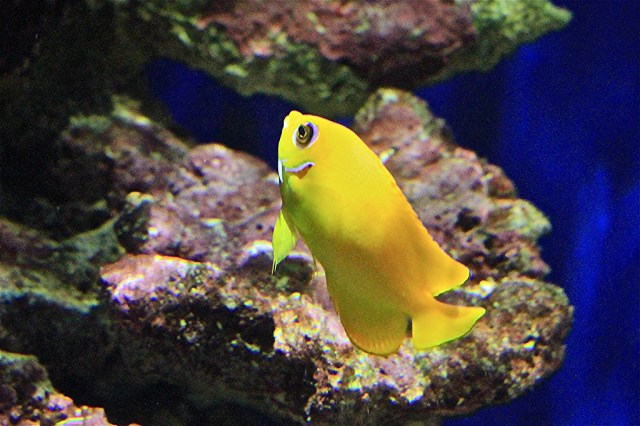
The common name “mimic” is based on the juvenile coloration; juveniles exhibit three different color patterns mimicking angelfish in the Centropyge genus. Coloration of juveniles mimics these angelfishes until they achieve the largest size attained by the angelfishes; then their appearance transforms to the appropriate adult coloration for A. pyroferus.
Juveniles mimic Centropyge spp. (in Guam, juveniles mimic C. flavissimus see below).

Centropyge flavissima6764335749_c4befc1269_b

Philippine Coral Reef 

REFERENCES

California Academy of Sciences Color of Life exhibit 2015

fishbase www.fishbase.se/summary/4742

Ron’s flickr  https://www.flickr.com/photos/cas_docents/2989062467/in/set-72157608332652056/
Ron’s WordPress shortlink  http://wp.me/p1DZ4b-1fA

EOL  http://eol.org/pages/211470/details


TAXONOMY
Kingdom:Animalia
Phylum: Chordata
Class:Actinopterygii (ray-finned fishes)
Order: Perciformes (Perch-likes)
Family: Apogonidae (Cardinalfishes)

Genus/species: Apogon cyanosoma

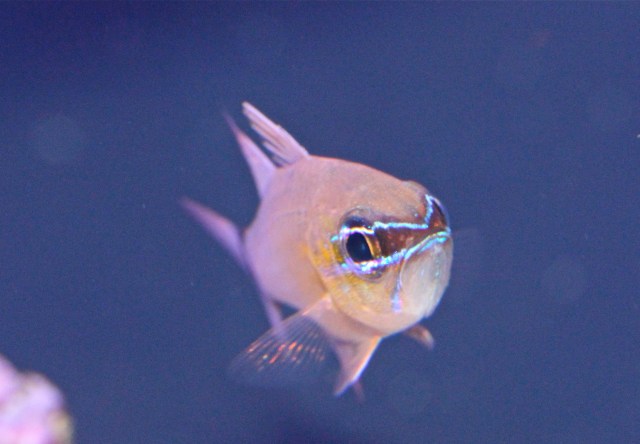
YellowstripedCardinalfish4184514661_35a0a5c254_b

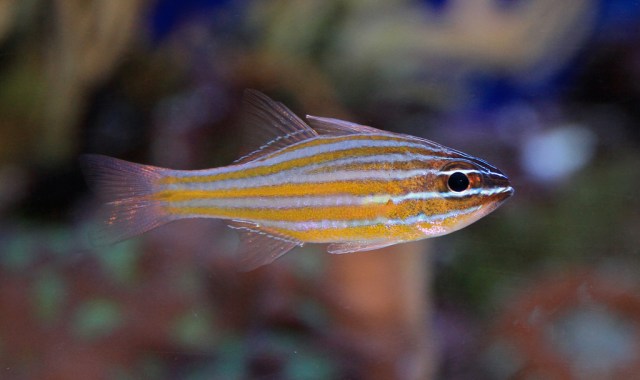
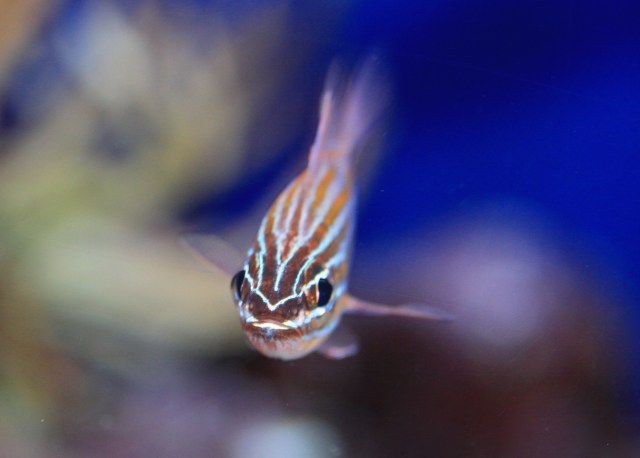
GENERAL CHARACTERISTICS : Silver body highlighted with 6 orange-gold horizontal stripes including a short post ocular stripe.. Pinkish to orange spot on base of caudal fin. Max. length: 8 cm.

YellowstripedCardinalfishApogon cyanosoma, PR24

DISTRIBUTION/HABITAT: Indo-west Pacific. Common from Australia to the Red Sea Inhabiting sheltered clear water areas of lagoon and seaward reefs. Associates in small to large aggregations under ledges, in holes, or even among long spines of sea urchins.

DIET IN THE WILD: Planktonic crustaceans and small invertebrates.

REPRODUCTION: Like all cardinalfishes, a paternal mouthbrooder.

CONSERVATION: IUCN; Not Evaluated.

REMARKS: Like all cardinalfishes, active at night, with large eyes adapted to gathering low light.


References:

fishbase http://www.fishbase.org/summary/4600

flickr https://www.flickr.com/photos/cas_docents/4184514661/in/set-72157…

eol eol.org/pages/985736/details

TAXONOMY
Kingdom: Animalia
Phylum: Chordata
Class: Actinopterygii (Ray-finned fishes)
Order: Perciformes (Perch-likes)
Family: Apogonidae (Cardinalfishes)

Genus/species: Ostorhinchus aureus (Apogon aureus)

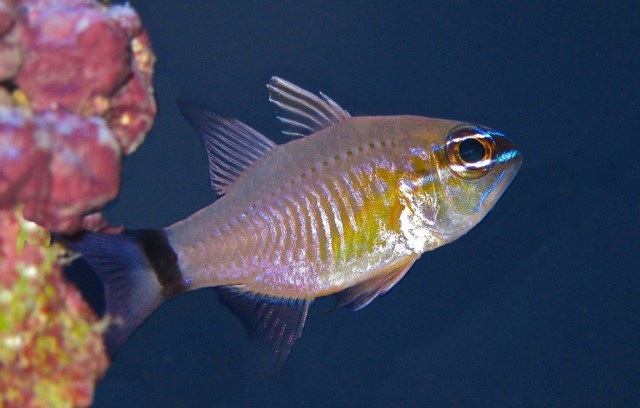
Ring-Tail Cardinalfish Ostorhinchus aureus13924803567_e8eb47a0af_b

GENERAL CHARACTERISTICS: Coppery with iridescence, paler posteriorly; a blackish stripe, bordered by a blue line, running from front of snout through eye and beyond; a narrow blue streak on maxilla. Black bar encircling caudal peduncle present in both young and adult phases.Length 4.4-14.7 cm (1.75-5.8 inches).

IMG_5514

DISTRIBUTION/HABITAT: Tropical Indo-West Pacific. Inhabits holes in rocks or under ledges in shallow waters. Depth range 1 – 40 m (3.2 to 130 feet).

DIET IN THE WILD: Benth crustaceans, zoobenthos, mobile invertebrates and small fishes.

REPRODUCTION: External fertilization, mouthbrooders.

CONSERVATION: IUCN; not evaluated.

References:

eol eol.org/pages/224893/details

flickr  www.flickr.com/photos/cas_docents/13924803567/in/set-7215…

fishbase.kaust.edu.sa/summary/Ostorhinchus-aureus.html

WordPress shortlink  http://wp.me/p1DZ4b-1gu

TAXONOMY
Kingdom: Animalia
Phylum: Chordata
Class: Actinopterygii (ray-finned fishes),
Order: Perciformes (Perch-likes)
Family: Apogonidae (Cardinalfishes)

 Ostorhinchus sealei  (Apogon sealei) 


GENERAL CHARACTERISTICS:  Length 80mm, (3.15 inches). Pale yellow with a  pair of thin brown stripes on the upper side and a dark spot on mid tail base. Two short orange bars in bluish white patch on gill cover.

DISTRIBUTION/HABITAT: Malaysia to the Solomon Islands, north to the Philippines, Palau, and south to Ashmore Reef, Australia. Usually found on coastal fringing reefs or patch reefs to a depth of 25 m (80 feet). It is often found in pairs or in groups among branching corals such as Acropora. 

DIET IN THE WILD: Individuals shelter in amongst the coral during the day and come out to feed at night on zooplankton and benthic invertebrates.

REPRODUCTION and DEVELOPMENT: This species demonstrates distinct pairing during courtship. The males mouthbrood the fertilized eggs until hatching is ready to occur.

LOCATION:  Philippine Coral Reef

References

fishbase http://www.fishbase.org/summary/6230

WORDPRESS SHORTLINK  http://wp.me/p1DZ4b-ki

flickr  https://www.flickr.com/photos/cas_docents/6615915253/in/set-72157625992053826

eol  neol.org/pages/212483/details

Cardinalfish general information.  

Found in the Atlantic and Indo-Pacific oceans, cardinalfishes are primarily marine, though some are found in brackish waters and a few in freshwater streams. Many species inhabit reef flats, lagoons, and seaward reefs to 60 feet (18 m).
The family is characterized by two widely separated dorsal fins, large eyes, short snouts, double-edged preopercula and a moderately large oblique mouth. The name derives from the red coloration of some well-known species, though many are drab or striped.
Most remain hidden during the day, and then disperse over the reef at night to feed on zooplankton and small benthic invertebrates, always remaining close to the substrate. Males of many species are mouth brooders.