Latest Entries »

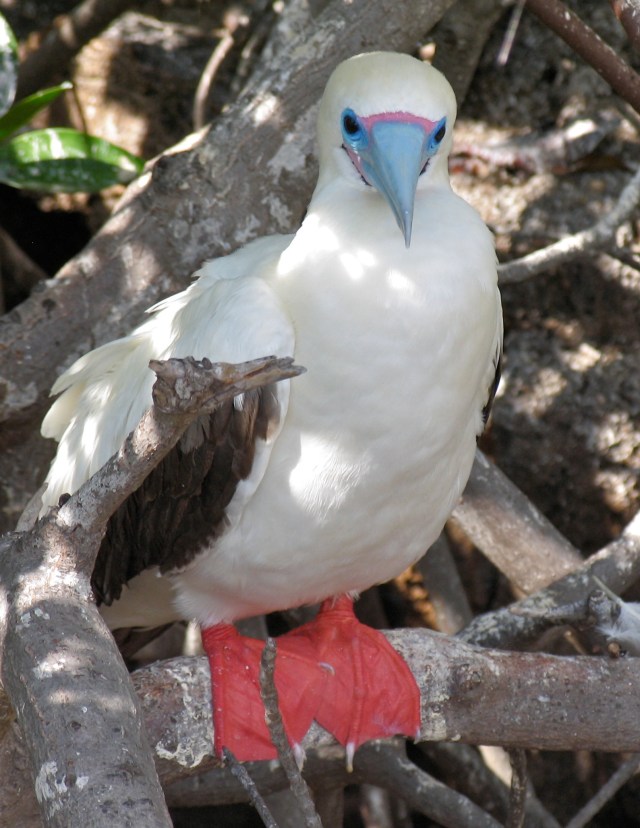
áReád-Footed Booby   Sula sula                       Sulidae

Distribution: found widely in the tropics, and breed colonially in coastal regions especially  islands.  

Habitat: Feed at sea, but nest on land, perching in coastal trees and shrubs.

Appearance: The Red-footed Booby is the smallest of all boobies at about 70 centimetres (28 in) in length and with a wingspan of up to 1 metre (3.3 ft). It has red legs, with its bill and throat pouch colored pink and blue.  Red-footed boobies appear in a variety of color morphs but all have red feet giving its name. In the white morph the plumage is mostly white (the head often tinged yellowish) and the flight feathers are black.

Diet: S. sula  are spectacular divers, plunging into the ocean at high speeds to catch prey. They mainly eat small fish or squid which gather in groups near the surface.

Remarks: These gregarious birds live in colonies and, during mating season, hundreds of animals may gather to pair up and mate. Females lay only one egg every 15 months, and both parents care for chicks. Young mature slowly, but the low reproduction rate is balanced by these birds’ long lifespan—over 20 years.

The biggest threats to red-footed boobies are a fishing industry that thins their food source, and coastal development with disappearing of the world’s coastlines.

Photo: Jean Haddad

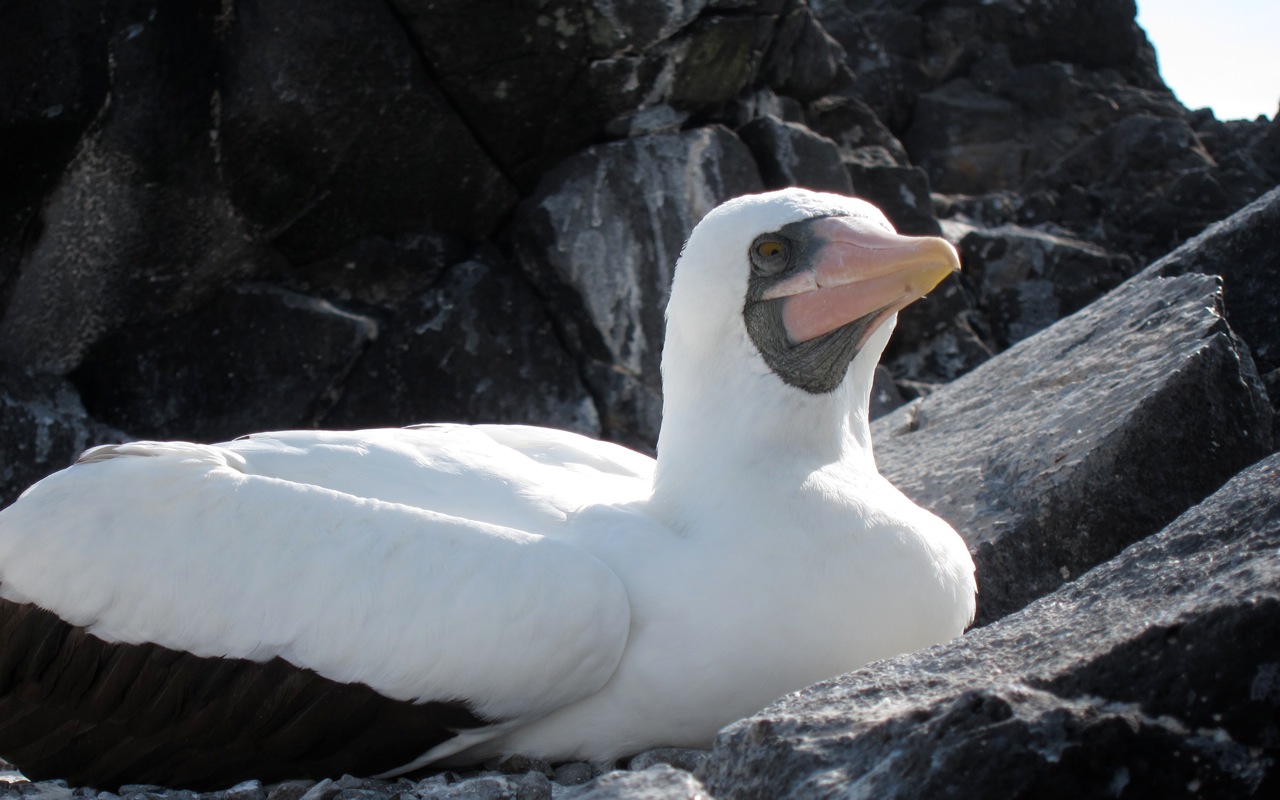
Masked Booby

Sulidae dactylata                         Sulidae

Distribution: Breeds in Bahamas and West Indies, and on other islands in tropical Atlantic, Indian, and Pacific oceans such as the  Galápagos Islands.

Habitat: Tropical seas, except when nesting in small colonies, on sandy beaches in shallow depressions.

Appearance: 32inches; (81 cm). A stocky white seabird with black tail, black tips and trailing edges to the wings, and stout pinkish or orange bill.

Diet:Mainly eat small fish, including flying fish.

Remarks: Boobies have little fear of humans. Because of their tameness they were easily killed for food by early mariners, who gave them their name (from the Spanish bobo or stupid) for this reason. Boobies obtain their prey in spectacular plunges from the air into the sea

Galápagos Video link   http://www.youtube.com/watch?v=VySe1X12gqs&hd=1

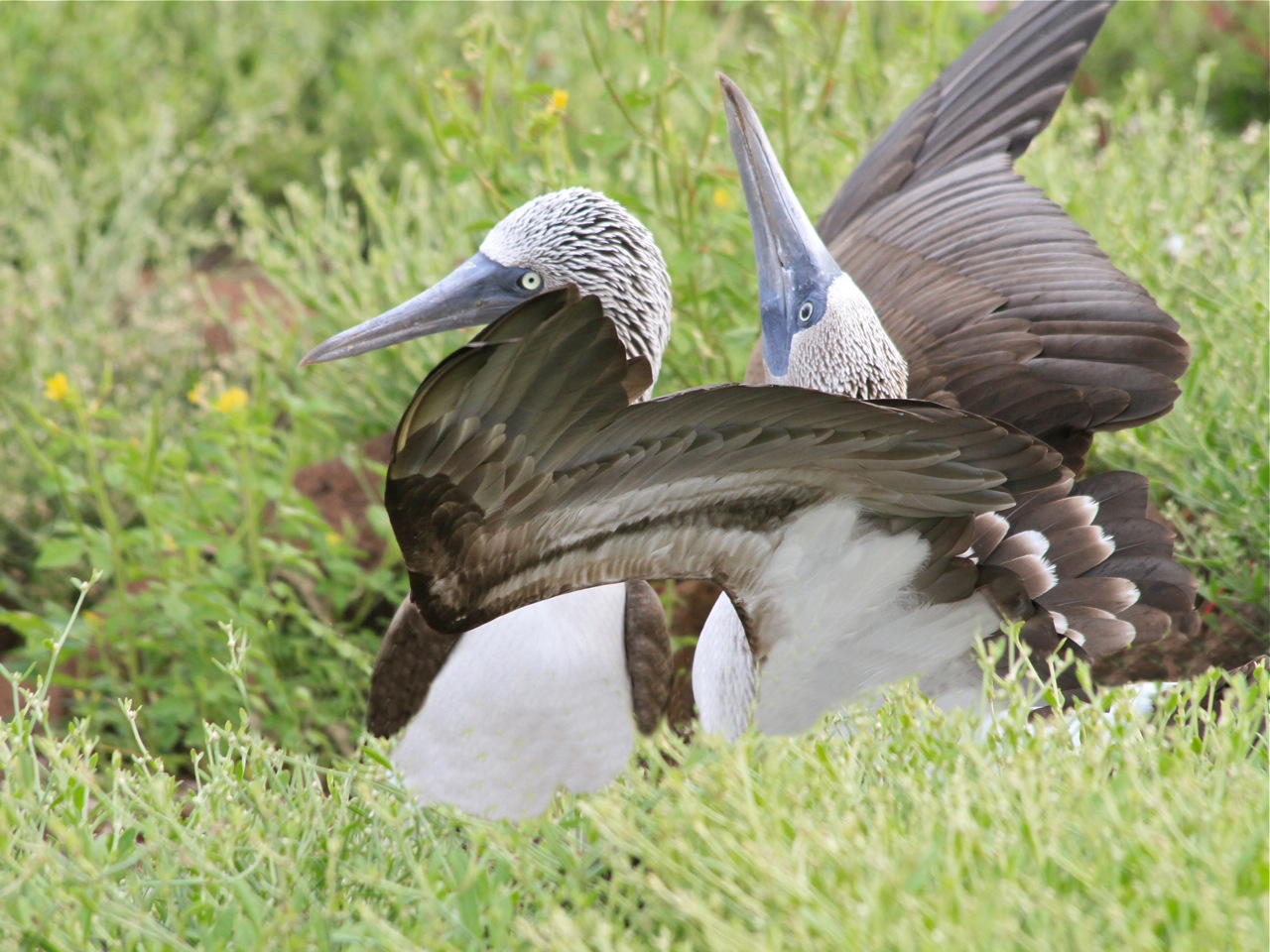
Blue-Footed Booby

Sula nebouxii   Sulidae

Distribution:  Baja Peninsula to northern peru and Galápagos Islands.

Habitat: The Blue-footed Booby is strictly a marine bird. Their only need for land is to breed, which they do along rocky coasts.

Appearance:   Average 81 centimetres (32 in) long and weighs 1.5 kilograms (3.3 lb), with the females slightly larger than the males.   S. nebouxii has long pointed wings and a wedge shaped tail.  The booby’s  yellow eyes are placed on either side of their bill and oriented towards the front with excellent binocular vision.  The male has more yellow on its iris than the female.   Their feet range from a pale turquoise to a deep aquamarine. Males and younger birds have lighter feet than females do.

Remarks: When they spot a school of fish, they will all dive in unison. They point their bodies down like an arrow and dive into the water plunging from heights of 33–100 ft (10–30.5 m) and even up to 330 ft (100 m). They hit the water around 60 mph (97 km/h) and can go to depths of 82 ft usually eating while underwater.


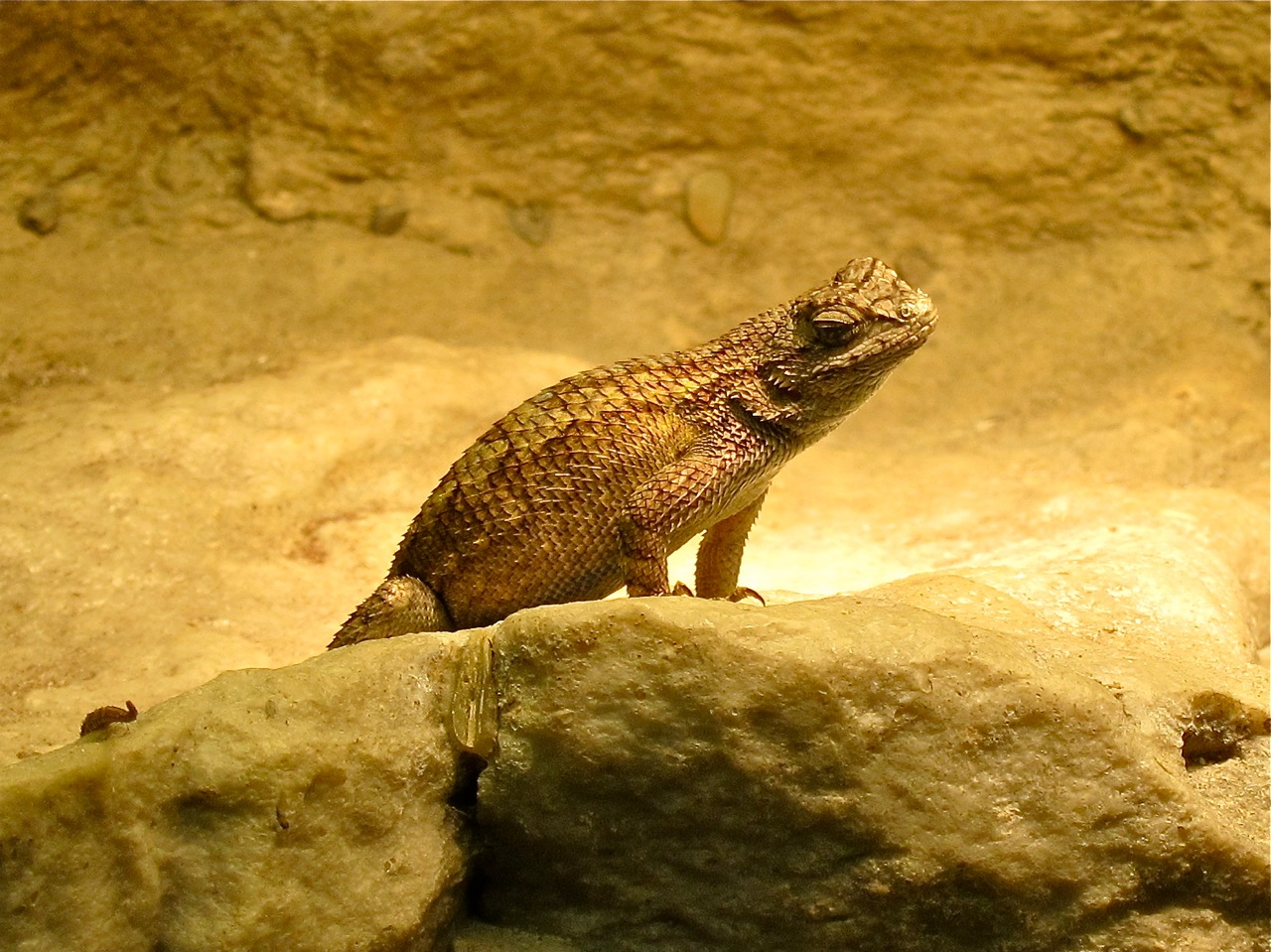
Western Fence Lizard

Sceloporus occidentalis              Phrynosomatidae

Distribution:  Western U.S.

Habitat: Grassland, broken chaparral, sagebrush, woodland, coniferous forest, and farmland, and occupies elevations from sea level to 10,800 ft. They generally avoid the harsh desert.

Appearance: 13-15cm (5-6 inches) They are brown to black in color (the brown may be sandy or greenish), but their most distinguishing characteristic is their bright blue belly, and the ventral side of the limbs are yellow. These lizards also have blue patches on their throats. This bright coloration is faint or absent in both females and juveniles. The scales of S. occidentalis are sharply keeled.

Diet: Fruits, leaves, buds and flowers.

Remarks: The presence of western fence lizards is thought to diminish the danger of transmission of Lyme disease by ticks. The incidence of Lyme disease is lower in areas where the lizards occur, and when ticks carrying Lyme disease feed on these lizards (which they commonly do, especially around their ears), the bacteria that cause the disease are killed

Cuban Knight Anole

Anolis equestris      Iguanidae

Distribution: Cuba and have been introduced into Dade and Broward counties in Florida.

Habitat: They are arboreal living in the shady canopy of large trees.

Appearance: Grow to a length of 12 to 20 inches (30 to 51 cm). They are the largest of the Genus Anolis. The snout is long and wedge-shaped and the tail is slightly compressed with a serrated upper edge. Each toe is expanded to form an adhesive pad allowing the anoles to easily run up smooth, vertical surfaces, or run body downward on a horizontal plane.  The body is covered with small granular scales with a yellow or white stripe under the eye and over the shoulder. They are bright green in color, which can change to a dull grayish-brown.

Diet: Insects, small lizards, amphibians.

Remarks:  They are easy to distinguish from other anoles by their size and the large, pink throat fan or dewlap.  When courting or defending its territory amale anole will extend its throat sac.


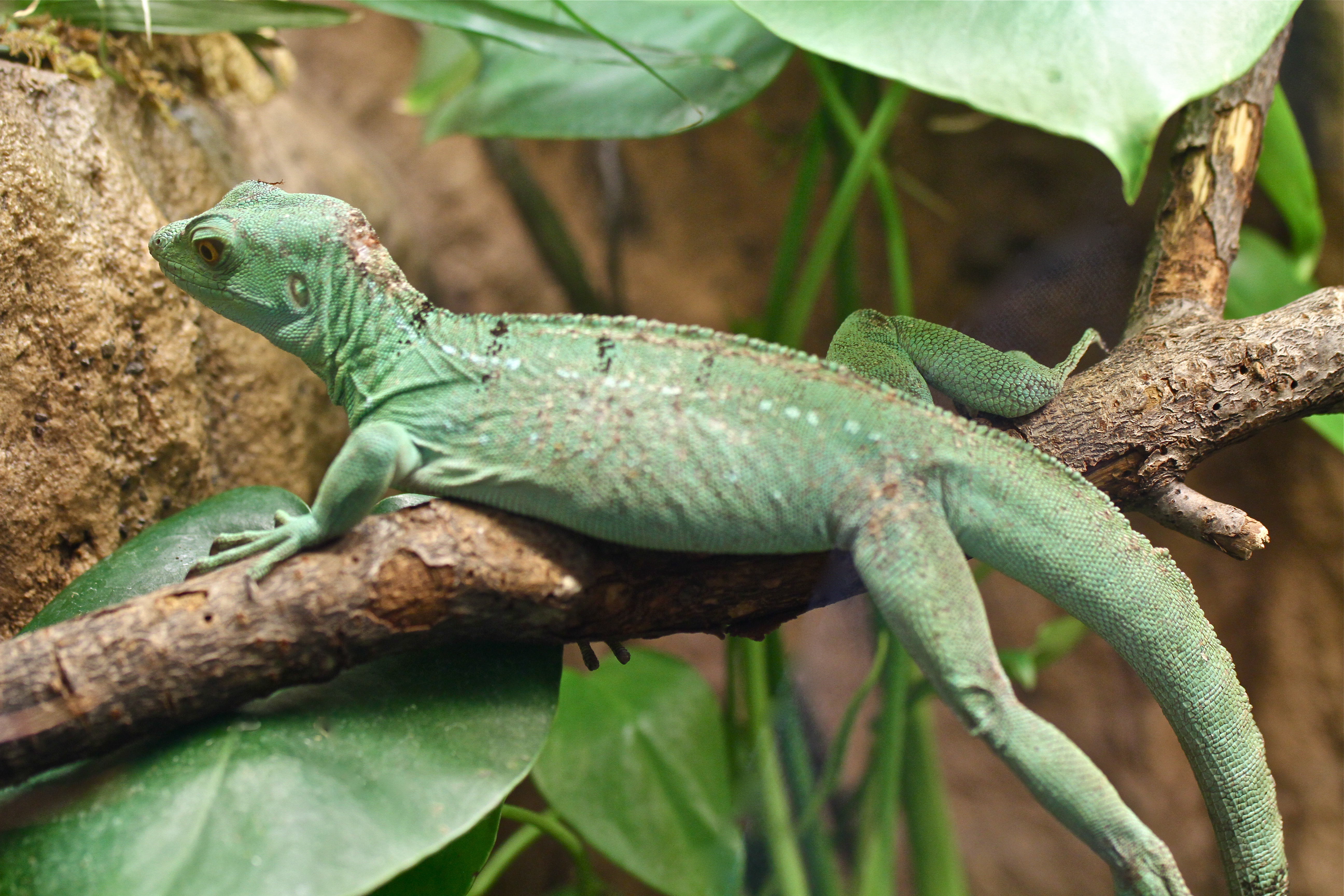
Green Basilisk Lizard

Basiliscus plumifrons     Corytophanidae

Distribution: Central and South America.

Habitat: Arboreal and semi-aquatic; inhabit the trees and bushes of the rainforest, often along riverbanks.

Appearance: Length, including tail, can be up to 85 cm.  Adult color is bright green, or slightly blue-green. Males have distinctive, high crests on their heads and backs, which they use to impress females. The females have only one small crest.

Diet: Omnivores, surviving on a diet of plant material, insects, fruit, and small vertebrates.

Remarks: Green basilisk lizard has been called the “Jesus Christ” lizard, because of its ability to walk on water. Their rear feet have long toes with fringes of skin that unfurl in the water, increasing surface area. They rapidly move their legs as they slap their splayed feet hard against the water. This creates tiny air pockets that keep them from sinking, provided they keep running fast enough. They can move more. When gravity eventually takes over, the basilisk is an excellent swimmer.             

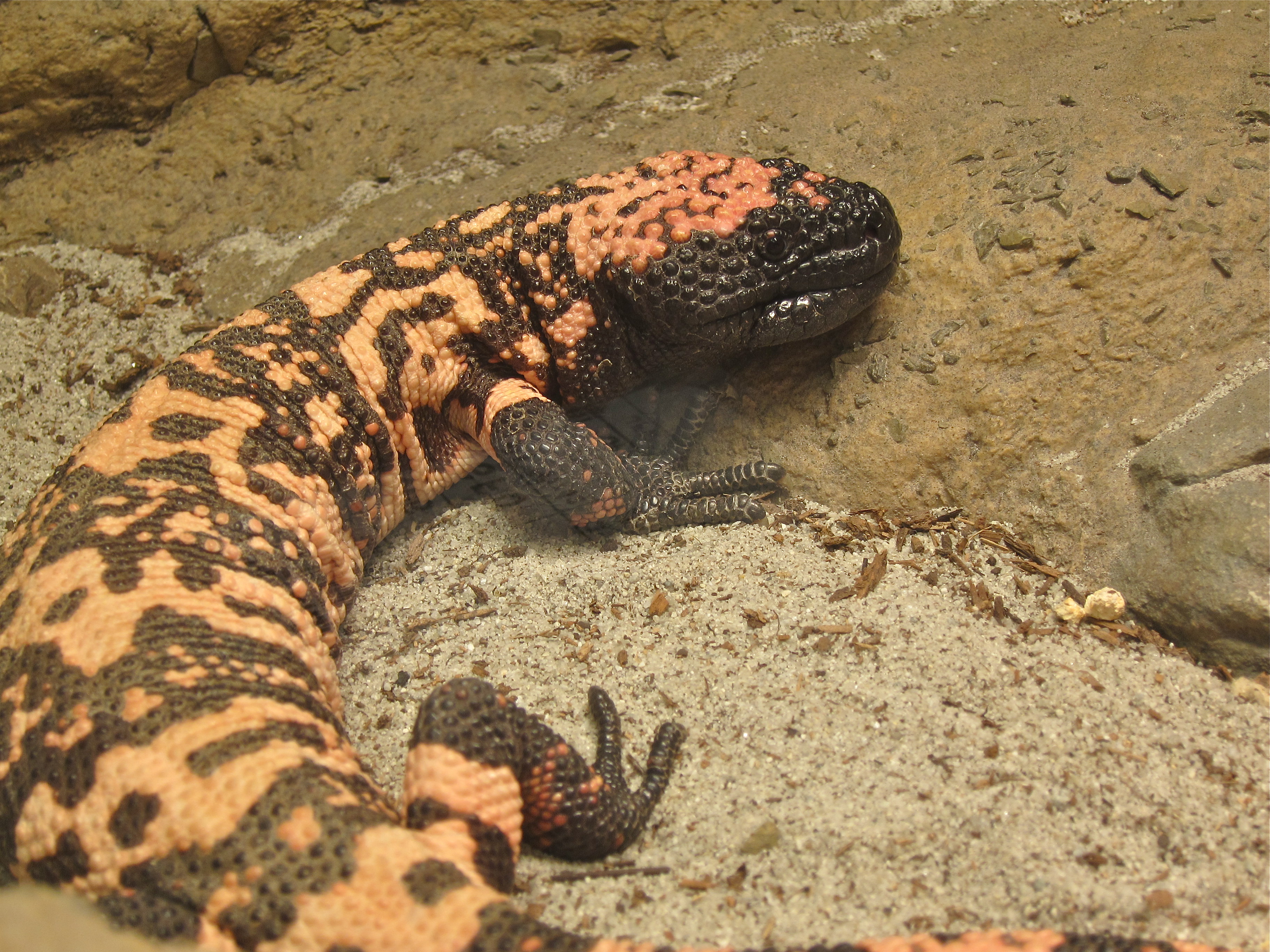
Gila Monster

Heloderma suspectum                      Helodermatidae

Distribution: Southwestern United States and Mexico.

Habitat: Scrubland, succulent desert, and oak woodland, seeking shelter in burrows, thickets, and under rocks in locations with ready access to moisture.

Appearance: Their black bodies are covered in bead-like scales with bright spots, blotches, or bands of pink, orange, or yellow, which probably warn other animals to stay away. Their bulky bodies, slow moving stride, thick forked tongue, and snorting hisses, reinforce the name Gila monster.

Diet: Eggs, young birds and small mammals.

Remarks: Jaw muscles are strong and after biting its prey it will not release, giving venom time to work. Glands in the lower jaws secrete the venom into grooves in its teeth which mixes with saliva killing or disabling its prey. Venom is very painful to humans but does not usually result in death.


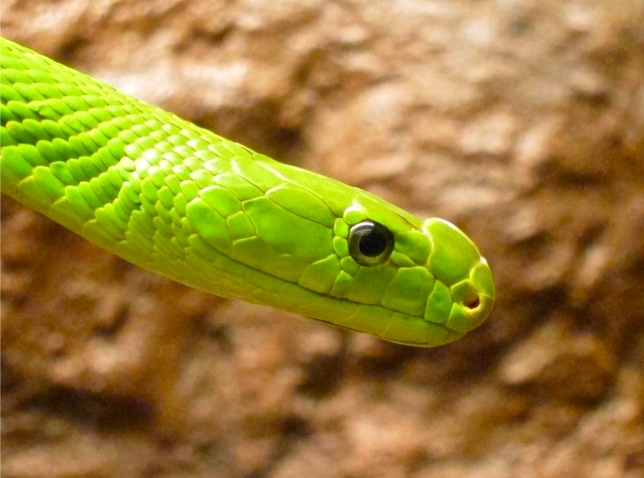
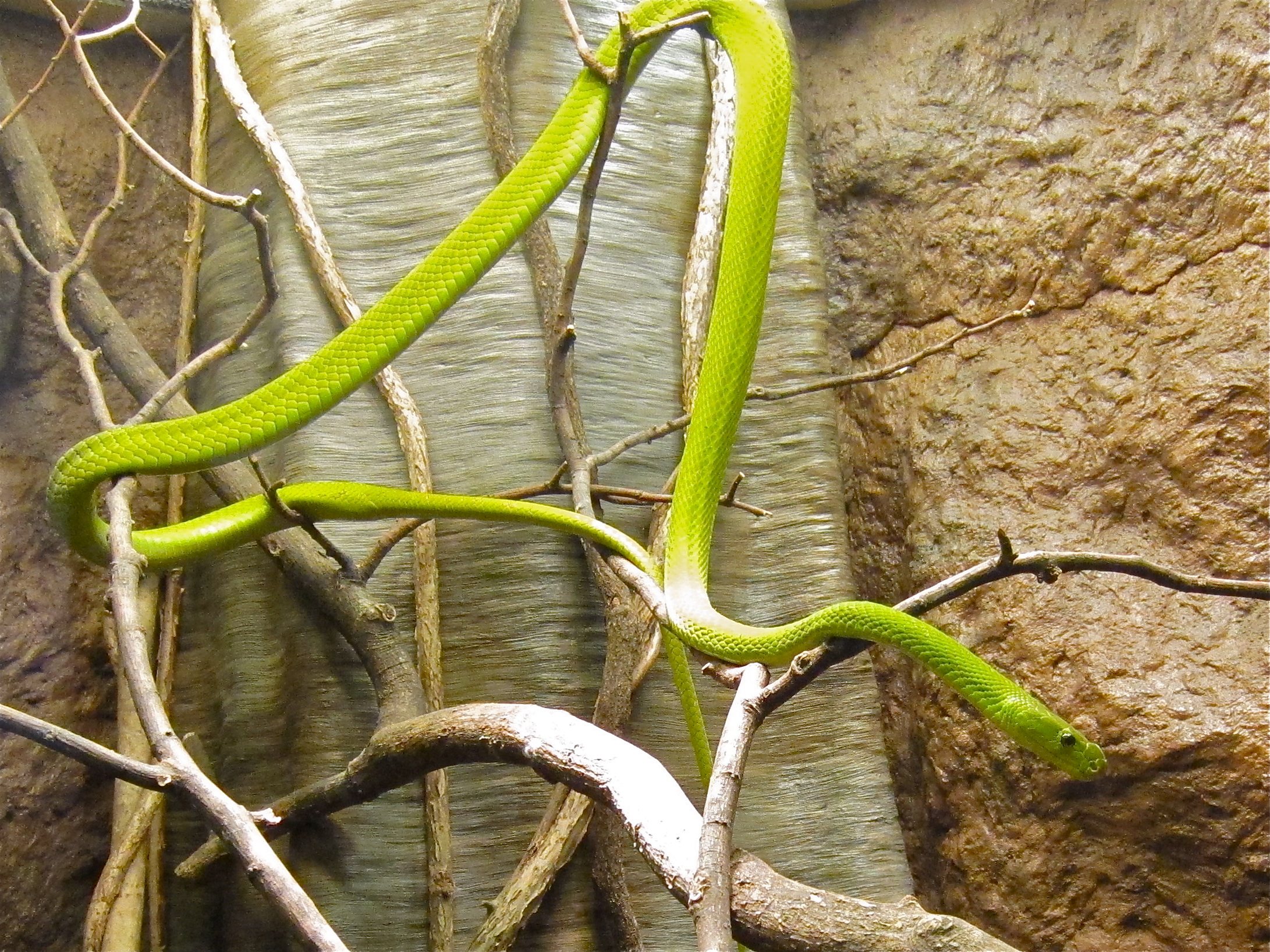
Eastern Green Mamba

Dendroaspis angusticeps  Elapidae

Distribution: indigenous to the eastern side of southern Africa.

Habitat: Green mambas make their homes near trees, often in evergreen forest, coastal scrub, or moist savannah. Bamboo thickets and mango plantations are also known to be mamba habitat.

Appearance: Green mambas are slender snakes, with a distinct head and long, thin tail.. D. angusticeps is overall glossy grass-green in color with light bright green underside.

Diet: Birds, rodents and bats.

Remarks: This venomous slender fast moving snake lives in treetops where its vivid green color is goo camouflage.

Eastern Green Mamba

Eastern Green Mamba

Rhinoceros Iguana

Cyclura cornuta                           Iguanidae

Distribution: Haiti and Dominican Republic.

Habitat: Primarily found near coastlines; however, many have been forced to relocate inland due to human expansion.

Appearance: One of the largest of the Iguanas, mature Rhinoceros Iguanas can be anywhere from two to four feet in length. They get their name from three horn-like outgrowths on the end of their nose. They are a dusky gray or olive green in color, with barely visible dark cross bands,

Diet: Mainly herbivorous eating leaves, flowers and fruit. They may eat carrion (mostly dead birds and fish.

Remarks: As with most Iguanas, Rhinoceros Iguanas have good hearing, smell and excellent eyesight.

Red Spitting Cobra

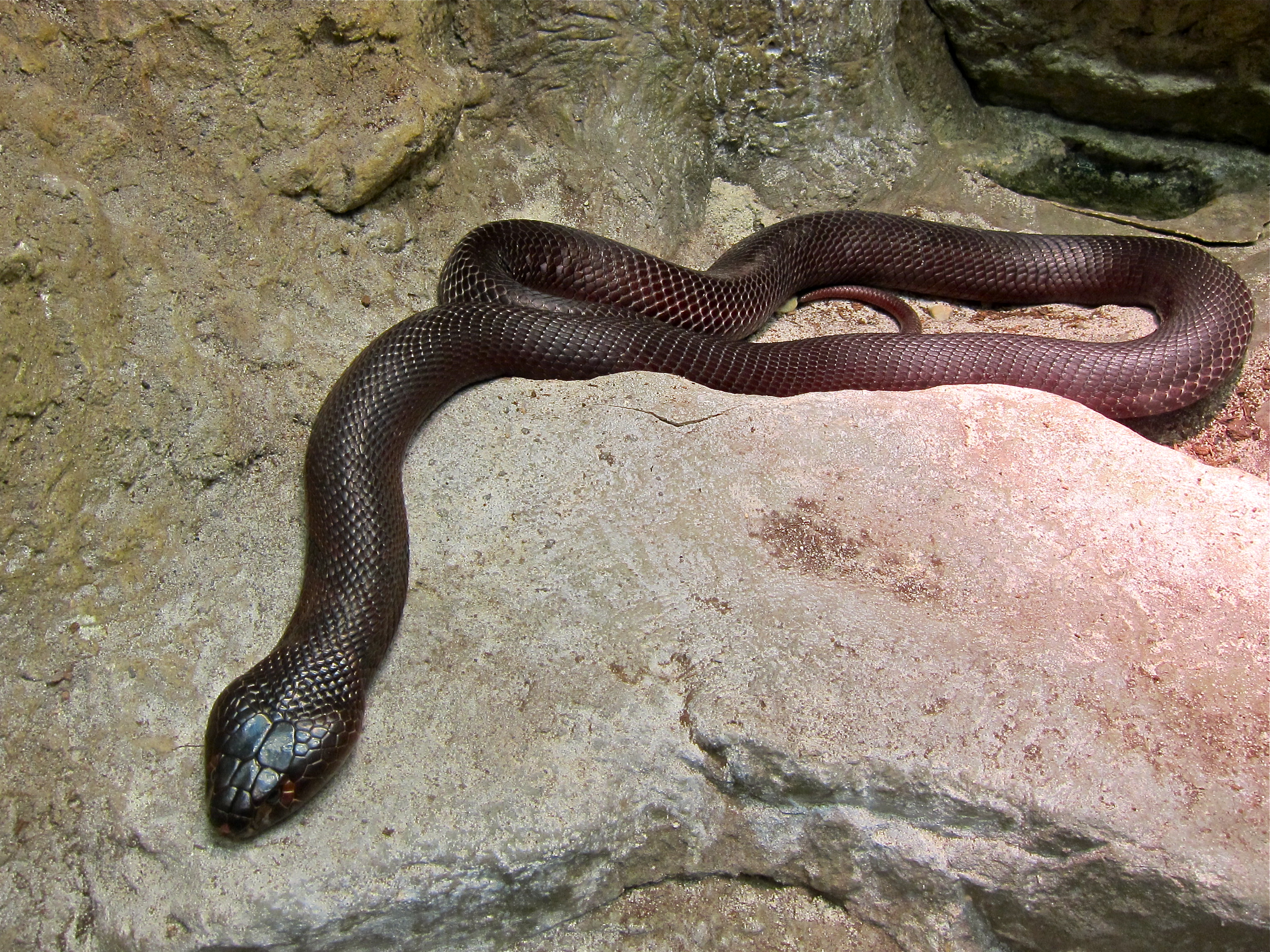
Red Spitting  Cobra                              Naja pallida                 Elapidae                                         Distribution: Eastern Africa                                                                                    Habitat: Primarily inhabits dry savanna and semi-desert area. Commonly found in oases in desert where it hunts.                                                                                      Appearance: Maximum length of 120 cm (4 feet). Color of this species has great variation from red, deep orange, pale red, pinkish and light brown. Red Spitting Cobras found in Northern Africa have duller color while others are much brighter. The hood of the Red Spitting Cobra is narrow compared with the Indian Cobra and the Cape Cobra. It also has a small round head and a pair of rather large eyes.                                                              Diet: Frogs, rodents and birds.                                                                                      Remarks: The snake squeezes muscles around its venom gland forcing a small jet of toxic liquid through a small hole in the front of the fangs with great accuracy at the eyes of a possible predator capable of blinding or at least causing extreme pain.