Latest Entries »

Kingdom Animalia, Phylum Cnidaria, Class Anthoza, Subclass Hexacorillia, Order Actiniara, Family Haluridae.

Halcurias carlgreni 

DISTRIBUTION: West North Pacific

HABITAT: From Japans deeper, cooler waters.

REMARKS:  From Rich Ross California Academy of Sciences Biologist.  http://packedhead.net/Last December when Koji Wada of the renowned Blue Harbor visited the Steinhart Aquarium he was kind enough to bring us two stunning Halcurias carlgreni anemones. From Japans deeper, cooler waters, these anemones are jaw droppingly bright and colorful. Currently, they are being kept at 66 degrees in our Nautilus exhibit and both animals seem to be getting along just fine with each other. The Halcurias are being fed thawed frozen mysis via ‘Julians Thing’ every other day, and we hope they will be so happy and full of food that we will have more of them in the near future. They are of course non-photosynthetic.
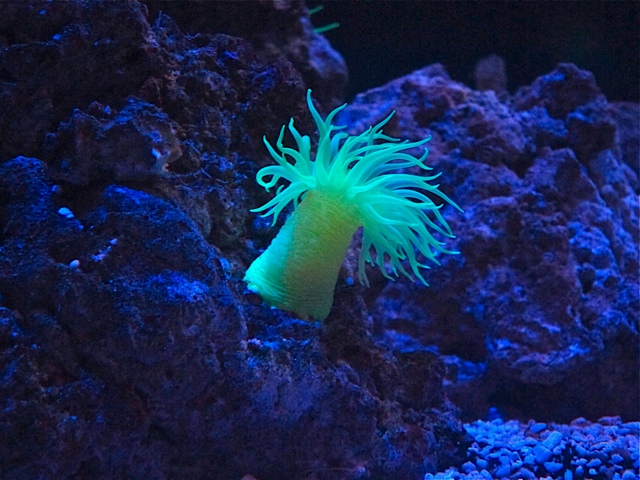
LOCATION: Nautilus Exhibit

WORDPRESS SHORTLINK  http://wp.me/p1DZ4b-pX
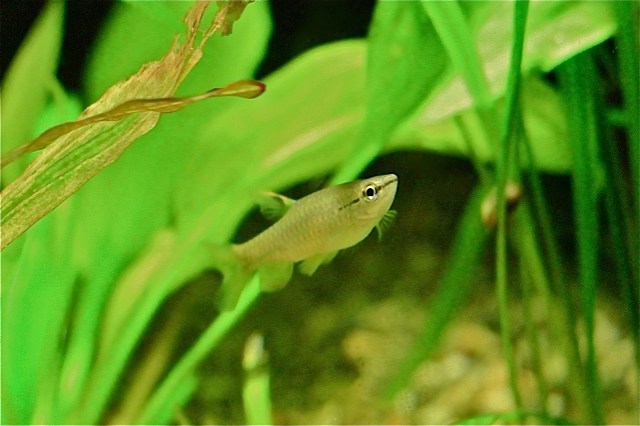

Actinopterygii (Ray-finned fishes) > Characiformes (Characins) > Lebiasinidae (Pencilfishes)

Copella arnoldi

 DISTRIBUTION: Amazon Basin.

 HABITAT: Slow-moving fresh water.

 APPEARANCE: Males tend to be larger and more colorful than females and have more elaborate fins. Max. length: 3.4 cm. 

 DIET: Worms, insects, and crustaceans.

 REPRODUCTION/DEVELOPMENT: The unusual behavior of the splashing tetra provides a unique strategy that keeps aquatic predators away from progeny: The male and female will leap out of the water as a pair, both remaining together while the female attaches her eggs to the leaves of plants at the water’s edge and the male then immediately fertilizes them. This procedure is repeated several times until 50 to 200 eggs have been laid. After attachment, the male, now in the water, faithfully flicks his tail every few minutes, shedding droplets of water onto the eggs to keep them moist. After 2 to 3 days the eggs hatch and the fry fall into the water below. The male’s attention then abates and the young tetras are on their own.

MORTALITY/LONGEVITY: Life span: about 3 years.

 REMARKS: In spite of their common name, they are not closely related to true tetras of the family Characidae found in a variety of other Steinhart exhibits.

Flickr http://www.flickr.com/photos/cas_docents/6939753715/in/set-72157629304397467

WORDPRESS SHORTLINK   http://wp.me/p1DZ4b-pP

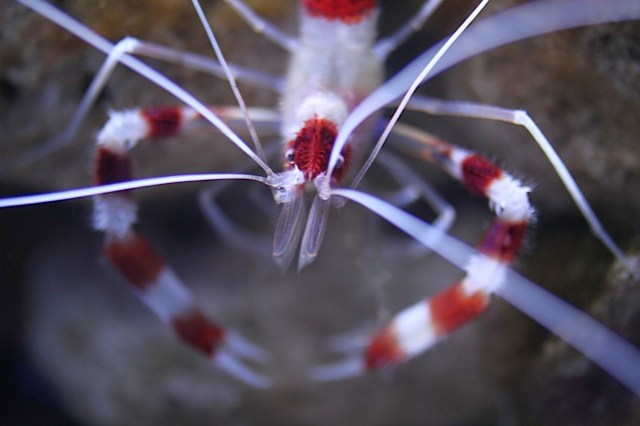
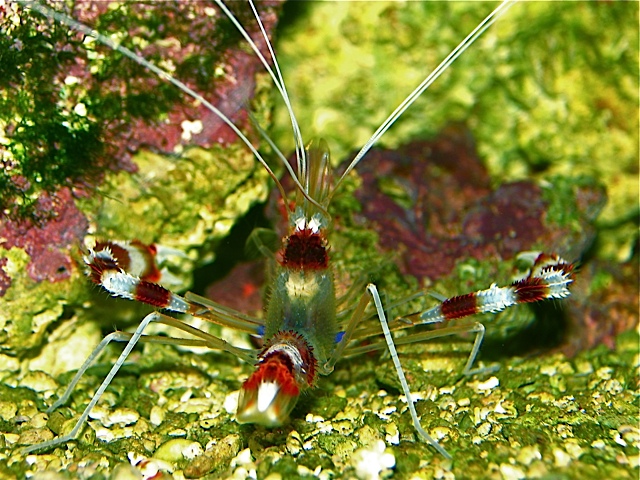
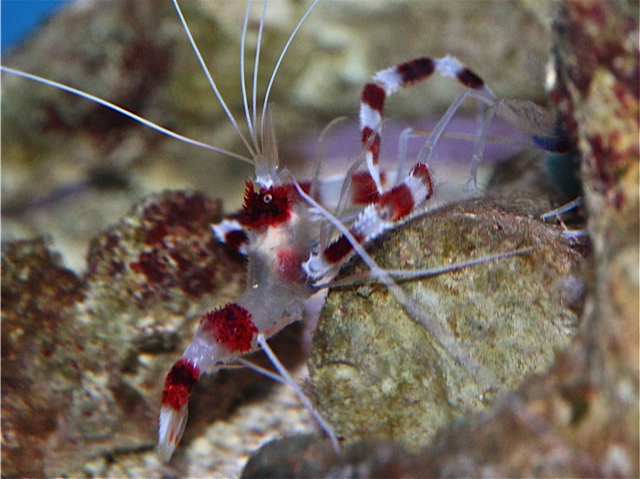
Phylum Arthropoda,  Subphylum Crustacea, Class Malacostraca, Order Decapoda, Family Stenopodidae

Stenopus sp.

DISTRIBUTION: tropical coral reefs worldwide

HABITAT: Male and female coral banded shrimp pair up when young, claim a territory, and never travel outside the small patch of reef they call home.

APPEARANCE: Strikingly colorful, they have a white body with contrasting red and white bands, bluish legs, slender pincers, and extremely long white antennae. Short spines cover the body and are used for defense. Males are smaller, more slender than females.

DIET: A cleaner shrimp, it removes dead tissue, algae and parasites from fish waving their long antennae to advertise their services. They are known to perform a dancing behavior, perched on a conspicuous spot near their home and whipping the antennae while swaying from side to side.  A fish ready for cleaning remains still in the water, allowing the shrimp to clean the scales and even enter the mouth and gills. They have been known to clean under the fingernails of divers’ hands!

REPRODUCTION: They are committed monogamists mating for life, a breeding strategy rare among most animal groups. Stenopus sp. defend their territory aggressively attacking and sometimes killing intruding shrimps. Mating occurs when the female is receptive. The male approaches her and transfers a packet of sperm to a specialized receptacle on her abdomen. With a few hours, the female begins to produce eggs, which are fertilized as released and then carried on her abdomen until they hatch into larvae, become part of the plankton, and eventually settle.

flickr http://www.flickr.com/photos/cas_docents/3067708530/in/set-72157608602469734/

 WORDPRESS SHORTLINK  http://wp.me/p1DZ4b-pj

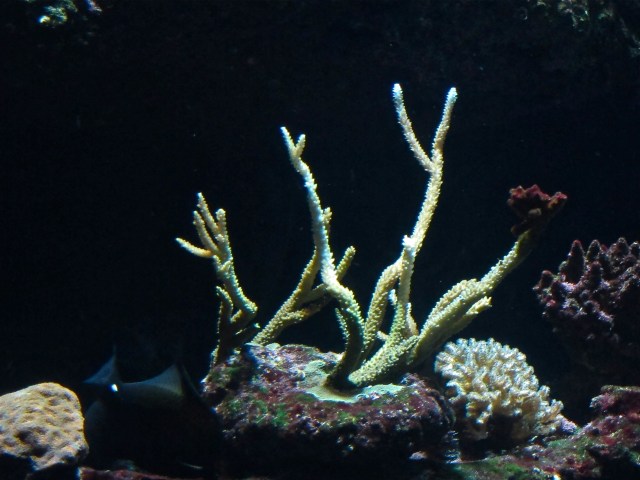
Phylum Cnidaria, Class Anthozoa, Order Scleractinia, Family Acroporidae,

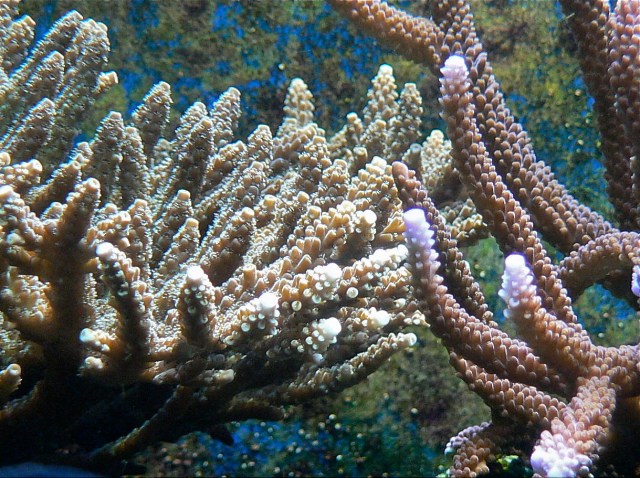
Acropora spp.

DISTRIBUTION:  Indo-Pacific, Caribbean.

HABITAT: Habitat: Shallow reef environments with bright light and relatively strong currents. Often dominate shallow parts of the reef, especially the surf zone

APPEARANCE: Growth forms extremely variable: slender branched fingers, broad antlers, table-like plates are common. Among the most colorful of reef-building corals; may be cream, yellow, blue, green, purple, pink, even fluorescent. Polyps small; set along the branches.  Characterized by light-colored polyps at the tips of branches where budding and growth take place, fueled by the energy produced by zooxanthellae in lower parts of the branch that give it color

DIET: Feed on microplankton, mostly at night; significant nutrition provided by photosynthetic zooxanthellae

REPRODUCTION/DEVELOPMENT: These fragile corals usually reproduce without sex (asexually). As pieces break off, they grow on their own as clones (fragmentation). But spring and summer bring an orgy of sex. Warming waters and a full moon can stimulate hundreds of corals to release clouds of eggs and sperm into the water at the same time. Most Acropora species are broadcasters, a few are brooders.

REMARKS: A major contributor to reef structures worldwide.

flickr http://www.flickr.com/photos/cas_docents/2999925430/in/set-72157608597451452/

WORDPRESSSHORTLINK http://wp.me/p1DZ4b-p9


LOCATION: Animal Attractions, Philippine Coral Reef, and other tropical reef exhibits.


Ref: California Academy of Sciences Animal Attraction Exhibit 2012


THE STEINHART AQUARIUMA VIEW FOR AND BY DOCENTS AND GUIDES  2009  California Academy of Sciences

2-17-12 Japanese Sea Nettle from Ron’s Animal Attraction Series (Exhibit)

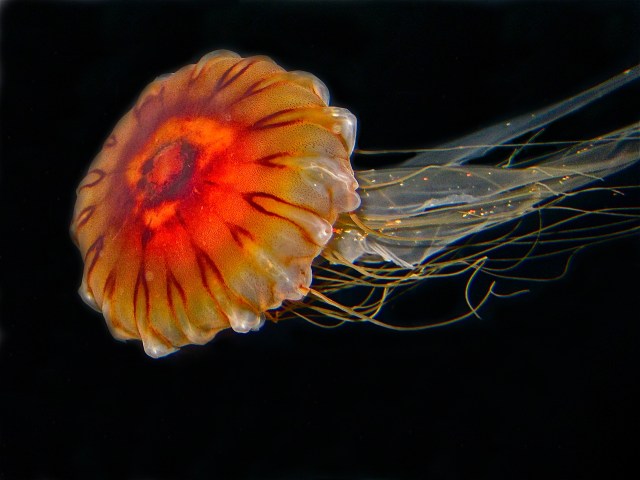
Phylum Cnidaria, Class Scyphozoa, Order Semaeostomea, Family Pelagiidae 

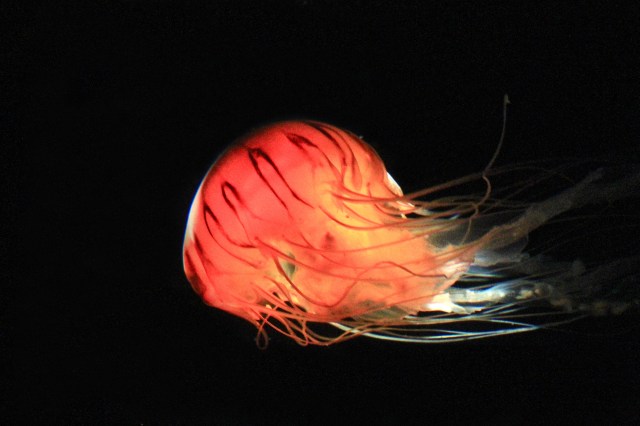
Chrysaora melanaster

DISTRIBUTION: Bering Sea, northern Atlantic, Pacific and Arctic oceans

HABITAT: Ocean surface to 200 meters below  the surface.

APPEARANCE: Their bells are 12 in across white with brown-to-orange stripes, containing up to 32 very long orange-red tentacles and four long lips. They have 16 brown stripes and eight stomach pouches.

DIET: Sea nettles snare prey (fishes, jellies, krill, other small invertebrates) with stinging tentacles that can stretch 6 m (20 ft).

REPRODUCTION: Alternation of life cycles—polyp, medusa.   The drifting jellies shown here represents just one phase of a sea nettle’s life. As adults pulsing through the water, these jellies reproduce sexually. But in another stage of life, on the seafloor, they reproduce without sex.

When spawning, adult sea nettles release clouds of sperm and tens of thousands of eggs a day. Their larvae sink and become polyps (like mini anemones) carpeting the seafloor. As they grow, each polyp buds off asexually producing scores of tiny identical jellies and will become sexual adults.

flickr   http://www.flickr.com/photos/cas_docents/6890184085/in/set-72157629304397467

WORDPRESS SHORTLINK http://wp.me/p1DZ4b-oN 


REF. 1. California academy of Sciences Animal Attractions Exhibit

         2. Shedd Aquarium Fact Sheet

Actinopterygii (ray-finned fishes),  Perciformes (Perch-likes), Cichlidae (Cichlids)

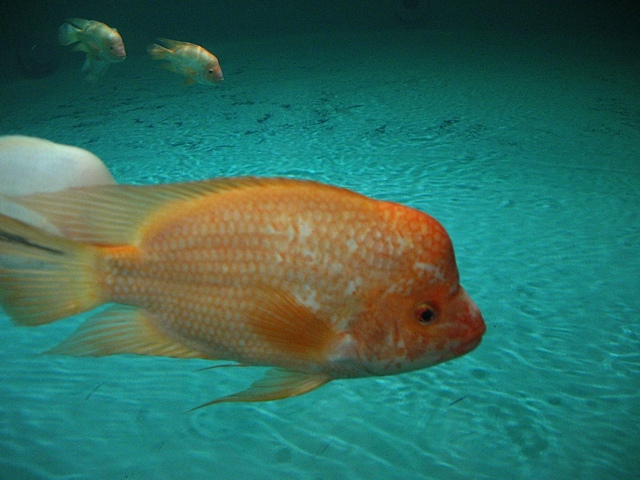
Amphilophus labiatus

FEMALE WITH BROOD BELOW

DISTRIBUTION: Atlantic slope of Mexico and Nicaragua; in Lakes Nicaragua and Managua.

HABITAT: Lakes; rarely enters streams or rivers.

APPEARANCE: The body of the Red Devil is robust and stocky. It has a great deal of variability in its structure and coloration. Some are bright red while others are white or yellow.  Males will develop an impressive nuchal hump as they grow. Length to 24 cm or approximately 10 in.

DIET: Small fishes, snails, insect larvae, worms and other bottom-dwelling organisms.

REPRODUCTION/DEVELOPMENT: Fertilization is external.  A. labiatus a substrate spawner prefers to spawn on flat surfaces.  Female lays 600–700 eggs and guards the clutch. The larvae hatch after about 3 days. After another 5-7 days they become free swimming.

MALE BELOW

flickr http://www.flickr.com/photos/cas_docents/6885205471/in/set-72157627952093337

WORDPRESS SHORTLINK http://wp.me/p1DZ4b-oC

Ref. Fishbase and Animal World

TAXONOMY

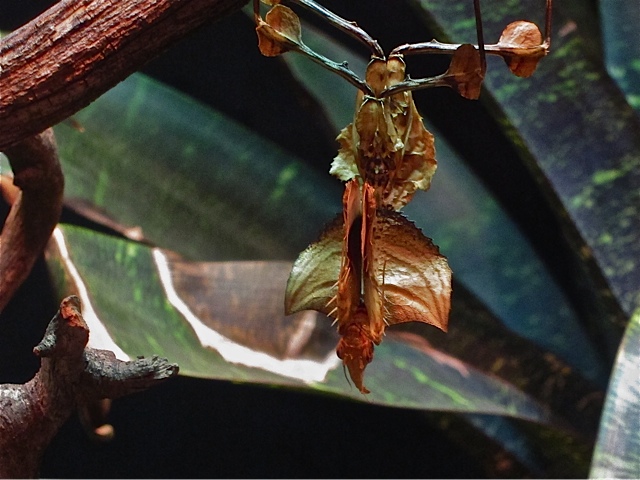
Phylum Arthropoda, Class Insecta, Order Mantodea, Family Empuisidea

Genus/species: Idolomantis diabolica

GENERAL CHARACTERISTICS: Its leafy color and leg flaps make this flower mimic a master of disguise.  Females, like this one, have straight antennae; males have feathery antennae.

DISTRIBUTION/HABITAT: Grasslands and savannas in Tanzania

DIET: flies, other flying insects

GENERAL CHARACTERISTICS: Its leafy color and leg flaps make this flower mimic a master of disguise.  Females, like this one, have straight antennae; males have feathery antennae.

Devil’s Flower Mantid IMG_6834

REPRODUCTION:  Like other mantids, this species is a voracious predator. It’s a cannibal as well. After mating, a female sometimes eats her partner.  If you’re afraid your mate might devour you after sex, you want to be careful. Male mantids seem to heed the dangers they face when mating. They seek to avoid detection by sneaking up on females from the rear or very, very slowly from the front.

REMARKS;  If threatened, this mantid rises up and spreads its arms to frighten predators.

Ref. California academy of Sciences, Animal Attractions 2012

flickr

WORDPRESS SHORTLINK  http://wp.me/p1DZ4b-om

TAXONOMY

KINGDOM Animalia
PHYLUM Chordata
CLASS  Actinopterygii (ray-finned fishes)
ORDER Gasterosteiformes (Sticklebacks and seamoths)
FAMILY Gasterosteidae (Sticklebacks and tubesnouts)
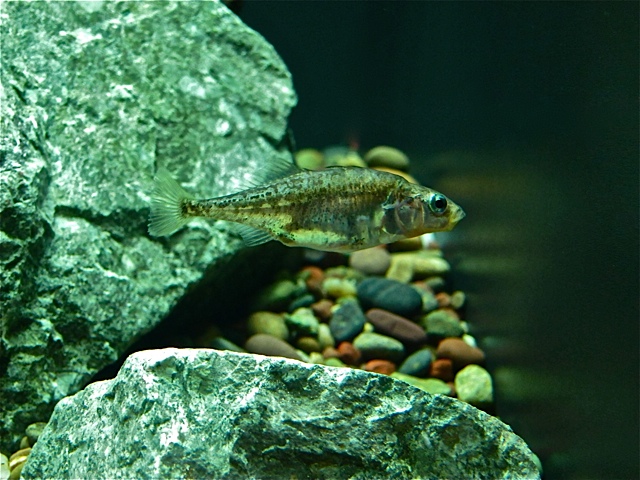
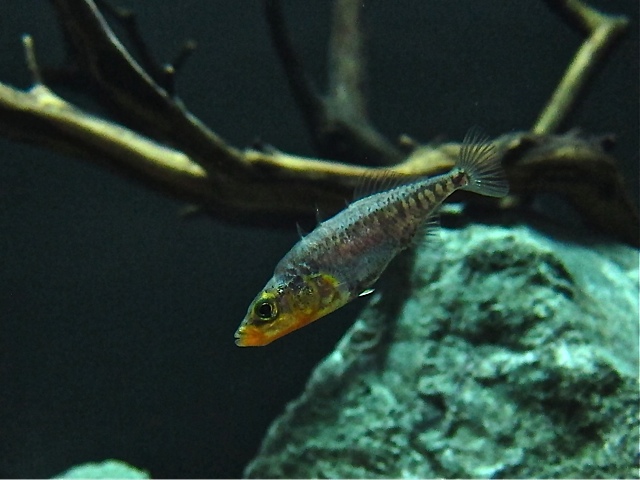
GENUS/SPECIES  Gasterosteus aculeatus


GENERAL CHARACTERISTICS

Common length : 5.1 cm or 2 in.  Identified by the 3 to 4 sharp, free spines before the dorsal fin, the pelvic fin reduced to a sharp spine and a small ray, the series of plates along the sides of the body and are usually mottled brown or greenish.


DISTRIBUTION/HABITAT 

 Coastal oceans in northern Europe, Asia and North America

 Freshwater streams, estuaries


DIET: worms, aquatic insects, fish eggs and fry


REPRODUCTION:  Red means ready.  At mating time, the chin and belly of male sticklebacks turn red. The brighter the red, the more enticing they are to the females they’re courting. Male sticklebacks weave rounded nests of algae, leaves and pebbles.   The neater the nest, the more likely a male is to woo a mate to lay her eggs inside. Once she does, he drives her out, guards and aerates the eggs until the hatch.

LOCATION

Salt Marsh Pop_up CC03
Animal Attractions


flickr http://www.flickr.com/photos/cas_docents/6870766417/in/set-72157629304397467

WORDPRESS SHORTLINK  http://wp.me/p1DZ4b-oa

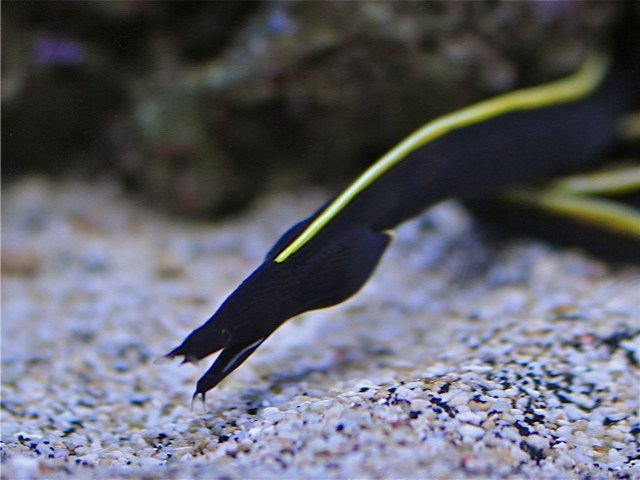
Actinopterygii (ray-finned fishes),  Anguilliformes (Eels and morays),  Muraenidae (Moray eels)

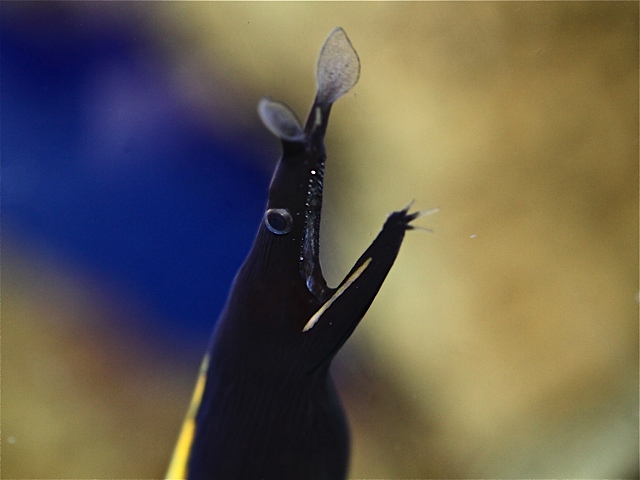
Rhinomuraena quaesita

DISTRIBUTION: Indo-Pacific from East Africa to the Tuamota Archipelago (French Polynesia).

HABITAT: Lagoons and associated reefs at depths up to 57 m.

APPEARANCE: Long thin body and high dorsal fins. Has three fleshy tentacles on the tip of its lower jaw, a single fleshy pointed projection at the tip of its snout, and tubular anterior nostrils ending in gaudy, fanlike expansions. Juveniles are black with a yellow dorsal fin, males are mostly blue, and females are mostly yellow. Length up to 130 cm (51 in).

DIET: Mostly small fishes, some invertebrates.

REPRODUCTION and DEVELOPMENT: External fertilization nonguarder.  R. quaesita is a protandrous hermaphrodite, i.e., functioning males reverse sex to become females.  It is the only moray that undergoes abrupt changes in coloration and sex.  Protandry is diagnosed based on coloration, but not confirmed.

MORTALITY/LONGEVITY May have lifespan up to 20 years.

REMARKS: The ribbon eel buries itself in sand or hides in rocks or reefs, sometimes with head protruding, lying in wait or emerging to hunt for small fish. Like all morays, it rests with mouth open, displaying sharp teeth that appear ready for use. Actually, ribbon eels are among the least aggressive of morays, the gaping mouth simply aiding breathing by allowing oxygenated water to enter and pass over the gills.

flickr  http://www.flickr.com/photos/cas_docents/4405139265/in/set-72157608402401040/

WORDPRESS SHORTLINK  http://wp.me/p1DZ4b-o0

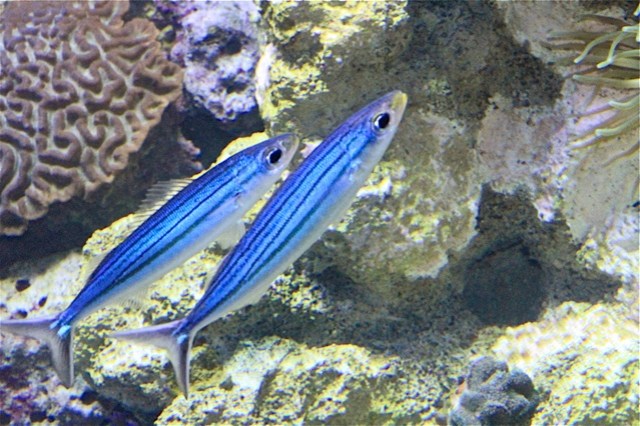
Actinopterygii (ray-finned fishes),  Perciformes (Perch-likes),  Haemulidae (Grunts)

Haemulon vittatum


DISTRIBUTION: Western Atlantic: southern Florida, USA and Bahamas to northern South America. Also Caribbean, including Antilles.

HABITAT: Marine; reef-associated; depth range 15 – 50 m

Haemulon vittatum

APPEARANCE: Average length 18.0 cm (7 in).

Spindle-shaped fish with a deeply forked tail and an extremely protrusible mouth. Dorsal fins close together. 

DIET: Zooplankton and small fishes.  REMARKS: Minor commercial fishery; bait: occasionally.

LOCATION: Caribbean Reef

Flickr http://www.flickr.com/photos/cas_docents/sets/72157625866509117/

WORDPRESS SHORTLINK  http://wp.me/p1DZ4b-ma