Latest Entries »

TAXONOMY
Kingdom: Animalia
Phylum: Chordata
Subphylum: Vertebrata (chordates with backbones)
Class: Reptilia (turtles, crocodilians, snakes, lizards and tuatara
Order: Squamata (scaled reptiles)
Suborder: Serpentes (snakes)
Family: Boidae (boas)

Genus/species: Corallus caninus

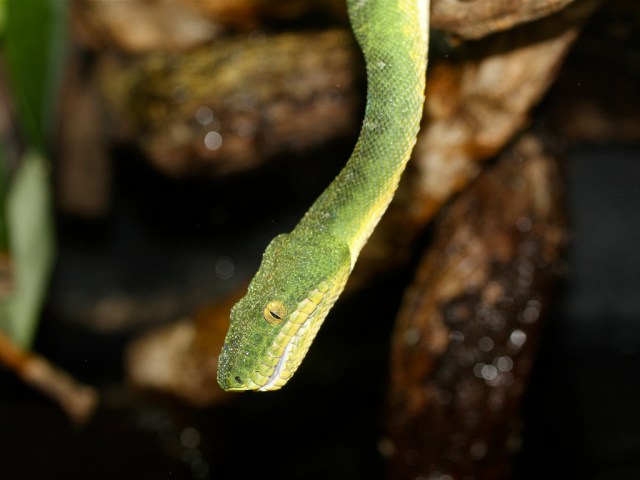
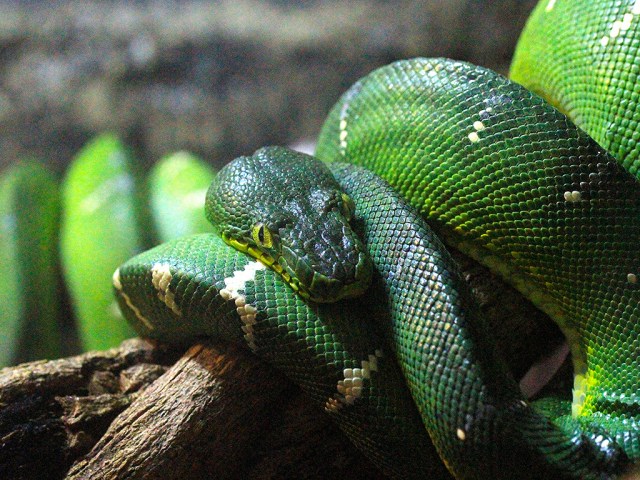
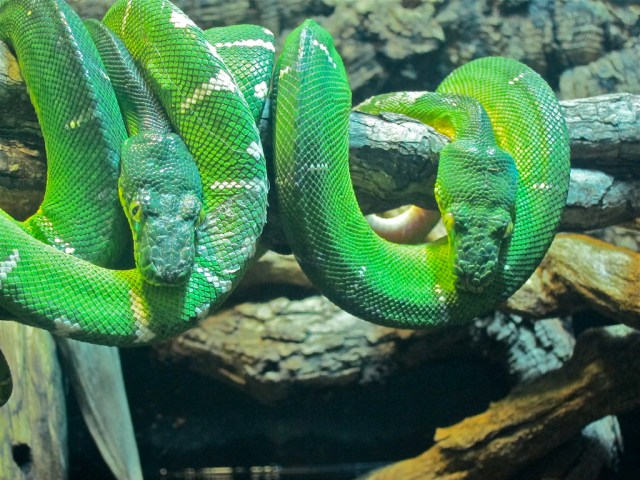
GENERAL CHARACTERISTICS: Adults are typically emerald-green, juveniles are yellow to orange to brown. This individual has striking white markings occurring along the dorsal midline, but some populations lack them. C. caninus has two tiny spurs on either side of its cloaca opening thought to be the evolutionary remnants of hind legs.

Length up to 2.2 m (7.2 feet).

2775389133_49be5f6ab9_o

DISTRIBUTION/HABITAT: C. caninus are found lowland tropical rainforests in the Amazonian and Guianan regions of South America.They are arboreal species that spend most of their time in the rainforest canopy foliage. 

They Use the “concertina” method of tree climbing. It holds on to the trunk with its tail and lower part of its body, reaches up with its head and hooks its neck around the trunk. Then it releases its hold with the tail and pulls the rear part of its body up to the level of the neck.

Corallus caninus5252794466_c85c5e40ef_b
DIET IN THE WILD: They perceive prey primarily through sight and infrared heat receptors located in the labial scales. Carnivore Nocturnal predators of rodents, lizards, marsupials and an occasional bird.
Nocturnally they remain coiled on its branch, but will extend its neck pointing beneath it, curled as if about to strike. It will then hold still in this position, waiting for prey to approach directly underneath it. Their highly developed front teeth that are proportionately larger than those of other non-venomous snakes.


Corallus caninus5099438187_af0d2a4e3b_b

REPRODUCTION; Viviparous with a gestation period of 6 to 7 months. They typically give birth 10 young at a time and by 4 months, they begin to develop their adult, green coloration.

LIFE EXPECTANCY: 15 years in captivity.

PREDATORS; Guianan crested eagles (Morphnus guianansis)

CONSERVATION: CITES; no special status.

Corallus caninus4770065279_923bce3efd_b

REMARKS: They are slow-moving but when collected in the wild have been described as making no effort to escape until seized, whereupon they strike viciously and apply constriction at full force.

References:

Animal diversity Web animaldiversity.org/accounts/Corallus_caninus/

Encyclopedia of life eol.org/pages/454883/details

Ron’s WordPress shortlink  http://wp.me/p1DZ4b-1×3

Ron’s flickr https://www.flickr.com/photos/cas_docents/18399138824/in/album-72157652559028013/

TAXONOMY
Kingdom: Animalia
Phylum: Chordata
Class: Mammalia
Order: Cetartiodactyla
Suborder: Odontoceti (toothed whales)
Family: Physeteridae
Genus/species: Physeter macrocephalus

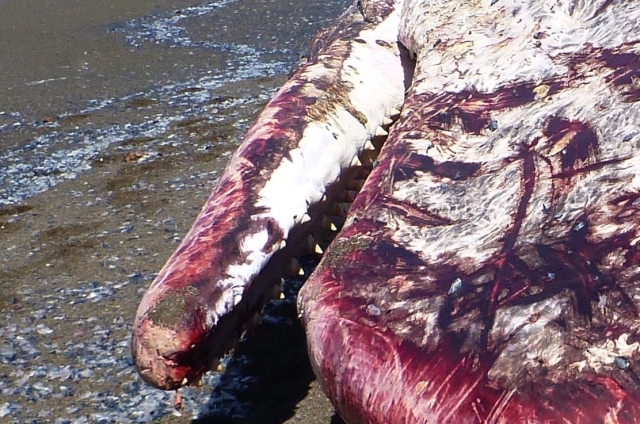
GENERAL CHARACTERISTICS: Have large square heads, comprising almost a third of the total body length with the largest and heaviest brain of any living animal. The head of a Sperm whales contains the spermaceti organ used in echo location. It is filled with a waxy liquid called spermaceti oil. Their single blowhole is located on the left of the head rather than on the top and they have a low, bushy spout, which is projected forward and slightly to the left. Their skin is wrinkled to increase surface area for heat loss, giving them a shriveled look. Color is dark brown to bluish-black and there usually is a large hump (no fin) on the back. There are 18-28 functional teeth on each side of the lower jaws, but the upper teeth are few, weak and nonfunctional. The lower teeth fit into sockets in the upper jaw. 

Male length to 17 m (60 ft) in length, making it the largest toothed whale. Weight up to 54,431 kg (60 tons).
Female length to 12 m (37 ft), Weight to 24,494 kg (27 tons).

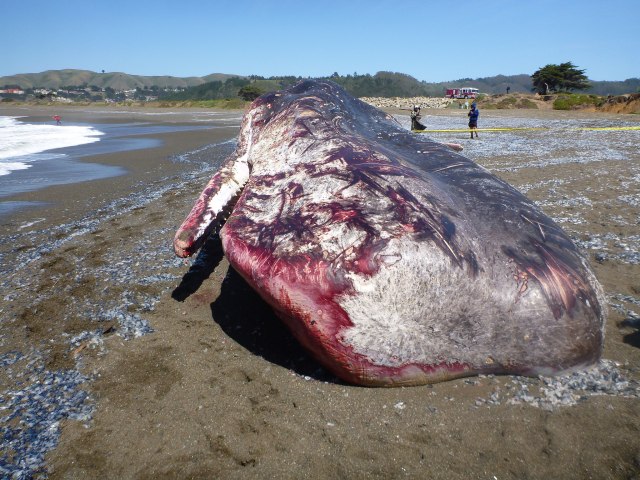
Photos below: Sperm whale, Initial Assessment, 2015, Pacifica       See Pacifica Sperm Whale 2015  californiadiver.com/second-dead-whale-washes-ashore-in-pa…

18639770676_ff60f26a21_k   Photo Credit Denise Greig18378411898_f5397c0b87_o   Photo Credit: Duncan Sinfield, Youtube screenshot

DISTRIBUTION/HABITAT: Found in all of the oceans of the world except the high Arctic. Primarily an inhabitant of the open ocean in offshore areas, the Sperm whale may also occasionally be seen closer to land, providing that the water is deeper than 200 m (650 ft). In California, sperm whales can be seen in waters off the continental slope from November to April.

18377274008_3490082081_k

Photo Credit Denise Greig

DIET: Powerful sound waves are emitted from the head which can stun and perhaps kill squid, octopuses and fish including sharks and rays. They eat about 907 kg (2,200 lbs/1 ton) per day.

Note:  Surprisingly teeth aren’t used mainly for eating. Male Sperm whales appear to use their teeth mostly for fighting other males. The whale sucks prey into its mouth and gullet which is large enough to swallow a man whole. Ref. Te Papa, New Zealand museum and The Encyclopedia of Life.

Version 2

Photo Credit Denise Greig

REPRODUCTION: Mating occurs in spring and summer.After a gestation period of about 16 months, a single calf weighing up to 500 kg (1100 lbs.) is born between July and November. The calf is suckled for up to two years.
Females protect their young by adopting a defensive ‘marguerite formation’ in which the calves are surrounded by a circle of females, facing tail outwards.
Adult males lead a solitary life except for the breeding season. Female and young male sperm whales are social and sometimes are seen in pods, or groups, of up to 50 whales.

PREDATORS: Killer whales

CONSERVATION: IUCN Red List Vulnerable VU   Large-scale hunting began in 1712 in the North Atlantic, based at Nantucket in America. These whales were not widely hunted for its meat, but for ambergris and spermaceti oil. Ambergris collects around the indigestible beaks of squid in the stomach of the whale, and was highly prized for use as a fixative in the perfume industry; spermaceti was used in the production of cosmetics and candles. Recent estimates suggest a global population of 300,000 animals, down from about 1,100,000 before whaling.

Although the International Whaling Commission brought an international moratorium on whaling into force in the 1980s Japan continues to kill whales and dolphins.

Threats: Japan continues to hunt Sperm whales every year at Lamalera, Indonesia using hand harpoons. Other threats include entanglement in fishing gear and collisions with boats.

REMARKS:
P. macrocephalus dives can last two hours and can be as deep as 3000m (9800 ft) making it the deepest diving mammal.

A white Sperm whale was featured in Herman Melville’s classic novel, Moby Dick.

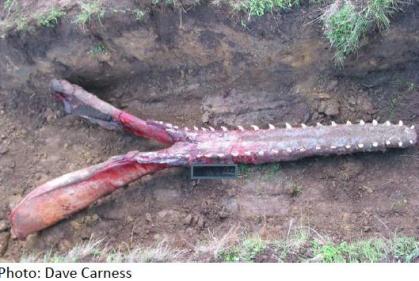
SPECIAL NOTE:  On April 15, 2015 biologists and researchers from the Marine Mammal Center and the California Academy of Sciences performed a necropsy on a beached sperm whale found below Mori Point in Pacifica. Because of its size the mandible is now on the Academy roof buried underneath some soil, which will allow the tissue remaining on the bone to decompose Exposure to the sun after removal from the dirt will naturally whiten the specimen which will become part of the Academy’s research collection.

Reference: Laura Wilkinson, California Academy of Sciences.

18478019998_9e6b459f22_o

The photo below is a mandible from beached Sperm whale jaw several years ago. It was buried then excavated for further processing and study by the California Academy of Sciences.

Sperm Whale Mandible18661069302_a1e3689d06_o

References

Te Papa, the New Zealand museum Whale to the exhibit at the California Academy of Sciences 2015

Laura Wilkinson, California Academy of Sciences.

ARKive www.arkive.org/sperm-whale/physeter-macrocephalus/

National Geographic www.flickr.com/photos/cas_docents/18639770676/in/album-72…

Marine Mammal Center  www.marinemammalcenter.org/education/marine-mammal-inform..

Monterey Bay Aquarium  www.montereybayaquarium.org/animal-guide/marine-mammals/s…

Encyclopedia of Life eol.org/pages/328547/details

Ron’s flickr https://www.flickr.com/photos/cas_docents/18639770676/in/album-72157652727235908/

Ron’s WordPress Shortlink wp.me/p1DZ4b-1wI


TAXONOMY
Kingdom: Animalia
Phylum: Chordata
Class: Mammalia
Order: Cetartiodactyla
Family: Eschrichtiidae

Genus/species: Eschrichtius robustus

GENERAL CHARACTERISTICS: This species is mottled dark to light grey and is encrusted with patches of barnacles and orange whale lice. Unlike Humpback whales, Grey whales lack a dorsal fin and instead has a series of bumps along a dorsal ridge on the final third of the back. Gray whales have small, paddle-shaped flippers, compared to the large white flippers of Humpback whales.
Length to 14 m (46 ft).
Weigh to 36,000 kg (79,300 pounds).

(see links below for live animal photos under references).

Grey Whale18204939731_f69eecb43a_k

DISTRIBUTION/HABITAT: Now found only in the North Pacific and adjacent waters. E. robustus are primarily bottom feeders and are thus restricted to shallow continental shelf waters for feeding.

DIET: The only cetacean to feed by straining the sediment on the sea floor. mainly for bottom-dwelling crustaceans but also worms and mollusks. Water, sand and mud are expelled through the baleen and food is then swallowed.
Sufficient fat reserves are stored in the feeding grounds to allow individuals to go without food during the breeding season; on return to the feeding grounds about a third of the body weight may have been lost.

REPRODUCTION: The breeding cycle last two years. Gestation takes about 13 months and the single calf is then suckled for a further seven months. The mother may have to hold the calf near the surface to help it to breathe during the first few hours after birth.

E. robustus makes the longest migration of any mammal known, each autumn and spring they pass between their Arctic summer feeding grounds and the mating and calving lagoons in Baja California.
Round-trip up to 20,400 kilometres (12,676 miles).

LONGEVITY: 25 to 80 years.

PREDATION: The only non-human predator of Gray whales is the Killer whale with up to 18% of all Gray whales showing evidence of an Orca attack.

CONSERVATION: IUCN RED LIST Least Concern (LC)
The Eastern North Pacific population has made a significant recovery since 1947 when whaling stopped for this species and now they number between 19,000 – 23,000, which may be close to their original population size.
Three gray whale breeding lagoons in Mexico enjoy some protection in the form of limitations on boating, fishing and coastal development.

Threats: Collisions with ships, entanglement in fishing nets and pollution. Habitat degradation resulting from drilling and dredging is also a problem.

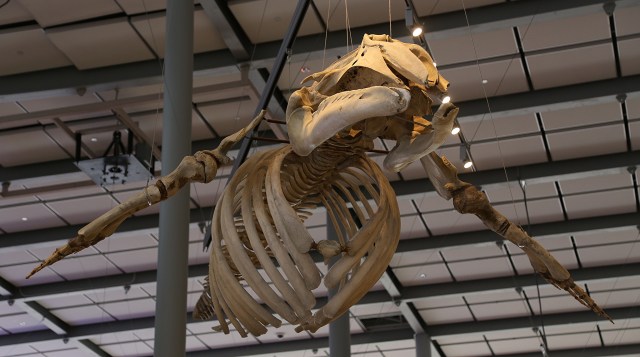
REMARKS: The California Academy’s Gray whale was a juvenile that beached in Baja California in 1966. It would have been about 35 feet long while alive. The two small, hanging, isolated bones towards the tail are remnants of pelvic bones, evidence that whales descended from four-legged land mammals that returned to the ocean about 53 million years ago.

References

California Academy of Sciences Docent program Whale  information March 2015

IUCN Red List www.iucnredlist.org/details/8097/0

ARKive  www.arkive.org/gray-whale/eschrichtius-robustus/

Ron’s flickr link www.flickr.com/photos/cas_docents/18204939731/in/album-72…

Shirihai, H & Jarrett (2006) Whales Dolphins and Other Marine Mammals of the World Princeton University Press.

Evans, P & Weinrich, M (2002) Whales Dolphins and Porpoises D K London New York Munich Melbourne and Delhi.

Reeves, R, R, et al (2002) Guide to Marine Mammals of the World  Chanticleer Press, Inc.

Ron’s WordPress Shortlink https://fishoncomputer.wordpress.com/wp-admin/post.php?post=5851&action=edit

TAXONOMY
Kingdom: Animalia
Phylum: Chordata
Class: Mammalia
Order: Cetacea
Family: Balaenopteridae

Genus/species: Balaenoptera musculus

GENERAL CHARACTERISTICS: The Blue whale is the largest animal to have ever lived, (almost as big as a Boeing 737. They are actually grayish-blue, with a mottled effect that is visible in some lights and can allow individuals to be identified. 50 people could stand on the tongue, which alone weighs as much as an elephant. The heart of the blue whale is the size of a small car (Volkswagen Beetle).
Blubber can be up to 51 cm (20 inches) thick. The spout of a blue whale can be 9 m (30 ft) high.
Weigh to 203,210 kg or 200 tons (448,000 pounds), as much
as 40 elephants.
Length to nearly 110 feet (33 m (110 ft)

Blue Whale18204939131_ab0b4836d7_k

DISTRIBUTION/HABITAT: B. musculus inhabit the open ocean, where they ares found in every ocean except the Arctic, with a range that extends from the periphery of drift-ice in polar seas to the tropics, although it is absent from some seas such as the Mediterranean, Okhotsk and Bering Sea.

They inhabit the open ocean, where it is found most frequently along the continental shelf edge and near polar ice. It feeds at both the surface and to depths of at least 100 m (300 feet).

DIET: Feeds mainly on shrimp-like krill, which are filtered through the baleen plates. Large volumes of water and food can be taken into the mouth because the pleated grooves in the throat expand. As the mouth closes, water is expelled through the baleen plates, which trap the food on the inside to be swallowed. During the summer months, one blue whale can eat more than 4,082 kg (9,000 lbs) of krill every day (up to 40 million krill a day).

REPRODUCTION: Reaches sexual maturity at 7 to 10 years of age, A calf is produced after 10 to 11 months of gestation which is 7 m (23 ft) long and weighs about 27,215 kg (30 tons or 60,000 pounds) and consumes around 190 liters (50 gallons) of the mother’s fat rich-milk resulting in a daily weight gain of about 90 kg (200 pounds).
Weaning occurs at the summer feeding grounds at about seven months old.

B. musculus produces louder calls than any other animal on earth. It appears to have functions in sensing the environment, prey detection and communication with male display.

CONSERVATION: IUCN Red List Endangered (EN).
No Blue whales have been deliberately caught since 1978. Today, there are an estimated 10,000 to 25,000 Blue whales surviving worldwide, which represents around 2 to 11 percent of the total pre-commercial exploitation population.

California Blue whale numbers are rising, and are possibly close to carrying capacity, according to a new study in Marine Mammal Science. The B. musculus whale population is estimated at about 2,200, or 97 percent of the estimated historical level. t’s a conservation success story. (Approximately 3,400 California Blue whales were caught between 1905 and 1971.)

Primary threats
1. vessel strikes
2. fisheries interactions

Additional threats
1. anthropogenic noise
2. habitat degradation
3. pollution
4. vessel disturbance
5. long-term changes in climate

REMARKS: They can dive 150 m (500 ft) below the surface and remain underwater for 30 minutes.

The Blue whale produces louder calls than any other animal on earth. It appears to have functions in sensing the environment, prey detection and communication with male display.

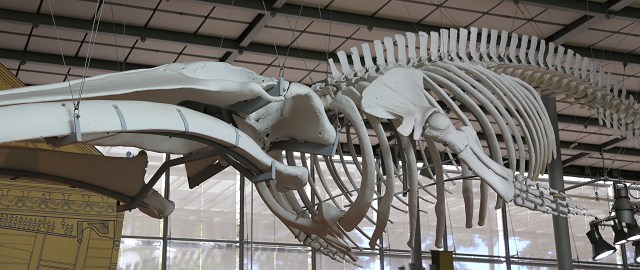
The California Academy’s Blue whale is an 26.5 m (87-ft) long male that weighed about 80 tons with a 6 m (20-ft) long skull. It was captured for its oil off the coast of Vancouver Island in 1908. It gave 60 barrels of oil and 181 kg (400 lbs) of baleen, the latter used for corsets, buggy whips, and other light-weight yet durable products. The Academy acquired the bones in 1915, and they were buried in the Shakespeare Garden in Golden Gate Park until they were ready for mounting, which was completed in 1917 in an open shed.

References

West Coast Blue Whales journals.plos.org/plosone/article?id=10.1371/journal.pone…

California Academy of Sciences www.calacademy.org/explore-science/blue-whale-survival

California Academy of Sciences  www.calacademy.org/explore-science/blue-whale-population-…

IUCN Red List (March, 2011)  www.iucnredlist.org

NOAA Fisheries Office of Protected Resources – Blue whale www.fisheries.noaa.gov/pr/species/mammals/whales/blue-wha…

ARKive www.arkive.org/blue-whale/balaenoptera-musculus/

Shirihai, H & Jarrett (2006) Whales Dolphins and Other Marine Mammals of the World Princeton University Press.

Evans, P & Weinrich, M (2002) Whales Dolphins and Porpoises D K London New York Munich Melbourne and Delhi.

Reeves, R, R, et al (2002) Guide to Marine Mammals of the World   Chanticleer Press, Inc.

Ron’s WordPress Shortlink https://fishoncomputer.wordpress.com/wp-admin/post.php?post=5843&action=edit


TAXONOMY
Kingdom: Animalia
Phylum: Chordata
Class: Mammalia
Order: Cetacea
Family: Delphinidae (Killer whales are the largest of the dolphin family)

Genus/species: Oricnus orca

GENERAL CHARACTERISTICS: Black on top with white undersides and white patches near their eyes; highly variable gray or white saddle behind the dorsal fins. They have the second heaviest brain among marine mammals (only the sperm whale which has the heaviest brain of any animal is heavier.

For photos in the wild see reference links below.
18016037680_d13b8f30a2_o

Males: Up to 10 m (32 ft) in length and can weigh up to 10,000 kg (22,000 pounds).
Females; Up to 8.5 m (28 ft) in length and can weigh up to 7,500 kg (16,500 pounds).
18177805802_d8bd1e3610_k

DISTRIBUTION/HABITAT: The most widely distributed marine mammals. Ten ectotypes are found in all parts of the oceans; most abundant in colder waters, including Antarctica, the North Atlantic and Pacific Oceans.

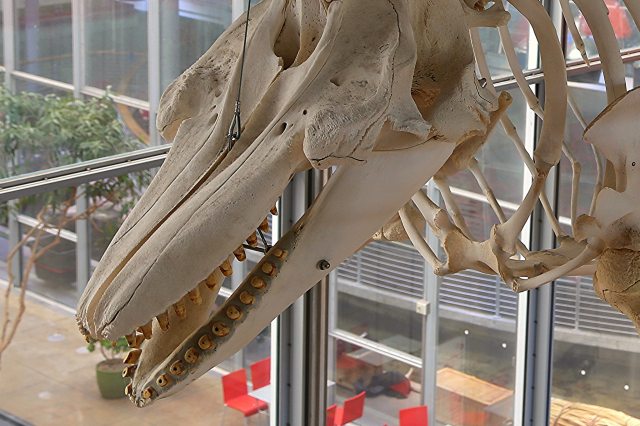
DIET: They swim in groups, like wolf packs and may reach speed bursts of 55 Kilometers (34 miles) per hour while hunting fish, marine mammals and sharks. Off Shore Orcas’ teeth are worn down from eating small sharks (generally dogfish), which have rough skin. See the teeth offshore Orca 0139 above. Orca depend heavily on underwater sound for orientation, feeding, and communication.
Some Orcas work together to ‘herd’ fish, before stunning the prey with strikes from the tail flukes, or join together in coordinated attacks on large whales.
18182342801_0f152dce77_k

REPRODUCTION: O. orca reach sexual maturity when they grow to about 4.6 m-5.4 m (15-18 ft) long, There is no distinct calving season. Newborns are up to 2.4 m (8 ft) long and weighing about 180 kg (400 pounds).
They are nursed for at least a year, and may be weaned between 1-2 years old. It is thought that females give birth about every 5 years for an average period of 25 years.

PREDATORS: None.  Killer whales are marine apex predators.

LONGEVITY: 60-80 years.

CONSERVATION: IUCN Redlist: data deficient (DD).
All marine mammals, including Killer whales, are protected in the United States. Global population at a minimum of about 50,000 animals.

Threats: Orca are also sometimes seen as competitors by fishermen and are often shot as a result. In addition, the orca may occasionally be caught accidentally in trawl and driftnet fisheries and overfishing can reduce its food supply.
Toxin accumulations that settle in their fatty tissue, such as PCBs, PBDEs and brominated fire retardants, are other hazards.

REMARKS: Highly social matriarchal societies; relying on underwater sound for orientation, feeding, and communication. They have relatively stable social groups that often range in size from 2 to 15 animals. Groups as large as several hundred individuals are rare.

Three types of Killer whales differ in morphology, ecology, behavior, and genetics. Resident, Transient, and Offshore.

Resident Orca remain in one general area, in small family groups, and prefer salmon as their main prey item. In the U.S. North Pacific.

Transient Orca are found throughout the eastern North Pacific, and have primarily been studied in coastal waters. Their geographic range overlaps that of the resident and offshore Killer whales. They often eat marine mammals, and migrating gray whale calves.

Offshores Orca have the largest geographic range of any Killer whale community in the northeastern Pacific and often occur 15 km (9 miles) or more offshore. They also are found in coastal waters and occasionally enter protected inshore waters congregating in groups of 20-75 animals with occasional sightings of larger groups up to 200 animals.

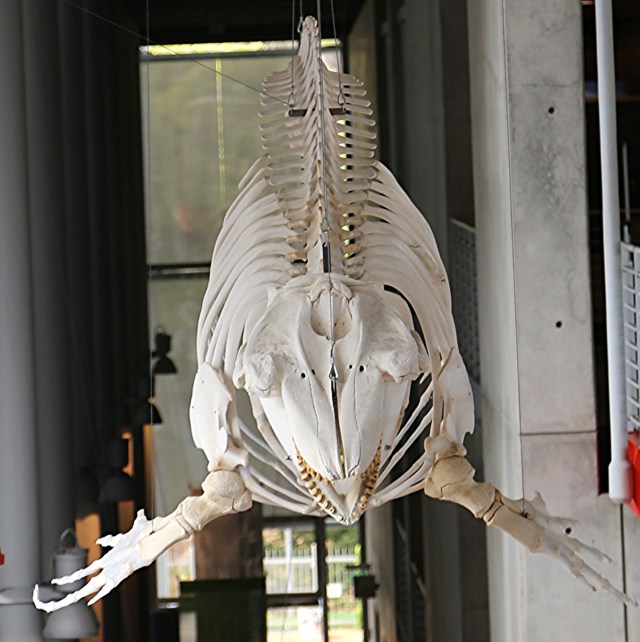
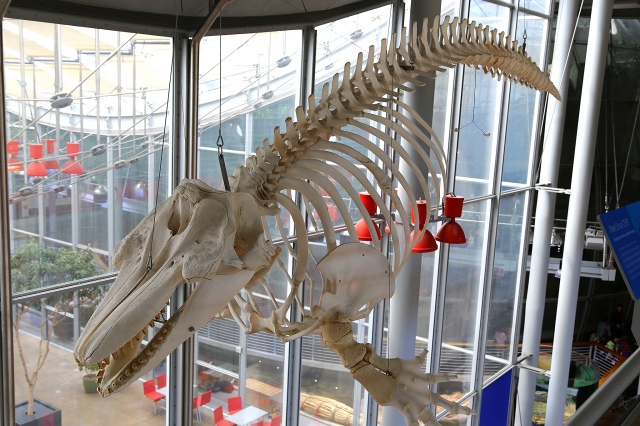
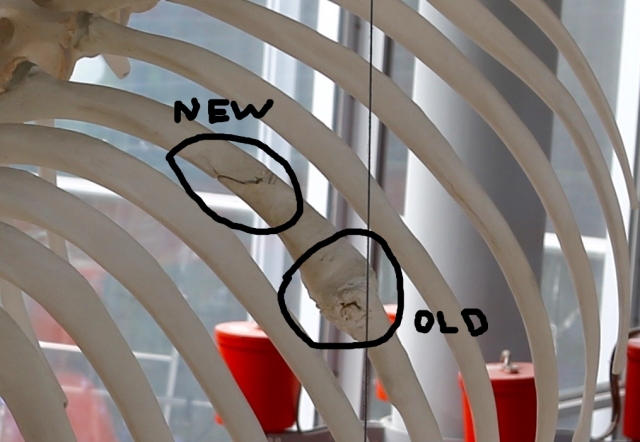
SPECIAL NOTE: This Offshore Orca was known to scientists before it died. It was last seen near Vancouver Island in Sept. 2011. This 5.5 m (18 ft) Killer Whale was discovered washed up on a beach Point Reyes, California Nov., 2011. Orca 0139 was collected and examined and was noted to have a broken rib which was the likely cause of death.  The ID was was confirmed by photos of his dorsal fin and saddle patch. It has been on display at the California Academy of Sciences since 2013. Alive, he weighed between 1360 kg – 1,800 kg (3000 and 4000 pounds), and was about 5.4 m (18 ft) long. His head alone weighed 91 kg (200 pounds).

Off Shore Orca 0139 has been on display at the California Academy of Sciences since 2013.
Version 2

References

California Academy of Sciences Docent program Whale information information March 2015

Ron’s flickr https://www.flickr.com/photos/cas_docents/18016037680/in/album-72157652727235908/

Ron’s WordPress Shortlink  https://fishoncomputer.wordpress.com/wp-admin/post.php?post=5834&action=edit&postpost=v2

 ARKive  www.arkive.org/orca/orcinus-orca/

 IUCN Red list:  www.iucnredlist.org/details/15421/0

 National Oceanic and Atmospheric Administration www.nmfs.noaa.gov/pr/species/mammals/whales/killer-whale….

 Shirihai, H & Jarrett (2006) Whales Dolphins and Other Marine Mammals of the World Princeton University Press.

 Evans, P & Weinrich, M (2002) Whales Dolphins and Porpoises D K London New York Munich Melbourne and Delhi.

 Reeves, R, R, et al (2002) Guide to Marine Mammals of the World Chanticleer Press, Inc.


TAXONOMY
Kingdom: Animalia
Phylum: Chordata
Class: Mammalia
Subclass: Eutheria
Order: Cetartiodactyla (whales and even-toed ungulates)
Family: Balaenopteridae

Genus/species: Megaptera novaeangliae

Humpback whale

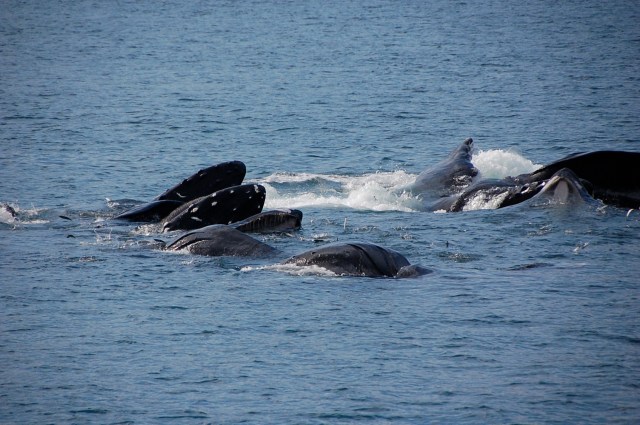
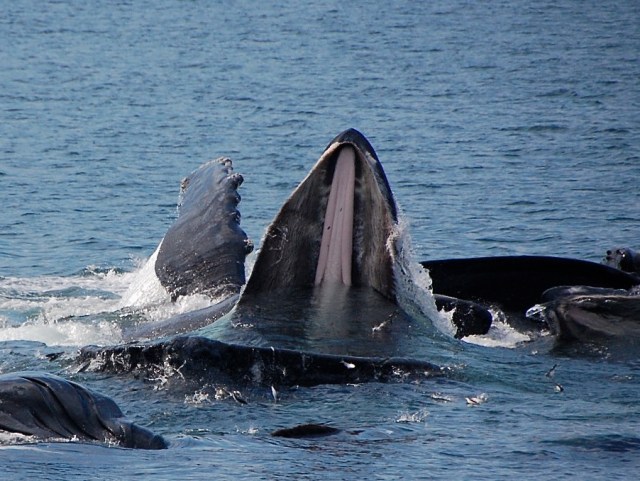
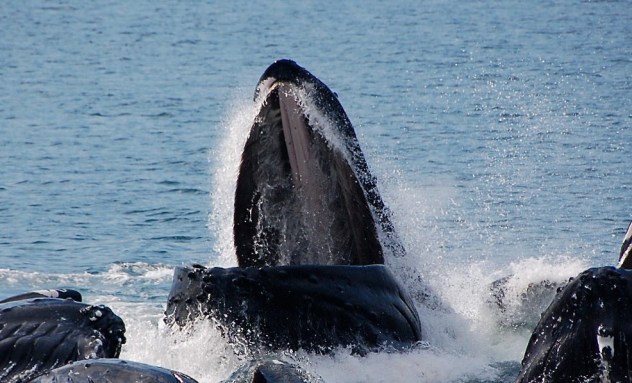
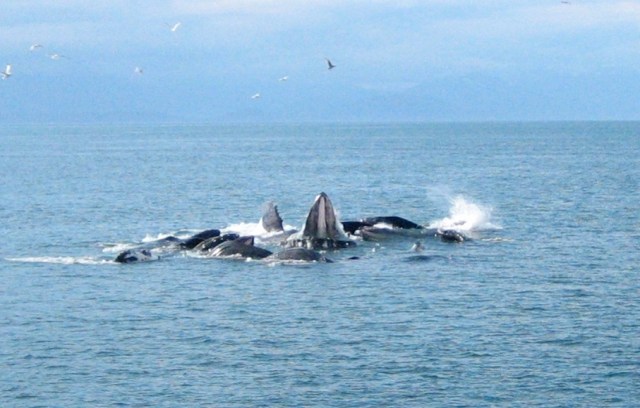
 A group of Humpback whales will locate a large group of small fishes and then blow bubbles from their blowholes as they circle toward the surface. The ring of bubbles forms a “bubble-net” which the fishes and or krill perceive as solid.  The fishes are compressed and the multiple whales then rise in unison to the surface inside the “bubble net” with their mouths open and their pleats expanded for a maxium catch of herring, caplin or sandlance.

All together now coming up

DSC_0332

Big gulp

DSC_0333_2

The water is expelled through their comb-like baleen (made of keratin) while their tongue sweeps the fishes down their throat.

17846092055_cdfe22e838_b


17660114570_c04b2af9ec_o

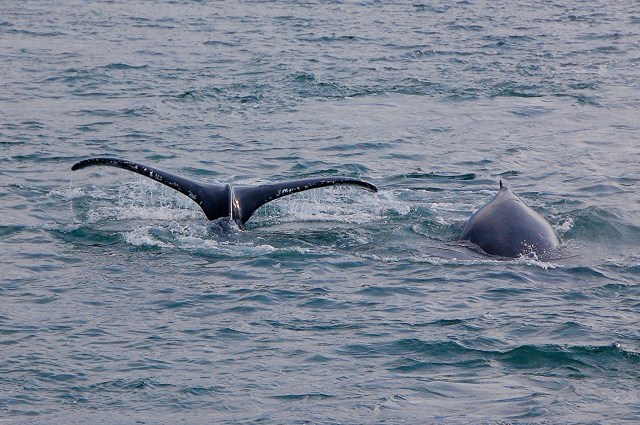
Waving good-bye with their flukes elevated and preparing a new bubble-net.

17661380019_4f748b80f4_b

Note: Flippering:  When a Humpback raises one or both flippers out of the water and slaps them against the water (see above).

Kickfeeding: The Humpback raises and slams his rear flukes against the water surface to stun fishes and then dives and surfaces to engulf the stunned fishes.

REMARKS Individual Humpbacks may lunge into schools of fishes or krill under water.

References

WordPress link:    https://fishoncomputer.wordpress.com/wp-admin/post.php?post=5820&action=edit

Ron’s flickr www.flickr.com/photos/cas_docents/17227254903/in/album-72…

Oxford Journals Integrative & Comparative Biology icb.oxfordjournals.org/content/51/1/203.full

IUCN red list 2008  www.iucnredlist.org/details/13006/0

IUCN Red List (July, 2009) www.iucnredlist.org

Monterey bay aquarium  www.montereybayaquarium.org/animal-guide/marine-mammals/h…

National Geographic animals.nationalgeographic.com/animals/mammals/humpback-w…

ARKive  www.arkive.org/humpback-whale/megaptera-novaeangliae/vide…

Shirihai, H & Jarrett (2006) Whales Dolphins and Other Marine Mammals of the World Princeton University Press.

Evans, P & Weinrich, M (2002) Whales Dolphins and Porpoises D K London New York Munich Melbourne and Delhi.

Reeves, R, R, et al (2002) Guide to Marine Mammals of the World   Chanticleer Press, Inc.

Buffington K, et al (1992) Whales Scholastic Professional Books


TAXONOMY
Kingdom: Animalia
Phylum: Chordata
Class: Mammalia
Subclass: Eutheria
Order: Cetartiodactyla (whales and even-toed ungulates)
Family: Balaenopteridae

Genus/species: Megaptera novaeangliae

GENERAL CHARACTERISTICS: Named for its stocky body with a distinctive hump formed by its black back when about to take a long dive. On the underside of the mouth are 12 to 36 throat pleats or grooves, which can expand when filtering water during feeding. Baleen is mostly black. Humpback whale 

M. novaeangliae  have knobbly heads, covered in many raised lumps (‘tubercles’) and barnacles. There are two blowholes. Unusually long pectoral fins with a characteristic serrated leading edge are adapted for high maneuverability associated with the whale’s unique feeding behavior. Fin color varies from all black to white. The expiration blow is bushy and highly visible 2.5-3 m ( 2.5-9.8 ft). Body length to 19 m (62 feet), weight to 48,100 kg (53 tons).

humpback whales17819773296_37dcacd696_o

about to dive

17227254903_ba7267992a_b

DISTRIBUTION/HABITAT: All Oceans in open waters.
The wintering grounds of these are:
A (Southwest Atlantic): coast of Brazil
B (Southeast Atlantic): the coast of West Africa from the Gulf of Guinea down to South Africa
C (southwestern Indian Ocean): coasts of eastern South Africa, Mozambique, Madagascar (southern, western and eastern coasts), Mayotte, the Comoros and other western Indian Ocean island groups;
D (southeastern Indian Ocean): northwestern Australia
E (southwest Pacific) northeastern Australia, New Caledonia, Tonga and Fiji.
F (central South Pacific): Cook Islands and French Polynesia
G (southeast Pacific): Ecuador, Galápagos, Colombia, Panama and Costa Rica.www.iucnredlist.org/details/13006/0

early dive

17843769572_0be6ff37c5_k

DIET: Feed only in summer, in polar waters on plankton, krill and small fishes. A group of Humpback whales will locate a large group of small fishes and then blow bubbles from their blowholes as they circle toward the surface. The ring of bubbles forms a “bubble-net” which the fishes and or krill perceive as solid. The fishes are compressed and the multiple whales then rise in unison to the surface inside the “bubble net” with their mouths open and their pleats expanded for a maxium catch of herring, caplin or sandlance. The water is expelled through their comb-like baleen (made of keratin) while their tongue sweeps the fishes down their throat. 

diving

DSC_0381_2 (1)

REPRODUCTION: Sales sing complex songs, with each group having its own dialect lasting hours, and can be heard for over 18 miles (30 km). Females nurse their calves for almost a year. Calves do not stop growing until they are ten years old. Annual tropical to cool water migration 2,300-3,600 km (1,400-2,200 miles)

net scars

17661379439_ceb41a7f1d_o

CONSERVATION: IUCN Redlist 2008 Least Concern (LC)
History:
1996–Vulnerable
1994–Vulnerable (Groombridge 1994)
1990–Vulnerable (IUCN 1990)
1988–Endangered (IUCN Conservation Monitoring Centre 1988)
1986–Endangered (IUCN Conservation Monitoring Centre 1986)
www.iucnredlist.org/details/13006/0

The Arabian Sea subpopulation and the Oceania subpopulation are classified as Endangered (EN) on the IUCN Red List (July, 2009) www.iucnredlist.org

REMARKS: Individual may be identified by the distinctive markings on their flukes, or tails.

References

Ron’s flickr https://www.flickr.com/photos/cas_docents/17227254903/in/album-72157652727235908/

Ron’s WordPress  https://fishoncomputer.wordpress.com/wp-admin/post.php?post=5808&action=edit&postpost=v2

Oxford Journals Integrative & Comparative Biology icb.oxfordjournals.org/content/51/1/203.full

IUCN Red List 2008 www.iucnredlist.org/details/13006/0

IUCN Red List (July, 2009) www.iucnredlist.org

Monterey bay aquarium  www.montereybayaquarium.org/animal-guide/marine-mammals/h…

National Geographic animals.nationalgeographic.com/animals/mammals/humpback-w…

ARKive   www.arkive.org/humpback-whale/megaptera-novaeangliae/vide…

Shirihai, H & Jarrett (2006) Whales Dolphins and Other Marine Mammals of the World,  Princeton University Press.

Evans, P & Weinrich, M (2002) Whales Dolphins and Porpoises,  D K London New York Munich Melbourne and Delhi.

Reeves, R, R, et al (2002) Guide to Marine Mammals of the World
Chanticleer Press, Inc.
Buffington K, et al (1992) Whales,  Scholastic Professional Books

TAXONOMY
Kingdom: Animalia
Phylum: Chordata
Class: Aves (Feathered, winged, bipedal, endothermic (warm-blooded), egg-laying, vertebrates)
Order: Passeriformes (passerines or perching birds) Toes; three pointing forward and one back.
Family: Thraupidae (Tanagers).

Genus/species: Tangara gyrola

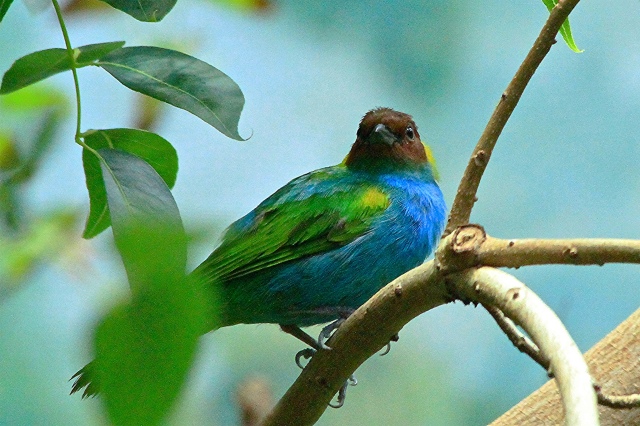
GENERAL CHARACTERISTICS: Highly variable geographically, with no fewer than nine recognized subspecies, making it one of the most phenotypically diverse of all Tanagra tanagers Adult Bay-headed Tanagers are 14 cm (5.5 inches) long and weigh 19.5 g (0.7 oz). The nominate race T. gyrola is mainly green apart from a chestnut head, a blue belly, and a thin gold collar on the hind neck. Sexes are similar, but immatures are duller with chestnut-flecked green heads. Length to 14 cm (5.5 inches) and weight 19.5 g (0.7 oz).

 Tangara gyrola16290751194_a008ec4f69_k

DISTRIBUTION/ HABITAT: Costa Rica, Panama, and in much of northern South America. Commonly occurs found in the canopy of humid forest. They also inhabit nearby clearings with scattered trees, semi-open areas, and tall second-growth forests. 

 SONG and MAP: xeno-canto  www.xeno-canto.org/species/Tangara-gyrola

 Tangara gyrola7028725217_a83409bbfc_k

DIET IN THE WILD: Eats mainly fruit, usually swallowed whole. Insects are also taken, mainly from the underside of branches.

REPRODUCTION/DEVELOPMENT: A bulky cup nest is built-in a tree and the normal clutch is two brown-blotched white eggs. The female incubates the eggs for 13–14 days to hatching, with another 15–16 days before the chicks fledge.

CONSERVATION: IUCN RedList Least Concern (LC)  Has an extremely large range. Despite the fact that the population trend appears to be decreasing, the decline is not believed to be sufficiently rapid to approach the thresholds for Vulnerable.

References

Cornell Lab of Ornithology neotropical.birds.cornell.edu/portal/species/overview?p_p…

IUCN Red List: Least Concern (LC) www.iucnredlist.org/details/22722878/0

Ron’s flickr https://www.flickr.com/photos/cas_docents/16290751194/in/photostream/

Ron’s WordPress Shortlink: wp.me/p1DZ4b-14T


TAXONOMY
Kingdom: Animalia
Phylum: Chordata
Class: Aves (Feathered, winged, bipedal, endothermic (warm-blooded), egg-laying, vertebrates)
Order: Passeriformes (passerines or perching birds) Toes; three pointing forward and one back.
Family: Thraupidae (Tanagers).

Genus/species: Sicalis flaveola


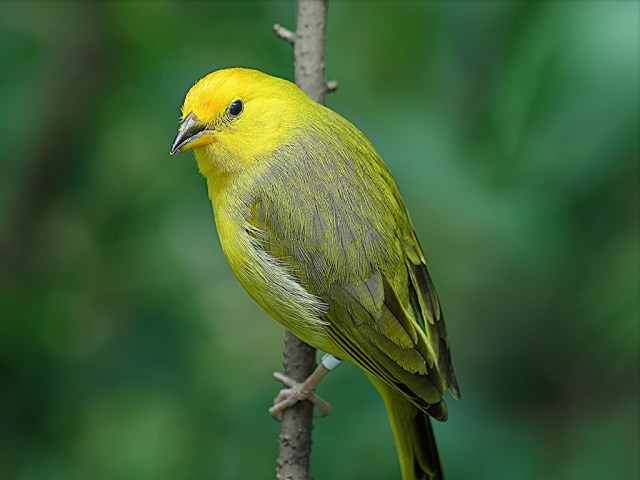
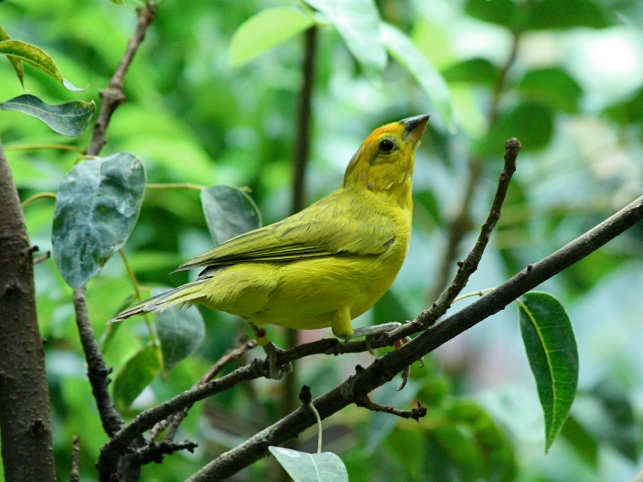
Saffron Finch3258198159_2655e576c6_b

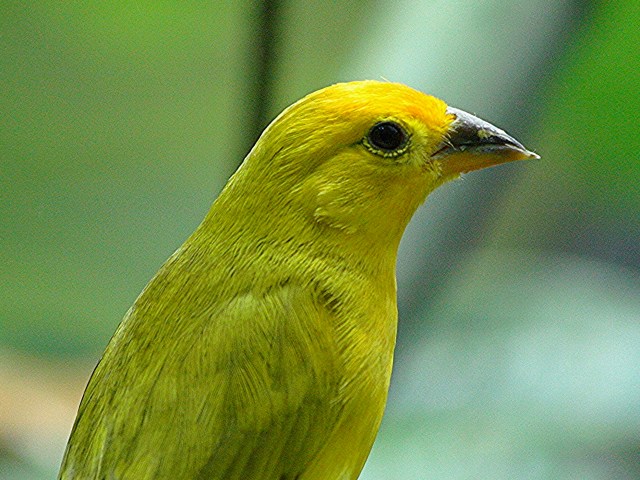
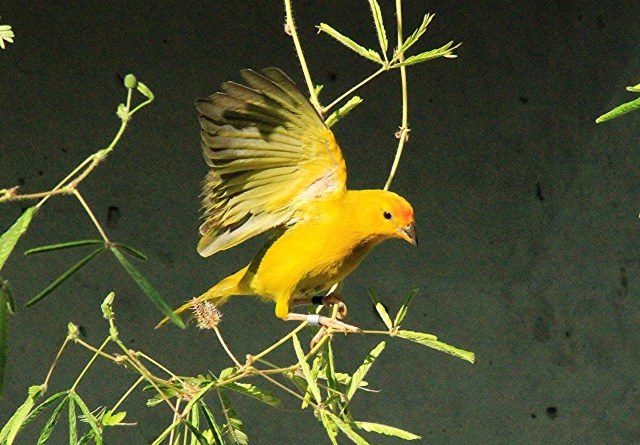
GENERAL CHARACTERISTICS: Forehead and crown bright orange. Yellow head, greenish-yellow mantle and back, bright yellow underparts. Female duller above and lighter below. Black maxilla (upper beak), pale mandible (lower beak),
The legs are dark pink.

DISTRIBUTION/HABITAT: Common in the South American tropics of Colombia, Venezuela, Ecuador, Peru, Brazil, and Argentina. Found in open and semi-open forests and fields from lowland areas to 1850 m (6000 feet). Prefer drier areas; generally reside outside the Amazon basin.

Safron Finch3186810022_9c2c4db872_o

DIET IN THE WILD: Forage in pairs or larger groups for seeds,
insects, and plant matter.

Saffron Finch16244705093_b0b0ee432d_o

REPRODUCTION: Nest in tree hollows, though use nesting boxes in captivity. Female lays 3–4 white eggs; incubation, 12–14 days. Female incubates the eggs, male guards the nest. After eggs hatch, both parents feed the young, and fledging takes place in about 2 weeks.

3142852303_271e65b9b7_o

REMARKS: Saffron finches are a favorite caged bird because of their handsome colors and pleasant song. Technically classified not a finch but as a tanager.

References

IUCN Red List www.iucnredlist.org/details/22723346/0

Finch Information Center www.finchinfo.com/birds/finches/species/saffron_finch.php

Ron’s flickr   http://www.flickr.com/photos/cas_docents/sets/72157608454346681/

Ron’s WordPress Shortlink  http://wp.me/p1DZ4b-f9


TAXONOMY
Kingdom: Animalia
Phylum: Chordata
Class: Aves (Feathered, winged, bipedal, endothermic (warm-blooded), egg-laying, vertebrates)
Order: Passeriformes (passerines or perching birds) Toes; three pointing forward and one back.
Family: Thraupidae (Tanagers)

Genus/species: Cyanerpes cyaneus

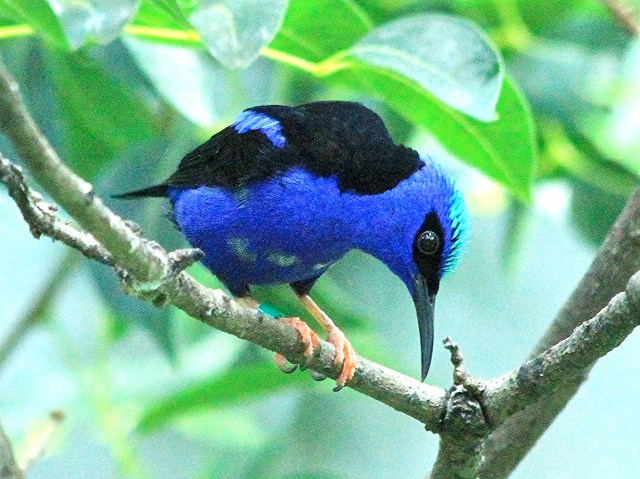
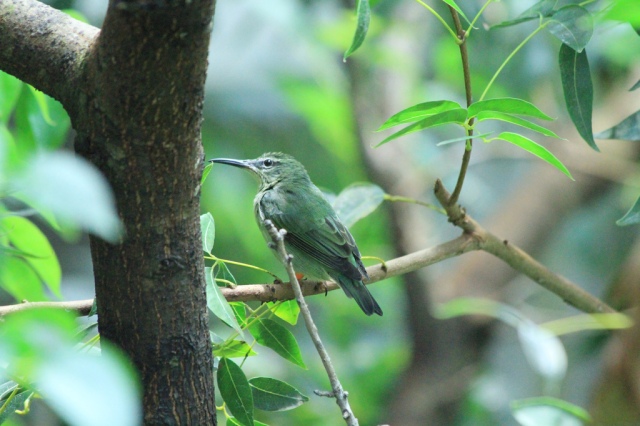
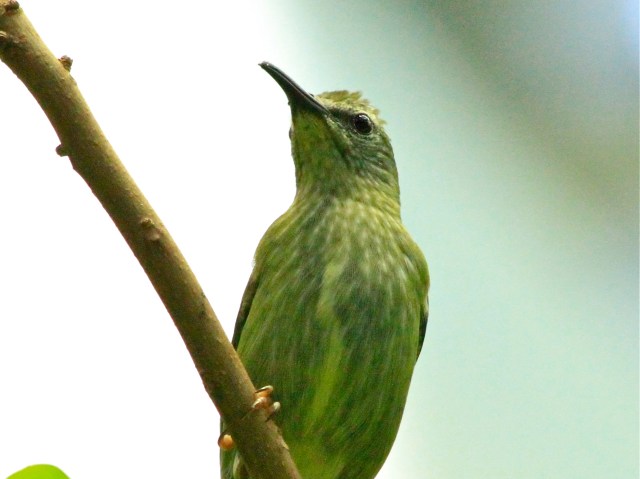
GENERAL CHARACTERISTICS: The male is violet-blue with black wings, tail and back, and bright red legs. The crown of its head is turquoise, and the underwing, visible only in flight, is lemon yellow. After the breeding season, the male moults into an eclipse plumage, mainly greenish with black wings. Females and immatures are mainly green, with paler, faintly streaked under parts and a pale stripe above the eye. The legs are red-brown in the female, and brown in young birds. Length ave 12.2 cm (4.8 inches).

male

Cyanerpes cyaneus  4141915877_5600a8d45a_o

DISTRIBUTION/HABITAT: tropical New World from southern Mexico south to Peru, Bolivia and central Brazil, Trinidad and Tobago, and on Cuba. Found at the forest edge, open woodland, cocoa and citrus plantations.

DIET IN THE WILD: Nectar and small insects in flowers. It feeds on ripe fruits, pulp and seeds, taken into the fruit, thanks to the long slender bill. It examines the underside of small twigs and leaves, in order to catch small invertebrates.

REPRODUCTION: The female Red-legged Honeycreeper builds a small cup nest in a tree, and incubates the clutch of two brown-blotched white eggs for 12-13 days, with a further 14 days to fledging.

CONSERVATION: IUCN Red List Least concern (LC)                                                     Due to its extremely large range.

Female

4141913837_6589cb943b_b

REMARKS: The call of Red-legged Honeycreeper is a thin, high-pitched tsip.

Female


Red-legged Honeycreeper (female) 4141915745_6f640230c1_o

References

EOL eol.org/pages/918134/details

CornellLab of ornithologyneotropical.birds.cornell.edu/portal/species/identificati…

IUCN www.iucnredlist.org/details/22723012/0

Ron’s flickr   http://www.flickr.com/photos/cas_docents/sets/72157608454346681/

Ron’s WordPress Shortlink  http://wp.me/p1DZ4b-fs