Latest Entries »

Color of Life, Color Conceals. Shape and color provide excellent camouflage. It also is an inefficient swimmer, moving by an undulating motion of its pectoral and dorsal fins blending into the grass.

TAXONOMY
Kingdom: Animalia
Phylum: Chordata
Class: Actinopterygii (ray-finned fishes)
Order: Syngnathiformes (Pipefishes and seahorses)
Family: Syngnathidae (Pipefishes Seadragons and seahorses)

Genus/species: Syngnathoides biaculeatus

GENERAL CHARACTERISTICS: Slender tetrahedral body; variably colored green to brown or grey, reportedly depending on habitat. Bony plates on skin form a series of protective rings. Distinct tubular snout with no jaw.
Length up to 29.0 cm
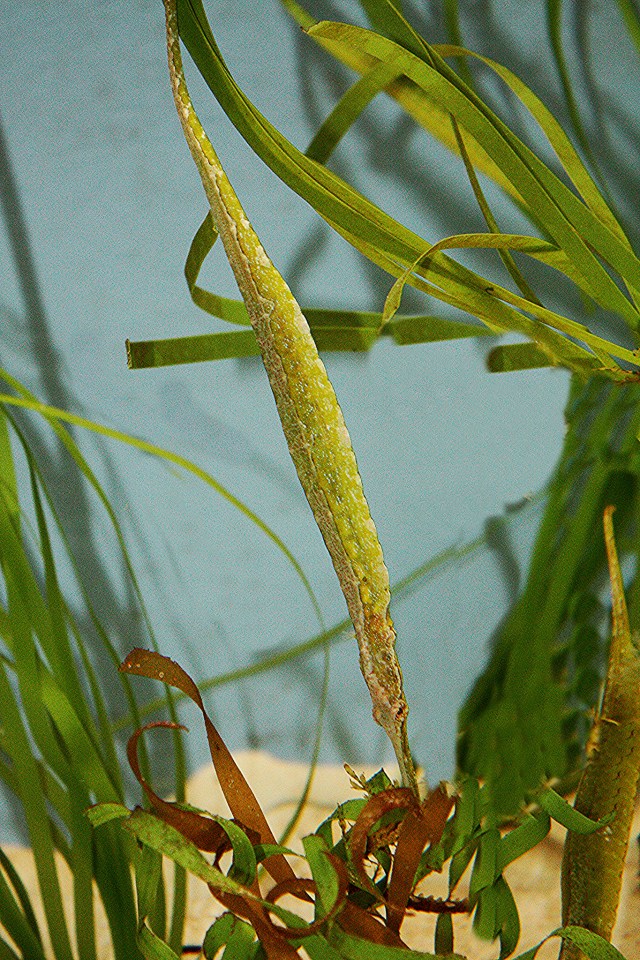
22510763066_31ff260215_k

DISTRIBUTION/HABITAT: Red Sea; South Africa to Samoa,
north to southern Japan, south to eastern Australia.
Found in protected coastal shallows over or among algae, seagrasses, or floating weeds. Juveniles occasionally found near the surface.

DIET IN THE WILD: Minute invertebrates and fish larvae.
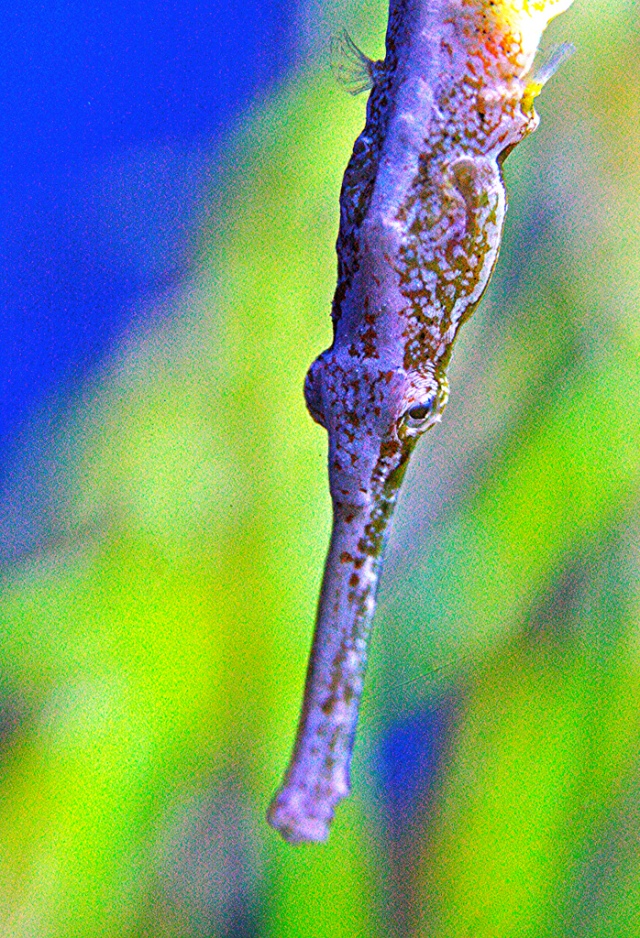
Alligator pipefish3888361153_13247050f2_b-2

REPRODUCTION: Ovoviviparous. The male carries the eggs in a brood pouch protectively located under his prehensile tail.

IUCN Red list Data deficient

3889153622_43d96aff7f_b

REMARKS: The prehensile tail is long and tapering and lacks a tail fin. It is used to anchor the fish to vegetation.

Used in Chinese medicine to extract Hailong.

References

California Academy of Sciences Color on the Reef Exhibit 2015

Ron’s flickr https://www.flickr.com/photos/cas_docents/22510763066/in/album-72157608441047857/

fishbase fishbase.org/summary/Syngnathoides-biaculeatus.html

IUCN Red List www.iucnredlist.org/details/40715/0

EOL eol.org/pages/995073/details

Ron’s WordPress shortlink  http://wp.me/p1DZ4b-1Bu

TAXONOMY
Kingdom: Animalia
Phylum: Cordata
Class: Actinopterygii (ray-finned fishes
Order: Perciformes (Perch-likes)
Family: Zanclidae (Moorish idol)

Genus/species: Zanclus cornutus


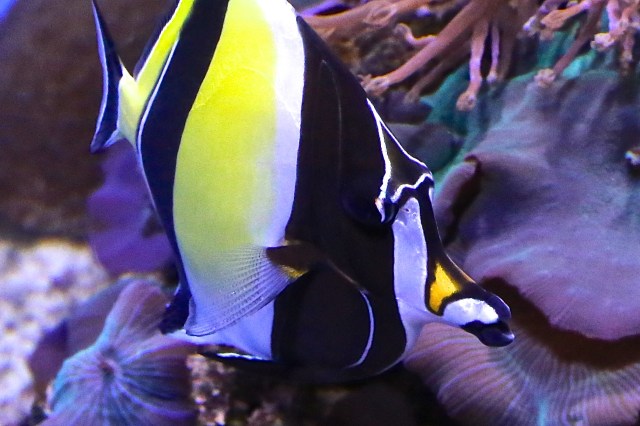
GENERAL CHARACTERISTICS: Discoid body, tubular snout, dorsal spines elongated into a very long white whip-like filament. Broad vertical white, black, white-yellow black, yellow banding. Tail black with white margin. Length to 23 cm (9 inches).

DISTRIBUTION/HABITAT: Indo-pan-Pacific. Southern Gulf of California found near hard substrates from turbid inner harbors and reef flats to clear seaward reefs as deep as 182 m (600 ft). Usually in small groups of conspecifics, occasionally in schools of more than 100.                 

 DIET IN THE WILD: Primarily sponges. Also consumes tunicates and algae.

 REPRODUCTION: It has a long larval phase and settles at a large size (6 cm or 2.4 in) resulting in its very wide geographic distribution.

 CONSERVATION: Not evaluated

REMARKS: The Moorish Idol was the icon of the Golden Gate Park Steinhart Aquarium.

Gill, was the leader of the tank fish in the movie Finding Nemo, with the voice of Willem Dafoe, is a Moorish idol.

Color of Life, Color on the Reef, Color Conceals, Hiding the eye.
Black stripes break up the body outline and hide the eye from predators.

IMG_3304

 Philippine Coral Reef  

 Ron’s flickr http://www.flickr.com/photos/cas_docents/sets/72157608440659805/

Ron’s  WordPress Shortlink  http://wp.me/p1DZ4b-Ax

fishbase: http://www.fishbase.org/summary/5950

EOL http://eol.org/pages/204516/hierarchy_entries/44696397/details

TAXONOMY
Kingdom: Animalia
Phylum: Chordata
Class: Amphibia
Order: Caudata
Family: Salamandridae

Genus/species: Taricha torosa

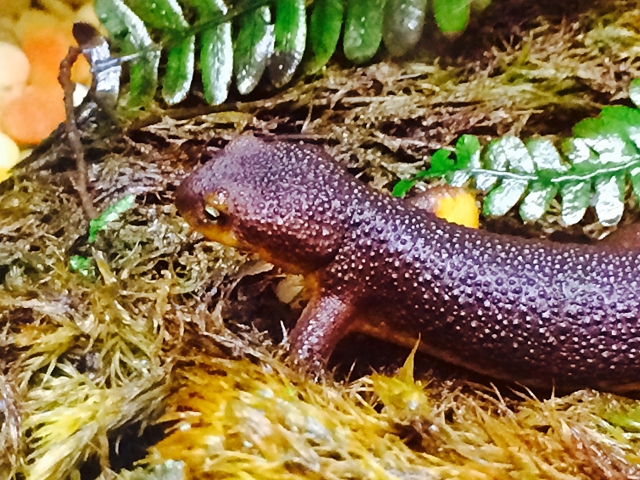
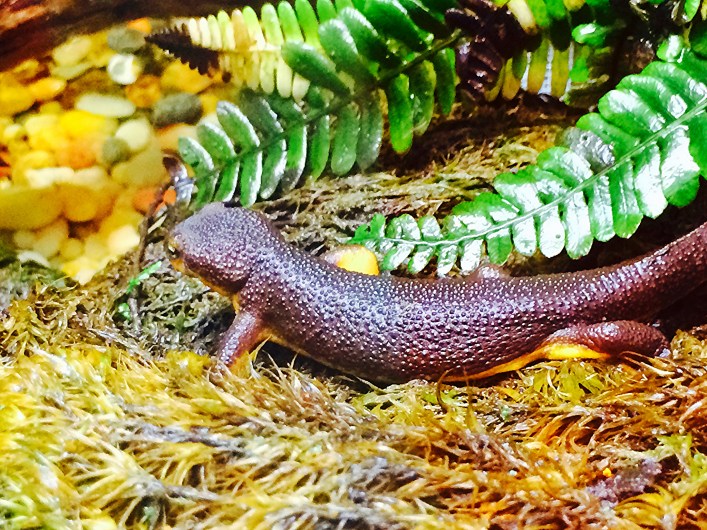
GENERAL DESCRIPTION: It has a warty brown dorsal side and a yellow-orange ventral side. In outward appearance, Eyes extend beyond the profile of the head.

Taricha torosa22363814856_37c18ac5bf_o


DISTRIBUTION/HABITAT: West coast of the United States, mainly in California, extending from Humbolt County to San Diego. They prefer grassy regions but are most visible from December to May when they migrate back to their breeding ponds.

DIET: Slugs, worms, many insects, and other amphibians.

REPRODUCTION: External fertilization. The female lays egg masses of 7-30 eggs that are protected by a toxic membrane containing the same tetrodotoxin found in adults. Within 3 months, most of the larvae metamorphose into juveniles of about 2 inches (~5 cm) or slightly longer.

22201795110_791e614f63_k

LONGEVITY: 12-15 years in the wild.

CONSERVATION: IUCN Red List Least Concern.

Some populations of T. torosa are threatened due to habitat destruction and the introduction of non-native predators such as mosquitofish (Gambusia affinis) and crayfish. In the state of California sections of roads have been closed during the rainy season in order to protect the migrating newts.

REMARKS: These newts have relatively few predators other than man due to their highly potent tetrodotoxin. The main natural native predator is the common garter snake (Thamnophis sirtalis). It is interesting to note that some garter snakes have developed a genetic resistance to tetrodotoxin.

References

California Academy of Sciences Color of Life Exhibit 2015

Ron’s flickr https://www.flickr.com/photos/cas_docents/22363814856/in/album-72157652559028013/

Ron’s WordPress shortlink       http://wp.me/p1DZ4b-1Bj

IUCN www.iucnredlist.org/details/59471/0

amphibiaweb  amphibiaweb.org/cgi/amphib_query?where-genus=Taricha&…

Caudata Culture www.caudata.org/cc/species/Taricha/T_torosa.shtml

NIH  www.ncbi.nlm.nih.gov/pmc/articles/PMC2726340/


TAXONOMY

Kingdom: Animalia
Phylum: Chordata
Class: Actinopterygii (ray-finned fishes)
Order: Perciformes (Perch-likes)
Family: Callionymidae (Dragonets)

Genus/species: Synchiropus splendidus

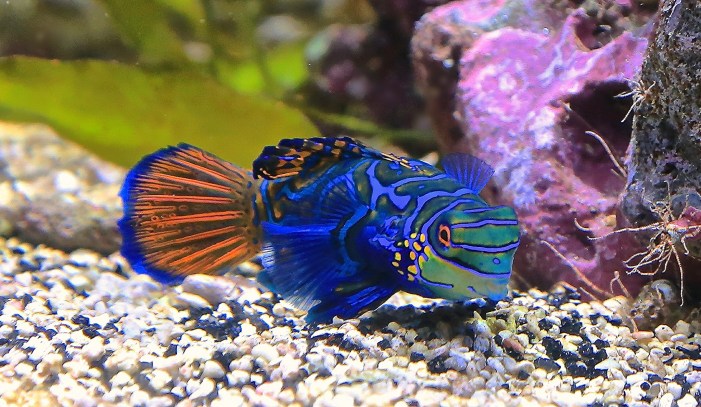
GENERAL CHARACTERISTICS: Body depressed, small head. Ground color green (rare individuals red). Body covered with dark blue blotches ringed with dark outlines. Pectoral fins, face yellow.
Length to 6 cm (2.36 in).

Synchiropus splendidus15148891995_e1b96e57d4_k

DISTRIBUTION/HABITAT: Western Pacific in shallow protected lagoons and inshore coral reefs with silty substrates 1 to 18 m
(3.28 to 59 ft).

DIET IN THE WILD: Small crustaceans such as amphipods and isopods, small worms and protozoans.

Green Mandarinfish aka Mandarin Dragonet3274882181_969702e800_b

REPRODUCTION: Polygynandrous (promiscuous). During spawning they are pelagic and are seen in the open ocean.

LIFESPAN: 10-15 years in the wild.

CONSERVATION: IUCN Not Evaluated

Color of Life: aposematic warning
S. splendidus have a vibrant display of colors. They secrete mucous that has an unpleasant smell with toxins and a bitter taste which is used as a repellent from predators.

References

California Academy of Sciences exhibit 2015

fishbase www.fishbase.org/summary/12644

Animal Diversity Web animaldiversity.org/accounts/Synchiropus_splendidus/

Ron’s flickr https://www.flickr.com/photos/cas_docents/15148891995/in/album-72157659465376212/

Ron’s WordPress shortlink http://wp.me/p1DZ4b-1Ba


TAXONOMY
Kingdom: Animalia
Phylum: Arthropoda
Class: Arachnida
Order: Scorpiones
Family: Caraboctonidae (hairy scorpions)

Genus/species: Hadrurus arizonensis

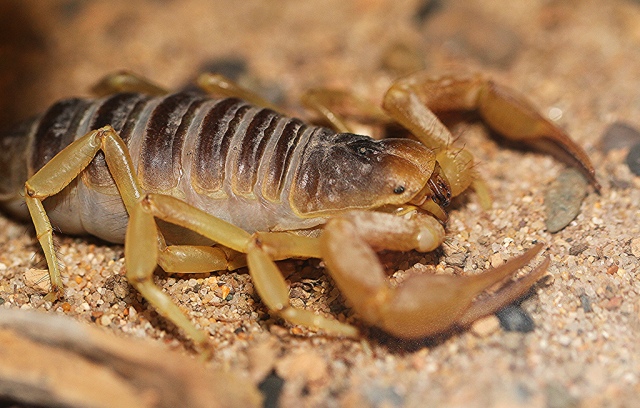
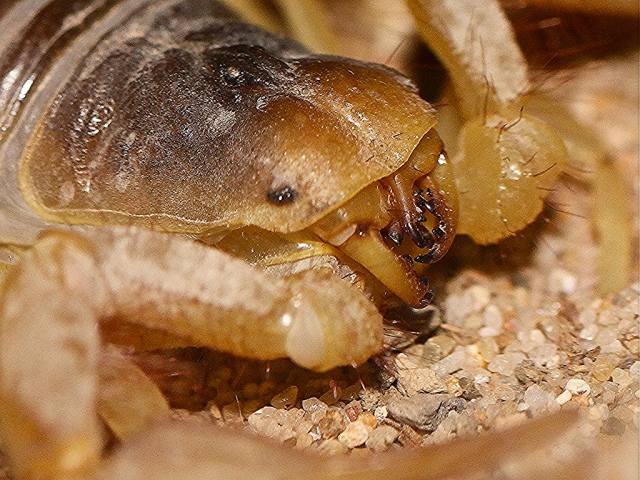
GENERAL CHARACTERISTICS: Black cephalothorax with pale yellow rimmed segments; pale yellow abdomen, pincer-like pedipalps, and legs; pale under-surface; and abundant erect dark brown sensory hairs.

Largest of the nine scorpion species in North America. Length 10 to 18 cm (3.94 to 7.09 in)
Ave. weight 5 g (0.18 oz)

They molt 4 to 6 times before reaching adulthood in about 4 years.

4798723964_ae2cf48854_b

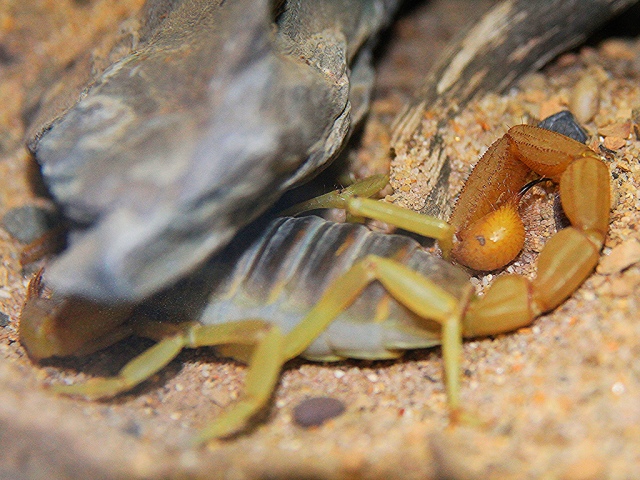
DISTRIBUTION/HABITAT: Mexico, western Arizona, southern California and Nevada, southwestern Utah. Found in semi-arid and arid habitats. Dig and live in deep burrows in soil during summer.

4798092901_1093a6cf23_b

DIET IN THE WILD: Although the venom of North American hairy scorpions is fairly week compared to most scorpions (about the same as a bee sting) these solitary predators immobilize and eat other scorpions, insects, spiders, small lizards and snakes. Forages at night for prey and mates.

4104007609_fe7dccca9a_b

REPRODUCTION: Scorpions reproduce sexually following an intricate mating behavior. Gestation lasts 6 to 12 months. Females give live birth to a large litter of 25 to 35 individuals. Occasionally, after mating, the female tracks down her mate and eats him.

LONGEVITY; Up to 25 years in captivity, ave, 7-10 in the wild.

PREDATORS: Owls and large lizards. When provoked they raise their legs and orienting themselves vertically, striking blindly at anything deemed threatening.

CONSERVATION: IUCN Red List, Not Evaluated

REMARKS: Venom in the scorpion’s stinger is used to subdue struggling prey and for self-defense. The venom is not very potent or painful to humans. Like all scorpions, has poor eyesight, excellent hearing, and a fine sense of touch (body hairs detect air and ground vibrations).

Color of Life note

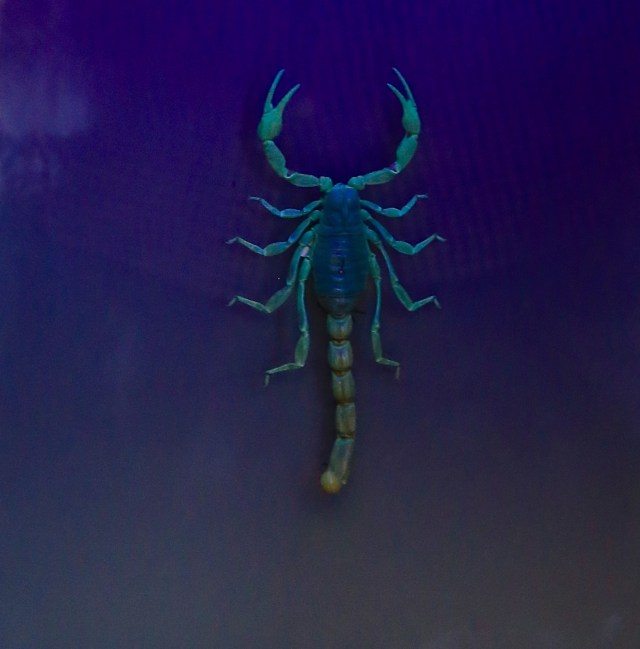
Also like all scorpions, they fluoresce under ultraviolet light, a characteristic that allows scientists (and well-equipped backpackers) to detect them in the night and perhaps signals scorpions to avoid damaging UV light.

Ref. California Academy of Science Docent program 2015

IMG_0219

REFERENCES

California Academy of Sciences, Steinhart Aquarium, Little Water 2018 with exoskeleton

Ron’s flickr  https://www.flickr.com/photos/cas_docents/4770063879/in/album-72157608653175263/

Ron’s WordPress shortlink  http://wp.me/p1DZ4b-1zv

Animal diversity Web animaldiversity.org/accounts/Hadrurus_arizonensis/

Encyclopedia of Life eol.org/pages/3195616/details

Getty Images www.gettyimages.com/detail/photo/giant-desert-hairy-scorp…


TAXONOMY
Kingdom:Animalia
Phylum: Chordata
Class Actinopterygii (ray-finned fishes)
Order Perciformes (Perch likes)
Family Chaetodontidae (Butterflyfishes)

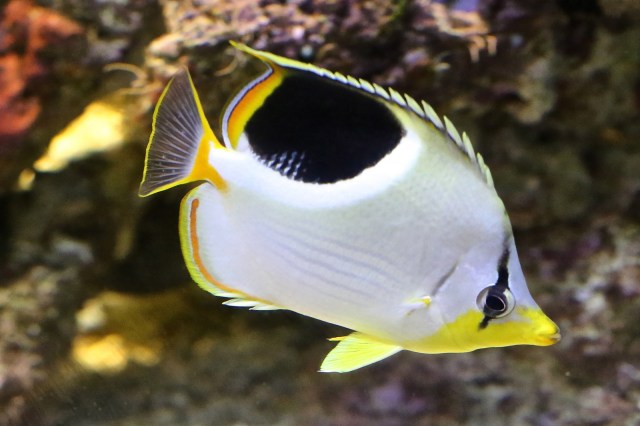
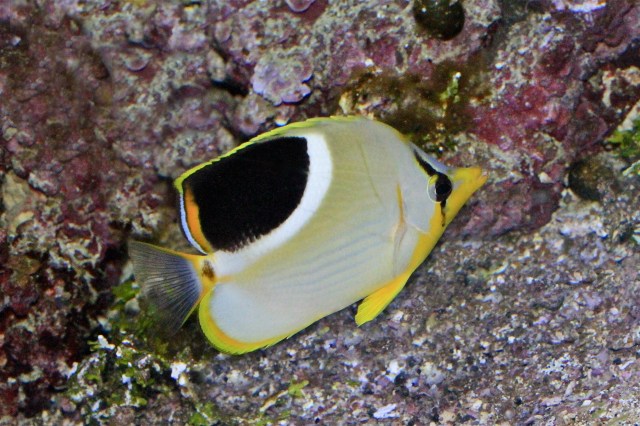
Genus/Species:  Chaetodon ephippium

Chaetodon ephippium 8410074954_fcdc073db2_h

GENERAL CHARACTERISTICS: Yellowish grey with a large black spot on the upper rear sides bordered below by a broad white band; orange area from snout to ventral fins, wavy blue lines on the lower sides. The breast and snout are yellow. Adults have a filament extending from the back of the dorsal fin.
Length to 23 cm (9 inches) in length.

DISTRIBUTION/HABITAT: Indo-Pacific. in lagoons and seaward reefs to 30 m (98 feet) in coral rich, clear waters.

DIET IN THE WILD: Filamentous algae, small invertebrates, sponges, coral polyps, and fish eggs.

REPRODUCTION: Oviparous

CONSERVATION: IUCN Least Concern (LC)

Color of Life, Color Conceals.
This Saddleback Butterflyfish helps conceals its head by having a vertical line through the eye and a large eve-like spot on its upper posterior less vital portion of its body confusing  predators.

Color Cluster

References

California Academy of Sciences Color of life docent training 2015

Ron’s WordPress Shortlink   http://wp.me/p1DZ4b-vi

Ron’s flickr  http://www.flickr.com/photos/cas_docents/sets/72157625119200613/
fishbase www.fishbase.org/summary/5562

EOL eol.org/pages/1012777/details

Australia Museum australianmuseum.net.au/Saddle-Butterflyfish-Chaetodon-ep…

TAXONOMY
Kingdom: Animalia
Phylum: Mollusca
Class: Gastropoda
Family: Dorididae

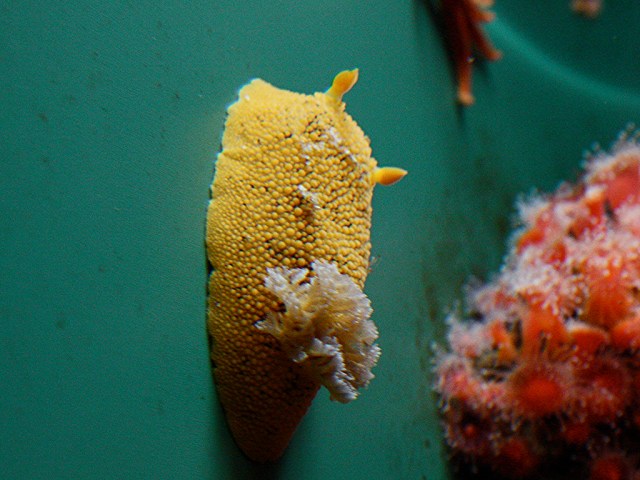
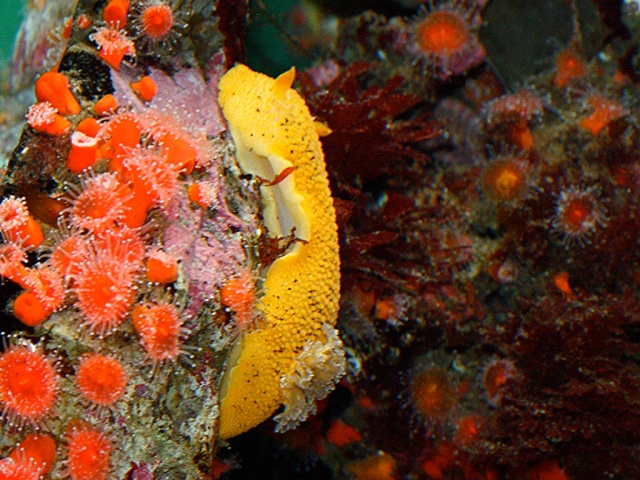
Genus/species: Peltodoris nobilis

GENERAL CHARACTERISTICS: Color variable: may be pale yellow to a deep rich yellow or orange. Back is covered with tubercules and dark spots. Fleshy antennae (sensory organs) and a rosette of gills protrude from the back of a sea lemon’s slim, flat body. One of the largest of all nudibranchs; 4 to 4.5 inches (10 to 11.5 cm).

Sea Lemon Nudibranch3124713462_3c7ecb3ff5_b

DISTRIBUTION/HABITAT: found from Alaska to Baja California in
rocky areas, mostly at low intertidal and subtidal depths to 300 feet (91 m). Often seen on harbor pilings. California is well-known for the diversity of nudibranchs found in its coastal waters.

DIET: uses a file-like radula to eat sponges.

Sea Lemon Nudibranch3123887143_7648580fb9_b

REPRODUCTION: like all nudibranchs, is hermaphroditic and can produce both sperm and eggs.

LIFE SPAN: approx. one year

CONSERVATION: abundant.

REMARKS: P. nobilis is one several dorid nudibranchs with a fruity, distinct lemon scent usually given off when the animal is handled, thus its common name. When concentrated, the odor repels many predators.

COLOR OF LIFE Note: Concealment by camouflage. Has a bumpy surface typical of those corals and sponges.

Sea Lemon Nudibranch2997671850_b9f4546718_b

References

California Academy of Sciences Color of Life docent training 2015

Ron’s flickr  https://www.flickr.com/photos/cas_docents/2997671850/in/album-72157608597736188/

Metropolitan Oceanic Institute and Aquarium  www.svsu.edu/~tkschult/moia/sea-lemon.html

Monterey Bay Aquarium  www.montereybayaquarium.org/animal-guide/invertebrates/se…

EOL eol.org/pages/451875/details

Ron’s WordPress shortlink  http://wp.me/p1DZ4b-1AF

https://www.flickr.com/photos/cas_docents/6427211687/in/album-72157652559028013/

TAXONOMY
Kingdom: Animalia
Phylum: Chordata
Class: Actinopterygii (Ray-finned fishes)
Order: Tetraodontiformes (Puffers and filefishes)
Family: Tetraodontidae (Puffers)

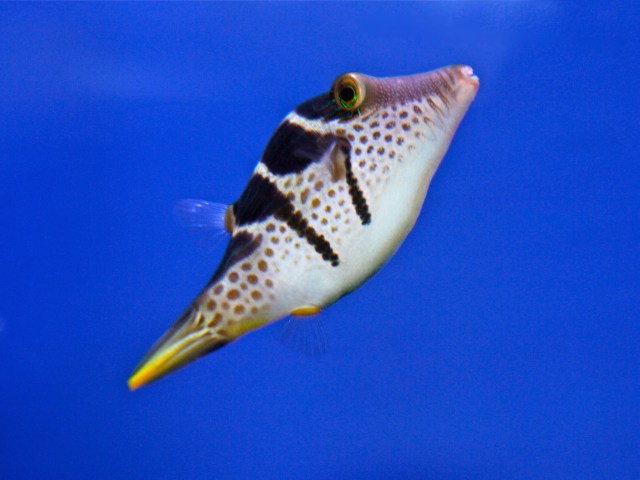
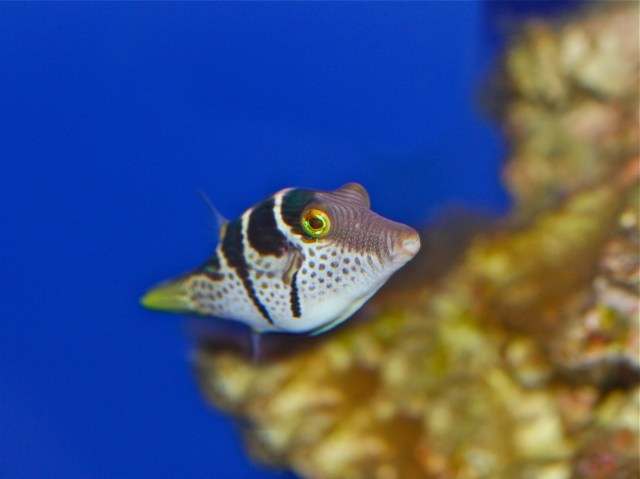
Genus/species: Canthigaster valentini

GENERAL CHARACTERISTICS: C. valentini has a white body with four distinct black stripes on the upper half. The body is also covered with brownish-orange dots. It has yellow fins, and blue striping running along the back. It lacks pelvic fins, but has learned to use the pectoral fins to move about the aquarium.
Males have blue-green lines radiating from the back of the eyes. They are also larger than females and may also have a light gray patch in front of the anus.

DISTRIBUTION/HABITAT: Occurs throughout the tropical, marine Indo-Pacific where it is common and locally abundant. It inhabits a wide range of coral reef and seagrass habitats at depths ranging from 1 to 55 metres.

DIET IN THE WILD: Forages on the benthos, feeding mainly on filamentous green and red algae, tunicates, and on smaller amounts of corals, bryozoans, polychaetes, echinoderms, mollusks.

CONSERVATION: IUCN Red List Least Concern (LC)

REMARKS: They are capable of inflating their abdomens with water when frightened or disturbed.
They can produce toxins such as tetrodotoxin and saxitoxin in the skin, gonads, and liver. Try not to use a net when handling this fish since it’s flesh is poisonous.The degree of toxicity varies by species, and also according to geographic area and season.

Color of Life:Color Communicates. The Mimic filefish (not shown here) evades predators by mimicking the Sharpnose Puffer (Canthigaster valentini).

The Mimic filefish can be distinguished from the Sharpnose Puffer (highly poisonous) by comparing their dorsal fins. The Mimic filefish has two dorsal fins, while the Sharpnose Puffer above has only one. – See more at: australianmuseum.net.au/blacksaddle-filefish-paraluteres-…

LOCATION:  COLOR CLUSTER   


References

California Academy of Sciences Color on the Reef exhibit 2015

Ron’s flickr https://www.flickr.com/photos/cas_docents/6427211687/in/album-72157652559028013/

Ron’s WordPress shortlink:  http://wp.me/p1DZ4b-iz

Australian Museum  australianmuseum.net.au/blacksaddle-toby-canthigaster-val…

Encyclopedia of life  eol.org/pages/225023/overview


TAXONOMY
Kingdom: Animalia

Phylum: Chordata
Class: Actinopterygii (ray-finned fishes)
Order: Perciformes (Perch-likes)
Family: Acanthuridae (Surgeonfishes, tangs, unicornfishes)

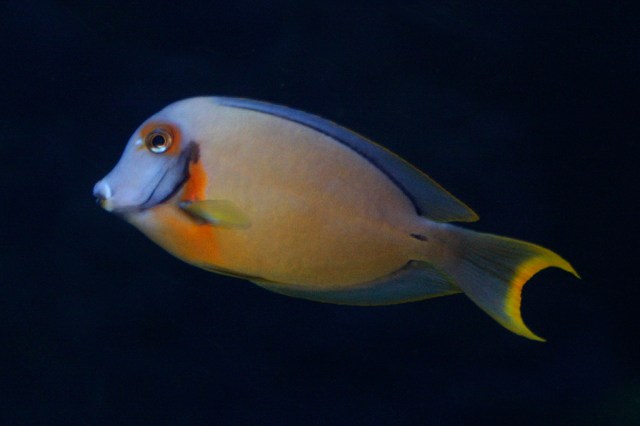
Genus/species: Acanthurus pyroferus

Acanthurus pyroferus3161779234_fc0fccc624_b

GENERAL CHARACTERISTICS: Adults have a
purplish-black to brown body; curving black band from chin to upper edge of the operculum; orange patch above base of pectoral fin.
Length to 25 cm. (10 in).
Front of juvenile’s body (“face”) is gray; body is white anteriorly and dark posteriorly. Dark-colored caudal fin rounded in juveniles.

DISTRIBUTION/HABITAT: Indonesia, Philippines, Micronesia to Polynesia, Japan to New Caledonia and the Great Barrier Reef.  Found in lagoon and seaward reefs from 12–200 ft.

DIET IN THE WILD: Algae.

REPRODUCTION: Following external fertilization female scatters eggs over open water substrate: eggs not guarded.

CONSERVATION: IUCN Least Concern

COLOR OF LIFE NOTE: Anti-predator Adaptations, Mimicry.

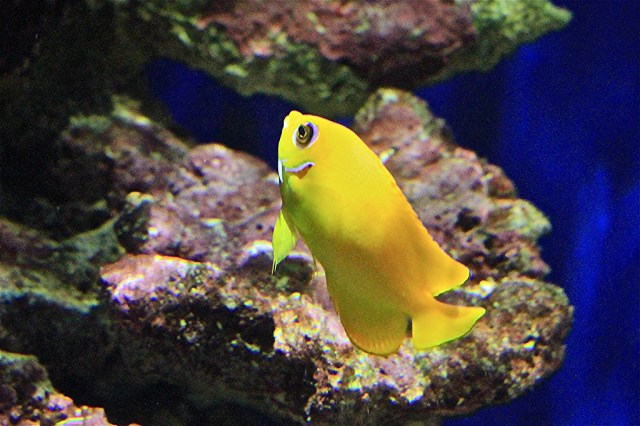
The common name “mimic” is based on the juvenile coloration; juveniles exhibit three different color patterns mimicking angelfish in the Centropyge genus. Coloration of juveniles mimics these angelfishes until they achieve the largest size attained by the angelfishes; then their appearance transforms to the appropriate adult coloration for A. pyroferus.
Juveniles mimic Centropyge spp. (in Guam, juveniles mimic C. flavissimus see below).

Centropyge flavissima6764335749_c4befc1269_b

Philippine Coral Reef 

REFERENCES

California Academy of Sciences Color of Life exhibit 2015

fishbase www.fishbase.se/summary/4742

Ron’s flickr  https://www.flickr.com/photos/cas_docents/2989062467/in/set-72157608332652056/

Ron’s WordPress shortlink  http://wp.me/p1DZ4b-1fA

EOL  http://eol.org/pages/211470/details


TAXONOMY
Kingdom: Animalia
Phylum: Chordata
Subphylum: Vertebrata
Class: Reptilia
Order: Squamata
Suborder: Serpentes
Family: Boidae

Genus/species: Boa constrictor constrictor

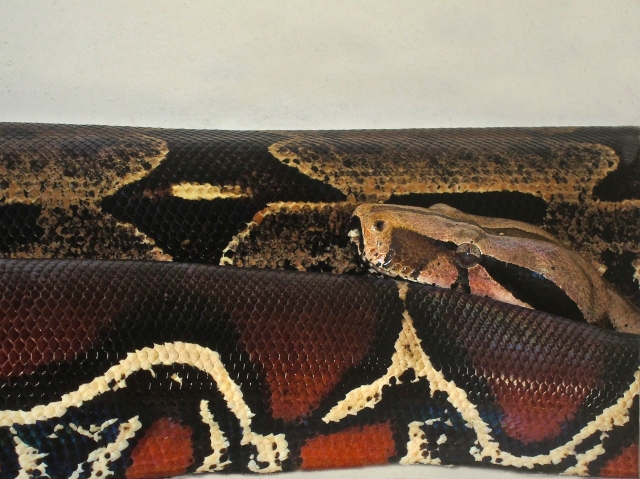
Red-tailed Boa IMG_0186

GENERAL CHARACTERISTICS: The background color is cream or brown that is marked with dark “saddle-shaped” bands. The head of a boa constrictor has 3 distinctive stripes. First is a line that runs dorsally from the snout to the back of the head. Second, there is a dark triangle between the snout and the eye. Third, this dark triangle is continued behind the eye, where it slants downward towards the jaw. However, there are many variations on appearance.
Length to 13 feet (3.9 m) as adults. Generally between 2 and 3 meters(6.5 – 10 feet) in length. Weigh 40 to 50 pounds.

DISTRIBUTION/HABITAT: Exclusive to the New World (Mexico to Argentina). Boa constrictors are both terrestrial and arboreal. They are found in deserts, wet tropical forests, open savanna, and cultivated fields, and from sea level to moderate elevation having the least need for water of all boas.

DIET IN THE WILD: They ate aglyphous, meaning they do not possess any elongated fangs. Instead, they have rows of long, recurved teeth of about the same size. Teeth are continuously replaced. They are carnivores eating small mammals, including bats, and birds or anything that fits in their mouths. Prey are killed by constriction and swollen whole taking 4-6 days to digest.

REPRODUCTION: Fertilization is internal. The male uses pelvic spurs (hind leg remnants found on either side of the cloacal opening) to aid the use of hemipenes (double penis) for cloacal insertion. Females give birth to live young (ave. 25 in number).

Red-tailed Boa 2775385563_c91e7827ff_o

MORTALITY: Lifespan, 25-30 years.

PREDATORS  Include humans, jaguars, and crocodile 

CONSERVATION : IUCN Red list; not evaluated.

REMARKS: In Mexico and South America, they are valued as destroyers of rodents. B. constrictor constrictor have been “domesticated” for this reason.

Color of Life Note: The Red-Tailed Boa demonstrates concealment with its beige and dark brown markings hiding it in the filtered light coming through tree branches and leaves.

References

California Academy of Sciences Flooded Amazon Exhibit 2015

Ron’s WordPress Shortlink  http://wp.me/p1DZ4b-VA

Ron’s flickr  http://www.flickr.com/photos/cas_docents/sets/72157608449603666/

U. of Michigan Animal Diversity Web animaldiversity.ummz.umich.edu/ site/ accounts/ information/ Boa_constrictor.html.

Smithsonian National Zoological Park  http://nationalzoo.si.edu/Animals/ReptilesAmphibians/Facts/FactSheets/Boaconstrictor.cfm