Latest Entries »

TAXONOMY
Kingdom: Animalia
Phylum: Cnidaria
Class: Anthozoa
Order: Actiniaria
Family: Actiniidae (the largest family of sea anemones)

Genus/species: Entacmaea quadricolor

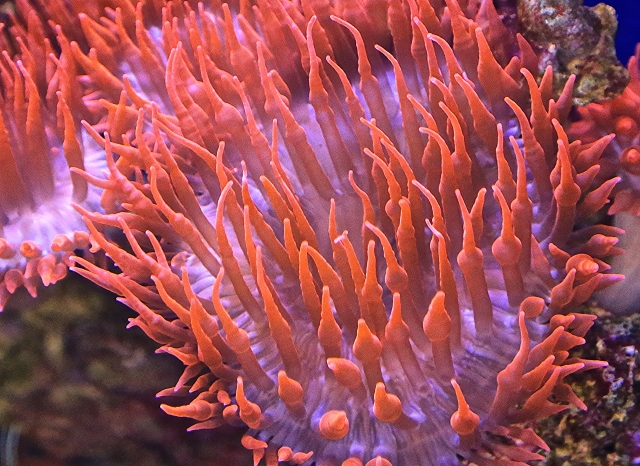
GENERAL CHARACTERISTICS: The Bubbletip Sea Anemone has an adherent base which attaches to the shape of the substratum. At the top of the column is a flattened oral disc with an oval mouth in the middle. The oral disc and column are smooth and brown, green, or occasionally a fluorescent reddish-orange. Tentacles are up to 10 cm (4 inches) length, often but not always inflated and balloonlike at the tips. 

Length up to 40 cm (16 inches)

Bubble tip anemone5389669474_fb02a667dc_o

DISTRIBUTION/HABITAT: Found in the Indo-Pacific, usually in deep crevices with only the tentacles visible.
Bubble tip anemone16122486362_7ee3a9b81d_o

DIET IN THE WILD: E. quadricolor obtains the majority of its energy from solar radiation via its symbiotic zooxanthellae.
Thet are also opportunistic carnivores that capture prey using cnidocytes on their tentacles which contain many “stinging organs” known as nematocysts (or cnidae).

REPRODUCTION: Bubbletip Sea Anemones are broadcast spawners releasing gametes directly into water.

The most common means of asexual reproduction for these anemones is called longitudinal fission, which amounts to them splitting down the middle to make two anemones from one. When it reproduces it will begin to pinch in at two points opposite each other on their base. Then the indentions will draw closer until it splits in two.

CONSERVATION: IUCN Red List Not Evaluated

REMARKS: They are symbiotic with many species of anemonefishes, such as the common clownfish (Amphiprion ocellaris)

E. quadricolor has obligate photosynthetic zooxanthellae, brown algae, which live inside the anemone acting as a carbon and nitrogen source.

This anemone also exhibits biofluorescence.

References

California Academy of Sciences Steinhart Aquarium Color on the Reef 2017 AQA16

Ron’s flickr https://www.flickr.com/photos/cas_docents/31483022142/in/album-72157659465376212/

Ron’s Worldpress shortlink http://wp.me/p1DZ4b-1Kv

The University of Queensland

http://www.gbri.org.au/SpeciesList/Entacmaeaquadricolor%7CNicolaWood.aspx

SeaLifebase www.sealifebase.org/summary/Entacmaea-quadricolor.html

taxo4254.wikispaces.com/Entacmaea+quadricolor
 

TAXONOMY
Kingdom: Animalia
Phylum: Arthropoda
Subphylum: Crustacea
Class: Malacostraca
Order: Decapoda
Infraorder: Caridea
Family: Hippolytidae

Genus/species: Lysmata amboinensis

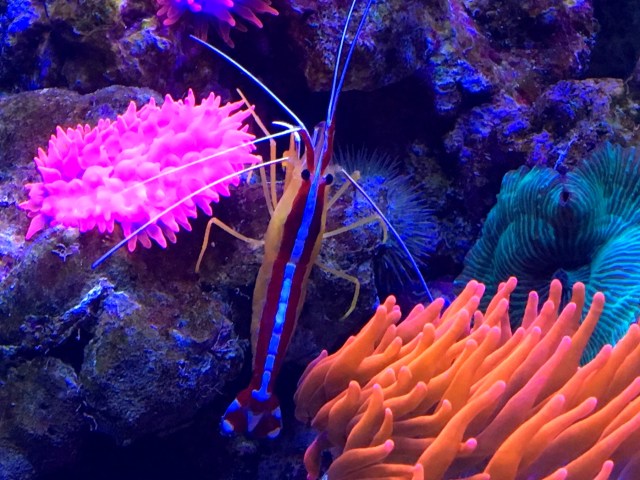
GENERAL CHARACTERISTICS: Dorsal redline on tan body. Long white antennae.

DISTRIBUTION/HABITAT: Red Sea to Australia; Indonesia, Society Islands. Active day and night at cleaning stations on coral and rocky reefs, 8–25 m. Reside in pairs or groups (to 100 individuals) in caves and crevices.

cleaner shrimp24441637412_8890f98e21_oDIET IN THE WILD: It has been observed that fish with parasites may come to cleaning stations. in the reef. Certain species of fish and several types of cleaner shrimp may assist the fish in large numbers and even go inside the mouth (and then to the gill cavity) without being eaten.
cleaner shrimp4337509985_c72ab0aedf_o

REPRODUCTION: L. amboinensis initially develop and reproduce as males then develop female reproductive organs to become hermaphrodites and function as both males and females throughout the reproductive cycle. This system called protandric simultaneous hermaphroditism is so far known only from caridean shrimp in the closely related genera Lysmata and Exhippolysmata.

REMARKS: Cleaner shrimp advertise their services by their bright coloration and by waving their very long antennae, which contrast with the dark recess of their station.

Jacques, a character in Finding Nemo, is a humpback cleaner shrimp. In aquaria, cleaner shrimp are valued because they clean not only the fish, but the tank as well.

References

California Academy of Sciences Steinhart Aquarium Color on the Reef AQA17 2017

EOL www.eol.org/pages/128343/details

Ron’s WordPress shortlink http://wp.me/p1DZ4b-1KD

Ron’s flickr https://www.flickr.com/photos/cas_docents/24441637412/in/album-72157659465376212/

TAXONOMY
Kingdom: Animalia
Phylum: Cnidaria
Class: Scyphozoa
Order: Semaeostomeae
Family: Pelagiidae

Genus: Sanderia sp.

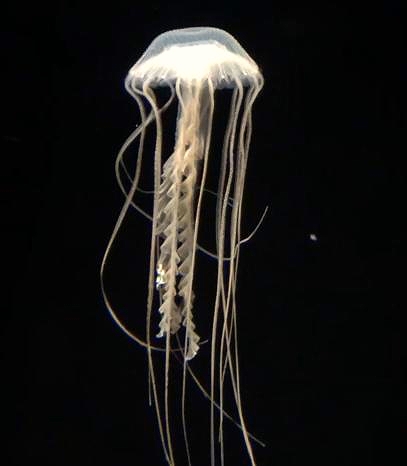
LOCOMOTION: Movement occurs when muscular contraction of the dome forces water out of the medusa. Refilling of the medusa occurs with muscular contraction.

Water currents control direction of the jelly thus they are considered plankton.

31575650231_48de03b9a4_o

REPRODUCTION: Alternation of life cycles—polyp, medusa
The drifting jellies shown here represents just one phase of a sea nettle’s life. As adults pulsing through the water, these jellies reproduce sexually. But in another stage of life, on the seafloor, they reproduce without sex.
When spawning, adults release clouds of sperm and tens of thousands of eggs a day. Their larvae sink and become polyps (like mini anemones) carpeting the seafloor. As they grow, each polyp buds off scores of tiny jellies and will become sexual adults.

References

Cailifornia Academy of Sciences Steinhart Aquarium Animal Attractions 2017

The Marine Biology Coloring Book Thomas Niesen 2000

Ron’s WordPress shortlink  wp.me/p1DZ4b-1Ka

Ron’s flickr https://www.flickr.com/photos/cas_docents/31575650231/in/album-72157629304397467/

TAXONOMY
Kingdom: Animalia
Phylum: Echinodermata
Class: Asteroidea
Order: Forcipulatida
Family: Asteriidae

Genus/species: Pisaster ochraceus

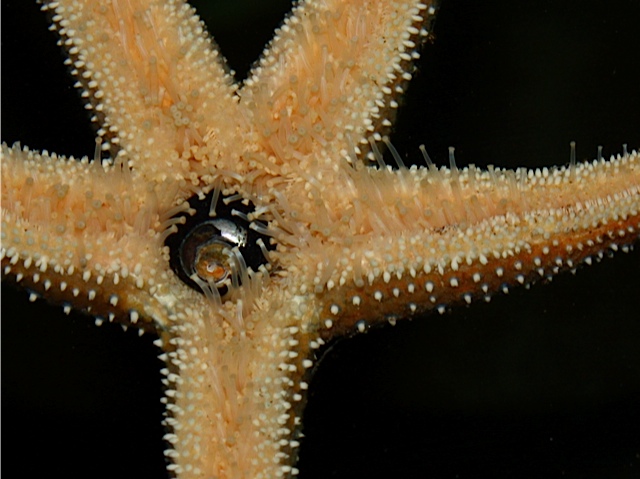
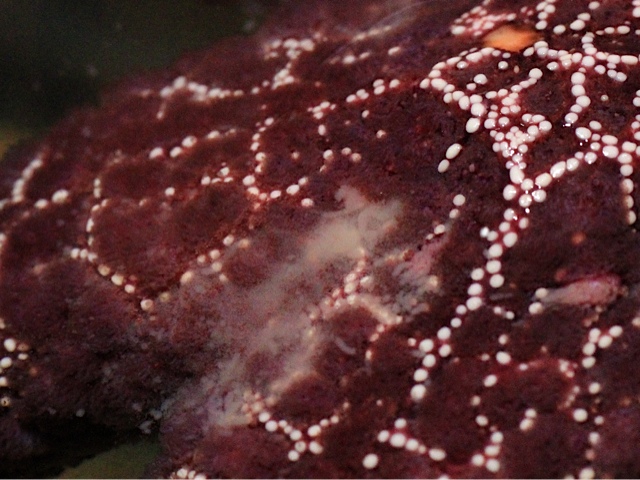
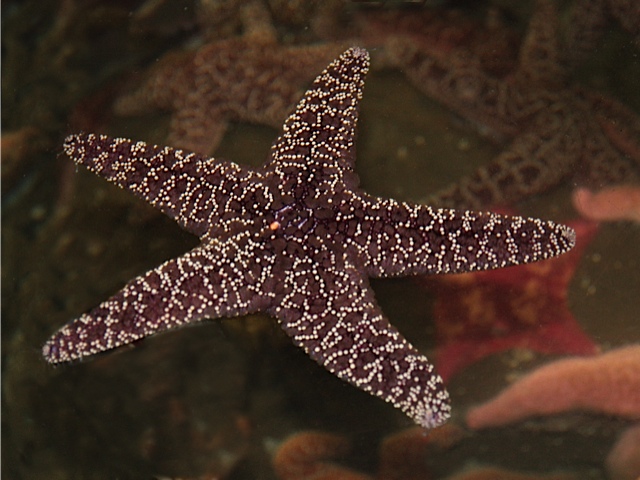
GENERAL CHARACTERISTICS: Color varies from orange, violet, dark brown or mottled, but very rarely ochre. One study showed that less than two percent of the individuals in three local Northern California populations were “ochre” in color. When dead and dry they become ochre in color.


The aboral surface contains many small spines (ossicles) that are arranged in a netlike or pentagonal pattern. Papulae or coelomic pouches give the seastar’s surface a soft, fuzzy appearance. They are used for respiration and waste excretion. P. ochraceus may have an arm radius of up to 28 cm (11 in), but the more common radius is half that figure. They typically have five arms or rays, but the number can range from four to seven. Like all sea stars, an adult P. ochraceus has tube feet which they use for locomotion and for handling prey.

DISTRIBUTION/HABITAT: Ochre stars range from Alaska to Santa Barbara County, California. They prefer the low-to-mid intertidal zones on rocky shores, especially on mussel beds, and are also found in the subtidal zone to a depth of 88 m (288 ft). Juveniles are found in crevices and under rocks.

DIET IN THE WILD: California mussels are the favored and locally abundant prey. They also consume acorn barnacles, emarginated dogwinkles, gooseneck barnacles, owl limpets, etc. They can insert their stomach into slits as narrow as 0.1 mm between the valves of bivalves and begin digestion.

ACADEMY DIET: Manila clams, chopped fish, large krill, chopped squid; it also eats other exhibit inhabitants.

REPRODUCTION: They are mainly dioecious (separate sexes). Male gametes are produced, but at a later date only females gametes are produced. During a transitional period, both eggs and sperm are produced. The gonopores of the individual gonads open at the bases of the arms. Fertilization is external. Larvae are free-swimming and plankton-feeding.

LIFESPAN: Up to 20 years

PREDATORS: Adults are eaten by sea otters and seagulls. According to Dr. Thomas Niesen, the sea otter can crunch them up but is also known to bite off the tips of the arms and suck out the gonads.

REMARKS:  One study showed that less than 2% of the individuals in three local Northern California populations were “ochre” in color. When dead and dry they become ochre in color.

P. ochraceus tolerate strong surges, large temperature changes, dilution by rainfall. It is resistant to desiccation and it can tolerate a loss of thirty-percent of its body weight in body fluids.

Sea stars can regenerate lost arms with a portion of the central disc intact and in some species from a single arm.

NOTE:   SEA STAR WASTING SYNDROME has become a major issue in both the Pacific and Atlantic Oceans since 2013. For an excellent summary check this link to the University of Santa Cruz 9-9-14.  http://www.eeb.ucsc.edu/pacificrockyintertidal/data-products/sea-star-wasting/updates.htm

Fitzgerald Marine Reserve. www.fitzgeraldreserve.org/newffmrsite/wp-content/uploads/...

11-17-14 Recent research identifies a virus (Parvoviridae) to be responsible for the wasting disease. Introduced virus was able to infect healthy sea stars with the virus, which then leads to the wasting symptoms. Published in the Proceedings of the National Academy of Science. http://theconversation.com/mystery-virus-that-turned-millions-of-starfish-into-goo-is-finally-identified-34336


Additional References

California Academy of Sciences Docent Tidepool Guide 2015

Woods Hole www.whoi.edu/science/B/people/kamaral/SeaStar.html

Bishop Museum hbs.bishopmuseum.org/pubs-online/pdf/op11-8.pdf

Encyclopedia of Life  eol.org/pages/598469/details

Animal Diversity Web, U of Michigan  animaldiversity.ummz.umich.edu/accounts/Pisaster_ochraceus/

Ron’s WordPress Shortlink  http://wp.me/p1DZ4b-sC

Ron’s flickr  https://www.flickr.com/photos/cas_docents/3407968572/in/set-72157608501343477/


TAXONOMY
Kingdom: Animalia
Phylum: Chordata
Class: Actinopterygii (ray-finned fishes)
Order: Perciformes (Perch-likes)
Family: Callionymidae (Dragonets)

Genus/species: Synchiropus picturatus

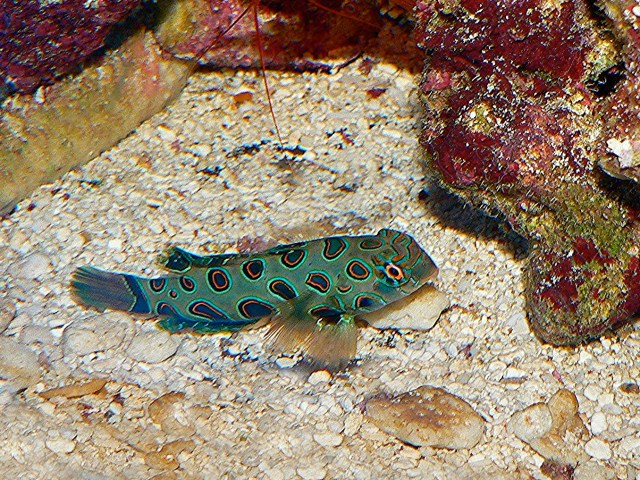
GENERAL CHARACTERISTICS: Elongate, moderately depressed, broad-headed. Pale brown to green, covered with large dark spots ringed with orange and green, turquoise band markings around eye.

Length up to 7 cm (2.75 inches)

dragonet2985463647_2857fa8c1f_o

DISTRIBUTION/HABITAT: Northwest Australia, Indonesia and Philippines. Found in rubble patches and sandy bottoms near living corals of coastal reefs at depths of 2–20 m.

DIET IN THE WILD: Small benthic invertebrates, especially live zooplankton, such as copepods and amphipods.

3289664960_03a882a295_o

IUCN RED LIST Not evaluated

References

California Academy of Sciences Steinhart Aquarium Color on the Reef AQA13

Ron’s flickr https://www.flickr.com/photos/cas_docents/2985463647/in/album-72157659465376212/

Fishbase  www.fishbase.org/summary/Synchiropus-picturatus.html

EOL eol.org/pages/339917/overview

Ron’s WordPress shortlink  http://wp.me/p1DZ4b-1JF


TAXONOMY
Kingdom: Animalia
Phylum: Chordata
Class: Actinopterygii (ray-finned fishes)
Order: Syngnathiformes (Pipefishes and seahorses)
Family: Centriscidae (Snipefishes and shrimpfishes)

Genus/species: Aeoliscus strigatus


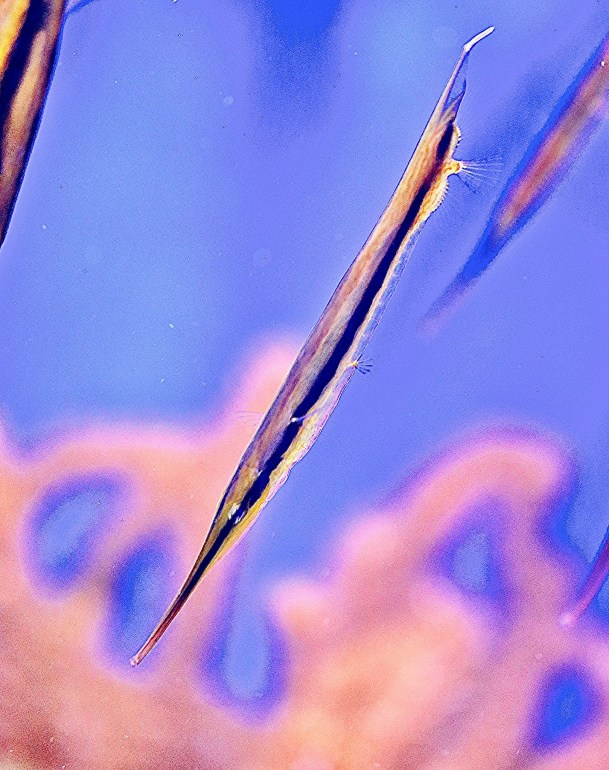
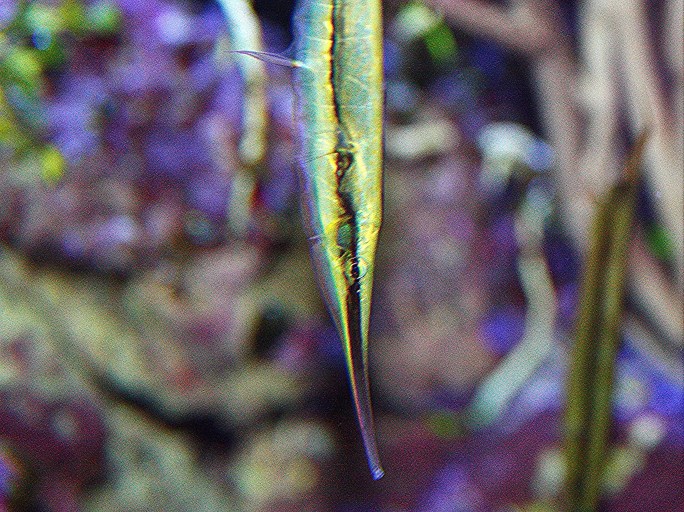
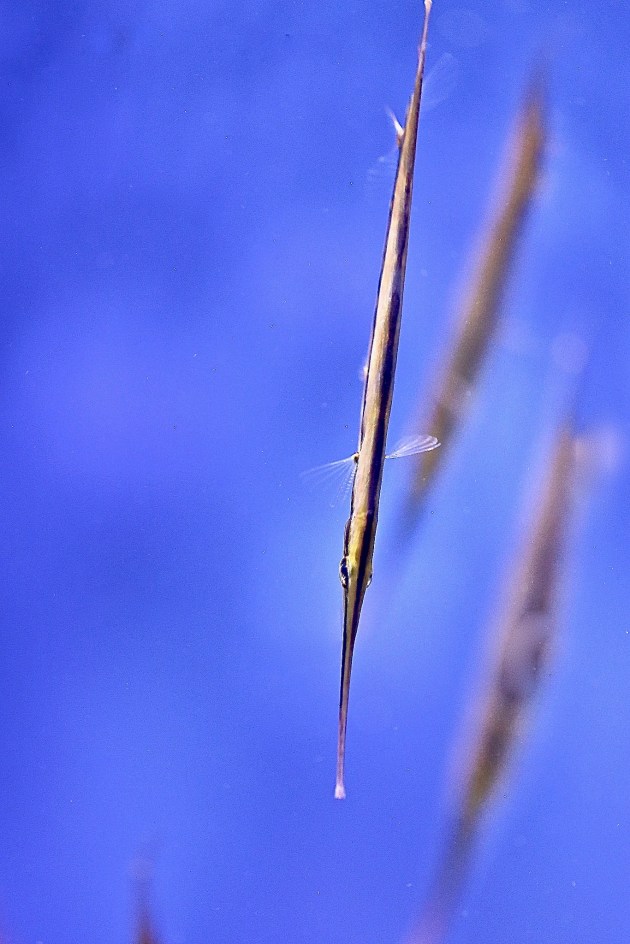
GENERAL CHARACTERISTICS: The body is encased in an armor of thin, transparent plates; they swim in synchronized groups, each fish in a vertical position with the snout pointing downwards. Color is golden-yellow with a dark band running the length of the body. The tail fin, terminates in a sharp spine.

Length up to 15 cm (6 in)

DISTRIBUTION/HABITAT: Tropical Indian and western Pacific oceans. Inhabits clear coastal reefs and leeward fringing reefs around offshore islands. Found In small groups swimming and resting with head down near long-spined sea urchins, branching corals or other hiding places to 42 m (140 feet).

DIET IN THE WILD: Minute planktonic crustaceans.

CONSERVATION: IUCN Not Evaluated

REMARKS: A. striates occurs  has been observed hiding in the spines of sea urchins, both as a defense mechanism and as a hunting mechanism. Swims horizontally only when hunting. Otherwise, swim with head down and back facing the direction of travel. If a rival enters their territory, they aim the sharp edge of the belly toward the adversary.

References

California Academy of Sciences Steinhart Aquarium Hidden Reef 2018

Ron’s WordPress Shortlink. https://brianeyes21comcast.net/2017/01/05/4-19-13-shrimpfish-aka-razorfish-from-rons-tropical-marine-series/

fishbase  http://www.fishbase.org/summary/6503

Animal Diversity Web http://animaldiversity.org/accounts/Aeoliscus_strigatus/classification/

Ron’s flickr. https://www.flickr.com/photos/cas_docents/30467635696/in/album-72157659465376212/

Fishes of Australia.  http://fishesofaustralia.net.au/home/species/3163#moreinfo

EOL eol.org/pages/205823/details#distribution


TAXONOMY
Kingdom: Animalia
Phylum: Cnidaria
Class: Scyphozoa
Order: Rhizostomeae
Family: Catostylidae

Genus/species; Catostylus mosaicus

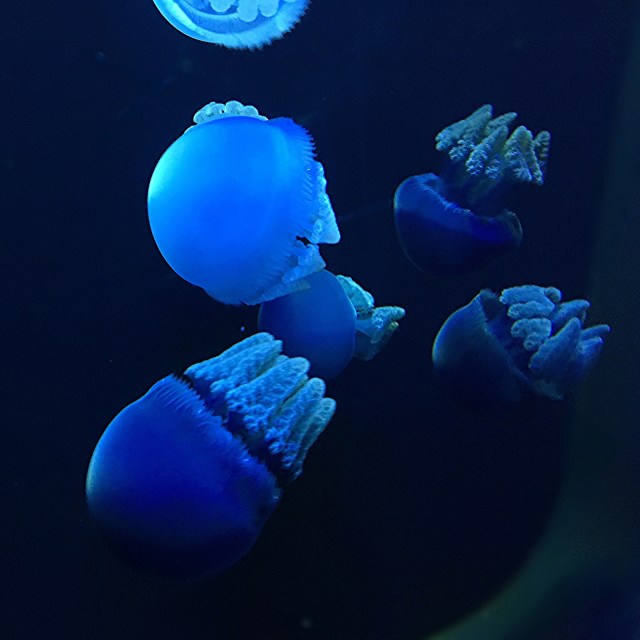
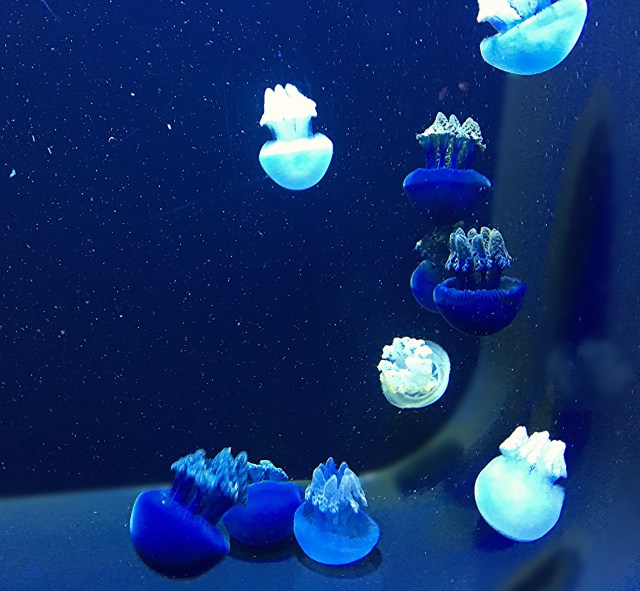
GENERAL CHARACTERISTICS: The blue, white or brown colors are derived from pigment produced by the jellyfish itself (not symbiotic algae, as in some other jellyfish). There is no obvious mouth on the underside, but there are small openings on each of its eight arm, through which food is passed to the stomach. Diameter up to 30 cm (18 in)  

29738845986_b24a44631b_k

DISTRIBUTION/HABITAT: Found in coastal waters of Australia, Queensland, New South Wales and Victoria.

DIET IN THE WILD: The tentacles also have stinging cells that can capture tiny crustaceans and other plankton.

29482409560_d2c608244e_k

REMARKS: The Chinese believe eating jellies will reduce high blood pressure. Dried jellies are popular in many Asian countries, especially Japan, where they’re considered a culinary delicacy. The texture is reportedly crispy, yet elastic—hence the name “rubber band salad” for a dish sold in China.

References

California Academy of Sciences Steinhart Aquarium Color on the Reef  2017 AQA10

EOL eol.org/pages/203402/details

Monterey Bay Aquarium  www.montereybayaquarium.org/animal-guide/invertebrates/bl…

WordPress  https://brianeyes21comcast.net/2016/09/18/9-9-16-blue-blub…o-pacific-series/   Shortlink  http://wp.me/p1DZ4b-1In

Ron’s flickr https://www.flickr.com/photos/cas_docents/29482409560/in/album-72157659465376212/


TAXONOMY
Kingdom: Animalia
Phylum: Chordata
Subphylum: Vertebrata
Class: Actinopterygii (ray-finned fishes)
Order: Tetraodontiformes (Puffers and filefishes)
Family: Tetraodontidae (Puffers)

Genus/species: Carinotetraodon travancoricus

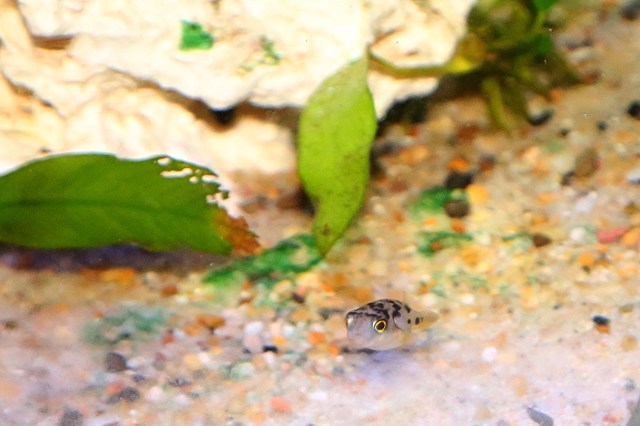
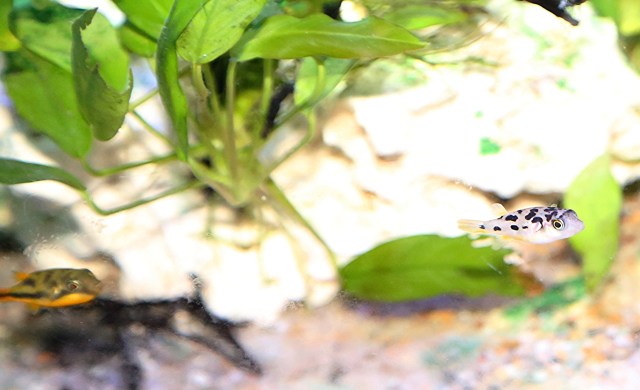
GENERAL CHARACTERISTICS: Both sexes are primarily yellow with dark green to black iridescent patches on the flanks and dorsal surface. Males can also have a dark stripe down the center of their pale belly and iridescent “eye wrinkle” patterns that females do not have. Females are more rounded, tend to be a bit larger than males, and may or may not show more smallish spots between their larger dark markings.
Length up to 2.5 cm (one inch)

24236155053_aaa17fd6c0_o
DISTRIBUTION/HABITAT: C. travancoricus  are found in freshwater rivers of Asia and India. Endemic to the Western Ghats of India

DIET IN THE WILD: The diet of dwarf pufferfish in the wild has not been reported, but other members of the genus feed on zooplankton and various benthic crustaceans and molluscs.

PeaPuffer24863009085_c71f422cfb_o

REPRODUCTION: Eggs are deposited and hidden in vegetation.

CONSERVATION: IUCN VULNERABLE VU
Results from habitat modifications caused by deforestation and conversion of lands in agricultural areas, increasing urbanization, and over harvesting for the pet trade.

References

California Academy of Sciences Steinhart Aquarium Water is life feeding

Ron’s flickr  https://www.flickr.com/photos/cas_docents/24236155053/in/album-72157662094208792/

fishbase www.fishbase.org/summary/Carinotetraodon-travancoricus.html

EOL www.eol.org/pages/222209/details

IUCN  www.iucnredlist.org/details/links/166591/0

Arkive www.arkive.org/malabar-pufferfish/carinotetraodon-travanc…

Ron’s WordPress Shortlink http://wp.me/p1DZ4b-1Jg


TAXONOMY
Kingdom: Animalia
Phylum: Chordata
Class: Actinopterygii (ray-finned fishes)
Order: Atheriniformes (Silversides)
Family: Melanotaeniidae (Rainbow fishes)

Genus/species: Melanotaenia trifasciata

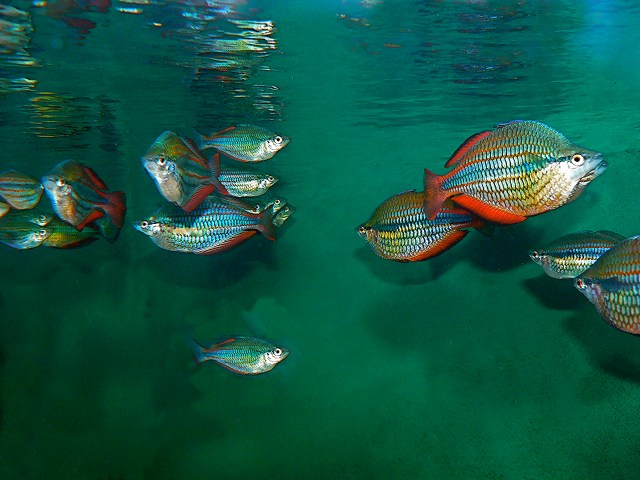
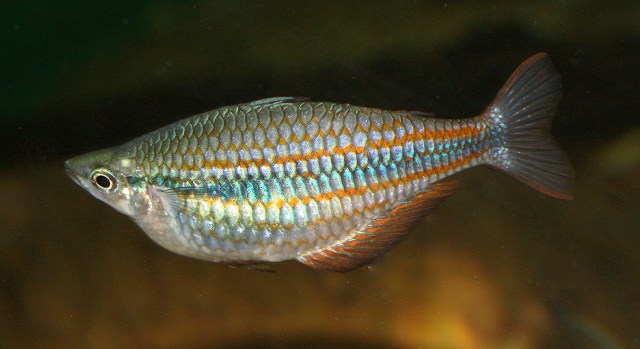
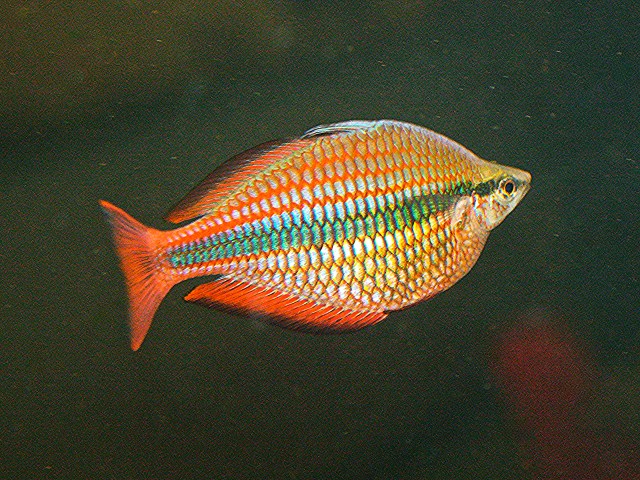
GENERAL CHARACTERISTICS: The coloration of Melanotaenia trifasciata is variable depending on location, water conditions and diet. Populations from almost every river system where they are found have their own distinctive body color with up to 30 varieties. They can be recognised by a very deep body, usually deeper than 1/3 of their body length, and an often discontinuous black mid-lateral band3059546344_bed3615034_o

Length up to 15 cm (6 in)

Rainbowfish3059546154_5f846da4d4_o

DISTRIBUTION/HABITAT: Northern Territories and Queensland, Australia. Found mainly in small streams and waterholes in clear to moderately turbid water. Occurs over rocky or gravel bottoms or in well vegetated areas, frequently around submerged logs and branches.
4360153723_b7a50ecda1_o
DIET IN THE WILD: Omnivore feeding in the surface and mid-water regions. The main food items are aquatic insects, algae and terrestrial insects such as green ants.

MORTALITY/LONGEVITY: Life span: 5–8 years.

IUCN RED LIST Not Evaluated

References

California Academy of Sciences Steinhart Aquarium Water Planet 2016

Fishbase http://www.fishbase.org/summary/Melanotaenia-trifasciata

Rainbowfish rainbowfish.angfaqld.org.au/Trifas.htm#Top_of_Page

Ron’s flickr https://www.flickr.com/photos/cas_docents/3059546154/in/album-72157662094208792/

Ron’s WordPress Shortlink http://wp.me/p1DZ4b-1J6


TAXONOMY
Kingdom: Animalia
Phylum: Chordata
Class: Sarcopterygii (lobe-finned fishes)
Order: Ceratodontiformes (Australian lungfishes)
Family: Ceratodontidae (Australian lungfish)

Genus/species: Neoceratodus forsteri

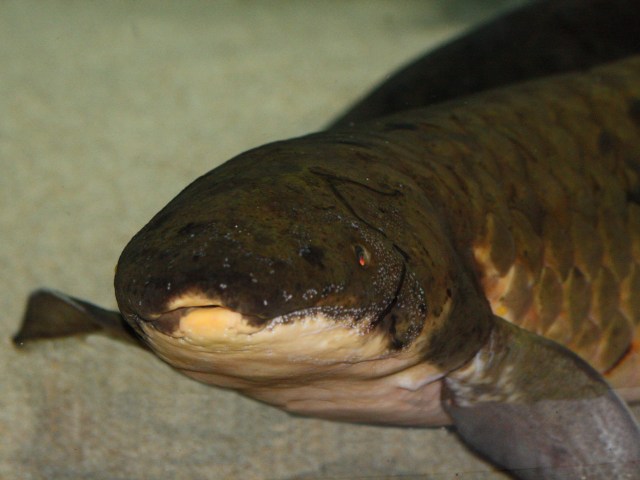
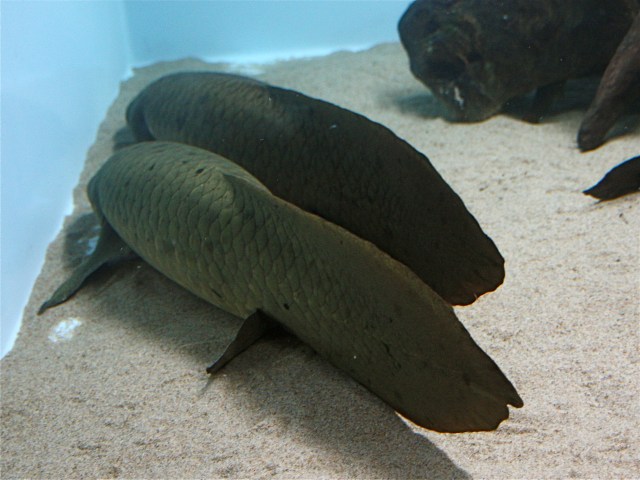
GENERAL CHARACTERISTICS: The brown or olive-brown body is covered with large, bony, overlapping scales. There is some whitish colour on the belly and underside of the head. The dorsal fin originating on the middle of the back is confluent with the caudal and anal fins. The pectoral fins are large and flipper-like just behind the head; the pelvic fins are also flipper-like, situated far back on the body.

3192737183_3ab00093a7_oLength up to nearly 2 m (6 feet)

DISTRIBUTION/HABITAT: Queensland, Australia in rivers with low flow in the austral summer, then restricted to pools that remain. During period of drought, it can tolerate stagnant conditions by breathing air, surfacing 1-2 times per hour; however, it lacks the ability to survive dry spells by aestivation; it is a facultative air-breather that will die if forced to depend on air-breathing.


3258189601_0fabe418bf_o

DIET IN THE WILD: Omnivorous. They use large, crushing teeth on the palate and lower jaw to feed on frogs, tadpoles, fishes, shrimp, earthworms, snails, aquatic plants and native fruits fallen from trees overhanging the creeks. It uses its electroreceptors on its head to pick up hidden mollusks, worms or crustaceans.

REPRODUCTION: First breeds at around 15 years of age in males and 20 years in females. Juveniles are vulnerable to predatory insect larvae, shrimps, fish and wood ducks. Adults have few or no natural predators

MORTALITY/LONGEVITY: Live to more than 65 years in captivity. Some individuals may live to 100 years. It is protected by law.

REMARKS: It is one of six extant representatives of the ancient air-breathing Dipnoi (lungfishes) that flourished during the Devonian period (about 413–365 million years ago) and is the most primitive surviving member of this lineage.

The oldest specimen at the California Academy of Sciences (“Methusela”) arrived from the Melbourne Zoo in 1938. It was half its current size at the time. This species most resembles lungfish fossil forms.

Unlike the African lungfish, this species cannot survive dry spells through estivation. Although the lung supplements the gills during times of oxygen stress, it cannot survive solely by breathing air. The Australian lungfish has only a single lung; the other two lungfish species have paired lungs.

References

California Academy of Sciences Steinhart Aquarium Water is life

Ron’s flickr https://www.flickr.com/photos/cas_docents/2996214117/in/album-72157662094208792/

Fishbase  fishbase.org/summary/4512

ADW animaldiversity.org/accounts/Neoceratodus_forsteri/classi…

EOL eol.org/pages/339109/details

Australian Government  www.environment.gov.au/cgi-bin/sprat/public/publicspecies…

Ron’s WordPress Shortlink  http://wp.me/p1DZ4b-1J0