Latest Entries »

TAXONOMY
Kingdom: Animalia
Phylum: Chordata
Class: Actinopterygii (ray-finned fishes)
Order: Syngnathiformes (Pipefishes and seahorses)
Family: Syngnathidae (Pipefishes and seahorses)

Genus/species: Haliichthys taeniophorus

GENERAL CHARACTERISTICS: Ribboned Pipefish have elongate scaleless bodies with bony knobs above the eyes and spines on body with a series of bony rings. The body color consists of shades of brown, green and yellow; The snout is tube like with no jaw and a terminal mouth. H. taeniophorus has a single dorsal fin, and its head and body are adorned with leafy appendages. They possess a prehensile tail that is used to attach to seagrass while searching for nearby prey.

Length up to 30.0 cm (11.8 in)
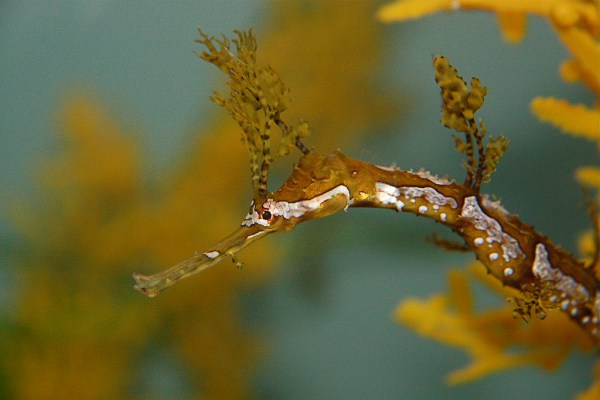
DISTRIBUTION/HABITAT: Indo-Pacific: Indonesia south to Australia. Found in protected coastal shallows over or among algae, sea grasses, or floating weeds.

DIET IN THE WILD: Minute invertebrates and small planktonic crustaceans.

REPRODUCTION: They are ovoviviparous. The male carries the eggs in a brood pouch which is found under the tail.

CONSERVATION: IUCN Least Concern. This species may be susceptible to being caught as bycatch and/or targeted for use in trade, but this has not been documented. There are no other known threats to this species.

REMARKS: Pipefishes differ from seadragons which lack the brood pouch of seahorses and pipefishes.

References

California Academy of Sciences Animal Attractions

Ron’s flickr https://www.flickr.com/photos/cas_docents/3429248779/in/album-72157608441047857/

fishbase fishbase.org/summary/Haliichthys-taeniophorus.html

Arkive  www.arkive.org/ribboned-pipefish/haliichthys-taeniophorus/

IUCN www.iucnredlist.org/details/95882787/0

Ron’s WordPress Shortlink http://wp.me/p1DZ4b-1Pb
TAXONOMY
Kingdom: Animalia
Phylum: Arthropoda
Class: Insecta
Order: Lepidoptera (Moths and butterflies)
Family: Nymphalidae (brush footed butterflies)

Genus/species: Heliconius hecale

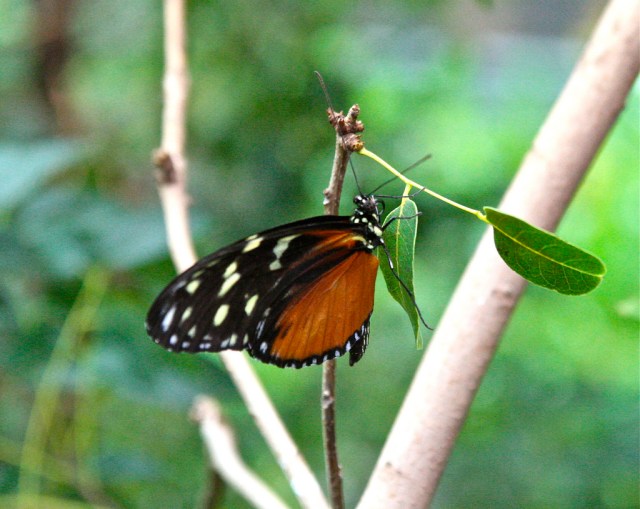
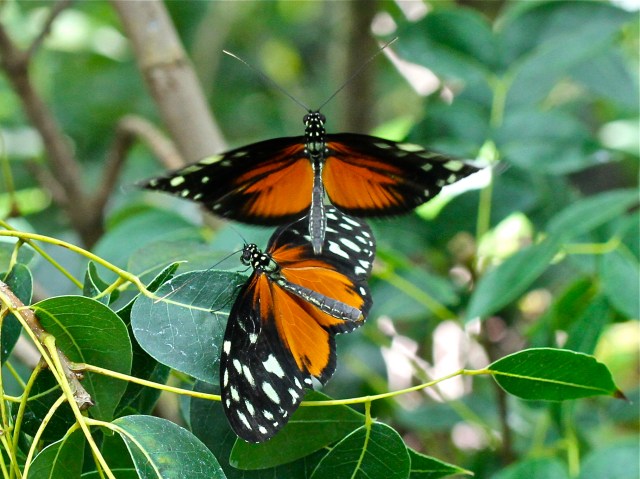
GENERAL CHARACTERISTICS: All Heliconius species have long black wings bearing simple but striking patterns, typically featuring streaks or patches of red and cream, or blue and cream. Several including hecale have subspecies which mimic ‘tiger complex’ orange and black. In fact every one of the 29 hecale subspecies mimics. They are all toxic to birds. Studies have provided strong evidence that birds which eat the them suffer from nausea and vomiting.

4427846261_2cb9a749fa_o

DISTRIBUTION/HABITAT: Found from Central America south throughout Amazonia. Habitat: Occurs from sea level to 1,400 m (4600 feet) in tall forests.

DIET IN THE WILD: they nectar at Hamelia, Lantana and Palicourea. Females feed on pollen as well as nectar.

Ventral or wing bottom

Tiger Longwing 3779879064_915dfdc8af_b

REMARKS: Heliconians are brightly colored butterflies with especially long wings, hence the common name. Tiger Longwings and many other Heliconians are communal roosters. Each night a number of butterflies, either of the same or related species, assemble for the night, often on a single branch.

References

California Academy of Sciences 2017

Ron’s WordPress Shortlink wp.me/p1DZ4b-13X

AWD http://animaldiversity.org/accounts/Heliconius_hecale/classification/

EOL http://eol.org/pages/154228/details

Butterflies of Mexico, USA and Canada. www.learnaboutbutterflies.com/North%20America%20-%20Helic…

Tree of life project www.tolweb.org/Heliconius_hecale/72904

Ron’s flickr http://www.flickr.com/photos/cas_docents/sets/72157608449327886/


TAXONOMY
Kingdom: Animalia
Phylum: Arthropoda
Class: Insecta
Order: Lepidoptera (moths and butterflies)
Family: Nymphalidae (Brush-footed Butterflies)

Genus/species: Heliconius sara

Sara Longwing (top wing)Heliconius sara

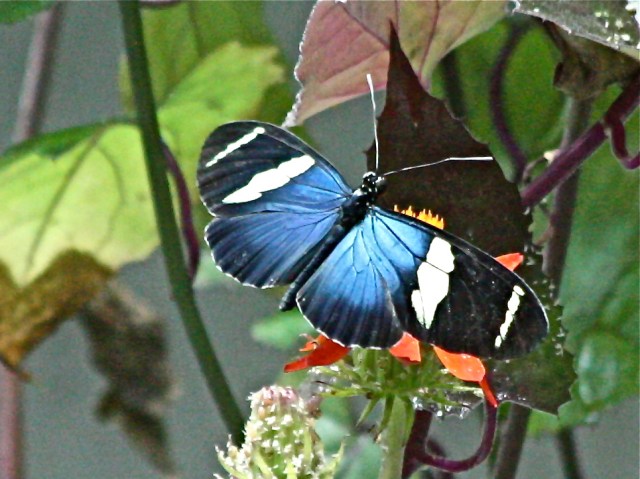
GENERAL CHARACTERISTICS: Upper wing surface (dorsal) is black with large patch of metallic blue framed by two white bands. Underside (ventral) is brown-black with faded white bars above and small red spots near the body.

DISTRIBUTION/HABITAT: Widespread throughout Central America and the tropics of South America, including the Amazon Basin. Usually found  flying  slowly in the middlestory of rainforests.

REPRODUCTION: Pupal maters. Males don’t even wait until the female emerges from the pupa. Instead they physically break open her pupa and copulate as soon as her genitalia are accessible.  Larvae of sara longwing butterflies avoid harm from cyanogenic leaves by metabolizing cyanogenic glycosides enzymatically.
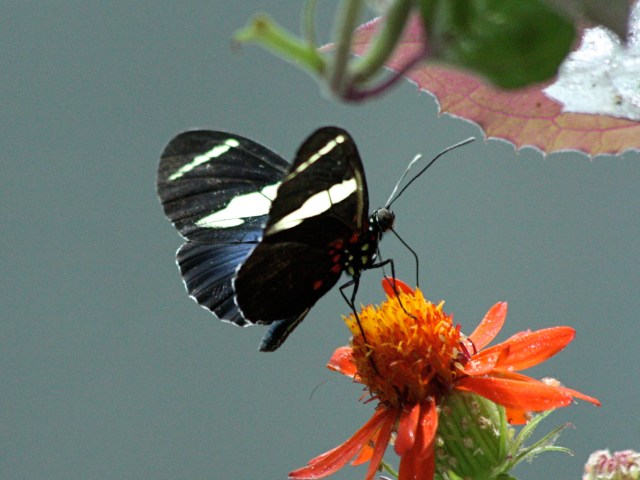
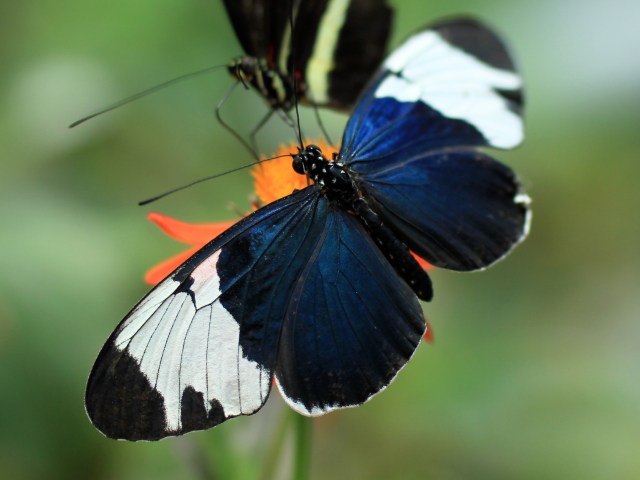
Sara Longwing Heliconius sara 3142858049_b1047eaf55_o

LONGEVITY: Adult life span: 2–3 months.

REMARKS: Passion flowers contain toxic compounds to which caterpillars are immune; like monarchs, the caterpillars concentrate the toxin in their tissues and pass it along to the adult during metamorphosis. Research suggests that adult Heliconian butterflies may be able to synthesize their own toxins with the amino acids they absorb through the protein-rich pollen they feed on.

References

California Academy of Sciences Rainforest

Ron’s flickr  http://www.flickr.com/photos/cas_docents/sets/72157608449327886/with/3143686808/

Ron’s WordPress Shortlink  http://wp.me/p1DZ4b-13P

EOL eol.org/pages/151535/details

Tree of Life tolweb.org/Heliconius_sara/72943

TAXONOMY
Kingdom: Animalia
Phylum: Arthropoda
Class: Insecta
Order: Lepidoptera (moths and butterflies)
Family: Nymphalidae (Brush-footed Butterflies)

Genus/species: Heliconius sapho

4427846137_e59fe66b98_o

GENERAL CHARACTERISTICS: H. sapho and H. cydno are Müllerian mimics (two or more unrelated noxious, critters exhibit similar warning systems), which is exhibited in the mimetic wing pattern. NOTE: Batesian mimicry differs because one critter of two similar critters is not noxious. In this case the predators avoid all organisms with a given or similar warning, thus making the resemblance a protective mechanism for the non noxious organism.
Heliconius sapho is black and white but has a blue metallic sheen when seen under the right lighting conditions. It can be distinguished from its co-mimic H. cydno by the ventral surface of the hind wings, which exhibit basal red rays and no brown bars.

Wing span 3-3.5 inches

DISTRIBUTION/HABITAT: Sapho longwings are found in central and northwestern South America to the west of the Andes in dense rainforests.

DIET IN THE WILD:  H. sapho  have a complex coevolved relationship with only one host plant, Passiflora pitteri.  Heliconius spp. caterpillars eat the plants that making their tissues poisonous. The butterflies are usually unpalatable to predators.

Wing bottom

3192752739_fbf5761406_b

REPRODUCTION: Also a pupal-mater (see Zebra Longwing)

LONGEVITY: Relatively long-lived

References

California Academy of Sciences Rainforest 2017

Ron’s flickr http://www.flickr.com/photos/cas_docents/sets/72157608449327886/with/4427846137/

Ron’s WordPress Shortlink   http://wp.me/p1DZ4b-13C

Tree of Life Project http://www.tolweb.org/Heliconius_sapho/72940

EOL http://eol.org/pages/153873/details

Missouri Botanical Garden http://www.missouribotanicalgarden.org/visit/family-of-attractions/butterfly-house/butterflies-and-plants/our-butterfly-collection/butterfly-collection-article/article/250/iheliconius-saphoi.aspx

TAXONOMY
Kingdom: Animalia
Phylum: Arthropoda
Class: Insecta
Order: Lepidoptera
Family: Nymphalidae (Brush-footed or four-footed butterflies) The first pair of legs are small or reduced, giving the family the other names of four-footed or brush-footed butterflies.
Subfamily: Heliconiinae (passion-vine butterflies)

Genus/species: Heliconius melpomene

3116912525_7c6d9815d6_o

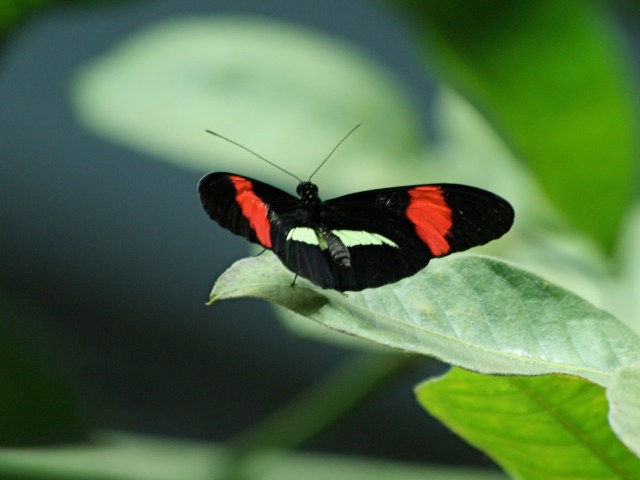
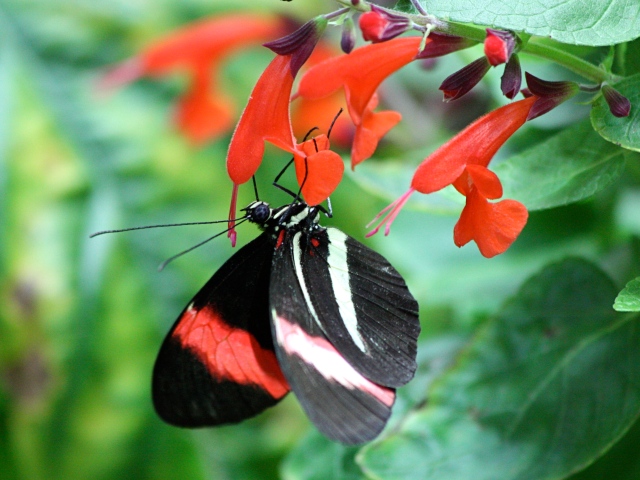
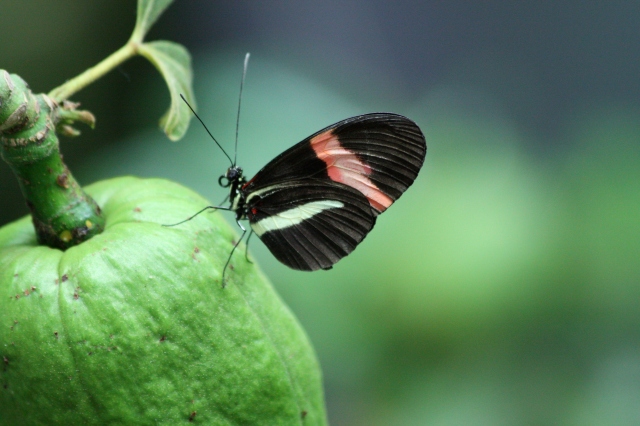
GENERAL CHARACTERISTICS: The Postman has large long wings with an orange stripe down each forewing and is famous for the geographic diversity of its color pattern, having around 30 named subspecies. These factors, in combination with its co-mimicry with Heliconius erato, make an individual sometimes difficult to identify.

Postman (wing bottom)Heliconius melpomene

DISTRIBUTION/HABITAT: H. melpomene is widespread in the Neotropics of Central and South America to southern Brazil. They are found in open areas, also locally common along river edges and streams.

DIET IN THE WILD: A plant specialist on passion vine flowers (Passiflora spp.). In Central America, focuses on only two species; in other areas, is more of a generalist, feeding on several Passiflora species.

Postman butterfly 3128914991_1200b58be7_o

LONGEVITY: Heliconius spp. are among the Methuselahs of the butterfly world. Most butterflies live only days; some Heliconians in the adult (butterfly) stage, including the Postman, live for as long as 8 months.

IMG_0766

REMARKS: The Postman is reportedly named after its habit of flying a route that allows visitation of all the nectar plants in a given area like a postman delivering the mail.
In Greek mythology, Mt. Helicon was sacred home to the Muses; Melpomene is the Muse of Tragedy.

References

California Academy of Sciences Docent Rainforest Training Manual 2014

Ron’s flickr  http://www.flickr.com/photos/cas_docents/sets/72157608449327886/

Ron’s WordPress Shortlink  wp.me/p1DZ4b-12R

Tree of Life web project tolweb.org/Heliconia

Encyclopedia of Life eol.org/pages/154557/details


TAXONOMY
Kingdom: Animalia
Phylum: Arthropoda
Class: Insecta
Order: Lepidoptera (moths and butterflies)
Family: Nymphalidae (Brush-footed Butterflies)

Genus/species: Heliconius charithonia


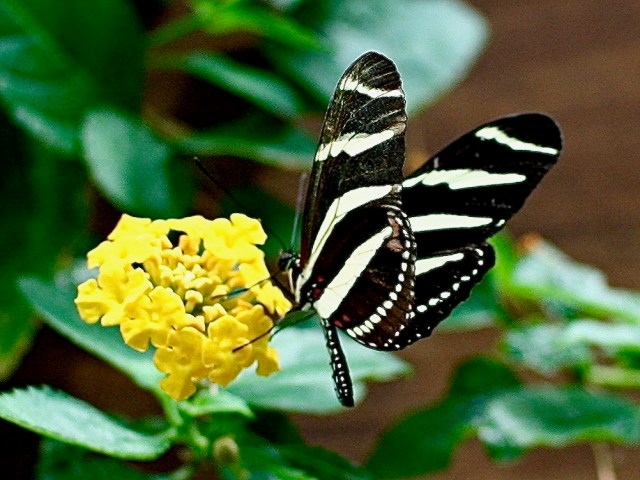
GENERAL CHARACTERISTICS: The wings are long, narrow, patterned with black and yellow stripes. Wing span: 2 3/4 – 4 inches.

DISTRIBUTION/HABITAT: Tropics and subtropics of Central and South America. Also West Indies, Mexico, southern Texas, Florida, and occasionally as far west as New Mexico and north to the Carolinas.  H. charithonia are found in moist forests, edges, and fields.


DIET IN THE WILD: Adults feed on flower nectar and pollen. Larvae feed almost exclusively on the leaves of a few host species of passion flowers (genus Passiflora).

REPRODUCTION: Almost half of the Heliconian species, including the Zebra Longwing, practice a unique mating behavior known as pupal mating. The male seeks out larval host plants to find female pupae of its species, and may fend off other males from one or more pupae for up to a week before the female butterfly emerges. Mating takes place before the female is fully hardened. With the exception of one other species, Heliconians are the only butterflies known to practice this behavior.

PREDATORS:  Taken by birds and larger insects.

REMARKS: Declared the Florida State Butterfly in 1996. Species name refers to the Charities, or Graces, of Greek mythology, known as the epitome of charm and natural beauty. The Zebra Longwing, because of its striking pattern and long life, is a favorite species for butterfly exhibits. This species also practices communal roosting.

References

California Academy of Sciences Rainforest 2017

Ron’s flickr http://www.flickr.com/photos/cas_docents/sets/72157608449327886/with/3259463506/

EOL http://eol.org/pages/147104/details

Bug guide http://bugguide.net/node/view/533

Ron’s WordPress Shortlink  http://wp.me/p1DZ4b-13m

TAXONOMY
Kingdom: Animalia
Phylum: Arthropoda
Class: Insecta
Order: Lepidoptera
Family: Papilionidae

Genus/species: Pachliopta kotzebuea

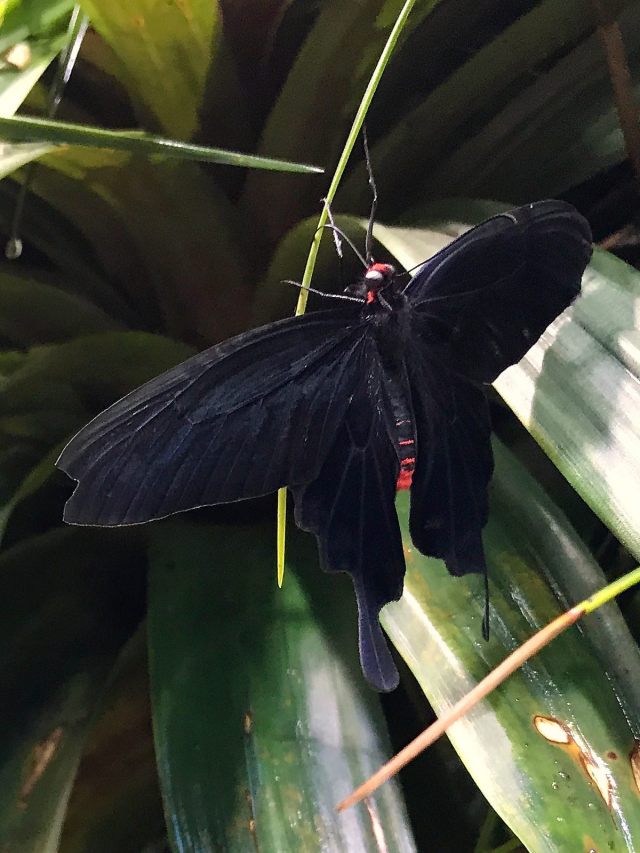
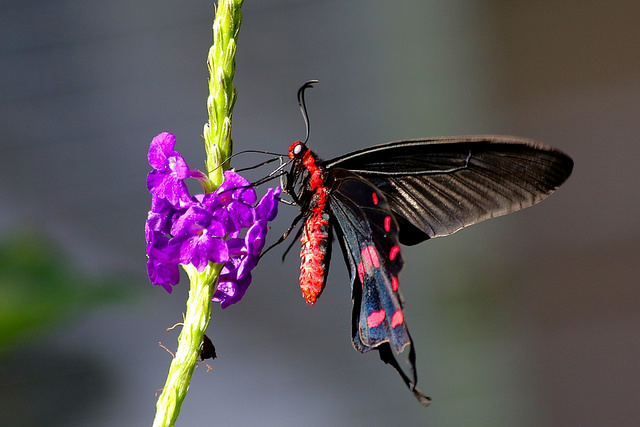
GENERAL CHARACTERISTICS: The Pink Rose’s color is velvet-black dorsally with scarlet red dots ventrally on the tailed wing.

DISTRIBUTION: Philippines

References

California Academy of Sciences 2017

Ron’s flickr https://www.flickr.com/photos/cas_docents/33326378344/in/album-72157608449327886/

Insecta insecta.pro/taxonomy/16366

EOL  http://eol.org/pages/130755/overview

ADW  animaldiversity.org/accounts/Pachliopta_kotzebuea/classif…

Ron’s WordPress Shortlink  http://wp.me/p1DZ4b-1OF


TAXONOMY
Kingdom: Animalia
Phylum: Chordata
Class: Aves (Feathered, winged, bipedal, endothermic (warm-blooded), egg-laying, vertebrates)
Order: Passeriformes (passerines or perching birds) Toes; three pointing forward and one back.
Family: Thraupidae (Tanagers)

Genus/species: Tangara mexicana

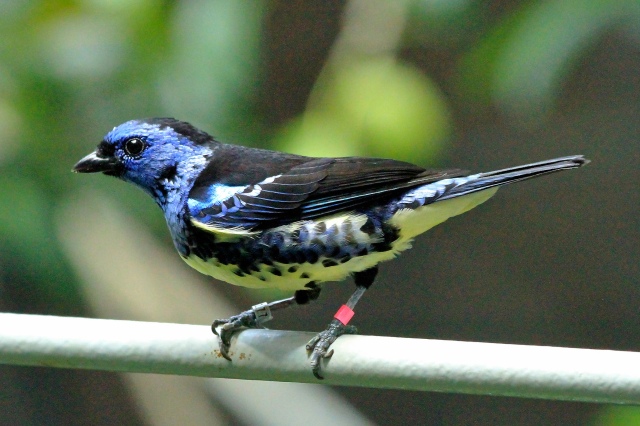
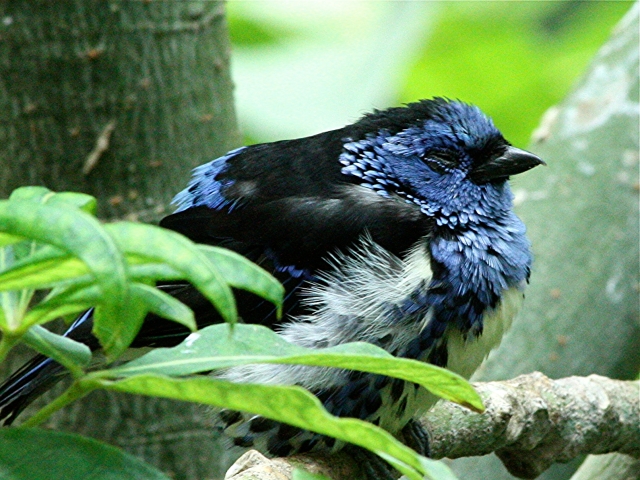
GENERAL CHARACTERISTICS: The adult takes its name from the turquoise face,  sides of the neck, and flanks. The upper parts are extensively black. The belly is a contrasting pale color, light yellow in Amazonia. Sexes are similar. T. mexicana has a long-tail and with a dark stout pointed bill.

Length 14 cm (5.5 inches)

Tangara mexicana9611641554_5dc8bd4f7e_k

DISTRIBUTION/HABITAT: Trinidad, Colombia, and Venezuela, much of Brazil, and south to Bolivia. Found in the canopy of the rainforest, mangroves, open woodland and cultivated areas.

DIET IN THE WILD: Insects and fruit.

REPRODUCTION: Cup nest are made of dead grasses and leaves lined with fine roots on branches, high above the ground. Eggs are whitish, marked with grayish and brown spots. The clutch size is two-three with the female incubating them for 12-14 days.

Call and Map: xeno-canto www.xeno-canto.org/species/Tangara-mexicana?&view=3

Tangara mexicana3044967328_5b81056859_o

CONSERVATION: IUCN Red List Least Concern (LC)

Despite the fact that the population trend appears to be decreasing, the decline is not believed to be sufficiently rapid to approach the thresholds for vulnerable. Also has an extremely large range.

REMARKS: Call: sharp, twittering chirps.

References

California Academy of Sciences Rainforest 2017

Ron’s flickr  http://www.flickr.com/photos/cas_docents/3160948559/in/set-72157608454346681

IUCN Red List www.iucnredlist.org/details/22722807/0

Cornell Lab of Ornithology http://neotropical.birds.cornell.edu/portal/species/identification?p_p_spp=610636

Ron’s WordPress Shortlink  http://wp.me/p1DZ4b-15N


TAXONOMY
Kingdom: Animalia
Phylum: Chordata
Class: Aves (Feathered, winged, bipedal, endothermic (warm-blooded), egg-laying, vertebrates)
Order: Passeriformes (passerines or perching birds) Toes; three pointing forward and one back.
Family: Thraupidae (Tanagers).

Genus/species: Tangara cayana

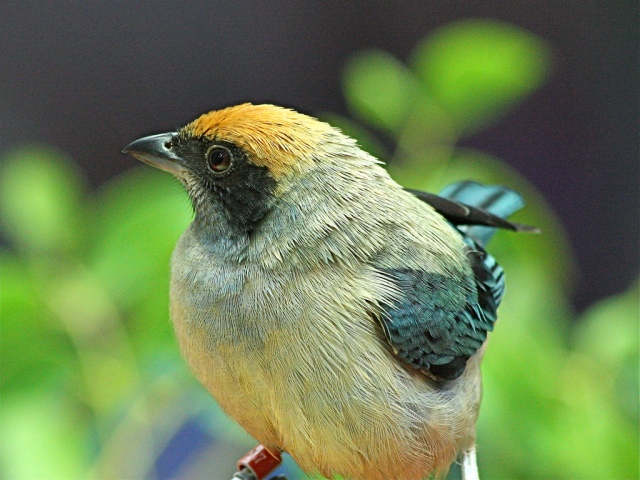
GENERAL CHARACTERISTICS: Males of the cayana group (our group) have an orange-rufous crown, black mask, and cream underparts distinctly tinged blue on the throat and chest. Wings and tail are turquoise. Females are duller than the males, and have black restricted to a poorly demarcated “shadow” of a mask.

Length 13-14 cm (5.1-5.5 inches)

Tangara cayana 3192755611_63af368705_b

DISTRIBUTION/HABITAT: Tropical to sub-tropical areas of South America. Favors tropical moist lowland forests, but also found in open terrain with scattered trees and cultivated areas.

Tangara cayana 3258665043_d18c0223fe_b

DIET IN THE WILD: Mainly fruit.

VOCALIZATIONS:  http://www.xeno-canto.org/explore?query=tangara+cayana

CONSERVATION: IUCN Least Concern due to an extremely large range.

References

California Academy of Sciences Rainforest 2017

Ron’s flickr  https://www.flickr.com/photos/cas_docents/3258665043/in/album-72157608454346681/

Cornell Ornithology http://neotropical.birds.cornell.edu/portal/species/identification?p_p_spp=607916

Cornell (map) https://birdsna.org/Species-Account/nb/species/bubtan2/overview

Encyclopedia of Life eol.org/pages/1052896/details

Ron’s WordPress shortlink http://wp.me/p1DZ4b-1u3


TAXONOMY
Kingdom: Animalia
Phylum: Arthropoda (Jointed Legged Animals)
Class: Insecta (head, usually with two antennae. The thorax, has six legs and usually four wings. The abdomen, is used for breathing and reproduction.)
Order: Lepidoptera (most butterflies and moths)
Family: Nymphalidae (Brush-footed Butterflies)
Subfamily: Brassolidae (owl butterflies and relatives)

Genus/species: Eryphanis automedon

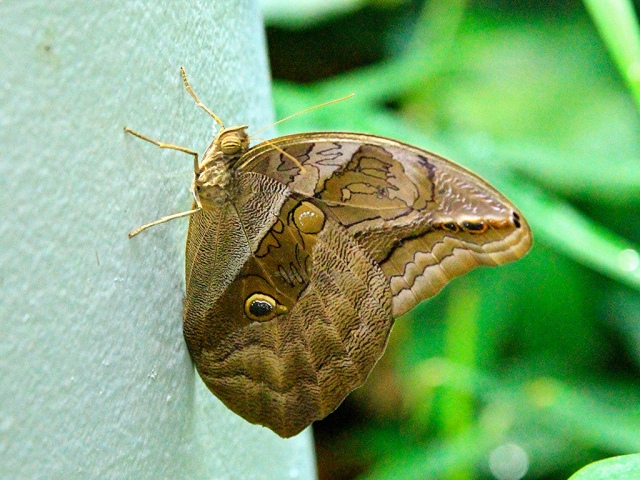
GENERAL CHARACTERISTICS: In males the dorsal sides of the wings show night blue iridescent patches, with well-defined borders separating the non-iridescent sections. (see eol.org/pages/149554/details) The bottom side or Ventral sides vary from faded brown to caramel color, with eyespots.

wing underside

4184513701_c7f7b4e5df_b 

DISTRIBUTION/HABITAT: E. automedon is present from Venezuela to the Guiana’s and Brazil and from Colombia to Paraguay, Found in rainforest and humid deciduous forest,

emerging from the chrysalis


References 

California Academy of Sciences Rainforest 2017

Ron’s flickr  https://www.flickr.com/photos/cas_docents/4184513701/in/album-72157608449327886/

Ron’s WordPress shortlink http://wp.me/p1DZ4b-1vw

EOL eol.org/pages/149554/details

ADW animaldiversity.org/accounts/Eryphanis_automedon/classifi…

breedingbutterflies.com  breedingbutterflies.com/eryphanis-sp-purple-mort-blue/