Category: TEMPERATE MARINE


Phylum Chordata (chordates)


Class Actinopterygii (ray-finned fishes) 
Order Perciformes (Perch-likes) 


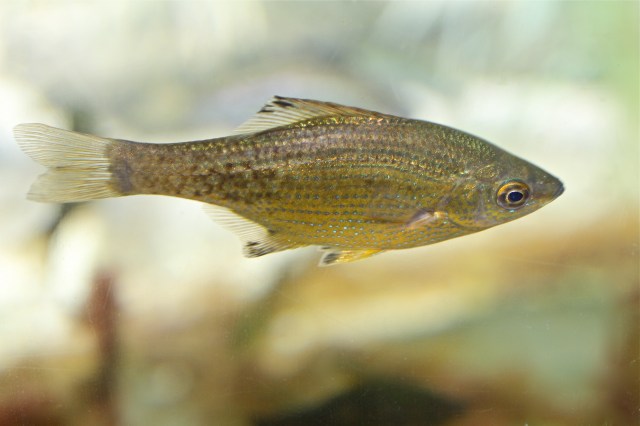
Family Embiotocidae (Surfperches) 


Genus/species Micrometrus minimus 


DISTRIBUTION: Northern British Columbia to central Baja California. 


 HABITAT: Among giant kelp, usually in kelp canopy.

 DIET: Algae and small invertebrates

 REPRODUCTION and DEVELOPMENT: Viviparous ( Livebearer), female carries the developing young. Breed in fall and early winter, spawn in spring.

LOCATION: Salt Marsh Pop_up CC03 and Tidepool CC15  


 flickr http://www.flickr.com/photos/cas_docents/sets/72157626486149324/

WORDPRESS SHORTLINK:  http://wp.me/p1DZ4b-wQ

Class: Actinopterygii, Order: Scorpaeniformes,  Family: Cottidae ( Sculpins)

Oligocottus snyderi 

DISTRIBUTION: Endemic to the Pacific Coast from Alaska to Baja California.

HABITAT: Temperate rocky intertidal pools, especially those with algae or eelgrass and asandy substrate. They don’t migrate but do move between pools. In Central California, dominant in sub- to mid-intertidal pools.

APPEARANCE: Coloration varies greatly from green to reddish brown to pink, depending on the color of the surrounding algae; sides spotted and mottled. Like many sculpins, they have no scales. Cirri line the base of the dorsal fin and the lateral line. The common name refers to a “fluffy” fleshy area behind the dorsal fin. Max. length: 9 cm (3.50 in); average weight: 8 g (0.28 oz). 

DIET: Worms, crustaceans, and other marine invertebrates.

REPRODUCTION: Males use claspers during intercourse for internal fertilization. Eggs are deposited on rocks, and are guarded by the males. O. Synderi develops through larval, post larval, juvenile and adult stages.

REMARKS: Can breathe air for hours at a time, often in response to reduction in the tide pool’s oxygen at night .

LOCATION: Tidepool  CC15

Flickr http://www.flickr.com/photos/cas_docents/sets/72157608359804936/

WORDPRESS SHORTLINK:  http://wp.me/p1DZ4b-vX


Family Poraniidae 

Dermasterias imbricate

DISTRIBUTION: Eastern North Pacific: Alaska to Northern California. 

HABITAT: On rocks and rocky reefs in subtidal areas.  APPEARANCE: Medium size sea star up to 5 Iin or 12 cm in diameter with disproportionately short broad arms with a smooth, slippery surface. Mottled coloring—bluish-grey with brown to orange blotches all over.  Oral side pale and smooth. Smells garlic-like.  

DIET: Mainly sea anemones, but also takes sea cucumbers, sea urchins, and other invertebrates. Leather stars, unlike many other sea stars, such as the ochre, bat, and pink sea stars, swallow their prey whole and digest internally. 

REPRODUCTION/DEVELOPMENT: Releases eggs and sperm; fertilized eggs float in plankton and develop into juveniles, which eventually settle out.

REMARKS: Known to eat the Plumose Anemone (Metridium senile and Metridium farcimen), and the Strawberry Anemone Corynactis californica.

Larger anemones have been observed to fight back by distending the mouth to envelope the attacking star. In the end the leather star often retreats and both the star and the anemone are none the worse for wear. 


LOCATION: Tidepool  CC15    **DisplayIntermittent 

WORDPRESS SHORTLINK   http://wp.me/p1DZ4b-u0

flickr    http://www.flickr.com/photos/cas_docents/sets/72157608501343477/

Phylum Echinodermata, Class Asteroidea, Order Forcipulatida, Family Asteriidae, 

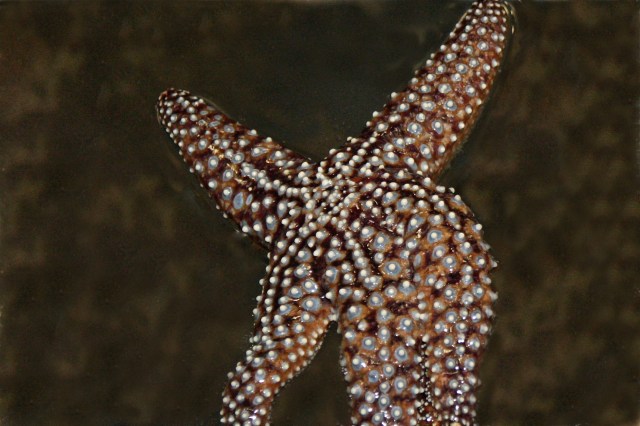
Pisaster gianteus


DISTRIBUTION: Eastern Pacific coast from British Columbia to Baja California.

HABITAT: Rocky but also sandy substrates from middle to lower intertidal zone down to 300 ft or 90 m.

APPEARANCE: Five arms. Can be colored red, orange, brown, or green. Evenly spaced blunt white stubby spines surrounded by blue plaques.  Maximum arm span about 24 in or 60 cm.

DIET: Typical prey are hard-shelled organisms such as mussels, snails, and barnacles. May occasionally eat anything slow-moving enough to be caught, such as dying fish or shellfish, anenomes, or other sea stars.

REPRODUCTION and DEVELOPMENT: Individual sea stars are male or female. Broadcast spawners, both sexes release gametes into the water for external fertilization. Larvae are planktonic and have bilateral symmetry.

MORTALITY/LONGEVITY: Sea gulls and sea otters are sea star predators. Giant sea stars live about 20 years.

TIDEPOOL CC15  

WORDPRESS SHORTLINK  http://wp.me/p1DZ4b-tO

flickr  http://www.flickr.com/photos/cas_docents/sets/72157608501343477/

Phylim Molluska, Class Gastropoda, Family ‪Aeolidioidea,

Aeolidia papillosa


DISTRIBUTION: Common on the Atlantic coast of Europe and North America and the Pacific coast of North America. Also from from both west and east coasts of South America

HABITAT: On rocks, or may be on floats or docks. Often near its perferred prey. Intertidal to 380m deep.

APPEARANCE: Its color appears to be quite variable, depending upon locale and food resources. This large aeolid grows to about 10 cm (4 in)  in length and its body is covered with close obliquely arranged rows of flattened cerata.

DIET: Feeds almost exclusively on sea anemones.

MORTALITY/LONGEVITY:  This species is famous for obtaining undischarged cnidae (cells which bear nematocysts) from its Cnidarian prey and moving to the tips of the cerata , where they are likely used for defense. If disturbed they sometimes wave their cerata. If one of the cerata is broken off, muscles within it contract, expelling the nematocysts, which then discharge . The chemical composition of A. papillosa mucus changes and does not trigger a discharge of nematocysts in the sea anemone.

REPRODUCTION/DEVELOPMENT: Nudibranchs are hermaphroditic, and thus have a set of reproductive organs for both sexes, but they cannot fertilize themselves.

REMARKS: Their eyes are simple and able to discern little more than light and dark. The eyes are set into the body, are about a quarter of a millimeter in diameter, and consist of a lens and five photoreceptors.

 WORDPRESS SHORTLINK: http://wp.me/p1DZ4b-sk


Phylum Molluska, Order: Veneroida, Class: Bivalvia, Family: Veneridae

Venerupis philippinarum

DISTRIBUTION: Native to Japan, Korea and China.  Introduced to British Columbia, Washington, Oregon, Baja California and French Atlantic Coast, and Mediterranean coast..

APPEARANCE: Shell is usually cream or gray, sometimes with green or brown tones, and sometimes stained rusty or black (the latter typical of anoxic mud). It often has patterns of dark brown or black, overlapping, triangular markings  Smaller specimens (up to about 3 cm)  found in muddy sand on the east shore of  San Francisco Bay come in a remarkable variety of hues, including white, tan, yellow, blue and green, The interior of the shell is mostly white, often with dark purple or yellow staining near the hind end and the lower margins of the shell.

DIET: Filter feeder

REMARKS: Global aquaculture production of V. philippinarum is estimated at over 1 million tons/year with a value of around $1.5 billion.

MORTALITY: A variety of organisms have been observed feeding on Venerupis philippinarum on the Pacific coast, including the moon snail Euspira lewisii, the Atlantic oyster drill Urosalpinx cinerea, crabs, bat rays, flounder, sturgeon, willet, gulls, ducks and raccoons, and undoubtedly many others. The small pea crabs Pinnixa faba and Pinnixa littoralis are sometimes found living inside the shells of live Venerupis philippinarum.

At the Steinheart Aquarium V. philippinarum is found in the tidepool where starfishes feed on them in place of mussels which are harder to obtain.   SEE PHOTO BELOW . 

Ochre Sea Star Pisaster ochraceus consuming a Manila Clam.

WORDPRESS SHORTLINK http://wp.me/p1DZ4b-rY

Kingdom Animalia, Phylum Cnidaria, Class Anthoza, Subclass Hexacorillia, Order Actiniara, Family Haluridae.

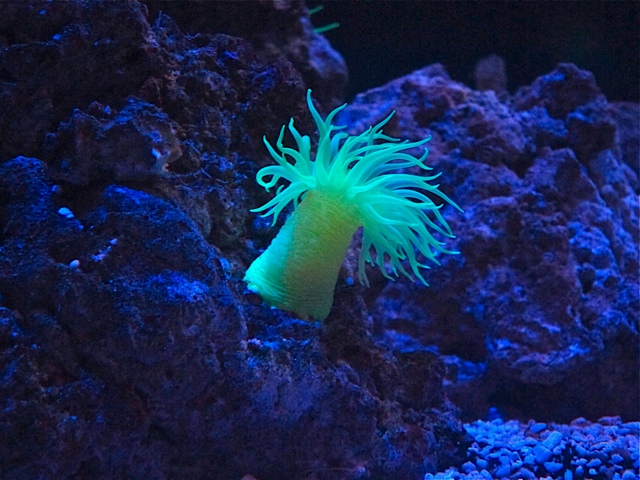
Halcurias carlgreni 

DISTRIBUTION: West North Pacific

HABITAT: From Japans deeper, cooler waters.

REMARKS:  From Rich Ross California Academy of Sciences Biologist.  http://packedhead.net/Last December when Koji Wada of the renowned Blue Harbor visited the Steinhart Aquarium he was kind enough to bring us two stunning Halcurias carlgreni anemones. From Japans deeper, cooler waters, these anemones are jaw droppingly bright and colorful. Currently, they are being kept at 66 degrees in our Nautilus exhibit and both animals seem to be getting along just fine with each other. The Halcurias are being fed thawed frozen mysis via ‘Julians Thing’ every other day, and we hope they will be so happy and full of food that we will have more of them in the near future. They are of course non-photosynthetic.

LOCATION: Nautilus Exhibit

WORDPRESS SHORTLINK  http://wp.me/p1DZ4b-pX


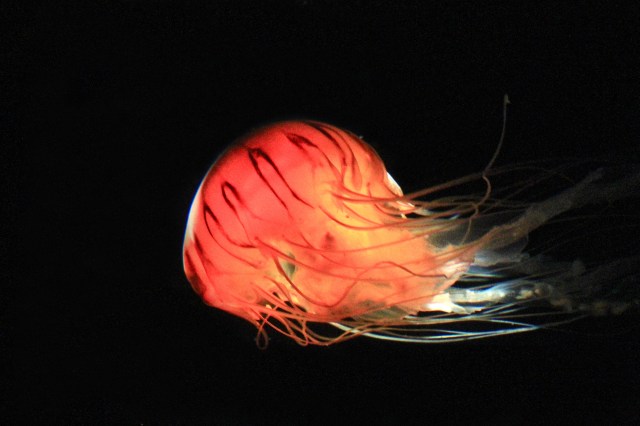
2-17-12 Japanese Sea Nettle from Ron’s Animal Attraction Series (Exhibit)

Phylum Cnidaria, Class Scyphozoa, Order Semaeostomea, Family Pelagiidae 

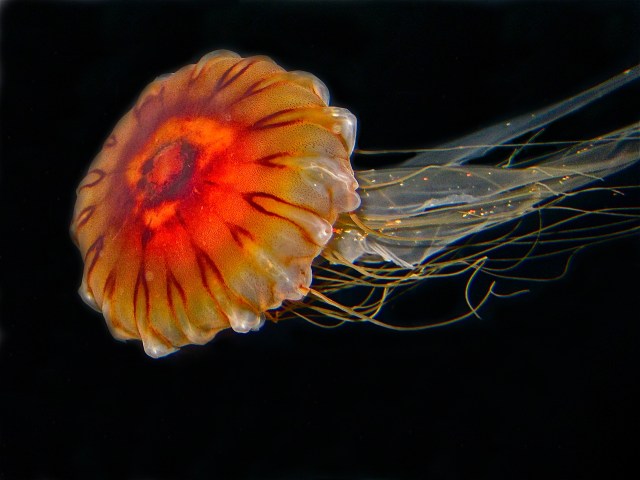
Chrysaora melanaster

DISTRIBUTION: Bering Sea, northern Atlantic, Pacific and Arctic oceans

HABITAT: Ocean surface to 200 meters below  the surface.

APPEARANCE: Their bells are 12 in across white with brown-to-orange stripes, containing up to 32 very long orange-red tentacles and four long lips. They have 16 brown stripes and eight stomach pouches.

DIET: Sea nettles snare prey (fishes, jellies, krill, other small invertebrates) with stinging tentacles that can stretch 6 m (20 ft).

REPRODUCTION: Alternation of life cycles—polyp, medusa.   The drifting jellies shown here represents just one phase of a sea nettle’s life. As adults pulsing through the water, these jellies reproduce sexually. But in another stage of life, on the seafloor, they reproduce without sex.

When spawning, adult sea nettles release clouds of sperm and tens of thousands of eggs a day. Their larvae sink and become polyps (like mini anemones) carpeting the seafloor. As they grow, each polyp buds off asexually producing scores of tiny identical jellies and will become sexual adults.

flickr   http://www.flickr.com/photos/cas_docents/6890184085/in/set-72157629304397467

WORDPRESS SHORTLINK http://wp.me/p1DZ4b-oN 


REF. 1. California academy of Sciences Animal Attractions Exhibit

         2. Shedd Aquarium Fact Sheet