Category: INDO-PACIFIC


TAXONOMY

Kingdom: Animalia
Phylum: Chordata
Class: Chondrichthyes
Subclass: Elasmobranchii
Order: Myliobatiformes
Family: Dasyatidae (Whiptail Stingrays, whip-like tails, which are much longer than the disc)

Genus/species: Himantura uarnak


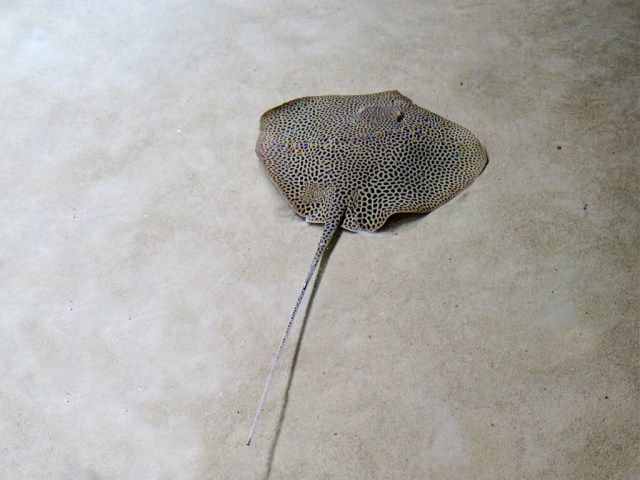
GENERAL CHARACTERISTICS: Disc light brown above with conspicuous dark spots, white ventrally. Tail with bands of black and white, three times the body length. One tail spine. The dark spots are separated in the young ray; in the adult they become crowded together, forming the reticulated pattern from which it gets its name. Snout sharply pointed. Band of flat denticles down the back.
Width up to 2 m (6.5 ft), weigh up to 120 kg (265 lbs).

 Himantura uarnak 18366435141_1e263bfff2_k

DISTRIBUTION/HABITAT: Subtropical, Indo-West Pacific, Red Sea, to southern Africa and French Polynesia, north to Taiwan, south to Australia.

Benthic, found in surf zone, sandy beaches, sandy areas of coral reefs, shallow estuaries and lagoons, down to 90 m (295 ft). It can tolerate brackish water and in India, has been found in the fresh water of Chilka Lake and the Hoogly River, a tributary of the Ganges River.
3300565561_c2b08f97ab_b

DIET IN THE WILD: Main foods: small fish, also bivalves crabs, shrimps, worms and jellies.

REPRODUCTION: Ovoviviparous. Embryos feeding initially on yolk, then receiving additional nourishment from the mother by indirect absorption of uterine fluid enriched with mucus, fat or protein through specialised structures

3300566493_c6e0f406ba_b

REMARKS: Although venomous, it is a popular angling fish due to its being a powerful fighter. It is not a food fish but is used in Chinese medicine.

CONSERVATION: IUCN Red list Vulnerable (VU)

REMARKS: Since their mouths are directed downward and often placed against the sand, stingrays use their spiracles rather than their mouths for water intake.

Stingrays have a spiral valve in their intestine that increases food absorption, and lack a swim bladder.

Although venomous, it is a popular angling fish due to its being a powerful fighter. It is not a food fish but is used in Chinese medicine.

References

California Academy of Sciences, Steinhart Aquarium, Reef Lagoon 2016

Ron’s flickr http://www.flickr.com/photos/cas_docents/sets/72157627919810858/

Ron’s WordPress Shortlink  http://wp.me/p1DZ4b-P8

fishbase  www.fishbase.us/summary/5507

IUCN www.iucnredlist.org/details/161692/0

Encyclopedia of Life  eol.org/pages/1859/details
TAXONOMY
Kingdom: Animalia
Phylum: Chordata
Class:Class: Chondrichthyes (sharks and rays)
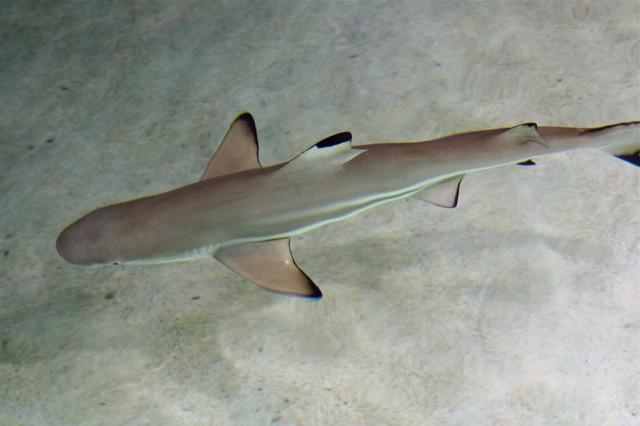
Order: Carcharhiniformes (Ground sharks)
Family: Carcharhinidae (Requiem sharks eg migratory, live-bearing sharks of warm seas)

Genus/species: Carcharhinus melanopterus

GENERAL CHARACTERISTICS:
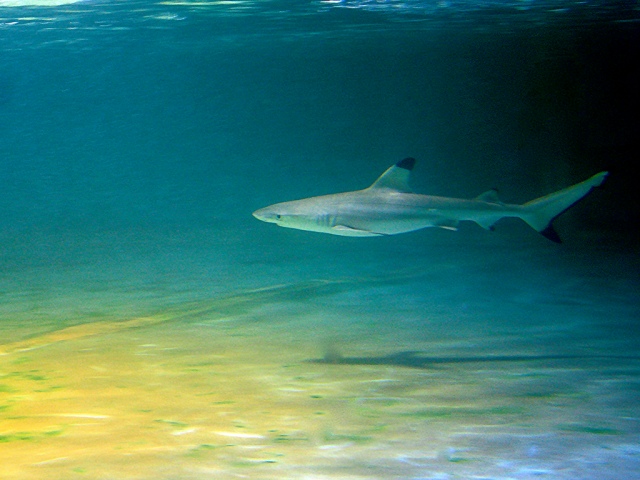
All fins tipped with black, the large dorsal fin with a white band beneath the black tip, conspicuous white bands along flanks, sometimes edged with black. Otherwise, yellowish-tan above, white below.
Length up to 2 m (6.5 ft) long and weight up to 13.6 kg (30 lbs)

Carcharhinus melanopterus2979831615_73451da081_b

DISTRIBUTION: Subtropical from Red Sea and East Africa to the Hawaiian Islands and the Tuamoto Archipelago. Also enters the Mediterranean from the Red Sea (via the Suez Canal). Prefers inshore coral reefs and the intertidal zone. Has been observed in mangrove areas and fresh water, traveling in and out with the tide.

DIET IN THE WILD: Teleost fishes sea snakes. Predation upon other elasmobranchs was rare.

REPRODUCTION: C. melanopterus is viviparous, incubating young for up to 16 months, producing 2–4 pups per litter. In a fashion not uncommon in sharks, the male takes the female’s pectoral fin in his teeth and the two mate belly to belly.

3267104972_6214b0cc45_b

PREDATORS: Preyed upon by other sharks as well as large groupers. Average lifespan c. 12 years

CONSERVATION: IUCN Near threatened (NT) 2015-4
The Blacktip Reef Shark is not a target of major fisheries, but is regularly caught by inshore fisheries in India and Thailand. It is caught for human consumption, fishmeal, and their fins enter the oriental sharkfin trade, for sharkfin soup. Their livers are also sought as a rich source of oil.

REMARKS: Often hunt in packs, driving prey into a tight ball and then attacking the ball in a feeding frenzy, even leaping out of the water. Its distinctive appearance and active swimming habit make it a favorite specimen for aquariums. It has been known to bite people wading in shallow water and is aggressive towards spear fishers.

References

Californiua Academy of Sciences Steinhart Aquarium Reef Lagoon 2-2-16

References

Californiua Academy of Sciences Steinhart Aquarium Reef Lagoon 2-2-16

Ron’s flickr https://www.flickr.com/photos/cas_docents/2979831615/in/album-72157627919810858/

Ron’s WordPress shortlink  http://wp.me/p1DZ4b-1DM

arkive  www.arkive.org/blacktip-reef-shark/carcharhinus-melanopte…

fishbase www.fishbase.org/summary/SpeciesSummary.php?&genusnam…

IUCN: www.iucnredlist.org/details/39375/0

fishbase www.fishbase.org/summary/SpeciesSummary.php?&genusnam…

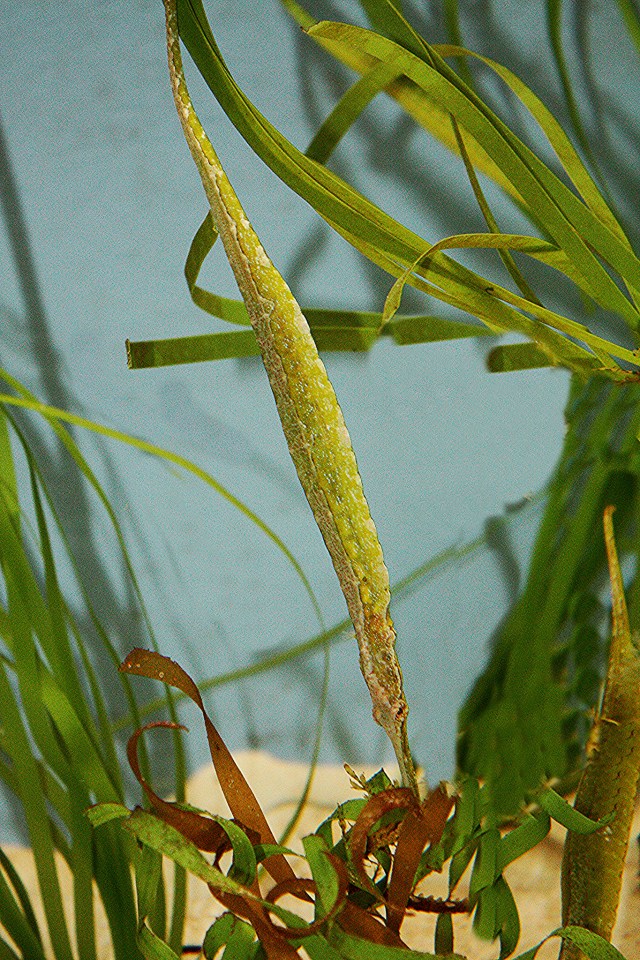
Color of Life, Color Conceals. Shape and color provide excellent camouflage. It also is an inefficient swimmer, moving by an undulating motion of its pectoral and dorsal fins blending into the grass.

TAXONOMY
Kingdom: Animalia
Phylum: Chordata
Class: Actinopterygii (ray-finned fishes)
Order: Syngnathiformes (Pipefishes and seahorses)
Family: Syngnathidae (Pipefishes Seadragons and seahorses)

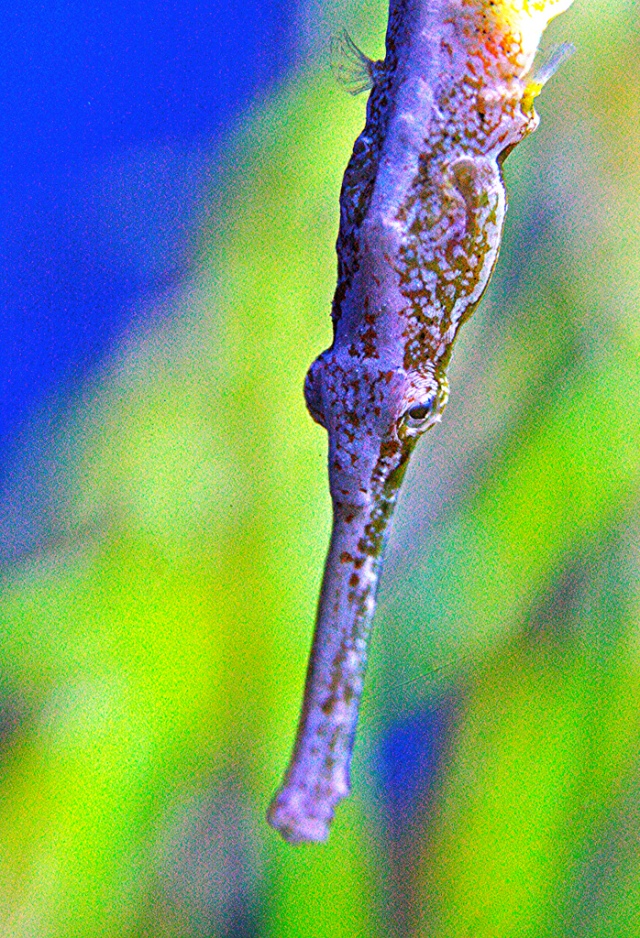
Genus/species: Syngnathoides biaculeatus

GENERAL CHARACTERISTICS: Slender tetrahedral body; variably colored green to brown or grey, reportedly depending on habitat. Bony plates on skin form a series of protective rings. Distinct tubular snout with no jaw.
Length up to 29.0 cm

22510763066_31ff260215_k

DISTRIBUTION/HABITAT: Red Sea; South Africa to Samoa,
north to southern Japan, south to eastern Australia.
Found in protected coastal shallows over or among algae, seagrasses, or floating weeds. Juveniles occasionally found near the surface.

DIET IN THE WILD: Minute invertebrates and fish larvae.

Alligator pipefish3888361153_13247050f2_b-2

REPRODUCTION: Ovoviviparous. The male carries the eggs in a brood pouch protectively located under his prehensile tail.

IUCN Red list Data deficient

3889153622_43d96aff7f_b

REMARKS: The prehensile tail is long and tapering and lacks a tail fin. It is used to anchor the fish to vegetation.

Used in Chinese medicine to extract Hailong.

References

California Academy of Sciences Color on the Reef Exhibit 2015

Ron’s flickr https://www.flickr.com/photos/cas_docents/22510763066/in/album-72157608441047857/

fishbase fishbase.org/summary/Syngnathoides-biaculeatus.html

IUCN Red List www.iucnredlist.org/details/40715/0

EOL eol.org/pages/995073/details

Ron’s WordPress shortlink  http://wp.me/p1DZ4b-1Bu

TAXONOMY
Kingdom: Animalia
Phylum: Cordata
Class: Actinopterygii (ray-finned fishes
Order: Perciformes (Perch-likes)
Family: Zanclidae (Moorish idol)

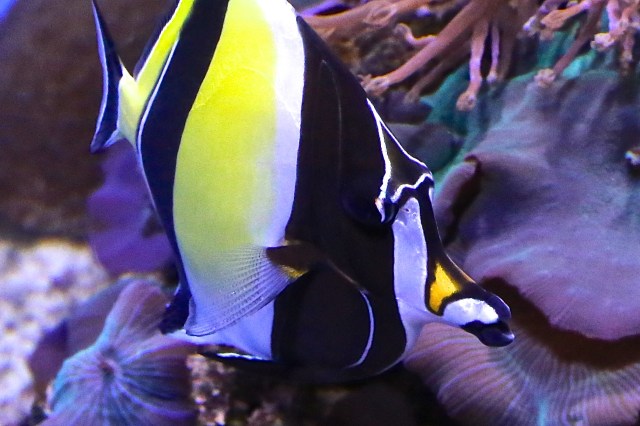
Genus/species: Zanclus cornutus


GENERAL CHARACTERISTICS: Discoid body, tubular snout, dorsal spines elongated into a very long white whip-like filament. Broad vertical white, black, white-yellow black, yellow banding. Tail black with white margin. Length to 23 cm (9 inches).

DISTRIBUTION/HABITAT: Indo-pan-Pacific. Southern Gulf of California found near hard substrates from turbid inner harbors and reef flats to clear seaward reefs as deep as 182 m (600 ft). Usually in small groups of conspecifics, occasionally in schools of more than 100.                 

 DIET IN THE WILD: Primarily sponges. Also consumes tunicates and algae.

 REPRODUCTION: It has a long larval phase and settles at a large size (6 cm or 2.4 in) resulting in its very wide geographic distribution.

 CONSERVATION: Not evaluated

REMARKS: The Moorish Idol was the icon of the Golden Gate Park Steinhart Aquarium.

Gill, was the leader of the tank fish in the movie Finding Nemo, with the voice of Willem Dafoe, is a Moorish idol.

Color of Life, Color on the Reef, Color Conceals, Hiding the eye.
Black stripes break up the body outline and hide the eye from predators.

IMG_3304

 Philippine Coral Reef  

 Ron’s flickr http://www.flickr.com/photos/cas_docents/sets/72157608440659805/

Ron’s  WordPress Shortlink  http://wp.me/p1DZ4b-Ax

fishbase: http://www.fishbase.org/summary/5950

EOL http://eol.org/pages/204516/hierarchy_entries/44696397/details

TAXONOMY

Kingdom: Animalia
Phylum: Chordata
Class: Actinopterygii (ray-finned fishes)
Order: Perciformes (Perch-likes)
Family: Callionymidae (Dragonets)

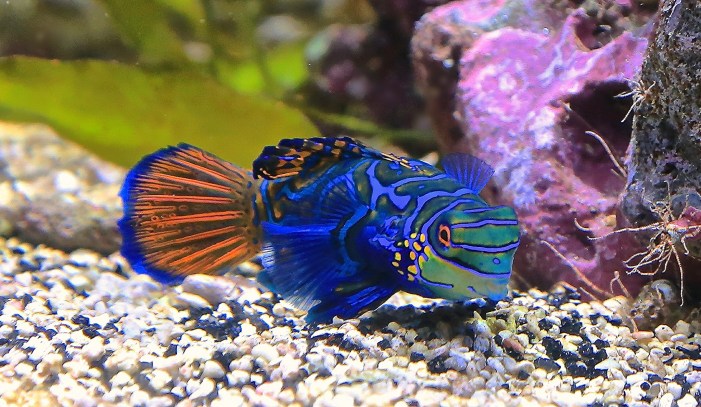
Genus/species: Synchiropus splendidus

GENERAL CHARACTERISTICS: Body depressed, small head. Ground color green (rare individuals red). Body covered with dark blue blotches ringed with dark outlines. Pectoral fins, face yellow.
Length to 6 cm (2.36 in).

Synchiropus splendidus15148891995_e1b96e57d4_k

DISTRIBUTION/HABITAT: Western Pacific in shallow protected lagoons and inshore coral reefs with silty substrates 1 to 18 m
(3.28 to 59 ft).

DIET IN THE WILD: Small crustaceans such as amphipods and isopods, small worms and protozoans.

Green Mandarinfish aka Mandarin Dragonet3274882181_969702e800_b

REPRODUCTION: Polygynandrous (promiscuous). During spawning they are pelagic and are seen in the open ocean.

LIFESPAN: 10-15 years in the wild.

CONSERVATION: IUCN Not Evaluated

Color of Life: aposematic warning
S. splendidus have a vibrant display of colors. They secrete mucous that has an unpleasant smell with toxins and a bitter taste which is used as a repellent from predators.

References

California Academy of Sciences exhibit 2015

fishbase www.fishbase.org/summary/12644

Animal Diversity Web animaldiversity.org/accounts/Synchiropus_splendidus/

Ron’s flickr https://www.flickr.com/photos/cas_docents/15148891995/in/album-72157659465376212/

Ron’s WordPress shortlink http://wp.me/p1DZ4b-1Ba


https://www.flickr.com/photos/cas_docents/6427211687/in/album-72157652559028013/

TAXONOMY
Kingdom: Animalia
Phylum: Chordata
Class: Actinopterygii (Ray-finned fishes)
Order: Tetraodontiformes (Puffers and filefishes)
Family: Tetraodontidae (Puffers)

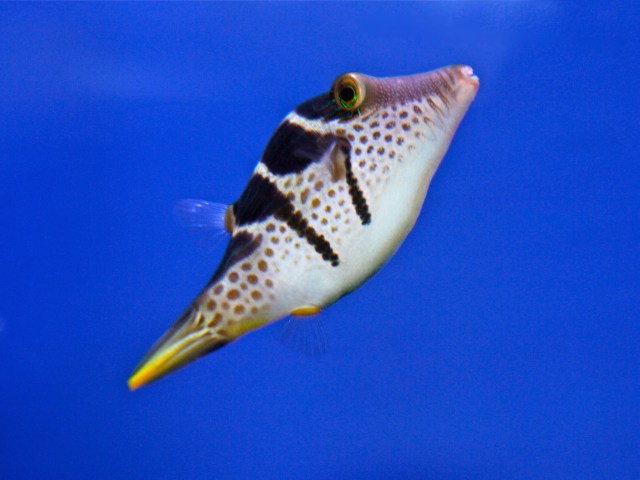
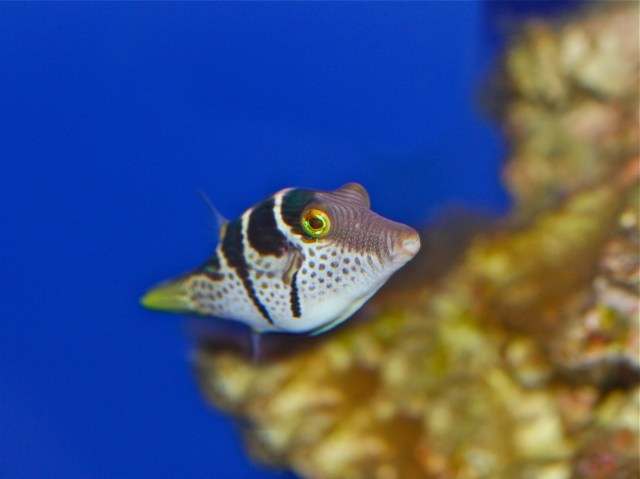
Genus/species: Canthigaster valentini

GENERAL CHARACTERISTICS: C. valentini has a white body with four distinct black stripes on the upper half. The body is also covered with brownish-orange dots. It has yellow fins, and blue striping running along the back. It lacks pelvic fins, but has learned to use the pectoral fins to move about the aquarium.
Males have blue-green lines radiating from the back of the eyes. They are also larger than females and may also have a light gray patch in front of the anus.

DISTRIBUTION/HABITAT: Occurs throughout the tropical, marine Indo-Pacific where it is common and locally abundant. It inhabits a wide range of coral reef and seagrass habitats at depths ranging from 1 to 55 metres.

DIET IN THE WILD: Forages on the benthos, feeding mainly on filamentous green and red algae, tunicates, and on smaller amounts of corals, bryozoans, polychaetes, echinoderms, mollusks.

CONSERVATION: IUCN Red List Least Concern (LC)

REMARKS: They are capable of inflating their abdomens with water when frightened or disturbed.
They can produce toxins such as tetrodotoxin and saxitoxin in the skin, gonads, and liver. Try not to use a net when handling this fish since it’s flesh is poisonous.The degree of toxicity varies by species, and also according to geographic area and season.

Color of Life:Color Communicates. The Mimic filefish (not shown here) evades predators by mimicking the Sharpnose Puffer (Canthigaster valentini).

The Mimic filefish can be distinguished from the Sharpnose Puffer (highly poisonous) by comparing their dorsal fins. The Mimic filefish has two dorsal fins, while the Sharpnose Puffer above has only one. – See more at: australianmuseum.net.au/blacksaddle-filefish-paraluteres-…

LOCATION:  COLOR CLUSTER   


References

California Academy of Sciences Color on the Reef exhibit 2015

Ron’s flickr https://www.flickr.com/photos/cas_docents/6427211687/in/album-72157652559028013/

Ron’s WordPress shortlink:  http://wp.me/p1DZ4b-iz

Australian Museum  australianmuseum.net.au/blacksaddle-toby-canthigaster-val…

Encyclopedia of life  eol.org/pages/225023/overview


TAXONOMY
Kingdom: Animalia

Phylum: Chordata
Class: Actinopterygii (ray-finned fishes)
Order: Perciformes (Perch-likes)
Family: Acanthuridae (Surgeonfishes, tangs, unicornfishes)

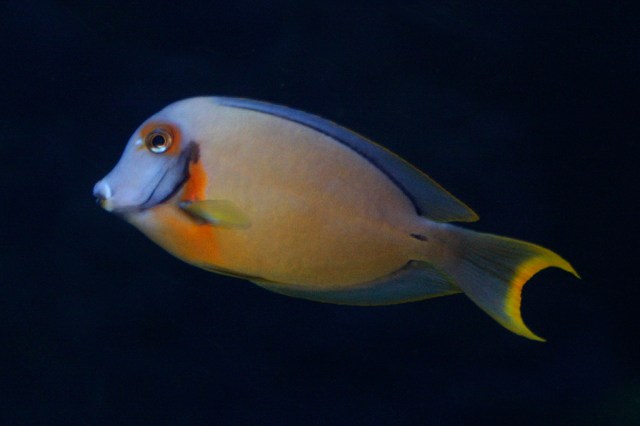
Genus/species: Acanthurus pyroferus

Acanthurus pyroferus3161779234_fc0fccc624_b

GENERAL CHARACTERISTICS: Adults have a
purplish-black to brown body; curving black band from chin to upper edge of the operculum; orange patch above base of pectoral fin.
Length to 25 cm. (10 in).
Front of juvenile’s body (“face”) is gray; body is white anteriorly and dark posteriorly. Dark-colored caudal fin rounded in juveniles.

DISTRIBUTION/HABITAT: Indonesia, Philippines, Micronesia to Polynesia, Japan to New Caledonia and the Great Barrier Reef.  Found in lagoon and seaward reefs from 12–200 ft.

DIET IN THE WILD: Algae.

REPRODUCTION: Following external fertilization female scatters eggs over open water substrate: eggs not guarded.

CONSERVATION: IUCN Least Concern

COLOR OF LIFE NOTE: Anti-predator Adaptations, Mimicry.

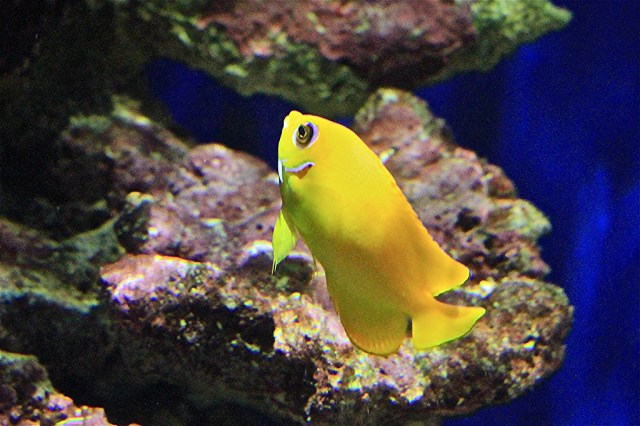
The common name “mimic” is based on the juvenile coloration; juveniles exhibit three different color patterns mimicking angelfish in the Centropyge genus. Coloration of juveniles mimics these angelfishes until they achieve the largest size attained by the angelfishes; then their appearance transforms to the appropriate adult coloration for A. pyroferus.
Juveniles mimic Centropyge spp. (in Guam, juveniles mimic C. flavissimus see below).

Centropyge flavissima6764335749_c4befc1269_b

Philippine Coral Reef 

REFERENCES

California Academy of Sciences Color of Life exhibit 2015

fishbase www.fishbase.se/summary/4742

Ron’s flickr  https://www.flickr.com/photos/cas_docents/2989062467/in/set-72157608332652056/

Ron’s WordPress shortlink  http://wp.me/p1DZ4b-1fA

EOL  http://eol.org/pages/211470/details


TAXONOMY
Kingdom: Animalia
Phylum: Mollusca
Class: Cephalopoda
Order: Sepiida
Family: Sepiidae (Cuttlefishes, shell internalized)

Genus/species: Sepia bandensis

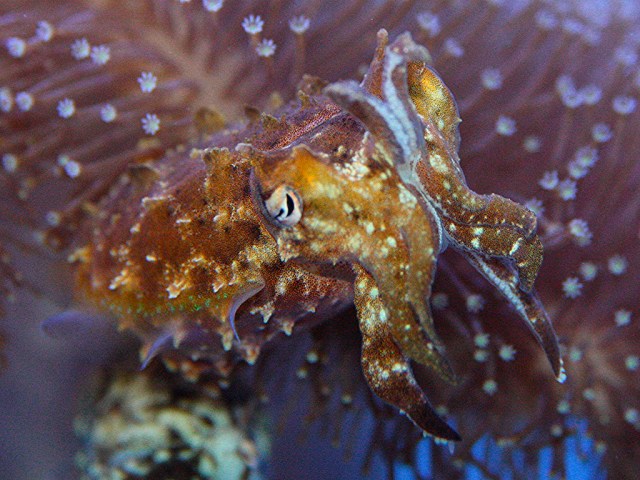
GENERAL CHARACTERISTICS:. Sepia bandensis has 8 arms with rows of suckers along each and 2 feeding tentacles. It moves by the undulation of lateral fins that surround the body. Cuttles have an internal shell within their bodies that they can fill with more or less gas to create neutral buoyancy. The cuttlebone is often collected and used as a calcium supplement, beak sharpener, and all-purpose toy for caged birds.
Like most cephalopods, cuttlefish have 3 hearts. Two hearts pump blood to the gills, and a central heart pumps oxygenated blood to the body.
Length: 5 cm – 10 cm (2 in – 4 in)

3953684509_d8a7ff53db_b

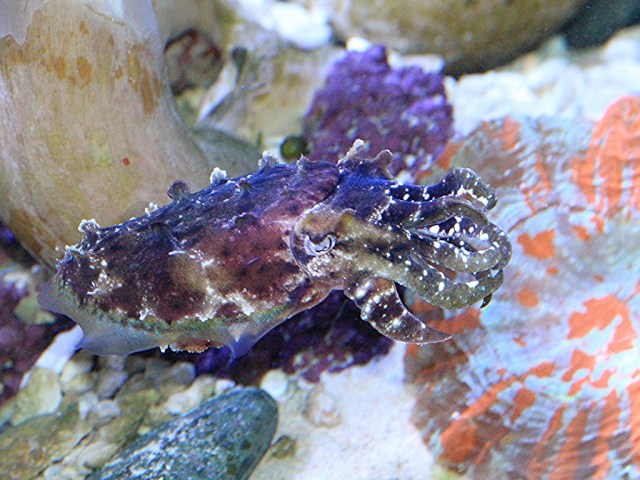
DISTRIBUTION/HABITAT: The Indo-Pacific region, including the Philippines, Indonesia, and Papua New Guinea.
Found in shallow coastal waters near or on coral reefs or sandy substrates.

4155077422_fbdca1e012_b

DIET IN THE WILD: Crustaceans and fish. The Cuttlefish changes colors and patterns as it approaches prey then ejects its feeding tentacles to capture its prey with its suckers and eating it with a parrot-like beak and a radula. Active diurnally.

ACADEMY DIET: Shrimp and crab (M Avila, staff biologist)

6502617393_a6e58de35b_b

LONGEVITY: Life span: 6 mos. to 3 yrs.

eggs below

5519039392_2b09a5da70_o

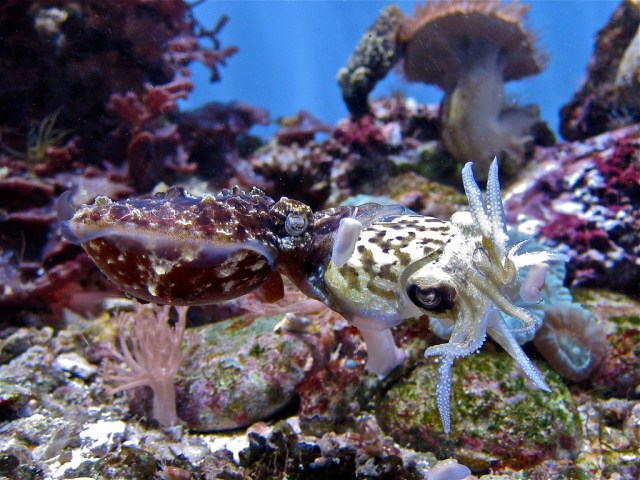
REMARKS: Masters of camouflage, cuttlefish and most cephalopods can change their colors, shapes and textures in seconds to avoid predators and blend into their surroundings. They have keen vision, but are color blind.

They also produce large amounts of ink, both as a decoy and foul-tasting deterrent. Known as sepia ink, after the genus name of cuttlefish, it was a dye once prized by artists.

The Steinhart Aquarium is the first institution in the U.S. to breed dwarf cuttlefish. To date, (2010) more than 350 have hatched at the Academy, most of which have been sent to other aquaria and research institutions. Quote from Rich Ross, Academy biologist and cuttlefish breeder extraordinaire: Over time, [cuttlefish] learn to recognize and respond to you, and will often greet you when you walk into the room (or maybe they just know you bring the food). 

Color of Life note: Cuttlefish are excellent examples of cryptic coloration. Chromatophores in the cuttlefish skin are controlledneurologically, allowing almost immediate color change disappearing into its background right before your eyes.
Ref: California Academy Color of Life exhibit

References 

California Academy Color of Life exhibit

The Marine Biology Coloring Book 2nd Ed. Thomas Niesen 2000

EOL Encyclopedia of Life  eol.org/pages/591499/details

Ron’s flickr  https://www.flickr.com/photos/cas_docents/3953684359/in/album-72157652559028013/

Ron’s WordPress shortlink    http://wp.me/p1DZ4b-1yp

TAXONOMY
Kingdom: Animalia
Phylum: Chordata
Class: Actinopterygii (ray-finned fishes)
Order: Perciformes (Perch-likes)
Suborder: Anabantoidei, (accessory breathing organ known as the labyrinth organ).
Family: Osphronemidae (Gouramies)

Genus/Species: Macropodus opercularis

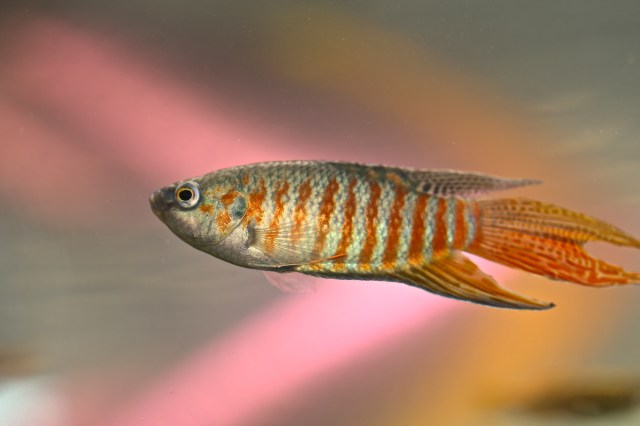
Paradisefish IMG_7999

GENERAL CHARACTERISTICS: Common length : 5.5 cm (2 inches). Can reach 10 cm (4 inches). Conspicuous dark brown opercular spot with whitish posterior margin (margin red in life); body with 7-11 bold, dark bars on a light background. Caudal fin forked, both lobes elongate with filamentous extension in each lobe

DISTRIBUTION/HABITAT: Native to East Asia from Korea to Northern Viet Nam. Introduced elsewhere. Air breather preferring, slow-moving or still habitats, ranging from irrigation ditches, rice paddies, streams and stagnant ponds to marshes and the backwaters of major rivers.

DIET IN THE WILD: Omnivore consuming planktonic invertebrates and smaller fish. 

REPRODUCTION: The males build bubble nests . After courtship, the male wraps himself around the female in a nuptial embrace during which he fertilizes eggs released by the female. He then gathers up the eggs in his mouth and blows them into the nest. . The male then tends the eggs until they hatch about 36 hours later.

CONSERVATION: IUCN Red List; Least concern.  M. opercularis has a large distribution area and there are no known widespread threats to this species.

REMARKS: Used as predators of mosquito larvae and to control Dengue Fever.

These fish are thought to be one of the first fish introduced to Europe as an ornamental fish, in the mid 1800s.

Males must be kept separate from each other in tanks to prevent fighting,

Rainforest Borneo BO09

References

fishbase  http://www.fishbase.org/summary/Macropodus-opercularis.html

Encyclopedia of Life   http://eol.org/pages/203995/details

Ron’s flickr http://www.flickr.com/photos/cas_docents/sets/72157627795872023/

Ron’s WordPress shortlink http://wp.me/p1DZ4b-17z

TAXONOMY
Kingdom: Animalia – animals
Phylum: Echinodermata Klein – echinoderms
Subphylum: Eleutherozoa
Superclass: Cryptosyringida
Class: Ophiuroidea – basket stars, brittlestars, snake stars
Order: Ophiurida – basket stars, serpent stars, basket stars, serpent stars
Suborder: Iohiura incrassata
Family Ophiodermatidae

Genus/species: Ophiarachna incrassata

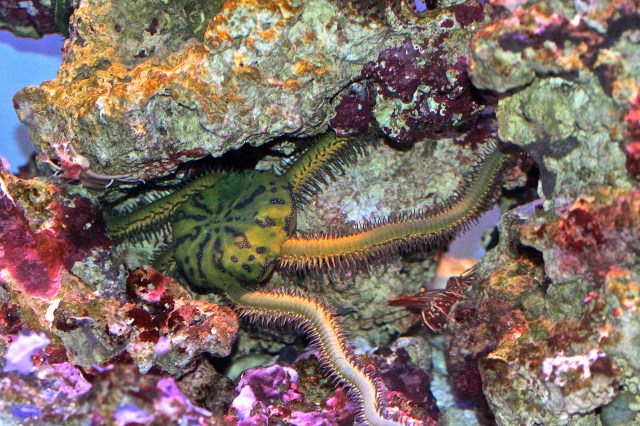
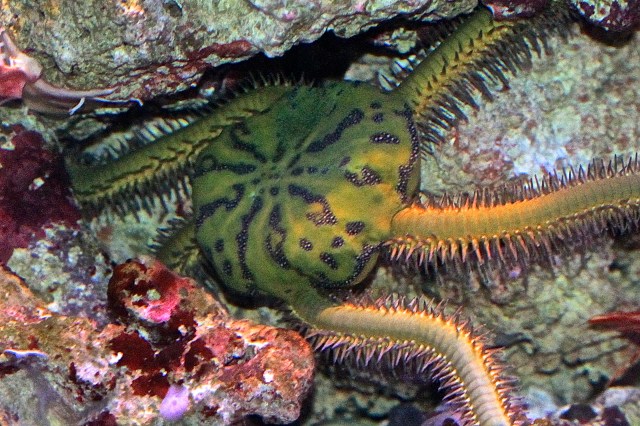
GENERAL CHARACTERISTICS: Green with yellow markings and dark-ringed white spots. Disc diameter to 5 cm (2 inches) and arm length to 20 cm (8 inches). Top of arms are wide and flat.

Stout Green Brittle Star8412648309_4004cdfca2_k

DIET IN THE WILD: Nocturnal feeder of  small organisms and detritus.

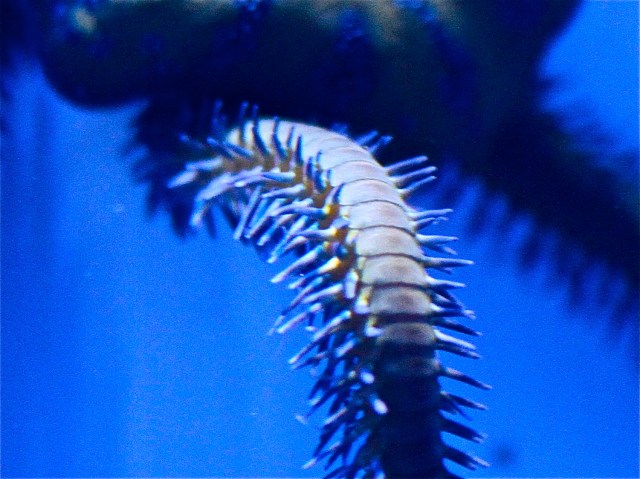
Stout Green Brittle Star4472769084_f4acdf93f2_o

DIET IN THE WILD: Small organisms and detritus. Nocturnal feeder.

Stout Green Brittle Star8282559749_1cb63a02d1_oReferences

Ron’s flickr  https://www.flickr.com/photos/cas_docents/8412648309/in/set-72157608501343477/

Encyclopedia of life  eol.org/pages/598310/details

Reef Creature Identification, Humann and Deloach 2010, page443

ADW animaldiversity.ummz.umich.edu/accounts/Ophiarachna_incra…

Ron’s WordPress shortlink  http://wp.me/p1DZ4b-1mb