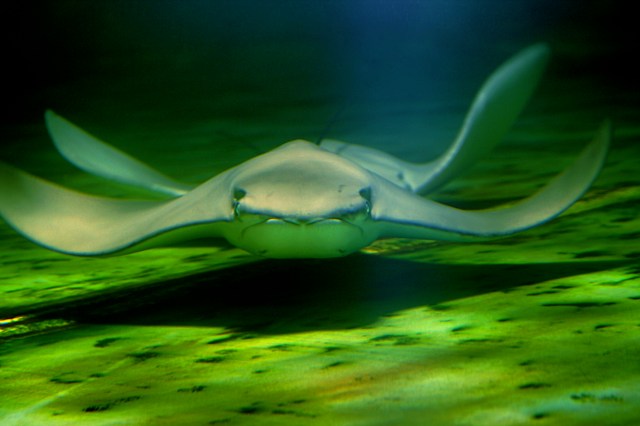
Category: INDO-PACIFIC


TAXONOMY
Kingdom: Animalia
Phylum: Chordata
Class: Actinopterygii (ray-finned fishes)
Order: Perciformes (Perch-likes)
Family: Pomacanthidae  (Angelfishes)

Genus/species: Centropyge flavissima

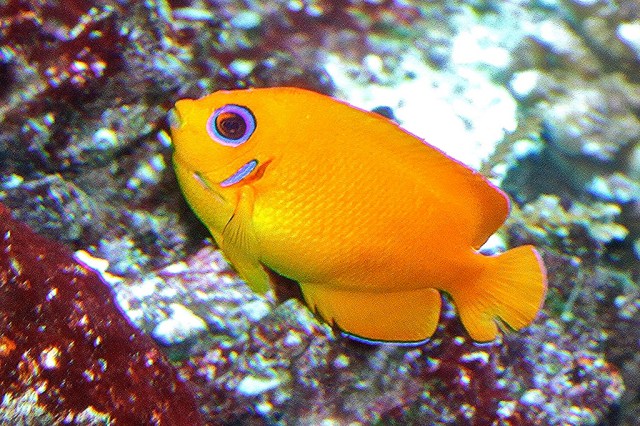
GENERAL CHARACTERISTICS: Yellow dwarf angelfish with blue eye ring, blue margin to the opercular cover and to dorsal, anal, and caudal fins. A preopercular spine common to angelfishes is present.

Max. size: 14 cm (5.5 in)

6764335749_c4befc1269_b

DISTRIBUTION/HABITAT: West-central Pacific among coral reefs in shallow lagoons.

DIET IN THE WILD The Lemonpeel Angelfish feed on algae and corals.

REPRODUCTION: As with other dwarf angels, they are sequential protogynous hermaphrodites. They start out sexually undifferentiated, develop into females, and with environmental influences, may develop into males. Males are typically larger.
6179231037_10696ec959_b

LONGEVITY: Reported 11 years in captivity.

CONSERVATION:  IUCN Least concern (LC)

REMARKS: The Juvenile Acanthurus pyroferus (Mimic Surgeonfish) is a mimic surgeonfish or tang. It looks similar to the adult Centropyge flavissima (an angelfish) which is presumably an advantage as the adult angelfish has a sharp preopercular spine, while the young Mimic Surgeonfish has small, ineffective immature peduncular spines.


References

California Academy of Sciences Steinhart Aquarium Philippine Coral Reef 2016

The Australian Museum australianmuseum.net.au/lemonpeel-angelfish-centropyge-fl…

Ron’s WordPress shortlink  http://wp.me/p1DZ4b-J

IUCN www.iucnredlist.org/details/165878/0

flickr  http://www.flickr.com/photos/cas_docents/6764335749/in/set-72157606840726733/

EOL  http://eol.org/pages/210322/details

fishbase   http://www.fishbase.se/summary/5457
TAXONOMY
Kingdom: Animalia
Phylum:Chordata
Class: Actinopterygii (ray-finned fishes)
Order: Perciformes (Perch-likes)
Family: Labridae (Wrasses)

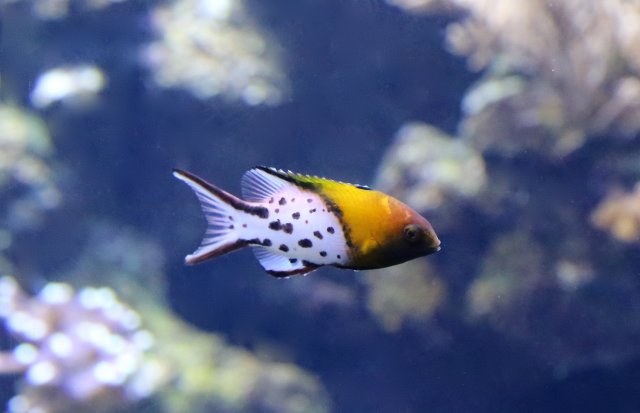
Genus/species: Bodianus anthioides

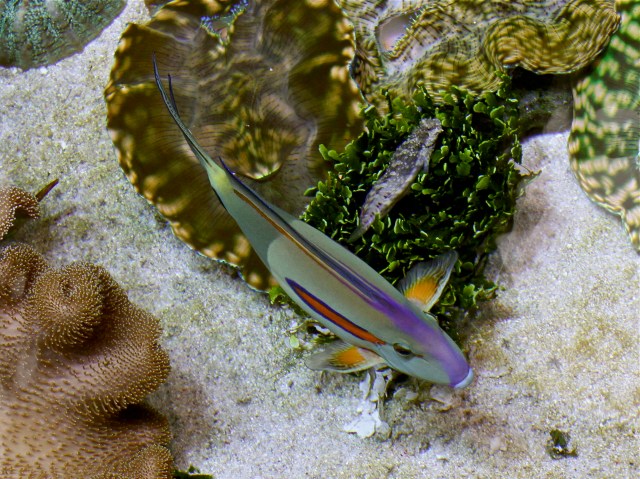
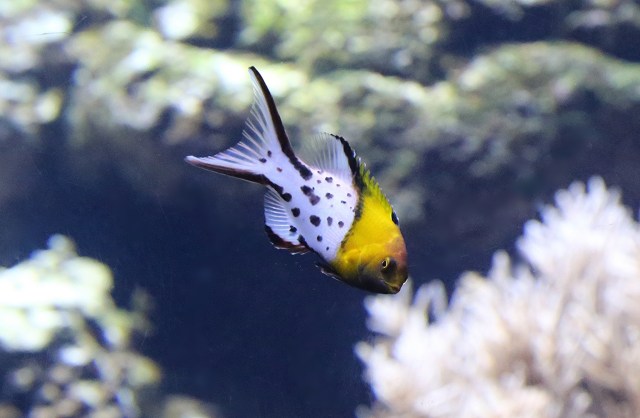
GENERAL CHARACTERISTICS: Brown head and forebody with a long pig-like snout, white rear body with scattered brown spots and a deeply forked tail.

Max length: 24.0 cm (9.5 in)

25762047822_9709aa1a9e_k

DISTRIBUTION/HABITAT: Tropical Indian Ocean inhabiting seaward reefs at depths of 20–60 m (65- 200 ft).

DIET IN THE WILD: The Lyretail Hogfish is a benthic (bottom) feeder of invertebrates and small crustaceans.

REPRODUCTION: They are oviparous with distinct pairing during breeding.

25894961095_960b8b3ea7_k

CONSERVATION: IUCN Red List Least Concern (LC)

REMARKS: Hogfish definition: Any of various wrasses of the genus Bodianus. Also described as possessing a very elongated snout which it uses to search for crustaceans buried in the sediment. Interestingly it is from this very long “pig-like” snout and its rooting behavior that the hogfish gets its name.

References

California Academy of Sciences Steinhart Aquarium Philippine coral reef 2016

Reef Fish Identification of the Tropical Pacific, Allen et al. Odyssey Pub. 2003 p.230

Ron’s flickr www.flickr.com/photos/cas_docents/albums/72157625992053826/

fishbase  www.fishbase.org/summary/SpeciesSummary.php?genusname=Bod...

EOL eol.org/pages/216945/details

IUCN www.iucnredlist.org/details/187715/0

Ron’s WordPress Shortlink  wp.me/p1DZ4b-1FE


TAXONOMY
Kingdom: Animalia
Phylum: Chordata
Class: Actinopterygii (ray-finned fishes)
Order: Perciformes (Perch-likes)
Family: Acanthuridae (Surgeonfishes, tangs, unicornfishes)

Genus/species: Acanthurus achilles

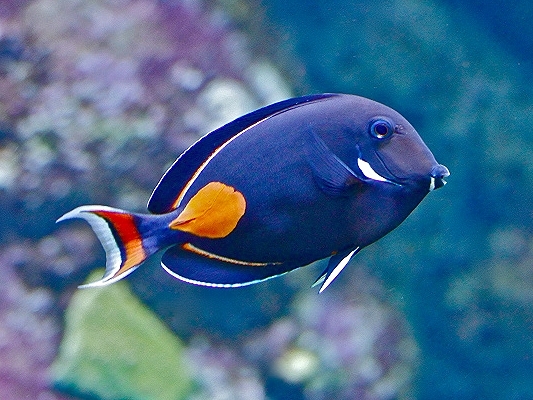
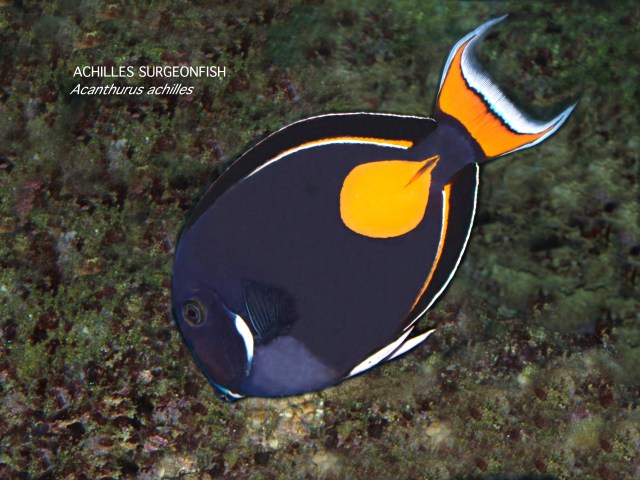
GENERAL CHARACTERISTICS: The Achilles Surgeonfish’s black body is ovate and compressed with a large orange caudal spot. The caudal fin has a broad vertical orange band. The spine in caudal peduncle may be venomous. Juveniles lack the orange spot.

Length to 24 cm (9.5 in)

Acanthurus achilles (Acanthuridae) Surgeonfishes, Tangs and Unicornfishes Distribution: Indo-Pacific. Habitat: Clear seaward reefs, primarily in the surf zone to 4 m. Usually in small groups. Appearance: Length to 24 cm. Ovate compressed body black with a large orange caudal spot. Caudal fin has a broad vertical orange band. Diet: Diurnal herbivores of filamentous and small fleshy algae. Reproduction and Development: Spawners. Juveniles lack the orange spot. Mortality/Longevity: An important food fish on tropical islands. Remarks: Highly territorial. “Tang” in British dialect means dagger or knife. Thus the common name refers to the caudal peduncle spines. Single scalpel-like peduncular spine folds into a groove on each side of the tail. Spines are used offensively or defensively, against conspecifics in struggles for dominance or against predators. Whether a fish has a common name of “surgeonfish” or “tang” seems to be a matter of convention, not substance.

DISTRIBUTION/HABITAT: Central Pacific: Micronesia, New Caledonia, Hawaii to Pitcairn and east to of French Polynesia Island. Found on clear seaward reefs, primarily in the surf zone to 4 m (12 ft). Usually in small groups.

DIET IN THE WILD: Diurnal herbivores of filamentous and small fleshy algae.

REPRODUCTION: Monogamous spawners

ACHILLES SURGEONFISH (Acanthurus achilles) .JPG

MORTALITY: An important food fish on tropical islands.

REMARKS: “Tang” in British dialect means dagger or knife. Thus the common name refers to the caudal peduncle spines. Single scalpel-like peduncular spine folds into a groove on each side of the tail. Spines are used offensively or defensively, against conspecifics in struggles for dominance or against predators. Whether a fish has a common name of “surgeonfish” or “tang” seems to be a matter of convention, not substance. The generic name comes from the Greek acantha (“thorn”) and oura (“tail”).

References

California Academy of Sciences Steinhart Aquarium Philippine Coral Reef 2016

fishbase  www.fishbase.org/summary/Acanthurus-achilles.html

IUCN Red List www.iucnredlist.org/details/177960/0

EOL eol.org/pages/210872/details

Ron’s flickr http://www.flickr.com/photos/cas_docents/4330628500/in/set-72157625992053826/

Ron’s WordPress shortlink http://wp.me/p1DZ4b-1ah


TAXONOMY
Kingdom: Animalia
Phylum: Chordata
Class: Actinopterygii (ray-finned fishes)
Order: Perciformes (Perch-likes)
Family: Acanthuridae (Surgeonfishes, tangs, unicornfishes)

Genus/species: Acanthurus blochii

RingtailSurgeonfish8680230384_409ba2ee72_k

GENERAL CHARACTERISTICS


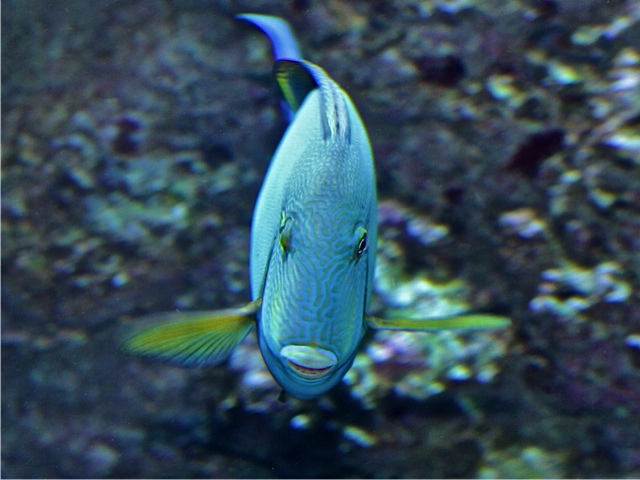
A. Bluish grey with numerous yellowish brown spots which tend to form irregular longitudinal lines.

B. Head with narrow irregular stripes

C. Behind eye a yellow spot

D. Brown pectoral fins

E. Base of caudal fin with white bar

F.  Caudal spine large.

Differs from A. dussumieri by having vertical stripes instead of spots on the blue central area of the caudal fin, from A. mata by having a lunate caudal fin, and from A. xanthopterus by having plain brown to blue-grey pectoral fins.

The white ring around the base of the tail varies in intensity and may occasionally be absent. 

Max size: up to 45 cm (18 in)

Ringtail Surgeonfish 4441603380_717ef654b8_b

DISTRIBUTION/HABITAT: Indo-Pacific: East Africa to the Hawaiian Islands, south to Australia in lagoons and shallow coral reefs.

Depth 2–15 m (6-50 ft)

DIET IN THE WILD: Graze on algae, diatoms and detritus

CONSERVATION; IUCN Red List Least Concern

References

California Academy of Sciences Steinhart Aquarium Philippine Coral Reef 2016

Ron’s flickr  http://www.flickr.com/photos/cas_docents/3320764840/in/set-72157625992053826

Ron’s WordPress shortlink  http://wp.me/p1DZ4b-C1

fishbase www.fishbase.se/summary/4750

Encyclopedia of life eol.org/pages/211484/details

IUCN www.iucnredlist.org/details/177971/0


TAXONOMY
Kingdom: Animalia
Phylum: Chordata
Class: Actinopterygii (ray-finned fishes)
Order: Perciformes (Perch-likes) 
Family: Acanthuridae (Surgeonfishes, tangs, unicornfishes)

Genus/species: Acanthurus olivaceus 

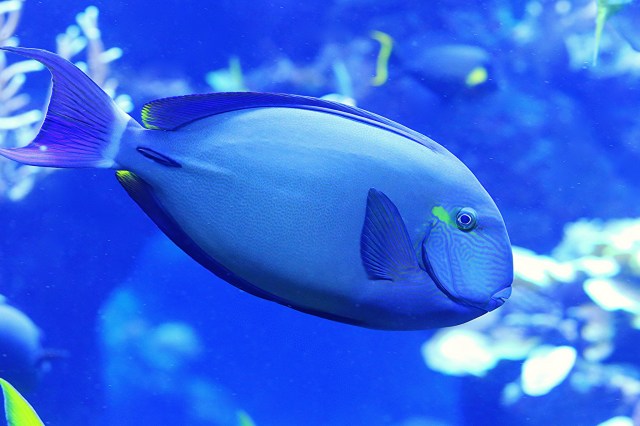
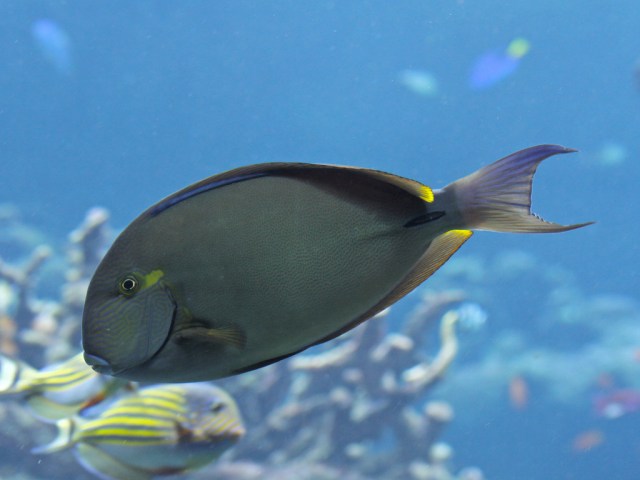
GENERAL CHARACTERISTICS: Adult coloration: light gray-brown  head and forebody, dark gray-brown behind; blue-edged elliptical orange band behind upper gill cover. Juveniles less than 6 cm are yellow, subadults become a dirty yellowish-brown. A “ scalpel ,” (distinctive spine) on either side of the tail base, identifies it as surgeonfish. Color marks emphasize the scalpels.

Length up to 35 cm (13 in)

Orangeband Surgeonfish4405089732_995ac616e4_b

DISTRIBUTION/HABITAT: Eastern Indo-Pacific. Near reefs over sand, bare rock and rubble substrates, 3–45 m (10-150 ft.). Juveniles inhabit protected bays and lagoons in depths as shallow as 3 m. Adults occur singly or in schools.

Orangeband Surgeonfish aka Orange Shoulder Tang IMG_6416

DIET IN THE WILD: The small mouths have a single row of teeth used for grazing on surface film of detritus, diatoms and filamentous algae covering sand and rocks.

REPRODUCTION: Fertilization is external. They are oviparous and do not display obvious sexual dimorphism.

CONSERVATION: IUCN, Least Concern (LC)

REMARKS: An important food fish.

References

California Academy of Sciences Steinhart Aquarium Philippine Coral Reef 

Ron’s flickr http://www.flickr.com/photos/cas_docents/2979737382/in/set-72157608332652056/

Ron’s WordPress Shortlink http://wp.me/p1DZ4b-1aq

Ref: fishbase http://www.fishbase.org/country/CountrySpeciesSummary.cfm?Country=Philippines&genusname=Acanthurus&speciesname=olivaceus

IUCN www.iucnredlist.org/details/177991/0

EOL http://eol.org/data_objects/24984776

TAXONOMY
Kingdom: Animalia
Phylum: Chordata
Class: Actinopterygii
Order: Perciformes
Family: Monodactylidae (Moonyfishes or fingerfishes)

Genus/species: Monodactylus argenteus


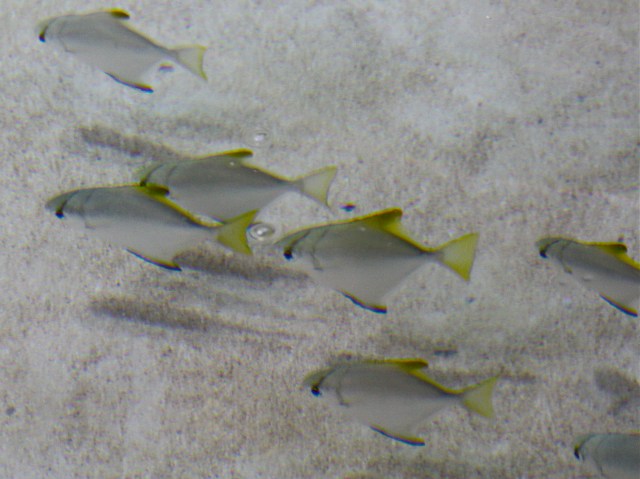
GENERAL CHARACTERISTICS: Adults are bright silver with yellowish dorsal and tail fins. Round to triangular-shaped, laterally compressed body. Small juveniles more colorful with yellow over most of the dorsal fin and two vertical black bands over the head.

Length to 27 cm (11 in)

DISTRIBUTION/HABITAT: Indo-West Pacific: Red Sea and East Africa south to New Caledonia and Australia in bays, mangrove estuaries, tidal creeks, and lower reaches of freshwater streams occasionally in silty coastal reefs.

DIET IN THE WILD: Omnivorous, feeding on plankton, a variety of plant matter, detritus, and insects.

4889665817_815d686e0b_o

MORTALITY: About 7-10 years.

CONSERVATION: IUCN Red List  Not Evaluated

REMARKS: Mono are seen in large fast swimming groups in bays, mangrove estuaries and tidal creeks, in the wild.

References

California Academy of Sciences Steinhart Aquarium Reef Lagoon 2016

Ron’s WordPress Shortlink http://wp.me/p1DZ4b-WT

Ron’s flickr  http://www.flickr.com/photos/cas_docents/sets/72157608440659805/with/4889666339/

fishbase fishbase.org/summary/Monodactylus-argenteus.html

Encyclopedia of Life eol.org/pages/206099/details

TAXONOMY
Kingdom: Animalia
Phylum: Chordata
Class: Actinopterygii (ray-finned fishes)
Order: Perciformes (Perch-likes)
Family: Carangidae ((Jacks and pompanos)

Genus/species: Trachinotus mookalee

GENERAL CHARACTERISTICS: Dorsal snout profile very steep. Pompano may also refer to various other, similarly shaped members of Carangidae, or the order Perciformes. Their appearance is deep bodied and mackerel-like, typically silver and toothless with a forked tail and narrow base. There are twenty described species and most are valued as food.
Common length : 90.0 cm (35 inches). Max. wt. 8.1kg (17.85 lbs)

Indian Pompano19251381660_2573191e7a_k

DISTRIBUTION/HABITAT: Indo-West Pacific found in tropical shallow coastal waters.

Indian Pompano8396538496_c3d6f271a5_k


DIET IN THE WILD: Pompano are primarily bottom feeders that opportunistically “graze” preferred species.  Well developed pharyngeal plates are present, and indicate that hard-shelled organisms such as crabs and mollusks are important in the diet. 

CONSERVATION: IUCN Red List Not Evaluated

References

California Academy of Sciences Reef Lagoon 2016

Ron’s WordPress shortlink http://wp.me/p1DZ4b-1Eg

Ron’s flickr  https://www.flickr.com/photos/cas_docents/19251381660/in/album-72157627919810858/

fishbase  http://fishbase.org/summary/SpeciesSummary.php?ID=1964&AT=Indian+Pompano

EOL http://www.eol.org/pages/26259/details

TAXONOMY
Kingdom: Animalia
Phylum: Chordata
Class: Elasmobranchii (sharks and rays)
Order; Orectolobiformes (Carpet sharks) Most carpet sharks feed on the seabed in shallow to medium-depth waters and have ornate patterns reminiscent of carpets.
Family: Stegostomatidae (Zebra sharks)

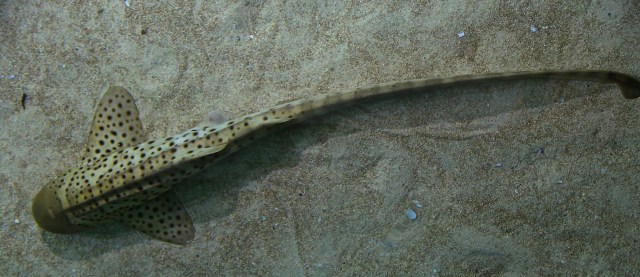
Genus/species: Stegastoma fasciatum ( juvenile)

GENERAL CHARACTERISTICS: S. fasciatum has a cylindrical body with a large, slightly flattened head and a short, blunt snout and is yellow-brown with dark brown spots. Young less than 70 cm (2,3 feet) in length are black with yellow bars. Adults have longitudinal skin ridges. The head has 5 small gill slits, the last three behind pectoral fin origin; nostrils close to front of snout, with short barbels.  Pectoral fins are large and broadly rounded and body has a long caudal fin, almost as long as the rest of the body.

Length up to 354 cm (11.7 feet) 

Zebra Shark 16235954845_08c3bb04f1_k

DISTRIBUTION/HABITAT: Tropical marine. Indo-West Pacific. Found near coral reefs with sandy bottoms and remain at the reef at where they were hatched or reefs that are closely connected to their natal area.

Depth range 0 – 63 m (206 feet).

DIET IN THE WILD: Feeds mainly on mollusks, but also small bony fishes, crustaceans (crabs and shrimps) and sea snakes.

REPRODUCTION: Oviparous S. fasciatum has large purplish-black eggs or dark brown egg cases with longitudinal striations.

Lifespan: Ave. 25 years. 

CONSERVATION: IUCN Red List; Vulnerable (VU)     Decreasing numbers secondary to heavily fished shallow coral reef habitat throughout all its range except Australia.

Remarks: Like other bottom dwelling sharks, it can pump water across its gills through its mouth, which allows the shark to respire while stationary. 

It was tank bred at the Shedd Aquarium.

References

California Academy of Sciences Reef Lagoon 2016

fishbase: www.fishbase.org/summary/5374

IUCN Red List  www.iucnredlist.org/details/41878/0

Arkive  www.arkive.org/leopard-shark/stegostoma-fasciatum/

Animal diversity web http://animaldiversity.org/site/accounts/information/Stegostoma_fasciatum.html

Marinebio marinebio.org/species.asp?id=56

Ron’s flickr https://www.flickr.com/photos/cas_docents/16235954845/

Ron’s WordPress shortlink  http://wp.me/p1DZ4b-1rb

TAXONOMY
Kingdom: Animalia
Phylum: Chordata
Class: Chondrichthyes
Subclass: Elasmobranchii
Order: Myliobatiformes
Family:Dasyatidae Family: Dasyatidae  Whiptail Stingrays; whip-like tails, which are much longer than the disc and lack dorsaland caudal fins. They also have one or more venomous spines near the base of the tail.

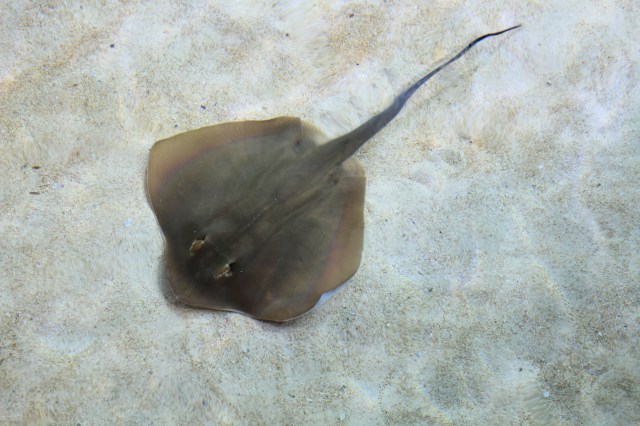
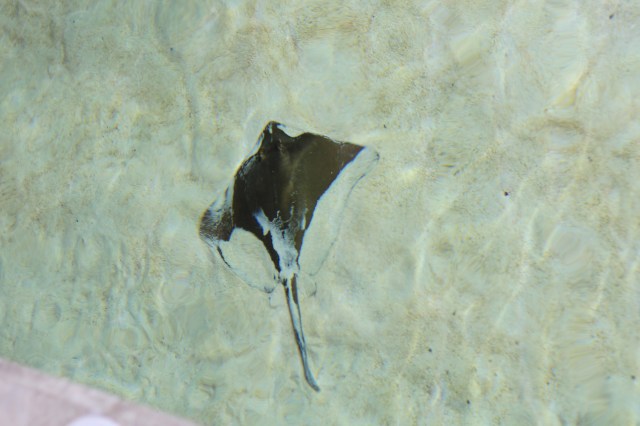
Genus/species: Dasyatis kuhlii

IMG_7263

GENERAL/CHARACTERISTICS: Angular disc. Dorsal color reddish-brown to olive drab with blue spots and smaller black spots, ventral side white. Tail with black and white bands is about as long as the body and usually has one stinging spine.

Maximum disc width: 50 cm (20 inches).

DISTRIBUTION/ HABITAT: Tropical Indo-West Pacific from the Red Sea east to the Philippines, Japan, and south to Australia. Found on sandy bottoms near coral and rocky reefs, from intertidal zone to 50 m (160 feet). Moves onto reef flats and into shallow lagoon waters at high tide.

IMG_7261

DIET IN THE WILD: Crabs and shrimp, also small fishes.

REPRODUCTION: Ovoviviparous; eggs retained in the female’s body; embryos receive nourishment from a yolk sac.

REMARKS: The Bluespotted Whiptail Stingray is venomous tail can deliver a painful wound. Like many other rays that wound humans, it usually stings only when inadvertently stepped on: it is difficult to see in turbid waters, especially when covered by sand with only the eyes visible.

References

California Academy of Sciences Reef Lagoon 2016

Ron’s WordPress shortlink  http://wp.me/p1DZ4b-YD

Ron’s flickr https://www.flickr.com/photos/cas_docents/5035114327/in/album-72157627919810858/

TAXONOMY
Kingdom: Animalia
Phylum: Chordata
Class: Chondrichthyes
Subclass: Elasmobranchii (sharks and rays)
Order: Rajiformes (Skates and rays)
Family: Myliobatidae (Cownose and Manta Rays)

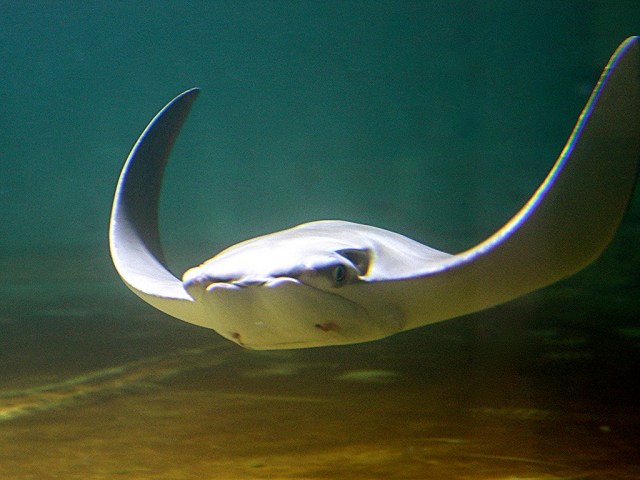
Genus/species: Rhinoptera javanica


GENERAL CHARACTERISTICS: R. javanica is a cartilaginous fish with bat-like, swept back pectoral fins. Double-lobed snout and indented forehead. Long, slender tail. Brown above, white below. The stinger is located at base of the tail rather than half way or more down the tail as in the whiptail rays
Width up to 1.5 m (5 ft), weight up to 45 kg (100 lbs).

Rhinoptera javanica2981790284_a7f88eab35_b

DISTRIBUTION/HABITAT: Tropical, Indo-West Pacific from South Africa north to India and possibly Thailand, Indonesia and southern China. Also in Okinawa, Ryukyu Islands.  The Javanese Cownose Ray inhabits tropical bays, estuaries, among mangroves, and near coral reefs over sand and mud bottoms. It can also tolerate brackish water.

JAVANESE COWNOSE RAY (Rhinoptera javanica) IMG_1769

DIET IN THE WILD: Feeds on clams, oysters and crustaceans. The ray sucks in sand and expels it out of its gills, blowing off sand covering its prey. (Looking for prey below)

Javanese Cownose Ray Rhinoptera javanica (Myliobatidae) eating IMG_0015

REPRODUCTION: Mating pair orient in a venter to venter position, and the male inserts one or both claspers. Ovoviviparous, 1–2 pups per litter. Females have been known to leap out of the water and slam into the surface; this action seems to be an aid in birthing.

CONSERVATION STATUS: IUCN Red List  Vulnerable

A declining population is inferred from the unregulated nature of inshore fisheries as well as small litter size.


REMARKS:  Like its pelagic relatives the manta and devil rays, it swims by flapping its pectoral fins like wings, enabling it to swim at greater speeds than most bottom dwelling stingrays. Sometimes these “wings” protrude above the water, bearing a frightening resemblance to a shark.

References

California Academy of Sciences Reef Lagoon 2016

ARKive www.arkive.org/javanese-cownose-ray/rhinoptera-javanica/

fishbase www.fishbase.org/summary/SpeciesSummary.php?id=7971

IUCN Red List www.iucnredlist.org/details/60129/0

Ron’s WordPress Shortlink  http://wp.me/p1DZ4b-RK

Ron’s flickr http://www.flickr.com/photos/cas_docents/sets/72157608440813109/with/2981790284/