Category: CORAL REEF


Class Actinopterygii (ray-finned fishes), Order Perciformes (Perch-likes), Family Chaetodontidae  (Butterflyfishes)

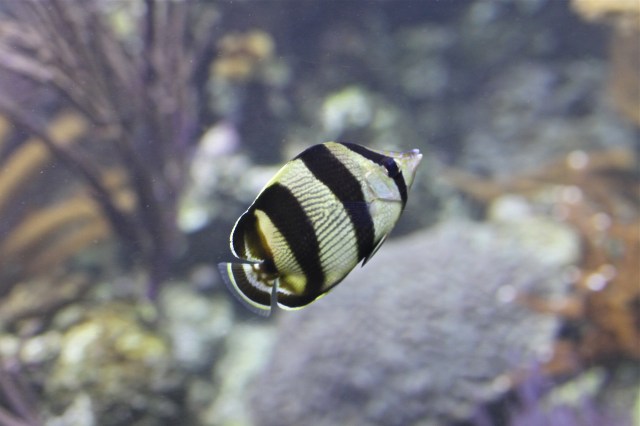
Chaetodon striatus
DISTRIBUTION:  Western Atlantic: Massachusetts, USA to Santa Catarina, Brazil including the Gulf of Mexico and Caribbean Sea.

HABITAT: shallow waters around coral reefs.

APPEARANCE:  Length: 6 inches (15cm). Two broad black bars on side of body and a third bar basally in soft portion of dorsal fin which extends onto caudal peduncle; broad black submarginal bands in the median fins; pelvic fins black except for the spine.

DIET: Feed on polychaete worms, coral polyps, crustaceans and mollusk eggs.

REPRODUCTION: Oviparous and monogamous forming pairs during breeding.

MORTALITY: Diurnal species, active during the day and sleeping at night.  At the end of the day it seeks shelter since it is highly vulnerable to such night predators as moray eels, sharks, and other large reef fishes.

REMARKS: The small, protractile mouth has comb-like teeth arranged in narrow rows in the jaws. “Chaetodontidae” is actually derived from ancient Greek (“Chaeto” = bristle and “donte” = teeth). The bristle nature of its teeth allows the butterfly to scrape at the invertebrates that make up its diet.

LOCATION:  Caribbean reef   PR36

flickr   http://www.flickr.com/photos/cas_docents/sets/72157625119200613/

WORDPRESS SHORTLINK   http://wp.me/p1DZ4b-uz

Class Actinopterygii (ray-finned fishes),  Order Perciformes (Perch-likes),  Family Pomacanthidae (Angelfishes)

Chaetodontoplus melanosoma


DISTRIBUTION: Indonesia and Philippines to S.W. Japan.  Also S.E. Papua New Guinea.

HABITAT: Marine. Inshore and outer rock and coral reefs (5-30m).

APPEARANCE: Up to 8 inches in size.  Light grey head and back, dark grey below, dorsal, anal and tailfins black with yellow margin; maze of yellow markings on snout and nape.  Several similar species, easily confused. Juveniles are almost identical as in other species complexes in the genus. Most confusion is caused as color changes occur with growth that may match between different species at certain stages, especially the caudal fin pattern that maybe yellow in sub-adults on one and yellow in adults of others

DIET: Omnivore, primarily feeding on sessile Invertebrates, Algae, Sponges, and Tunicates.

REMARKS; Solitary or in pairs.

LOCATION: Philippine coral Reef

WORDPRESS SHORTLINK  http://wp.me/p1DZ4b-rB


TAXONOMY
Class: Actinopterygii (Ray-finned fishes)
Order: Perciformes (Perch-likes)
Family: Serranidae (Sea basses: groupers and fairy basslets)
Subfamily: Anthiinae (Anthias)

On exhibit:

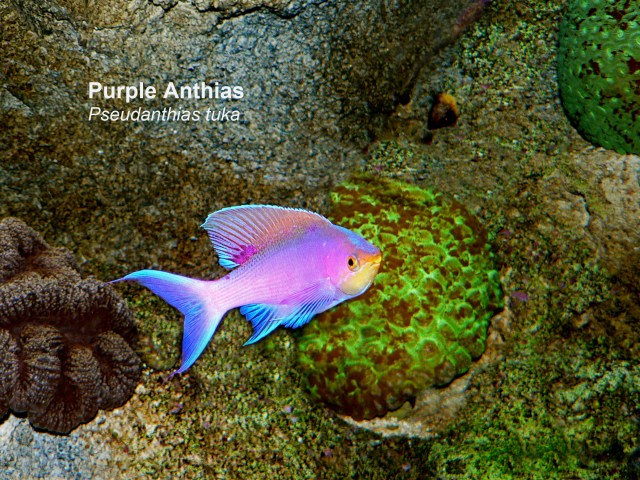
Pseudanthias dispar – Redfin anthias
P. lori – Lori’s anthias
P. randalli – Randall’s anthias* (not currently on exhibit 1-31-14)
P. tuka – Yellowstrip anthias
P. ventralis ­– Longfin anthias
Serranocirrhitus latus  – Sunburst anthias ( a closely related genus)
 

 DISTRIBUTION: Pseudanthias species are found throughout the Indo-Pacific region. Many of the some 64 species have fairly wide distribution.

 HABITAT: During the day, they are found along the upper reef face in areas of strong current. At night, when predators threaten, they seek shelter in the reef’s caves and crevices.

GENERAL CHARACTERISTICS: Pseudanthias are small, fast-moving, colorful fishes. The male and female pseudanthias, like many members of the family Serranidae display gender-specific body shape and/or color. The male of P. dispar, for example, has a bright red dorsal fin and more pink and blue on the head and sides than the generally yellow female. The male yellowstripe anthias is a deeper purple overall than the female that sports a bright yellow stripe on the back not seen in the male.

DIET IN THE WILD: Plankton and fish eggs.

REPRODUCTION: All are sequential protogynous hermaphrodites. Protogynous literally means “first female,” a reference to the fact that all individuals are born as females, but a few, usually the largest females, will in time will change sex and develop male sex organs. The sex change, which can be completed in only a few days, is triggered by the loss of the dominant male, usually to predation.

 This reproductive strategy may confer at least two benefits: first, many young, healthy females serviced by a few large males means that in a given aggregation of fish more eggs, which are larger and therefore more energetically expensive, are produced.  Sperm, especially that produced by a large male, is plentiful enough to fertilize the eggs of even a large group of females. Also, the large males are extremely territorial and protective of their harems.

PREDATORS: These small fish are snack food for many larger predators. Life span of most species is about 3­–5 years.


REMARKS: The Steinhart displays several other fish families besides serranids with members that practice protogynous hermaphoditism, including wrasses, angelfishes, gobies, found in a number of tanks. Bocalo, the giant sea bass, is the Steinhart’s most notable practitioner

flickr  http://www.flickr.com/photos/cas_docents/sets/72157608545590153/

WORDPRESS SHORTLINK  http://wp.me/p1DZ4b-rh

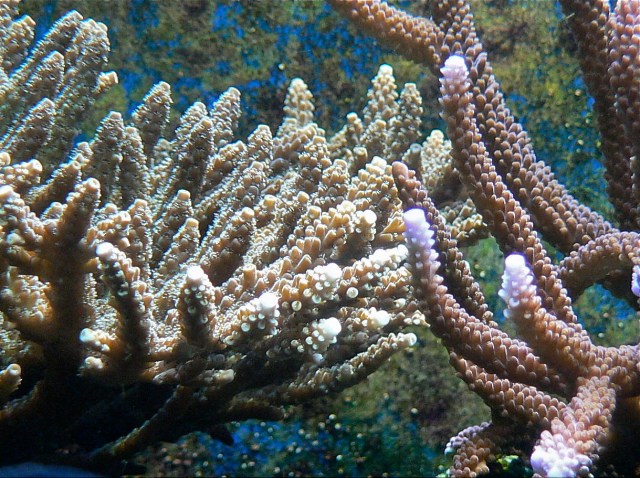
Phylum Cnidaria, Class Anthozoa, Order Scleractinia, Family Acroporidae,

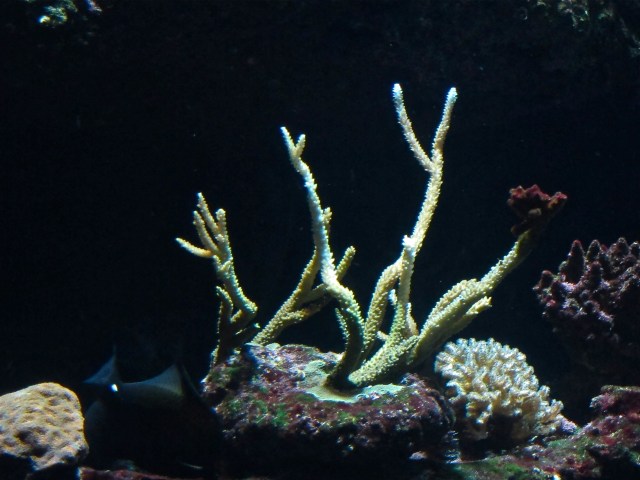
Acropora spp.

DISTRIBUTION:  Indo-Pacific, Caribbean.

HABITAT: Habitat: Shallow reef environments with bright light and relatively strong currents. Often dominate shallow parts of the reef, especially the surf zone

APPEARANCE: Growth forms extremely variable: slender branched fingers, broad antlers, table-like plates are common. Among the most colorful of reef-building corals; may be cream, yellow, blue, green, purple, pink, even fluorescent. Polyps small; set along the branches.  Characterized by light-colored polyps at the tips of branches where budding and growth take place, fueled by the energy produced by zooxanthellae in lower parts of the branch that give it color

DIET: Feed on microplankton, mostly at night; significant nutrition provided by photosynthetic zooxanthellae

REPRODUCTION/DEVELOPMENT: These fragile corals usually reproduce without sex (asexually). As pieces break off, they grow on their own as clones (fragmentation). But spring and summer bring an orgy of sex. Warming waters and a full moon can stimulate hundreds of corals to release clouds of eggs and sperm into the water at the same time. Most Acropora species are broadcasters, a few are brooders.

REMARKS: A major contributor to reef structures worldwide.

flickr http://www.flickr.com/photos/cas_docents/2999925430/in/set-72157608597451452/

WORDPRESSSHORTLINK http://wp.me/p1DZ4b-p9


LOCATION: Animal Attractions, Philippine Coral Reef, and other tropical reef exhibits.


Ref: California Academy of Sciences Animal Attraction Exhibit 2012


THE STEINHART AQUARIUMA VIEW FOR AND BY DOCENTS AND GUIDES  2009  California Academy of Sciences

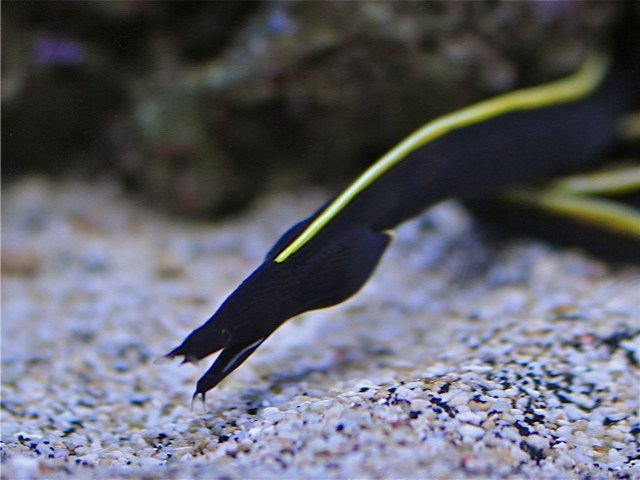
Actinopterygii (ray-finned fishes),  Anguilliformes (Eels and morays),  Muraenidae (Moray eels)

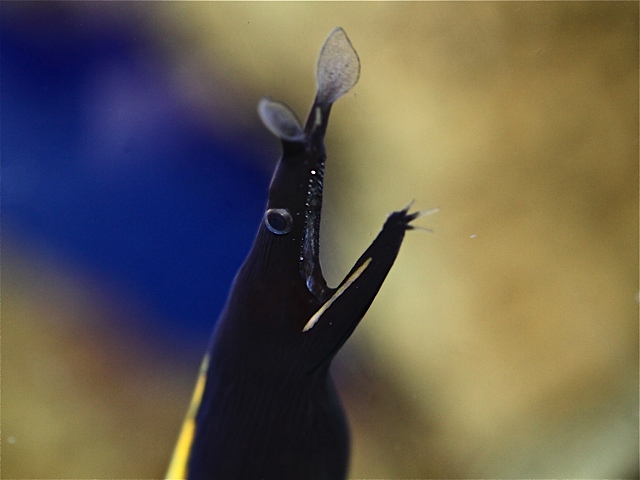
Rhinomuraena quaesita

DISTRIBUTION: Indo-Pacific from East Africa to the Tuamota Archipelago (French Polynesia).

HABITAT: Lagoons and associated reefs at depths up to 57 m.

APPEARANCE: Long thin body and high dorsal fins. Has three fleshy tentacles on the tip of its lower jaw, a single fleshy pointed projection at the tip of its snout, and tubular anterior nostrils ending in gaudy, fanlike expansions. Juveniles are black with a yellow dorsal fin, males are mostly blue, and females are mostly yellow. Length up to 130 cm (51 in).

DIET: Mostly small fishes, some invertebrates.

REPRODUCTION and DEVELOPMENT: External fertilization nonguarder.  R. quaesita is a protandrous hermaphrodite, i.e., functioning males reverse sex to become females.  It is the only moray that undergoes abrupt changes in coloration and sex.  Protandry is diagnosed based on coloration, but not confirmed.

MORTALITY/LONGEVITY May have lifespan up to 20 years.

REMARKS: The ribbon eel buries itself in sand or hides in rocks or reefs, sometimes with head protruding, lying in wait or emerging to hunt for small fish. Like all morays, it rests with mouth open, displaying sharp teeth that appear ready for use. Actually, ribbon eels are among the least aggressive of morays, the gaping mouth simply aiding breathing by allowing oxygenated water to enter and pass over the gills.

flickr  http://www.flickr.com/photos/cas_docents/4405139265/in/set-72157608402401040/

WORDPRESS SHORTLINK  http://wp.me/p1DZ4b-o0

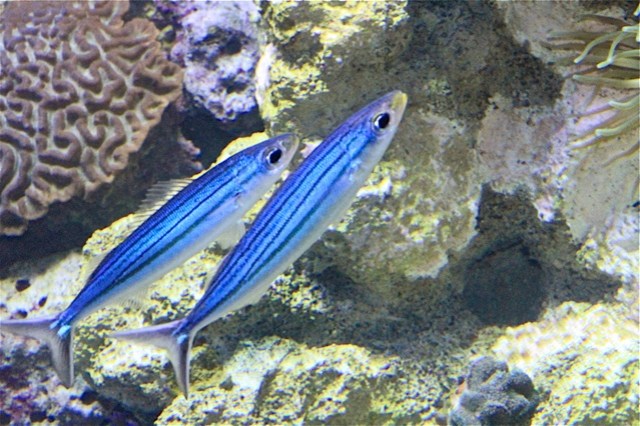
Actinopterygii (ray-finned fishes),  Perciformes (Perch-likes),  Haemulidae (Grunts)

Haemulon vittatum


DISTRIBUTION: Western Atlantic: southern Florida, USA and Bahamas to northern South America. Also Caribbean, including Antilles.

HABITAT: Marine; reef-associated; depth range 15 – 50 m

Haemulon vittatum

APPEARANCE: Average length 18.0 cm (7 in).

Spindle-shaped fish with a deeply forked tail and an extremely protrusible mouth. Dorsal fins close together. 

DIET: Zooplankton and small fishes.  REMARKS: Minor commercial fishery; bait: occasionally.

LOCATION: Caribbean Reef

Flickr http://www.flickr.com/photos/cas_docents/sets/72157625866509117/

WORDPRESS SHORTLINK  http://wp.me/p1DZ4b-ma

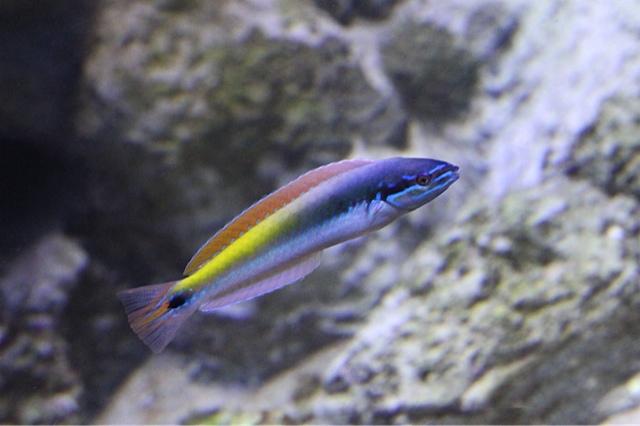
1-25-12 Rainbow Wrasse from Ron’s Tropical Marine Series

Actinopterygii (ray-finned fishes), Perciformes (Perch-likes),  Labridae (Wrasses)

Halichoeres pictus   

ADULT MALE BELOW


DISTRIBUTION:  Western Atlantic: southern Florida, USA and Bahamas to northern South America. 

HABITAT: Marine; reef-associated; depth range 5 – 25 m.

APPEARANCE: Large adult males are blue-green to yellowish green on the upper half of body and pale blue on lower half; blue stripes on head; a large black spot at caudal base. Females or young are silvery tan with a brown back and a brown stripe along the midsize.

DIET:  Various invertebrates.

REPRODUCTION: A protogynous hermaphrodites.  Protogynous hermaphrodites refer to organisms that are born female and at some point in their lifespan change sex to males.  Also noted in the following fish families: Serranidae (groupers), Sparidae (porgies), Synbranchidae (swamp eels), Scaridae (parrotfishes), Pomacanthidae (angelfishes), Gobiidae (gobies), Lethrinidae (emperors).

REMARKS: Note: Protandrous hermaphrodites refer to organisms that are born male and at some point in their lifespan change sex to female. Protandrous animals include clownfish.  

LOCATION: Caribbean Reef.

Flickr  http://www.flickr.com/photos/cas_docents/sets/72157608208133134/

FEMALE OR IMMATURE BELOW

WORDPRESS SHORTLINK  http://wp.me/p1DZ4b-m0

TAXONOMY

Phylum Chordata

Class Actinopterygii (Ray-finned fishes)

Order Tetraodontiformes (Puffers and filefishes)

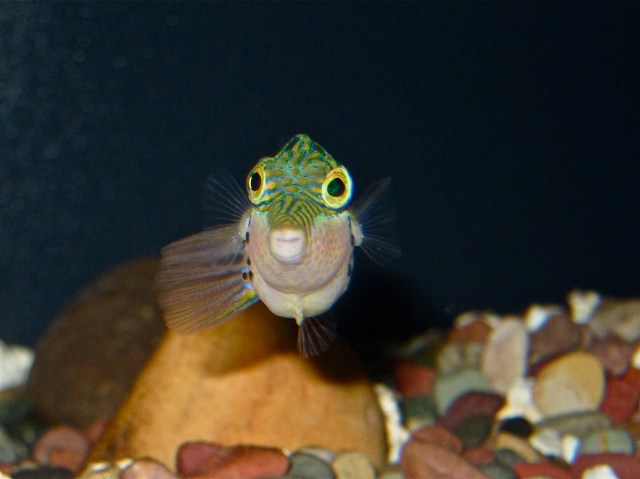
Family Tetraodontidae (Puffers) 

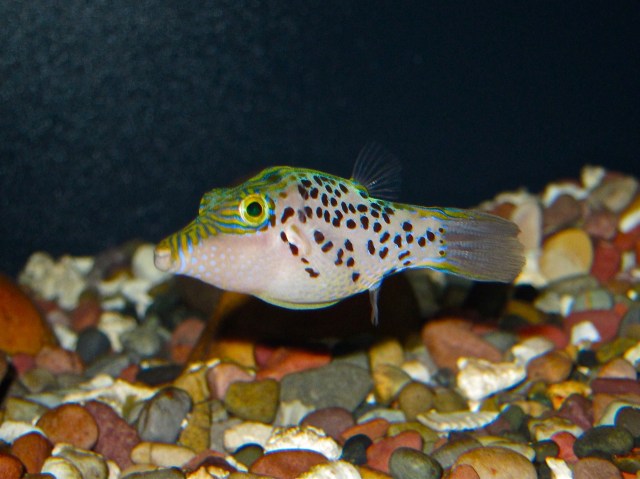
Canthigaster leoparda  

DISTRIBUTION: Eastern Indian Ocean: Christmas Island. Western Pacific: Philippines, Ambon, and Guam. 

 HABITAT: Lives in deep water, usually along deep drop-offs in caves at more than 30 meters depth.

 APPEARANCE: size to 7 cm. (2.75 in).  Topside of face and body are yellow with blue lines; the sides and underside are white with blue spots; the sides with several clusters of brown blotches. Fins clear, except tail.  

 PR11  Color Cluster11-29-11

WORDPRESS SHORTLINK  http://wp.me/p1DZ4b-iH

flickr LINK http://www.flickr.com/photos/cas_docents/5630165858/in/set-72157625020091079