Tag Archive: rainforest


TAXONOMY
Kingdom: Animalia
Phylum: Chordata
Class: Amphibia
Order: Anura
Suborder: Neobatrachia
Family: Dendrobatidae

Genus/species: Dendrobates auratus

GENERAL CHARACTERISTICS:  Green marking on dark background. Color and pattern varies widely among populations of this species.  Aposematic (“warning”) coloration shies diurnal predators away from this bold frog An average species in size, toxicity, and coloration.  Males reach about three-quarters of an inch long; females are slightly larger.
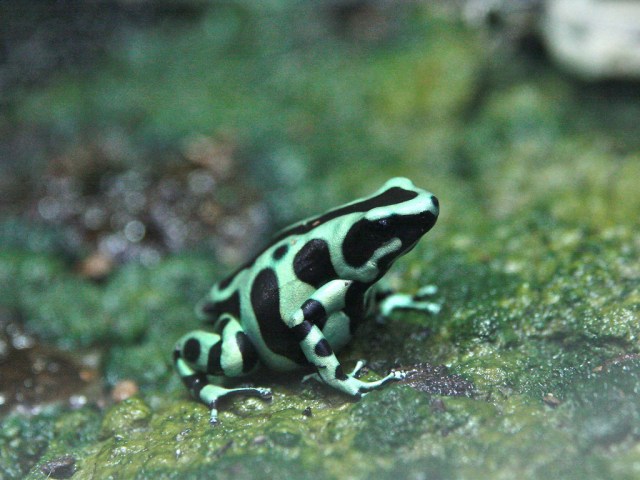
3776076618_9b282b6eaf_b

DISTRIBUTION/HABITAT: Central America to Northwest Colombia lowland tropical rainforests. Common in cocoa (not coca) plantations. Introduced to Hawaii (1932 Oahu) to control non-native insect populations. The “success” of this experiment has yet to be proven. Terrestrial frogs, but will climb. Active diurnally.

DIET IN THE WILD : Ants and mites, also tiny beetles, flies and springtails. Often captures insects feeding on rotting fruit.

REPRODUCTION: Each individual male frog clears a small patch for himself. Females wander among the males, the latter then attempt to impress the former with their bird-like mating calls. the two then mate. The male grasps the female in a gentle embrace, and fertilizes each egg as it is produced. In approximately 2 weeks, these hatch into tadpoles which are carried to the canopy the tadpoles sticking to the mucus on their parents’ backs. The parents then deposit their tadpoles into the small pools of water that accumulate in the center of bromeliads protecting them until their development is complete.
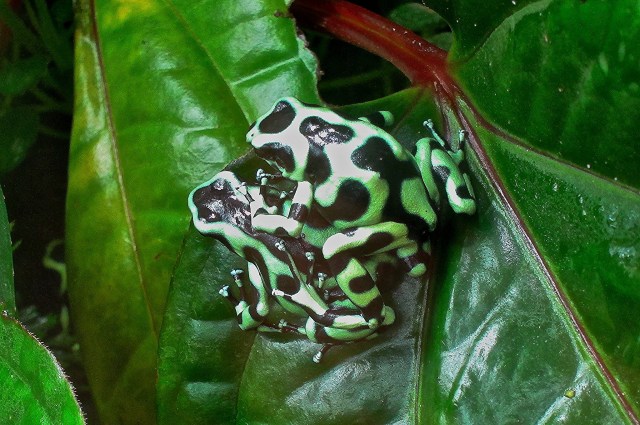
Green and black poison dart frog16461015440_7dab815173_k

MORTALITY/LONGEVITY: Can live to 17 years.

CONSERVATION: Least Concern (IUCN Red List). Still reported to be locally common, they are at some risk due to habitat destruction. They are popular in the pet trade, but most are captive-born.

REMARKS: D. auratus produces pumiliotoxin, a potent nerve poison manufactured and stored in subcutaneous membranes and secreted through a modified layer of epidermis. The small amount of pumiliotoxin poison the frog possesses is enough to make humans seriously ill by interfering with muscle contraction in the heart and skeletal muscle.

D. auratus, as with all poison dart frogs, loses its toxicity in captivity due to a change in diet. This has led scientists to believe that the green-and-black poison frog actually takes its poison from the ants it feeds on.

Green & Black Poison Dart Frog Dendrobates auratus (Dendrobatidae) 2

Costa Rica Rainforest

References 

 Animal diversity Web animaldiversity.org/accounts/Dendrobates_auratus/

 California Academy of Sciences Docent Rainforest Training Manual 2014

 Dendrobates.org  www.dendrobates.org/auratus.html

Ron’s flickr  http://www.flickr.com/photos/cas_docents/sets/72157608456457315/

WordPress shortlink  http://wp.me/p1DZ4b-Ln
TAXONOMY
Kingdom: Animalia
Phylum: Chordata
Class: Reptilia
Order: Squamata
Suborder: Lacertilia
Family: Polychrotidae

Genus/species: Norops oxylophus

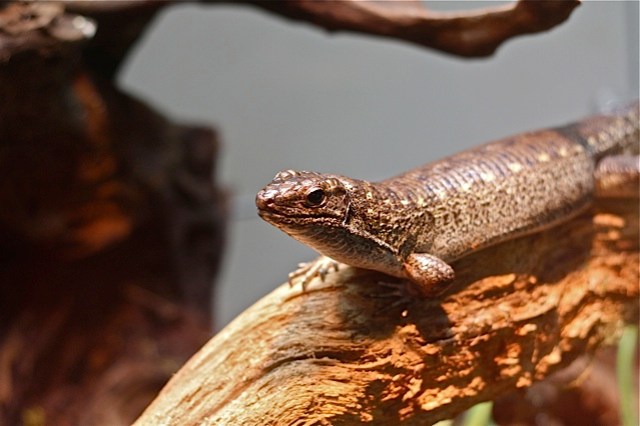
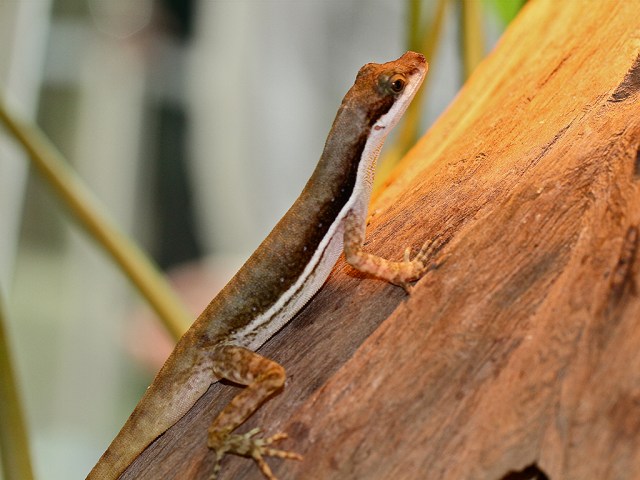
GENERAL CHARACTERISTICS: Stream anoles are moderately large, about 8 cm (3 in) snout to vent, short-legged lizards. Females are slightly smaller than males. They are chocolate-colored with a pair of cream-colored lateral stripes that run from the shoulder down about 2/3 the length of the body. The irises of their eyes are a coppery color. This is one of the characteristics that distinguish N. oxylophus from N. aquaticus, a blue-eyed anole that lives in the same area.

Norops oxylophus 5389062001_ef78684622_b

DISTRIBUTION/HABITAT: Honduras to northwestern Panama. Found in lowland forest and streams.

DIET IN THE WILD: Invertebrates. Anoles are visual lizards with excellent eyesight. They have color vision that includes ultraviolet wavelengths. Unlike many lizards, their sense of smell is poor, and they use their tongues to capture prey, rather than to sense them.

Norops oxylophus 5389664708_63b917acef_o

REMARKS: May dart across water to escape predators.

Rainforest Costa Rica CR04

References

California Academy of Sciences Docent Rainforest Training Manual 2014

Ron’s WordPress Shortlink http://wp.me/p1DZ4b-1sN

Ron’s flickr https://www.flickr.com/photos/cas_docents/5389062001/in/album-72157620708938680/

TAXONOMY
Kingdom: Animalia
Phylum: Chordata
Class: Reptilia (snakes, worm lizards, lizards, alligators, caimans, crocodiles, tortoises, turtles, and tuataras)
Order: Squamata (scaled reptiles, all lizards and snakes)
Family: Gekkonidae
Subfamily: Gekkoninae (Geckos)

Genus/species: Phelsuma grandis

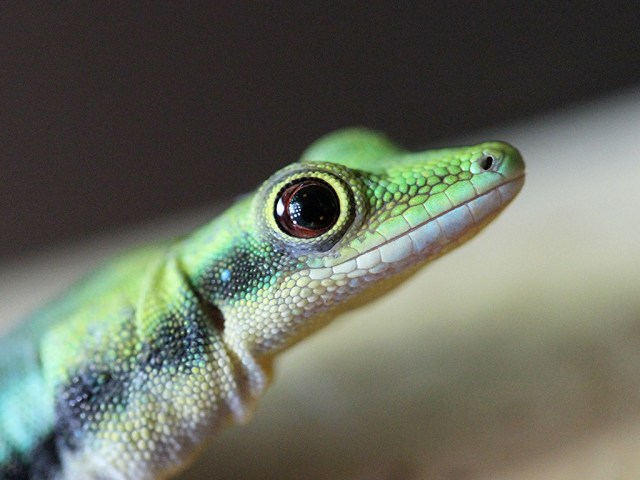
GENERAL CHARACTERISTICS: Largest species of the genus Phelsuma, 23–27 cm (9-10.6 in). They are bright green, with granular red spots on the body and a red line running from the eye to the tip of the nose. Eye color is much like the skin color. blending into their heads and surroundings. The eyes are surrounded by blue rings, have round pupils, indicative of a diurnal life style.

16492091872_3510b6b6b2_o

DISTRIBUTION/HABITAT: Northern Madagascar, Seychelles, and smaller islands close to Madagascar. Found in the canopy of tropical rain forests and on the walls of buildings in towns and villages.

DIET IN THE WILD: Mostly insects and other invertebrates; also soft sweet fruit, nectar, and pollen.

REPRODUCTION: Breeding season is between November and the first weeks of May. During this period, the females lay up to 6 pairs of eggs which hatch after approximately two months.

MORTALITY AND LONGEVITY: They live up to 10 years in captivity.

15639828877_f1c7063e96_h

CONSERVATION: Widespread in northern common and tolerant of disturbance within its known range. There are no known major threats.

REMARKS Many geckos can make sounds to attract mates, to advertise their territories, to warn off unwanted intruders or to frighten predators. Geckos do not have eyelids. Instead the lids have fused, and the eye is covered with a large transparent scale. Geckos keep their eyes clean by licking them with their broad flat tongues.

Madagascar MA08

References

California Academy of Sciences Docent Rainforest Training Manual 2014

IUCN Red List Least Concern (LC) www.iucnredlist.org/details/193490/0

Encyclopedia of Life  eol.org/pages/2448279/details

Ron’s WordPress shortlink http://wp.me/p1DZ4b-U7

Ron’s flickr https://www.flickr.com/photos/cas_docents/16492091872/in/set-72157620708610230/

TAXONOMY
Kingdom: Animalia
Phylum: Chordata
Class: Reptilia
Order: Squamata
Family: Gekkonidae (Geckos)

Genus/species: Phelsuma klemmeri

IMG_0913

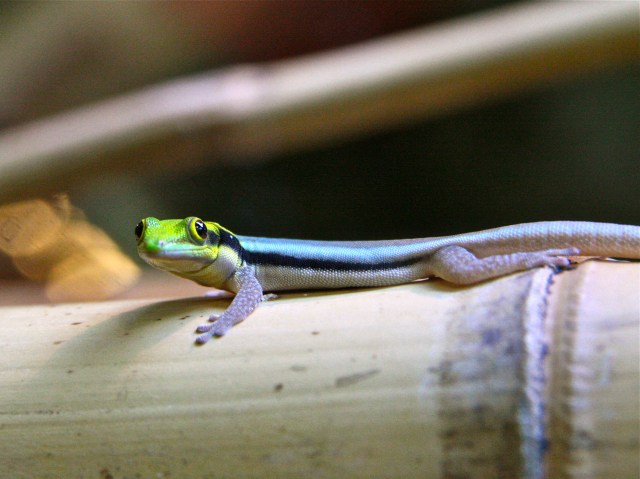
GENERAL CHARACTERISTICS: Dorsal color is brown to turquoise with turquoise bands. A black lateral line runs from the eyes to the hind legs. The head and neck are yellow. The ventral surface is whitish; scales are small and smooth. Adults are about 9 cm (3.5 in) long.

DISTRIBUTION/HABITAT: Found only in northwest Madagascar among medium-sized bamboo in fragmented “bamboo islands.” When disturbed they hide in the cracks in older dead bamboo.

Phelsuma klemmeri 4813861605_40e1c52a37_b

DIET IN THE WILD: Insects, other invertebrates and soft sweet fruit, pollen and nectar. In the wild, they avoid the hotter part of the day and usually hunt and forage in the early morning, late afternoon, or right after a shower.

DIET IN CAPTIVITY: A variety of insects, including crickets and fruit flies, but will also eat fruit baby foods. They also eat fruits such as guava, papaya, and peaches.

REPRODUCTION: Females lay eggs every 3 to 5 weeks. Like most geckos, she usually lay two eggs at a time, often inside a hollow piece of bamboo. The babies are iridescent and look like tiny copies of the adults. Newborns weigh a mere 0.1 g at birth.

CONSERVATION: IUCN Endangered (EN)
it is known from only two locations and occurs as a severely fragmented population, and there is a continuing decline in the extent and quality of forest habitat within its range.

REMARKS: First described in 1990.

Geckos have very special feet that contain millions of hairs capable of producing electrical forces, probably van der Waals forces. These forces, which are molecular and not caused by a sticky substance, allow the gecko to attract any surface, even polished glass.

Rainforest Madagascar with Madagascar Tree Boa MA06

References

California Academy of Sciences Docent Rainforest Training Manual 2014

IUCN Red List  www.iucnredlist.org/details/172981/0

phelsumania www.phelsumania.com/public/systematics/species/phelsuma_k…

Ron’s WordPress shortlink http://wp.me/p1DZ4b-TM

Ron’s flickr https://www.flickr.com/photos/cas_docents/3707689563/in/set-72157620708610230

TAXONOMY
Kindom: Animalia
Phylum: Chordata
Class: Actinoptergii
Order: Perciformes
Family: Cichlidae (cichlids)
Subfamily: Etroplinae

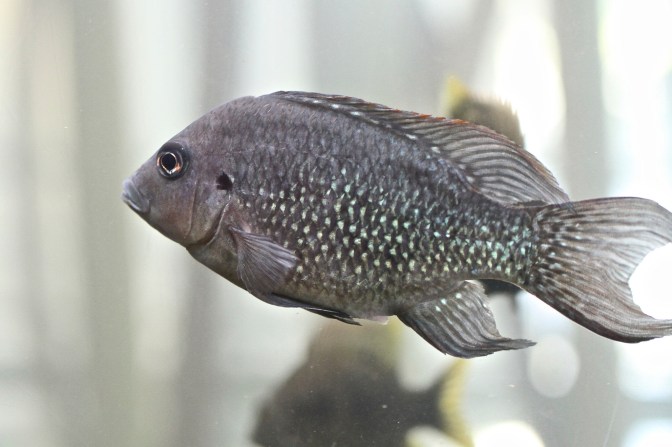
Genus/species: Paretroplus menarambo

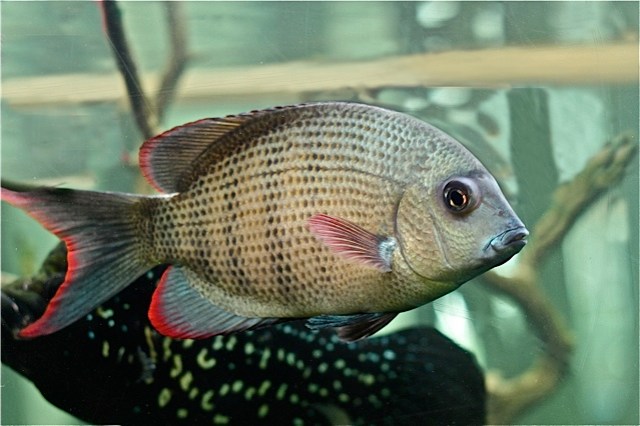
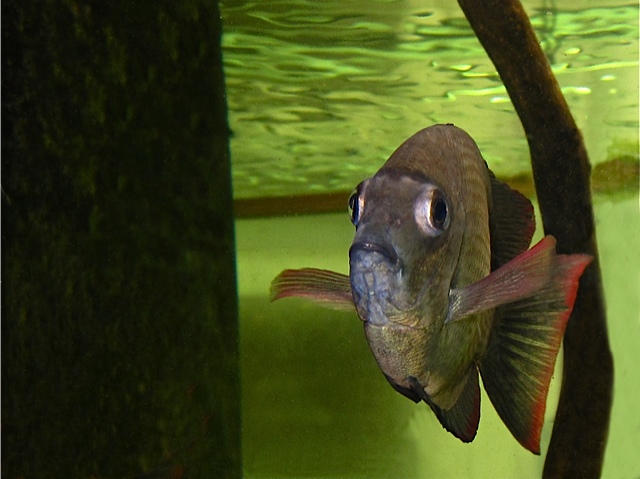
GENERAL CHARACTERISTICS: When young, Mearambos are a pale gold with black dots in a pin stripe pattern. As they reach adulthood, around 4 inches or 3 years of age, they are blue/gray to almost white with black dot pin stripes. The fins are edged in red, especially the tail. Max length : 12.8 cm (5 in).

DISTRIBUTION/HABITAT: Endemic to Madagascar. Present in the freshwater flood plain lakes of the Bemarivo River, the major northwards-flowing tributary of the Sofia River in northwestern Madagascar. The species is now known to occur in a single lake of that system: Lac Tseny.

DIET IN THE WILD: Have teeth specially designed for crushing snail shells.

REPRODUCTION: Substrate spawner. Eggs are laid in a pit and will adhere to surfaces such as driftwood.

PREDATORS: Critically endangered species threatened by invasive species and over-fishing.

CONSERVATION: IUCN Red list: Critically Endangered (CR)
No data are available on the wild population; previously it was thought to have disappeared from its native range, but more recent surveys rediscovered the species in Lac Tseny Habitat degradation, the presence of invasive exotic species and overfishing account for its Critically Endangered status. Breeding populations of this species are maintained in captivity.

LOCATION Madagascar MA04

References

fishbase www.fishbase.org/summary/SpeciesSummary.php?id=57958

IUCN www.iucnredlist.org/details/44492/0

Encyclopedia of Life eol.org/pages/211122/details

Ron’s flickr http://www.flickr.com/photos/cas_docents/sets/72157627949403670/

Ron’s WordPress shortlink  http://wp.me/p1DZ4b-yp


TAXONOMY
Kingdom: Animalia
Phylum: Chordata
Class: Actinopterygii (ray-finned fishes)
Order: Percifomes (Perch-likes)
Family: Cichlidae (Cichlids)

Genus/species: Ptychochromis sp. “Tarantsy”

GENERAL CHARACTERISTICS: Males are generally silver with a faint black strip mid-body and a spot on the gill plate. Females are darker in color overall, especially when breeding.
Length to 16cm (6.5 inches).

Tarantsy8342758012_95170c71b4_k

DISTRIBUTION/HABITAT: Tarantsy River and Lake Tarantsy, near Amboasary and Fort Duaphin, Madagascar.

DIET IN THE WILD: Omnivores

REPRODUCTION: Substrate spawning egg layers.

REMARKS; Little information is available.

Madagascar MA04

References

Greater Chicago Cichlid Association:  www.gcca.net/madagascan-cichlids/139-ptychochromis-sp-nor…

Ron’s flickr  https://www.flickr.com/photos/cas_docents/8342758012/in/set-72157620708610230

Ron’s WordPress Shortlink  http://wp.me/p1DZ4b-yH

Vetted Jenoh Gonzales Biologist, Steinhart Aquarium
California Academy of Sciences 1-7-15

TAXONOMY
Kingdom: Animalia
Phylum: Chordata
Class: Actinopterygii (ray-finned fishes)
Order: Perciformes (Perch-likes)
Family: Cichlidae (Cichlids)
Subfamily: Ptychochrominae

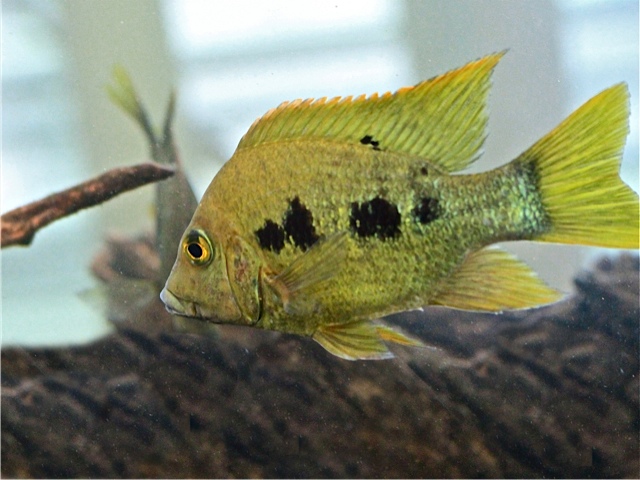
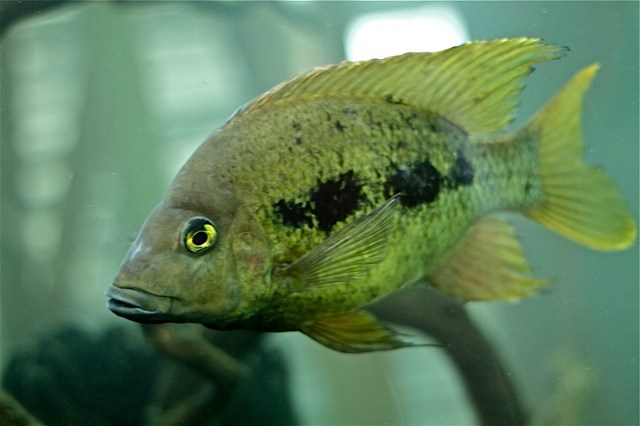
Genus/species: Ptychochromis grandidieri

GENERAL CHARACTERISTICS: Yellowish to golden base coloration with a horizontal series of well-defined black blotches situated mid-laterally on the flank. Length to 21 cm (8.25 inches).

DISTRIBUTION/HABITAT: Eastern drainages of Madagascar. Found in fresh water in areas of high forest as well as brackish water.

DIET IN THE WILD: Invertebrates, plant materials.

REPRODUCTION: Egg layers; both male and female care for fry. The rate of breeding would allow the population to double in less than 15 months.

CONSERVATION: IUCN Red List Least concern (LC)  Common throughout its range, which extends along much of eastern coastal Madagascar. Vulnerable to introduced Asian snakehead fish.


LOCATION: Rainforest Madagascar MA04 

References

fishbase fishbase.sinica.edu.tw/summary/Ptychochromis-grandidieri….

Encyclopedia of Life eol.org/pages/210956/details

IUCN Red List Least concern (LC) www.iucnredlist.org/details/44502/0

Ron’s flickr http://www.flickr.com/photos/cas_docents/sets/72157627949403670/

Ron’s WordPress Shortlink  http://wp.me/p1DZ4b-yz

TAXONOMY
Kingdom: Animalia
Phylum: Chordata
Class: Reptilia
Order: Squamata
Family: Gerrhosauridae

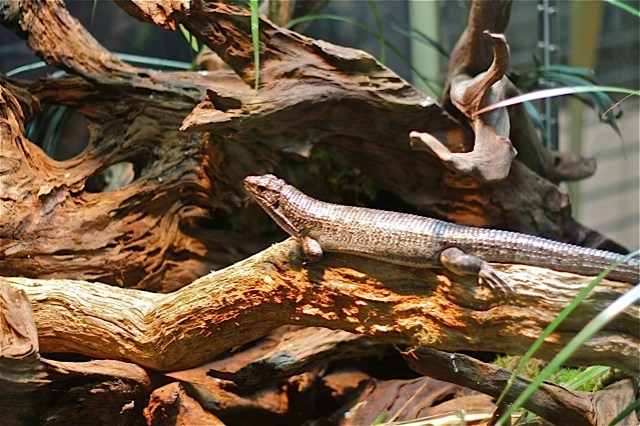
Genus: Zonosaurus maximus

 GENERAL CHARACTERISTICS: Relatively flattened body with a long, pointed snout. The body is covered with heavy armor of large, bony, keeled scales, especially on the dorsal surface. The scaleless area along the sides functions as expansion joints for gravid females that allow distention after feeding. Length is up to 70 cm (28 inches).


DISTRIBUTION/HABITAT: Endemic to Madagascar, this species is found in lowland humid forest associated with rivers and streams as well as non-forested riparian areas where it builds dens close to water. When disturbed, it seeks shelter in water and can stay submerged for several minutes.

DIET IN THE WILD: Plant matter, invertebrates, small rodents, other reptiles.

PREDATORS: Predators are primarily snakes.

REPRODUCTION: Oviparous. Life span: about 20 years.


CONSERVATION: IUCN Red List Vulnerable (VU)
Populations are severely fragmented and declining because of the reduced size and quality of habitat due to agricultural activities. Mature animals may also be over-collected for the pet trade. Some sites where this plated lizard occurs are fortunately under conservation management, including newly protected areas.

LOCATION:  Madagascar Rainforest  MA13

References

California Academy of Sciences, Docent Rainforest Training Manuel 2014

Encyclopedia of Life eol.org/pages/462210/details

IUCN Red List www.iucnredlist.org/details/172865/0

Ron’s flickr  https://www.flickr.com/photos/cas_docents/7423084566/in/set-72157620708610230/

Ron’s WordPress Shortlink  http://wp.me/p1DZ4b-xI


TAXONOMY:
Kingdom: Animalia
Phylum: Chordata
Class: Actinopterygii (ray-finned fishes)
Order: Cypriniformes (Carps)
Family: Cyprinidae (Minnows or Carps)

Genus/species: Puntius titteya

3729700826_694a261026_b

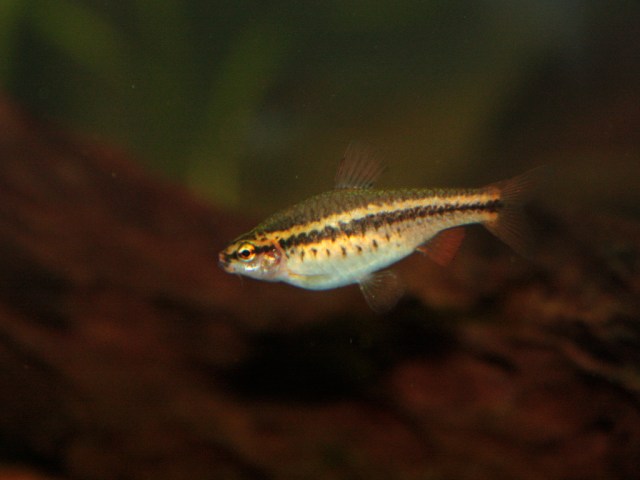
GENERAL CHARACTERISTICS: An elongated fish with a compressed body, fawn-colored on top with a slight greenish sheen. Sides and belly have silver highlights with a horizontal stripe extending from the tip of the snout through the eye to the base of the caudal fin, with an iridescent, metallic line above it. Males are redder than females and attain a deeper red color at breeding time. Females are usually yellow and they are much lighter in color, usually just with some yellow and a light orange/black horizontal band. The female is also a lot plumper than the male. Cherry refers to the fish’s red color. Max. length: 5 cm (2 inches).

Male above and female below.

Cherry Barb (female)  3750942153_ca01fdd6c8_b

DISTRIBUTION/HABITAT: Native to Sri Lanka with introduced populations established in Mexico
and Colombia. Found in heavily shaded streams and rivulets, preferring shallow, slow-moving water with silt substrate and leaf cover.

DIET IN THE WILD: Omnivorous, detritus, green algae, diatoms, dipterans and animal matter.

REPRODUCTION: Most small cyprinids Puntius spp. are egg-scattering free spawners exhibiting no parental care.

CONSERVATION IUCN: Least concern

BO09 Rainforest Borneo Southeast Asia Community

References

fishbase www.fishbase.org/summary/Puntius-titteya.html

Encyclopedia of Life eol.org/pages/212437/details

Ron’s flickr  http://www.flickr.com/photos/cas_docents/3729700826/in/set-72157620567930293/

Ron’s WordPress shortlink  http://wp.me/p1DZ4b-17f

TAXONOMY
Kingdom: Animalia
Phylum: Chordata
Class: Actinopterygii (ray-finned fishes)
Order: Cypriniformes (Carps)
Family: Cyprinidae (Minnows or carps) 

Genus/species: Systomus rhomboocellatus

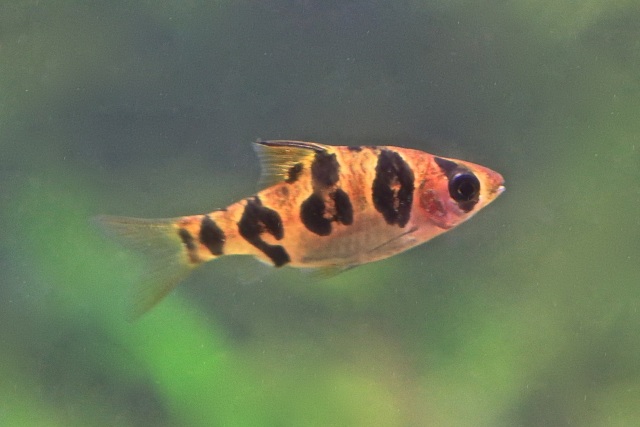
Snakeskin Barb IMG_7888

GENERAL CHARACTERISTICS: Diamond-shaped markings on their body, giving them a snake-skin appearance. Length 5-8 cm (2-3 inches).

DISTRIBUTION/HABITAT: West and Central Kalimantan in Borneo, Indonesia in black water streams in forested areas.

DIET IN THE WILD: Omnivorous; eats insects and worms.

REPRODUCTION: Egg scatter within areas of dense plant growth.

CONSERVATION: IUCN and CITES Not Evaluated

References

fishbase www.fishbase.org/summary/Puntius-rhomboocellatus.html

 Encyclopedia of Life eol.org/pages/224467/details

Ron’s flickr http://www.flickr.com/photos/cas_docents/sets/72157608614099673/

Ron’s WordPress Shortlink http://wp.me/p1DZ4b-16F