Tag Archive: frogs


TAXONOMY
Kingdom: Animalia
Phylum:  Chordata
Class: Amphibia
Order: Anura
Family: Mantellidae

Genus/species: Mantella viridis

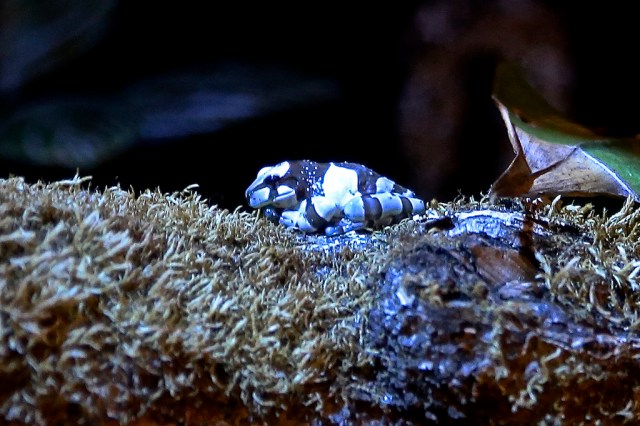
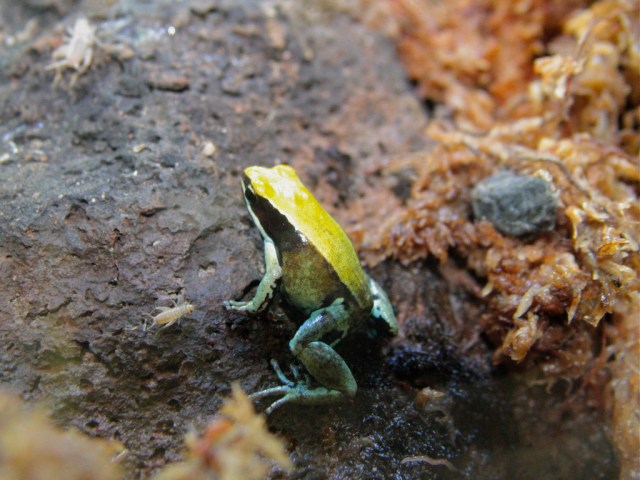
GENERAL CHARACTERISTICS: The back and sides are yellow-green; ventral parts are black with blue spots. The toes are not webbed. A light stripe runs along the upper lip. M. viridis is one of the biggest of the Madagascar mantella frogs; max length: 3.5 cm (1.37 inches).

3407271755_080ecf20e7_b

DISTRIBUTION/HABITAT: Endemic to Madagascar. Inhabits deciduous forests. Usually found around temporary streams. Also lives in degraded mango plantations.

DIET IN THE WILD: Diurnal predators, eating mainly insects, ants, and termites. May also eat fruit that has fallen to the ground.

REPRODUCTION: Between 15 and 60 greenish-yellow eggs are laid in cavities under rocks and in the trunks of dead trees. They hatch into tadpoles during heavy rainfall, which washes them into small pools of water (

CONSERVATION: IUCN Red List Endangered (EN)
The main threat is habitat loss, due to the impacts of fires, logging and livestock grazing. It is also affected by the drying out of smaller streams following forest loss. It has been recorded in the pet trade in relatively large numbers, although this is now greatly reduced.

REMARKS: Many species of tropical frogs sequester toxins in their skins. In most cases these toxins come from eating toxic arthropods such as ants. During the past 30 years, over 400
alkaloids of over 20 structural classes have been detected. The skin of Mantella viridis has been shown to contain such toxins.
3708490144_dd425c4260_b

Rainforest Madagascar Exhibit MA10

References

ARKive  www.arkive.org/green-mantella/mantella-viridis/

IUCN Red List: www.iucnredlist.org/details/57451/0

flickr  http://www.flickr.com/photos/cas_docents/sets/72157608456457315/with/3708490144/

WordPress Shortlink  http://wp.me/p1DZ4b-Na
TAXONOMY
Kingdom: Animalia
Phylum: Chordata
Class: Amphibia
Order: Anura
Family: Mantellidae

Genus/species: Mantella baroni

4708448392_717d47ae1f_b

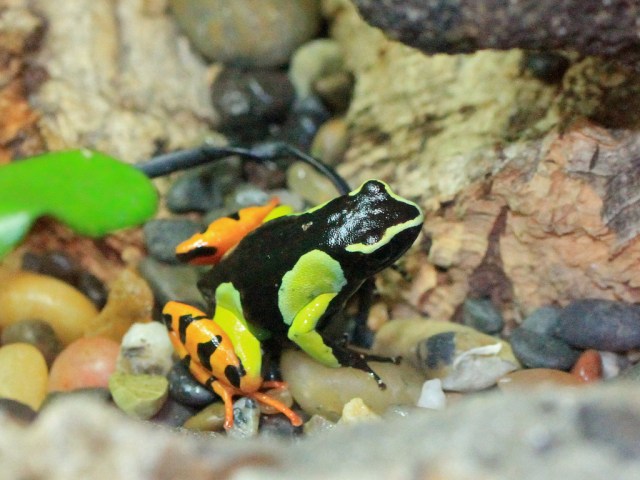
GENERAL CHARACTERISTICS: Has vibrant warning colors of black, orange, and yellow or green. The eye iris is black. Unlike many other frogs, mantella frogs move through trees and on the jungle floor, thus they do not have a need for webbed feet. 2.5-3.2 cm (1.0-1.3 inches) in length.

DISTRIBUTION/HABITAT: Widely distributed throughout east-central Madagascar. It is terrestrial found in forest and in slash-and-burn areas, often at considerable distance from forest. Males can be found calling loudly during the day, exposed near the sides of streams and surrounding forests.

DIET IN THE WILD: Insects including termites, fruit flies, and ants due to the fact that their meals provide them with alkaloid toxins.

REPRODUCTION: Eggs are laid on land, and the larvae are washed by rain into streams, where they develop.

CONSERVATION: IUCN: Red List; Least Concern (LC)
Has a wide distribution and is tolerant to habitat modification.

REMARKS: Secretes allopumiliotoxin 267A, which is one of the most toxic compounds but not strong enough to kill other predators. Their poison can make dangerous creatures sick. In captivity, the frog loses its toxicity as a result of an altered diet.

Painted Mantella

Rainforest Madagascar MA06

REFERENCES

Encyclopedia of Life  eol.org/pages/329310/details

IUCN www.iucnredlist.org/details/57438/0

Ron’s http://www.flickr.com/photos/cas_docents/sets/72157608456457315/

Ron’s WordPress shortlink  http://wp.me/p1DZ4b-Lt

Frogs cc  frogs.cc/mantella-frog-baroni/

TAXONOMY
Kingdom: Animalia
Phylum: Chordata
Class: Amphibia
Order: Anura (frogs and toads)
Family: Rhacophoridae (shrub frogs including Asian flying frogs)

Genus/species: Polypedates otilophus

IMG_0389

GENERAL CHARACTERISTICS: Dorsal color light brown to gray to yellowish brown or bright yellow. Head triangular and longer than broad; serrated bony ridge behind the eye. Pupils are horizontal, with yellowish gray irises. Thin black stripes run from the head down the back; thighs marked by black bars. Finger and toe tips expanded into large discs; toes webbed. Length from snout to vent: 6–8 cm (2.4- 3 inches) female 10 cm (4 inches).

Reinwardt's flying frog (Rhacophorus reinwardtii) MG_0098_2

DISTRIBUTION/HABITAT: Islands of Borneo and Sumatra in lowland rainforest up to elevations of around 400 m (1300 feet). Found in trees, bushes and freshwater ponds.

DIET IN THE WILD: Insects, crickets and spiders .

REPRODUCTION: When ready to mate the male calls loudly then the pair builds a foam nest overhanging water which the tadpoles eventually drop into.

CONSERVATION: IUCN least concern. Though populations are declining somewhat, this frog’s wide distribution and ability to thrive under conditions modified by humans suggest a strong survivability quotient.

IMG_0231

REMARKS: Has a has an unpleasant musty smell, which people find irritating.

Borneo, B011

References

Encyclopedia of life  eol.org/pages/1048298/details

AmphibiaWeb  http://amphibiaweb.org/cgi/amphib_query?where-genus=Polypedates&where-species=otilophus

flickr  http://www.flickr.com/photos/cas_docents/sets/72157608456457315/with/3766068513/

WordPress Shortlink http://wp.me/p1DZ4b-11k

TAXONOMY
Kingdom:Animalia
Phylum: Chordata
Class: Amphibia
Order: Anura
Family: Rhacophoridae

Genus/species: Rhacophorus pardalis

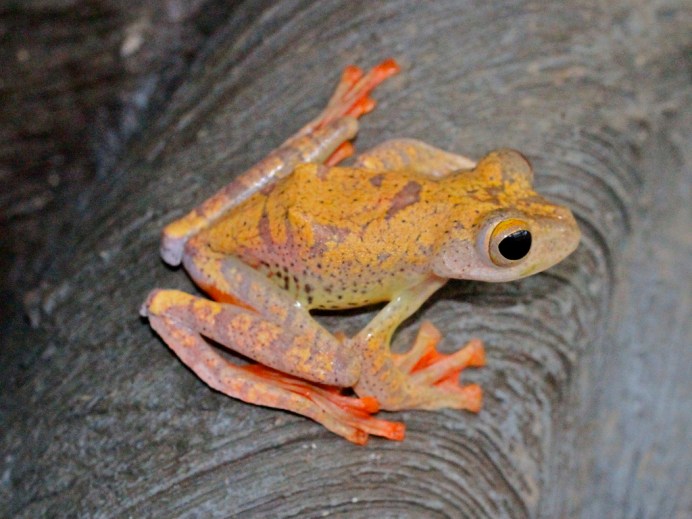
GENERAL CHARACTERISTICS: Fingers webbed and bear expanded discs, outer edge of hand and forearm have wide flap of skin – all adaptations for gliding. Bright red hand and foot webbing make this frog easy to identify. Dorsal side tan to reddish-brown, often with spots. Flanks yellowish with black spots. Size: Snout to vent males to 5.0 cm (2 inches) females, to 7.0cm (2.75 inches).


5170277207_42b048bdfe_b

DISTRIBUTION/HABITAT: Known from peninsular Malaysia, Sumatra, Borneo, and the Philippines. Found in subtropical primary forest, secondary forest and freshwater marshes from sea level to 1,000 m (3,281 feet). 

5170277417_17153bc773_b

REPRODUCTION: R. pardalis breeds at swampy forest pools.

CONSERVATION: IUCN Red List; Least Concern (LC) 

The most important threat to this species is logging.

Borneo Gliding Herps BO11

References

Encyclopedia of Life  eol.org/pages/1025363/details

IUCN Red List  www.iucnredlist.org/details/full/59012/0

Ron’s WordPress shortlink  http://wp.me/p1DZ4b-1q1

Ron’s flickr  https://www.flickr.com/photos/cas_docents/5170877230/in/set-72157620567930293

TAXONOMY
KINGDOM: Animalia
Phylum: Chordata
Class: Amphibia
Order: Anura
Family: Rhacophoridae

Genus/species: Nyctixalus pictus

DISTRIBUTION/HABITAT: Southern Southeast Asia. Found in shrub and lower tree strata in primary and secondary forests.

 Nyctixalus pictus15762349568_83118c678d_k

REPRODUCTION: Breeds by larval development in arboreal water-filled cavities and in rotting logs.

15923978406_3abc22c9b1_o

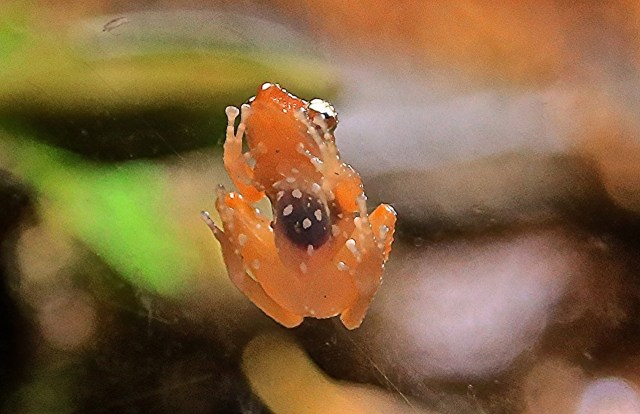
CONSERVATION: ICUN Redlist Near Threatened (NT)    The extent and quality of its habitat is declining very rapidly due to widespread forest loss within its range.

www.iucnredlist.org/details/58806/0

Borneo Nursery BO08

References  

Ron’s flickr https://www.flickr.com/photos/cas_docents/15762349568/in/set-72157608456457315/

Ron’s WordPress shortlink  http://wp.me/p1DZ4b-1pS


TAXONOMY
Kingdom: Animalia
Phylum: Chordata
Class: Amphibia
Order: Anura (frogs)
Family: Hylidae (“tree frogs and their allies”)

Genus/species: Trachycephalus resinifictrix

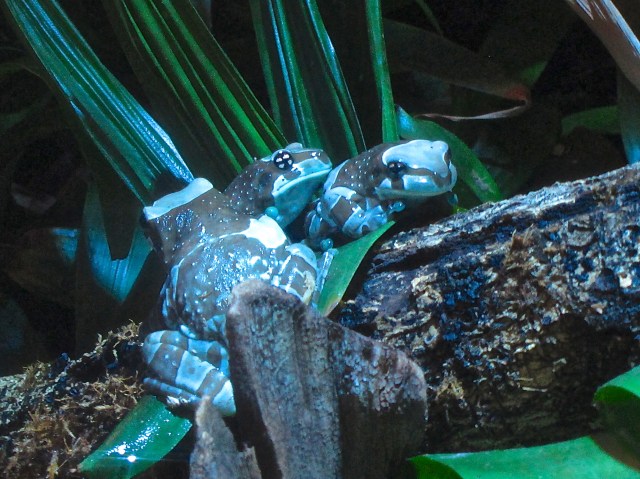
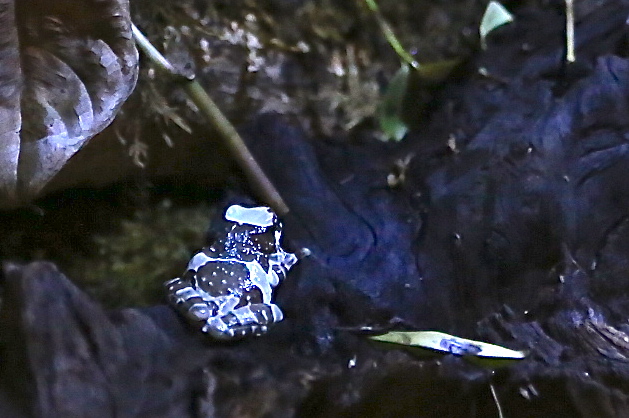
GENERAL CHARACTERISTICS: Light grey in color with brown or black banding,  Older frogs develop a slightly bumpy texture. The iris is golden with a black Maltese cross centered on the pupil. There is a vocal sac on each side of the head.  Reach 2.5 to 4 inches in length.

9830839556_f67b20a3fe_o

GENERAL CHARACTERISTICS: Light grey in color with brown or black banding, Older frogs develop a slightly bumpy texture. Reach 2.5 to 4 inches in length.

DISTRIBUTION/HABITAT:  Bolivia, Brazil, Colombia, Ecuador, French Guiana, Suriname, Venezuela.  Found in the canopy of tropical primary humid rainforests. They often inhabit vegetation which extends over permanent, slow-moving water.

IMG_0243

DIET IN THE WILD: Insectivorous

REPRODUCTION: Mainly in the rainy season between November and May. Clutches of about 2500 eggs form a gelatinous mass that floats near the surface of water or adheres to the inner wall of the tree holes. Tadpoles feed on conspecific eggs and vegetable detritus until metamorphosis in the tree holes.

IMG_4424

LIFESPAN Up to 25 years.

CONSERVATION: IUCN Red List; Least concern.

8353978767_29b24b4235_b

 REMARKS: The “milk” in the name comes from the poisonous milky-coloured fluid these frogs excrete when stressed.

References

Ron’s flickr  http://www.flickr.com/photos/cas_docents/8353978767/sizes/l/in/set-72157608456457315/

Ron’s WordPress Shortlink  http://wp.me/p1DZ4b-Mo

eol  eol.org/pages/1025259/details

Connecticut Beardsely Zoo  beardsleyzoo.org/amazonmilkfrog-fk1

TAXONOMY
Kingdom: Animalia
Phylum: Chordata
Class: Amphibia
Order: Anura
Family: Hylidae

Genus/species: Hyla cinerea

3202286940_36e85084b3_b

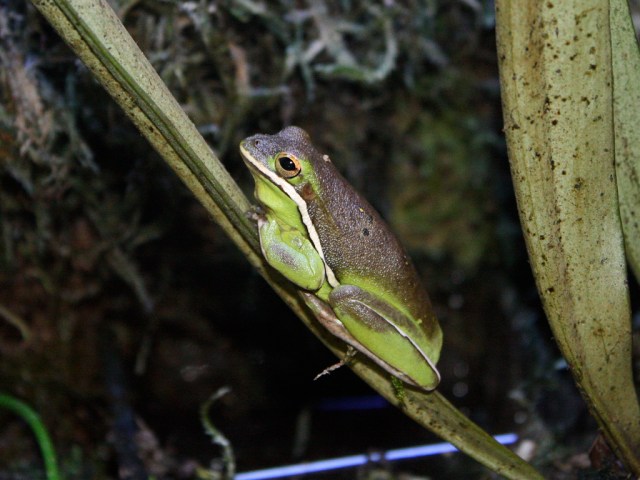
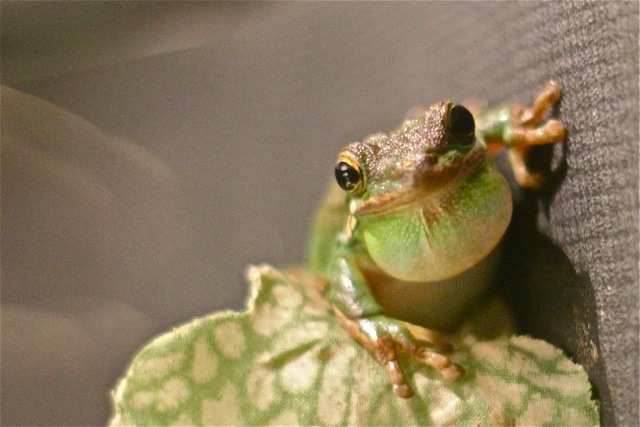
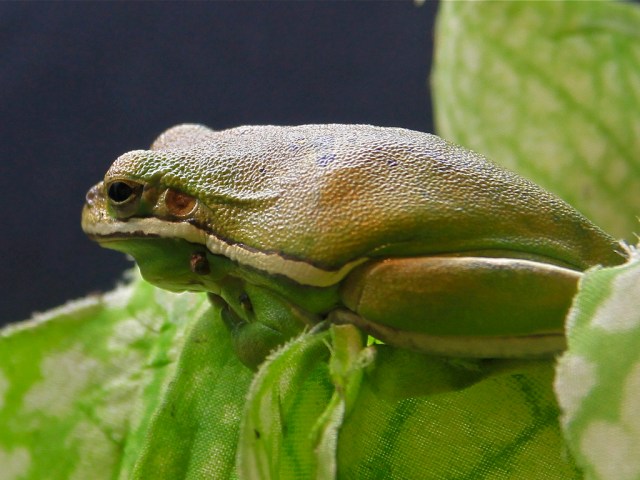
GENERAL CHARACTERISTICS: Bright yellow-green above, though some are reddish-brown to green, often with small golden spots. White to cream below with a prominent white lateral stripe
on each side.  Up to 6 cm (2.5 in) long.

DISTRIBUTION/HABITAT: Central to Southeastern United States. North to Virginia’s eastern shore, south to the southern tip of Florida, west to central Texas. Habitat: Forest habitats in small ponds, large lakes, marshes, and streams, especially in richly vegetated areas.

Green Treefrog  8593645003_ef71a3137d_o

DIET IN THE WILD: Insectivores: flies, mosquitoes, and other small insects

PREDATORS: Predators include snakes, birds, large fish, and other frogs. Predatory aquatic insects such as giant water bugs may take tadpoles. Green frogs in captivity are known to live as long as 6 years.

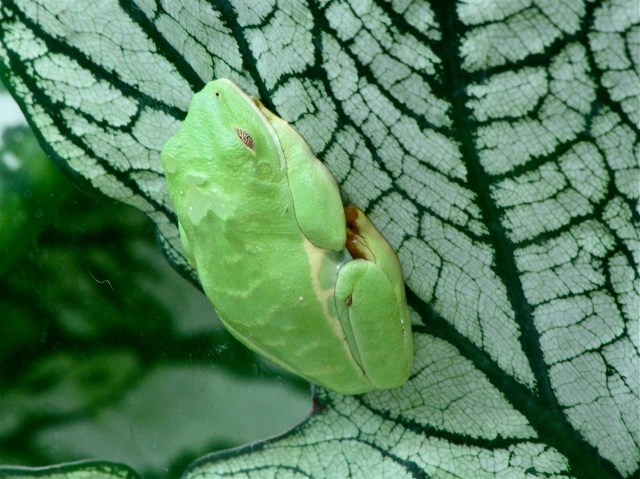
REMARKS: Active at night. During the day, adults are well camouflaged among grasses and other vegetation, especially when legs are tucked below the body and eyes are closed.

4664138328_3b7a8bbb04_b

Swamp SW07

flickr http://www.flickr.com/photos/cas_docents/sets/72157608456457315/

WordPress Shortlink : http://wp.me/p1DZ4b-LT

TAXONOMY
Kingdom:  Animalia
Phylum:  Chordata
Subphylum:  Vertebrata
Class:  Amphibia
Order:  Anura
Family:  Megophryidae

Genus/species: Megophrys nasuta

4427840755_184d36bab6_b

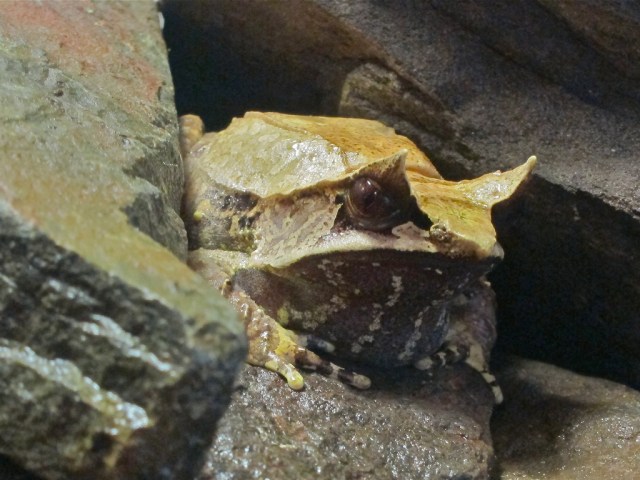
GENERAL CHARACTERISTICS: Have projections above each eye and nasal area, hence the name Horned Frog. Designed for camouflage; back is gray, tan, russet, or brown and darkens toward the side making the frog almost invisible among the forest leaf litter. The smooth skin resembles dead leaves.

4329887255_429231e129_b

DISTRIBUTION/HABITAT: Borneo, Malay Peninsula, Sumatra. Lives in relatively cool damp environs. Optimal temperature is between 22–24° C. Found on the rainforest floors, usually near small streams.

DIET IN THE WILD: Crabs and scorpions are their main food; also take arachnids, nestling rodents, lizards and other frogs that live on the forest floor.5536565600_f6c87f37ec_b-1


REMARKS: Call is unmistakable: a loud, resonating, metallic honk or henk, somewhat reminiscent of an air horn. The Jahai, an aboriginal group from northern Peninsular Malaysia, call this frog “Kengkang,” onomatopoeic after its call.

Rainforest Borneo  BO08

flickr  http://www.flickr.com/photos/cas_docents/sets/72157608456457315/with/4427840755/

WordPress Shortlink  http://wp.me/p1DZ4b-Mb


TAXONOMY

Kingdom: Animalia

Class: Amphibia

Order: Anura

Family: Hylidae

Genus/species: Agalychnis callidryas


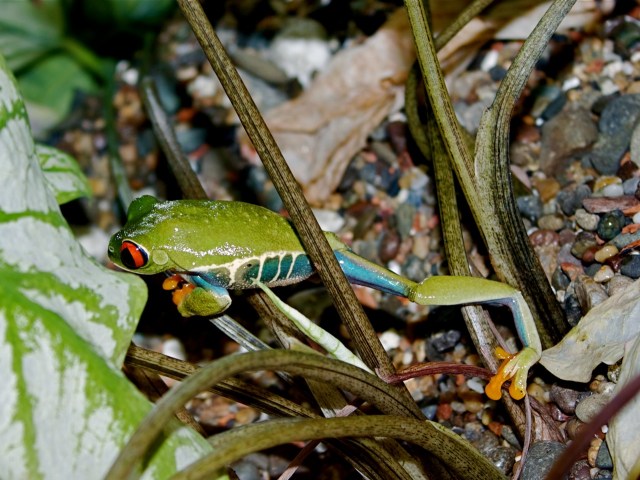
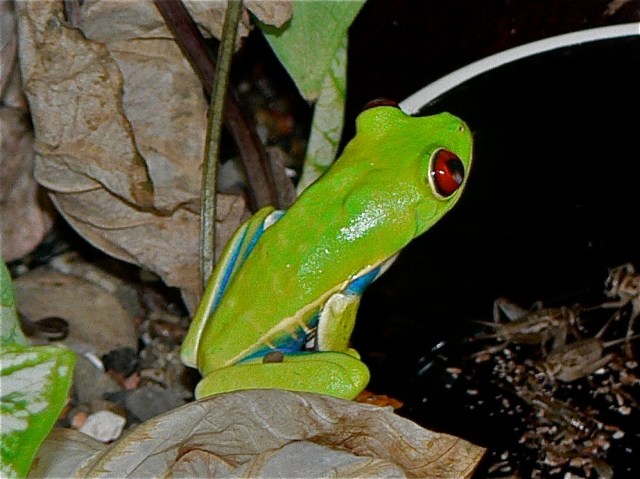
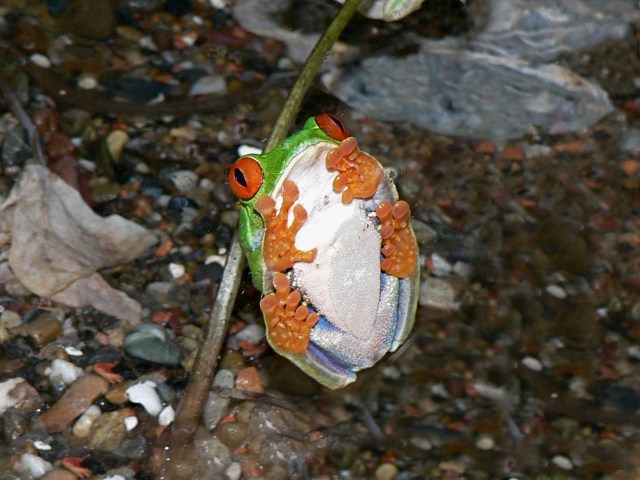
GENERAL CHARACTERISTICS:  Males are smaller (about 5 cm or 2.5 inches) than females (almost 7.62 cm or 3 cm). Both have neon green backs. With its bright orange-red suction toe pads it easily clings, climbs, and jumps among arboreal surfaces. Their distinctive bright red, bulging eyes provide highly developed parabolic vision. A reticulated pale nictitating membrane shields the frog’s sensitive eyes.

DISTRIBUTION/HABITAT: Southeastern Mexico, through Central America, to northwestern Colombia.  Lives near ponds or rivers in neotropical rainforests from sea level up to 960m. These nocturnal frogs are completely arboreal. During the day they remain motionless, blending in among the foliage. They live in warm (75-85°F, day; 66-77°F, night), humid (80-100%) climates.

DIET IN THE WILD: Carnivorous; crickets, moths, beetles, flies, grasshoppers and even smaller frogs.

REPRODUCTION: Males call from branches and leaves of trees above ponds in the rainy season; they vocalize in unison and threaten one another competing for females. Females with one or several males attached, climbs to a leaf above the water. Clutches of 11–78 eggs are deposited on the leaf, which usually is folded around the egg clutch. Hatchling tadpoles drop into the water where they become mid-water filter feeders

PREDATORS: Life span: 3–5 yrs. Preyed upon by birds, turtles, lizards, snakes, bats and other mammals.

CONSERVATION STATUS: Neither endangered nor threatened currently, A. callidryas has become the familiar icon for conservation of the world’s rainforests Global warming, deforestation, climatic and atmospheric changes, wetland drainage and pollution have caused dramatic declines and deformities in all amphibian populations including those of the neotropical rainforests.

Costa Rica Rainforest  CRO6

flickr http://www.flickr.com/photos/cas_docents/sets/72157608456457315/with/3143683892/

WORDPRESS SHORTLINK  http://wp.me/p1DZ4b-dZ

DAYTIME COLORS BELOW