Tag Archive: freshwater fishes


TAXONOMY
Class: Actinopterygii (ray-finned fishes)
Order: Acipenseriformes (Sturgeons and paddlefishes)
Family:Polyodontidae Paddlefishes (Paddlefishes)

Genus/species: Polyodon spathula
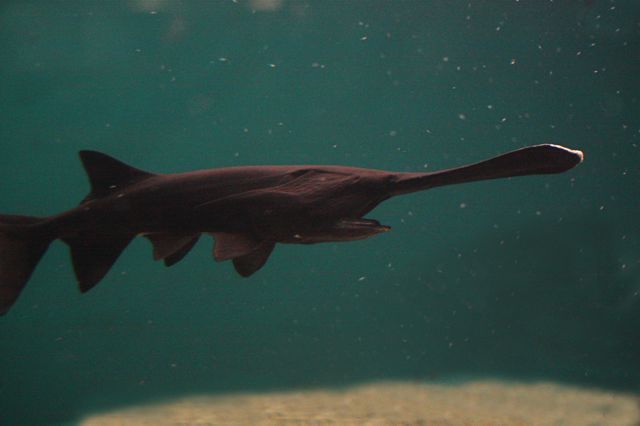
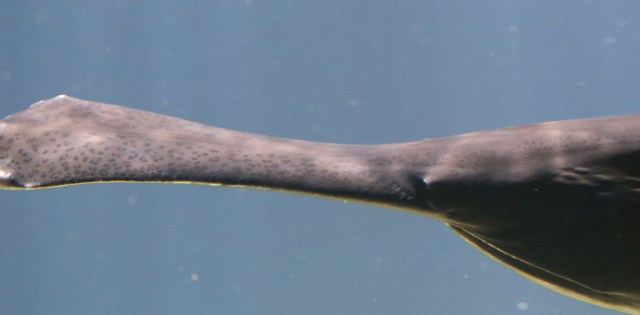
GENERAL CHARACTERISTICS: Gray, shark-like body with a deeply forked tail and huge toothless mouth when feeding. Extended upper jaw (rostrum) flattened into paddleshape, accounts for 1/3 of total body length. Fins stiffer than those of teleost fishes. Heterocercal tail. Skeleton cartilaginous, skin tough, scales lacking. Max length 221 cm (87 inches); max weight 90.7 kg (200 pounds), average weight considerably less.

DISTRIBUTION/HABITAT: Rivers of central United States, especially Mississippi River and its tributaries. Prefers deep pools in large rivers where the current is slow; is highly mobile and has been known to travel more than 2,000 miles.
8440810977_b3ddc58544_b

DIET IN THE WILD: Zooplankton, the majority being water fleas, also tiny crustaceans and larvae. To feed, the fish swims with its huge mouth wide open. As the water passes over its gills food is filtered out by special filaments called gill rakers. Also, the paddle is covered with pores that extend over the head and along the gill covers. These pores are electroreceptors capable of detecting as little as 1/100 of 1-millionth volt per cm, enough to sense the presence of plankton, a valuable tool, especially since vision, hearing and smell are poor.
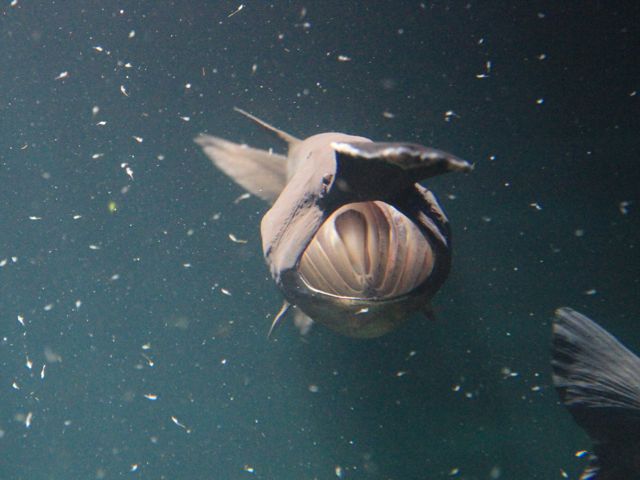

REPRODUCTION and DEVELOPMENT: Female spawn only once every 4 to 7 years starting when they are 6-12 years old swimming up river to lay 2 eggs at a time. Egg cases rounded. Eggs hatch in 7 days; young are swept downstream to permanent home.

MORTALITY: Live up to 30 years.

PREDATORS: Only man.

CONSERVATION STATUS: IUCN: vulnerable. Threatened by overfishing throughout much of its range, particularly for its eggs since the ban on imported caviar. Dams prevent fish from reaching spawning grounds, sedimentation and river modifications destroy habitat.
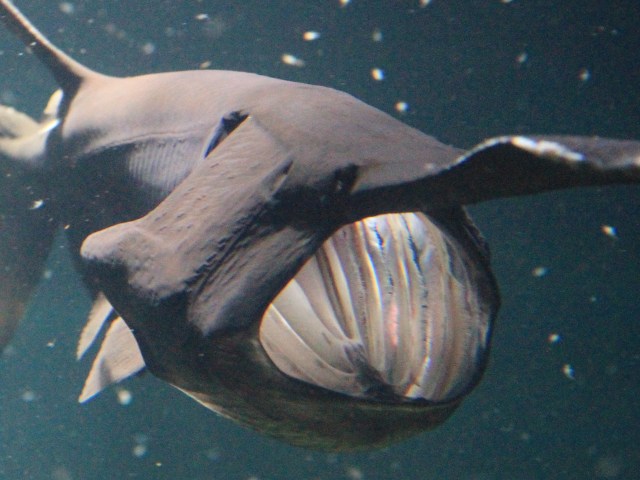
Mississippi paddlefish   (Polyodon spathula)  IMG_2499 - Version 2

REMARKS: The paddle is covered with pores that extend over the head and along the gill covers. These pores are electroreceptors capable of detecting as little as 1/100 of 1-millionth volt per cm, enough to sense the presence of plankton, a valuable tool, especially since vision, hearing and smell are poor.

Both paddlefish and sharks have skeletons made of cartilage, not bone. Paddlefish have no scales.

Paddlefish are the oldest surviving animal species in North America. Fossil records indicate that they date back 300 million years.

Water Planet Feeding Cluster WP31

Ron’s flickr  http://www.flickr.com/photos/cas_docents/sets/72157625017923579/with/3186623140/

Ron’s WordPress shortlink  http://wp.me/p1DZ4b-lb
TAXONOMY
Kingdom: Animalia
Phylum: Chordata
Class Actinopterygii (ray-finned fishes) 
Order Acipenseriformes (Sturgeons and paddlefishes)
Family  Acipenseridae (Sturgeons)

Genus/species: Scaphirhynchus albus 

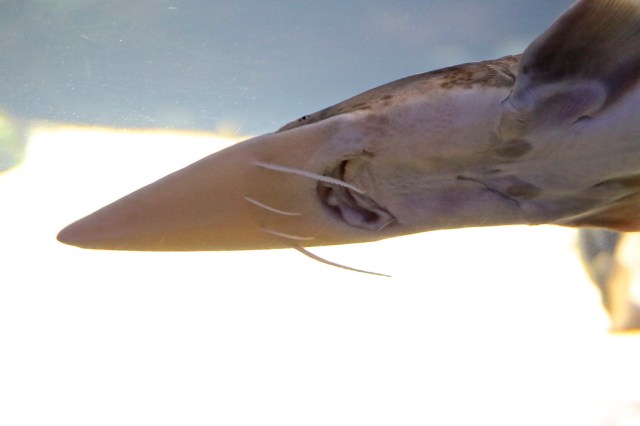
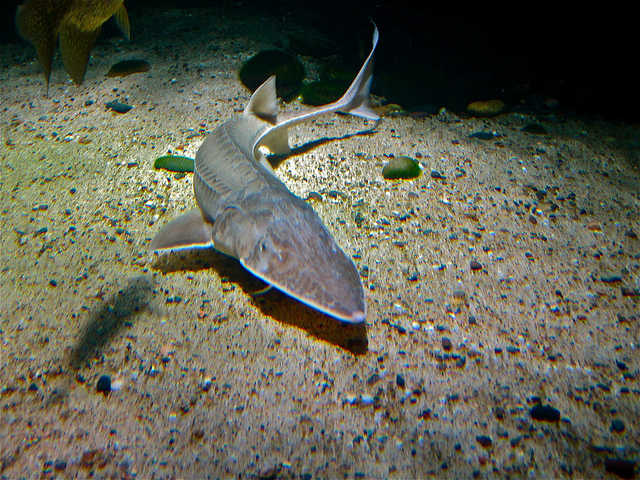
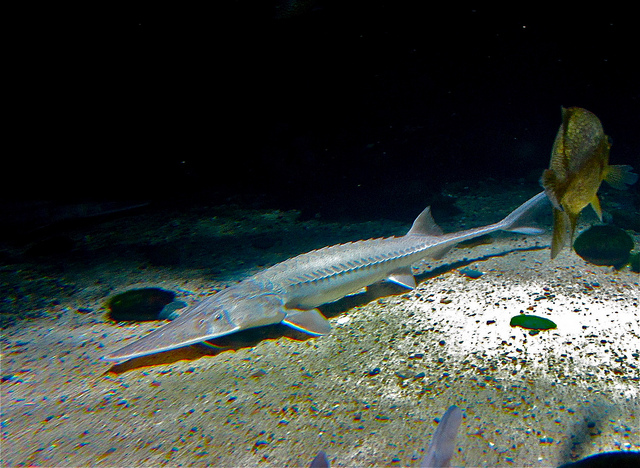
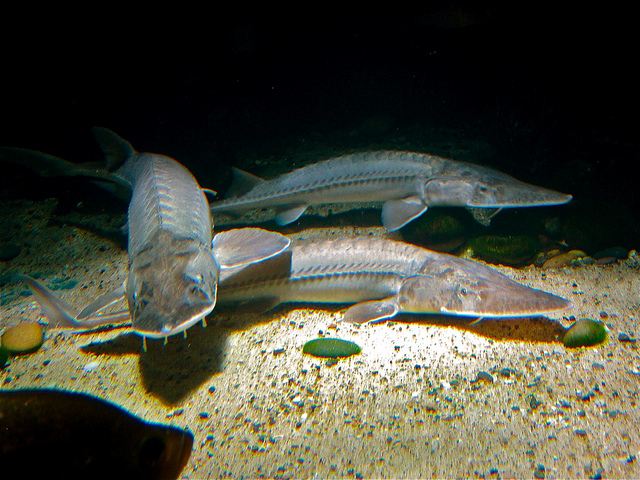
GENERAL CHARACTERISTICS: Shark-like with heterocercal tale and scutes instead of scales; gray above, white below. Flat, upturned head. Four long barbels. One of the rarest and largest freshwater fishes in North America; length to over 2 m (6.5 feet), weight over 75 lbs.

Pallid Sturgeon  8395624080_f62868641d_b

DISTRIBUTION/HABITAT: Missouri and Mississippi Rivers and their large tributaries, especially the Kansas River, from Montana to the Gulf
of Mexico. Found on the bottom in turbid, deep, fast
 flowing rivers over sand and gravel bars. 

DIET: Mollusks, insects, and small fishes. S. albus  is a bottom feeder. In addition to taste buds on the tips of the barbels it has sensory organs on the ventral surface of the
snout that pick up electrical fields emanating from prey. The sturgeon stirs up the muck with its snout, then the mouth, which is folded in.

REPRODUCTION and DEVELOPMENT: In the wild, external fertilization, eggs scattered and not guarded. However, natural reproduction is almost non-existent. Since 1990 over 150,000 pallid sturgeon have been raised in hatcheries and released.

MORTALITY/LONGEVITY: Life span: up to 50 years or more.

CONSERVATION STATUS:: ESA: federally listed 1990: Endangered.Our juvenile pallids came from Gavin’s Point National Fish Hatchery in Montana. The Steinhart is permitted to display these 88 A Docent & Guide View of the Steinhart Aquarium Species
endangered species as long as an educational message is presented about their distribution, endangered status, and threats facing them.

REMARKS: Pallid and shovelnose sturgeon are
 known to hybridize, another potential threat to the species survival in the southern portion of the pallid’s range where shovel nose sturgeon dominate. Often referred to as the Dinosaur of the Missouri, the pallid sturgeon is known from 70 million years ago and at one time was the top freshwater carnivore. Like all sturgeon, have a cartilaginous skeleton.

Water Planet, Feeding Cluster WP31 

flickr http://www.flickr.com/photos/cas_docents/sets/72157608608528651/with/8395624080/

WordPress Shortlink http://wp.me/p1DZ4b-kX

TAXONOMY
Kingdom: Animalia
Phylum: Chordata
Class: Actinopterygii (ray-finned fishes)
Order: Lepisosteiformes (Gars)
Family: Lepisosteidae (Gars)

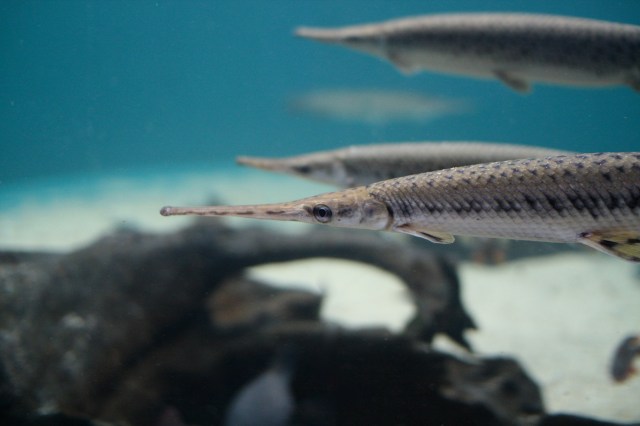
Genus/species: Lepisosteus osseus

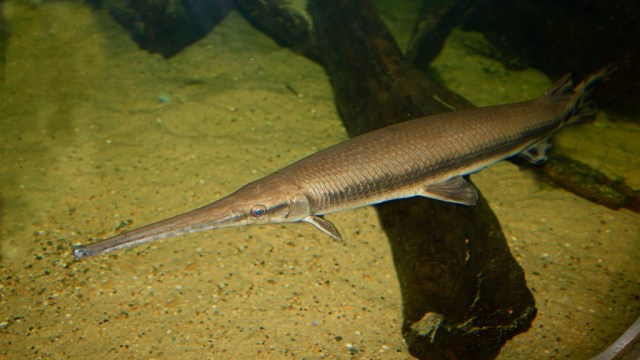
Longnose Gar 3079559158_8c3e7931ff_b

GENERAL CHARACTERISTICS: Very long, cylindrical with dorsal and anal fins set well back on the body, and a large rounded tail fin. Snout more than twice as long as head. Olivaceous brown above and white below. Dark spots on median fins and on body. Ganoid scales. Two to three feet in length not uncommon.

DISTRIBUTION/HABITAT: Saint Lawrence River drainage; along Atlantic coast from south of New Jersey to Florida; Southern Great Lakes and Mississippi River system, south to Rio Grande in Texas.
Found in backwaters, large creeks, lakes; may enter brackish water.
They can live in very warm water with little oxygen.

DIET IN THE WILD: Voracious predators. Piscivorous; also feeds on crabs and other crustaceans. Catches prey by swinging jaws back and forth, impaling fish on its sharp teeth.

REPRODUCTION: Sexual maturity for males is reached between 3 and 4 years of age while females at 6 years of age. Spawn in spring depositing eggs in weedy bays on vegetation. Young have a special disk on its head to attach to vegetation, much like pike fry.

PREDATORS: Rarely eaten by fish.

Longnose Gar 8703062067_f828b535c6_b

CONSERVATION: Not federally listed as endangered but but some states list it as threatened because of overfishing and habitat loss.

REMARKS: The roe is poisonous.

Gar can also take in oxygen by swimming to the surface and gulping air into their swim bladders allowing them to live in oxygen poor water..

Family dates back 245 million years

Feeding Cluster WP31

flickr http://www.flickr.com/photos/cas_docents/sets/72157608608528651/with/3079559158/

WordPressShortlink http://wp.me/p1DZ4b-10m

TAXONOMY
Kingdom: Animalia
Phylum: Chordata
Class: Actinopterygii (ray-finned fishes)
Order: Lepisosteiformes (Gars)
Family: Lepisosteidae (Gars)

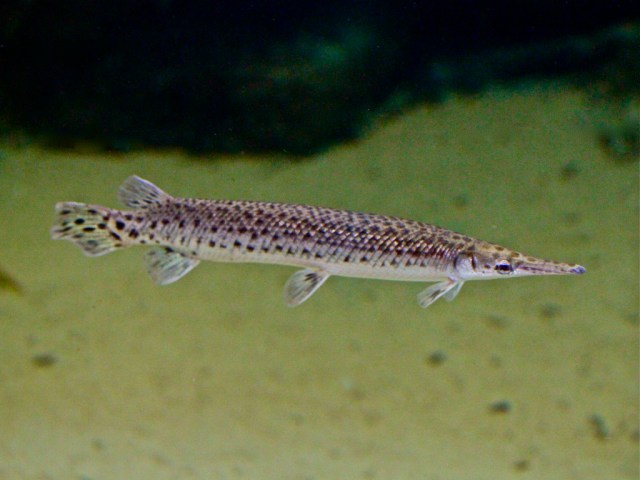
Genus/species: Lepisosteus oculatus

3392056841_98e722a87a_o

GENERAL CHARACTERISTICS: The smallest of the four species of gar. Weight to 4.4 kg.(9.7 pounds), maximum recorded for wild fish is 44.8″ (112cm). Body long and cylindrical with elongated mouths. colored dark olive to brown above. L. oculatus has thick, ganoid (diamond-shaped) scales. All fins with dark spots; belly whitish; snout short.

DISTRIBUTION/HABITAT: Lake Erie and south Lake Michigan drainages; Mississippi River drainage from Illinois south to East Oklahoma, East Tennessee; Gulf Coast streams from West Florida to Central Texas. Found in clear pools with aquatic plants in streams, swamps and lakes; may enter brackish water on the Gulf Coast.

DIET IN THE WILD: Voracious predator with an elongated mouth with many teeth feeding on fishes and benthic crustaceans.

Spotted Gar IMG_1369

REPRODUCTION: Spawns between the months of May and July. Eggs are simply scattered among aquatic vegetation, and no parental care is exhibited. The roe (or egg mass) is highly toxic to humans, animals, and birds.

PREDATORS: Eaten by larger fish, alligators and herons.

LONGEVITY: Live to at least 18 years.  

CONSERVATION: Not evaluated by the IUCN. Not in need of special conservation efforts.

4515019385_e7aea751fb_b

REMARKS: Have a specialized swim bladder which allows them to gulp air and live in the poorly oxygenated back waters.

They are primitive fish and date back to the Cretaceous period, some 65 to 100 million years ago. The ancestors of spotted gar swam with the dinosaurs.

Water Planet Feeding Cluster WP31

Swamp SW02

flickr http://www.flickr.com/photos/cas_docents/sets/72157608608528651/

WordPress Shortlink http://wp.me/p1DZ4b-10a

TAXONOMY
Kingdom: Animalia
Phylum: Chordata
Class: Actinopterygii (ray-finned fishes)
Order: Perciformes (Perch-likes)
Family: Centrarchidae (Sunfishes)

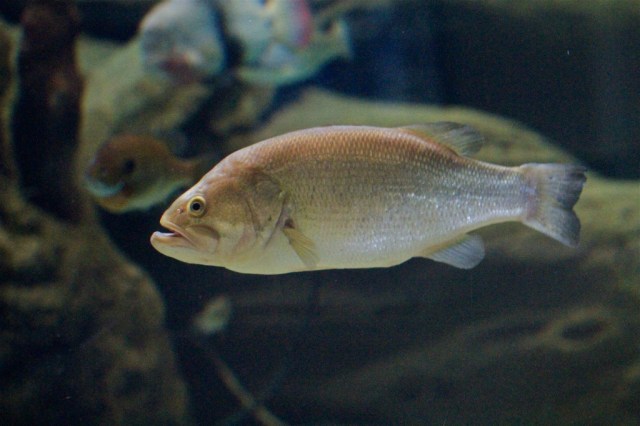
Genus/species: Micropterus  salmoides

Largemouth Bass 4515020403_327c45ebbd_b

GENERAL CHARACTERISTICS: Common length : 40.0 cm, (16 inches), max. published weight: 10.1 kg (22 1/4 lbs). Mouth large; maxillary extending beyond the eye. Green to olive dorsally, milk-white to yellow ventrally, with a black band running from the operculum to the base of the caudal fin. Caudal fin rounded

DISTRIBUTION/HABITAT: Native to eastern North America and historically ranged from southern Canada to northern Mexico, and from the Atlantic coast to the central region of the United States. Prefers quiet, shallow, clear water with lots of vegetation. Seldom found deeper than 20 feet.

DIET: Crayfish and other fish species including their own. Other sunfish species are the food of choice for most adult largemouth bass.

REPRODUCTION and DEVELOPMENT: Males prepare and build a crude nest in shallow water. Following an act of courtship, female lays eggs in the nest. Males guard the eggs until they hatch. The schooling fry remain close to their father for about a month.

PREDATORS: Herons, bitterns, and kingfishers. Max. reported age: 23 years.

Largemouth Bass 6268037751_8f1c84e75e_b

CONSERVATION: World Conservation Union (IUCN) not listed as endangered or vulnerable.

REMARKS: It is the most popular game fish in the United States and is a potential pest as it can eradicate indigenous species. Largemouth bass have been introduced successfully all over the world.

Swamp SW02

flickr http://www.flickr.com/photos/cas_docents/sets/72157625017923579/with/4515020403/

WordPress Shortlink http://wp.me/p1DZ4b-ZL

TAXONOMY
Kingdom: Animalia
Phylum: Chordata
Class: Actinopterygii
Order: Perciformes
Family: Centrarchidae (Sunfishes)

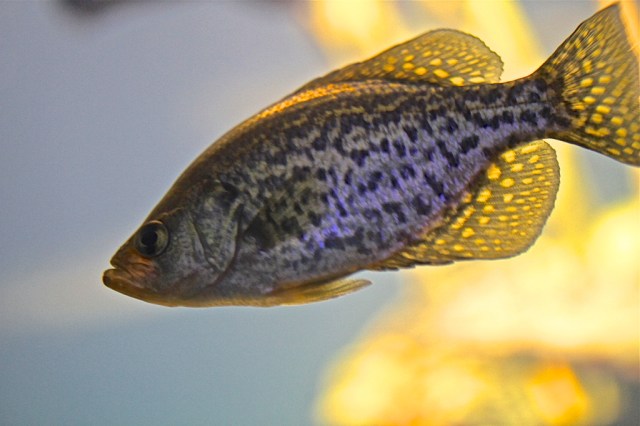
Genus/species: Pomoxis nigromaculatus

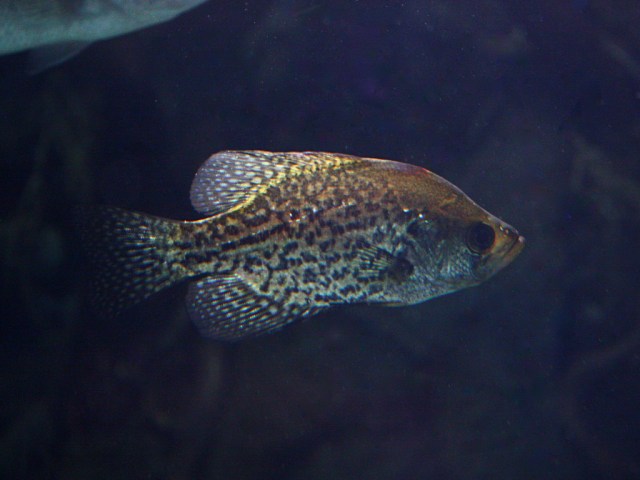
Black Crappie  5230993160_366f8f8c16_b

GENERAL CHARACTERISTICS: Length 13-38 cm (5 – 15 in) in length. The average weight varies from 0.25-0.90 kg (9 – 31 oz). Deep and laterally compressed body with symmetrical dorsal and anal fins. Color is silvery-gray to green with irregular or mottled black splotches over the entire body. Color varies among populations of P. nigromaculatus with age, habitat, and breeding are all determinants of the intensity of mottling.

DISTRIBUTION/HABITAT: North America: native to freshwaters of central and eastern North America, today widely introduced throughout the U.S.  Habitat: Lakes, ponds, sloughs, and backwaters and pools of streams. Prefers clear water and sites with vegetation over mud or sand.

DIET IN THE WILD: Mid-water omnivore that feeds in vegetation and open water. Its numerous gill rakers allow it to consume planktonic crustaceans; however aquatic insects, minnows, and fingerlings of other species comprise its main diet.

Black Crappie 3202662242_7502b65334_b

REPRODUCTION: P. nigromaculatus produce an average of 40,000 spherical eggs and the male watches o the nest until eggs hatch, which is usually about 2–3 days.

PREDATORS: Larger fishes such as pike, walleye and muskellunge. Average lifespan 10-13 years.

CONSERVATION: Not endangered.

REMARKS: A very popular tasty sport fish.

Feeding Strategies WP31 and Swamp SW02

flickr http://www.flickr.com/photos/cas_docents/sets/72157608608528651/with/3202662242/

WordPress Shortlink  http://wp.me/p1DZ4b-ZD

TAXONOMY
Class: Actinopterygii (ray-finned fishes)
Order: Perciformes (Perch-likes)
Family: Toxotidae (Archerfishes)

Genus/species: Toxotes jaculatrix

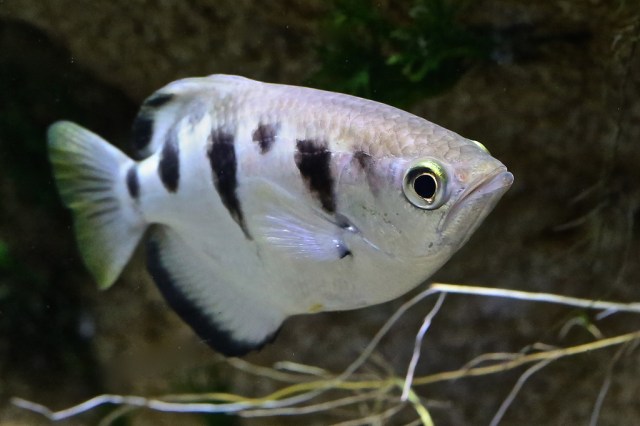
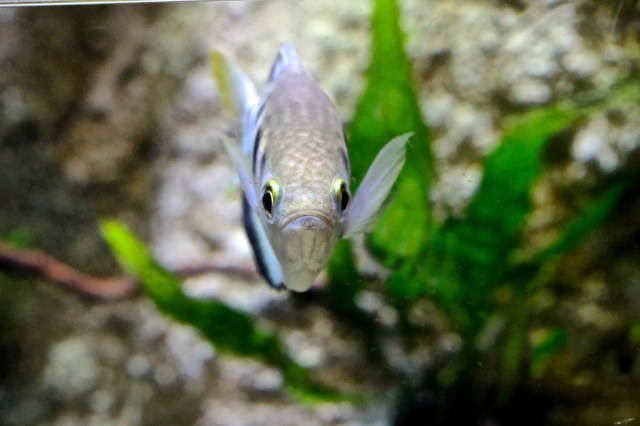
Banded Archerfish 8393611643_5ce29954b5_b

GENERAL CHARACTERISTICS: Have silvery or white bodies with black bars. Maximum length 30 cm (12 inches), common length : 20.0 cm (8 inches).

DISTRIBUTION/HABITAT: Asia and Oceania: India eastward to the
Philippines, and south to Indonesia, Vanuatu, Solomon Islands, Papua New Guinea, and northern Australia. Habitat: primarily in brackish mangrove estuaries, but also penetrates rivers and small streams.

DIET IN THE WILD: Insects, crustaceans, small fishes and floating plant matter.

CONSERVATION: Not endangered.

REMARKS: Used in In botanical gardens to help control plant pests.

T. jaculatrix has the unique ability to shoot insects off branches with amazing accuracy, up to five feet (150 cm) away. They form a tube using the ridge in their tongue and a groove on the roof of their mouth to become living squirt guns. Slamming their gill covers closed propels a powerful jet of water through the channel.
They also have the remarkable ability to compensate for visual refraction when aiming its shoots from water into the air.

Banded Archerfish 8412951528_42ec8b3dd2_b

Feeding Cluster WP32

flickr http://www.flickr.com/photos/cas_docents/sets/72157608614099673/

WordPress Shortlink http://wp.me/p1DZ4b-Zq