Tag Archive: fishes


Actinopterygii (ray-finned fishes),  Anguilliformes (Eels and morays),  Muraenidae (Moray eels)

Rhinomuraena quaesita
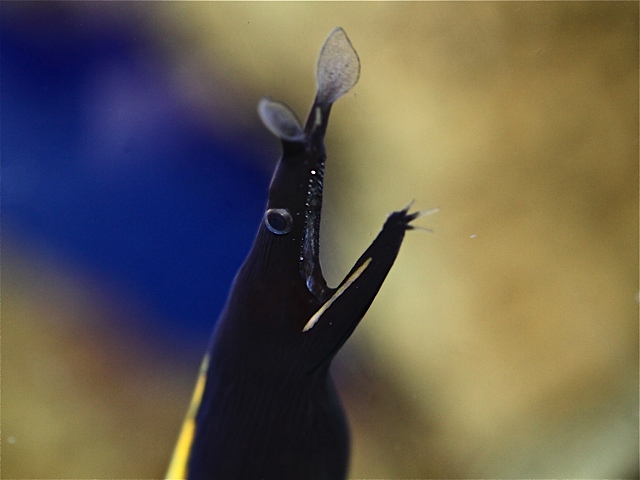
DISTRIBUTION: Indo-Pacific from East Africa to the Tuamota Archipelago (French Polynesia).

HABITAT: Lagoons and associated reefs at depths up to 57 m.

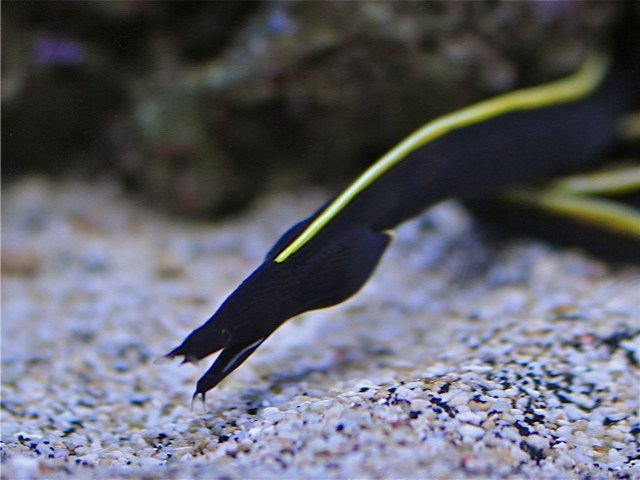
APPEARANCE: Long thin body and high dorsal fins. Has three fleshy tentacles on the tip of its lower jaw, a single fleshy pointed projection at the tip of its snout, and tubular anterior nostrils ending in gaudy, fanlike expansions. Juveniles are black with a yellow dorsal fin, males are mostly blue, and females are mostly yellow. Length up to 130 cm (51 in).

DIET: Mostly small fishes, some invertebrates.

REPRODUCTION and DEVELOPMENT: External fertilization nonguarder.  R. quaesita is a protandrous hermaphrodite, i.e., functioning males reverse sex to become females.  It is the only moray that undergoes abrupt changes in coloration and sex.  Protandry is diagnosed based on coloration, but not confirmed.

MORTALITY/LONGEVITY May have lifespan up to 20 years.

REMARKS: The ribbon eel buries itself in sand or hides in rocks or reefs, sometimes with head protruding, lying in wait or emerging to hunt for small fish. Like all morays, it rests with mouth open, displaying sharp teeth that appear ready for use. Actually, ribbon eels are among the least aggressive of morays, the gaping mouth simply aiding breathing by allowing oxygenated water to enter and pass over the gills.

flickr  http://www.flickr.com/photos/cas_docents/4405139265/in/set-72157608402401040/

WORDPRESS SHORTLINK  http://wp.me/p1DZ4b-o0
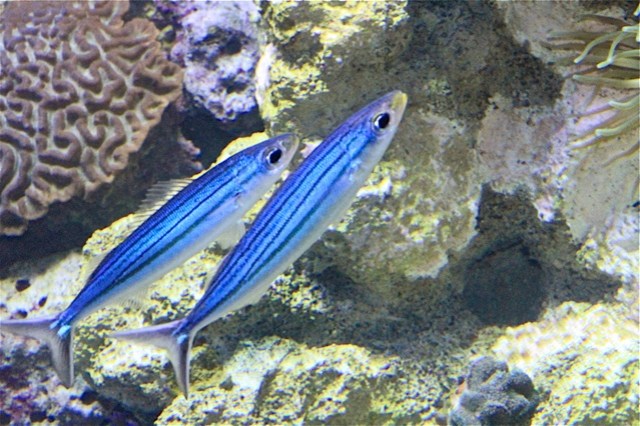
Actinopterygii (ray-finned fishes),  Perciformes (Perch-likes),  Haemulidae (Grunts)

Haemulon vittatum


DISTRIBUTION: Western Atlantic: southern Florida, USA and Bahamas to northern South America. Also Caribbean, including Antilles.

HABITAT: Marine; reef-associated; depth range 15 – 50 m

Haemulon vittatum

APPEARANCE: Average length 18.0 cm (7 in).

Spindle-shaped fish with a deeply forked tail and an extremely protrusible mouth. Dorsal fins close together. 

DIET: Zooplankton and small fishes.  REMARKS: Minor commercial fishery; bait: occasionally.

LOCATION: Caribbean Reef

Flickr http://www.flickr.com/photos/cas_docents/sets/72157625866509117/

WORDPRESS SHORTLINK  http://wp.me/p1DZ4b-ma

Phylum:Chordata, Superclass: Osteichthyes,  Class:Actinopterygii (Ray-finned fishes), Order: Characiformes (Characins) Family: Lebiasinidae (Pencilfishes). .

Copella arnoldi

DISTRIBUTION: Guyana, Suriname, French Guiana and Brazil

HABITAT: Streams and tributaries off main river channels, and also occurs in flooded forests during the wet season with large amounts of overhanging vegetation.

APPEARANCE: Length 1.6″ (4cm).  The male grows larger than the female, and is more brightly coloured. Mature males also develop extended fins.

DIET: Feeds on worms, insects and crustaceans.

REPRODUCTION and DEVELOPMENTC. arnoldi   spawn on the underside of plant leaves or other surfaces that, are always above the water surface. The spawning site is selected by the male who once a site has been chosen will display at and follow a female forming a pair. At the climax of courtship, the pair lock themselves together using their fins, and jump out of the water, landing on the spawning site. Using their ventral fins, they can hold themselves here for up to 10 seconds, as eggs and sperm are released. Up to 12 eggs may be laid and fertilized, and the process is then repeated. Usual brood size is approximately 50.

LOCATION: Animal Attraction Series, Staff picks

flickr site  http://www.flickr.com/photos/cas_docents/6699435185/in/set-72157620568438047

WORDPRESS SHORTLINK  http://wp.me/p1DZ4b-lz

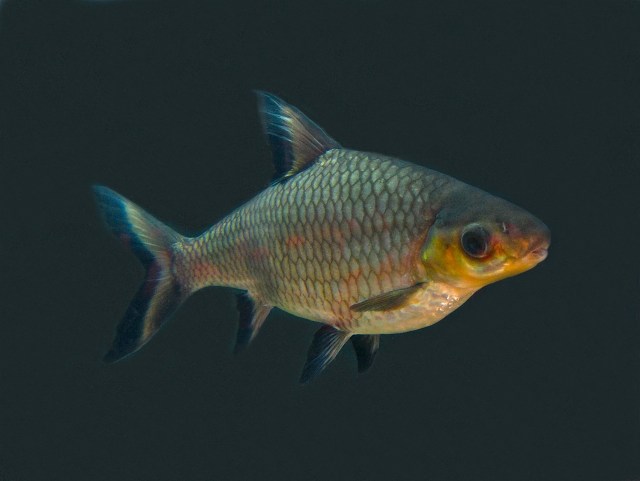
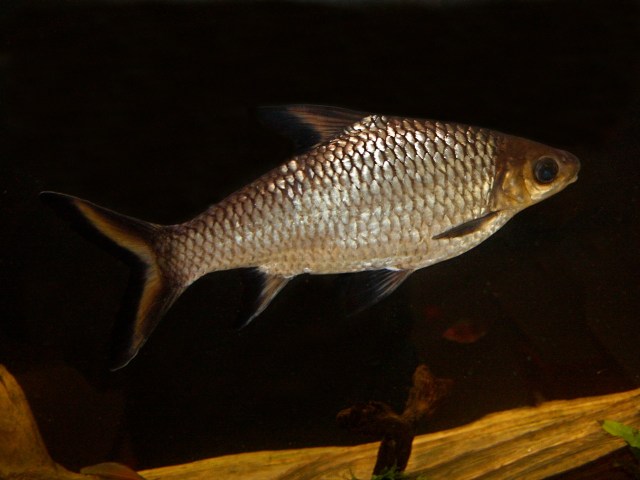
Balantiocheilos melanopterus      

Class: Actinopterygii,  Order: Cypriniformes,  Family: Cyprinidae Minnows or Carps

DISTRIBUTION: Mekong and Chao Phraya River basins, Malay Peninsula, Sumatra, and Borneo.

HABITAT: Midwater depth in large and medium sized rivers and lakes.

APPEARANCE: Elongated silver body up to 35 cm in length; black margins on dorsal, caudal, anal and pelvic fins; large, prominent eyes.

DIET: Phytoplankton, small crustaceans, rotifers, insects and their larvae. 

REPRODUCTION and DEVELOPMENT: External  fertilization.

REMARKS:  The shark portion of the name Tricolor Sharkminnow refers to their torpedo shaped bodies and long fins, not that they are sharks. They belong to the family Cyprinidae, from the Ancient Greek kyprînos, consisting of the carps, the true minnows, and their relatives (for example, the barbs and barbels). Cyprinids are stomachless fish with toothless jaws. Even so, food can be effectively chewed by the gill rakers of the specialized last gill bow.  Commonly called the carp family or the minnow family, its members are also known as cyprinids. It is the largest family of fresh-water fish, with over 2,400 species in about 220 genera.

LOCATION: AC01 Academy Cafe 

WORDPRESS SHORTLINK  http://wp.me/p1DZ4b-j9

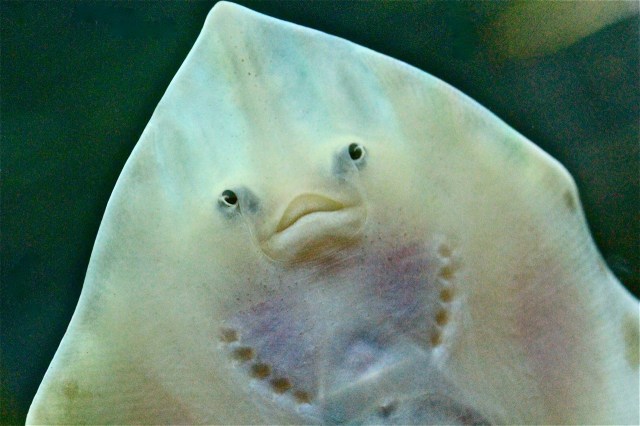
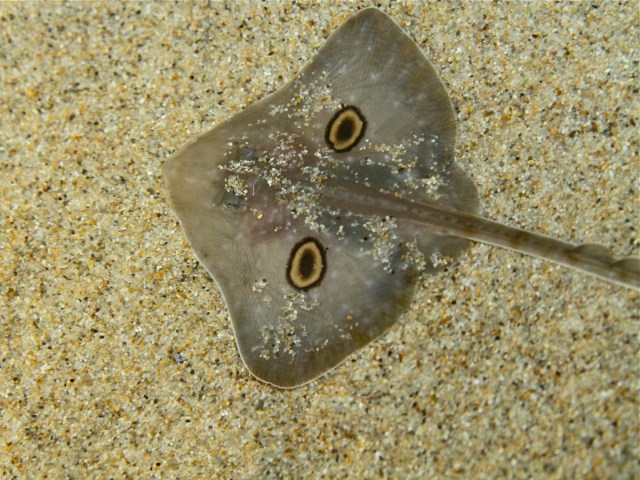
Raja binoculata  Class Chondrichthyes, Subclass Elasmobranchii (sharks and rays), Order Rajiformes (Skates and rays), Family Rajidae (Skates).

DISTRIBUTION: Bering Sea and southeastern Alaska to central Baja California.

HABITAT: Bottom dwellers on soft substrates, usually from shallow water to 300 m.  Found along the coast in estuaries, bays, and over the continental shelf. 

APPEARANCE:  Largest species of skate, adults usually 1.8 m (5.9 ft) and 91 kg (200 lb). There are two large dark spots with pale borders, one on each wing. The ventral side is white, sometimes with dark spots or blotches.

DIET: Benthic shrimps, worms, clams, some fishes.

REPRODUCTION and Development: Oviparous, and is one of the few skate species that typically have more than one embryo within each egg capsule, commonly called “mermaid’s purses”.   The egg capsule of a big skate is the largest of any skate, measuring 23–31 cm (9–12 in) long and 11–19 cm (4–7 in) wide.  The young emerge after 9 months and measure 18–23 cm (7–9 in).

REMARKS: Commercially fished off California.   R. binoculata‘s slow reproductive rate has led it to be assessed as Near Threatened by the World Conservation Union. 

LOCATION: Salt marsh pop-up CC03

 WORDPRESS SHORTLINK   http://wp.me/p1DZ4b-ev

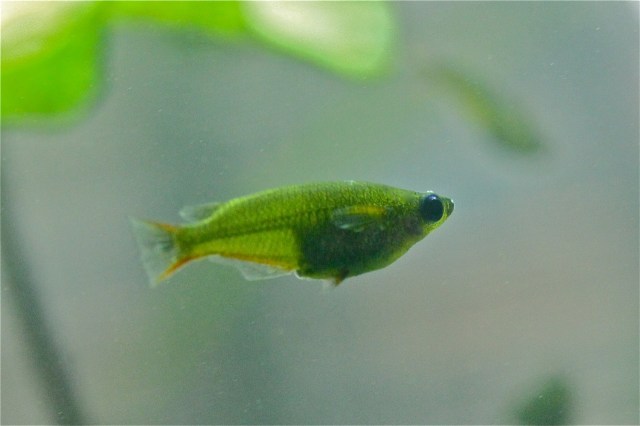
Oryzias woworae   Actinopterygii (Ray-finned fishes), Beloniformes (Needle fishes),  Adrianichthyidae (Ricefishes) 

DISTRIBUTION: Daisy’s ricefish was collected from a freshwater stream on Muna Island, off the southeastern coast of Sulawesi in Indonesia in 2007.

HABITAT:  fresh and brackish waters.

APPEARANCE: about an inch long, steel blue body (in males), highlighted with brilliant red stripes on its abdomen, pectoral fins and caudal fins. O. woworae  also have striking,  blue eyes

REMARKS:  many species are found in Japanese rice paddies gives this group of fishes its common name

LOCATION: Rainforest Borneo Exhibit  Southeast Asia Community tank  BO09 

REFERENCE; California Academy Rainforest Blog 3-27-11 and fishbase

WORDPRESS SHORTLINK  http://wp.me/p1DZ4b-dh

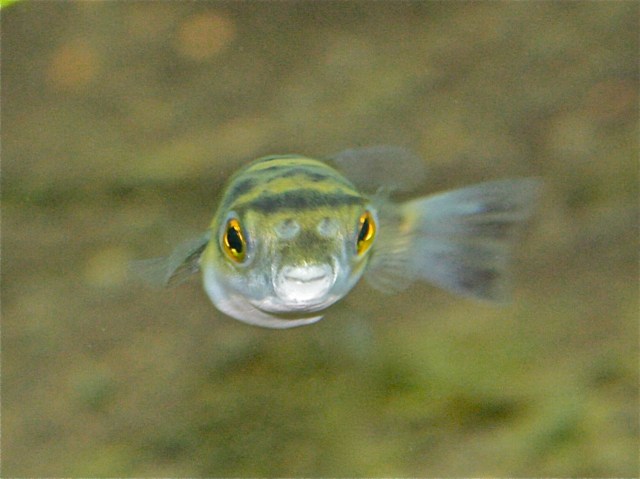
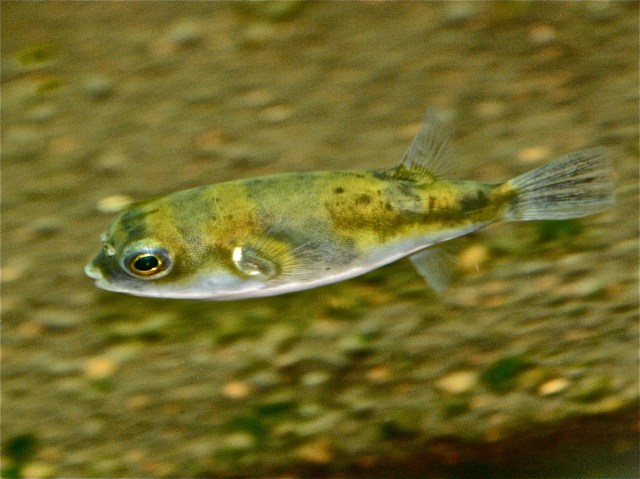
Colomesus asellus (Tetradontidae) Pufferfish

DISTRIBUTION: Peru, Colombia, Brazil. The Amazon Basin.

HABITAT: Mostly warm freshwater and coastal streams.

APPEARANCE: Max size: 7.5 cm, green above, white below, and patterned with black transverse bands across the dorsal surface.

DIET: An active carnivore, especially of snails.

REPRODUCTION: Pairs breed during the wet season, spawning in rivers. Small eggs are scattered on the substrate and hatched larvae are carried downstream.

MORTALITY and LONGEVITY: Life span: 10+ years.

REMARKS: Continuous growth of teeth keeps these fish ready for their crunchy and abrasive diet of crustaceans and snails. In captivity, these puffers should have a daily dose of snails to prevent beak overgrowth.

Like other puffers, can inflate themselves when threatened, presenting a much larger and spineladen body to suddenly disheartened predators.

Flooded Amazon Cardinal Tetra Exhibit.  AM14

WORDPRESS SHORTLINK   http://wp.me/p1DZ4b-d7

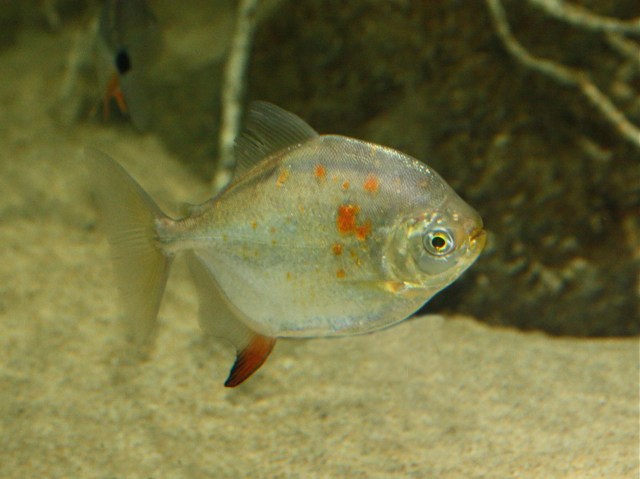
Metynnis sp. (Characidae) Characins

DISTRIBUTION: Tropical South America primarily Amazon and Orinoco basins.

HABITAT: Calm river reaches overhung by foliage.

APPEARANCE: Almost circular in profile; juveniles may be spotted or striped; adults solidly silver with anal and caudal fins edged in red or orange; grows to length of 30 cm (12 in) in wild.

DIET: Generally herbivorous, eating leaves of river plants; occasionally eats worms and small insects.

REPRODUCTION and DEVELOPMENT: Females release up to 2000 eggs; juveniles hatch in a few days.

REMARKS: A schooling species related to piranhas.  

LOCATION: Anaconda exhibit, AM3

WORDPRESS SHORTLINK  http://wp.me/p1DZ4b-ca


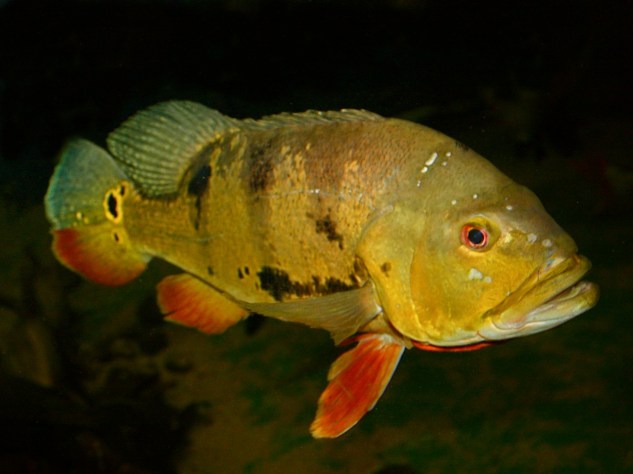
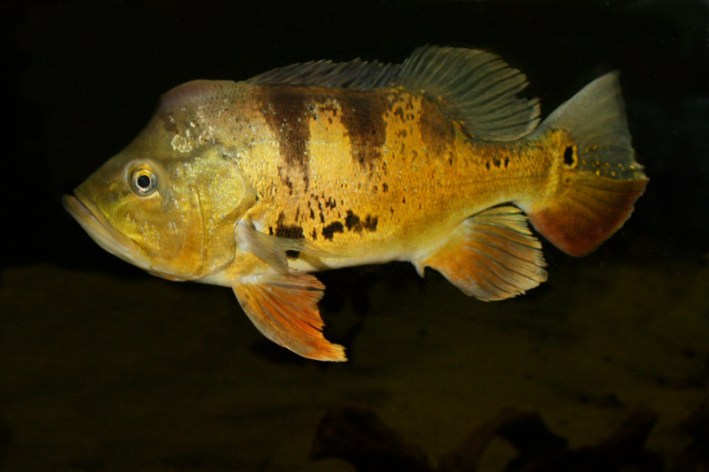
Cichla ocellaris (Cichlidae)  Cichlid

Female below.

DISTRIBUTION: Amazon, Orinoco, and La Plata basins in South America. Currently established in southern Florida.

HABITAT: Warm freshwater.

APPEARANCE: Elongate body with deeply notched dorsal fin, large mouth with projecting lower jaw. Color: olive-green fading ventrally to yellow-white, with three dark vertical bars on sides and series of dark spots in between. A large black spot encircled by silver adorns the caudal fin. Max. length: 60 cm. Male has a lump no top of the skull.

DIET: Diurnal feeders on other fishes. High speed pursuit predators.

REPRODUCTION and DEVELOPMENT: Substrate spawner. Both parents guard their clutch for about 9 weeks. Like most cichlids, breeding pairs are highly territorial and aggressive.

REMARKS: Legally introduced to Florida. Are considered a prized sport and food fish.

LOCATION: Flooded amazon tunnel, AM11

WORDPRESS SHORTLINK  http://wp.me/p1DZ4b-b9

Male below; note lump on top of the skull.

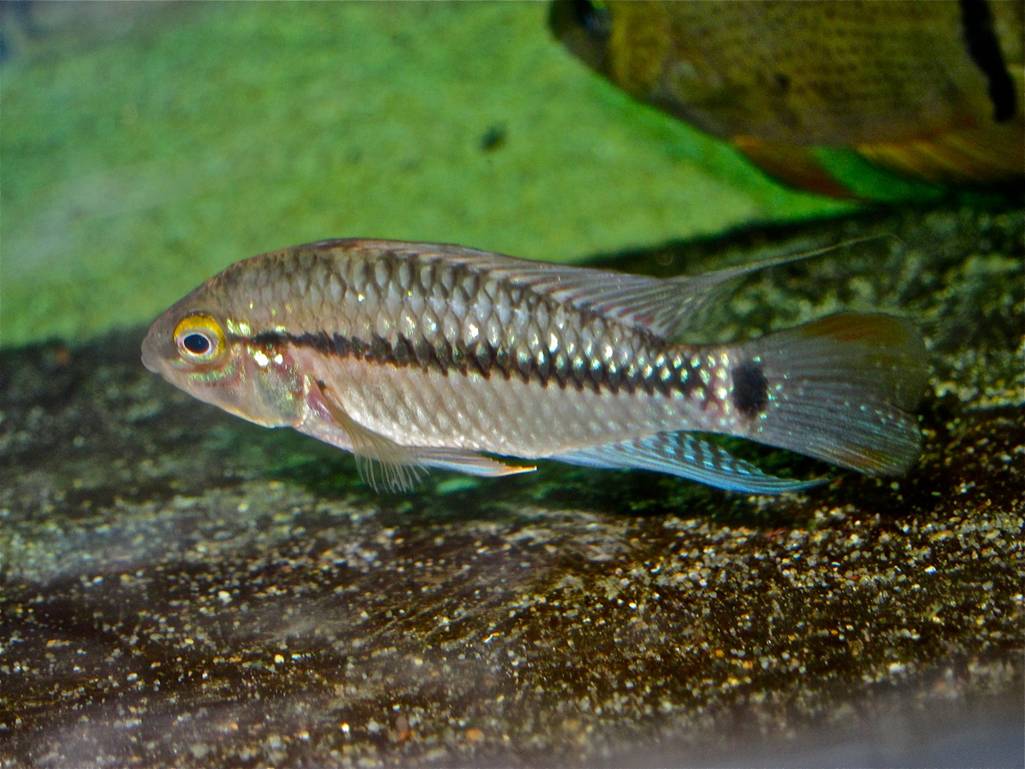
Apistogramma eunotus       Actinopterygii (Ray-finned fishes),Perciformes (Perch-likes) , Cichlidae (Cichlids)

DISTRIBUTION: Native to the western Amazon basin in the area around the Peruvian/Brazilian border. It’s found in the tributary systems of several rivers, including the Rio Ucayali, Rio Yavarí, Rio Japurá and the Amazon itself.

HABITAT: Slow-moving streams, creeks and tributaries, as well as smaller rivers.

APPEARANCE: Maximum length 3.5″ (male) 3″ (female).  The male is the larger fish and has much more prominent coloring, especially the blue markings around the gill area that give this fish its common name. The male also has elongated dorsal and anal fins.

DIET: A. eunotus is a micropredator. Their main prey items consist of insect larvae, fry of other fishes and other invertebrates

REMARKS:  Apistogramma is a genus of approximately a hundred species of fish from the family Cichlidae found in tropical areas of the Amazon basin and Venezuela. Apistogramma literally means “irregular lateral line” referring to a common trait of the species under this taxon. Most species are strongly sexually dimorphic.

Location: Flooded Amazon Tunnel, AM11

WORDPRESS SHORTLINK:  http://wp.me/p1DZ4b-ad