Latest Entries »

Frilled Lizard

Chlamydosaurus kingie

Distribution: Northern Australia and Southern New Guinea.

Habitat: Tropical and warm temperate forests and savanna woodlands of northern Australia. They spend most of their lives in the trees,

Appearance: Length to 3 ft (0.9 m) and weight: to 1.1 lbs (0.5 kg). They have a thin fold of skin that usually hangs like a cape (frill) which when erect can be 12 inches (30 cm) across used to communicate with each other.

Diet: Mostly insects and some small mammals.

Remarks: Escapes to a tree for protection.

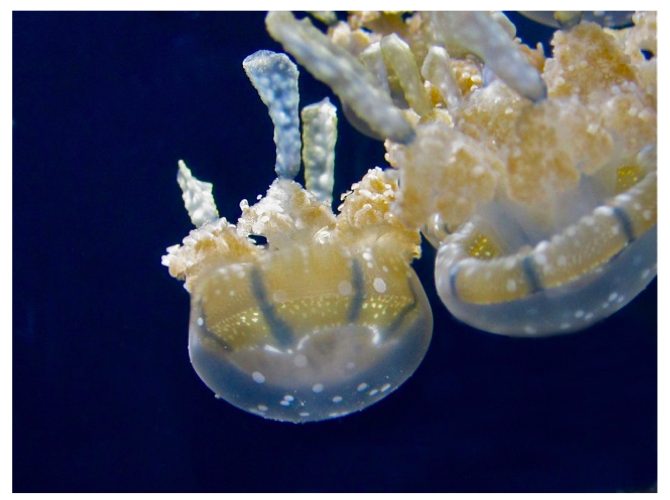
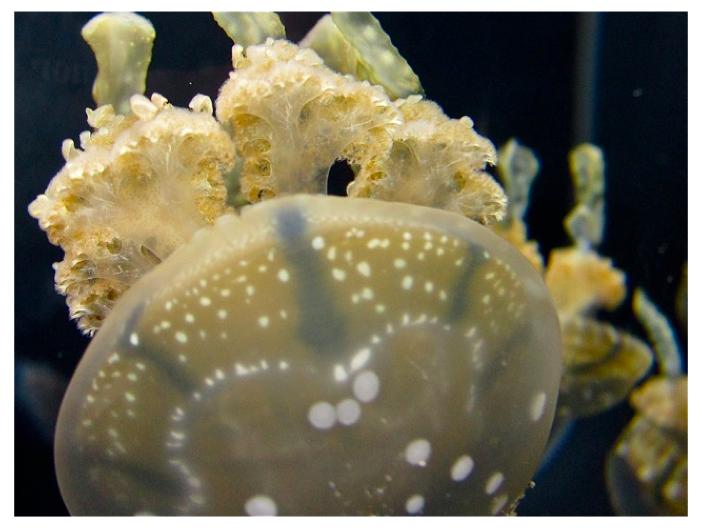
Spotted Jellyfish

Mastigias sp.

His recent addition to tank PR05 in the color cluster will be described further as more information becomes available.

* Not currently on display


TAXONOMY
Kingdom: Animalia
Phylum: Chordata
Subphylum: Vertebrata
Class: Reptilia
Order: Squamata
Suborder: Serpentes
Family: Viperidae

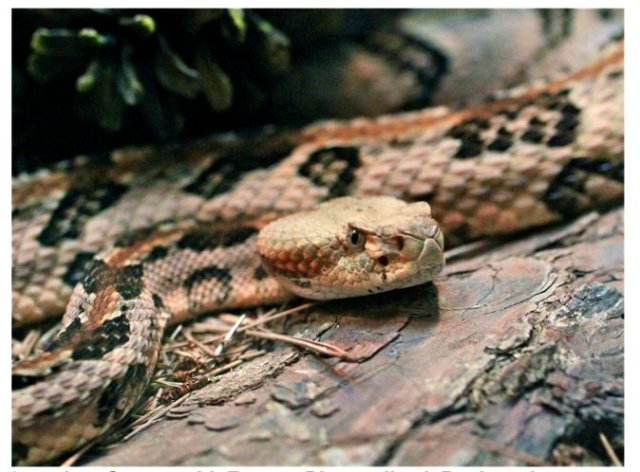
Genus/species: Crotalus horridus

GENERAL CHARACTERISTICS:  Average length of 91–152 cm (35.8-59.8 in). Dorsally they have a pattern of dark brown or black cross-bands on a yellowish brown or grayish background and an irregular zig-zag edges, and may be V-shaped or M-shaped. Often a rust-colored vertebral stripe is present.

DISTRIBUTION/HABITAT: Eastern United States from southern Minnesota and southern New Hampshire, south to east Texas and north Florida in deciduous forests in rugged terrain. 

DIET IN THE WILD: Prey is mainly small mammals, but may include small birds, frogs, or other snakes usually garter snakes.

REMARKS: Potentially, this is one of North America’s most dangerous snakes, due to its long fangs, impressive size and high venom yield. This is to some degree offset by its relatively mild disposition. Before striking, they often do a good deal of preliminary rattling and feinting.
Swamp

References

Ron’s flickr https://www.flickr.com/photos/cas_docents/8328119005/in/album-72157625194985646/

Ron’s WordPress shortlink http://wp.me/s1DZ4b-17

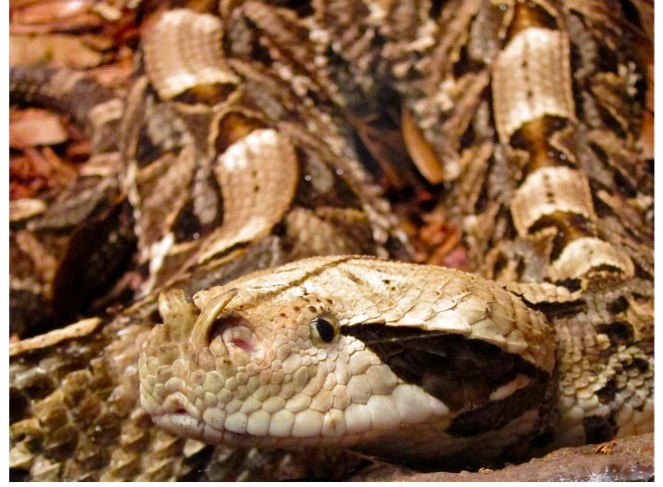
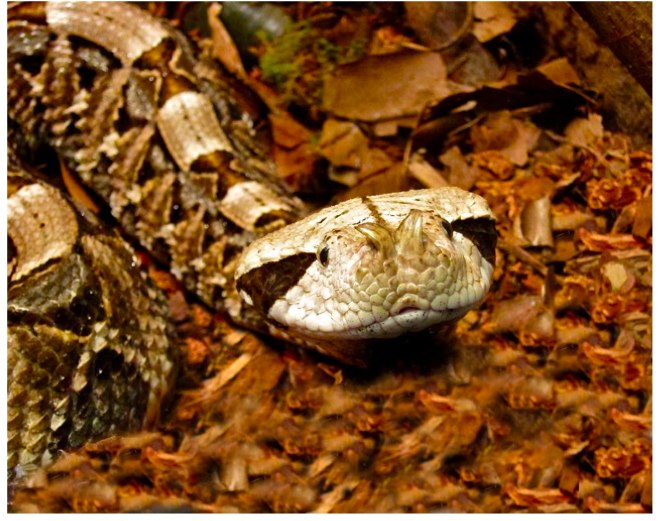
Gabon Viper

Bitis gabonica

Distribution: Tropical Africa

Habitat: Rainforests and nearby woodlands, mainly at low altitudes. they may also be found in swamps, as well as in still and moving waters. They are commonly found in agricultural areas near forests and on roads at night.

Appearance: 1.8 meters, 10kilograms. Adults reach an average length of 4 – 5 feet (up to 1.5 meters). It has camouflage with a color pattern consisting of a series of pale, sub-rectangular blotches running down the center of the back, interspaced with dark, yellow- edged hourglass markings. The flanks have a series of fawn of brown rhomboidal shapes, with light vertical central bars. The belly is pale with irregular brown or black blotches. The head is white or cream with a fine, dark central line, black spots on the rear corners, and a dark blue-black triangle behind and below each eye. The iris color iscream, yellow-white, orange or silvery. As the gaboon viper grows older, it develops rostral horns on its nose.

Diet: Small mammals.

Remarks: B. gabonica has very long fangs known to exceed 1.5 inches. It is a docile slow moving sit and wait predator with a quick strike.