Latest Entries »

1-25-12 Rainbow Wrasse from Ron’s Tropical Marine Series

Actinopterygii (ray-finned fishes), Perciformes (Perch-likes),  Labridae (Wrasses)

Halichoeres pictus   

ADULT MALE BELOW
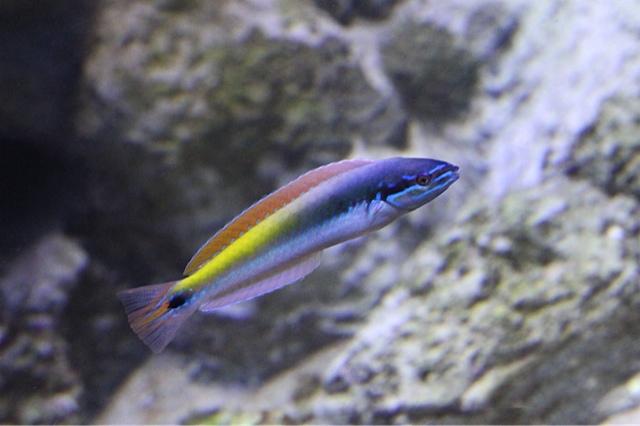
  

DISTRIBUTION:  Western Atlantic: southern Florida, USA and Bahamas to northern South America. 

HABITAT: Marine; reef-associated; depth range 5 – 25 m.

APPEARANCE: Large adult males are blue-green to yellowish green on the upper half of body and pale blue on lower half; blue stripes on head; a large black spot at caudal base. Females or young are silvery tan with a brown back and a brown stripe along the midsize.

DIET:  Various invertebrates.

REPRODUCTION: A protogynous hermaphrodites.  Protogynous hermaphrodites refer to organisms that are born female and at some point in their lifespan change sex to males.  Also noted in the following fish families: Serranidae (groupers), Sparidae (porgies), Synbranchidae (swamp eels), Scaridae (parrotfishes), Pomacanthidae (angelfishes), Gobiidae (gobies), Lethrinidae (emperors).

REMARKS: Note: Protandrous hermaphrodites refer to organisms that are born male and at some point in their lifespan change sex to female. Protandrous animals include clownfish.  

LOCATION: Caribbean Reef.

Flickr  http://www.flickr.com/photos/cas_docents/sets/72157608208133134/

FEMALE OR IMMATURE BELOW

WORDPRESS SHORTLINK  http://wp.me/p1DZ4b-m0
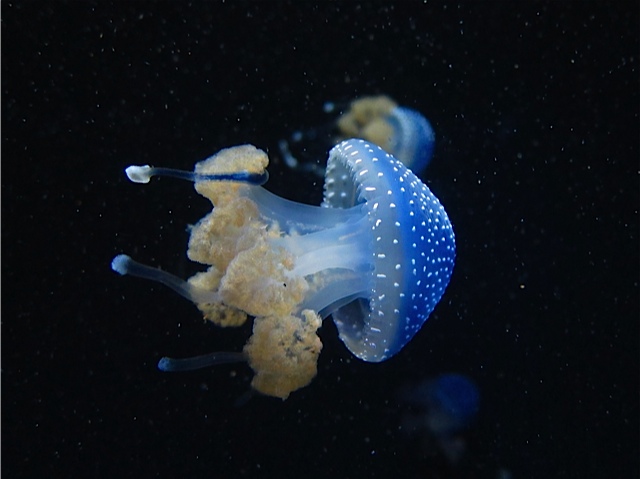
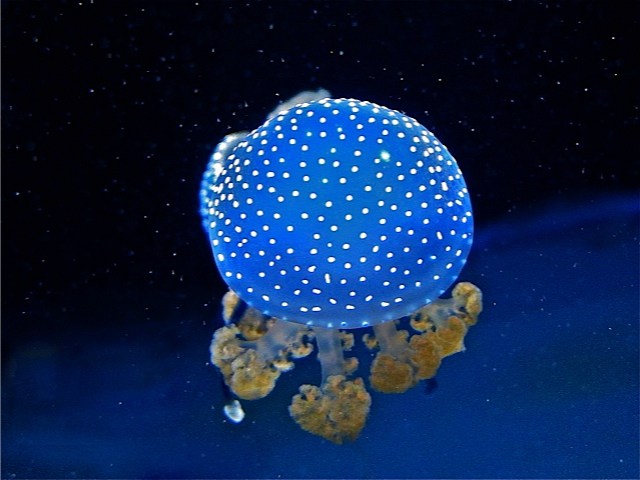
1-17-12  White-spotted Jelly from Ron’s Jellies Series

Kingdom: Animalia,  Phylum: Cnidaria,  Class:Scyphozoa,  Order: Rhizostomae,   Family: Mastigiidae

Phyllorhiza punctata   

DISTRIBUTION:  Native to Southwestern Pacific and introduced widely. 

HABITAT: P. punctata is a coastal and estuarine jellyfish.

APPEARANCE; P. punctuate is a large jellyfish with a rounded and somewhat flattened gelatinous bell that is clear or possibly tinted brown with many small white crystalline refractive spots close to the surface. As is characteristic of members of Order Rhizostomae, the bell margin lacks tentacles and the central mouth area is ringed by eight highly dichotomous (branching) oral arms that each bear 14 lappets (flaps of tissue) and become fused near their bases.  Within it’s native range and in certain introduced localities, symbiotic zooxanthellae reside in the tissue of the animal, giving these jellyfish a brownish tint.

DIET: Like most members of Phylum Cnidaria, the tentacles of Phillorhiza are equipped with stinging cells called cnidocytes. Within these cells are stinging organelles called nematocysts. When discharged, nematocysts can immobilize small prey items that are subsequently ingested. Nematocysts are also used as a defense mechanism. The planktonic egg and larval stages of several fish species (including commercially important species such as red snapper in the gulf of Mexico) are probably important as prey items.  Additionally, throughout its native range and much of its introduced range, P. punctata also harbor endosymbiotic zooxanthellae within their bell. In a relationship analogous to that of reef-building tropical corals and their resident zooxanthellae, primary production of the photosynthetic zooxanthellae likely fulfills a large proportion of the nutritional needs of the host jellyfish.   

REPRODUCTION and DEVELOPMENT: Scyphozoans have a life cycle that can be broadly divided into two parts: a free-living medusa and an attached, sessile polyp stage.  Sexes are separate in the medusae and these produce haploid gametes that combine through external fertilization to form free-swimming planula larvae.  Planulae search out suitable settlement sites and leave the water column to assume a sessile benthic existence.  Once on the bottom a polyp form occurs and this form reproduces asexually by “cloning” or dividing itself into other polyps. These polyps or scyphistomae then give rise to new offspring in the form of free-swimming medusa.  Jellyfish can live for up to five years in the polyp stage and up to two years in the medusa stage.

REMARKS: An invasive species now found in the Caribbean, Hawaii, and southern Brazil.  Phyllorhiza consumes large amounts of small zooplankton (including fish eggs and larvae) and directly impacts the shrimp industry because nets were becoming clogged with jellyfish.  (after Smithsonian Marine Station at Fort Pierce)  

LOCATION: Color Cluster 1-17-12

flickr site  http://www.flickr.com/photos/cas_docents/sets/72157610031545571/

WORDPRESS SHORTLINK  http://wp.me/p1DZ4b-lE

Phylum:Chordata, Superclass: Osteichthyes,  Class:Actinopterygii (Ray-finned fishes), Order: Characiformes (Characins) Family: Lebiasinidae (Pencilfishes). .

Copella arnoldi

DISTRIBUTION: Guyana, Suriname, French Guiana and Brazil

HABITAT: Streams and tributaries off main river channels, and also occurs in flooded forests during the wet season with large amounts of overhanging vegetation.

APPEARANCE: Length 1.6″ (4cm).  The male grows larger than the female, and is more brightly coloured. Mature males also develop extended fins.

DIET: Feeds on worms, insects and crustaceans.

REPRODUCTION and DEVELOPMENTC. arnoldi   spawn on the underside of plant leaves or other surfaces that, are always above the water surface. The spawning site is selected by the male who once a site has been chosen will display at and follow a female forming a pair. At the climax of courtship, the pair lock themselves together using their fins, and jump out of the water, landing on the spawning site. Using their ventral fins, they can hold themselves here for up to 10 seconds, as eggs and sperm are released. Up to 12 eggs may be laid and fertilized, and the process is then repeated. Usual brood size is approximately 50.

LOCATION: Animal Attraction Series, Staff picks

flickr site  http://www.flickr.com/photos/cas_docents/6699435185/in/set-72157620568438047

WORDPRESS SHORTLINK  http://wp.me/p1DZ4b-lz

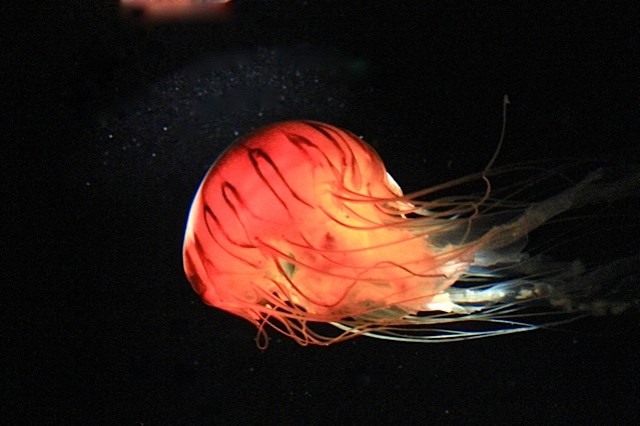
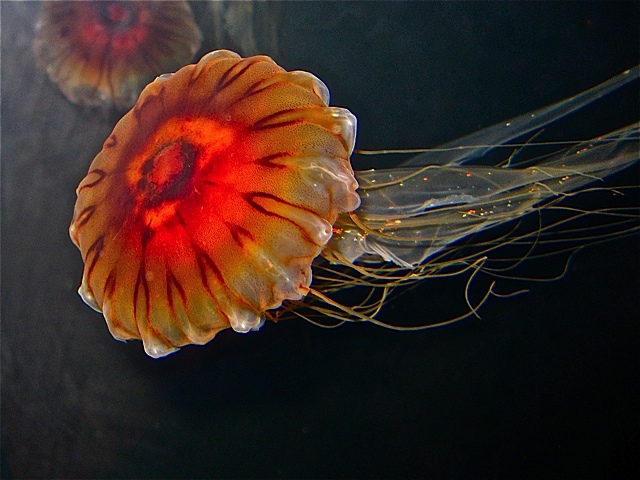
Kingdom Animalia, Phylum: Cnidaria (anemones, corals and jellyfish), Class: Scyphozoa,  Order: Semaeostomeae,  Family: Pelagiidae 

Chrysaora Pacifica

DISTRIBUTION: Deep open waters of the northern Pacific Ocean, Arctic Ocean and the Bering Sea. 

HABITAT: Ocean surface to 200 meters below the surface. 

APPEARANCE:  Bells can grow up to 12 inches across and tentacles can stretch 10 feet or more. Their bells are white with brown-to-orange stripes, containing up to 32 very long orange-red tentacles and four long lips.  One of C. Pacifica’s most distinguishing characteristics can be found on their undersides, where they have 16 brown stripes and eight stomach pouches.

DIET: Other jellies, small crustaceans called copepods, and small fishes. 

REPRODUCTION and DEVELOPMENT: The life cycle made up of five stages. They go through a metamorphosis or change in shape as they grow . 

1.lifecycle begins when males broadcast or release sperm into the water and the females catch the sperm to fertilize the eggs she has produced and is holding in her mouth.

2. The fertilized eggs remain attached to the mother’s oral arms and grow into a flat jelly bean-shaped planula.

3. The planula then grows into flower-shaped polyps and the mother releases them into the ocean.

4. The polyps attach to a solid surface and undergo asexual reproduction through which they make an exact copy of themselves without eggs and sperm. The polyp makes these identical animals by budding where the new polyp grows out of its side. 

5.After the new polyp is fully formed, it is released into the ocean and starts to change shape, looking more like the adult nettle. The nettle develops a bell, arms and tentacles until it is a fully formed medusa or adult.

REMARKS: Like many jellies, Japanese sea nettles use stinging cells to defend themselves and stun their prey. While not especially poisonous, their stings can cause intense skin irritation and burning sensations in humans. Some people can have allergic reactions to their venom. If you see one in the water, stay away because there’s a good chance more of them are nearby. Japanese sea nettles travel in swarms, which increases your chance of being stung if you encounter one.

 LOCATION: Staff Picks

flickr site  http://www.flickr.com/photos/cas_docents/sets/72157610031545571/

WORDPRESS SHORT LINK  http://wp.me/p1DZ4b-lo

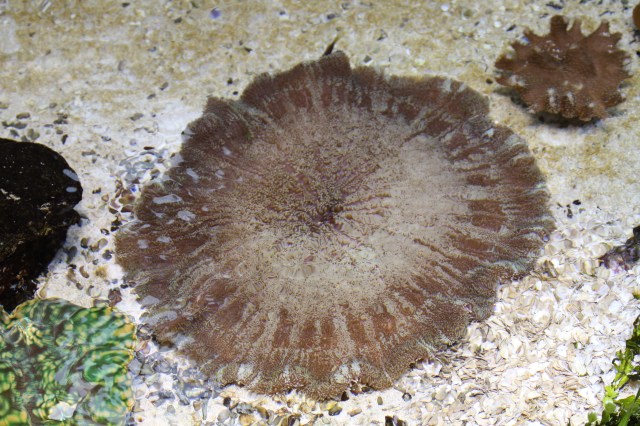
1-5-12 Haddon’s Carpet Anemone from Ron’s Anemone Series

Stichodactyla haddoni    (Stichodactylidae).

DISTRIBUTION:  Indo Pacific and Red Sea.  

HABITAT: Outside of the reef it resides in soft muddy or sandy substrate.  

APPEARANCE: Identified by its thick central column with large pedal disc, very short, stubby tentacles and tentacle-free oral area, and attains a diameter of about 60 cm.  Can be distinguished from their close relatives Stichodactyla gigantea and Stichodactyla mertensii by the lack of any coloration, spots or markings on the underside of the anemone and down its column

DIET: It consumes any and all animal matter that comes in contact with its tentacles. 

REMARKS: serves as a host for many types of Clownfish in the wild including: Amphiprion clarkii shown here.   S. haddoni has a very potent venomous sting and may harm corals, other anemones and fish.   Most animals that come in contact with the tentacles of Haddon’s anemone will stick to the anemone and be killed by its nematocysts in a few seconds to a few minutes.  May bury itself in sand if threatened.

LOCATION PR03  Seagrass shallows

WORDPRESS SHORTLINK  http://wp.me/p1DZ4b-kJ


flickr site  http://www.flickr.com/photos/cas_docents/sets/72157623903687834/

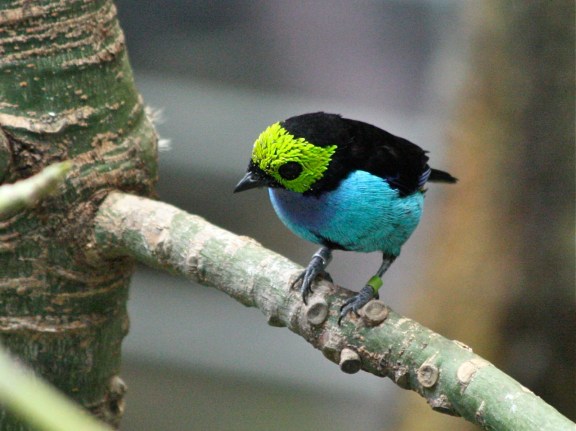
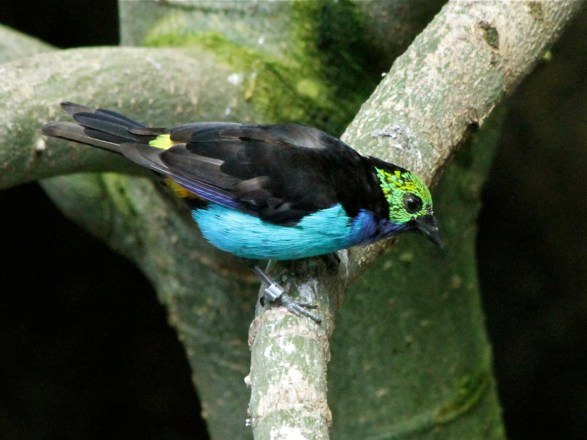
TAXONOMY
Kingdom: Animalia
Phylum: Chordata
Class: Aves
Order: Passeriformes
Family: Thraupidae

Genus/species: Tangara chilensis paradisea

GENERAL CHARACTERISTICS:  In Spanish, called “sieite colores” for its seven-colored appearance: green, yellow, scarlet, black, and three colors of blue feathers adorn this handsome bird. Monomorphic (males and females look similar).  Length 13.5 to 15 cm 5.3  to 6 inches.

DISTRIBUTION/HABITAT: South America: common in Venezuela, Peru, Columbia, Ecuador, Brazil. Found in the canopy and edges of subtropical to tropical lowland humid forests, including parts of the Amazon basin and upwards to 1400 m (4500 feet).  Often moves in mixed flocks.

DIET IN THE WILD: Mainly fruit, buds, leaves. Forage from middle heights to treetops. Also, like other Tangara tanagers, picks insects from leaves or sometimes takes them in flight. Often moves and feeds in mixed flocks.

REPRODUCTION: Female builds a cup nest where she lays two or three brown- or lilac-speckled white eggs. Eggs hatch in 13–14 days; chicks fledge in additional 15–16 days. Nestlings are feed insects and fruit by both male and female..

CONSERVATION: IUCN, least concern.

LOCATION: Rainforest

References

Ron’ flickr http://www.flickr.com/photos/cas_docents/sets/72157608454346681/

Ron’s WordPress shortlink  http://wp.me/p1DZ4b-jN

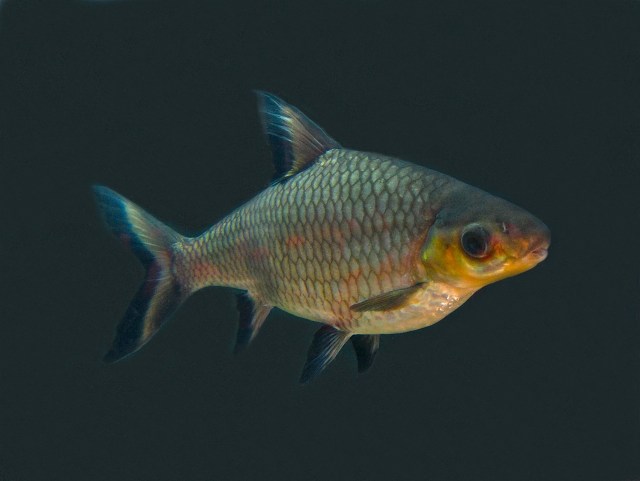
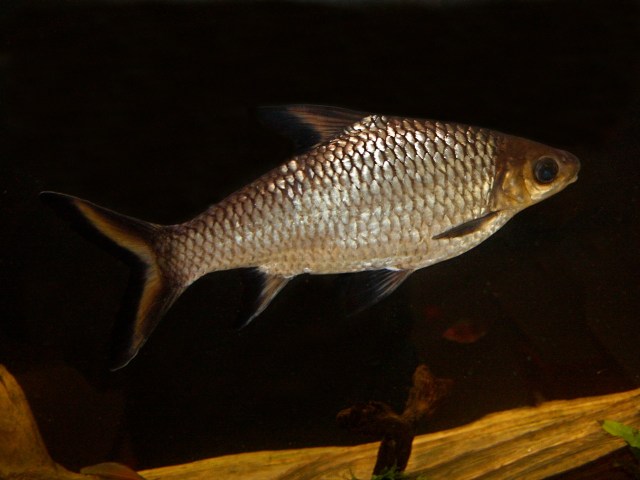
Balantiocheilos melanopterus      

Class: Actinopterygii,  Order: Cypriniformes,  Family: Cyprinidae Minnows or Carps

DISTRIBUTION: Mekong and Chao Phraya River basins, Malay Peninsula, Sumatra, and Borneo.

HABITAT: Midwater depth in large and medium sized rivers and lakes.

APPEARANCE: Elongated silver body up to 35 cm in length; black margins on dorsal, caudal, anal and pelvic fins; large, prominent eyes.

DIET: Phytoplankton, small crustaceans, rotifers, insects and their larvae. 

REPRODUCTION and DEVELOPMENT: External  fertilization.

REMARKS:  The shark portion of the name Tricolor Sharkminnow refers to their torpedo shaped bodies and long fins, not that they are sharks. They belong to the family Cyprinidae, from the Ancient Greek kyprînos, consisting of the carps, the true minnows, and their relatives (for example, the barbs and barbels). Cyprinids are stomachless fish with toothless jaws. Even so, food can be effectively chewed by the gill rakers of the specialized last gill bow.  Commonly called the carp family or the minnow family, its members are also known as cyprinids. It is the largest family of fresh-water fish, with over 2,400 species in about 220 genera.

LOCATION: AC01 Academy Cafe 

WORDPRESS SHORTLINK  http://wp.me/p1DZ4b-j9

TAXONOMY

Phylum Chordata

Class Actinopterygii (Ray-finned fishes)

Order Tetraodontiformes (Puffers and filefishes)

Family Tetraodontidae (Puffers) 

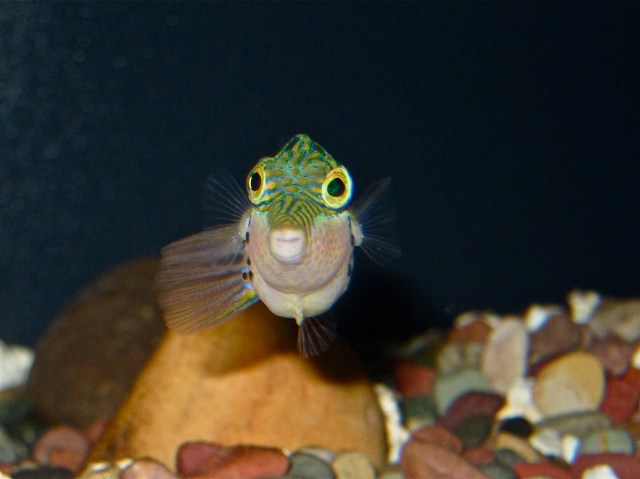
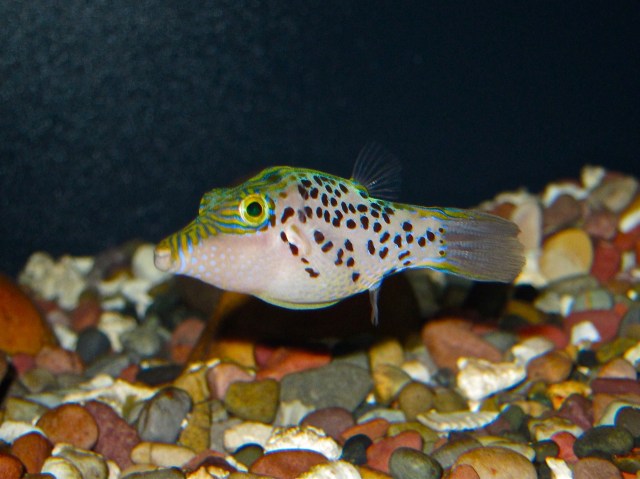
Canthigaster leoparda  

DISTRIBUTION: Eastern Indian Ocean: Christmas Island. Western Pacific: Philippines, Ambon, and Guam. 

 HABITAT: Lives in deep water, usually along deep drop-offs in caves at more than 30 meters depth.

 APPEARANCE: size to 7 cm. (2.75 in).  Topside of face and body are yellow with blue lines; the sides and underside are white with blue spots; the sides with several clusters of brown blotches. Fins clear, except tail.  

 PR11  Color Cluster11-29-11

WORDPRESS SHORTLINK  http://wp.me/p1DZ4b-iH

flickr LINK http://www.flickr.com/photos/cas_docents/5630165858/in/set-72157625020091079

Phylum: Cnidaria, Class: Anthozoa, Order; Actinaria (Anemones), Family: Actinodendronidae.

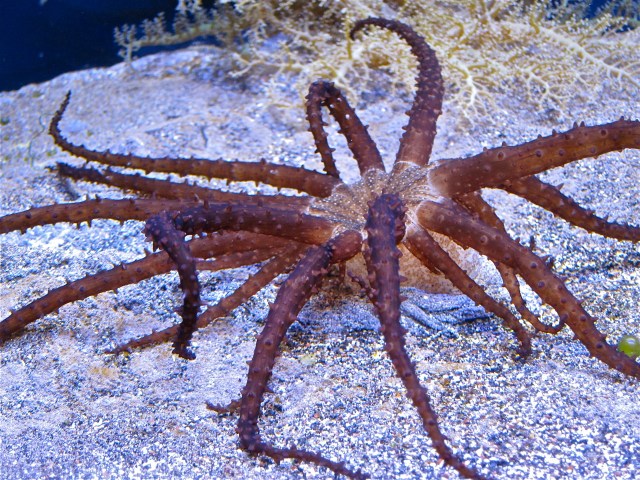
Actinostephanus haeckeli    

DISTRIBUTION: Western Pacific Ocean

HABITAT; Found on sandy bottoms in lagoons and bays with 12 or more tentacles, and buried during day and active at night.

APPEARANCE: 10-20cm in diameter. It has about 12 long fat cylindrical tentacles that taper at the tips, and below these, another ring of much shorter, slimmer tentacles. The tentacles are studded with bumps. They have a and a flat oral disc. Those seen were a uniform dark brown to black.

DIET: Plankton. 

REMARKS: This anemone could be confused with sea stars.  The projections are tentacles not arms.  they reach out of the mud and sand in which the anemone lives.   

They can move fairly rapidly along the ocean floor leaving a trail in the sand.   

Venoms Cluster PR 25      11-17-11

WORDPRESS BLOG  http://wp.me/p1DZ4b-ho

Flickr sea anemone series.  http://www.flickr.com/photos/cas_docents/sets/72157625127345346/


Phylum Arthropoda, Subphylum Crustacea, Class Malacostraca. Order Decapoda, Family Porcellanidae

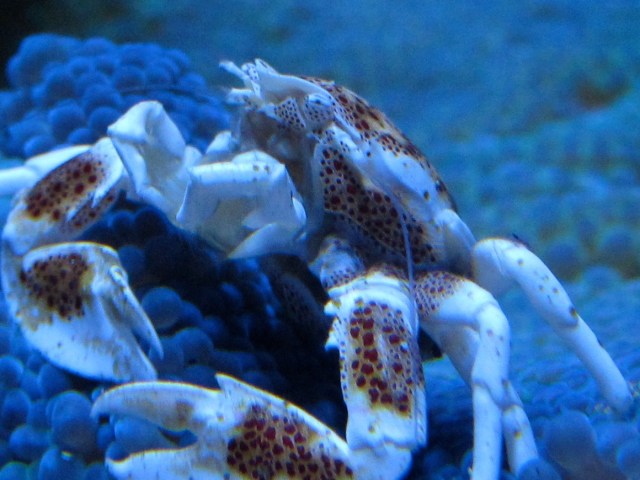
Neopetrolisthes maculosus

VIDEO LINK http://www.flickr.com/photos/cas_docents/5389598848/in/set-72157608602469734

DISTRIBUTION: tropical seas confined to the western Pacific and Indo Australian. 

HABITAT: Often be found hiding in amongst its host anemone.  When disturbed they will hide under the anemone away from predators.  Pairs of the species can be often seen living in the same anemone and quite often they will try to defend their territory from anemonefish although the anemonefish generally prevails due to its large size.

APPEARANCE: Color may be varied. N. maculosus body cream white with ground red peas.  The body is round, claws large and flat, sharp.  Males will generally grow larger than the females and the crab is generally less than 5cm (2 in) in width, 2.5cm length (1 in).

DIET: They feed by combing plankton and other organic particles from the water using long setae (feathery hair or bristle-like structures) on the mouthparts. These animals will also scavenge on the sea floor for detritus.

REMARKS: They share the general body plan of a squat lobster, but their bodies are more compact and flattened, an adaptation for living and hiding under rocks. Porcelain crabs are quite fragile animals, and will often shed their limbs to escape predators, hence their name. The lost appendage can grow back over several moults. Porcelain crabs have large chelae (claws), which are used for territorial struggles, but not for catching food. The fifth pair of pereiopods are reduced and are used for cleaning.

Reef Partners Cluster PR33 Small Giant Clams Exhibit

WORDPRESS SHORTLINK  http://wp.me/p1DZ4b-hd