Latest Entries »

TAXONOMY

KINGDOM                 Animalia

PHYLUM                   Chordata

CLASS                      Aves

ORDER                     Struthioniformes

FAMILY                    Struthionidae

GENUS/SPECIES    Struthio camelus


GENERAL CHARACTERISTICS

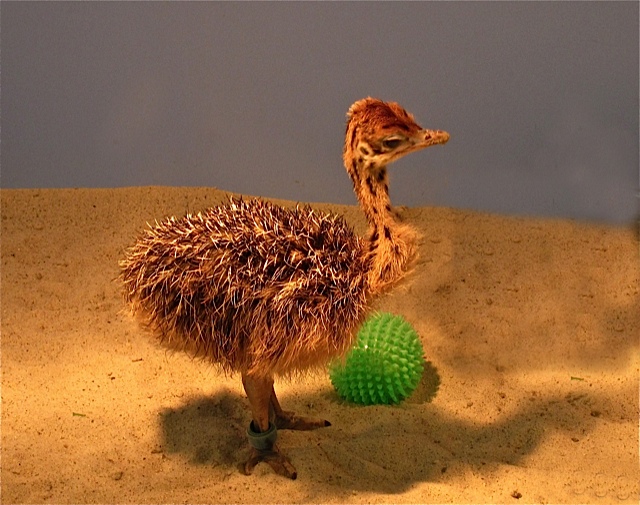
 S. camelus is the largest living bird in the world! Size: 7 to 9 ft (2.1 to 2.7 m) tall.  Weight:  220 to 350 lbs (100 to 160kg)

The feathers of adult males are loose soft and smooth mostly black, with white primaries and a white tail. Females and young males are greyish-brown and white. The head and neck of both male and female Ostriches is nearly bare, with a thin layer of down,The skin of the female’s neck and thighs is pinkish gray, while the male’s is blue-gray, gray or pink dependent on subspecies.  Their eyes are almost the size of billiard balls and are larger than their brain.

Although ostriches cannot fly, they are fleet, strong runners. They are the fastest runner of any bird sprinting up to 43 miles (70 kilometers) an hour and can run over distance at 31 miles at 50 kilometers an hour. They may use their wings as “rudders” to help them change direction while running.  An ostrich’s powerful, long legs can cover 10 to 16feet (3 to 5 meters) in a single stride


DISTRIBUTION/HABITAT

They are nomadic living in small herds on the African savanna and desert that typically contain less than a dozen birds.


 DIET IN THE WILD

Omnivore, eating plants, roots, and seeds but will also eat insects and lizards. All water necessary comes from food.


PREDATORS

Cheeths, lions, African hunting dogs and hyenas.

Ostrich kicks can kill a human or a potential predator as large as  a lion. Each two-toed foot has a long, sharp claw

At the approach of trouble, ostriches will lie low and press their long necks to the ground in an attempt to become less visible. They do not bury their head in the sand.

Average life span in the wild: 30 to 40 years


REPRODUCTION

They are sexually mature at 2 to 4 years of age.  They are polygamous with the males have a harem of two to seven females.  The dominant female Ostrich lays up to 12 fertilized eggs (at 3 lbs largest in the world) in a single communal nest of up to 25 eggs, in a simple pit, 30–60 cm (12–24 in) deep and 3 m (9.8 ft) wide, scraped in the ground by the male. They are actually the smallest eggs relative to the size of the adult bird being on average they are 15 cm (5.9 in) long, 13 cm (5.1 in) wide but are the size of 24 chicken eggs,  The incubation period is 35 to 45 days with fewer than 10% of nests surviving and of the surviving chicks, only 15% of those survive to 1 year of age.

 LOCATION

Earthquake Exhibit.  Note that the closest relatives of the Ostrich live in South America and Australia suggesting that their relatives lived together on the supercontinent Pangaea before it separated  into Laurasia (northern continents) and Gondwana (southern continents) 200 million years ago.


Flickr  http://www.flickr.com/photos/cas_docents/7449984428/in/set-72157608454346681

WordPress Shortlink http://wp.me/p1DZ4b-y1


Taxonomy

 Kingdom   Animalia

Phylum     Chordata

Class         Reptilia

Order         Squamata

Family       Corytophanidae

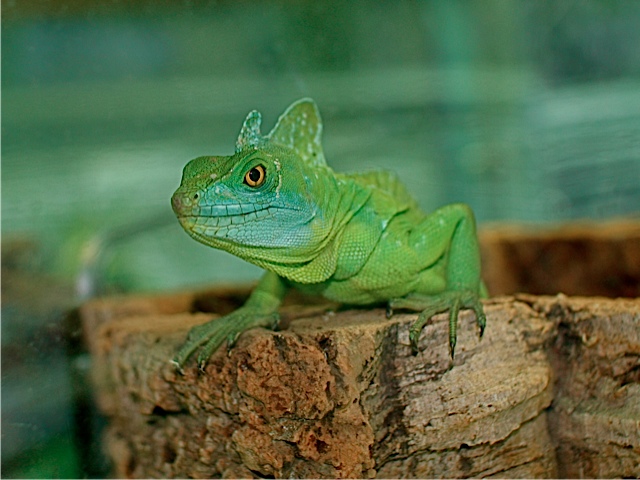
Genus/species  Basiliscus plumifrons


General Characteristics

 Their length, including tail, can be up to 85 cm (33 in).   Adult color is bright green, or slightly blue-green with males having  distinctive, high crests on their heads and backs, which they use to impress females. The females have only one small crest. During the first months of their lives, young ones are a brownish/olive green color, with bright green heads.

 B. plumifrons has been called the “Jesus Christ” lizard, because of its ability to walk on water. Their rear feet have long toes

with fringes of skin that unfurl in the water, increasing surface area. They rapidly move their legs as they slap their splayed feet hard against the water. This creates tiny air pockets that keep them from sinking, provided they keep running fast enough. They can move along the surface like this for 4.5 meters or more. When gravity eventually takes over, the basilisk is an excellent swimmer.

 Distribution/Habitat:  

Central and South America. They are arboreal and semi-aquatic; inhabit the trees and bushes of the rainforest, often along riverbanks.

Diet in the Wild:  

Omnivores, surviving on a diet of plant material, insects, fruit, and small vertebrates.

 Reproduction

In Costa Rica breeding occurs during the wet season, May to September. Pregnant females prepare a shallow trench where they lay up to 20 eggs leaving the eggs to hatch on their own. Incubation period is about 2 months. Hatchlings are born with the ability to run (on land and water), climb, and swim.

 Predators

In the wild raptors, opossums, and snakes prey upon the lizards.  Life span is up to 10 years in captivity.

Location: Costa Rica CR02

 flickr   http://www.flickr.com/photos/cas_docents/5329669312/in/set-72157608449603666

WordPress Shortlink  http://wp.me/p1DZ4b-xl


TAXONOMY


Kingdom:  Animalia

Phylum:     Arthopoda

Class:          Malacostraca

Order:        Decapoda

Family:      Epialtidae

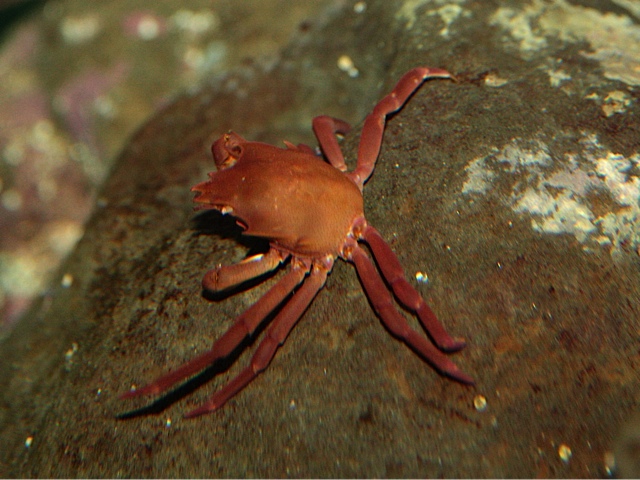
Genus/species;  Pugettia producta


GENERAL CHARACTERISTICS

 Mostly dark brown to green varying depending on the type of algae consumed. Like other members of its family, noted for its unique, elongated carapace with extended rostrum like an upside down shovel with the handle end towards its mouth. and four pairs of relatively long, slender walking legs. Because of these features, the family common name is “spider crabs.”

Most crabs in this family are called masking crabs; they attach fragments of shells and algae to their carapace for camouflage. P.producta, a large active crab, maintains a clean surface, perhaps for ease of movement.  It is a feisty animal; long legs are dextrous, and claws pinch hard.

DISTRIBUTION/HABITAT

 Alaska to Baja California in rocky intertidal in kelp beds and tidepools with abundant surfgrass or algae.  The crab uses the vegetation as protection from  sun and predators. Subtidal to 70 m (230 ft).

 DIET IN WILD

Mainly a nocturnal vegetarian feeding on bull kelp, sea lettuce, rockweed and other kelp. Occasionally will take barnacles, mussels, hydroids, and bryozoans in winter when vegetation is scarce.

 REPRODUCTION

Reproduction and Development: Females usually mate June to July, though can mate year round. Fertilized eggs develop for several months underneath the female’s abdomen.

 PREDATORS


Preyed upon by sculpins, gulls, cabezon, and sea otters among others.

LOCATION: CC15  TIDEPOOL

Flickr http://www.flickr.com/photos/cas_docents/sets/72157626486149324/

WORDPRESS SHORTLINK  http://wp.me/p1DZ4b-xc

TAXONOMY

CLASS   Actinopterygii (ray-finned fishes)

ORDER    Atheriniformes (Silversides)

FAMILY    Atherinopsidae (Neotropical silversides

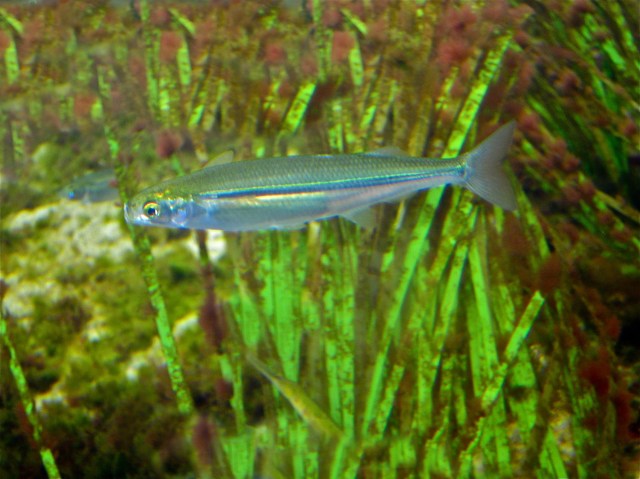
GENUS/SPECIES    Atherinops affinis

GENERAL CHACTERISTICS

Blue gray to green above, silvery below; a striking silver band bordered above with blue extends the full length of the body.

DISTRIBUTION/HABITAT

Marine; brackish; pelagic-neritic..  Eastern Pacific: Vancouver Island in British Columbia, Canada to Baja California, Mexico and the Gulf of California. Subtropical; 55°N – 23°N.Common in bays, muddy and rocky areas and kelp beds, also in estuaries forming schools.

 DIET:

 A.  affinis adults feed on zooplankton while juveniles feed on algae and kelp fly larvae.

REPRODUCTION: 

Demersal spawner in nearshore habitats. Oviparous, with planktonic, primarily neustonic larvae  Eggs are attached to spawning substrate and to one another by adhesive filaments

PREDATORS

Other fishes, birds and people.

REMARKS

Called “topsmelt” for their habit of swimming up near the surface and schooling near shore.

LOCATION

Salt Marsh Pop-up CC03

flickr;  http://www.flickr.com/photos/cas_docents/sets/72157625063185432/

WORDPRESS SHORTLINK  http://wp.me/p1DZ4b-x5

Phylum Chordata (chordates)


Class Actinopterygii (ray-finned fishes) 
Order Perciformes (Perch-likes) 


Family Embiotocidae (Surfperches) 


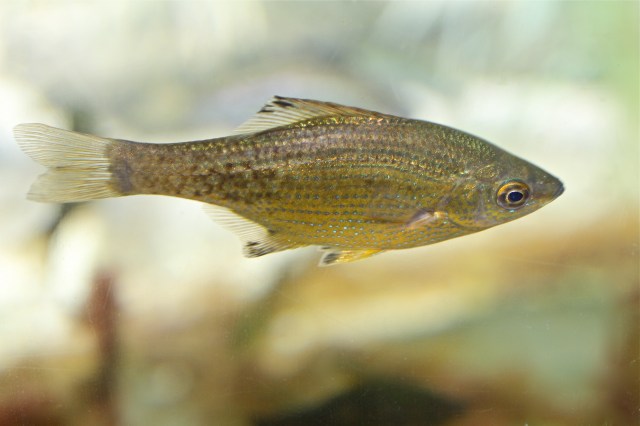
Genus/species Micrometrus minimus 


DISTRIBUTION: Northern British Columbia to central Baja California. 


 HABITAT: Among giant kelp, usually in kelp canopy.

 DIET: Algae and small invertebrates

 REPRODUCTION and DEVELOPMENT: Viviparous ( Livebearer), female carries the developing young. Breed in fall and early winter, spawn in spring.

LOCATION: Salt Marsh Pop_up CC03 and Tidepool CC15  


 flickr http://www.flickr.com/photos/cas_docents/sets/72157626486149324/

WORDPRESS SHORTLINK:  http://wp.me/p1DZ4b-wQ

Class: Actinopterygii, Order: Scorpaeniformes,  Family: Cottidae ( Sculpins)

Oligocottus snyderi 

DISTRIBUTION: Endemic to the Pacific Coast from Alaska to Baja California.

HABITAT: Temperate rocky intertidal pools, especially those with algae or eelgrass and asandy substrate. They don’t migrate but do move between pools. In Central California, dominant in sub- to mid-intertidal pools.

APPEARANCE: Coloration varies greatly from green to reddish brown to pink, depending on the color of the surrounding algae; sides spotted and mottled. Like many sculpins, they have no scales. Cirri line the base of the dorsal fin and the lateral line. The common name refers to a “fluffy” fleshy area behind the dorsal fin. Max. length: 9 cm (3.50 in); average weight: 8 g (0.28 oz). 

DIET: Worms, crustaceans, and other marine invertebrates.

REPRODUCTION: Males use claspers during intercourse for internal fertilization. Eggs are deposited on rocks, and are guarded by the males. O. Synderi develops through larval, post larval, juvenile and adult stages.

REMARKS: Can breathe air for hours at a time, often in response to reduction in the tide pool’s oxygen at night .

LOCATION: Tidepool  CC15

Flickr http://www.flickr.com/photos/cas_docents/sets/72157608359804936/

WORDPRESS SHORTLINK:  http://wp.me/p1DZ4b-vX


TAXONOMY

Phylum: Chordata

Class: Lissamphibia

Order: Anura

Family: Hylida  

Genus/species:  Phyllomedusa sauvagii

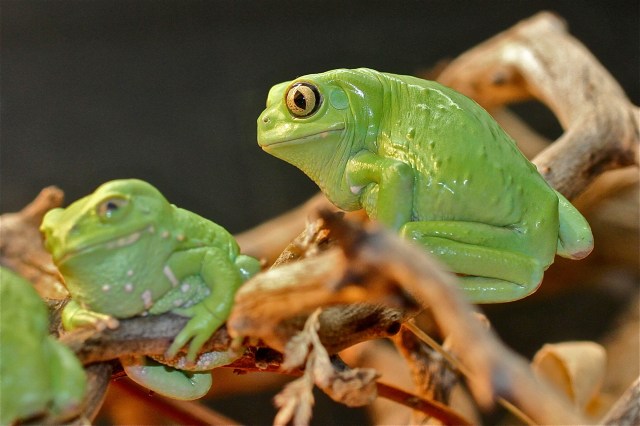
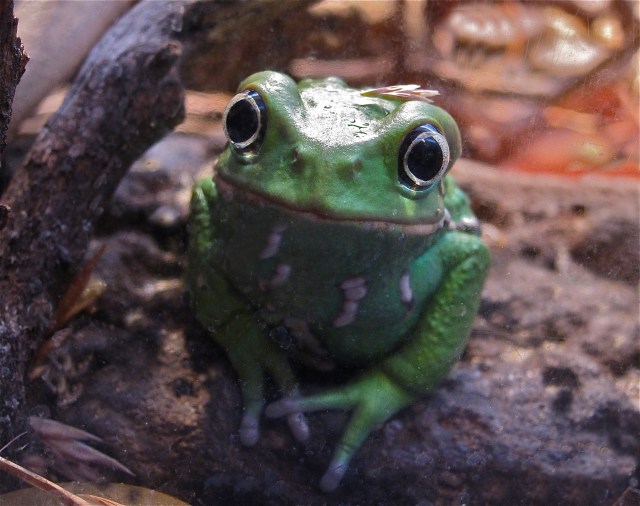
GENERAL CHARACTERISTICS:  Females grow larger, 3.24 in. (8.2 cm); Males – 2.8 in. (7.1 cm).  They have white spots and markings on their bellies and a white line that runs laterally around their bodies. P. sauvagii are bright lime green in color, though they can change color (becoming dark/olive) quite rapidly when stressed.

DISTRIBUTION/HABITAT:  Southeast Bolivia, northwest Argentina and Paraguay where hot, dry, windy, desert-like conditions are common. Inhabits dry prairie on savanna, shrub land and forested areas.  Also found in  trees and vegetation near temporary freshwater ponds and lagoons.

DIET:  Small insects such as flies and ants. 

REPRODUCTION: P. sauvagii make a coarse, leaf nest in which they lay their eggs. The nest hangs over water and when the eggs hatch, the tadpoles drop into the water where they develop into frogs.

MORTALITY: Can live for up to 8 years.

Waxy monkey FrogIMG_8772

REMARKS: Their feet are more like “hands” with opposable thumbs that allow them to grasp branches. They rarely jump (unless frightened) but prefer to climb/walk hand over hand, much like a monkey, with slow, methodical movements.

They secrete a waxy substance that they spread over their bodies to “seal in” moisture and prevent water loss. They also excrete semi-solid urates, which further allows them to minimize water loss.

LOCATION: Water Planet  WP45

flickr http://www.flickr.com/photos/cas_docents/sets/72157608456457315/

WORDPRESS SHORTLINK  http://wp.me/p1DZ4b-va

Class Actinopterygii (ray-finned fishes), Order Perciformes (Perch-likes), Family Chaetodontidae  (Butterflyfishes)

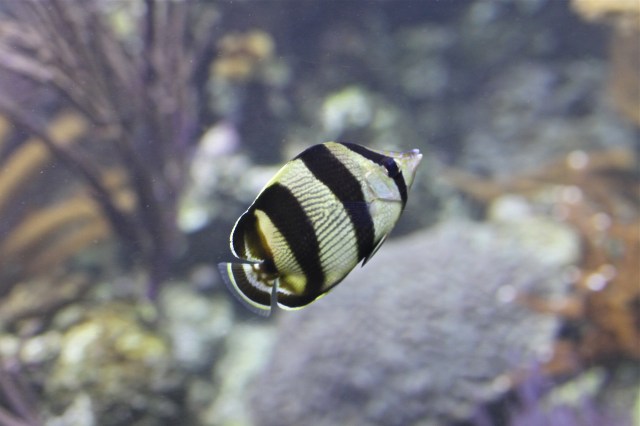
Chaetodon striatus

DISTRIBUTION:  Western Atlantic: Massachusetts, USA to Santa Catarina, Brazil including the Gulf of Mexico and Caribbean Sea.

HABITAT: shallow waters around coral reefs.

APPEARANCE:  Length: 6 inches (15cm). Two broad black bars on side of body and a third bar basally in soft portion of dorsal fin which extends onto caudal peduncle; broad black submarginal bands in the median fins; pelvic fins black except for the spine.

DIET: Feed on polychaete worms, coral polyps, crustaceans and mollusk eggs.

REPRODUCTION: Oviparous and monogamous forming pairs during breeding.

MORTALITY: Diurnal species, active during the day and sleeping at night.  At the end of the day it seeks shelter since it is highly vulnerable to such night predators as moray eels, sharks, and other large reef fishes.

REMARKS: The small, protractile mouth has comb-like teeth arranged in narrow rows in the jaws. “Chaetodontidae” is actually derived from ancient Greek (“Chaeto” = bristle and “donte” = teeth). The bristle nature of its teeth allows the butterfly to scrape at the invertebrates that make up its diet.

LOCATION:  Caribbean reef   PR36

flickr   http://www.flickr.com/photos/cas_docents/sets/72157625119200613/

WORDPRESS SHORTLINK   http://wp.me/p1DZ4b-uz

Family Poraniidae 

Dermasterias imbricate

DISTRIBUTION: Eastern North Pacific: Alaska to Northern California. 

HABITAT: On rocks and rocky reefs in subtidal areas.  APPEARANCE: Medium size sea star up to 5 Iin or 12 cm in diameter with disproportionately short broad arms with a smooth, slippery surface. Mottled coloring—bluish-grey with brown to orange blotches all over.  Oral side pale and smooth. Smells garlic-like.  

DIET: Mainly sea anemones, but also takes sea cucumbers, sea urchins, and other invertebrates. Leather stars, unlike many other sea stars, such as the ochre, bat, and pink sea stars, swallow their prey whole and digest internally. 

REPRODUCTION/DEVELOPMENT: Releases eggs and sperm; fertilized eggs float in plankton and develop into juveniles, which eventually settle out.

REMARKS: Known to eat the Plumose Anemone (Metridium senile and Metridium farcimen), and the Strawberry Anemone Corynactis californica.

Larger anemones have been observed to fight back by distending the mouth to envelope the attacking star. In the end the leather star often retreats and both the star and the anemone are none the worse for wear. 


LOCATION: Tidepool  CC15    **DisplayIntermittent 

WORDPRESS SHORTLINK   http://wp.me/p1DZ4b-u0

flickr    http://www.flickr.com/photos/cas_docents/sets/72157608501343477/

Phylum Echinodermata, Class Asteroidea, Order Forcipulatida, Family Asteriidae, 

Pisaster gianteus


DISTRIBUTION: Eastern Pacific coast from British Columbia to Baja California.

HABITAT: Rocky but also sandy substrates from middle to lower intertidal zone down to 300 ft or 90 m.

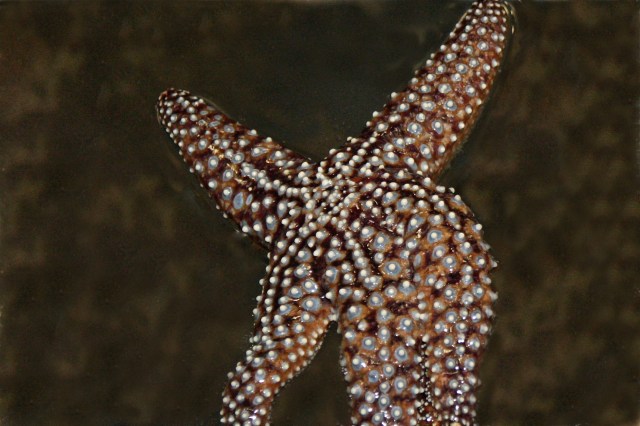
APPEARANCE: Five arms. Can be colored red, orange, brown, or green. Evenly spaced blunt white stubby spines surrounded by blue plaques.  Maximum arm span about 24 in or 60 cm.

DIET: Typical prey are hard-shelled organisms such as mussels, snails, and barnacles. May occasionally eat anything slow-moving enough to be caught, such as dying fish or shellfish, anenomes, or other sea stars.

REPRODUCTION and DEVELOPMENT: Individual sea stars are male or female. Broadcast spawners, both sexes release gametes into the water for external fertilization. Larvae are planktonic and have bilateral symmetry.

MORTALITY/LONGEVITY: Sea gulls and sea otters are sea star predators. Giant sea stars live about 20 years.

TIDEPOOL CC15  

WORDPRESS SHORTLINK  http://wp.me/p1DZ4b-tO

flickr  http://www.flickr.com/photos/cas_docents/sets/72157608501343477/