Latest Entries »

TAXONOMY
Kingdom: Animalia
Phylum: Chordata
Class: Actinopterygii
Order: Perciformes
Family: Centrarchidae (Sunfishes)

Genus/species: Pomoxis nigromaculatus
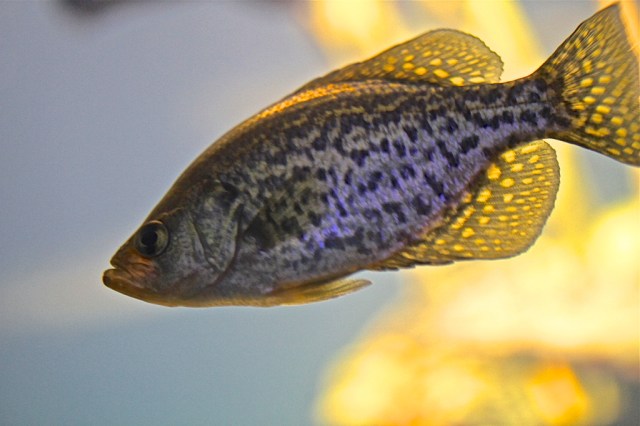
Black Crappie  5230993160_366f8f8c16_b

GENERAL CHARACTERISTICS: Length 13-38 cm (5 – 15 in) in length. The average weight varies from 0.25-0.90 kg (9 – 31 oz). Deep and laterally compressed body with symmetrical dorsal and anal fins. Color is silvery-gray to green with irregular or mottled black splotches over the entire body. Color varies among populations of P. nigromaculatus with age, habitat, and breeding are all determinants of the intensity of mottling.

DISTRIBUTION/HABITAT: North America: native to freshwaters of central and eastern North America, today widely introduced throughout the U.S.  Habitat: Lakes, ponds, sloughs, and backwaters and pools of streams. Prefers clear water and sites with vegetation over mud or sand.

DIET IN THE WILD: Mid-water omnivore that feeds in vegetation and open water. Its numerous gill rakers allow it to consume planktonic crustaceans; however aquatic insects, minnows, and fingerlings of other species comprise its main diet.
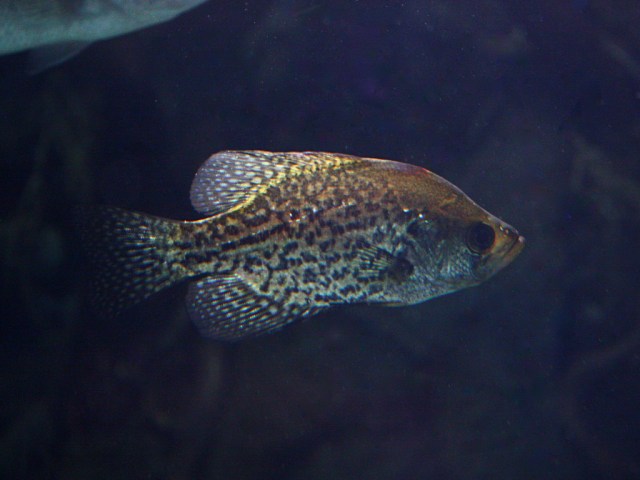
Black Crappie 3202662242_7502b65334_b

REPRODUCTION: P. nigromaculatus produce an average of 40,000 spherical eggs and the male watches o the nest until eggs hatch, which is usually about 2–3 days.

PREDATORS: Larger fishes such as pike, walleye and muskellunge. Average lifespan 10-13 years.

CONSERVATION: Not endangered.

REMARKS: A very popular tasty sport fish.

Feeding Strategies WP31 and Swamp SW02

flickr http://www.flickr.com/photos/cas_docents/sets/72157608608528651/with/3202662242/

WordPress Shortlink  http://wp.me/p1DZ4b-ZD
TAXONOMY
Class: Actinopterygii (ray-finned fishes)
Order: Perciformes (Perch-likes)
Family: Toxotidae (Archerfishes)

Genus/species: Toxotes jaculatrix

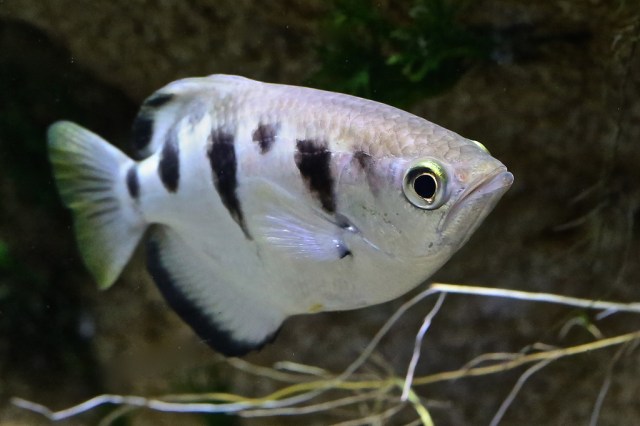
Banded Archerfish 8393611643_5ce29954b5_b

GENERAL CHARACTERISTICS: Have silvery or white bodies with black bars. Maximum length 30 cm (12 inches), common length : 20.0 cm (8 inches).

DISTRIBUTION/HABITAT: Asia and Oceania: India eastward to the
Philippines, and south to Indonesia, Vanuatu, Solomon Islands, Papua New Guinea, and northern Australia. Habitat: primarily in brackish mangrove estuaries, but also penetrates rivers and small streams.

DIET IN THE WILD: Insects, crustaceans, small fishes and floating plant matter.

CONSERVATION: Not endangered.

REMARKS: Used in In botanical gardens to help control plant pests.

T. jaculatrix has the unique ability to shoot insects off branches with amazing accuracy, up to five feet (150 cm) away. They form a tube using the ridge in their tongue and a groove on the roof of their mouth to become living squirt guns. Slamming their gill covers closed propels a powerful jet of water through the channel.
They also have the remarkable ability to compensate for visual refraction when aiming its shoots from water into the air.

Banded Archerfish 8412951528_42ec8b3dd2_b

Feeding Cluster WP32

flickr http://www.flickr.com/photos/cas_docents/sets/72157608614099673/

WordPress Shortlink http://wp.me/p1DZ4b-Zq

TAXONOMY
Kingdom: Animalia 
Phylum: Chordata
Class: Actinopterygii (ray-finned fishes) 
Order: Perciformes (Perch-likes) 
Family: Serranidae (Sea basses: groupers and fairy basslets)
Subfamily: Anthiinae (Anthias)

Genus/species: Serranocirrhitus lathus

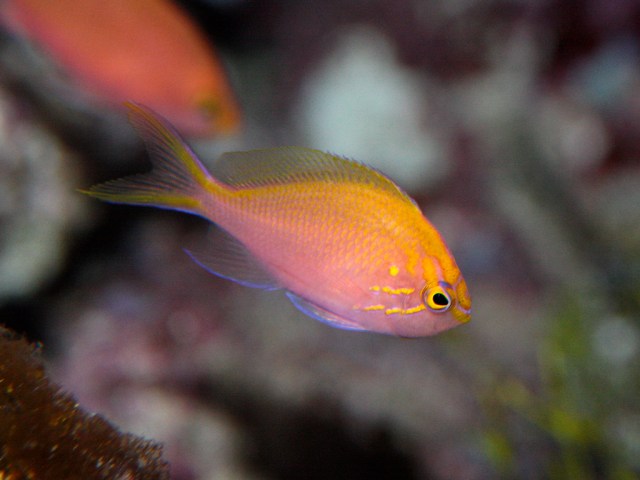
4482852401_4ab3a860ab_b

GENERAL CHARACTERISTICS: Unlike its cousins the Pseudanthias species, the Flathead Anthias has a deep body and elongate pectoral fins that extend back as far as the posterior part of the anal fin.. Predominantly pink, with heavy yellow-to-orange scale margins and facial markings. Max.length: 10 cm (4 inches).

DISTRIBUTION/HABITAT: Western Pacific. Found near coral reefs usually at depths of 18 m (60 feet) or more, either solitarily or in small haremic groups; also found near caves, ledges, and drop-offs, usually close to crevices where they retreat if threatened.

DIET IN THE WILD: Zooplankton

REMARKS; First described in 1949 as a hawkfish in the family Cirritidae but in 1978 it was placed in the subfamily Anthiinae (Anthias).

Animal Attractions Staff Picks SP14

flickr http://www.flickr.com/photos/cas_docents/4482852401/in/set-72157608545590153/

WordPress Shortlink http://wp.me/p1DZ4b-Zl

TAXONOMY
Kingdom: Animalia
Phylum: Chordata
Class: Actinopterygii (ray-finned fishes)
Order: Perciformes (Perch-likes)
Family: Serranidae (Sea basses: groupers and fairy basslets)

Subfamily: Anthiinae (Anthias)

Genus/species: Pseudanthias tuka

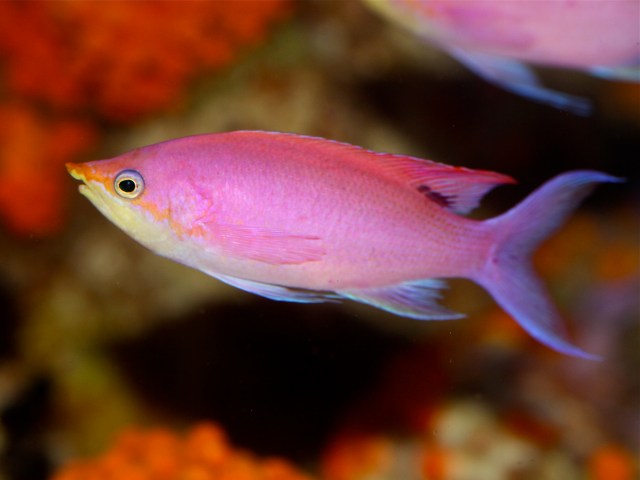
Male below

Purple AnthiasI MG_2808

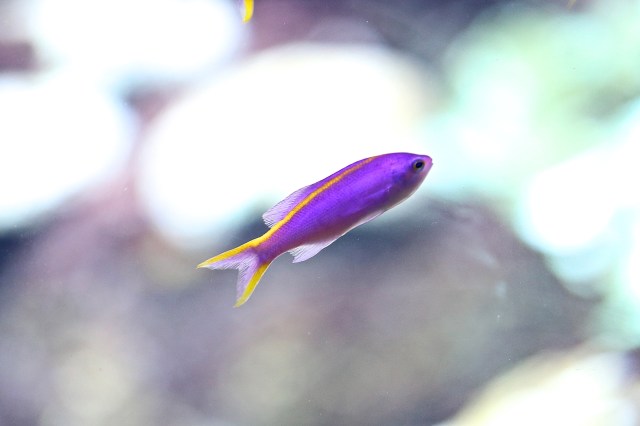
GENERAL CHARACTERISTICS: Sexes bichromatic. Both sexes are a deep pink to purple; however, females have a bright yellow stripe on the back extending onto the caudal fin. Males have a purple blotch on the base of the dorsal fin, elongated fin rays, and a pointed snout Max. size: 12 cm.

DISTRIBUTION/HABITAT: Indo-Pacific: Philippines, Bali, Solomon Islands, Great Barrier Reef, Japan. Habitat: Favor strong currents along the edge of drop-offs and steep outer reef slopes at depths of 30 m or more.

Female below

Purple Anthias (female) IMG_7268
DIET IN THE WILDt: Planktonic crustaceans and fish eggs.

REPRODUCTION: As in all Anthias species, if a dominant male dies, the largest female will usually change into a male and take his place.

REMARKS: Usually found in large aggregations with many more females than males.

Animal Attractions SP14, Philippine Coral Reef PR04

flickr http://www.flickr.com/photos/cas_docents/sets/72157608545590153/

WordPress Shortlink http://wp.me/p1DZ4b-YR

TAXONOMY
Kingdom: Animalia
Phylum: Chordata
Class: Actinopterygii (ray-finned fishes)
Order: Perciformes (Perch-likes)
Family: (Labridae) Wrasses

Genus/speces: Halichoeres semicinctus

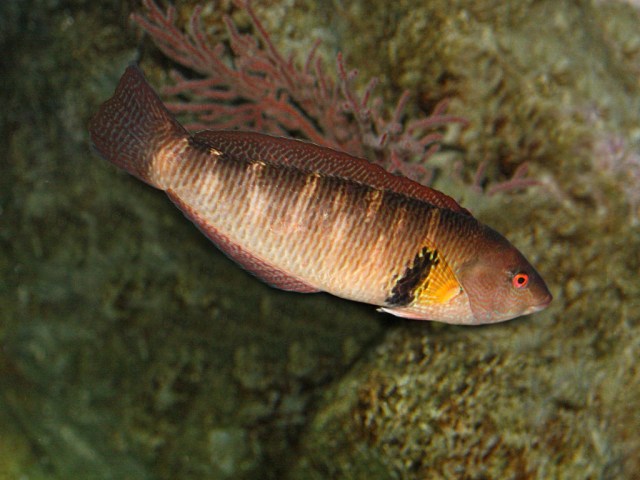
Rock Wrasse (male) below:

Rock Wrasse Male 3995256931_9e14b0f8ab_b

GENERAL CHARACTERISTICS: Length to 38 cm (15 inches). Terminal phase males are characterized by a partial dark stripe behind yellow pectoral fins and pink eyes, while females and immature male rock wrasses are similar in appearance having ranging from brown to yellow to orange. 

Rock Wrasse (female or immature male) below:

Rock Wrasse (female or immature male)  3995255809_8f686dbab8_b

DISTRIBUTION/HABITAT: Pt. Conception, California to Guadalupe Island off central Baja California, Mexico. Habitat: Close to rocks near patches of sand; tidepools and down to 24 m (79 feet).

DIET IN THE WILD: Small invertebrates, taken during the day.

REPRODUCTION: Each individual starts as female then changes to a male at length of about 30 cm. Pelagic spawners

CONSERVATION: IUCN: Least concern.

REMARKS : Sleeps at night buried in sand, with head protruding, and will dart to a sandy refuge during the day if startled.

Rock Wrasse (female or immature male) below:

Rock Wrasse (female or immature male)  2972940984_0ce80884d9_b

Southern California Kelp Tank CC14

WordPress Shortlink http://wp.me/p1DZ4b-Yk

flickr http://www.flickr.com/photos/cas_docents/sets/72157633391356187/with/3995255809/

TAXONOMY
Class: Actinopterygii (ray-finned fishes)
Order: Perciformes (Perch-likes)
Family: Labridae (Wrasses)

Genus/species: Oxyjulis californica

Senorita Wrasse 3995255581_88e76a0033_b

GENERAL CHARACTERISTICS Length to 10 inches (25 cm). Cigar-shaped fish with large scales and protruding teeth. Orange to brownish, a few are more pink or yellow. Large black marking at base of caudal fin.

DISTRIBUTION/HABITAT: Salt Point, northern California to south-central Baja California. Habitat: Found in kelp and other seaweeds and over rocky reefs, usually at shallow depths. Five to 240 feet (1.5 m-76 m) deep.

DIET IN THE WILD: Hydroids, bryozoans, amphipods, parasitic copepods, and isopods

REMARKS: Popular in the aquarium trade. At night, señoritas seek out a nearby sandy area and bury themselves with a headfirst dive into the sand, ultimately sleeping with head protruding.
Señoritas cleaner fish. picking external parasites and copepods from the skin of other fishes.

Senorita Wrasse 3996018576_6967b7abb5_b-1

Southern California Kelp Exhibit CC14

WordPress Shortlink http://wp.me/p1DZ4b-Y8

flickr http://www.flickr.com/photos/cas_docents/sets/72157633391356187/

TAXONOMY
Kingdom: Animalia
Phylum: Arthropoda
Subphylum: Crustacea
Class: Malacostraca
Order: Decapoda
Family: Atyidae

Genus/species: Atyopsis moluccensis

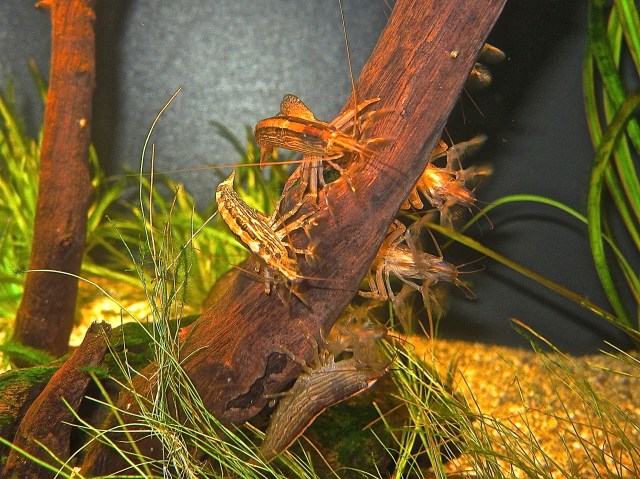
Bamboo Shrimp IMG_0285

GENERAL CHARACTERISTICS: Most species are a brown base color with a tan strip running from head to tail. They vary greatly in color however. Some a greenish-yellow or even red as the base color. Clawless and 4-5 inches in length. Male bamboo shrimp displays two larger forelegs, while the female’s legs are all the same size.

DISTRIBUTION/HABITAT: Found on high islands from Sri Lanka to the Samoan Islands, and as far north as Okinawa, as well as on the Asian mainland from the Malay Peninsula in freshwater areas where their is high current..

DIET IN THE WILD: Filter feeder. using four fan-like appendages on the head to sweep food particles from the water.

Bamboo Shrimp  8724380835_382a2b1ec6_o

Water Planet

WordPress Shortlink http://wp.me/p1DZ4b-XZ

flickr  http://www.flickr.com/photos/cas_docents/8717355179/in/set-72157608602469734

TAXONOMY
Kingdom: Animalia
Phylum: Chordata
Class: Actinopterygii (ray-finned fishes)
Order: Perciformes (Perch-likes)
Family: Pomacentridae (Damselfishes)

Genus/species: Chromis punctipinnis

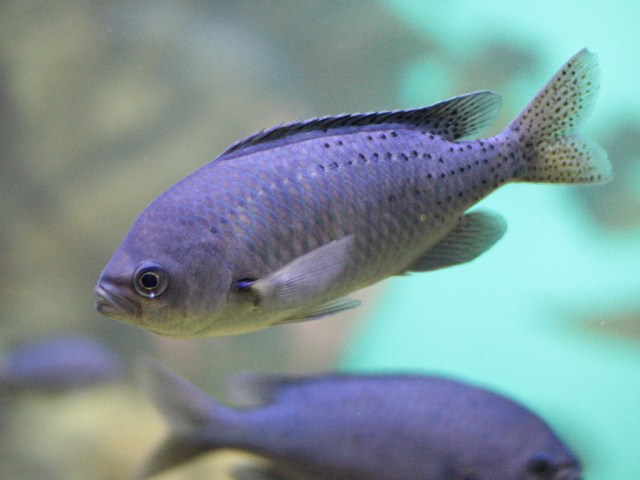
Blacksmith  4020282794_5437a61f15_b

GENERAL CHARACTERISTICS: Gray-blue or gray on sides with black spots on rear of body. Length about 30 cm or 12 inches.

DISTRIBUTION/HABITAT: Monterey Bay to central Baja California, most common from Pt. Conception south. Habitat: Large schools of hundreds of individuals are common during the day above nearshore rocky reefs to 45 m or 150 feet. Shelters night on or near crevices, again often in large groups.

DIET IN THE WILD: Zooplankton (copepods and other crustacean larvae and eggs).

REPRODUCTION: Males prepare nest sites in overhangs or small caves of reefs, and guard eggs. Females oviparous. Spawn summer or fall.

PREDATORS: Other fishes (including kelp bass, moray eels, and lingcod), marine mammals (harbor seals, California sea lions), and birds.

REMARKS: Turns until it is perpendicular to the ground. Senorita fish will then commence cleaning the blacksmith. Not only does the senorita get a meal, but the blacksmith gets groomed in this symbiotic relationship.

3399374199_3ffcf124b8_b

Southern California Kelp Forest CC14

WordPress Shortlink  http://wp.me/p1DZ4b-Xj

flickr http://www.flickr.com/photos/cas_docents/sets/72157608359804936/with/3399374199/

TAXONOMY
Kingdom: Animalia
Phylum: Chordata
Class: Actinopterygii (ray-finned fishes)
Order: Perciformes (Perch-likes)
Family: Labridae (Wrasses)

Genus/species: Semicossyphus pulcher

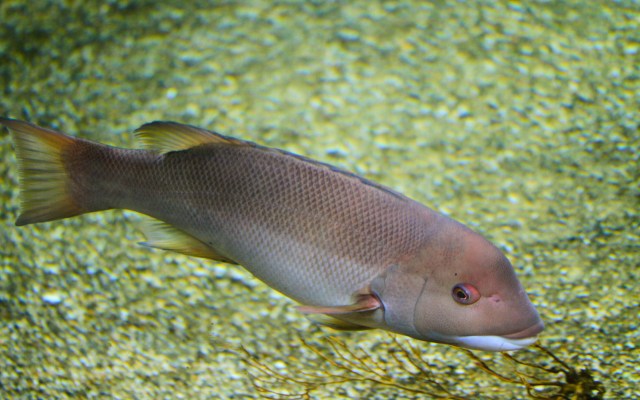
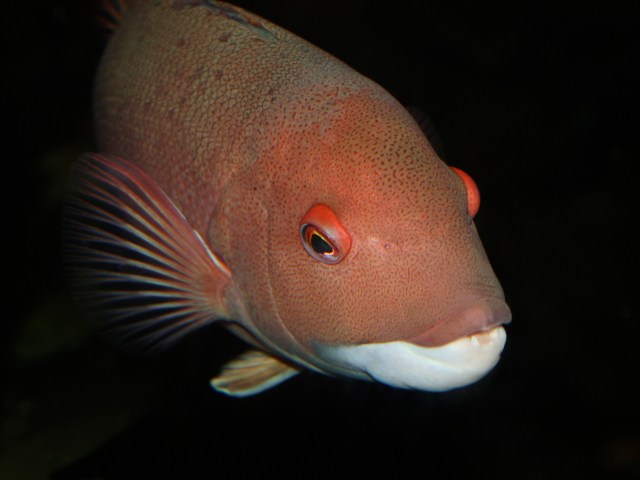
California sheephead IMG_5773

GENERAL CHARACTERISTICS: Length to 91 cm (36 in), weight to 16kg (35 lbs). Body is fusiform, deeply, compressed. Males are larger, with black tail and head sections with wide, reddish-orange midriff and white chins,. Adult females reddish-brown. Caudal fin almost square. Juveniles are brick-red on sides with white stripe and a black spot on its tail.

DISTRIBUTION/HABITAT: Monterey Bay, California to Baja California, Mexico on rocky bottoms or in kelp forests and shallow reefs to 55 m, typically 3 (10 ft)–30 m (!00 ft).

DIET IN THE WILD: Hard-shelled prey (sea urchins, barnacles, clams, gastropods, mussels, lobsters and crabs) crushed with tooth-plates in rear of mouth. Also take octopuses and various worms; can pry prey from substrate with canine teeth.

CALIFORNIA SHEEPHEAD 1

REPRODUCTION: Protogynous hermaphrodite. Individuals initially female, change to males at about 30 cm and 8 years old. Sex change metamorphosis takes less than one year.

PREDATORS/MORTALITY: Can live to more than 50 years, in ideal areas although this rarely happens now. During the night, they move to crevices and wrap themselves in a mucus cocoon so predators can’t detect them.

CONSERVATION: The California Department of Fish and Game restricts the catch size to prevent over fishing.

REMARKS: Large teeth can cause serious bite wounds.

California Coast CC19

WordPress Shortlink  http://wp.me/p1DZ4b-WZ

flickr http://www.flickr.com/photos/cas_docents/sets/72157608359804936/

TAXONOMY

Kingdom: Animalia
Phylum: Chordata
Class: Actinopterygii (ray-finned fishes)
Order: Atheriniformes (Silversides)
Family: Melanotaeniidae (Rainbowfishes, blue eyes)

Genus/species: Iriatherina werneri

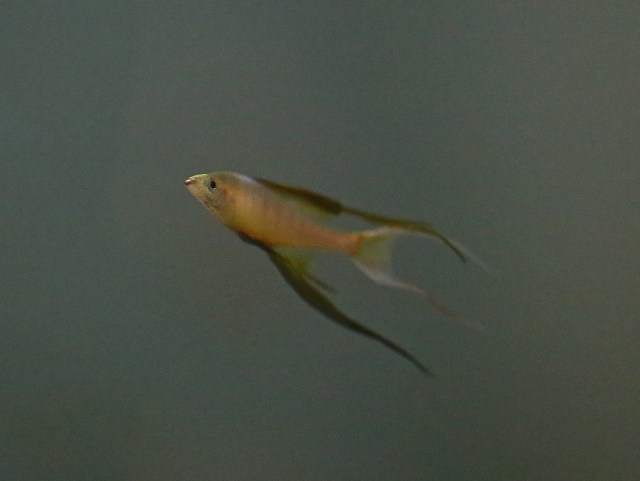
Threadfin rainbow fish, Iriatherina werneri IMG_7039

GENERAL CHARACTERISTICS: Length up to 5 cm (2.0 in) not including the long tail.

DISTRIBUTION/HABITAT: Northern Australia and Indonesia on the island of New Guinea in slow-moving streams, freshwater swamps, lagoons, and billabongs. It’s most commonly found in heavily vegetated, marginal habitats less than 1.5 m in-depth.

DIET IN THE WILD: Phytoplankton, diatoms, and other zooplankton.

REPRODUCTION: Egg-scatterer exhibiting no parental care and will consume its own eggs and fry given the opportunity.

Threadfin rainbow fish, Iriatherina werneri IMG_7044

Water Planet  In and Out of Water Cluster WP12

WordPress Shortlink  http://wp.me/p1DZ4b-VS

flickr http://www.flickr.com/photos/cas_docents/sets/72157608614099673/