Latest Entries »

TAXONOMY
Kingdom: Animalia
Phylum: Chordata
Class: Actinopterygii
Order: Perciformes
Family: Cichlidae

Genus: Symphysodon aequifasciatus

GENERAL CHARACTERISTICS: Color varies as they age. They present a dark brownish to green body. They have nine vertical bars along the body, but lack a bold centrally located bar. They have irregular metallic streaks along the belly, dorsal fin, anal fins, and on the dorsal area of the body of green, blue, or turquoise.

Length up to 5 inches (13.7 cm)

DISTRIBUTION/ HABITAT: Blue Discus are found in freshwater in the South America eastern Amazon River basin in Brazil In deep, rocky areas in crevices and among roots. Normally in schools.

DIET IN THE WILD: They feed on insect larvae, insects, and planktonic invertebrates.
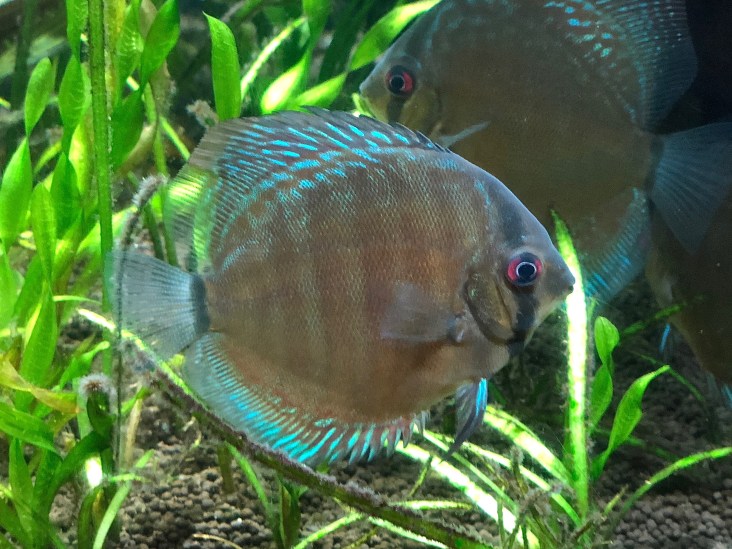
REPRODUCTION: S. aequifasciatus eggs are deposited on stones or plants; both parents defend eggs and larvae; larvae feed on a skin mucus during their first few days.

CONSERVATION: IUCN Not Evaluated

References

California Academy of Sciences Steinhart Aquarium, Flooded Amazon 2018 (Vetted C Delbeek)

Ron’s Flickr  https://www.flickr.com/photos/cas_docents/27863424969/in/dateposted-public/

fishbase www.fishbase.org/summary/Symphysodon-aequifasciatus.html

Animal Diversity Web. animaldiversity.org/accounts/Symphysodon_aequifasciatus/c…

Ron’s WordPress Shortlink wp.me/p1DZ4b-1TF


TAXONOMY
Kingdom: Animalia
Phylum: Chordata
Class: Actinopterygii
Order: Gasterosteiformes
Family: Aulorhynchidae (Tube-snouts)

Genus/species: Aulorhynchus flavidus

GENERAL CHARACTERISTICS: The body has a small caudal fin and small soft dorsal fin. Color is a pale mottled brown, varying from olive-green to yellow-brown dorsally, creamy white ventrally and a bright silvery patch between operculum and pectorals extending to throat.

Length up to length: 18.0 cm (7 inches)


DISTRIBUTION/HABITAT: occurs on the west coast of North America from Prince William Sound, Alaska, to Rompiente, Baja California. Found in kelp beds, eelgrass, rocky areas, and over sand bottoms.


DIET IN THE WILD: Feeds on small crustaceans and fish larvae.

REPRODUCTION: A nest is constructed in kelp and guarded by the male.

LONGEVITY: Up to 9 years

CONSERVATION: IUCN Least Concern

References

California Academy of Sciences, Steinhart Aquarium, California Coast Gallery 2018

Ron’s WordPress Shortlink https://wp.me/p1DZ4b-1Tv

fishbase  www.fishbase.org/summary/3270

Pacific coast Fishes Eschmeyer et al Houghton Mifflin 1986 page 128

IUCN www.iucnredlist.org/details/65134524/0

 EOL eol.org/pages/207010/overview

TAXONOMY
Kingdom: Animalia
Phylum: Arthropoda
Class: Insecta
Order: Coleoptera
Family: Scarabaeidae
Subfamily: Cetoniinae

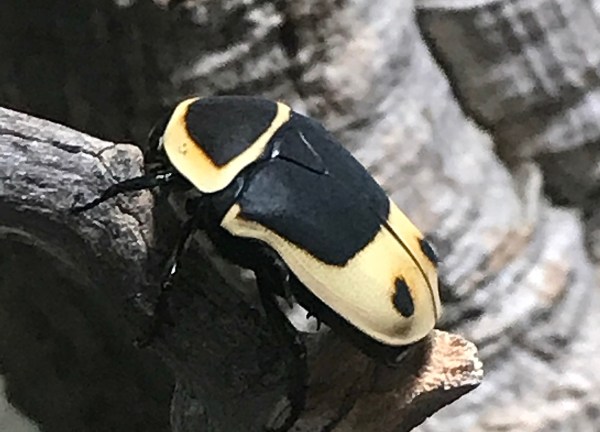
Genus/species: Pachnoda marginata

GENERAL CHARACTERISTICS: They have a yellow with brownish-black front wings that can be seen on its back. Their body is shiny black. Size of around (2,5 cm) 1 inch

DISTRIBUTION: Central and Western Africa

DIET IN THE WILD: These adult beetles eat flowers and fruit. Their larvae have enzyme-releasing microbes in their digestive system which breakdown tough fibrous food. The larvae and their internal microorganisms recycle nutrients back to the forest floor.

REPRODUCTION: Eggs and grubs live underground. The grubs eat rotten fruit and decomposing leaves.
From egg to beetle takes about 3 to 5 months depending on temperature and beetles will live for 2 to 5 months.

REMARKS: the most common pet beetle

References

California Academy of Sciences Rainforest 2018

Ron’s WordPress Shortlink https://wp.me/p1DZ4b-1Tn

Ron’s flickr https://www.flickr.com/photos/cas_docents/38840093994/in/dateposted-public/


1-13-18 Northern Feather Duster Worms from Ron’s California Coast Gallery

TAXONOMY
Kingdom: Animalia
Phylum: Annelida
Class: Polychaeta
Order: Sabellida
Family: Sabellidae

Genus/species: Eudistylia vancouveri

GENERAL CHARACTERISTICS: E. vancouveri secretes a soft, leathery, parchment like tube. The peristomium has several featherlike banded green and purple or maroon light sensitive radioles (tentacles) that are closely associated with the mouth, forming a feather-duster like structure. The radioles are also used for gas exchange (like gills) but the circulatory pattern within them is unusual. Instead of having afferent and efferent vessels, the radioles have a single branchial vessel in each radiole which the blood flows in and out of. Sabellids possess giant nerve fibers running down their body which allows them to retract rapidly into their tube if disturbed.

The pencil like vertical tubes are up to about 45 cm (18 in) long and the tentacle plumes up to 2 inches in diameter.

An excellent group of diagrams of fan worm anatomy can be found on page 27 of the Marine Biology Coloring Book by T. Niesen (2000).


Northern Feather Duster Worm30312750995_19fd3dac96_o

DISTRIBUTION/HABITAT: Found from Alaska to central California in low intertidal areas to 20 m (60 ft) deep. Often in large clusters attached to crevices of boulders, bedrock, pilings; and on vertical rock faces and surge channels in heavy surf.

DIET IN THE WILD: Plankton-feeders such as this often live where there are strong currents and wave action, moving food past the animal at a high rate.

REPRODUCTION: The sexes are separate in these worms, but gametes are produced on internal surfaces rather than in gonads. During spawning, the sperm and eggs are carried up the same groove that carries the fecal pellets and shed into the water. Fertilization is thus a random process, and the larvae that develop are planktonic spheroids with flagella and cilia, at first looking nothing like worms. They add segments little by little and finally drop out of the plankton as real worms, to begin their feather-duster life.

REMARKS: E. vancouveri are marine segmented worms that are sessile, attached to rocks or sand by their base.

Northern Feather Duster Worms are light sensitive and will retract when a shadow passes over them to protect their delicate radiaols.

References

California Academy of Sciences J. Charles Delbeek, M.Sc.
Assistant Curator, Steinhart Aquarium

EOL eol.org/pages/614627/details

University of Puget Sound  www.pugetsound.edu/academics/academic-resources/slater-mu…

Wallawalla.edu inverts.wallawalla.edu/Annelida/Sabellidae/Eudistylia_van…

Ron’s Flickr  https://www.flickr.com/photos/cas_docents/30312750995/in/dateposted-public/

Ron’s WordPress shortlink  http://wp.me/p1DZ4b-1IA


TAXONOMY
Kingdom: Animalia
Phylum: Cnidaria Scyphozoa
Class: Scyphozoa
Subclass: Discomedusae
Order: Semaeostomeae
Family: Pelagiidae

Genus/species: Chrysaora plocamia

GENERAL CHARACTERISTICS: Sometimes huge, diameter reported to max.of 1 m (3ft), oral arms up to. 5 m (15+ft)  or more, but in many populations reported smaller, more typically to ca. 50 cm (20 inches) diameter. Exumbrella smooth. Tentacles in adult 24, 3 per octant; and oral arms are frilled distally.
Color varies. Ground color may also be orange, or white; bell may have dark purple edge; tentacles may be dark purple; mouth-arms may be white/translucent-colorless. Marginal tentacles white to red with yellowish bases (type description).

DISTRIBUTION/HABITAT: They occur along both Atlantic and Pacific South American coasts.

REPRODUCTION: Jellies reproduce sexually and asexually.
In the adult, or medusa, jellyfish can reproduce sexually by releasing sperm and eggs into the water, forming a planula. In this larval stage of jellyfish life, which attaches to the bottom of a smooth rock or other structure and grows into another stage. The polyp resembles a miniature sea anemone. During this stage, which can last for several months or years, asexual reproduction occurs. The polyps clone themselves and budhat grows into the adult medusa jellyfish.

REMARKS: Stings are irritating but not severe, lasting 30-60 minutes.

Refrences

California Academy of Sciences Steinhart Aquarium Animal Attractions 2018

Ron’s flickr  https://www.flickr.com/photos/cas_docents/24372029277/in/album-72157629304397467/

Smithsonian Ocean Portal  ocean.si.edu/ocean-photos/jellyfish-lifecycle-and-reprodu…

Scientific American    www.scientificamerican.com/article/how-do-jellyfish-repro…

Springer Link link.springer.com/chapter/10.1007/978-94-007-7015-7_10

Worms Taxon www.marinespecies.org/aphia.php?p=taxdetails&id=287210

Marine Species Identification Portal

species-identification.org/species.php?species_group=zsao…

Ron’s WordPress Short link https://wp.me/p1DZ4b-1Te

TAXONOMY
Kingdom: Animalia
Phylum: Chordata
Class: Actinopterygii
Order: Anguilliformes (Eels and morays)
Family: Muraenidae (Moray eels)

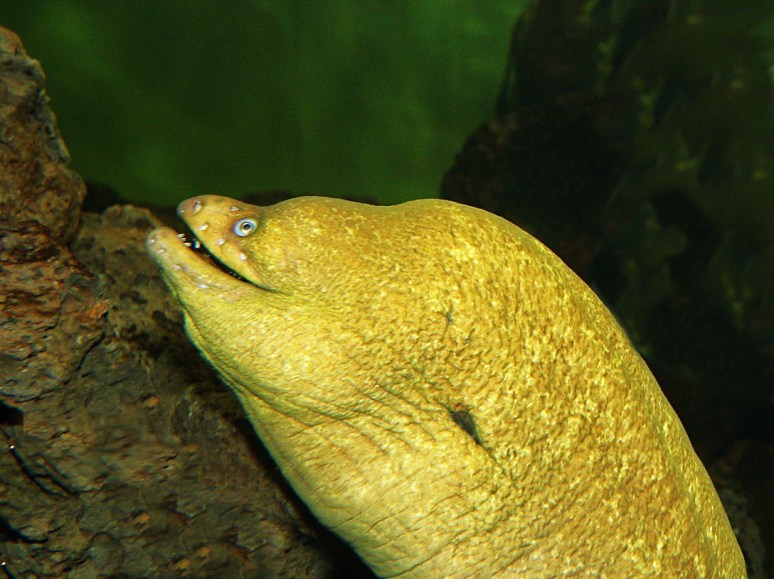
Gymnothorax mordax 

GENERAL CHARACTERISTICS: Color is dark brown to green, mottled. The is somewhat compressed and has no pectoral fins
(all eels lack pelvic fins)..

Length up to 1.5 m (5 ft)

DISTRIBUTION AND HABITAT: Found from Point Conception to south Baja California in rocky subtidal areas diurnally resting in crevices or holes with their head usually protruding. Depth 6–40 m, typically 0.6–20 m.

DIET IN THE WILD: Feeds nocturnally upon crustaceans, octopuses and fishes. Prey is detected by smell.

MORTALITY/LONGEVITY: They can live up to 30 years.

CONSERVATION: IUCN: NO SPECIAL STATUS

REMARKS: Morays constantly open and close their mouth. They do this to aid respiration. It is not a threat display. California Moray bites can cause serious lacerations, and may be unprovoked.

Much of its time they hiding in holes and crevices amongst the rocks on the ocean floor. They are able to remain out of sight from predators and are also able to ambush any unsuspecting prey that passes.

California Morays may be eaten but some species of Moray are poisonous.

References

California Academy of Sciences, Steinhart Aquarium 2017

Pacific Coast Fishes Eschmeyer, Herald and Hammann page 64

More Than You Want To Know About The Fishes of the Pacific Coast, Milton Love 1996 pages 83-84

Animal Diversity Web animaldiversity.org/accounts/Gymnothorax_mordax/

fishbase www.fishbase.org/summary/Gymnothorax-mordax.html

Ron’s WordPress Shortlink  https://wp.me/p1DZ4b-1T8

Ron’s flickr https://www.flickr.com/photos/cas_docents/2996881475/in/album-72157633406973974/


TAXONOMY
Kingdom: Animalia
Phylum:Chordata
Class: Actinopterygii (ray-finned fishes)
Order: Perciformes (Perch-likes)
Family: Pomacentridae (Damselfishes) They resemble the related cichlids and, like them, have a single nostril on each side of the head (most fishes have 2 nostrils on each side) and have interrupted lateral lines. They have a round to oval compressed body. Damselfishes have two anal spines (usually 3 in perch like species). Many species are brilliantly colored, often in shades of red, orange, yellow, or blue; most do not exceed a length of about 15 cm (6 inches).

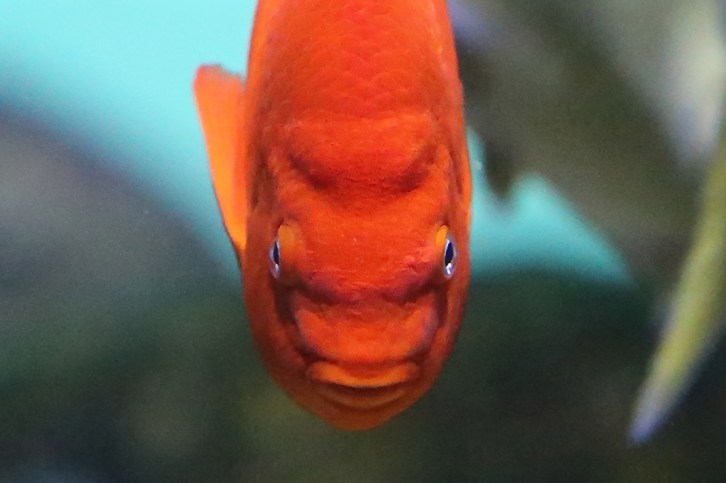
Genus/species: Hypsypops rubicundus

GENERAL CHARACTERISTICS: Adults are perched-shaped and brilliant orange with green eyes. Young Garibaldi are even more colorful with bright blue spots on a reddish-orange body. Normally propels itself withers pectoral fins.

Length approximately 38 cm (15 in) in length (weight 2 pounds in nature)

DISTRIBUTION/HABITAT: Monterey Bay, California to southern Baja California, Mexico among rocky bottom reefs and kelp beds,intertidal to more than 30 m (100 ft). Often near crevices and caves.

DIET IN THE WILD: Diurnal consumers of sponges, bryozoans, anemones and worms.

MORTALITY: Lives to at least 25 years.

PREDATION: Bald Eagles at Santa Catalina Island eat them.

CONSERVATION: IUCN LEAST CONCERN

REPRODUCTION: Oviparous, pairs during breeding with eggs are demersal and adhere to the substrate. Males guard and aerate the eggs.


REMARKS: H. rubicundus is the official marine fish of the State of California. Common name is a reference to the redshirts worn by the armies of Giuseppe Garibaldi, a fighter for Italian unification.

In California it is illegal to catch tis species. they must be released alive.

Disturbed specimens will emit thumping sounds audible to divers.

The California State freshwater fish is the golden trout (Salmo agua-bonita, native only to California). It was found only in a few streams in the icy headwaters of the Kern River, south of Mount Whitney, before transplanting to other CA. locations.

References

California Academy of Sciences, Steinhart Aquarium, Giants and Southern California exhibits 2017

Ron’s flickr https://www.flickr.com/photos/cas_docents/8160274463/in/album-72157633391356187/

Ron’s WordPress Shortlink: wp.me/p1DZ4b-Rt

Pacific Coast Fishes Eschmeyer, Herald and Hammann page 233-4

More Than You Want To Know About The Fishes of the Pacific Coast, Milton Love 1996 pages 279-281


TAXONOMY
Kingdom: Animalia
Phylum: Chordata
Class: Actinopterygii (ray-finned fishes)
Order: Perciformes (Perch-likes)
Family: Serranidae (Sea basses: groupers and fairy basslets)

Sea basses have an elongated body has small scales, with a large mouth, and the tail is generally straight-edged or rounded. The dorsal fin, a diagnostic feature, consists of a forward, spiny section and a hinder, soft-rayed section; the two portions are usually joined but may be separated by a notch.

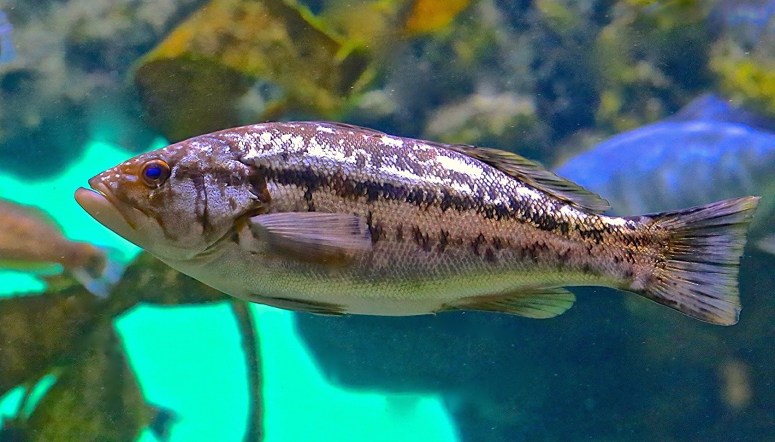
Genus/species: Paralabrax clathratus

GENERAL CHARACTERISTICS:Pale blotches on back. Brown to olive above and cream below with pale spots along sides.

Length up to 72 cm (28.5in) and 14.5 pounds (6.6 kg)

DISTRIBUTION/HABITAT: Eastern Pacific coast from southern Washington to southern Baja California. Most often found near or in kelp beds or structures of any kind; shallow water usually from about 2.5 (8 ft) to 20 m (65 ft).

DIET IN THE WILD: Juveniles: plankton and small invertebrates, especially crustaceans. Adults: small fishes, octopuses, squid, crabs, shrimps, and algae. Known to form groups to prey on schooling fishes.

REPRODUCTION: Spawn in groups in deep water. Pelagic eggs hatch into larvae, which metamorph into juveniles after approximately a month. The juveniles settle among blades of kelp

MORTALITY/LONGEVITY: Life span: to at least 33 years.

PREDATION: California barracuda, Giant Sea bass

CONSERVATION: IUCN RED LIST LEAST CONCERN

REMARKS: The kelp bass is a fine food fish, and among the most important recreational game fishes in southern California.

References

California Academy of Sciences Steinhart Aquarium Southern California exhibit, 2017

Animal Diversity Web animaldiversity.org/accounts/Paralabrax_clathratus/

Pacific Coast Fishes Eschmeyer, Herald and Hammann page 200

More Than You Want To Know About The Fishes of the Pacific Coast, Milton Love 1996 Page 230-233

Ron’s flickr  https://www.flickr.com/photos/cas_docents/38994241111/in/album-72157633391356187/


TAXONOMY
Kingdom: Animalia
Phylum: Chordata
Class: Actinopterygii (ray-finned fishes)
Order: Perciformes (Perch-likes)
Family: Kyphosidae (Sea chubs) All similar families recognized by combination of ovate body, small mouth, strong caudal fin

Genus/species: Medialuna californiensis

GENERAL CHARACTERISTICS: Oval with a small mouth and caudal fin slightly indented. Color is Slate blue to blue-black, silver belly. dusky area above gill cover. Medialuna and common name refers to the half-moon shape of the tail. Scales extend over part of dorsal fin.

Length up to 19 inches (48 cm)


DISTRIBUTION/HABITAT: Vancouver Island, British Columbia to Gulf of California. Most common south of Point Conception, California. Found commonly on nearshore rocky reefs and in kelp beds. Most abundant from 3–20m (10-65 feet).
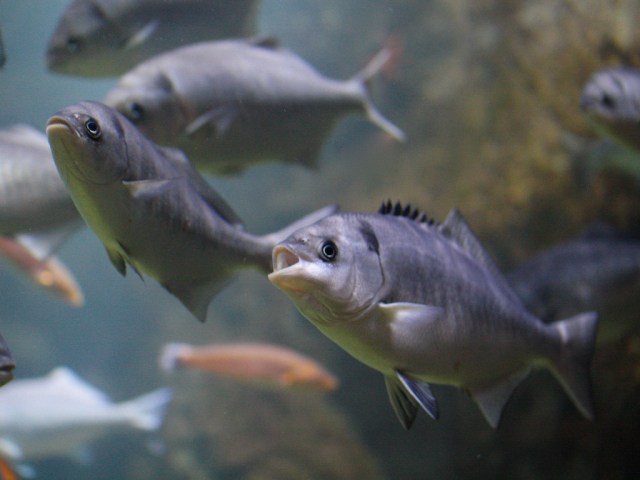
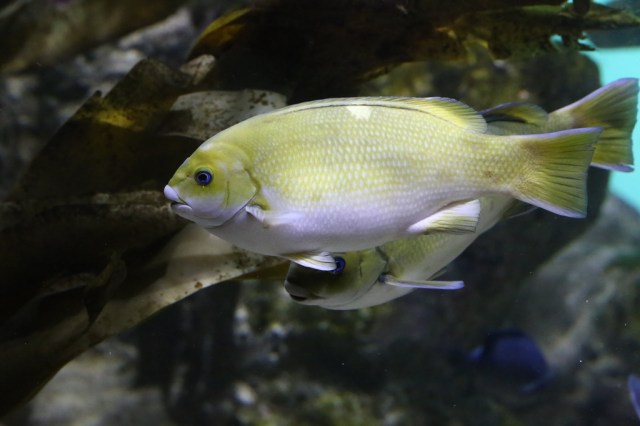
DIET IN THE WILD: Seaweed, sponges, small invertebrates. Diurnal feeders.

REPRODUCTION: Females oviparous.

PREDATORS: Taken by California sea lions, northern fur seals, loons, cormorants, and bald eagles among others.

CONSERVATION: IUCN LEAST CONCERN

Halfmoon 3702917995_61211c59dc_b

REMARKS: A popular sport fish, especially from Santa Monica south. Also a small commercial fishery, as flesh is of excellent quality. Typically found in schools or loose aggregations.

References

California Academy of Sciences, Steinhart Aquariun, Southern California kelp forest 2017

Ron’s WordPress Shortlink wp.me/p1DZ4b-XA

Pacific Coast Fishes Eschmeyer, Herald and Hammann page 224

fishbase www.fishbase.org/summary/3597

More than You Want To Know About Pacific Coast Fishes Milton Love page 256

Ron’s flickr https://www.flickr.com/photos/cas_docents/2959049802/in/album-72157633391356187/


TAXONOMY
Kingdom: Animalia
Phylum: Chordata
Class: Actinopterygii (ray-finned fishes)
Order: Perciformes (Perch-likes)
Family: Kyphosidae (Sea chubs) All similar families recognized by combination of ovate body, small mouth, strong caudal fin

Genus/species: Girella nigricans

GENERAL CHARACTERISTICS: The body has an ovally rounded football-shaped profile. Color is olive-green, frequently shaded with blue or gray; often the snout has a white-colored area. It can display a silvery-white spotted pattern over the entire body; one to three whitespots on back. Bright blue to blue-green eyes. They often have a white bar across the snout.

Length up to 26 inches weight up to 13 1/2 pounds (most caught off piers are under 16 inches)

Opaleye Perch 8394553449_878b685a3b_b

DISTRIBUTION?HABITAT: Oregon to southern Baja California intertidal species with strong homing behavior. Can leave tide pools if aquatic conditions become inhospitable. Also found near or over rocky reefs and in kelp beds up to about 30 m (100 ft) depth..

DIET IN THE WILD: Omnivore feeding diurnally, mainly on seaweeds;
occasionally take invertebrates.

REPRODUCTION: Oviparous

Opaleye Perch 4566438661_569907b825_b


PREDATORS: A popular sport fish, also a mild, good-eating fish, sold commercially as “perch.”

References

California Academy of Sciences Steinhart Aquarium Southern California Kelp Forest 2017

Ron’s flickr https://www.flickr.com/photos/cas_docents/8394553449/in/album-72157633391356187/

fishbase fishbase.org/summary/Girella-nigricans.html

Pacific Coast Fishes Eschmeyer, Herald and Hammann page 223

More Than You Want To Know About The Fishes of the Pacific Coast Milton Love 1996 Page 255

Ron’s WordPress Shortlink  http://wp.me/p1DZ4b-Xt