Category: TROPICAL MARINE


TAXONOMY
Kingdom:Animalia
Phylum: Chordata
Class: Actinopterygii (ray-finned fishes)
Order: Perciformes (Perch-likes)
Family: Acanthuridae (Surgeonfishes, tangs, unicornfishes)

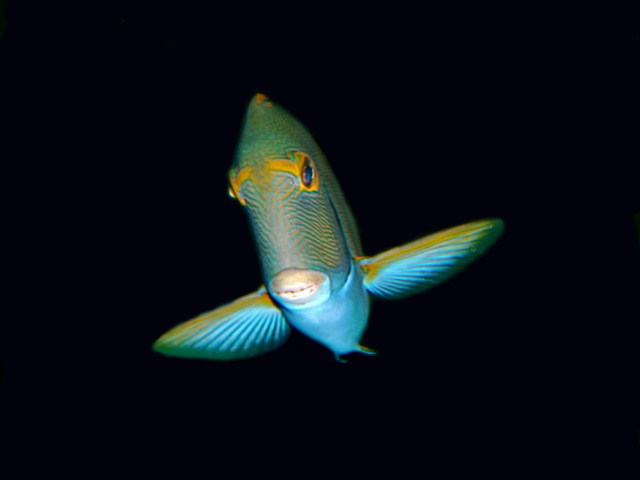
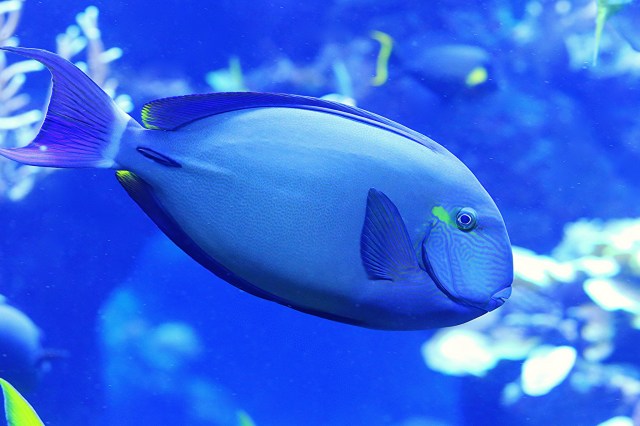
Genus/species: Acanthurus mata
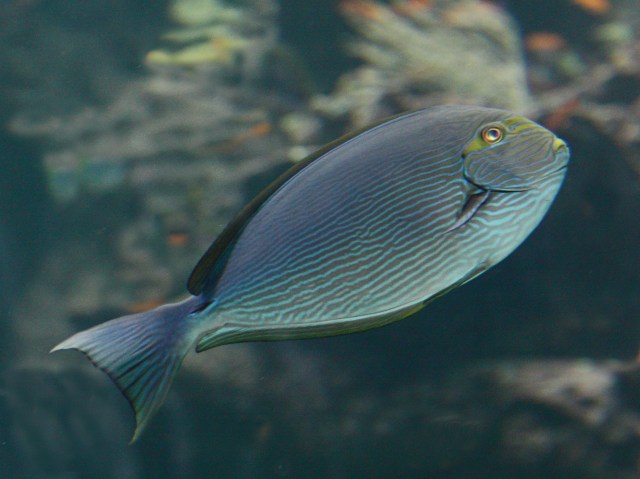
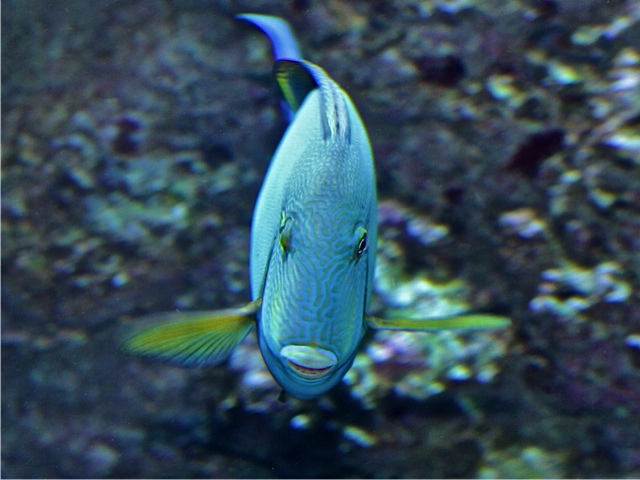
Mata Tang Acanthurus mata (Acanthuridae) RJD_IMG_0 IMG_0726

GENERAL CHARACTERISTICS: Oval, compressed, pale to dark bluish body with numerous dark to blue horizontal lines. A longitudinal yellow stripe runs across the eye and splits in two lines extending anterior the eye. Yellow dorsal fin, upper lip and band across eyes. The caudal fin has a crescent shape.

Length up to 50 cm (20 inches)

DISTRIBUTION/HABITAT: Red Sea and East Africa to French Polynesia; southwest to Japan, Great Barrier Reef, New Caledonia. Frequently inshore in turbid water, as well as outer reefs in depths 5–100 m. or 16.5-330 ft. Usually in groups of conspecifics.

DIET IN THE WILD: The Mata Tang is a group grazer upon plankton.

REPRODUCTION: Form resident spawning aggregations mid-water.

CONSERVATION: IUCN Least concern

REMARKS: A. mata is marketed as a food fish.

References

California Academy of Sciences Steinhart Aquarium Philippine Coral Reef 2016

Ron’s flickr  http://www.flickr.com/photos/cas_docents/3201527871/in/set-72157608332652056

Ron’s WordPress Shortlink http://wp.me/p1DZ4b-1be

fishbase  www.fishbase.org/summary/speciessummary.php?genusname=Aca…

Encyclopedia of life  eol.org/pages/206880/details
IUCN www.iucnredlist.org/details/177967/0

TAXONOMY

Kingdom:Animalia
Phylum: Chordata
Class: Actinopterygii (ray-finned fishes)
Order: Perciformes (Perch-likes) 
Family: Acanthuridae (Surgeonfishes, tangs, unicornfishes)

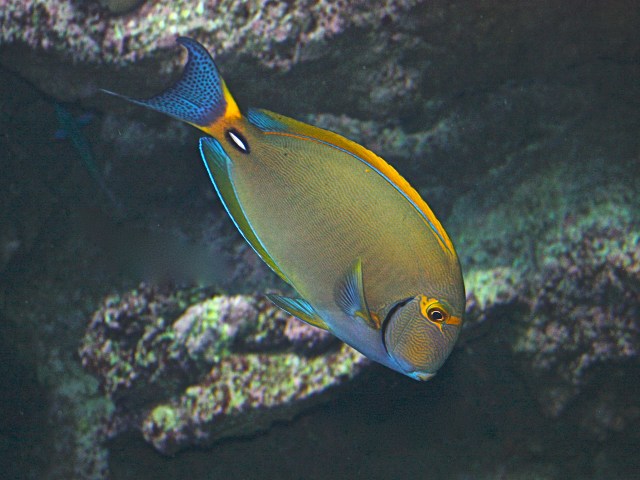
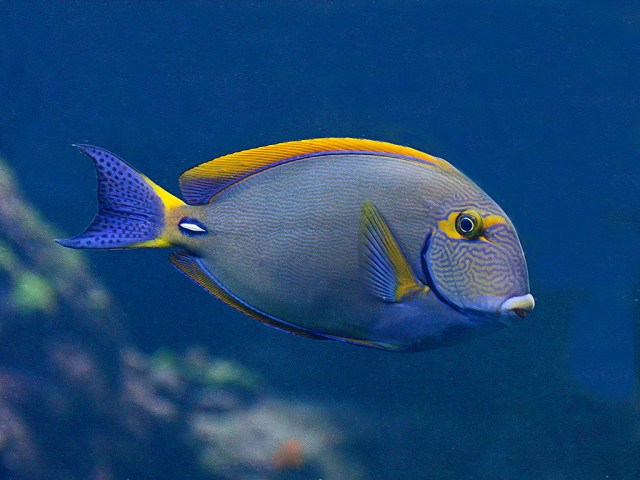
Genus/species: Acanthurus dussumieri

Eyestripsurgeonfish3161438409_067c34e458_b

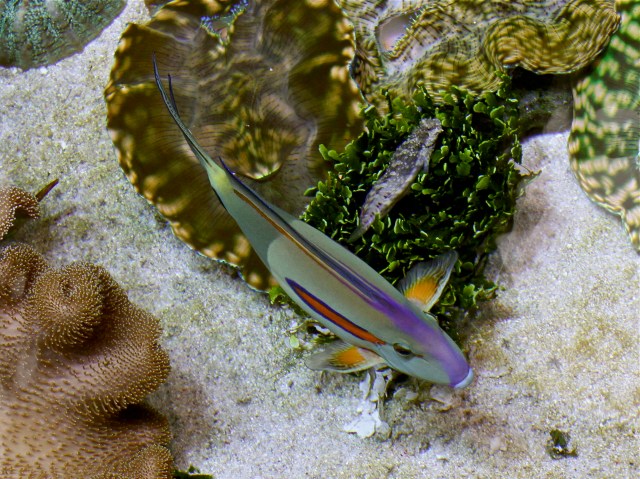
GENERAL CHARACTERISTICS: Bluish to brownish body with horizontal line markings; orange band between eyes, continued behind each eye to gill cover., blue tail with numerous black spots; white caudal spine with the socket edged in black. Typically seen as a solitary fish but may also occur in small groups.

Max. size: up to 50 cm (20 in).


3119304093_7eeabb9447_o

DISTRIBUTION/HABITAT: Indo-Pacific: from East Africa to Hawaii and the eastern Central Pacific. Also from Southwest Japan to the Great Barrier Reef. Absent from most of the Central Pacific. Adults are found mainly on deep coastal reef slopes and outer reef walls.

Depth ranges from 4–131 m (12-430 ft) and are usually found below 30 ft.

EYESTRIPE SURGEONFISH Acanthurus dussumieri

DIET IN THE WILD: Grazes algae from reefs and sand.

CONSERVATION: IUCN Least concern

REMARKS: The eyestripe surgeonfish reputedly has a strong odor when cooked. The Hawaiian name for this fish is palani and a Hawaiian riddle based on this name means “odor reaching to heaven.” This species can quickly change its coloration to a much darker shade that obscures the yellow and markings. 

References

California Academy of Sciences Steinhart Aquarium Philippine Coral Reef 2016

Ron’s WordPress shortlink  http://wp.me/p1DZ4b-1aY

Encyclopedia of life   eol.org/pages/206881/details
fishbase  www.fishbase.org/summary/1256

Ron’s WordPress Shortlink  https://fishoncomputer.wordpress.com/wp-admin/post-new.php

IUCN Red List  www.iucnredlist.org/details/177981/0

Australian Museum australianmuseum.net.au/eyestripe-surgeonfish-acanthurus-…

Ron’s flickr: http://www.flickr.com/photos/cas_docents/8375327580/in/set-72157608332652056/

TAXONOMY
Kingdom: Animalia
Phylum: Chordata
Class: Actinopterygii (ray-finned fishes)
Order: Perciformes (Perch-likes)
Family: Acanthuridae (Surgeonfishes, tangs, unicornfishes)

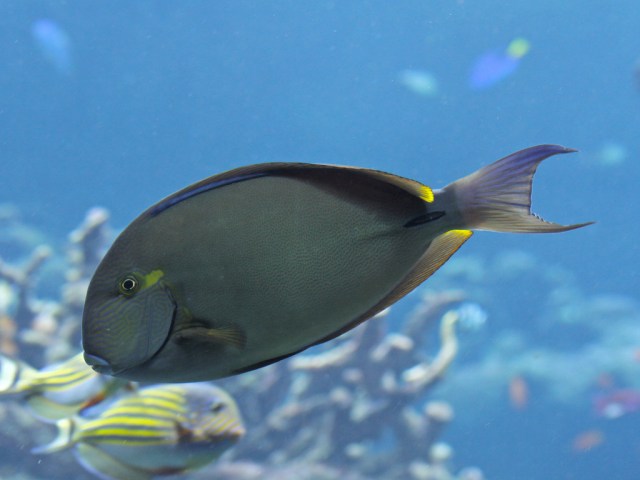
Genus/species: Acanthurus blochii

RingtailSurgeonfish8680230384_409ba2ee72_k

GENERAL CHARACTERISTICS


A. Bluish grey with numerous yellowish brown spots which tend to form irregular longitudinal lines.

B. Head with narrow irregular stripes

C. Behind eye a yellow spot

D. Brown pectoral fins

E. Base of caudal fin with white bar

F.  Caudal spine large.

Differs from A. dussumieri by having vertical stripes instead of spots on the blue central area of the caudal fin, from A. mata by having a lunate caudal fin, and from A. xanthopterus by having plain brown to blue-grey pectoral fins.

The white ring around the base of the tail varies in intensity and may occasionally be absent. 

Max size: up to 45 cm (18 in)

Ringtail Surgeonfish 4441603380_717ef654b8_b

DISTRIBUTION/HABITAT: Indo-Pacific: East Africa to the Hawaiian Islands, south to Australia in lagoons and shallow coral reefs.

Depth 2–15 m (6-50 ft)

DIET IN THE WILD: Graze on algae, diatoms and detritus

CONSERVATION; IUCN Red List Least Concern

References

California Academy of Sciences Steinhart Aquarium Philippine Coral Reef 2016

Ron’s flickr  http://www.flickr.com/photos/cas_docents/3320764840/in/set-72157625992053826

Ron’s WordPress shortlink  http://wp.me/p1DZ4b-C1

fishbase www.fishbase.se/summary/4750

Encyclopedia of life eol.org/pages/211484/details

IUCN www.iucnredlist.org/details/177971/0


TAXONOMY
Kingdom: Animalia
Phylum: Chordata
Class: Actinopterygii (ray-finned fishes)
Order: Perciformes (Perch-likes)
Family: Acanthuridae (Surgeonfishes, tangs, unicornfishes)

Genus/species: Ctenochaetus tominiensis

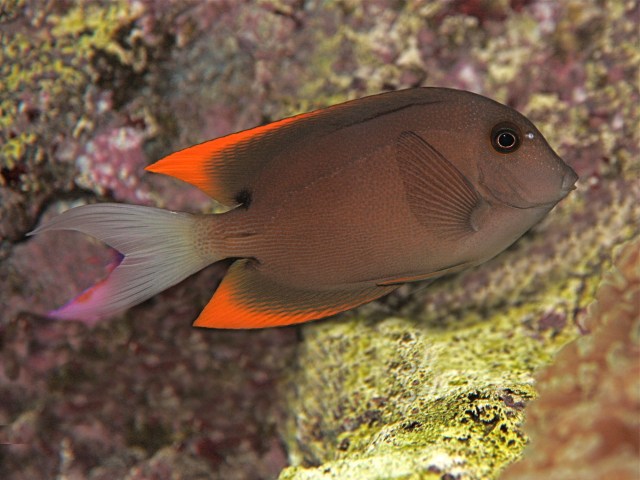
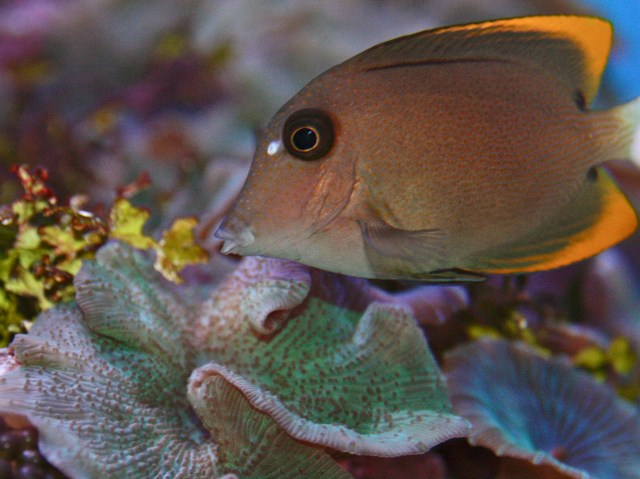
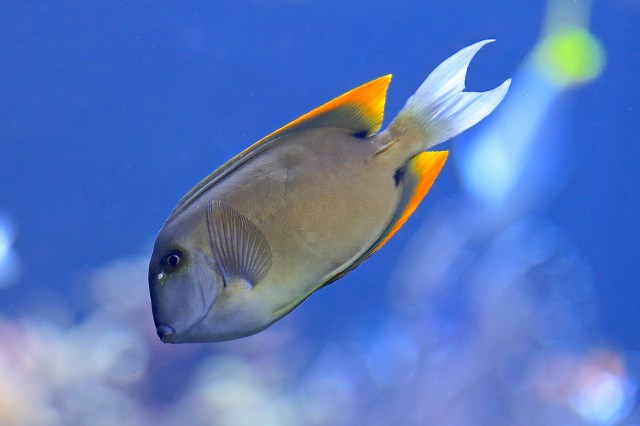
Acanthurus pyroferus (Acanthuridae)

GENERAL CHARACTERISTICS: Brown with pale lower head. The only species of Ctenochaetus (bristletooths) with angular dorsal and anal fins; outer portion of these fins is a bright orange. Caudal fin white.

Max length: 15 cm. (6 inches).

Acanthurus pyroferus (Acanthuridae) IMG_0497

DISTRIBUTION/HABITAT: Western Central Pacific, including Indonesia, Philippines, to northern Great Barrier Reef. Found on steep coral drop-offs of sheltered coasts.

DIET IN THE WILD: The Orangetip Bristletooth Tang feeds on detritus using its comb-like teeth

TominiTang8749715662_50d2f33b0e_k

REPRODUCTION: Pelagic spawner.

CONSERVATION: IUCN, Least concern

References

California Academy of Sciences Steinhart Aquarium Philippine Coral Reef 2016

Ron’s WordPress shortlink  http://wp.me/p1DZ4b-1aJ

Ron’s flickr  http://www.flickr.com/photos/cas_docents/3708499036/in/set-72157608332652056/
EOL eol.org/pages/212379/details

fishbase  http://www.fishbase.org/summary/6016

IUCN Chttp://www.iucnredlist.org/details/177986


TAXONOMY
Kingdom:Animalia
Phylum: Chordata
Class: Actinopterygii (ray-finned fishes)
Order: Perciformes (Perch-likes)
Family: Acanthuridae (Surgeonfishes, tangs, unicornfishes)

Genus/species: Acanthurus lineatus

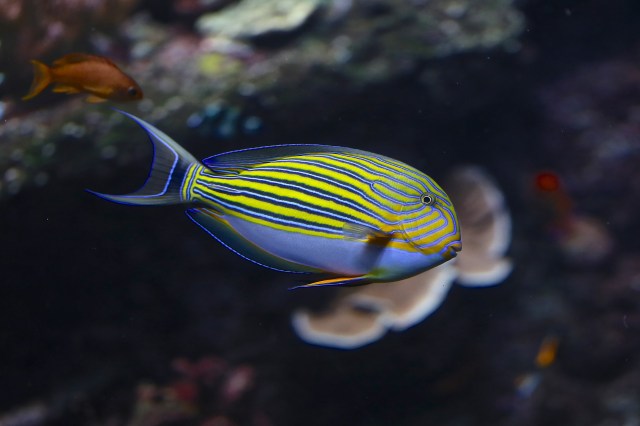
GENERAL CHARACTERISTICS: The Lined Surgeonfish has a compressed and disc-like body with a large venomous, scalpel-like caudal spine on each side of the caudal peduncle. The body is yellowish-green, with bright blue stripes edged with black most pronounced on the flank. The stripes on the belly are lavender blue to bluish-white on the belly. The pelvic fins are bright orange.
Length to 38 cm (15 in)

Lined Surgeonfish Acanthurus lineatus 8624034686_90d26c8326_o


DISTRIBUTION/HABITAT: Indo-Pacific from East Africa north to southern Japan and south to New South Wales, Australia found on exposed outer reef areas at depths of 3-9 ft.

DIET IN THE WILD: Herbivorous, browses on algae but also feeds on crustaceans.

Lined Surgeonfish Acanthurus lineatus

REPRODUCTION: Large males patrol defined feeding areas and maintain harems of females. Migrates to and spawns in aggregations at specific sites, although they sometimes spawn in pairs. Spawning occurs year-round at lower latitudes but may be seasonal at higher latitudes. The eggs and larvae are pelagic.

MORTALITY: It is estimated that this species can live 30 to 45 years.

CONSERVATION: Least concern.

REMARKS: The venomous caudal spines are very effective defense mechanisms for surgeonfish. They are razor-sharp and useful weapons against attack. The lined surgeonfish was first described in 1758 by Carl Linnaeus.

References:

California Academy of Sciences Steinhart Aquarium Philippine Coral Reef 2016

Ron’s flickr  https://www.flickr.com/photos/cas_docents/3142856255/in/album-72157625992053826/

Ron’s WordPress shortlink  http://wp.me/p1DZ4b-1b7

fishbase  http://www.fishbase.org/country/CountrySpeciesSummary.php?c_code=144&id=1258

EOL http://eol.org/pages/208629/details

Australia Museum    http://australianmuseum.net.au/Striped-Surgeonfish-Acanthurus-lineatus-Linnaeus-1758


TAXONOMY
Kingdom: Animalia
Phylum: Chordata
Class: Actinopterygii (ray-finned fishes)
Order: Perciformes (Perch-likes)
Family: Acanthuridae (Surgeonfishes, tangs, unicornfishes)

Genus/species: Acanthurus japonicus

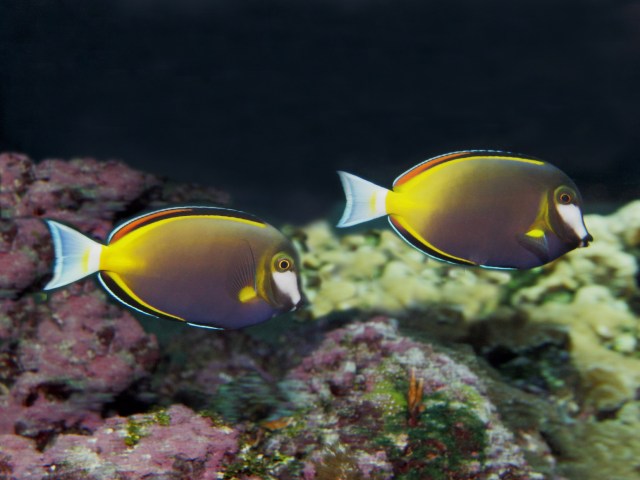
GENERAL CHARACTERISTICS: Like all surgeonfish, A. japonicus are colorful, thin-bodied, oval-shaped. They typically have long continuous dorsal and anal fins and crescent caudal fins. The body is brownish with a white patch on cheek between eyes and mouth; pectoral, anal, and dorsal fins brown with blue highlight at tip. An orange band is found on last third of dorsal fin. Yellow stripes are along base of dorsal and anal fins with a blue tail with yellow bar.  In addition like other surgeonfishes it has a (5)razor-sharp caudal spine located at the base of their caudal fin. 

Length up to 8.3 in.

powder brown tang8748590549_6ab4610498_k

DISTRIBUTION/HABITAT: Found in Asian-Pacific: Sulawesi to Philippines, SW Japan in clear lagoons and shallow (6–36 ft) seaward reefs.

Power Brown Tang

DIET IN THE WILD: Algae.

REPRODUCTION: Group spawner.

CONSERVATION: IUCN, Least concern

References

California Academy of Sciences Steinhart Aquarium Philippine Coral Reef 2016

Ron’s flickr http://www.flickr.com/photos/cas_docents/2779042635/in/set-72157608332652056/

Ron’s WordPress shortlink http://wp.me/p1DZ4b-1aA

fishbase  www.fishbase.org/summary/23375

IUCN  www.iucnredlist.org/details/177977/0

EOL eol.org/pages/225053/overview

TAXONOMY
Kingdom: Animalia
Phylum: Chordata
Class: Actinopterygii (ray-finned fishes)
Order: Perciformes (Perch-likes) 
Family: Acanthuridae (Surgeonfishes, tangs, unicornfishes)

Genus/species: Acanthurus olivaceus 

GENERAL CHARACTERISTICS: Adult coloration: light gray-brown  head and forebody, dark gray-brown behind; blue-edged elliptical orange band behind upper gill cover. Juveniles less than 6 cm are yellow, subadults become a dirty yellowish-brown. A “ scalpel ,” (distinctive spine) on either side of the tail base, identifies it as surgeonfish. Color marks emphasize the scalpels.

Length up to 35 cm (13 in)

Orangeband Surgeonfish4405089732_995ac616e4_b

DISTRIBUTION/HABITAT: Eastern Indo-Pacific. Near reefs over sand, bare rock and rubble substrates, 3–45 m (10-150 ft.). Juveniles inhabit protected bays and lagoons in depths as shallow as 3 m. Adults occur singly or in schools.

Orangeband Surgeonfish aka Orange Shoulder Tang IMG_6416

DIET IN THE WILD: The small mouths have a single row of teeth used for grazing on surface film of detritus, diatoms and filamentous algae covering sand and rocks.

REPRODUCTION: Fertilization is external. They are oviparous and do not display obvious sexual dimorphism.

CONSERVATION: IUCN, Least Concern (LC)

REMARKS: An important food fish.

References

California Academy of Sciences Steinhart Aquarium Philippine Coral Reef 

Ron’s flickr http://www.flickr.com/photos/cas_docents/2979737382/in/set-72157608332652056/

Ron’s WordPress Shortlink http://wp.me/p1DZ4b-1aq

Ref: fishbase http://www.fishbase.org/country/CountrySpeciesSummary.cfm?Country=Philippines&genusname=Acanthurus&speciesname=olivaceus

IUCN www.iucnredlist.org/details/177991/0

EOL http://eol.org/data_objects/24984776

TAXONOMY
Kingdom: Animalia
Phylum: Chordata
Class: Actinopterygii   (ray-finned fishes)
Order:  Perciformes      (Perch-likes)
Family: Acanthuridae  (Surgeonfishes, Tangs, and Unicornfishes)

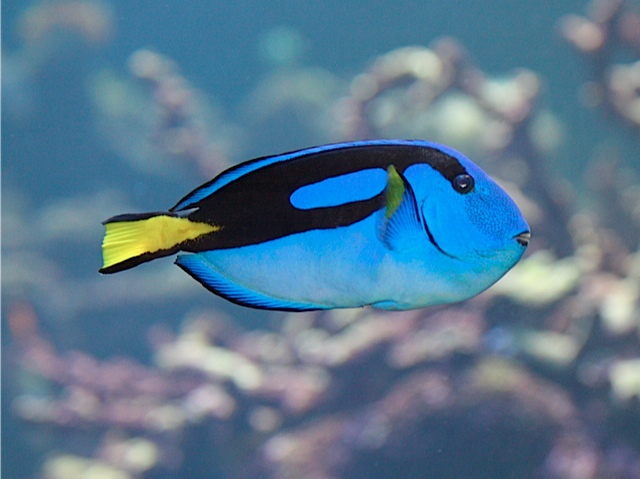
Genus/species:   Paracanthurus hepatus


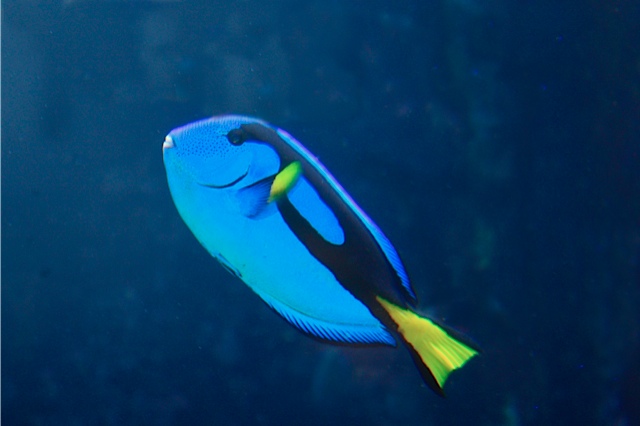
GENERAL CHARACTERISTICS: The color of their oval-shaped bodies is sky blue enhanced by reflective pigment cells called iridophores. The tail fin is yellow extending into a “V” shape from the caudal fin to a point just beyond the caudal spine. A black oval extends under dorsal fin to caudal peduncle. Color changes as they mature; juveniles are bright yellow with blue spots near their eyes, and their dorsal and anal fins are tipped in light blue. Their body becomes blue as they mature.

Length up to 31 cm (12 in)
Weigh on average 600 g. (1.3 pounds)

DISTRIBUTION/HABITAT: Indo-Pacific in clear, current-swept terraces of seaward reefs, 2–40 m (6-120ft). Typically in loose groups 1–3 m (3-9 ft) above substrate.  Shelters among branches of Procillopora corals or in crevices of rocks.  

DIET IN THE WILD: Zooplankton. 

REPRODUCTION: P. hepatus is oviparous with external fertilization.  They are open water egg scatterers on substrate and are nonguarders.        

CONSERVATION: IUCN Least concern         

REMARKS: P. hepatus like other surgeonfishes has a razor-sharp caudal spine located at the base of their caudal fin. This spine contains toxins that can cause a debilitating pain to small predators and uncomfortable irritation and pain in humans. This spine is in a groove below the surface of the skin and can be extended from the body for defensive purposes.

Dory, the co-star of Finding Nemo, with the voice of Ellen DeGeneres’ “spaced-out” fish, is a hepatus tang. Most kids now recognize this fish as Dory.  


References

California Academy of Sciences Steinhart Aquarium Philippine Coral reef 2016

Ron’s WordPress shortlink  wp.me/p1DZ4b-Ab

Ron’s flickr   http://www.flickr.com/photos/cas_docents/sets/72157608332652056/

Encyclopedia of Life   http://eol.org/pages/222042/details

Animal Diversity Web: http://animaldiversity.ummz.umich.edu/accounts/Paracanthurus_hepatus/

fishbase: http://www.fishbase.org/summary/6017

TAXONOMY
Kingdom: Animalia
Phylum: Chordata
Class: Actinopterygii
Order: Perciformes
Family: Monodactylidae (Moonyfishes or fingerfishes)

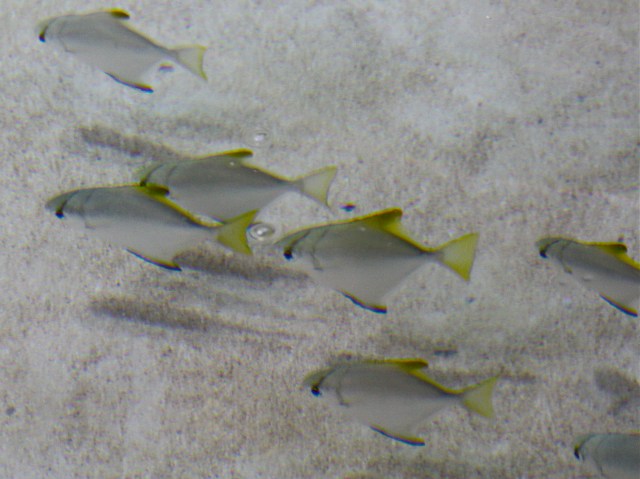
Genus/species: Monodactylus argenteus


GENERAL CHARACTERISTICS: Adults are bright silver with yellowish dorsal and tail fins. Round to triangular-shaped, laterally compressed body. Small juveniles more colorful with yellow over most of the dorsal fin and two vertical black bands over the head.

Length to 27 cm (11 in)

DISTRIBUTION/HABITAT: Indo-West Pacific: Red Sea and East Africa south to New Caledonia and Australia in bays, mangrove estuaries, tidal creeks, and lower reaches of freshwater streams occasionally in silty coastal reefs.

DIET IN THE WILD: Omnivorous, feeding on plankton, a variety of plant matter, detritus, and insects.

4889665817_815d686e0b_o

MORTALITY: About 7-10 years.

CONSERVATION: IUCN Red List  Not Evaluated

REMARKS: Mono are seen in large fast swimming groups in bays, mangrove estuaries and tidal creeks, in the wild.

References

California Academy of Sciences Steinhart Aquarium Reef Lagoon 2016

Ron’s WordPress Shortlink http://wp.me/p1DZ4b-WT

Ron’s flickr  http://www.flickr.com/photos/cas_docents/sets/72157608440659805/with/4889666339/

fishbase fishbase.org/summary/Monodactylus-argenteus.html

Encyclopedia of Life eol.org/pages/206099/details

TAXONOMY
Kingdom: Animalia
Phylum: Chordata
Class: Chondrichthyes
Subclass: Elasmobranchii (sharks and rays)
Order: Rajiformes (Skates and rays)
Family: Myliobatidae (Cownose and Manta Rays)

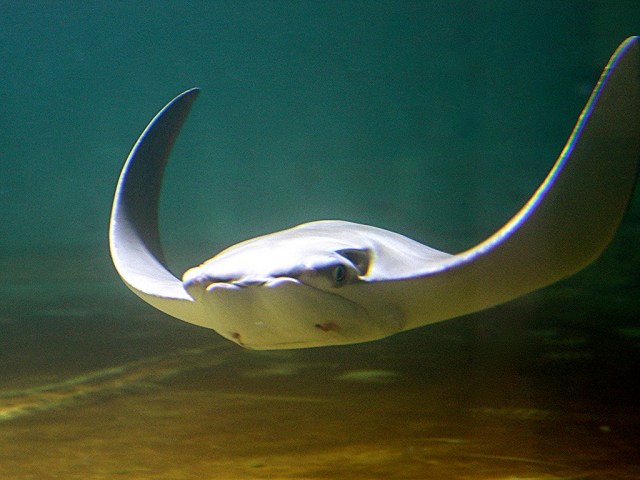
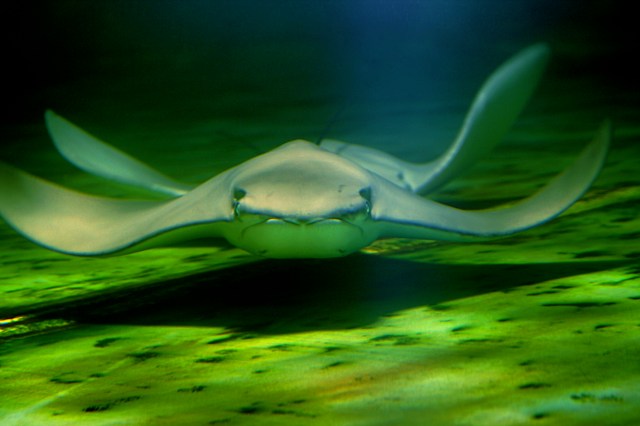
Genus/species: Rhinoptera javanica


GENERAL CHARACTERISTICS: R. javanica is a cartilaginous fish with bat-like, swept back pectoral fins. Double-lobed snout and indented forehead. Long, slender tail. Brown above, white below. The stinger is located at base of the tail rather than half way or more down the tail as in the whiptail rays
Width up to 1.5 m (5 ft), weight up to 45 kg (100 lbs).

Rhinoptera javanica2981790284_a7f88eab35_b

DISTRIBUTION/HABITAT: Tropical, Indo-West Pacific from South Africa north to India and possibly Thailand, Indonesia and southern China. Also in Okinawa, Ryukyu Islands.  The Javanese Cownose Ray inhabits tropical bays, estuaries, among mangroves, and near coral reefs over sand and mud bottoms. It can also tolerate brackish water.

JAVANESE COWNOSE RAY (Rhinoptera javanica) IMG_1769

DIET IN THE WILD: Feeds on clams, oysters and crustaceans. The ray sucks in sand and expels it out of its gills, blowing off sand covering its prey. (Looking for prey below)

Javanese Cownose Ray Rhinoptera javanica (Myliobatidae) eating IMG_0015

REPRODUCTION: Mating pair orient in a venter to venter position, and the male inserts one or both claspers. Ovoviviparous, 1–2 pups per litter. Females have been known to leap out of the water and slam into the surface; this action seems to be an aid in birthing.

CONSERVATION STATUS: IUCN Red List  Vulnerable

A declining population is inferred from the unregulated nature of inshore fisheries as well as small litter size.


REMARKS:  Like its pelagic relatives the manta and devil rays, it swims by flapping its pectoral fins like wings, enabling it to swim at greater speeds than most bottom dwelling stingrays. Sometimes these “wings” protrude above the water, bearing a frightening resemblance to a shark.

References

California Academy of Sciences Reef Lagoon 2016

ARKive www.arkive.org/javanese-cownose-ray/rhinoptera-javanica/

fishbase www.fishbase.org/summary/SpeciesSummary.php?id=7971

IUCN Red List www.iucnredlist.org/details/60129/0

Ron’s WordPress Shortlink  http://wp.me/p1DZ4b-RK

Ron’s flickr http://www.flickr.com/photos/cas_docents/sets/72157608440813109/with/2981790284/