Category: TROPICAL MARINE


TAXONOMY
Kingdom: Animalia
Phylum: Chordata
Class: Actinopterygii (ray-finned fishes)
Order:Perciformes (Perch-likes)
Family: Pomacentridae (Damselfishes, Chromis, Aneomonefishes)
Subfamily: Amphiprioninae (anemonefishes)

Genus/species: Amphiprion ocellaris

GENERAL CHARACTERISTICS: Adults are orange with three broad vertical white bands with thin black margins. Females are larger than males. Similar to the Clown Anemonefish (Amphiprion percula) but has 11 spines in the dorsal fin compared to 10, while the spiny part of the dorsal fin is also taller.

Length up to 9 cm (3.5 inches)

DISTRIBUTION/HABITAT: Found among tropical Pacific Ocean coral reefs. They sleep and feed among the tentacles of their host anemone. Stichodactyla gigantea, Stichodactyla mertensi, as well as the anemone Heteractis magnifica and others. The False Clownfish is usually found at depths of about 15 m (50 ft).
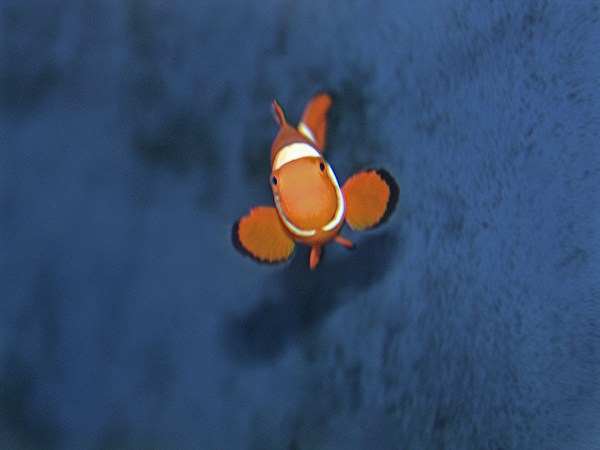
(Amphiprion ocellaris) aka FALSE CLOWNFISH

DIET IN THE WILD: Feeds primarily on zooplankton, especially copepods and also on filamentous algae.

REPRODUCTION: A. ocellaris breeds continuously at the Steinhart. Adhesive eggs are laid on a patch of cleared rock near the host anemone’s base and guarded by the male. Eggs hatch after 10 days. The tiny transparent planktonic larvae swim away from the anemone. Two weeks later the larvae metamorphose into small fish. As protandrous hermaphrodites; all individuals mature as males, and all females are sex-reversed males. In the absence of a female the largest male will turn into a female.
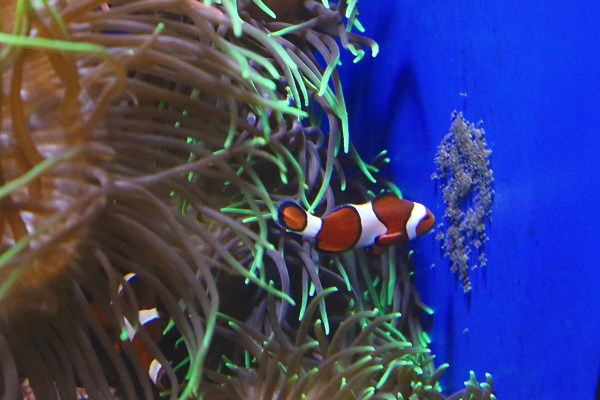
Longevity: Up to 12 years in captivity

REMARKS:  Clownfish and anemone display a classic case of mutualism. Clownfish become resistant to their host by gradually (matter of minutes to days) acquiring a covering of mucus
by brushing against the tentacles of their host. Once the fish has become chemosensorilly camouflaged, the host anemone’s nematocysts do not sting the clownfish.

Some of the anemone’s nutrition results from the clownfish’s activities; clownfish gain protection among the anemone’s nematocysts.

Nemo and his parents in Finding Nemo resemble this species. That said, Marlin, Nemo’s father, given the scenario would have changed into a female following the death of Nemo’s mother and remained near his host anemone, rather than swimming to Sydney. But then the film makers wouldn’t have a narrative to support this film! The name “Nemo” has found its way into FishBase (http://www.fishbase.org) as a common name for this species in the USA!        

References

California Academy of Sciences Steinhart Aquarium Philippine coral reef 2016

Animal Diversity Web  animaldiversity.org/accounts/Amphiprion_ocellaris/

fishbase  fishbase.org/summary/Amphiprion-ocellaris.html

Flickr  http://www.flickr.com/photos/cas_docents/sets/72157608339622313/

WordPress shortlink  http://wp.me/p1DZ4b-mp
 

TAXONOMY
Kingdom: Animalia
Phylum: Cnidaria
Class: Scyphozoa
Order: Rhizostomeae
Family: Mastigiidae

Genus/species: Mastigias papua 

IMG_5610

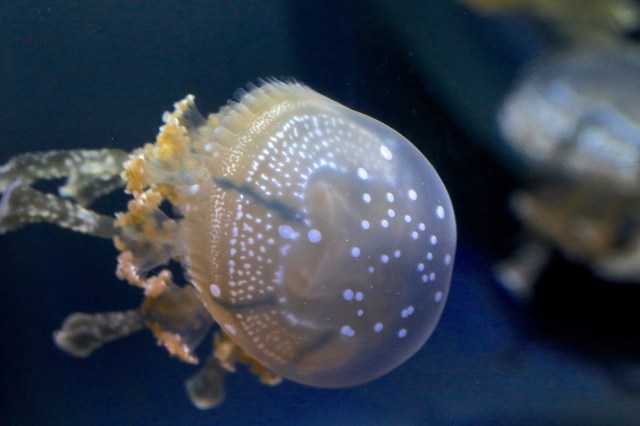
GENERAL CHARACTERISTICS: The translucent bell of M. papua is usually hemispherical, with a diameter ranging from 30 to 80 mm (1 in to 3 inches). This species has 8 frilled oral arms, rather than tentacles. These arms end in a club-like filament that has a triangular cross-section, though this is absent in some species. Each oral arm has mouths on the club, as well as along the length towards the bell.
Color variation exists within Mastigias papua, though the bell is usually greenish blue to olive-green with yellow, white, and/or brown oval, granular spots across the rim (over the exumbrella). Coloring can be attributed to the zooxanthellae that reside symbiotically within the lagoon jellyfish (mostly in the mesoglea)

DISTRIBUTION/HABITAT: Tropical Pacific ocean usually bays, harbors and lagoons.

DIET IN THE WILD: Instead of a single mouth, they have many small mouth openings on their oral-arms, which capture small animal plankton. In addition, each jelly grows a crop of algae, which gives them a greenish-brown color. They harvest some of their food directly from the algae.

MORTALITY: Lifespan of approximately 4 months

PREDATION The only creature that has been confirmed to prey on Mastigias papua is a sea anemone, Entacmaea medusivora.

IMG_5608

REMARKS: Some species of small, juvenile fishes are known to shelter within this jelly’s bell for protection from larger predators.
The famous jellyfish of Jellyfish Lake, a well-known dive site in the Pacific islands of Palau, are descended from M. papua However unlike its jellyfish lake cousin M. papua possess venomous stinging cells for feeding and protection.

Human contacts may  experience many adverse effects such as rashes, severe itching, nausea, and vomiting when contacting tentacles.

References

California Academy of Sciences Steinhart Aquarium Color on the Reef 2017 AQA17

Monterey Bay Aquarium  www.montereybayaquarium.org/animal-guide/invertebrates/sp…

ADW animaldiversity.org/accounts/Mastigias_papua/

EOL  eol.org/pages/203445/overview

Ron’sW0rdpress Shortlink  http://wp.me/p1DZ4b-PC

Ron’s flickr http://www.flickr.com/photos/cas_docents/sets/72157610031545571/with/5985963712/


California Academy of Sciences Steinhart Aquarium Color on the Reef 2017 AQA17

Monterey Bay Aquarium

www.montereybayaquarium.org/animal-guide/invertebrates/sp…

ADW animaldiversity.org/accounts/Mastigias_papua/

Eol eol.org/pages/203445/overview


TAXONOMY
Phylum: Cnidaria
Class: Anthozoa
Subclass: Hexacorallia
Order: Corallimorpharia
Family: Corallimorphidae

Genus/species: Corynactis sp.

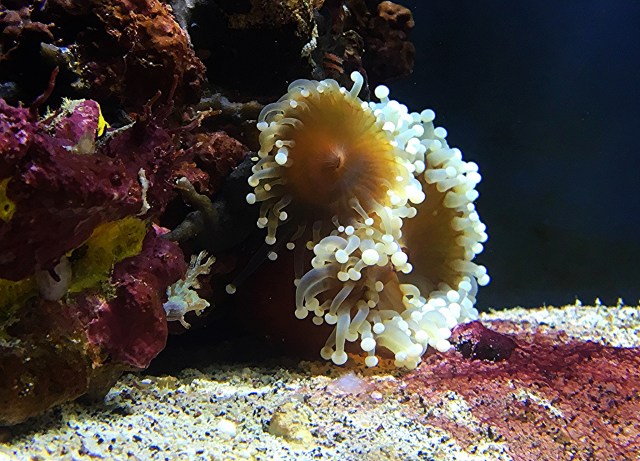
GENERAL CHARACTERISTICS: Note ball tipped tentacles. 

BallAnemone31690177025_2d4172bda6_k 


DISTRIBUTION: Tropical Indian, Central and Western Pacific Oceans

HABITAT: Reef associated

DIET: Small fish and zooplankton

REMARKS: This close relative of sea anemones has sticky ball-tipped tentacles.  Some species of shrimps and fish are immune to the stickiness and live within the tentacles.

Corallimorpharia (Corallimorph) is an order of marine cnidarians closely related to the true sea anemones (Actiniaria). They are mostly tropical, with a narrow column topped with a wide oral disc. The tentacles are usually short or very short, arranged in rows radiating from the mouth. Many species occur together in large groups. In many respects, they resemble the stony corals, except for the absence of a stony skeleton. 

References

California Academy of Sciences Steinhart Aquarium Color on the Reef 2017 AQA17 Charles Delbeek

EOL eol.org/pages/75554/names

WordPress Shortlink  http://wp.me/p1DZ4b-ji

flickr https://www.flickr.com/photos/cas_docents/31690177025/in/album-72157659465376212/


TAXONOMY
Kingdom: Animalia
Phylum: Cnidaria
Class: Anthozoa
Order: Scleractinia
Family: Fungiidae

Genus/species: Fungia sp.

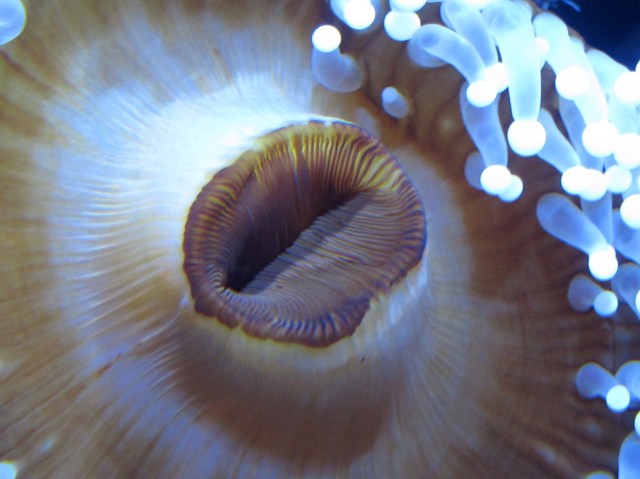
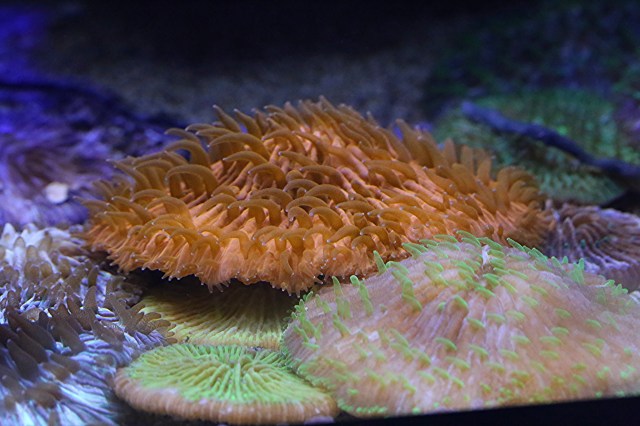
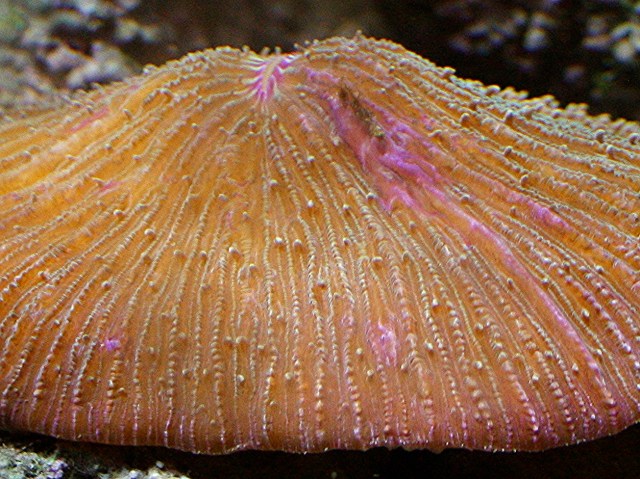
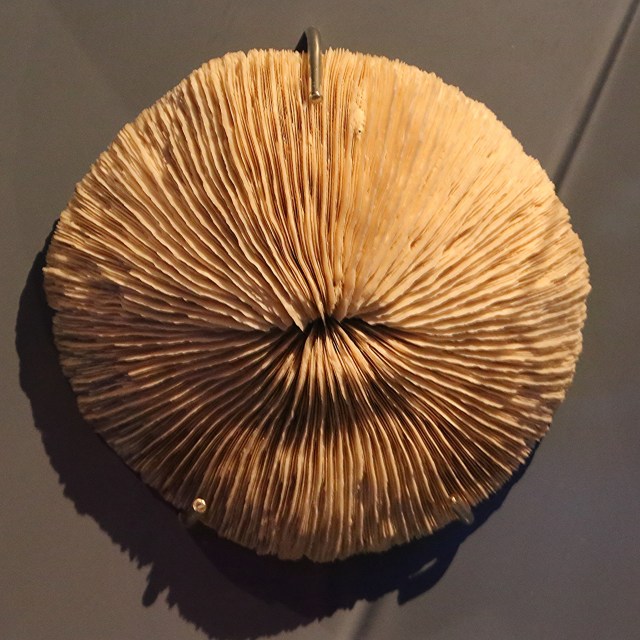
GENERAL CHARACTERISTICS: Hexacoral Genus noted for short, tapering tentacles and a very large mouth opening. The structure is home to a single polyp which sits in a calcareous cup, the corallite. Many septae stretch from the central mouth to sides of the polyp. Usually the form is nearly circular. 

This specimen has its tentacles retracted.

Diameter up to 28 cm (11 inches

Mushroom Coral24651024753_5ace92aaf6_k

DISTRIBUTION/HABITAT: Indo-Pacific from the Red Sea and east Africa, west to Hawaii in tropical and subtropical latitudes. Found among other coral, rubble, or on sand.

DIET IN THE WILD: Plankton, jellies (using nematocysts), proteins (using sticky cilia)

REPRODUCTION: Fungia corals can reproduce sexually or asexually. During sexual reproduction, eggs and sperm are released into the water where the egg is fertilised and develops into larvae. Juvenile Fungia are attached, but become free-living with age, Budding and fragmentation.also can occur.

This specimen has its tentacles retracted.

Mushroom Coral5064192598_beeff0e593_o

CONSERVATION: IUCN Red List Least Concern (LC)

REMARKS: Rather than forming colonies like most corals, Fungia corals are usually solitary and free-living. Because they are unattached, Fungia can be easily moved by waves, and so are most often found in protected places, often at depths where wave action is reduced.

By inflating the body cavity, mushroom corals are able to upright themselves after being overturned. They will travel by inflating their tissue and using current to move.

When Fungi are in immediate contact with other hard corals, they secrete a mucus that can damage coral tissues and prevents the over growth of these neighbouring corals.

Mushroom coral skeleton below


Mushroom Coral24929915125_850e98ad03_k

References

California Academy of Sciences Steinhart Aquarium Water is life Color on the Reef 2017

Aquarium Corals E H Borneman TFH Publications 2001 page253-257

Ron’s flickr  https://www.flickr.com/photos/cas_docents/5063580569/in/album-72157659465376212/

Ron’s WordPress shortlink http://wp.me/p1DZ4b-1Lb

Arkive www.arkive.org/mushroom-corals/fungia-spp/

Animal World animal-world.com/Aquarium-Coral-Reefs/Plate-Coral

TAXONOMY
Kingdom: Animalia
Phylum: Cnidaria
Class: Anthozoa
Order: Scleractinia
Family: Trachyphylliidae (Solitary stony Coral)

Genus/species: Trachyphyllia geoffroyi

GENERAL CHARACTERISTICS: Name comes from Gr: trachys (rough) and phylon (leaf) as it looks like a leaf lying on the substrate. Trachyphyllia are secondarily free-living, usually beginning growth as a single polyp attached to a hard surface. Later it breaks off, and is found detached on sandy or muddy bottoms. Color may vary with depth or substrate: pink to red,
brownish, gray, green, or blue, even multistreaked and iridescent. Fleshy polyps extend well beyond the margin of the stony skeleton.

Open Brain Coral30683128974_b9d9e4ba50_k

DISTRIBUTION/HABITAT: Found in the Indian and Western Pacific oceans on sandy bottoms among seagrass in the outer feel margins.

DIET IN THE WILD: Nutrition from photosynthetic zooxanthellae; also microplankton and other small food bits. Tentacles extended in low light or at night to capture plankton.

CONSERVATION: IUCN RED LIST Near Threatened (NT)

REMARKS: Tangs and angelfishes like to nip and feed on them.
At night their soft tissues may swell to remove debris and sand that accumulates during the day.

References

California Academy of Sciences Steinhart Aquarium Color on the Reef AQA17

Aquarium Corals E H Borneman TFH Publications 2001 pages 301-3

Ron’s flickr https://www.flickr.com/photos/cas_docents/30683128974/in/album-72157659465376212/

Australian Institute of Marine Science  coral.aims.gov.au/factsheet.jsp?speciesCode=0350

Arkive.org www.arkive.org/open-brain-coral/trachyphyllia-geoffroyi/

IUCN www.iucnredlist.org/details/133260/0

Ron’s WordPress Shortlink  http://wp.me/p1DZ4b-1L5


TAXONOMY
Kingdom: Animalia
Phylum:Cnidaria
Class: Anthozoa
Subclass: Hexacorallia
Order: Actiniaria
Family: Actinodendronidae

Genus/species: Actinodendron plumosum

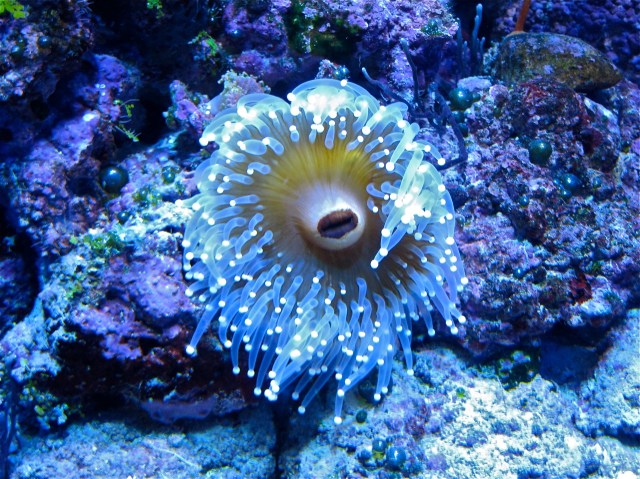
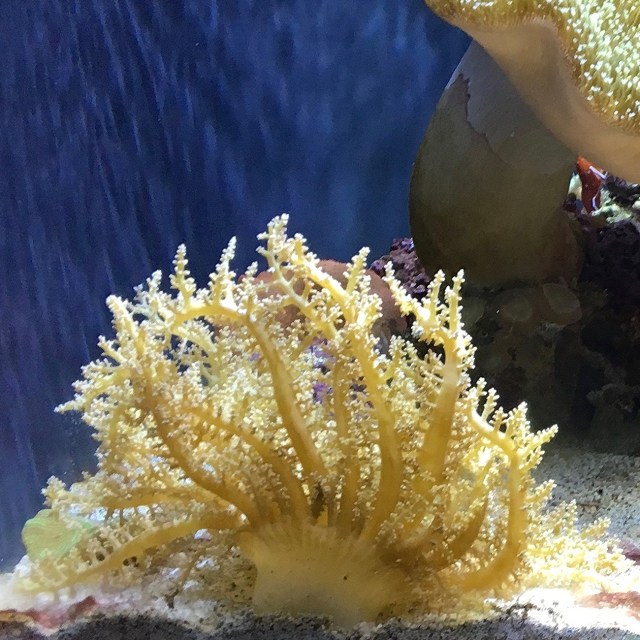
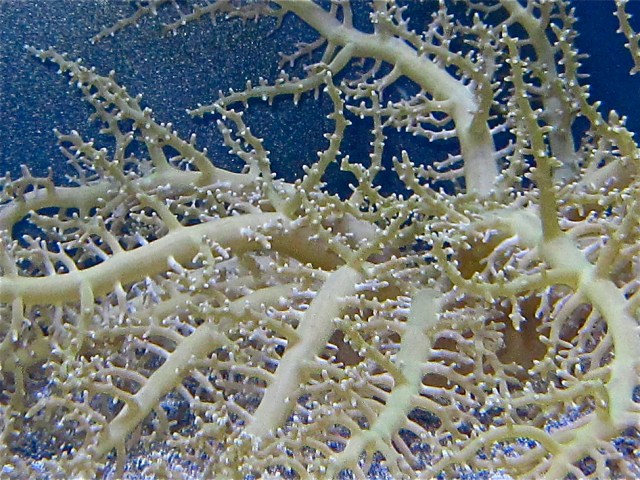
GENERAL CHARACTERISTICS: The Hell’s Fire Anemone is poorly described. It looks more like a coral than and anemone. The color of  A. plumosum can be light yellowish-green, tan, brown, light green or gray. They have an oral disc that is drawn out into branched tentacles tipped with white swellings resembling globular spheres. Their tree like shape is unique in comparison to other anemones. Size: up to 12″ (30 cm).

Hell fire anemone31862717602_e9e55aaff4_o

DISTRIBUTION/HABITAT: Indo-Pacific on coral rich slopes and drop offs with coral gravel, or in shallow sandy and muddy areas. They bury their foot and body into the substrate and adhere their foot to hard surfaces underneath, having only their oral disc and tentacles emerging. When disturbed they can retract their entire body into the sand and be virtually invisible.

REMARKS: The sting from these anemones can damage and even kill other corals and fish. They use their very powerful and venomous nematocyst found in their tentacles to sting and deflect any possible threats or attacks, as well as for capturing prey. In humans the stings can cause ulcers at the site which last for months.

IMG_3633

References

California Academy of Sciences Steinhart Aquarium Color on the Reef AQA17  2017

Ron’s flickr https://www.flickr.com/photos/cas_docents/31862717602/in/album-72157659465376212/

EOL eol.org/pages/421192/details#habitat

Animal-World  animal-world.com/Aquarium-Coral-Reefs/Hells-Fire-Anemone

Ron’s WordPress Shortlink, http://wp.me/p1DZ4b-8C

TAXONOMY
Kingdom: Animalia
Phylum: Chordata
Class: Actinopterygii (ray-finned fishes)
Order: Syngnathiformes (Pipefishes and seahorses)
Family: Centriscidae (Snipefishes and shrimpfishes)

Genus/species: Aeoliscus strigatus


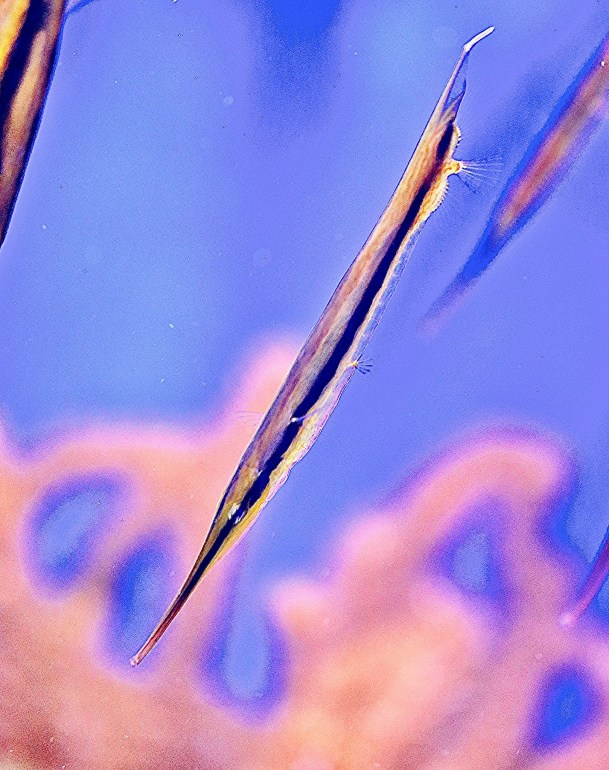
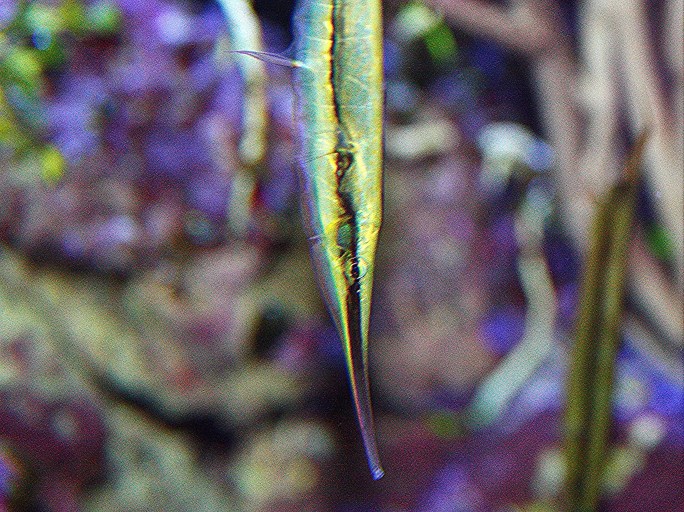
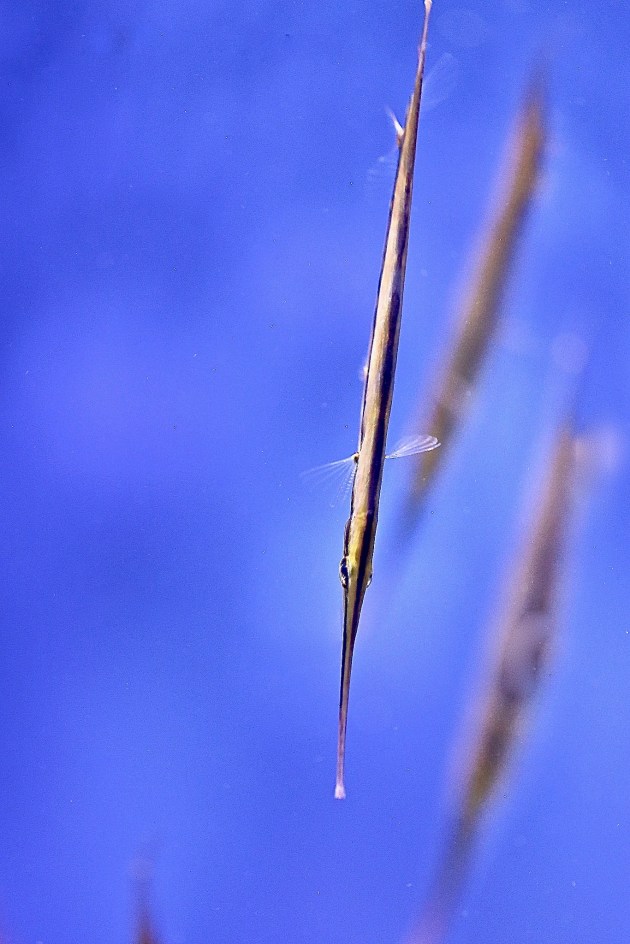
GENERAL CHARACTERISTICS: The body is encased in an armor of thin, transparent plates; they swim in synchronized groups, each fish in a vertical position with the snout pointing downwards. Color is golden-yellow with a dark band running the length of the body. The tail fin, terminates in a sharp spine.

Length up to 15 cm (6 in)

DISTRIBUTION/HABITAT: Tropical Indian and western Pacific oceans. Inhabits clear coastal reefs and leeward fringing reefs around offshore islands. Found In small groups swimming and resting with head down near long-spined sea urchins, branching corals or other hiding places to 42 m (140 feet).

DIET IN THE WILD: Minute planktonic crustaceans.

CONSERVATION: IUCN Not Evaluated

REMARKS: A. striates occurs  has been observed hiding in the spines of sea urchins, both as a defense mechanism and as a hunting mechanism. Swims horizontally only when hunting. Otherwise, swim with head down and back facing the direction of travel. If a rival enters their territory, they aim the sharp edge of the belly toward the adversary.

References

California Academy of Sciences Steinhart Aquarium Hidden Reef 2018

Ron’s WordPress Shortlink. https://brianeyes21comcast.net/2017/01/05/4-19-13-shrimpfish-aka-razorfish-from-rons-tropical-marine-series/

fishbase  http://www.fishbase.org/summary/6503

Animal Diversity Web http://animaldiversity.org/accounts/Aeoliscus_strigatus/classification/

Ron’s flickr. https://www.flickr.com/photos/cas_docents/30467635696/in/album-72157659465376212/

Fishes of Australia.  http://fishesofaustralia.net.au/home/species/3163#moreinfo

EOL eol.org/pages/205823/details#distribution


TAXONOMY
Kingdom:Animalia
Phylum: Chordata
Class: Actinopterygii (ray-finned fishes)
Order: Perciformes (Perch-likes)
Family: Labridae (Wrasses)

Genus/species: Stethojulis bandanensis

Stethojulis bandanensisIMG_8597

GENERAL CHARACTERISTICS: The body is elongate and fusiform with a pointed head and small mouth. Primary phase individuals are brown with hundreds of tiny white specks, a white belly, yellowish cheeks, and an orange shoulder patch. Terminal males typically have a series of partial to complete longitudinal thin blue lines on their sides. Females mainly bluish grey with fine white spotting over upper sides and a small red spot at axil of pectoral fin. They have a blue-green on upper half and bluish below.

Length up to 15 cm (6 inches)

DISTRIBUTION/HABITAT: Tropical Indo-Pacific: eastern Indian Ocean to western Australia, Found in shallow clear water of reef flats and lagoon and seaward reefs, in areas of mixed sand, rubble and coral. Depth 3-30m (10-100 feet).

DIET IN THE WILD: Zoobenthos ( small benthic invertebrates living on, in, or near the seabed, also known as the benthic zone)

REPRODUCTION: Oviparous with distinct pairing during breeding

CONSERVATION: IUCN Least concern LC

References

California Academy of Sciences Philippine coral reef 2016
Vetted J. Charles Delbeek, M.Sc.
Assistant Curator, Steinhart Aquarium

fishbase www.fishbase.se/summary/5640

EOL eol.org/pages/994413/details

Ron’s flickr www.flickr.com/photos/cas_docents/13226075944/

IUCN  www.iucnredlist.org/details/full/187424/0

Ron’s WordPress Shortlink  http://wp.me/p1DZ4b-1e5


www.guammarinelab.com/fish/species_html/stethojulis.banda…

TAXONOMY
Kingdom:Animalia
Phylum: Chordata
Subphylum: Vertebrata
Class: Actinopterygii (ray-finned fishes)
Order: Perciformes (Perch-likes)
Family: Labridae (Wrasses)

Genus/species: Cirrhilabrus rubrimarginatus


GENERAL CHARACTERISTICS: Body shape is fusiform. The male is more brilliantly colored compared to the female and the juvenile, Has a red margin on both the tail and dorsal fin.

length up to 5 inchesRed-Margin Wrasse

DISTRIBUTION/HABITAT: Western Pacific: north to the Ryukyu Islands, through the Philippines, Palau, and Indonesia. Adults found in deep coastal to outer reef drop-offs and steep slopes to 40 m (130 feet) or more, usually in loose aggregations.

CONSERVATION: IUCN; Least concern.

REMARKS: Fairy wrasses, along with 4 other closely related genera, have an unusual eye structure. The cornea is divided into two segments, basically forming a double pupil. It is theorized that the center pupil acts like a close-up lens to give the fish a clear view of its small prey. Fairy wrasses are active during the day, and sleep at night wedged into crevasses protected by a mucous cocoon they secrete around themselves.

References

California Academy of Sciences Philippine coral reef 2016      Charles Delbeek, M.Sc  Assistant Curator, Steinhart Aquarium  California Academy of Sciences

Ron’s WordPress shortlink http://wp.me/p1DZ4b-1en

Ron’s flickr www.flickr.com/photos/cas_docents/13277420973/in/set-7215…

fishbase www.fishbase.org/summary/Cirrhilabrus-rubrimarginatus.html

EOL eol.org/pages/213476/hierarchy_entries/44698464/details

Reef Keeping  http://www.reefkeeping.com/issues/2003-01/hcs3/

TAXONOMY
Kingdom: Animalia
Phylum: Chordata
Class: Actinopterygii (ray-finned fishes)
Order: Perciformes (Perch-likes)
Family: Labridae (Wrasses)

Genus/species: Halichoeres prosopeion

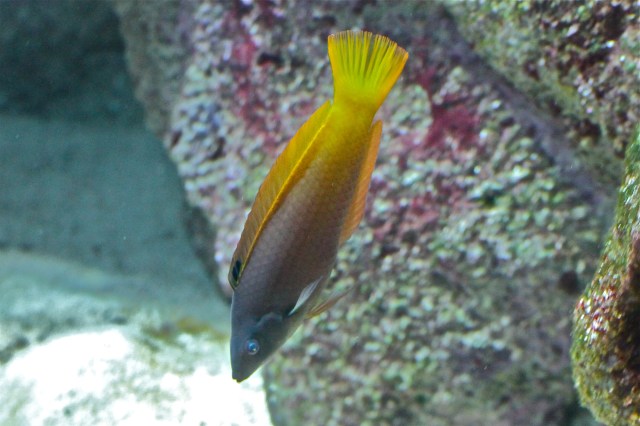
GENERAL CHARACTERISTICS: Adults green-blue in front fading to light yellow behind. A dark spot behind the eye; dorsal fin with large black spot near the front. Unlike most wrasses, no obvious differences between sexes.

Length up to 13 cm (5 inches).

Two-tonewrasseIMG_6778

DISTRIBUTION/HABITAT: Western Pacific; east to Indonesia and Sumatra, north to southern Japan, south to Great Barrier Reef. Habitat: Lagoons and seaward reefs. Depth range 2 – 40 m (6.5 -130 feet).

DIET IN THE WILD: Small crabs, shrimps, worms, and other benthic invertebrate.

Two-tonewrasse13572020553_2c6e678b2e_b

REMARKS: Like many wrasses, it quickly buries itself in sand when threatened or alarmed.

CONSERVATION: IUCN Least concern

References

California Academy of Sciences Philippine coral reef 2016
Vetted J. Charles Delbeek, M.Sc.
Assistant Curator, Steinhart Aquarium

Ron’s Wordpress shortlink  http://wp.me/p1DZ4b-1fe

Ron’s flickr https://www.flickr.com/photos/cas_docents/13572020553/in/album-72157625992053826/

 fishbase www.fishbase.org/summary/Halichoeres-prosopeion.html

 EOL eol.org/pages/211449/details