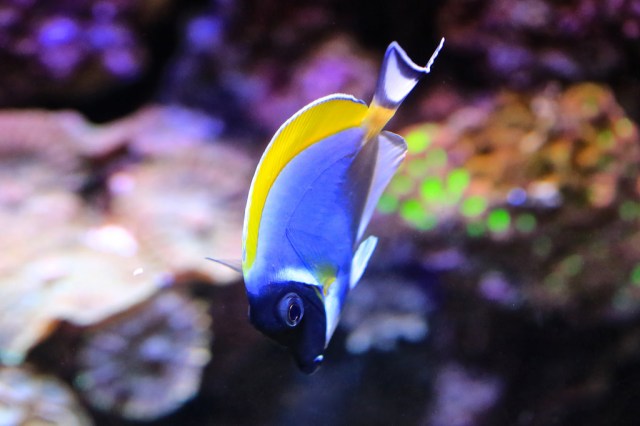
Category: TROPICAL MARINE


TAXONOMY
Kingdom: Animalia
Phylum: Echinodermata
Class: Echinoidea (Sea urchins)
Subclass: Cidaroidea
Order: Cidaroida
Family: Cidaridae

Genus/species: Eucidaris tribuloides

GENERAL CHARACTERISTICS: Brown body with thick spines in all directions. 

Slate Pencil UrchinIMG_1479

DISTRIBUTION/HABITAT: North Carolina through Brazil, Caribbean, Bahamas, Florida. Found in coral reef crevices, in turtle grass beds, or under rocks and rubble in back reef lagoon areas. Depth to 800 m (usually 50 m). 
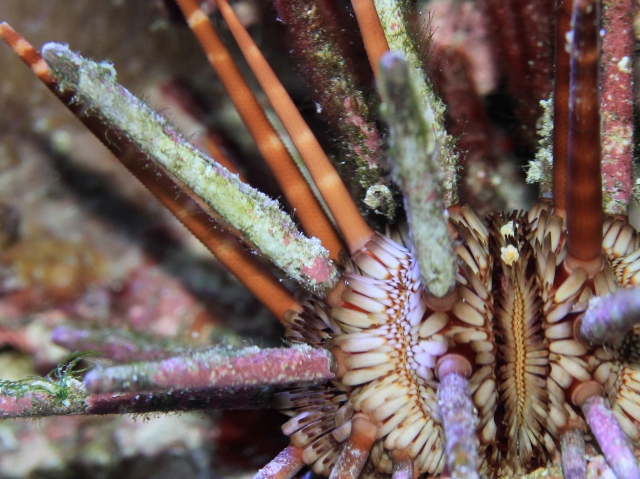


Slate Pencil UrchinIMG_1478

DIET IN THE WILD: Nocturnal omnivore: algae and small invertebrates such as sea squirts and sponges.

Slate Pencil UrchinIMG_0664

REMARKS: The spines of pencil urchins, unlike other urchin groups, are not covered with epidermis. They are, however, often covered with algae and epizoans that provide excellent camouflage. Spines are also covered with barbs that can inflict serious pain to a predator. Seek shelter in rocky crevices by day, using the thick spines to maintain a protected position.

References

Encyclopedia of life eol.org/pages/600976/details

Smithsonian Tropical Research Institute 

biogeodb.stri.si.edu/bocas_database/search/species/1130

Animal Diversity Web animaldiversity.ummz.umich.edu/accounts/Eucidaris_tribulo…

Ron’s flickr https://www.flickr.com/photos/cas_docents/4330820247/in/set-72157608501343477

Ron’s WordPress shortlink  http://wp.me/p1DZ4b-1nk

Caribbean  PR36
TAXONOMY
Kingdom: Animalia
Phylum: Echinodermata
Class: Echinoidea
Order: Diadematoida
Family: Diadematidae

Genus/species: Diadema setosum

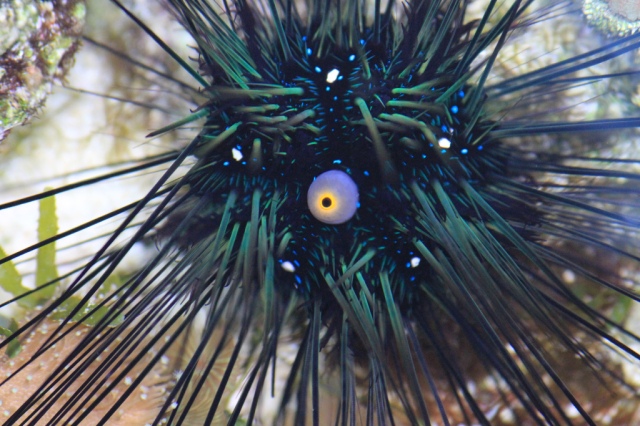
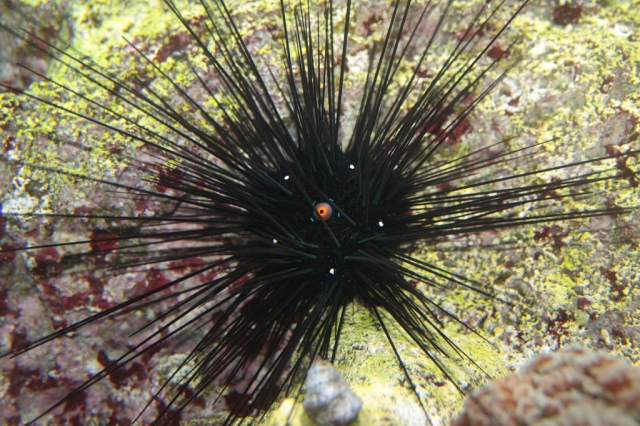
GENERAL CHARACTERISTICS:  Usually black but some or all of them can be grey or white. Very long, black spines are up to 30 cm (1.1 inches). Orange-red ring around anal cone at the center of its dorsal surface is distinctive. Weight 35 gm (1.25 oz) to 80 gm (2.8 oz).  Adult test to 9 cm (3.5 inches) diameter with a distinct pattern of iridophores, usually with 5 white dots.  Height to around 40 mm (1.5 inches) high. 

3708478244_83afedaa94_b

DISTRIBUTION/HABITAT: Red Sea, east Africa to western Pacific (Philippines) in low tide areas to 20 m (66 ft) on rubble and seagrasses. Often abundant in shallow water areas that have been recently disturbed. Also in lagoons and on coral and rocky reefs.

4333507132_3945bbf3a3_b

DIET IN THE WILD: Herbivore. Hides during the day, and emerges at night to feed on algae, plankton, and waste material. Its feeding habits help keep the reef free from coral-smothering algae; however, too many of these algal-eating machines can actually threaten a reef, scraping away living coral as they devour algae and leaving little food for other herbivores.

CONSERVATION: IUCN Red List ; not evaluated.

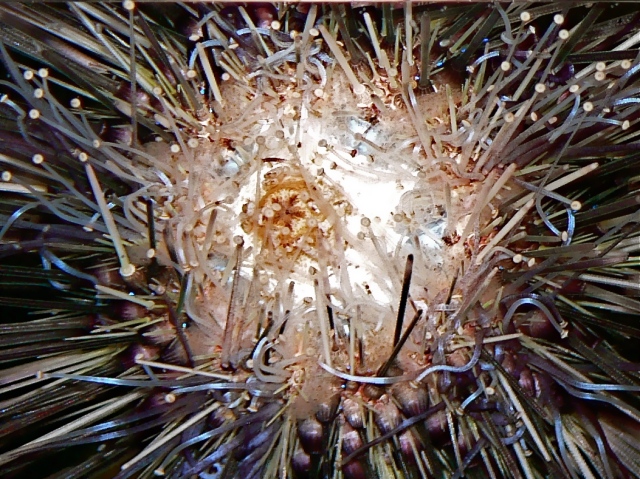
REMARKS: Uses hundreds of flexible, tube feet to move around, eat and breathe.

The venom is mild and causes swelling and pain, and gradually diffuses over several hours. Tiny hooked barbs often require surgical removal.

Commensal with a number of species, including various shrimps and fishes.

2985491545_3eef5bdec7_o

Sea-grass shallows PR03a

References

Encyclopedia of Life  eol.org/pages/2942801/details

Archive www.arkive.org/long-spined-sea-urchin/diadema-setosum/

WordPress Shortlink  http://wp.me/p1DZ4b-Qv

flickr http://www.flickr.com/photos/cas_docents/sets/72157608501343477/with/4333507132/

TAXONOMY
Kingdom: Animalia – animals
Phylum: Echinodermata Klein – echinoderms
Subphylum: Eleutherozoa
Superclass: Cryptosyringida
Class: Ophiuroidea – basket stars, brittlestars, snake stars
Order: Ophiurida – basket stars, serpent stars, basket stars, serpent stars
Suborder: Iohiura incrassata
Family Ophiodermatidae

Genus/species: Ophiarachna incrassata

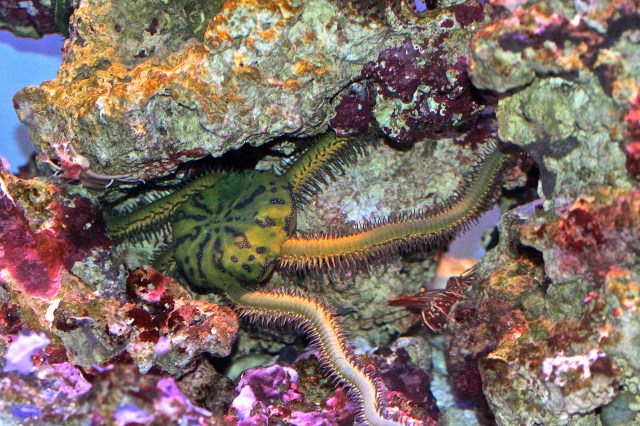
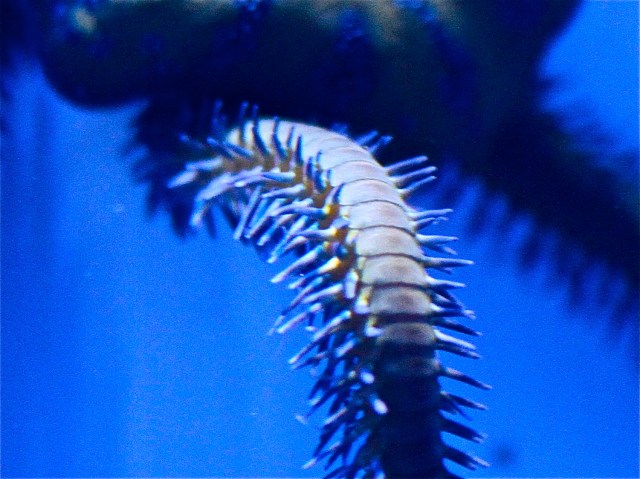
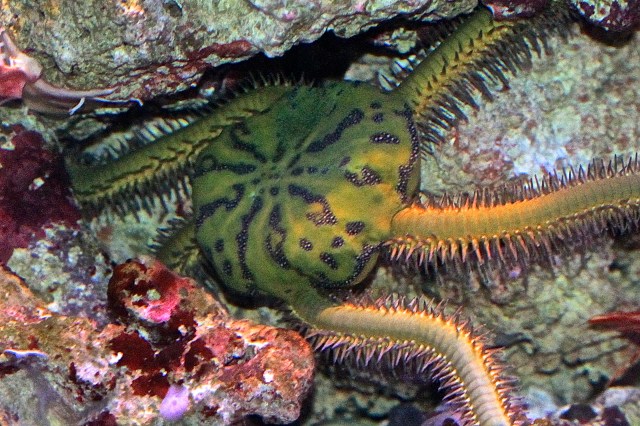
GENERAL CHARACTERISTICS: Green with yellow markings and dark-ringed white spots. Disc diameter to 5 cm (2 inches) and arm length to 20 cm (8 inches). Top of arms are wide and flat.

Stout Green Brittle Star8412648309_4004cdfca2_k

DIET IN THE WILD: Nocturnal feeder of  small organisms and detritus.

Stout Green Brittle Star4472769084_f4acdf93f2_o

DIET IN THE WILD: Small organisms and detritus. Nocturnal feeder.

Stout Green Brittle Star8282559749_1cb63a02d1_oReferences

Ron’s flickr  https://www.flickr.com/photos/cas_docents/8412648309/in/set-72157608501343477/

Encyclopedia of life  eol.org/pages/598310/details

Reef Creature Identification, Humann and Deloach 2010, page443

ADW animaldiversity.ummz.umich.edu/accounts/Ophiarachna_incra…

Ron’s WordPress shortlink  http://wp.me/p1DZ4b-1mb


TAXONOMY
Kingdom: Animalia (animals)
Phylum: Chordata (chordates)
Class: Actinopterygii (ray-finned fishes)
Order: Beryciformes (Sawbellies)
Family: Monocentridae (Pinecone fishes)

Genus/species: Monocentris japonica


GENERAL CHARACTERISTICS: Body except for caudal peduncle armored with huge, immovable scales. Body yellow, scales outlined in black; lower jaw black. Length to 17 cm (6.7 inches).

 PineconeFish14809348647_ca6e4f130d_k

DISTRIBUTION/HABITAT: Indo-Pacific. Tropical marine found in schools in clear water above rocky bottom near reefs. Depth range 10 – 200 m (33-660 feet).

PineconeFish14996127685_785385956b_k


DIET IN THE WILD: Feeds at night on small invertebrates and zooplankton

 CONSERVATION: IUCN 2006 red list of threatened species

 REMARKS: By moving its jaw M. japonica  exposes a bioluminescence producing organ with pure culture of luminous bacteria which emit light.

 Location: Dark Cluster

 References

 eol eol.org/pages/214300/details

 fishbase www.fishbase.org/summary/Monocentris-japonica.html

 Ron’s flickr www.flickr.com/photos/cas_docents/14809348647/

Ron’s WordPress shortlink  http://wp.me/p1DZ4b-1kC

TAXONOMY
Kingdom: Animalia
Phylum: Chordata
Class: Actinopterygii (ray-finned fishes),
Order: Perciformes (Perch-likes)
Family: Apogonidae (Cardinalfishes)

 Ostorhinchus sealei  (Apogon sealei) 


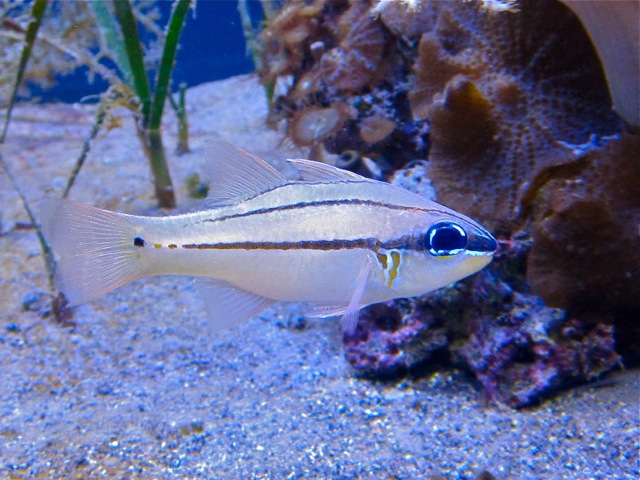
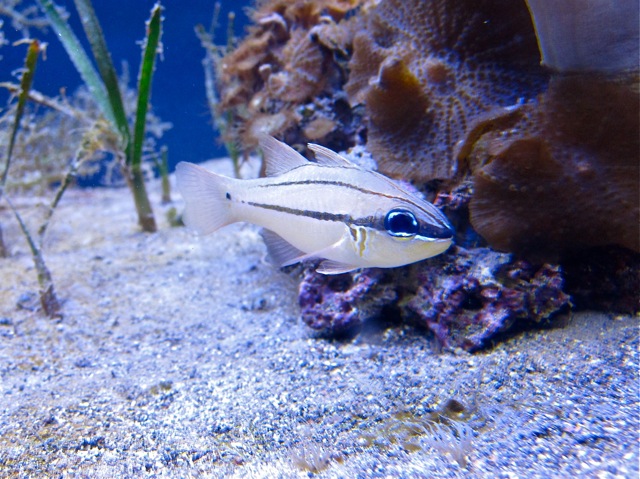
GENERAL CHARACTERISTICS:  Length 80mm, (3.15 inches). Pale yellow with a  pair of thin brown stripes on the upper side and a dark spot on mid tail base. Two short orange bars in bluish white patch on gill cover.

DISTRIBUTION/HABITAT: Malaysia to the Solomon Islands, north to the Philippines, Palau, and south to Ashmore Reef, Australia. Usually found on coastal fringing reefs or patch reefs to a depth of 25 m (80 feet). It is often found in pairs or in groups among branching corals such as Acropora. 

DIET IN THE WILD: Individuals shelter in amongst the coral during the day and come out to feed at night on zooplankton and benthic invertebrates.

REPRODUCTION and DEVELOPMENT: This species demonstrates distinct pairing during courtship. The males mouthbrood the fertilized eggs until hatching is ready to occur.

LOCATION:  Philippine Coral Reef

References

fishbase http://www.fishbase.org/summary/6230

WORDPRESS SHORTLINK  http://wp.me/p1DZ4b-ki

flickr  https://www.flickr.com/photos/cas_docents/6615915253/in/set-72157625992053826

eol  neol.org/pages/212483/details

Cardinalfish general information.  

Found in the Atlantic and Indo-Pacific oceans, cardinalfishes are primarily marine, though some are found in brackish waters and a few in freshwater streams. Many species inhabit reef flats, lagoons, and seaward reefs to 60 feet (18 m).
The family is characterized by two widely separated dorsal fins, large eyes, short snouts, double-edged preopercula and a moderately large oblique mouth. The name derives from the red coloration of some well-known species, though many are drab or striped.
Most remain hidden during the day, and then disperse over the reef at night to feed on zooplankton and small benthic invertebrates, always remaining close to the substrate. Males of many species are mouth brooders.

TAXONOMY
Kingdom: Animalia
Phylum: Chordata
Class: Actinopterygii (ray-finned fishes)
Order: Perciformes (Perch-likes)
Family: Labridae (Wrasses)

Genus/species: Labroides dimidiatu

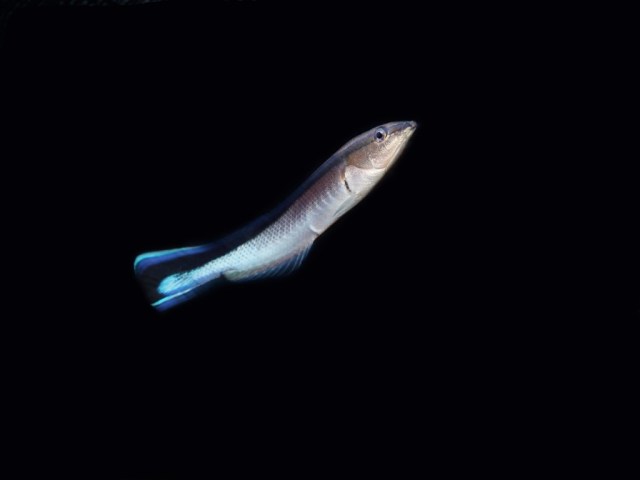
GENERAL CHARACTERISTICS: Length to 11.5 cm (4.5 inches). Elongate body, tubular mouth. Blue to yellow above fading to white or yellow below. There is a black stripe from the eye to the caudal fin margin. The stripe widens posteriorly.

DISTRIBUTION/HABITAT: Indo-Pacific in virtually all coral reef habitats: inner lagoons and subtidal reef flats to seaward reefs, 0.5-40 m (18 in to 125 ft), typically near branching corals. Active diurnally. Aggressively territorial. Nocturnally retires to small crevices in the reef, enclosing itself in a mucus cocoon. Remains in stations where other fish come to be cleaned.

DIET: The most common cleaner wrasse on reefs. Pick external parasites from other fishes. Also clean the wounds of other fishes by removing scar tissue. Clean the gills and even enter the mouth of the host.

REPRODUCTION: Monogamous. A protogynous hermaphrodite.
Open water/substratum egg scatterers, non guarders.

CONSERVATION: IUCN, Least concern

Cleaner Wrasse13298334135_9737aa3d26_b

Philippine Coral Reef PR04

flickr http://www.flickr.com/photos/cas_docents/sets/72157608208133134/with/2977676226/

WordPress Shortlink http://wp.me/p1DZ4b-Kp

fishbase fishbase.sinica.edu.tw/summary/SpeciesSummary.php?ID=5459

EOL eol.org/pages/204814/details

Australia Museum  australianmuseum.net.au/Common-Cleanerfish-Labroides-dimi…

TAXONOMY
Kingdom: Animalia
Phylum: Chordata
Class: Actinopterygii (ray-finned fishes)
Order: Perciformes (Perch-likes)
Family: Labridae (Wrasses)

Genus/species: Thalassoma hardwicke

Sixbar Wrasse8410603333_678203e399_b

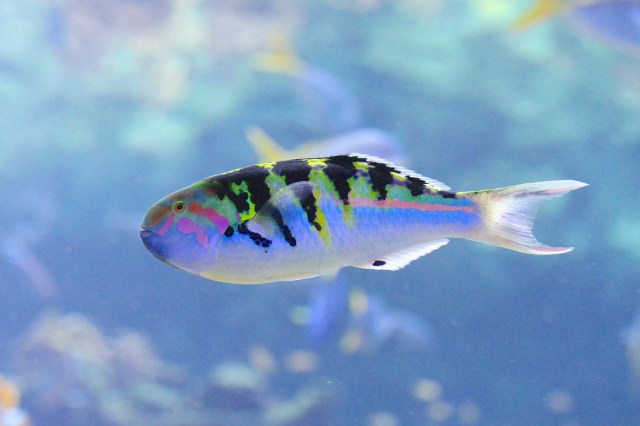
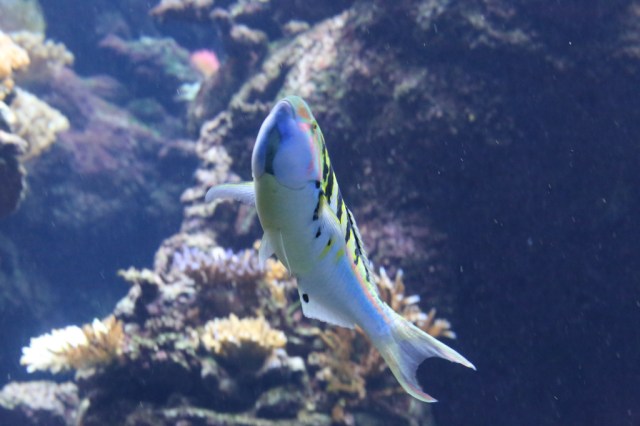
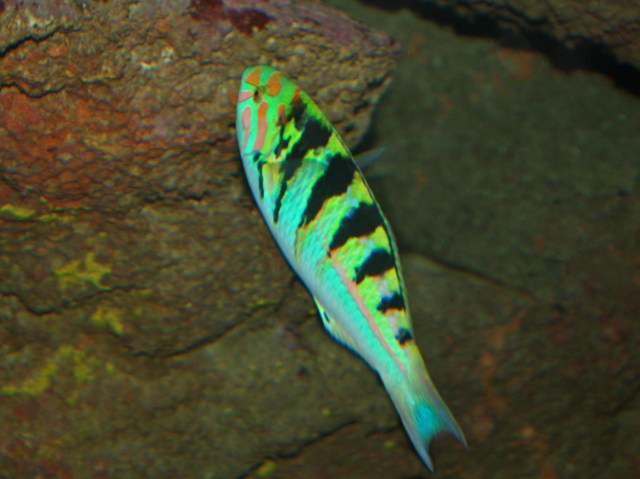
GENERAL CHARACTERISTICS: Adult is pastel blue to pale green with six dark, vertical bars on their body, the last two saddling the tail. The head has a distinct ‘daisy’ print around the eyes made of a few different pastel colors (e.g., pink bands radiating from the eye) in larger adults.  Max length: 20 cm (7.9 in).

DISTRIBUTION/HABITAT: Found in the tropical Indo-Pacific in shallow lagoons and seaward reefs. Depth to 15 m (50 ft.).

DIET IN THE WILD: Carnivore on benthic and planktonic crustaceans, invertebrates and small fishes.

Sixbar Wrasse8393609669_e1f3601c7c_b

REPRODUCTION: Protogynous hermaphrodite; Hermaphroditism occurs when a given individual in a species possesses both male and female reproductive organs, or can alternate between possessing first one, and then the other. The most common pattern is for a female to change into a male (protogyny). This often happens when a large dominant male is removed by a predator. Within a few days, the largest female in the harem becomes a dominant male and takes over the missing male’s function. This pattern is common in coral reef fishes, such as parrotfishes, wrasses, and groupers.
T.hardwicke is a pelagic spawner meaning water currents widely disperse the young. The eggs, embryos and larvae of pelagic spawners contain oil globules or have a high water content. As a result, they are buoyant and are widely dispersed by currents. The downside is that mortality is high, because they can be eaten so easily by pelagic predators. Pelagic spawners who live in or around coral reefs can spawn a small number of eggs almost daily over a period of months.

CONSERVATION: IUCN; least concern

REMARKS. Occur in small, loose groups.

References

flickr http://www.flickr.com/photos/cas_docents/4390962019/in/set-72157608208133134/

WordPress shortlink wp.me/p1DZ4b-nD

fishbase www.fishbase.org/summary/Thalassoma-hardwicke.html

EOL eol.org/pages/220102/details

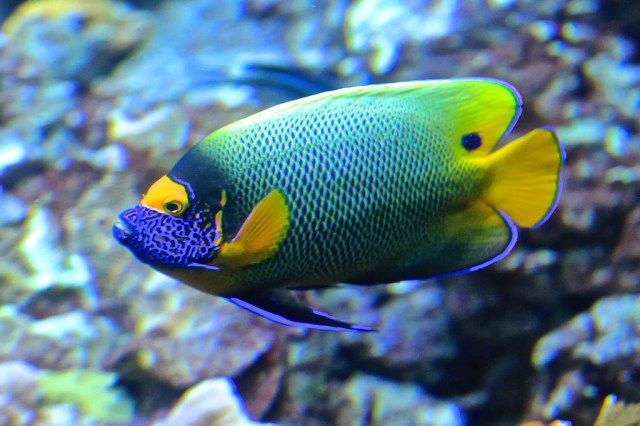
Kingdom: Animalia
Phylum: Chordata
Class: Actinopterygii (ray-finned fishes)
Order: Perciformes (Perch-likes)
Family: Pomacanthidae (Angelfishes)

Genus/species:  Pomacanthus xanthometopon

Yellow Mask Angelfish13298710574_515d270046_b

GENERAL CHARACTERISTICS: The head is blue with a yellow eye mask. Scales are blue with a yellow margin creating a network pattern. The yellow dorsal fin has a spot black large posteriorly and the caudal fin is also yellow. Body depth 1.7-1.9 in. Length 6-9 inches.

DISTRIBUTION/HABITAT: Indo-Asian Pacific. Found in lagoons and coral reefs 5-30 meters (16-100 feet).

Yellow Mask Angelfish13298332785_879178297f_b

DIET IN THE WILD: Encrusting organisms such as sponges and tunicates.

CONSERVATION: IUCN Least concern

On exhibit at the Long Beach Aquarium 2016

References

California Academy of Sciences Steinhart Aquarium Philippine coral reef 2016

WordPress shortlink  http://wp.me/p1DZ4b-1et

fishbase www.fishbase.org/summary/Pomacanthus-xanthometopon.html

EOL eol.org/pages/994431/overview

Australian museum australianmuseum.net.au/Blueface-Angelfish-Pomacanthus-xa…

TAXONOMY
Kingdom:Animalia
Phylum: Chordata
Class: Actinopterygii (ray-finned fishes)
Order: Perciformes (Perch-likes) 
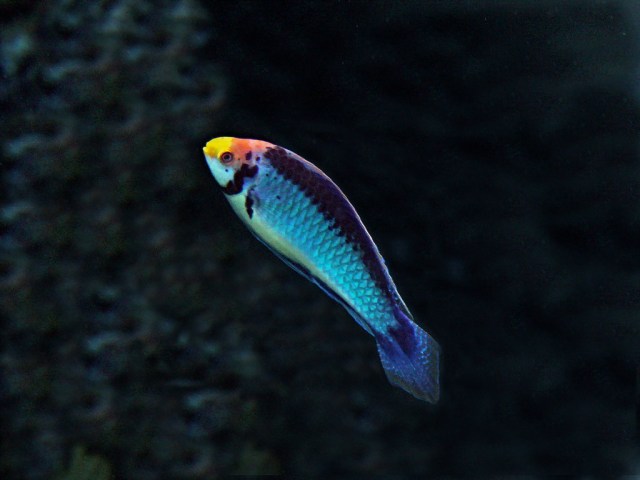
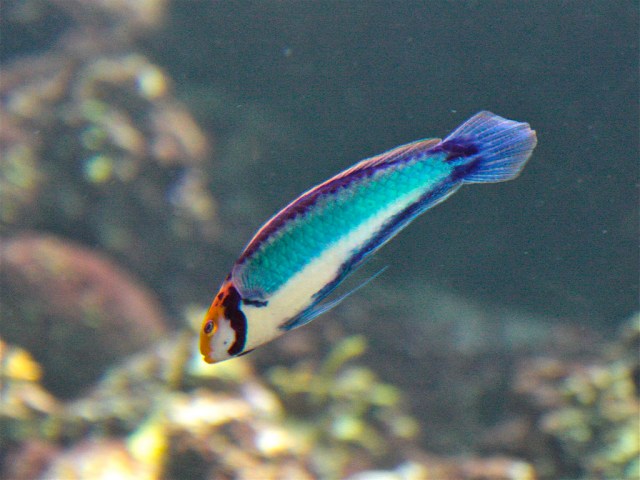
Family: Labridae (Wrasses)

Genus/species: Cirrhilabrus solorensis

Cirrhilabrus solorensis3380013623_6c8c3e586c_b

GENERAL CHARACTERISTICS: Highly variable. The eye is bright red. Males usually have a dark band along the end of the gill covering. Change color and sex with growth. Females are able to change sex into an often brilliantly colored terminal male phase. Max. size: 11 cm (4.3 inches).

DISTRIBUTION/HABITAT: Found in the Western Central Pacific and Indonesia. in coastal to outer reef lagoons on rubble and coral habitats.

DIET IN THE WILD: Zooplankton.

Cirrhilabrus solorensis3813060378_a4f75890b9_b

REMARKS: The cornea of the eye of fairy wrasses is divided into two segments, essentially forming a double pupil. It is thought that the center pupil is a close-up lens that lets the fish have a magnified view of their small prey.

Philippine Coral Reef PR04

References:

flickr http://www.flickr.com/photos/cas_docents/3380013623/in/set-72157608208133134/

WordPress shortlink http://wp.me/p1DZ4b-1ef

fishbase www.fishbase.org/Summary/SpeciesSummary.php?id=60815

EOL eol.org/pages/210468/details

TAXONOMY
Kingdom: Animalia
Phylum: Chordata
Superclass: Osteichthyes
Class: Actinopterygii (ray-finned fishes)
Order: Perciformes (Perch-likes)
Family: Acanthuridae (Surgeonfishes, Tangs, and Unicornfishes)

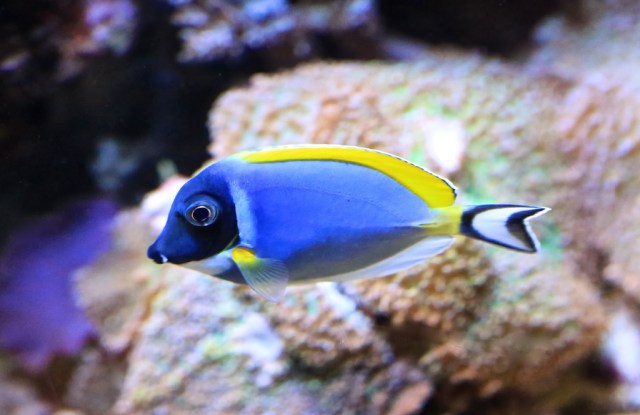
Genus/species; Acanthurus leucosternon

Acanthurus leucosternon 13140534045_d29f009b4f_b

GENERAL CHARACTERISTICS: Blue with a white chest. Head black with a broad white band from pectoral-fin base to throat.Also has a white band at base of lips. Dorsal fin yellow (except white margin and black submarginal line). Anal and pelvic fins white. Common length 19 cm (7.5 inches).

DISTRIBUTION/HABITAT: Indian Ocean in shallow, clear coastal and island reefs, 0.5-25 m (1.5-80 feet) . Usually on reef flats and along upper seaward slopes; sometimes in huge aggregations.

DIET IN THE WILD: benthic algae.

REPRODUCTION: Monogamous, open water/substratum egg scatterers

CONSERVATION: IUCN Least concern.

Acanthurus leucosternon13140818894_48010cf40c_b

Animal attractions Rich Ross

3-14-14

References

flickr www.flickr.com/photos/cas_docents/2978892415/in/set-72157…

WordPress shortlink  http://wp.me/p1DZ4b-1dQ

fishbase fishbase.org/summary/1257

EOL eol.org/pages/206882/details