Category: TROPICAL MARINE


https://www.flickr.com/photos/cas_docents/6427211687/in/album-72157652559028013/

TAXONOMY
Kingdom: Animalia
Phylum: Chordata
Class: Actinopterygii (Ray-finned fishes)
Order: Tetraodontiformes (Puffers and filefishes)
Family: Tetraodontidae (Puffers)

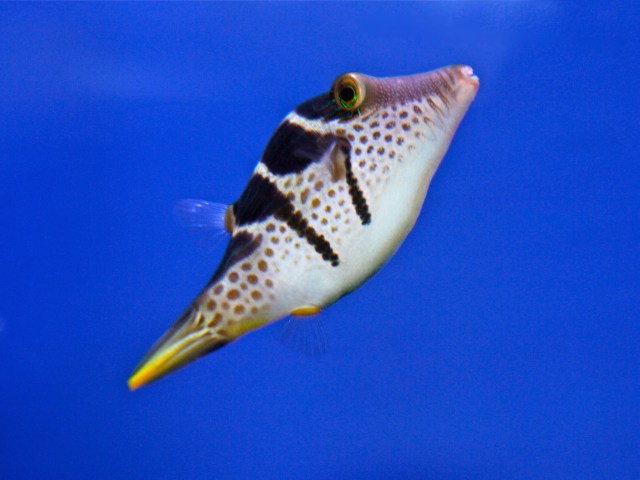
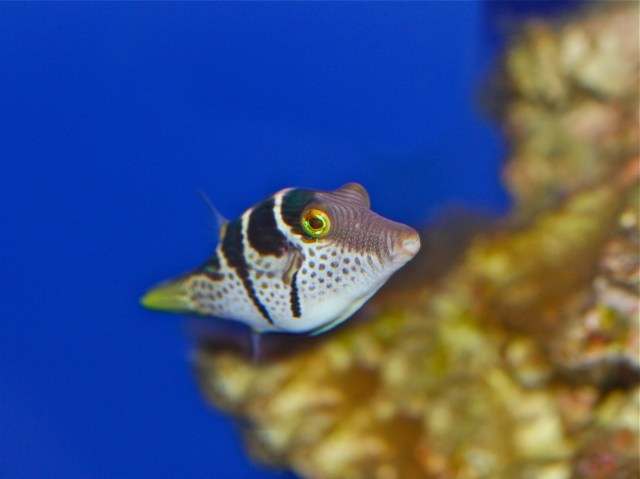
Genus/species: Canthigaster valentini

GENERAL CHARACTERISTICS: C. valentini has a white body with four distinct black stripes on the upper half. The body is also covered with brownish-orange dots. It has yellow fins, and blue striping running along the back. It lacks pelvic fins, but has learned to use the pectoral fins to move about the aquarium.
Males have blue-green lines radiating from the back of the eyes. They are also larger than females and may also have a light gray patch in front of the anus.

DISTRIBUTION/HABITAT: Occurs throughout the tropical, marine Indo-Pacific where it is common and locally abundant. It inhabits a wide range of coral reef and seagrass habitats at depths ranging from 1 to 55 metres.

DIET IN THE WILD: Forages on the benthos, feeding mainly on filamentous green and red algae, tunicates, and on smaller amounts of corals, bryozoans, polychaetes, echinoderms, mollusks.

CONSERVATION: IUCN Red List Least Concern (LC)

REMARKS: They are capable of inflating their abdomens with water when frightened or disturbed.
They can produce toxins such as tetrodotoxin and saxitoxin in the skin, gonads, and liver. Try not to use a net when handling this fish since it’s flesh is poisonous.The degree of toxicity varies by species, and also according to geographic area and season.

Color of Life:Color Communicates. The Mimic filefish (not shown here) evades predators by mimicking the Sharpnose Puffer (Canthigaster valentini).

The Mimic filefish can be distinguished from the Sharpnose Puffer (highly poisonous) by comparing their dorsal fins. The Mimic filefish has two dorsal fins, while the Sharpnose Puffer above has only one. – See more at: australianmuseum.net.au/blacksaddle-filefish-paraluteres-…

LOCATION:  COLOR CLUSTER   


References

California Academy of Sciences Color on the Reef exhibit 2015

Ron’s flickr https://www.flickr.com/photos/cas_docents/6427211687/in/album-72157652559028013/

Ron’s WordPress shortlink:  http://wp.me/p1DZ4b-iz

Australian Museum  australianmuseum.net.au/blacksaddle-toby-canthigaster-val…

Encyclopedia of life  eol.org/pages/225023/overview


TAXONOMY
Kingdom: Animalia

Phylum: Chordata
Class: Actinopterygii (ray-finned fishes)
Order: Perciformes (Perch-likes)
Family: Acanthuridae (Surgeonfishes, tangs, unicornfishes)

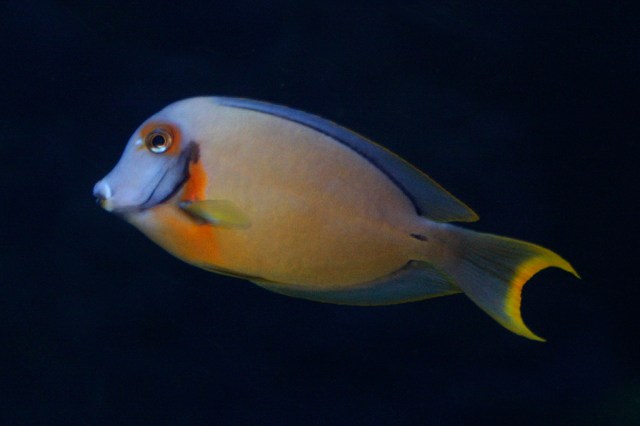
Genus/species: Acanthurus pyroferus

Acanthurus pyroferus3161779234_fc0fccc624_b

GENERAL CHARACTERISTICS: Adults have a
purplish-black to brown body; curving black band from chin to upper edge of the operculum; orange patch above base of pectoral fin.
Length to 25 cm. (10 in).
Front of juvenile’s body (“face”) is gray; body is white anteriorly and dark posteriorly. Dark-colored caudal fin rounded in juveniles.

DISTRIBUTION/HABITAT: Indonesia, Philippines, Micronesia to Polynesia, Japan to New Caledonia and the Great Barrier Reef.  Found in lagoon and seaward reefs from 12–200 ft.

DIET IN THE WILD: Algae.

REPRODUCTION: Following external fertilization female scatters eggs over open water substrate: eggs not guarded.

CONSERVATION: IUCN Least Concern

COLOR OF LIFE NOTE: Anti-predator Adaptations, Mimicry.

The common name “mimic” is based on the juvenile coloration; juveniles exhibit three different color patterns mimicking angelfish in the Centropyge genus. Coloration of juveniles mimics these angelfishes until they achieve the largest size attained by the angelfishes; then their appearance transforms to the appropriate adult coloration for A. pyroferus.
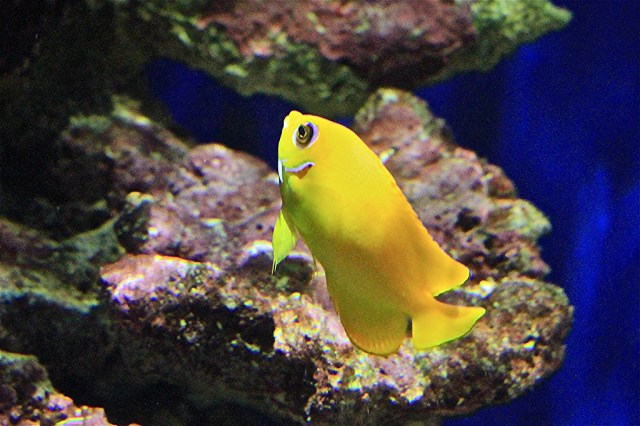
Juveniles mimic Centropyge spp. (in Guam, juveniles mimic C. flavissimus see below).

Centropyge flavissima6764335749_c4befc1269_b

Philippine Coral Reef 

REFERENCES

California Academy of Sciences Color of Life exhibit 2015

fishbase www.fishbase.se/summary/4742

Ron’s flickr  https://www.flickr.com/photos/cas_docents/2989062467/in/set-72157608332652056/

Ron’s WordPress shortlink  http://wp.me/p1DZ4b-1fA

EOL  http://eol.org/pages/211470/details


TAXONOMY
Kingdom: Animalia
Phylum: Chordata
Class: Actinopterygii (ray-finned fishes)
Order: Anguilliformes (Eels and morays)
Family: Congridae (Conger and garden eels)
Subfamily: Heterocongrinae

Genus/species: Gorgasia preclara

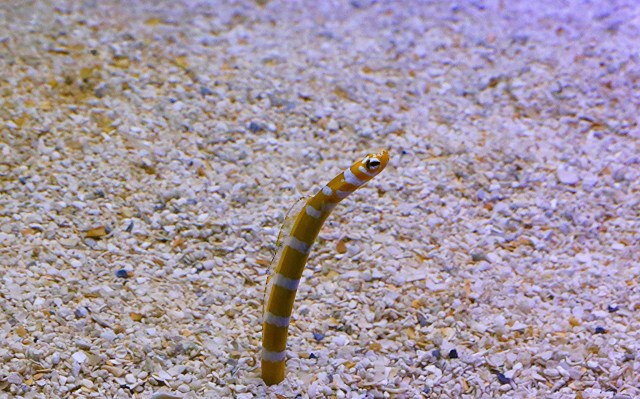
GENERAL CHARACTERISTICS: Its yellow to orange with characteristic white bands body has a circular shape with a diameter of about 10 mm (0.4 in). Length up to 40 cm (15.75 in) maximum.
Typically, only its head and upper body protrudes from the sand where the garden eel lives in a buried tube in the sand either alone or in small groups.

Garden Eel20776620435_68e152af6d_k

DISTRIBUTION/HABITAT: Found in the Indo-West Pacific in sandy areas exposed to currents at depths between 18 and 75 m (60-245 ft), but is usually observed at an average depth of 30 m (100 ft).

DIET IN THE WILD: Plankton

CONSERVATION: Not Evaluated

References

fishbase  fishbase.org/summary/Gorgasia-preclara.html

California Academy of Sciences Water is life Exhibit 8-20-15

Ron’s flickr  https://www.flickr.com/photos/cas_docents/20776620435/in/dateposted/

WordPress shortlink http://wp.me/p1DZ4b-1zP

TAXONOMY
Kingdom: Animalia
Phylum: Chordata
Class: Actinopterygii (ray-finned fishes)
Order: Perciformes (Perch-likes)
Family: Serranidae (Sea basses: groupers and fairy basslets)

Genus/species: Hypoplectrus gummigutta

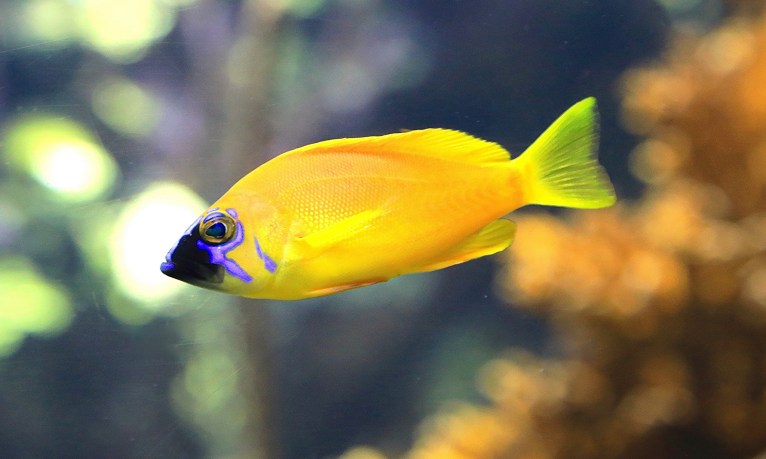
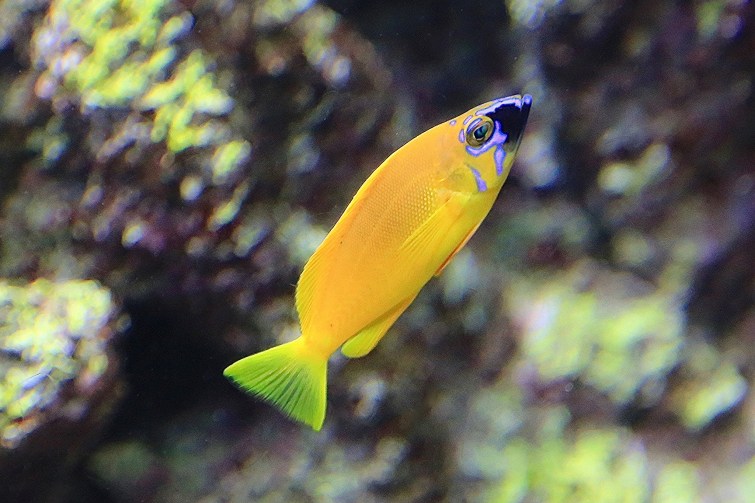
GENERAL CHARACTERISTICS: Body rich chrome-yellow in color. The snout is black bordered by an iridescent blue. Pectoral fins pigmented. Hamlet “species” are defined primarily on differences in color patterns. They are known to interbreed and hybridize freely with very little consistent genetic differentiation amongst them.

Golden Hamlet19442208331_9807a11d99_k

DISTRIBUTION/HABITAT: H. gummigutta is rare and found in the Western Central Atlantic. It is coral reef associated.

CONSERVATION: IUCN: Least Concern (LC)

No known major threat but juveniles are potentially a prey item of the invasive Lionfish.


Golden hamlet18815471474_4ab1413005_k

REPRODUCTION: The Golden Hamlet is a simultaneous hermaphrodite (possesses both male and female sex organs).  Successful spawning requires two individual fish.

Color of Life note: Brightly colored fish seem to jump into your sight. But underwater, these bright colors mingle with those of other fish, reef creatures, and the coral itself, to offer a mixtures of color and patterns in which no one individual stands out. Movement of the anemones and corals in the current also serve to obscure and protect the fish.
Ref: California Academy Academy of Sciences, Color of Life Exhibit 2015

References

Ron’s flickr  https://www.flickr.com/photos/cas_docents/19442208331/in/album-72157652559028013/

Ron’s WordPress shortlink  http://wp.me/p1DZ4b-1yL

Reef builders.com (an excellent description of the Caribbean reef exhibit at the California Academy of Sciences). http://reefbuilders.com/2015/03/24/steinhart-aquariums-caribbean-display-realistic-biotope-representation/#

fishbase  www.fishbase.org/summary/Hypoplectrus-gummigutta.html

IUCN Red List  www.iucnredlist.org/details/16751128/0

TAXONOMY
Kingdom:Animalia
Phylum: Chordata
Class: Actinopterygii (ray-finned fishes)
Order: Salmoniformes (Salmons)
Family: Salmonidae (Salmonids)
Subfamily: Salmoninae

 Genus/Species: Oncorhynchus tshawytscha

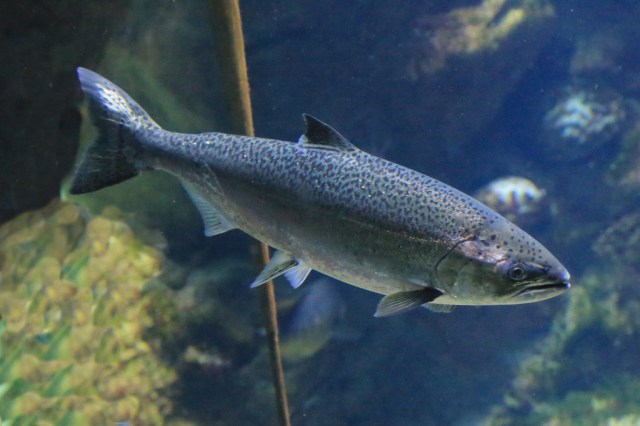
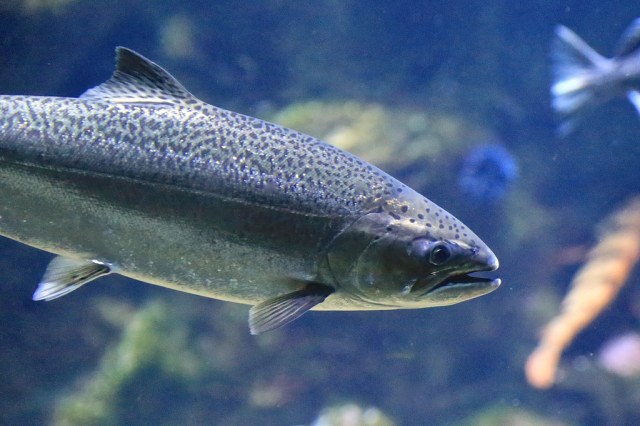
Chinook Salmon aka King Salmon14630212572_bab25a96d9_b

 GENERAL CHARACTERISTICS: Largest species in the Pacific salmon (Oncorhynchus) genus. Max length :150 cm.(59 inches). Max wt. 64 kg (140 pounds). They average 10 to 50 pounds (4.5 to 22.7 kg.
Small black spots on the back and on the upper and lower lobes of the caudal fin, and the black gums of the lower jaw. In the sea are dark greenish to blue-black on top of head and back, silvery to white on the lower sides and belly; numerous small, dark spots along back and upper sides and on both lobes of caudal; gum line of lower jaw black.
In fresh water, with the approach of the breeding condition, the fish change to olive-brown, red or purplish,

Chinook Salmon 14444106928_8b07130949_b

DISTRIBUTION/HABITAT:, Native areas include Alaska, Canada, northwestern USA, Russia, and Japan. Introduced in New Zealand, Chile, Argentina, and the Great Lakes along the USA-Canada border. Found in marine, freshwater; brackish; benthopelagic. (swim just above the seabed at depths below about 200 m, 650 feet (the edge of the continental shelf). Benthopelagic river fish are found near the bottom of the water column, feeding on benthos and zooplankton

DIET IN THE WILD: Young may feed on insects and crustaceans. Adults feed primarily on other fishes.

 REPRODUCTION: Onset of fertility 4.0 years. At breeding time, the head of the male is transformed into a ‘kype’, with a deformed, upturned jaw and a hooked nose. Anadromous (migrate from the sea into fresh water to spawn; or, ones that stay entirely in fresh water and migrate upstream to spawn). May also spawn in lakes.
Max age 9yrs.

 PREDATORS: Young are preyed upon by fishes and birds (such as mergansers and kingfishers); adults are prey of large mammals and large birds.

 CONSERVATION: IUCN not evaluated

 REMARKS: The Alaska Salmon fishery of this species has been certified by the Marine Stewardship Council as well-managed and sustainable.

Color of Life note: The salmon’s  rich marine diet gives them their iconic pink hue. Farmed salmon raised on manufactured, aquaculture feed (pellets) tend to have a gray tone. The color pattern of salmon demonstrates countershading, where the dark back and light belly allows the fish to blend into the darker water when seen from above and into the lighter sky when seen from below.

Reference: Shepherd, B. 2015. Color of Life Public Engagement and Education presentation. California Academy of Sciences. March 26, 2015.

 California Coastal Marine

 References

Margarita Upton, Biologist II
Steinhart Aquarium, California Academy of Sciences

Ron’s flickr pro  https://www.flickr.com/photos/cas_docents/14630212572/in/album-72157652559028013/

 ADW  animaldiversity.ummz.umich.edu/accounts/Oncorhynchus_tsha…

 eol  eol.org/pages/205252/hierarchy_entries/44694307/details

 fishbase  www.fishbase.org/summary/244

WordPress Shortlink   http://wp.me/p1DZ4b-1in


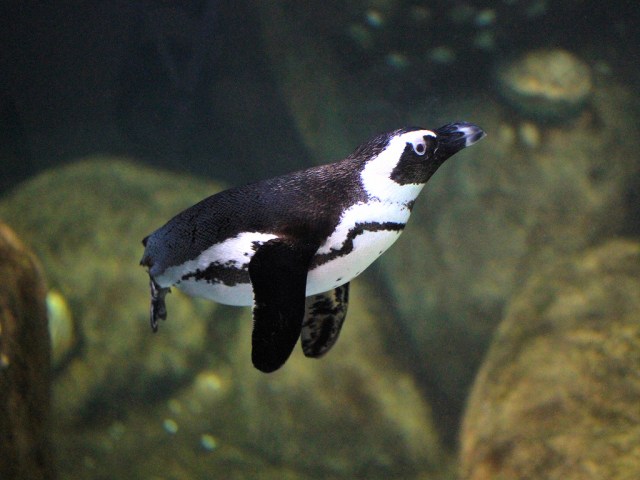
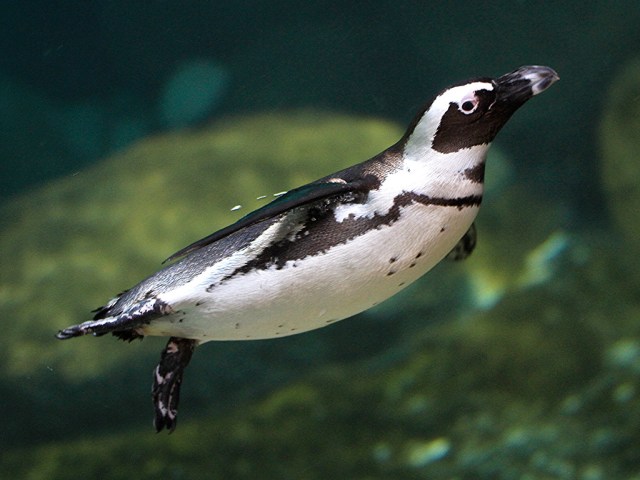
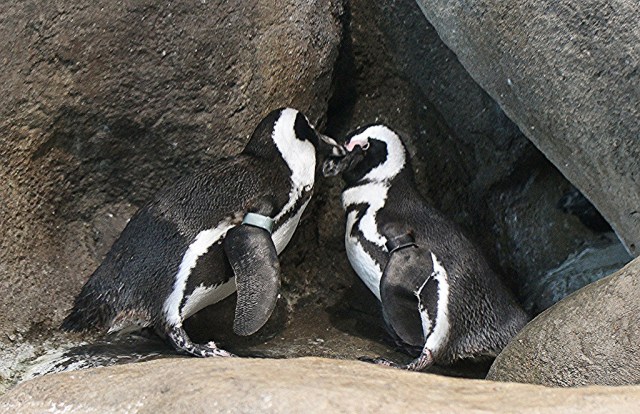
Color of Life note: The blackish-grey top surface of the African Penguin camouflages it from predators above it and the mostly white underside does the same for predators below it.

TAXONOMY
Kingdom:Animalia
Phylum: Chordata
Subphylum: Vertebrata
Class: Aves (birds)
Order: Sphenisciformes (Penguins )
Family: Spheniscidae

Genus/species: Spheniscus demersus

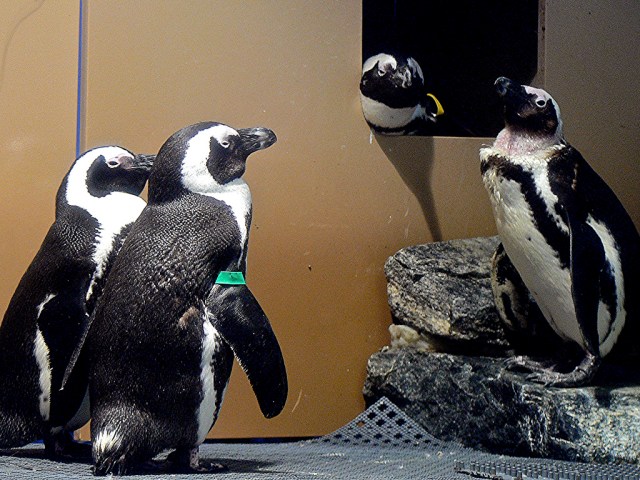
GENERAL CHARACTERISTICS: Like most birds with shared parental duties, sexes are similar in appearance. Adults: upper parts blackish-grey, underparts mostly white with inverted black horseshoe extending down flank to thigh. Feet and legs black. Chicks arrive with secondary down feathers. Juveniles are grey blue and immatures gradually come to resemble adults in approx. 3 years..
Length up to To 70 cm (28 inches) tall.
Weight up to 3.5 kg (7.7 lb)

4546692496_18964c0e05_b

DISTRIBUTION/HABITAT: Found off the Coasts of South Africa and
Namibia. Nests in colonies mainly on offshore islands. Rarely encountered more than 8 km from islands or mainland.4545404530_496c8cf6b1_b

DIET IN THE WILD: Piscivorous. They feed primarily on shoaling fishes such as anchovies, mackerel and herring. They can reach a top speed of close to 20 km/h (12 mph). On the west coast a typical foraging trip could range from 30 to 70 km (18-44 miles) for a single trip. On the south coast, foraging birds cover an average of 110 km (68 miles) per trip.

Academy diet: Vitamin fortified herring, and capelin.

5230397759_d463c01f85_b

REPRODUCTION: S. demersus are monogamous colonial nesters. They dig nesting burrows.and lays 2 eggs which are then incubated by both parents for about 40 days. The pair feeds their young for about one month by regurgitating food into the hatchling’s mouth.The average time to independence is 80 days.

LONGEVITY: May live to at least 25 years.

PREDATORS: Seals in the water and mongooses, large-spotted genets and leopards on land. Eggs and chicks are eaten by feral cats, Kelp gulls and Sacred Ibises.

CONSERVATION: IUCN Red List: Vulnerable (VU) 2010

Threats: Depleted fish stocks, human collection of penguin guano fertilizer, oil pollution and collection of eggs in the past have resulted in a 90 percent drop in the population since 1900.

REMARKS: The alternate common name “jackass” is a reference to its donkey-like vocalization.

California Academy of Sciences penguins
Wing bands identify males females and couples. Males right, females left and couples are the same color.

African penguins are finding a strong ally in the Species Survival Plan (SSP), a program sponsored by the California Academy of Sciences and 53 other zoos and scientific institutions in the U.S. and Canada. The captive population acts as a reservoir for genetic diversity, and could eventually be used to bolster wild penguin populations.
See the Academy web site below for more information and a 24 hour web cam.

4544769957_4534b0d012_b

Penguins constantly work to keep their feathers clean, well-oiled, and waterproofed. They preen their feathers by nipping at an oil glad at the base of their tail to express oil which transferred to their beaks and then to their body feathers.

References

Ron’s flickr  https://www.flickr.com/photos/cas_docents/4569783089/in/album-72157623916364716/

California Academy of Sciences  www.calacademy.org/explore-science/common-penguin-behaviors

California Academy of Sciences www.calacademy.org/explore-science/live-penguin-cams

BirdLife International www.birdlife.org/datazone/speciesfactsheet.php?id=3861

ARKive  www.arkive.org/african-penguin/spheniscus-demersus/

Animal Diversity Web  animaldiversity.org/accounts/Spheniscus_demersus/

IUCN Red List  www.iucnredlist.org/details/22697810/0

Ron’s WordPress shortlink  http://wp.me/p1DZ4b-1xH


TAXONOMY
Kingdom: Animalia
Phylum: Chordata
Class: Mammalia
Order: Cetartiodactyla
Family: Eschrichtiidae

Genus/species: Eschrichtius robustus

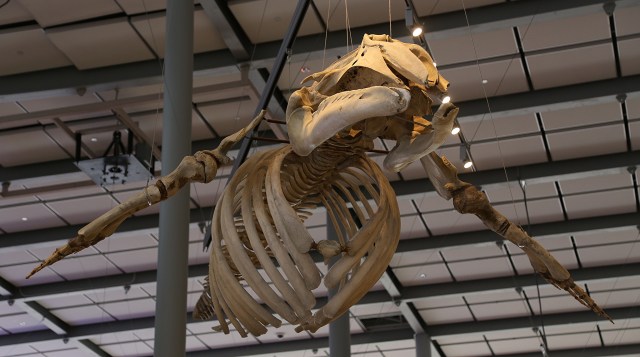
GENERAL CHARACTERISTICS: This species is mottled dark to light grey and is encrusted with patches of barnacles and orange whale lice. Unlike Humpback whales, Grey whales lack a dorsal fin and instead has a series of bumps along a dorsal ridge on the final third of the back. Gray whales have small, paddle-shaped flippers, compared to the large white flippers of Humpback whales.
Length to 14 m (46 ft).
Weigh to 36,000 kg (79,300 pounds).

(see links below for live animal photos under references).

Grey Whale18204939731_f69eecb43a_k

DISTRIBUTION/HABITAT: Now found only in the North Pacific and adjacent waters. E. robustus are primarily bottom feeders and are thus restricted to shallow continental shelf waters for feeding.

DIET: The only cetacean to feed by straining the sediment on the sea floor. mainly for bottom-dwelling crustaceans but also worms and mollusks. Water, sand and mud are expelled through the baleen and food is then swallowed.
Sufficient fat reserves are stored in the feeding grounds to allow individuals to go without food during the breeding season; on return to the feeding grounds about a third of the body weight may have been lost.

REPRODUCTION: The breeding cycle last two years. Gestation takes about 13 months and the single calf is then suckled for a further seven months. The mother may have to hold the calf near the surface to help it to breathe during the first few hours after birth.

E. robustus makes the longest migration of any mammal known, each autumn and spring they pass between their Arctic summer feeding grounds and the mating and calving lagoons in Baja California.
Round-trip up to 20,400 kilometres (12,676 miles).

LONGEVITY: 25 to 80 years.

PREDATION: The only non-human predator of Gray whales is the Killer whale with up to 18% of all Gray whales showing evidence of an Orca attack.

CONSERVATION: IUCN RED LIST Least Concern (LC)
The Eastern North Pacific population has made a significant recovery since 1947 when whaling stopped for this species and now they number between 19,000 – 23,000, which may be close to their original population size.
Three gray whale breeding lagoons in Mexico enjoy some protection in the form of limitations on boating, fishing and coastal development.

Threats: Collisions with ships, entanglement in fishing nets and pollution. Habitat degradation resulting from drilling and dredging is also a problem.

REMARKS: The California Academy’s Gray whale was a juvenile that beached in Baja California in 1966. It would have been about 35 feet long while alive. The two small, hanging, isolated bones towards the tail are remnants of pelvic bones, evidence that whales descended from four-legged land mammals that returned to the ocean about 53 million years ago.

References

California Academy of Sciences Docent program Whale  information March 2015

IUCN Red List www.iucnredlist.org/details/8097/0

ARKive  www.arkive.org/gray-whale/eschrichtius-robustus/

Ron’s flickr link www.flickr.com/photos/cas_docents/18204939731/in/album-72…

Shirihai, H & Jarrett (2006) Whales Dolphins and Other Marine Mammals of the World Princeton University Press.

Evans, P & Weinrich, M (2002) Whales Dolphins and Porpoises D K London New York Munich Melbourne and Delhi.

Reeves, R, R, et al (2002) Guide to Marine Mammals of the World  Chanticleer Press, Inc.

Ron’s WordPress Shortlink https://fishoncomputer.wordpress.com/wp-admin/post.php?post=5851&action=edit

TAXONOMY
Kingdom: Animalia
Phylum: Chordata
Class: Mammalia
Order: Cetacea
Family: Balaenopteridae

Genus/species: Balaenoptera musculus

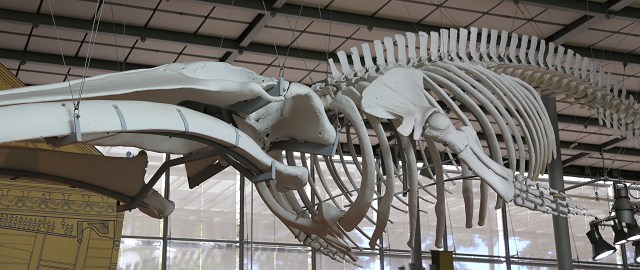
GENERAL CHARACTERISTICS: The Blue whale is the largest animal to have ever lived, (almost as big as a Boeing 737. They are actually grayish-blue, with a mottled effect that is visible in some lights and can allow individuals to be identified. 50 people could stand on the tongue, which alone weighs as much as an elephant. The heart of the blue whale is the size of a small car (Volkswagen Beetle).
Blubber can be up to 51 cm (20 inches) thick. The spout of a blue whale can be 9 m (30 ft) high.
Weigh to 203,210 kg or 200 tons (448,000 pounds), as much
as 40 elephants.
Length to nearly 110 feet (33 m (110 ft)
Blue Whale18204939131_ab0b4836d7_k

DISTRIBUTION/HABITAT: B. musculus inhabit the open ocean, where they ares found in every ocean except the Arctic, with a range that extends from the periphery of drift-ice in polar seas to the tropics, although it is absent from some seas such as the Mediterranean, Okhotsk and Bering Sea.

They inhabit the open ocean, where it is found most frequently along the continental shelf edge and near polar ice. It feeds at both the surface and to depths of at least 100 m (300 feet).

DIET: Feeds mainly on shrimp-like krill, which are filtered through the baleen plates. Large volumes of water and food can be taken into the mouth because the pleated grooves in the throat expand. As the mouth closes, water is expelled through the baleen plates, which trap the food on the inside to be swallowed. During the summer months, one blue whale can eat more than 4,082 kg (9,000 lbs) of krill every day (up to 40 million krill a day).

REPRODUCTION: Reaches sexual maturity at 7 to 10 years of age, A calf is produced after 10 to 11 months of gestation which is 7 m (23 ft) long and weighs about 27,215 kg (30 tons or 60,000 pounds) and consumes around 190 liters (50 gallons) of the mother’s fat rich-milk resulting in a daily weight gain of about 90 kg (200 pounds).
Weaning occurs at the summer feeding grounds at about seven months old.

B. musculus produces louder calls than any other animal on earth. It appears to have functions in sensing the environment, prey detection and communication with male display.

CONSERVATION: IUCN Red List Endangered (EN).
No Blue whales have been deliberately caught since 1978. Today, there are an estimated 10,000 to 25,000 Blue whales surviving worldwide, which represents around 2 to 11 percent of the total pre-commercial exploitation population.

California Blue whale numbers are rising, and are possibly close to carrying capacity, according to a new study in Marine Mammal Science. The B. musculus whale population is estimated at about 2,200, or 97 percent of the estimated historical level. t’s a conservation success story. (Approximately 3,400 California Blue whales were caught between 1905 and 1971.)

Primary threats
1. vessel strikes
2. fisheries interactions

Additional threats
1. anthropogenic noise
2. habitat degradation
3. pollution
4. vessel disturbance
5. long-term changes in climate

REMARKS: They can dive 150 m (500 ft) below the surface and remain underwater for 30 minutes.

The Blue whale produces louder calls than any other animal on earth. It appears to have functions in sensing the environment, prey detection and communication with male display.

The California Academy’s Blue whale is an 26.5 m (87-ft) long male that weighed about 80 tons with a 6 m (20-ft) long skull. It was captured for its oil off the coast of Vancouver Island in 1908. It gave 60 barrels of oil and 181 kg (400 lbs) of baleen, the latter used for corsets, buggy whips, and other light-weight yet durable products. The Academy acquired the bones in 1915, and they were buried in the Shakespeare Garden in Golden Gate Park until they were ready for mounting, which was completed in 1917 in an open shed.

References

West Coast Blue Whales journals.plos.org/plosone/article?id=10.1371/journal.pone…

California Academy of Sciences www.calacademy.org/explore-science/blue-whale-survival

California Academy of Sciences  www.calacademy.org/explore-science/blue-whale-population-…

IUCN Red List (March, 2011)  www.iucnredlist.org

NOAA Fisheries Office of Protected Resources – Blue whale www.fisheries.noaa.gov/pr/species/mammals/whales/blue-wha…

ARKive www.arkive.org/blue-whale/balaenoptera-musculus/

Shirihai, H & Jarrett (2006) Whales Dolphins and Other Marine Mammals of the World Princeton University Press.

Evans, P & Weinrich, M (2002) Whales Dolphins and Porpoises D K London New York Munich Melbourne and Delhi.

Reeves, R, R, et al (2002) Guide to Marine Mammals of the World   Chanticleer Press, Inc.

Ron’s WordPress Shortlink https://fishoncomputer.wordpress.com/wp-admin/post.php?post=5843&action=edit


TAXONOMY
Kingdom: Animalia
Phylum: Chordata
Class: Mammalia
Subclass: Eutheria
Order: Cetartiodactyla (whales and even-toed ungulates)
Family: Balaenopteridae

Genus/species: Megaptera novaeangliae

Humpback whale

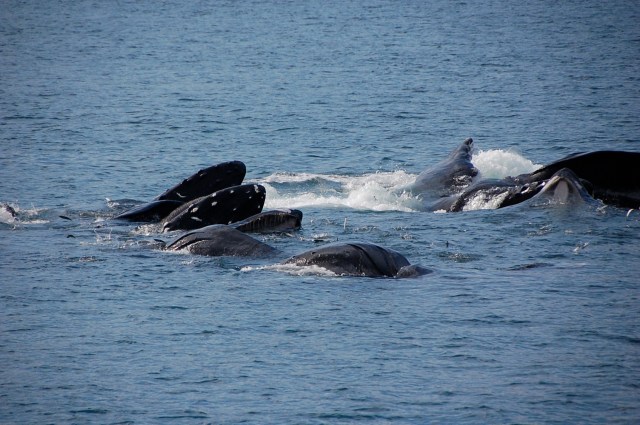
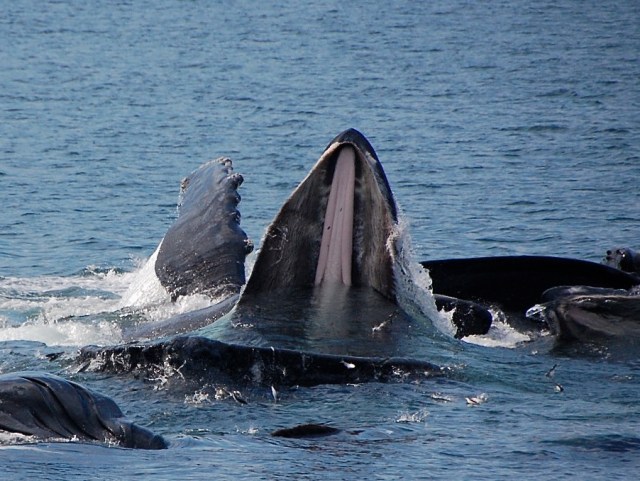
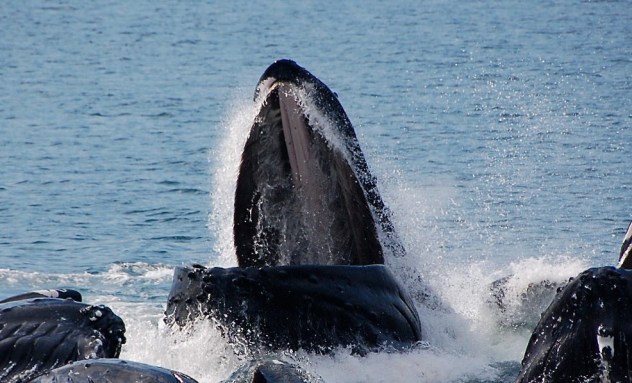
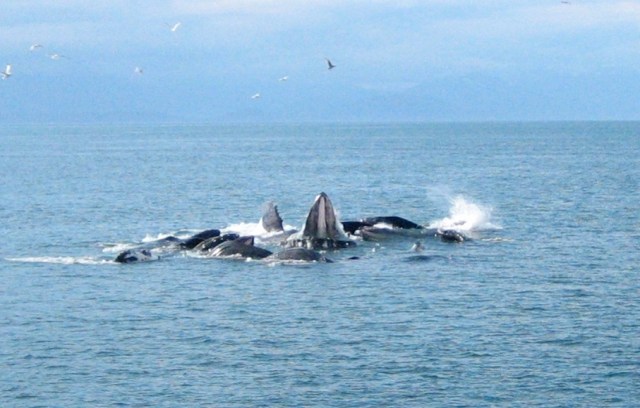
 A group of Humpback whales will locate a large group of small fishes and then blow bubbles from their blowholes as they circle toward the surface. The ring of bubbles forms a “bubble-net” which the fishes and or krill perceive as solid.  The fishes are compressed and the multiple whales then rise in unison to the surface inside the “bubble net” with their mouths open and their pleats expanded for a maxium catch of herring, caplin or sandlance.

All together now coming up

DSC_0332

Big gulp

DSC_0333_2

The water is expelled through their comb-like baleen (made of keratin) while their tongue sweeps the fishes down their throat.

17846092055_cdfe22e838_b


17660114570_c04b2af9ec_o

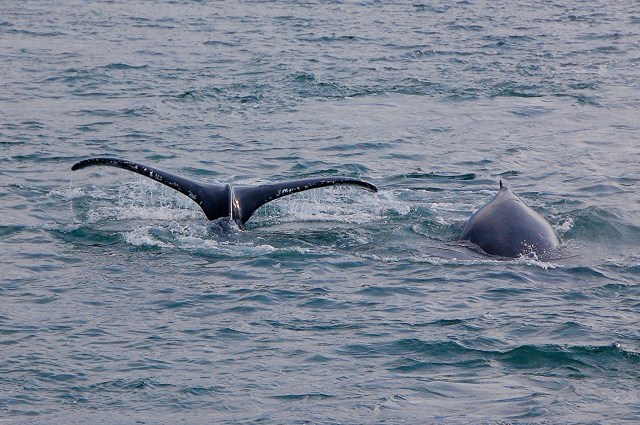
Waving good-bye with their flukes elevated and preparing a new bubble-net.

17661380019_4f748b80f4_b

Note: Flippering:  When a Humpback raises one or both flippers out of the water and slaps them against the water (see above).

Kickfeeding: The Humpback raises and slams his rear flukes against the water surface to stun fishes and then dives and surfaces to engulf the stunned fishes.

REMARKS Individual Humpbacks may lunge into schools of fishes or krill under water.

References

WordPress link:    https://fishoncomputer.wordpress.com/wp-admin/post.php?post=5820&action=edit

Ron’s flickr www.flickr.com/photos/cas_docents/17227254903/in/album-72…

Oxford Journals Integrative & Comparative Biology icb.oxfordjournals.org/content/51/1/203.full

IUCN red list 2008  www.iucnredlist.org/details/13006/0

IUCN Red List (July, 2009) www.iucnredlist.org

Monterey bay aquarium  www.montereybayaquarium.org/animal-guide/marine-mammals/h…

National Geographic animals.nationalgeographic.com/animals/mammals/humpback-w…

ARKive  www.arkive.org/humpback-whale/megaptera-novaeangliae/vide…

Shirihai, H & Jarrett (2006) Whales Dolphins and Other Marine Mammals of the World Princeton University Press.

Evans, P & Weinrich, M (2002) Whales Dolphins and Porpoises D K London New York Munich Melbourne and Delhi.

Reeves, R, R, et al (2002) Guide to Marine Mammals of the World   Chanticleer Press, Inc.

Buffington K, et al (1992) Whales Scholastic Professional Books


TAXONOMY
Kingdom: Animalia
Phylum: Chordata
Class: Mammalia
Subclass: Eutheria
Order: Cetartiodactyla (whales and even-toed ungulates)
Family: Balaenopteridae

Genus/species: Megaptera novaeangliae

GENERAL CHARACTERISTICS: Named for its stocky body with a distinctive hump formed by its black back when about to take a long dive. On the underside of the mouth are 12 to 36 throat pleats or grooves, which can expand when filtering water during feeding. Baleen is mostly black. Humpback whale 

M. novaeangliae  have knobbly heads, covered in many raised lumps (‘tubercles’) and barnacles. There are two blowholes. Unusually long pectoral fins with a characteristic serrated leading edge are adapted for high maneuverability associated with the whale’s unique feeding behavior. Fin color varies from all black to white. The expiration blow is bushy and highly visible 2.5-3 m ( 2.5-9.8 ft). Body length to 19 m (62 feet), weight to 48,100 kg (53 tons).

humpback whales17819773296_37dcacd696_o

about to dive

17227254903_ba7267992a_b

DISTRIBUTION/HABITAT: All Oceans in open waters.
The wintering grounds of these are:
A (Southwest Atlantic): coast of Brazil
B (Southeast Atlantic): the coast of West Africa from the Gulf of Guinea down to South Africa
C (southwestern Indian Ocean): coasts of eastern South Africa, Mozambique, Madagascar (southern, western and eastern coasts), Mayotte, the Comoros and other western Indian Ocean island groups;
D (southeastern Indian Ocean): northwestern Australia
E (southwest Pacific) northeastern Australia, New Caledonia, Tonga and Fiji.
F (central South Pacific): Cook Islands and French Polynesia
G (southeast Pacific): Ecuador, Galápagos, Colombia, Panama and Costa Rica.www.iucnredlist.org/details/13006/0

early dive

17843769572_0be6ff37c5_k

DIET: Feed only in summer, in polar waters on plankton, krill and small fishes. A group of Humpback whales will locate a large group of small fishes and then blow bubbles from their blowholes as they circle toward the surface. The ring of bubbles forms a “bubble-net” which the fishes and or krill perceive as solid. The fishes are compressed and the multiple whales then rise in unison to the surface inside the “bubble net” with their mouths open and their pleats expanded for a maxium catch of herring, caplin or sandlance. The water is expelled through their comb-like baleen (made of keratin) while their tongue sweeps the fishes down their throat. 

diving

DSC_0381_2 (1)

REPRODUCTION: Sales sing complex songs, with each group having its own dialect lasting hours, and can be heard for over 18 miles (30 km). Females nurse their calves for almost a year. Calves do not stop growing until they are ten years old. Annual tropical to cool water migration 2,300-3,600 km (1,400-2,200 miles)

net scars

17661379439_ceb41a7f1d_o

CONSERVATION: IUCN Redlist 2008 Least Concern (LC)
History:
1996–Vulnerable
1994–Vulnerable (Groombridge 1994)
1990–Vulnerable (IUCN 1990)
1988–Endangered (IUCN Conservation Monitoring Centre 1988)
1986–Endangered (IUCN Conservation Monitoring Centre 1986)
www.iucnredlist.org/details/13006/0

The Arabian Sea subpopulation and the Oceania subpopulation are classified as Endangered (EN) on the IUCN Red List (July, 2009) www.iucnredlist.org

REMARKS: Individual may be identified by the distinctive markings on their flukes, or tails.

References

Ron’s flickr https://www.flickr.com/photos/cas_docents/17227254903/in/album-72157652727235908/

Ron’s WordPress  https://fishoncomputer.wordpress.com/wp-admin/post.php?post=5808&action=edit&postpost=v2

Oxford Journals Integrative & Comparative Biology icb.oxfordjournals.org/content/51/1/203.full

IUCN Red List 2008 www.iucnredlist.org/details/13006/0

IUCN Red List (July, 2009) www.iucnredlist.org

Monterey bay aquarium  www.montereybayaquarium.org/animal-guide/marine-mammals/h…

National Geographic animals.nationalgeographic.com/animals/mammals/humpback-w…

ARKive   www.arkive.org/humpback-whale/megaptera-novaeangliae/vide…

Shirihai, H & Jarrett (2006) Whales Dolphins and Other Marine Mammals of the World,  Princeton University Press.

Evans, P & Weinrich, M (2002) Whales Dolphins and Porpoises,  D K London New York Munich Melbourne and Delhi.

Reeves, R, R, et al (2002) Guide to Marine Mammals of the World
Chanticleer Press, Inc.

Buffington K, et al (1992) Whales,  Scholastic Professional Books