Category: INVERTEBRATES


TAXONOMY
Kingdom: Animalia
Phylum: Echinodermata
Class: Asteroidea
Order: Forcipulatida
Family: Asteriidae

Genus/species: Pisaster ochraceus

GENERAL CHARACTERISTICS: Color varies from orange, violet, dark brown or mottled, but very rarely ochre. One study showed that less than two percent of the individuals in three local Northern California populations were “ochre” in color. When dead and dry they become ochre in color.
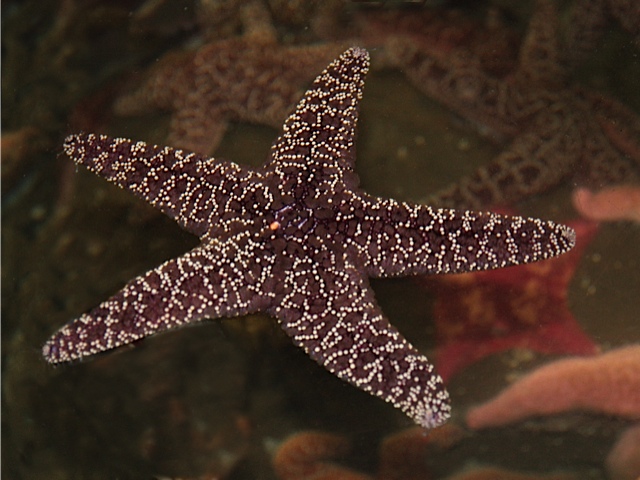

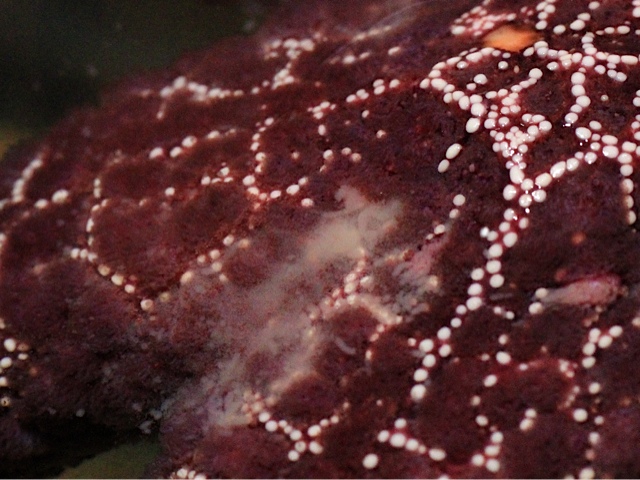
The aboral surface contains many small spines (ossicles) that are arranged in a netlike or pentagonal pattern. Papulae or coelomic pouches give the seastar’s surface a soft, fuzzy appearance. They are used for respiration and waste excretion. P. ochraceus may have an arm radius of up to 28 cm (11 in), but the more common radius is half that figure. They typically have five arms or rays, but the number can range from four to seven. Like all sea stars, an adult P. ochraceus has tube feet which they use for locomotion and for handling prey.

DISTRIBUTION/HABITAT: Ochre stars range from Alaska to Santa Barbara County, California. They prefer the low-to-mid intertidal zones on rocky shores, especially on mussel beds, and are also found in the subtidal zone to a depth of 88 m (288 ft). Juveniles are found in crevices and under rocks.

DIET IN THE WILD: California mussels are the favored and locally abundant prey. They also consume acorn barnacles, emarginated dogwinkles, gooseneck barnacles, owl limpets, etc. They can insert their stomach into slits as narrow as 0.1 mm between the valves of bivalves and begin digestion.

ACADEMY DIET: Manila clams, chopped fish, large krill, chopped squid; it also eats other exhibit inhabitants.
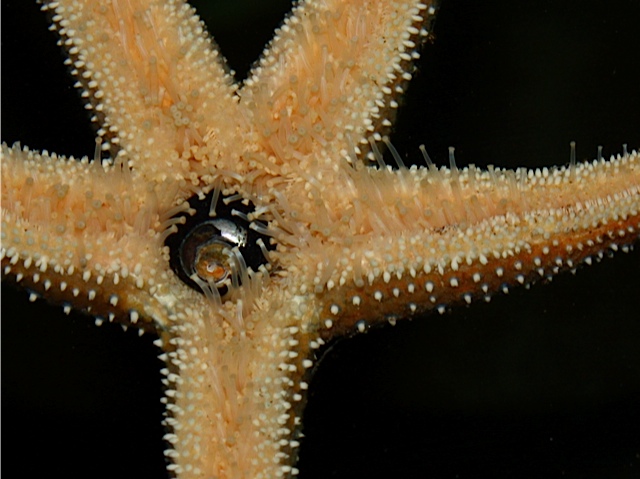
REPRODUCTION: They are mainly dioecious (separate sexes). Male gametes are produced, but at a later date only females gametes are produced. During a transitional period, both eggs and sperm are produced. The gonopores of the individual gonads open at the bases of the arms. Fertilization is external. Larvae are free-swimming and plankton-feeding.

LIFESPAN: Up to 20 years
PREDATORS: Adults are eaten by sea otters and seagulls. According to Dr. Thomas Niesen, the sea otter can crunch them up but is also known to bite off the tips of the arms and suck out the gonads.

REMARKS:  One study showed that less than 2% of the individuals in three local Northern California populations were “ochre” in color. When dead and dry they become ochre in color.

P. ochraceus tolerate strong surges, large temperature changes, dilution by rainfall. It is resistant to desiccation and it can tolerate a loss of thirty-percent of its body weight in body fluids.

Sea stars can regenerate lost arms with a portion of the central disc intact and in some species from a single arm.

NOTE:   SEA STAR WASTING SYNDROME has become a major issue in both the Pacific and Atlantic Oceans since 2013. For an excellent summary check this link to the University of Santa Cruz 9-9-14.  http://www.eeb.ucsc.edu/pacificrockyintertidal/data-products/sea-star-wasting/updates.htm

Fitzgerald Marine Reserve. www.fitzgeraldreserve.org/newffmrsite/wp-content/uploads/...

11-17-14 Recent research identifies a virus (Parvoviridae) to be responsible for the wasting disease. Introduced virus was able to infect healthy sea stars with the virus, which then leads to the wasting symptoms. Published in the Proceedings of the National Academy of Science. http://theconversation.com/mystery-virus-that-turned-millions-of-starfish-into-goo-is-finally-identified-34336


Additional References

California Academy of Sciences Docent Tidepool Guide 2015

Woods Hole www.whoi.edu/science/B/people/kamaral/SeaStar.html

Bishop Museum hbs.bishopmuseum.org/pubs-online/pdf/op11-8.pdf

Encyclopedia of Life  eol.org/pages/598469/details

Animal Diversity Web, U of Michigan  animaldiversity.ummz.umich.edu/accounts/Pisaster_ochraceus/

Ron’s WordPress Shortlink  http://wp.me/p1DZ4b-sC

Ron’s flickr  https://www.flickr.com/photos/cas_docents/3407968572/in/set-72157608501343477/


TAXONOMY
Kingdom: Animalia
Phylum: Cnidaria
Class: Scyphozoa
Order: Rhizostomeae
Family: Catostylidae

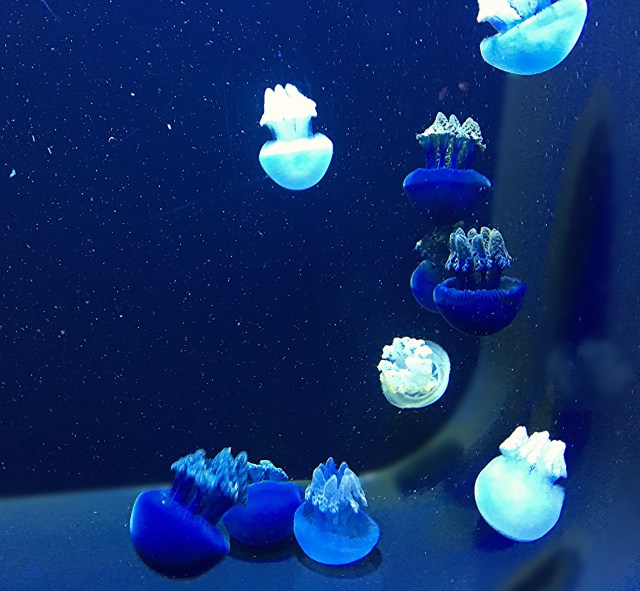
Genus/species; Catostylus mosaicus

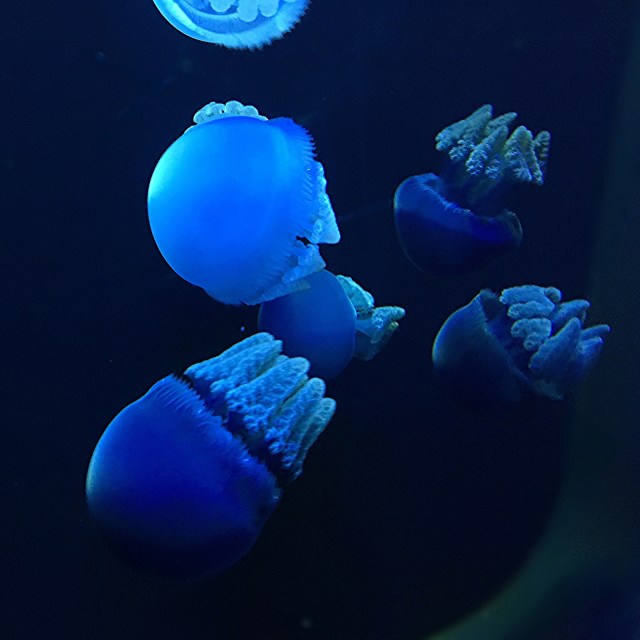
GENERAL CHARACTERISTICS: The blue, white or brown colors are derived from pigment produced by the jellyfish itself (not symbiotic algae, as in some other jellyfish). There is no obvious mouth on the underside, but there are small openings on each of its eight arm, through which food is passed to the stomach. Diameter up to 30 cm (18 in)  

29738845986_b24a44631b_k

DISTRIBUTION/HABITAT: Found in coastal waters of Australia, Queensland, New South Wales and Victoria.

DIET IN THE WILD: The tentacles also have stinging cells that can capture tiny crustaceans and other plankton.

29482409560_d2c608244e_k

REMARKS: The Chinese believe eating jellies will reduce high blood pressure. Dried jellies are popular in many Asian countries, especially Japan, where they’re considered a culinary delicacy. The texture is reportedly crispy, yet elastic—hence the name “rubber band salad” for a dish sold in China.

References

California Academy of Sciences Steinhart Aquarium Color on the Reef  2017 AQA10

EOL eol.org/pages/203402/details

Monterey Bay Aquarium  www.montereybayaquarium.org/animal-guide/invertebrates/bl…

WordPress  https://brianeyes21comcast.net/2016/09/18/9-9-16-blue-blub…o-pacific-series/   Shortlink  http://wp.me/p1DZ4b-1In

Ron’s flickr https://www.flickr.com/photos/cas_docents/29482409560/in/album-72157659465376212/


TAXONOMY
Kingdom: Animalia
Phylum: Cnidaria
Class: Anthozoa
Subclass: Zoantharia
Order: Actiniara (anemones)
Family: Actiniidae

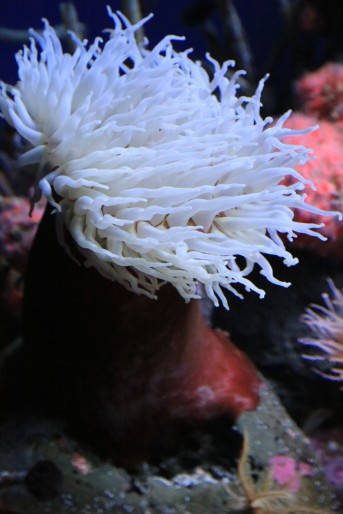
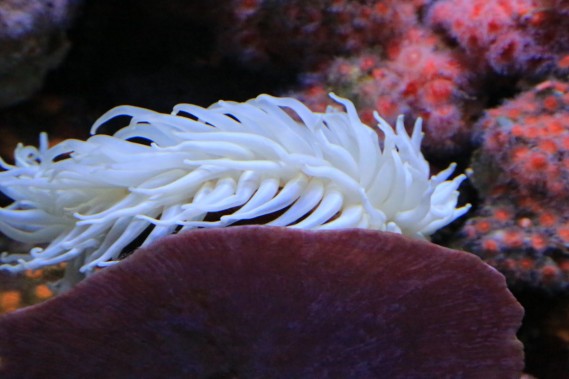
Genus/species: Urticina piscivora

GENERAL CHARACTERISTICS: Large to 20 cm (8 inches) high and 26 cm (10 inches) across. The column is red (without spots) with white. Tentacles are white, and the oral disc is creamy yellow. Normally they do not accumulate debris such as shells and sand.

IMG_9525 

DISTRIBUTION/HABITAT: Alaska to southern California. Found in low intertidal areas with rocky attachment sites and at least moderate current. Depth to about 50 m (160 feet)

IMG_9523

DIET IN THE WILD: Invertebrates, shrimp and small fishes. U. piscivora have no zooxanthellae and depend wholly on capturing their food, a strategy aided by their exceptionally virulent nematocysts (stinging cells), which can cause long-lasting lesions on humans. Food items are usually swept into the central mouth by the tentacles where enzymes digest the food. Non digested items are expelled out through the mouth.


Genus/species: Urticina piscivora3702912695_1708579b2e_b 

CONSERVATION: IUCN Not evaluated

REMARKS: One fish species, the painted greenling (Oxylebius pictus), has been observed lying unharmed in this anemone much as clownfish do in tropical anemones. 

References

California Academy of Sciences Steinhart Aquarium California Coastal Marine Reef Exhibit

eol eol.org/pages/2549643/details

Walla Walla Universitywww.wallawalla.edu/academics/departments/biology/rosario/…

Georgia Aquariumanimalguide.georgiaaquarium.org/home/galleries/cold-water…

Ron’s flickr www.flickr.com/photos/cas_docents/3702912695/in/set-72157…

Ron’s WordPress shortlink http://wp.me/p1DZ4b-1l6


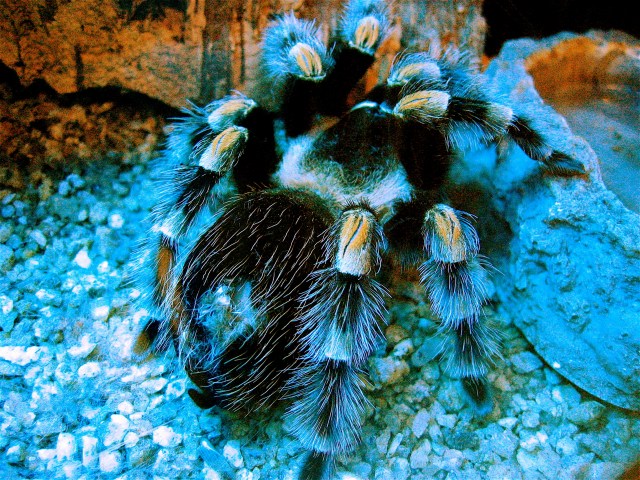
Kingdom: Animalia
Phylum: Arthropoda
Class: Arachnida
Order: Araneae
Family: Theraphosidae

Genus/species: Brachypelma smithi

GENERAL CHARACTERISTICS: The body and legs are dark brown with orange-red leg joints. The ends of the legs can detect vibrations, smells and tastes, to help the tarantula locate prey and the opposite sex, although it also has a group of eight eyes on the top of the carapace.

Length up to 14 cm (5.5 in)

Mexican Red Knee Tarantula30463911086_990fd616a7_k

DISTRIBUTION/HABITAT: Found in in dry areas with little vegetation, usually in scrubland, deserts, dry thorn forests, or tropical deciduous forests along the central Pacific coast of Mexico.
DIET IN THE WILD: Hunting at night by lying in ambush, the Mexican redknee tarantula attacks insects, small frogs, small lizards, and mice. An area on the end of each leg is sensitive to smells, tastes and vibrations, and this is used to detect prey. The tarantula holds its prey with its pedipalps (front limbs) and injects it with venom delivered via two hollow fangs. This venom has a double purpose, paralysing the prey as well as beginning digestion. Once the venom has acted, the tarantula is able to suck up the proteins and fats of its prey, leaving just a small ball of undigested body parts

REPRODUCTION: Mating occurs in or near to the female’s burrow, where the male uses his pedipalps (front limbs) to transfer his sperm into openings in the underside of the female’s abdomen. After mating, some females will try to kill and eat the male. In the spring, the female deposits hundreds of eggs and the sperm onto a silk mat which she has made and then fashions this mat into a ball or egg sac. Fertilisation takes place within minutes and the spiderlings hatch in just less than three months. Once out of the egg-sac they spend two weeks in the burrow before dispersing. Males mature at about four years of age and females two to three years later at about six or seven years old. They are a long-lived species with females living up to 25 to 30 years old, however males only live about one year after maturity.


Mexican Red Knee Tarantula4515783385_eb611c7fd6_o

REMARKS: This usually docile tarantula will kick hairs off the abdomen with its hind legs when threatened, which cause blindness if they hit the eyes of a predator and can also cause a rash on the skin.
References

California Academy of Sciences Animal Attractions 2016

Ron’s Flickr   https://www.flickr.com/photos/cas_docents/30463911086/in/album-72157608653175263/

EOL  eol.org/pages/1181785/details

Ron’s WordPress Shortlink  http://wp.me/p1DZ4b-1IR


TAXONOMY
Kingdom: Animalia
Phylum: Cnidaria
Class: Anthozoa
Order: Actiniaria
Family: Metridiidae

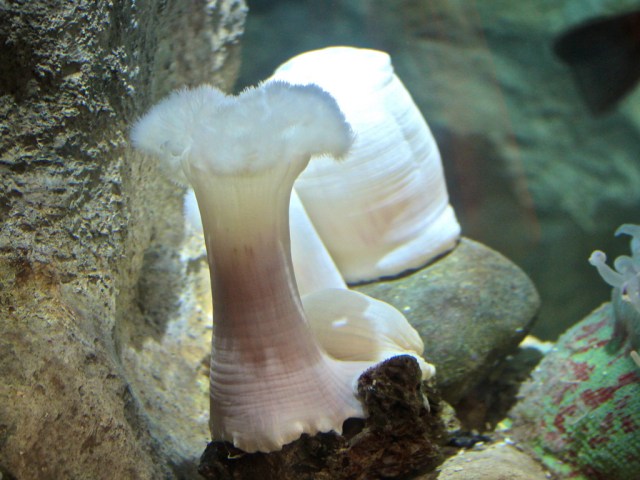
Genus/species: Metridium farcimen  aka Metridium giganteum
Metridium farcimen4545409258_06cac3dd83_b

GENERAL CHARACTERISTICS: Erect smooth column. Usually 50 cm (20 in) or less in height The column is slender, smooth and studded with acontia. These are openings through which thread-like nematocysts from inside the body wall can protrude. The oral disc is lobed and deeply convoluted at the edge and bears well over 100 fine, short, tapering tentacles. Color variable from white through cream to tan, brown and orange. Carries short, feathery tentacles in white, brown or gray.

 Metridium farcimenIMG_9548

DISTRIBUTION/HABITAT: Eastern North Pacific: Alaska to Baja California. Found in sub tidal areas attached to rocky substrate. Individuals usually aggregate in groups on deeper rocky reefs.

 Metridium farcimen4673318353_928bfcd2f0_o

DIET IN THE WILD: Plankton—whatever drifts by or is carried in by the tide; predators include Pisaster spp. sea star and some species of nudibranchs.

REPRODUCTION: Eggs and sperm from the gonads embedded in the body wall which are ejected through the mouth. Fertilised eggs develop into planula larvae which settle and metamorphose into polyps.                   

PREDATORS: Pisaster spp. sea star and some species of nudibranchs.

REMARKS: When attacked, they contract suddenly, extruding specialized nematocysts through the mouth and body wall that, much larger than those found in the tentacles, can deter or even kill predators.

 Location: California Rocky Coast and Giant Pacific Octopus exhibits

 References

 The University of Kansas kuscholarworks.ku.edu/dspace/handle/1808/6043

 eol eol.org/pages/704280/details#type_information

 racerocks:www.racerocks.com/racerock/eco/taxalab/ensy02/bend.htm

 Ron’s flickr  https://www.flickr.com/photos/cas_docents/3400331201/in/set-72157625127345346/

Ron’s WordPress shortlink  http://wp.me/p1DZ4b-1lg


TAXONOMY
Kingdom: Animalia
Phylum: Cnidaria
Class: Anthozoa
Subclass: Hexacorallia
Order: Corallimorpharia
Family: Corallimorphidae

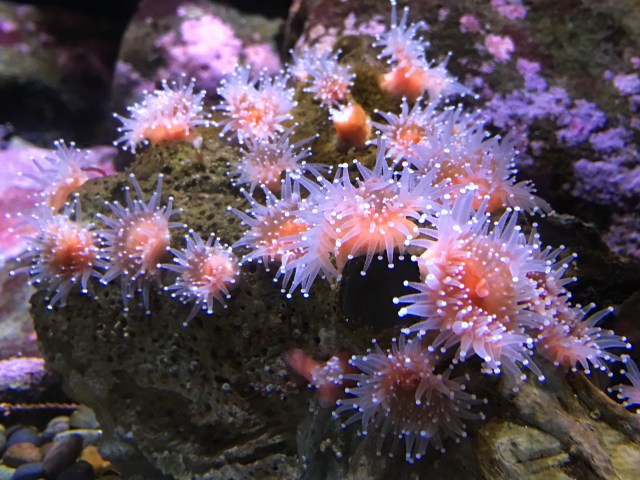
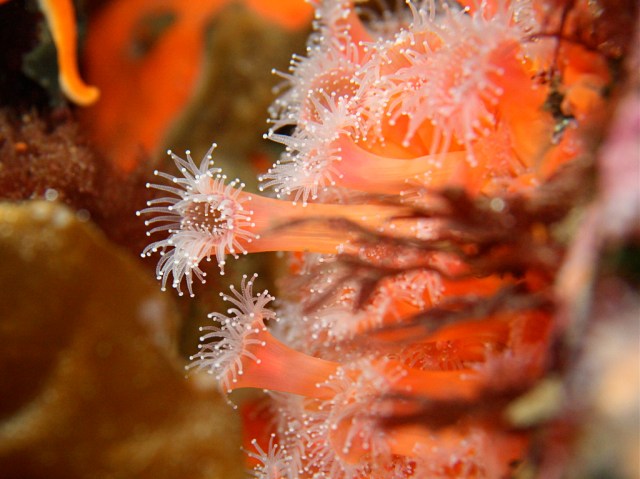
Genus/species: Corynactis californica

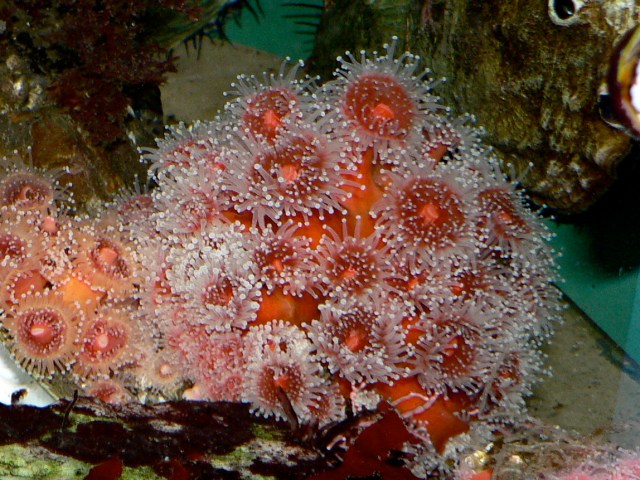
GENERAL CHARACTERISTICS: Typically red or orange-pink, occasionally purple, yellow, buff, brown or nearly white.
Corallimorphs are not true anemones. Tentacles end in knobs (club-tipped tentacles) and are not fully retractile, usually being white. Corallimorphs are also very similar to corals in some other characters, but lack the hard coral skeleton. Found in groups, with individuals up to 2 cm (0.8 inches) long (average height and diameter is 1 cm  (0.4 inches).

Northern Feather Duster Wormimg_5344

3395717381_112ffd5d87_b-2

DISTRIBUTION/HABITAT: British Columbia, Canada to Baja California, Mexico. Habitat: Colonies abundant from the low rocky intertidal to 30 m (98 feet).

3124837767_b890803df1_o

DIET IN THE WILD: C. californica captures prey by extruding mesenterial filaments onto its prey which are used for digestion and absorption of food in the coelenteron. If the prey is too large to take into the coelenteron, the mesenterial filaments are used to digest it externally. They are carnivores consuming  copepods, crustacean larvae and other zooplankton.

REPRODUCTION: Asexual by fission and budding resulting in a dense cluster of clones

REMARKS: The presence of aggregations of C. californica increase the density of rock oysters and mussels by protecting them from predatory sea stars.

References

California Academy of Sciences Steinhart Aquarium 2016

Ron’s flickr https://www.flickr.com/photos/cas_docents/2996776409/in/set-72157608597451452/

Ron’s WordPress  http://wp.me/p1DZ4b-1l0

eol eol.org/pages/1006944/details

 U. of Michigan ADWanimaldiversity.ummz.umich.edu/accounts/Corynactis_califo…

 Walla Walla Universitywww.wallawalla.edu/academics/departments/biology/rosario/…


TAXONOMY
Kingdom: Animalia
Phylum: Mollusca
Class: Cephalopoda
Order: Octopoda
Family: Octopodidae

Genus/species: Octopus bimaculoides

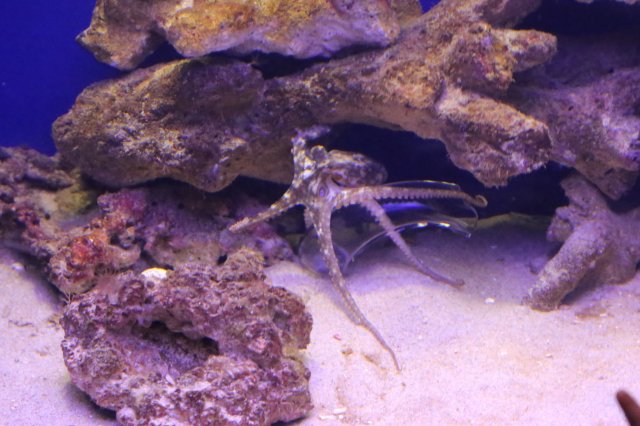
GENERAL CHARACTERISTICS: Usually a mottled-brown color with a dark deep-blue ovoid spot under each eye. It can use the chromatophores in its skin to change its color and texture when hunting for prey or hiding from predators (including its eye spots).

Size to 3 feet (including its body and outstretched arms)

2spot Octopus25853155380_e17555cef7_k

DISTRIBUTION/HABITAT: Found from central California to northern Baja California among reefs and pilings on the sea floor.

DIET IN THE WILD: Limpets, black abalone, snails, clams, hermit crabs and small fishes. Prey are subdued with a parrotlike beak and toxic secretions through a salivary gland. Their food is then scraped out with a radula.

REPRODUCTION: Females lay up to 150,000 eggs under rocks from late winter to early summer, then brood on them continuously for 2-4 months. During brooding, the female doesn’t feed and usually dies when eggs hatch.

Two-spot Octopus26033508582_96a0c27793_k

Life Span: One-and-a-half to two years.

PREDATORS: Moray eels, scorpionfish and humans. Arms are often lost during a fight with a moray eel and can regenerate.

CONSERVATION: O bimaculoides is very sensitive to impaired water quality, thus water pollution is an issue for its survival.

References

California Academy of Sciences Steinhart aquarium Animal Attractions 2016

Ron’s flickr  https://www.flickr.com/photos/cas_docents/26033508582/in/album-72157629304397467/

Animal Diversity Web animaldiversity.org/accounts/Octopus_bimaculatus/

Jaffe Laboratory jaffeweb.ucsd.edu/node/twospottedoctopus

Monterey bay Aquarium  www.montereybayaquarium.org/animal-guide/octopuses-and-ki…

Cabrillo Marine Aquarium www.cabrillomarineaquarium.org/exhibits/socal-species-det…

Ron’s WordPress Shortlink  http://wp.me/p1DZ4b-1G9


TAXONOMY
Phylum Cnidaria
Class Anthozoa
Subclass Zoantharia
Order Actiniaria (anemones)
Family Actiniidae

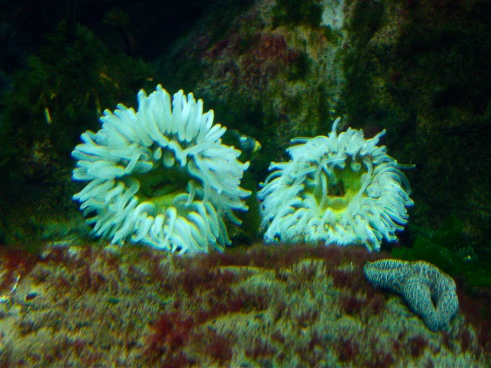
Genus/species: Anthopleura xanthogrammica

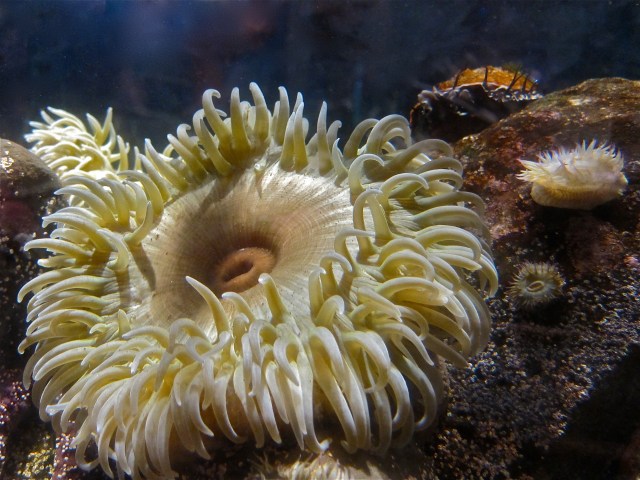
GENERAL CHARACTERISTICS: A  solitary species and one of the largest species of anemone in the world. Column to 30 cm (12 in) tall and 30 cm (12 in) tentacular crown with 25 cm (10 in ) diameter mid base. The base bottom is only slightly larger than column diameter and adheres to rocks.  Tentacles are green, blue, or white without pink on the tips.  No marks or bands.  The oral disk is flat and usually green, but can be grayish-blue to greenish-blue.  Contracted animals form a green to dark greenish-brown, occasionally white hemispherical mound.

DISTRIBUTION/HABITAT: Alaska to Panama in prefers rocky areas and deeper tide pools of the low to middle intertidal zones to 9 m (30 ft), and wharf pilings. Usually solitary; in favorable locations can occur in numbers to 14 per square m.

DIET IN THE WILD: Detached mussels and sea urchins, also take crabs and small fishes. Zoochlorellae endosymbionts supplement host’s diet.

PREDATORS: Nudibranchs, snails, sea spiders and some sea stars, especially leather stars.

REPRODUCTION: A. xanthogrammica have separate sexes releasing sperm and eggs in late spring to summer. The larvae swim or float freely. They do not use asexual reproduction.


REMARKS: Some fishes and the hermit crab Pagurus samuelis develop protection from the anemone’s toxins by covering themselves with mucus that prevents them from being stung.

The bright green can be attributed to green pigment in the anemone epidermis and to symbiotic algae that live in the tissues that line the gut. Inside there may be zoochorellae (green algae) or zooxanthellae, which are dinoflagellates. The symbiotic algae are reduced in numbers or even absent (aposymbiotic) when in shady areas.

LOCATION: Tidepool and California coast.

REFERENCES

Walla Walla University

www.wallawalla.edu/academics/departments/biology/rosario/…

 eol eol.org/pages/704306/details#cite_note-Skiles-4

flickr  http://www.flickr.com/photos/cas_docents/sets/72157625127345346/

WordPress shortlink: http://wp.me/p1DZ4b-w4

TAXONOMY

Phylum: Mollusca
Class: Bivalvia
Order: Filibranchia
Family: Mytilidae

Genus/species: Mytilus californianus

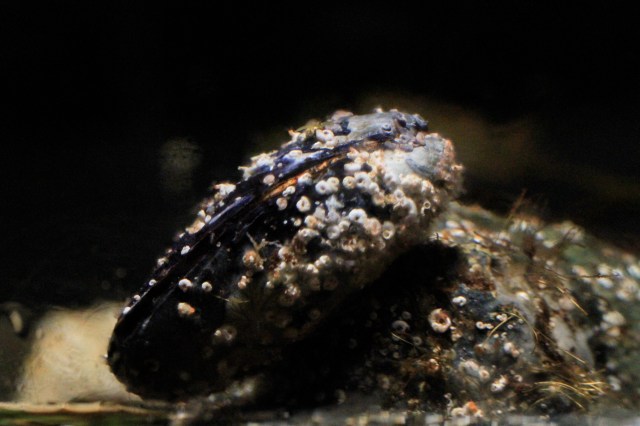
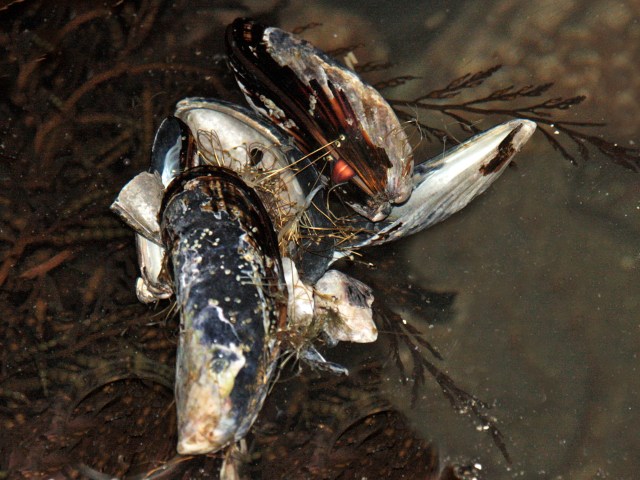
GENERAL CHARACTERISTICS: California mussels are relatively large mussels, with a blue-black shell with strong radial ribs and irregular growth lines. Maximum size is about 13 cm (5 in). The shell surface is often worn and eroded.


DISTRIBUTION/HABITAT:  California mussels form extensive beds, commonly mixed with gooseneck barnacles (Pollicipes polymerus). Attached firmly to the substrate by tough proteinaceous byssal threads, mussels are able to thrive in the most surf-swept areas. Mussel beds break the force of waves and collect organic debris, and so provide shelter and food for other organisms. Worms, chitons, snails, clams, isopods, crabs, and sea cucumbers are among the invertebrates found in mussel beds.

The upper limit of the mussel beds is set primarily by physical factors, particularly time out of water. The lower limit is set in part by the predation of the ochre star (Pisaster ochraceus), which practices vertical foraging, moving up and down with the tides. Mussels range from low intertidal to 40 m (131 ft) deep and are common in surf-swept, rocky areas, and are found from Alaska to southern Baja California.


DIET IN THE WILD: Mussels filter fine organic detritus and living plankton from sea water. A mussel filters 1.8 l to 2.8 l (2 to 3 qts) of water an hour.


PREDATORS: California mussels are favored food items of seas stars (especially ochre stars), crabs, predatory snails, shorebirds, sea otters, and humans. Sea otters have devastated formerly extensive mussel beds in Monterey Bay.


REPRODUCTION: Mussels are either male or female. During breeding they broadcast sperm or eggs into the sea where fertilization occurs. They spawn November to May. Mussel larvae are free-swimming for about four weeks. After settling and attachment they grow to full size in about three years.


Remarks

  • The California mussel attaches to rocks by fibers called byssal threads. These threads are produced as a liquid by the byssal gland. The liquid runs down a groove formed by the foot. When the foot pulls back, exposing the liquid to sea water, the liquid solidifies into a thread.
  • A large mussel moves by breaking old threads, then attaching new ones to another spot; a small mussel creeps around on its foot.
  • By filtering algae spores from the water, mussels may limit algae growing around mussel beds.
  • Coastal areas are at risk from development and pollution. Mussels are also at risk because many of their homes are in danger of being ‘loved too much’ by too many tide pool visitors.

References

California Academy of Sciences Docent Guide 2015

flickr http://www.flickr.com/photos/cas_docents/5118861762/in/set-72157608597736188/

WordPress shortlink:  http://wp.me/p1DZ4b-wF

Encyclopedia of Life eol.org/pages/449960/details

Monterey Bay Aquarium www.montereybayaquarium.org/animal-guide/invertebrates/ca…


TAXONOMY
Phylum: Echinodermata
Class: Echinoidea
Order: Echinoida
Family: Strongylocentrotidae

Genus/species: Strongylocentrotus purpuratus

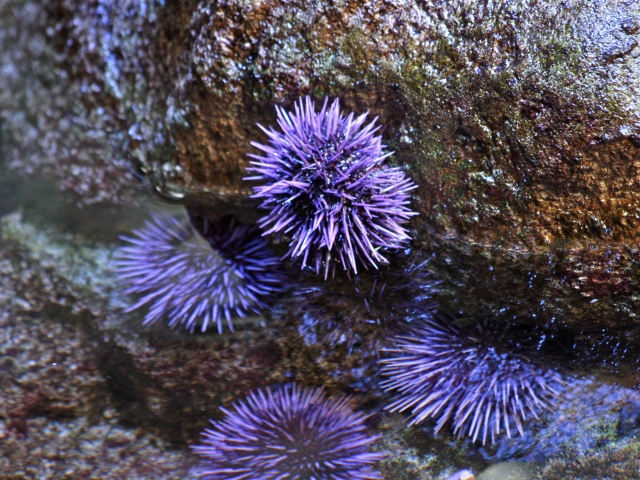
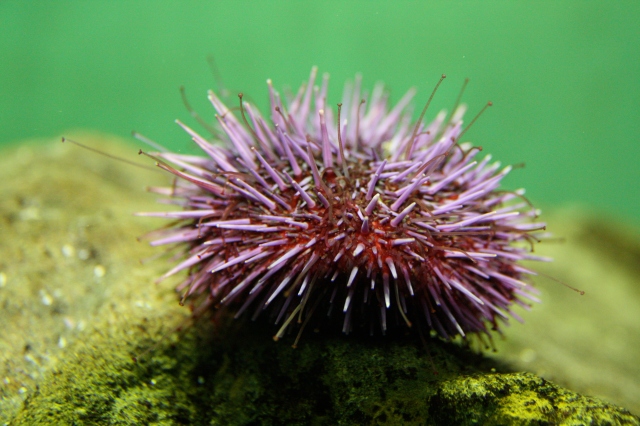
GENERAL CHARACTERISTIC: Round body with radially symmetrical test, (shell), covered with large spines 0.5 cm (2 in) in diameter, rarely to 10 cm (4 in). Test and spines are pale green (young) to purple (adults). Also covering the test or shell, are tube feet and pedicellariae (pincers). The long
suckered tube feet visible above the spines are used for locomotion and capture of food, which is then passed along to the mouth. The oral side of the urchin, on which the mouth is located, faces the substrate (down). Sexes are not physically distinguishable from one another (monomorphic).

DISTRIBUTION/HABITAT: British Columbia to Baja California in the lower intertidal to 160 m (525 ft) depth. Rounded burrows in rock that have been scoured out by the present or previous urchin using its teeth (Aristotle’s lantern) and spines, a strategy that protects from predators and surge.  Subtidal purple urchins live, often in large numbers, on the substrate among kelp holdfasts.


DIET IN THE WILD: Herbivore/Detritivore. Uses calcite (CaCO3) teeth (Aristotle’s lantern) to feed on kelp, other algae, diatoms and scavenge on dead animals. These urchins prefer the giant brown kelp Macrocystis and can destroy entire forests of kelp which are commercially important for fisheries. Algin a product from kelp is also used in the manufacturing of plastics, paints and as a thickening agent in foods such as gravy and pudding.


REPRODUCTION: Sexually mature during their second year. Sexes are separate, although hermaphrodites occur. Broadcast spawning deposits sperm or eggs into the sea where random fertilization occurs. Pluteus larvae hatch, drift and settle. Growth after metamorphosis is slow.

PREDATORS: Preyed upon by seastars such as the sunflower star and cancer crab species as well as fish such as the California sheepshead, shorebirds and sea otters. Sheephead blow over sea urchins and nibble at the oral side where the spines are shortest. When approached by most sea stars, the urchin allows the potential predator to get close, then uses its pincers to attack the sea star’s tube feet. Most sea star species will beat a hasty retreat; however, the sunflower star is too big and fast; the urchin cannot escape and is swallowed whole! Average lifespan 20 years but can live to more than 30 years.

CONSERVATION: CITES; no special status

REMARKS: Purple pigments from this urchin lodge in the bones and teeth of sea otters, turning the otter’s skeleton and teeth purple.

In the wild, they protect themselves from predation, drying out, and damage from the sun’s UV light by covering themselves with seaweed or shells.

Sea urchin is commonly used in sushi and is considered a delicacy Japan. The primary urchin harvesting company in California sends 75% of the harvest to Japan.

LOCATION

RockyReefcluster, Abalone and urchins, Rocky Coast Main Exhibit, Tidepool

References

California Academy of Sciences Docent Water is Life Guide 2015

eol  http://eol.org/pages/598175/details

Ron’s flickr http://www.flickr.com/photos/cas_docents/sets/72157608501343477/

Ron’s WordPress shortlink: http://wp.me/p1DZ4b-vq