Category: INDO-PACIFIC


TAXONOMY
Kingdom: Animalia
Phylum: Arthropoda
Subphylum: Crustacea
Class: Malacostraca
Order: Decapoda
Infraorder: Caridea
Family: Hippolytidae

Genus/species: Lysmata amboinensis

GENERAL CHARACTERISTICS: Dorsal redline on tan body. Long white antennae.

DISTRIBUTION/HABITAT: Red Sea to Australia; Indonesia, Society Islands. Active day and night at cleaning stations on coral and rocky reefs, 8–25 m. Reside in pairs or groups (to 100 individuals) in caves and crevices.
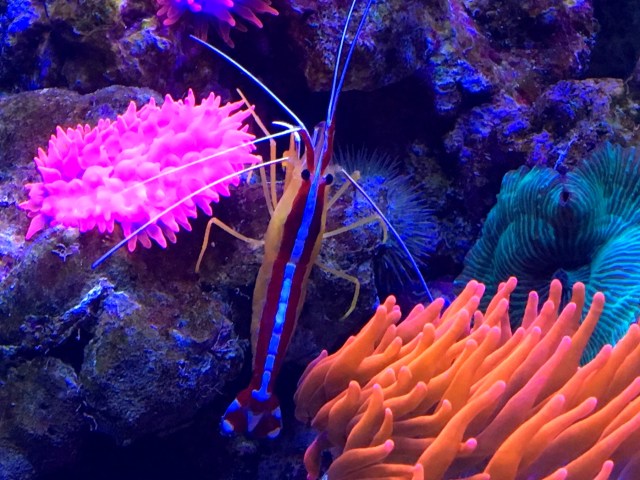
cleaner shrimp24441637412_8890f98e21_oDIET IN THE WILD: It has been observed that fish with parasites may come to cleaning stations. in the reef. Certain species of fish and several types of cleaner shrimp may assist the fish in large numbers and even go inside the mouth (and then to the gill cavity) without being eaten.

cleaner shrimp4337509985_c72ab0aedf_o

REPRODUCTION: L. amboinensis initially develop and reproduce as males then develop female reproductive organs to become hermaphrodites and function as both males and females throughout the reproductive cycle. This system called protandric simultaneous hermaphroditism is so far known only from caridean shrimp in the closely related genera Lysmata and Exhippolysmata.

REMARKS: Cleaner shrimp advertise their services by their bright coloration and by waving their very long antennae, which contrast with the dark recess of their station.

Jacques, a character in Finding Nemo, is a humpback cleaner shrimp. In aquaria, cleaner shrimp are valued because they clean not only the fish, but the tank as well.

References

California Academy of Sciences Steinhart Aquarium Color on the Reef AQA17 2017

EOL www.eol.org/pages/128343/details

Ron’s WordPress shortlink http://wp.me/p1DZ4b-1KD

Ron’s flickr https://www.flickr.com/photos/cas_docents/24441637412/in/album-72157659465376212/
TAXONOMY
Kingdom: Animalia
Phylum: Chordata
Class: Actinopterygii (ray-finned fishes)
Order: Perciformes (Perch-likes)
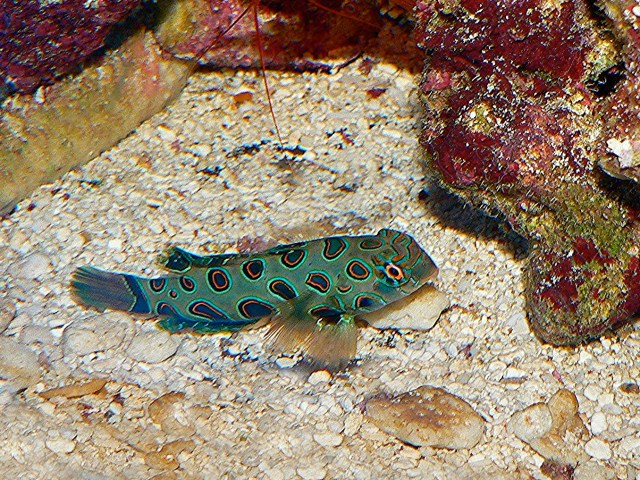
Family: Callionymidae (Dragonets)

Genus/species: Synchiropus picturatus

GENERAL CHARACTERISTICS: Elongate, moderately depressed, broad-headed. Pale brown to green, covered with large dark spots ringed with orange and green, turquoise band markings around eye.

Length up to 7 cm (2.75 inches)

dragonet2985463647_2857fa8c1f_o

DISTRIBUTION/HABITAT: Northwest Australia, Indonesia and Philippines. Found in rubble patches and sandy bottoms near living corals of coastal reefs at depths of 2–20 m.

DIET IN THE WILD: Small benthic invertebrates, especially live zooplankton, such as copepods and amphipods.

3289664960_03a882a295_o

IUCN RED LIST Not evaluated

References

California Academy of Sciences Steinhart Aquarium Color on the Reef AQA13

Ron’s flickr https://www.flickr.com/photos/cas_docents/2985463647/in/album-72157659465376212/
Fishbase  www.fishbase.org/summary/Synchiropus-picturatus.html

EOL eol.org/pages/339917/overview

Ron’s WordPress shortlink  http://wp.me/p1DZ4b-1JF


TAXONOMY
Kingdom: Animalia
Phylum: Chordata
Class: Actinopterygii (ray-finned fishes)
Order: Syngnathiformes (Pipefishes and seahorses)
Family: Centriscidae (Snipefishes and shrimpfishes)

Genus/species: Aeoliscus strigatus


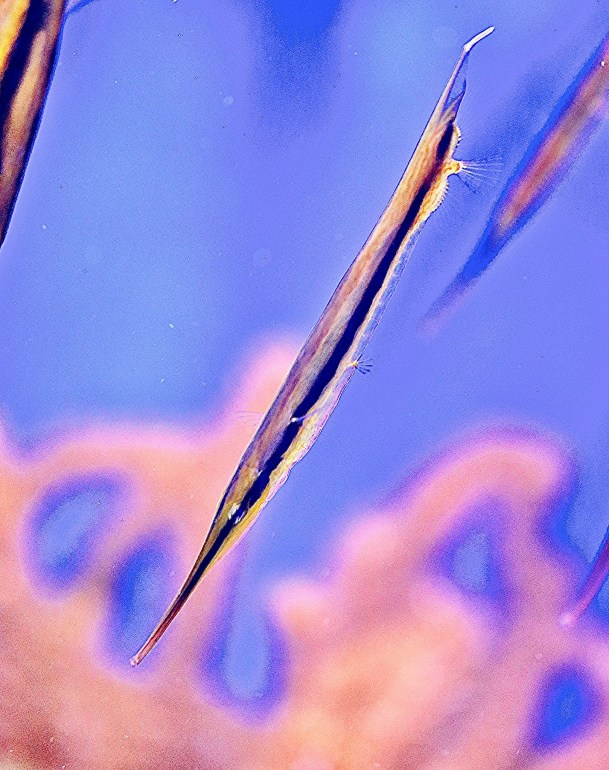
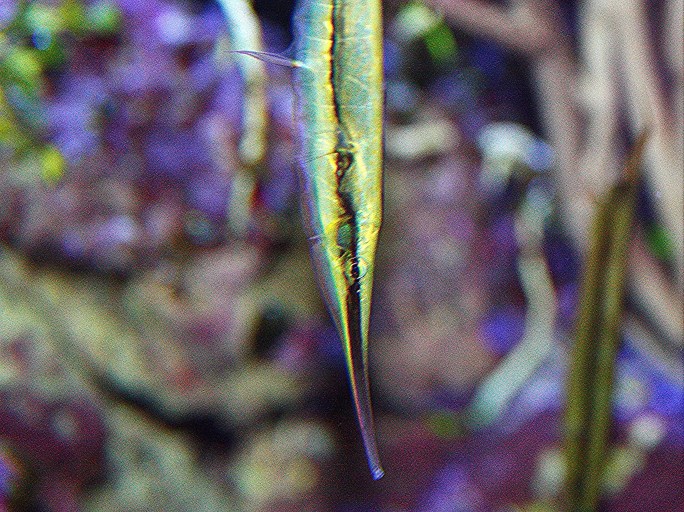
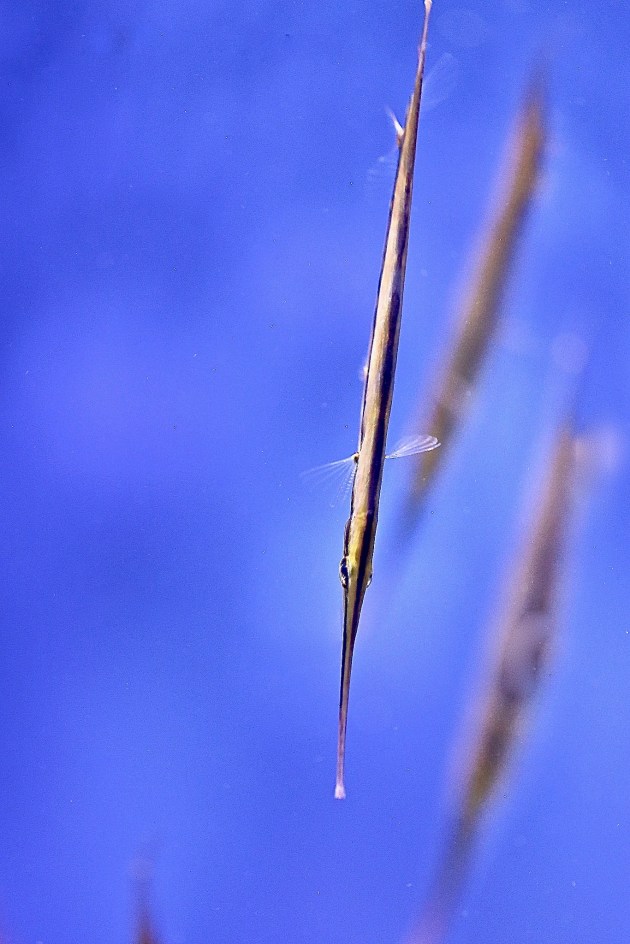
GENERAL CHARACTERISTICS: The body is encased in an armor of thin, transparent plates; they swim in synchronized groups, each fish in a vertical position with the snout pointing downwards. Color is golden-yellow with a dark band running the length of the body. The tail fin, terminates in a sharp spine.

Length up to 15 cm (6 in)

DISTRIBUTION/HABITAT: Tropical Indian and western Pacific oceans. Inhabits clear coastal reefs and leeward fringing reefs around offshore islands. Found In small groups swimming and resting with head down near long-spined sea urchins, branching corals or other hiding places to 42 m (140 feet).

DIET IN THE WILD: Minute planktonic crustaceans.

CONSERVATION: IUCN Not Evaluated

REMARKS: A. striates occurs  has been observed hiding in the spines of sea urchins, both as a defense mechanism and as a hunting mechanism. Swims horizontally only when hunting. Otherwise, swim with head down and back facing the direction of travel. If a rival enters their territory, they aim the sharp edge of the belly toward the adversary.

References

California Academy of Sciences Steinhart Aquarium Hidden Reef 2018

Ron’s WordPress Shortlink. https://brianeyes21comcast.net/2017/01/05/4-19-13-shrimpfish-aka-razorfish-from-rons-tropical-marine-series/

fishbase  http://www.fishbase.org/summary/6503

Animal Diversity Web http://animaldiversity.org/accounts/Aeoliscus_strigatus/classification/

Ron’s flickr. https://www.flickr.com/photos/cas_docents/30467635696/in/album-72157659465376212/
Fishes of Australia.  http://fishesofaustralia.net.au/home/species/3163#moreinfo

EOL eol.org/pages/205823/details#distribution


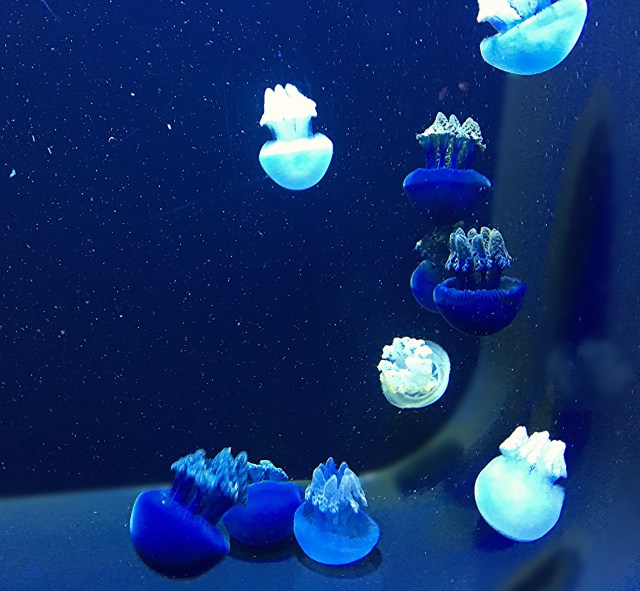
TAXONOMY
Kingdom: Animalia
Phylum: Cnidaria
Class: Scyphozoa
Order: Rhizostomeae
Family: Catostylidae

Genus/species; Catostylus mosaicus

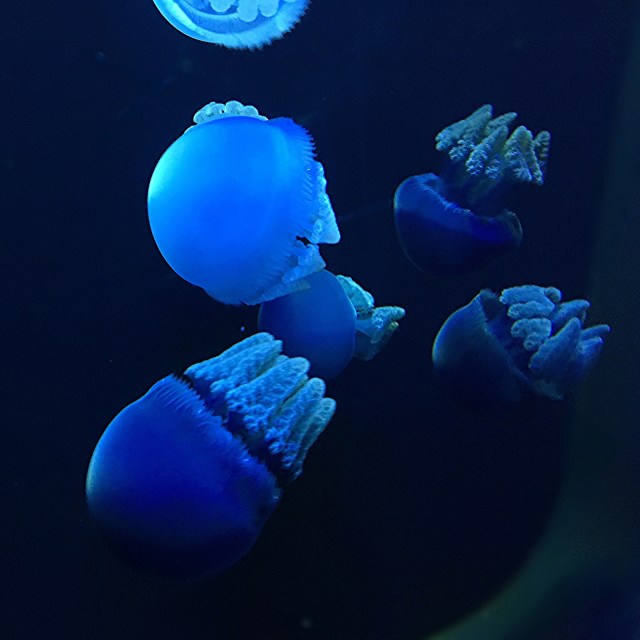
GENERAL CHARACTERISTICS: The blue, white or brown colors are derived from pigment produced by the jellyfish itself (not symbiotic algae, as in some other jellyfish). There is no obvious mouth on the underside, but there are small openings on each of its eight arm, through which food is passed to the stomach. Diameter up to 30 cm (18 in)  

29738845986_b24a44631b_k

DISTRIBUTION/HABITAT: Found in coastal waters of Australia, Queensland, New South Wales and Victoria.

DIET IN THE WILD: The tentacles also have stinging cells that can capture tiny crustaceans and other plankton.

29482409560_d2c608244e_k

REMARKS: The Chinese believe eating jellies will reduce high blood pressure. Dried jellies are popular in many Asian countries, especially Japan, where they’re considered a culinary delicacy. The texture is reportedly crispy, yet elastic—hence the name “rubber band salad” for a dish sold in China.

References

California Academy of Sciences Steinhart Aquarium Color on the Reef  2017 AQA10

EOL eol.org/pages/203402/details

Monterey Bay Aquarium  www.montereybayaquarium.org/animal-guide/invertebrates/bl…

WordPress  https://brianeyes21comcast.net/2016/09/18/9-9-16-blue-blub…o-pacific-series/   Shortlink  http://wp.me/p1DZ4b-1In

Ron’s flickr https://www.flickr.com/photos/cas_docents/29482409560/in/album-72157659465376212/


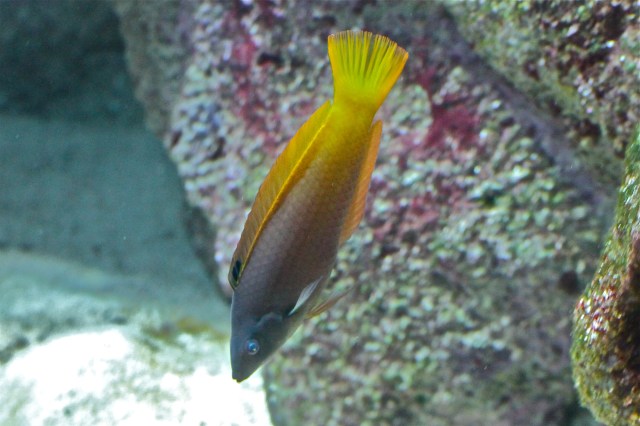
TAXONOMY
Kingdom:Animalia
Phylum: Chordata
Subphylum: Vertebrata
Class: Actinopterygii (ray-finned fishes)
Order: Perciformes (Perch-likes)
Family: Labridae (Wrasses)

Genus/species: Cirrhilabrus rubrimarginatus


GENERAL CHARACTERISTICS: Body shape is fusiform. The male is more brilliantly colored compared to the female and the juvenile, Has a red margin on both the tail and dorsal fin.

length up to 5 inchesRed-Margin Wrasse

DISTRIBUTION/HABITAT: Western Pacific: north to the Ryukyu Islands, through the Philippines, Palau, and Indonesia. Adults found in deep coastal to outer reef drop-offs and steep slopes to 40 m (130 feet) or more, usually in loose aggregations.

CONSERVATION: IUCN; Least concern.

REMARKS: Fairy wrasses, along with 4 other closely related genera, have an unusual eye structure. The cornea is divided into two segments, basically forming a double pupil. It is theorized that the center pupil acts like a close-up lens to give the fish a clear view of its small prey. Fairy wrasses are active during the day, and sleep at night wedged into crevasses protected by a mucous cocoon they secrete around themselves.

References

California Academy of Sciences Philippine coral reef 2016      Charles Delbeek, M.Sc  Assistant Curator, Steinhart Aquarium  California Academy of Sciences

Ron’s WordPress shortlink http://wp.me/p1DZ4b-1en

Ron’s flickr www.flickr.com/photos/cas_docents/13277420973/in/set-7215…

fishbase www.fishbase.org/summary/Cirrhilabrus-rubrimarginatus.html

EOL eol.org/pages/213476/hierarchy_entries/44698464/details

Reef Keeping  http://www.reefkeeping.com/issues/2003-01/hcs3/

TAXONOMY
Kingdom: Animalia
Phylum: Chordata
Class: Actinopterygii (ray-finned fishes)
Order: Perciformes (Perch-likes)
Family: Labridae (Wrasses)

Genus/species: Halichoeres prosopeion

GENERAL CHARACTERISTICS: Adults green-blue in front fading to light yellow behind. A dark spot behind the eye; dorsal fin with large black spot near the front. Unlike most wrasses, no obvious differences between sexes.

Length up to 13 cm (5 inches).

Two-tonewrasseIMG_6778

DISTRIBUTION/HABITAT: Western Pacific; east to Indonesia and Sumatra, north to southern Japan, south to Great Barrier Reef. Habitat: Lagoons and seaward reefs. Depth range 2 – 40 m (6.5 -130 feet).

DIET IN THE WILD: Small crabs, shrimps, worms, and other benthic invertebrate.

Two-tonewrasse13572020553_2c6e678b2e_b

REMARKS: Like many wrasses, it quickly buries itself in sand when threatened or alarmed.

CONSERVATION: IUCN Least concern

References

California Academy of Sciences Philippine coral reef 2016
Vetted J. Charles Delbeek, M.Sc.
Assistant Curator, Steinhart Aquarium

Ron’s Wordpress shortlink  http://wp.me/p1DZ4b-1fe

Ron’s flickr https://www.flickr.com/photos/cas_docents/13572020553/in/album-72157625992053826/

 fishbase www.fishbase.org/summary/Halichoeres-prosopeion.html

 EOL eol.org/pages/211449/details


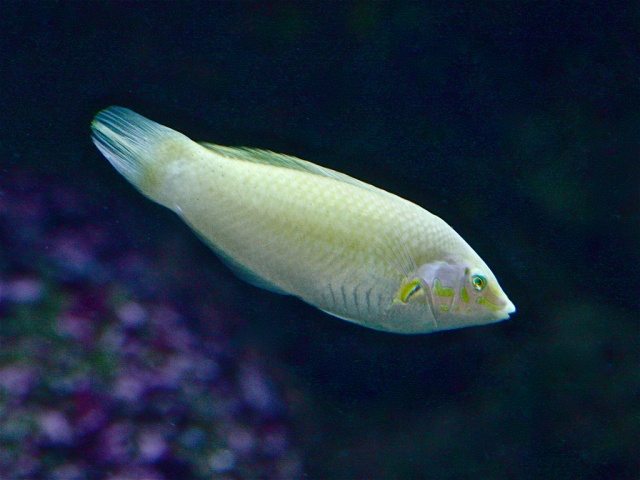
TAXONOMY
Kingdom: Animalia
Phylum: Chordata
Class: Actinopterygii (ray-finned fishes)
Order: Perciformes (Perch-likes)
Family: Labridae (Wrasses)

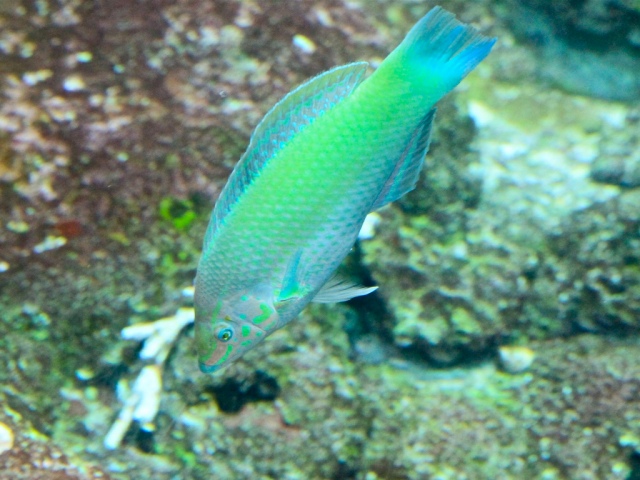
Genus/species: Halichoeres chloropterus

13392429345_0df197f614_b

GENERAL CHARACTERISTICS: Juveniles lime green; females pale green above and white below, with a thin dark line on the base of the pectoral fin. Terminal males head of male with intricate reticulate pattern of bands that varies from one individual to another; small blackish spot on anus.

Length up to 19 cm (7.5 inches).

DISTRIBUTION/HABITAT: West Central Pacific: Philippines to the Great Barrier Reef. Found in shallow protected coral reef on silt, sand and rubble bottom. Depth to 10 meters (33 feet)

Pastel-green wrasse4391731072_b36a014eca_b

DIET IN THE WILD: Hard-shelled prey, including mollusks, crustaceans, and sea urchins.

CONSERVATION: IUCN Least concern.

References

California Academy of Sciences Philippine coral reef 201

Ron’s flickr  https://www.flickr.com/photos/cas_docents/3332103036/in/set-72157608208133134/

Ron’s WordPress shortlink  http://wp.me/p1DZ4b-1eI

fishbase: www.fishbase.org/summary/Halichoeres-chloropterus.html

EOL eol.org/pages/223761/details


TAXONOMY

Kingdom: Animalia

Phylum: Chordata

Subphylum: Vertebrata

Class: Actinopterygii

Order: Perciformes

Family: Labridae: (Wrasses)


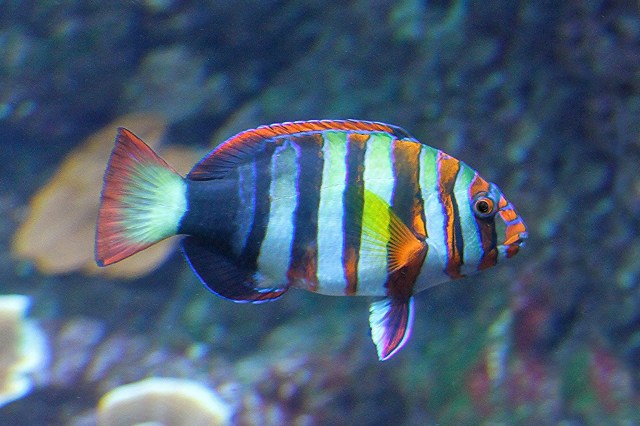
Genus/species;   Choerodon fasciatus

GENERAL CHARACTERISTICS: 
C. fasciatus 
has vertical, broad, bright orange bands interspersed with blue bands. The caudal peduncle is black,  tail is white and dorsal as well as pelvic fins are orange. As it ages the back half of the body darkens to a dark blue/purple color. The mouth has large blue teeth is a very distinctive feature. 

Length up to 30 cm (12 in).

13468909953_41792a2c76_k

DISTRIBUTION/HABITAT: Found in the Western Pacific among seaward reefs, 5–35 m (15-100 ft). Usually solitary.

DIET IN THE WILD:
 Tuskfish have protruding canines used for moving rubble to expose invertebrate prey and prying mollusks from the substrate. Hard shelled prey crushed by pharyngeal teeth. Eats mollusks, echinoderms, crustaceans, worms.

REPRODUCTION
 Pelagic spawners, initial males spawn in large groups; terminal males are usually territorial and pair
 spawn with females of their choice. Females change sex into males for their terminal phase.

CONSERVATION: IUCN Least Concern

REMARKS: Wrasses are most easily identified by their pointed snouts and prominent canine teeth that protrude in front of the jaw. Other common characteristics include their form of propulsion, which depends mostly on the wing like motion of the pectoral fins with only an occasional burst of speed provided by the caudal fin. Color, markings and body shapes change during maturation.

References

California Academy of Sciences Philippine coral reef 2016

Ron’s flickr  https://www.flickr.com/photos/cas_docents/13468909953/in/album-72157608208133134/

Ron’s Wordpress Shortlink  http://wp.me/p1DZ4b-BV

EOL  http://eol.org/pages/206009/details

fishbase   http://www.fishbase.org/summary/Choerodon-fasciatus.html

TAXONOMY
Kingdom: Animalia
Phylum: Chordata
Class: Actinopterygii (ray-finned fishes)
Order: Perciformes (Perch-likes)
Family: Labridae (Wrasses)

Genus/species: Gomphosus varius

GENERAL CHARACTERISTICS: Wrasses vary greatly in size and body shape. All have terminal mouths, prominent canines, thick lips, and a single continuous dorsal fin.

The Bird Wrasse common name refers to the fish’s long snout, which is said to resemble a bird’s beak. This species, like many wrasses, changes appearance as it matures. During the juvenile phase it is green above and white below. The snout is short. In the next phase, called the initial phase, most or all are females, and they are white with a black spot on each scale. The top of the snout is orange, and the caudal fin is black with a white border. 

During the terminal phase, a dominant male becomes blue-green. The caudal fin has a bright blue crest.

Length of males up to 30 cm (12 inches) Females to about 20 cm (8 inches)

Initial Phase below

DISTRIBUTION/HABITAT: Indo-Pacific: East Africa to Hawaiian Islands, north to southern Japan, south to Australia. Found in lagoons and seaward reefs at depths 2–30 m (6-100 ft.).

DIET IN THE WILD: Unlike parrotfishes which scrape algae from rocks with fused beaks, most wrasses feed on hard-shelled invertebrates such as crabs, brittle stars and shrimps  They use scissored motions with protruding canines and crush with powerful pharyngeal teeth. 

REPRODUCTION: Anthias and most wrasses are protogynous hermaphrodites meaning they are born female but if a dominant male perishes, the largest female of the group will often change into a male to take its place. On the other hand, clown anemonefish are protandrous hermaphrodites. This means that they mature as males and the largest one will change into a female when the resident female dies.

REMARKS: Like other wrasses, the bird wrasse can be recognized by its characteristic swimming pattern: the pectoral fins move up and down in a “flying” motion”.

Terminal phase below

References

California Academy of Sciences Philippine coral reef 2016

Ron’s flickr  https://www.flickr.com/photos/cas_docents/3751456858/in/album-72157625992053826/

Australian Museum http://australianmuseum.net.au/Birdnose-Wrasse-Gomphosus-varius

EOL  http://eol.org/pages/224889/details

Ron’s WordPress shortlink http://wp.me/p1DZ4b-K8

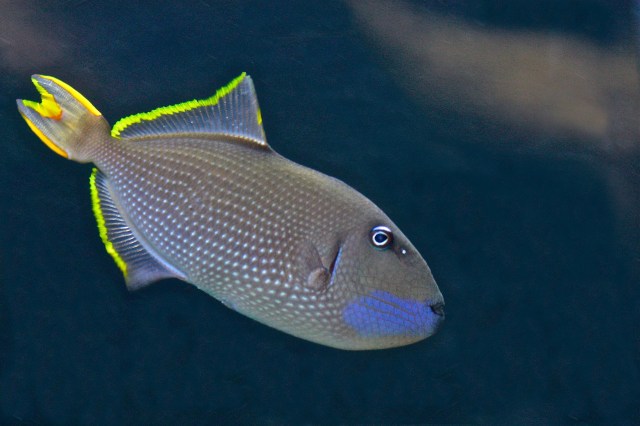
TAXONOMY
Kingdom: Animalia
Phylum: Chordata
Class: Actinopterygii (ray-finned fishes)
Order: Tetraodontiformes (Puffers and filefishes)
Family: Balistidae (Triggerfishes)

Genus/species: Xanthichthys auromarginatus

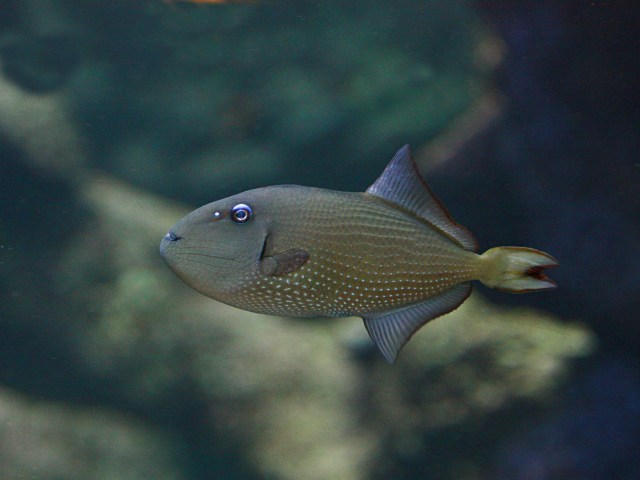
 Male belowBluechin Triggerfish aka Gilded Triggerfish (male) Xanthichthys auromarginatus (Balistidae)TriggerfishesIMG_1613

GENERAL CHARACTERISTICS: Steel blue with white spots. Males have blue chin patch and yellow margins on dorsal, anal, and caudal fins. Females lack chin patch, and have maroon stripe on base of dorsal and anal fins, and on outer margin of tail.

Their scales are plate-like and have no pelvic fins.

Length to up to 11.8 inches. (male above, female below)

Gilded Triggerfish (female) Xanthichthys auromarginatus _2

DISTRIBUTION/HABITAT: Indo-Pacific: East Africa to Hawaiian Islands, north to the Ryukyus, south to New Caledonia. Marine reefs 25 – 450 ft depths.

DIET IN THE WILD: Feeds a few meters above the bottom where it consumes zooplankton (prefers copepods).

REPRODUCTION: Distinct pairing, oviparous, external fertilization.

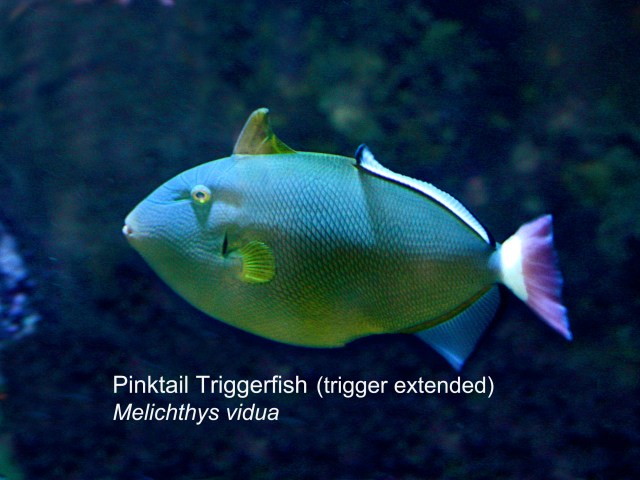
REMARKS: The common name comes a unique interaction between the large first dorsal spine and the smaller second one behind. When the posterior spine is erect, it locks the strong first spine vertically in place, allowing it to wedge itself into a protective space, perhaps a hole or under a rock, where a predator can rarely extract it. When the posterior spine is depressed, the anterior spine folds back easily, like taking a lock off a trigger.

Pink tail triggerfish with trigger erect below (not on exhibit)

PinkTail Triggerfish Erect trigger IMG_0863 copy

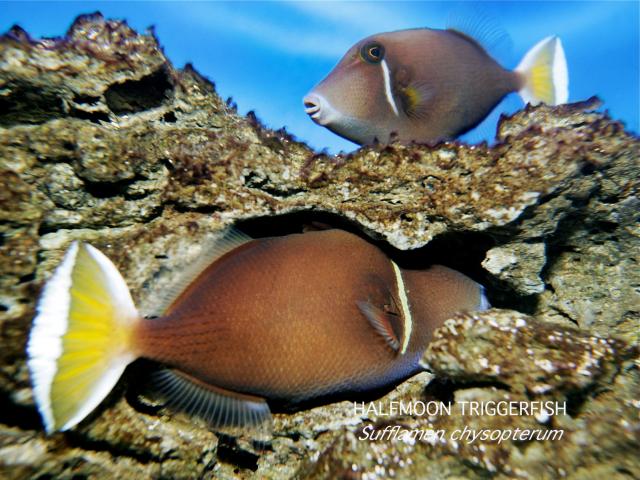
Halfmoon trigger hiding below (not on exhibit)

HALFMOON TRIGGERFISH

Like all triggerfishes, able to rotate eyeballs independently.

References

California Academy of Sciences Philippine coral reef 2016

Ron’s  flickr www.flickr.com/photos/cas_docents/2978997545/edit-details/

Ron’s  Wordpress shortlink http://wp.me/p1DZ4b-RX

 fishbase www.fishbase.us/summary/6030

 EOL eol.org/pages/204534/details