Category: INDO-PACIFIC


TAXONOMY
Kingdom:Animalia
Phylum: Cnidaria
Class: Anthozoa
Order: Corallimorpharia
Family: Discosomatidae (Corallimorphian)

Genus/species: Discosoma spp.

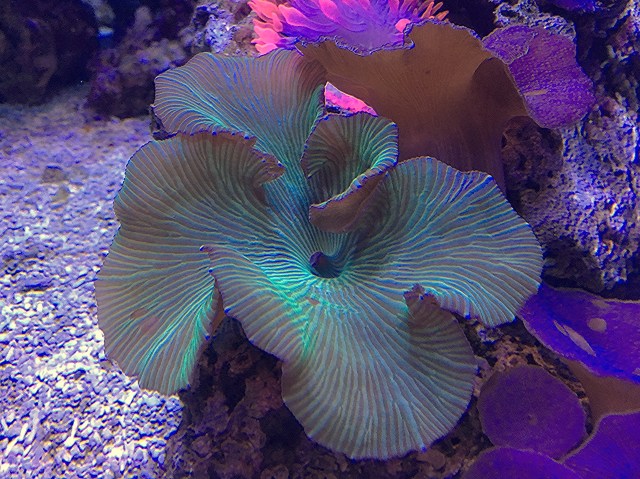
GENERAL CHARACTERISTICS: Generally they are disc shaped with a conical mouth, and the oral disc may be smooth, ribbed, with small or large pseudo tentacles or none at all. Unlike Rhodactus spp., most Discosoma spp. have smooth disc surfaces that lack obvious tentacles, though some may have small or rudimentary tentacles that are visible as rows of knobs.  Discosoma spp.  have many different colors such as blue, red, green and purple and some comes in stripes and spotted pattern,

The consistency of the tissues is thick and, due to copious mucus production, they are slippery to the touch.
26535600445_40b1028ba7_o

Diameter up to 8–15 cm (3-6 in)

DISTRIBUTION/HABITAT: Widespread in Indo-Pacific; also common in the Caribbean. Found in tropical coral reefs, typically in dense aggregations.

2999123527_d91c88eb75_o

DIET IN THE WILD: Discosoma spp. is a microcarnivore of plankton; may also possess zooxanthellae.

REPRODUCTION: Sexual and asexual, mostly through budding and pedal laceration. Formation of colonies of clones is common for most species.

5063052164_42df453911_o

REMARKS:

Corallimorphs are, as their name implies, very coral-like, but they do not secrete a skeleton.

Aquarists commonly use the generic term Actinodiscus.

REFERENCES

California Academy of Sciences Steinhart Aquarium Color on the Reef 2018

Aquarium Corals E H Borneman TFH Publications 2001 page 201-3

Ron’s flickr https://www.flickr.com/photos/cas_docents/26535600445/in/album-72157659465376212/

Ron’s WordPress shortlink wp.me/p1DZ4b-1Kn

Advanced Aquarist www.advancedaquarist.com/2002/10/inverts#section-0

TAXONOMY
Kingdom: Animalia
Phylum: Cnidaria
Class: Anthozoa
Order: Actiniaria
Family: Stichodactylidae

Genus/species: Stichodactyla tapetum  (aka Discosoma tapetum in the past)


GENERAL CHARACTERISTICS: Tentacles are short bulbous variegated in a multicolored pattern and densely packed. They are often arrayed in fields on the entire disc. 

Diameter is up to 4 inches.

DISTRIBUTION/HABITAT: S. tapetum are found in the Indo-Pacific and Red Sea covering the sand or reef like a carpet.

DIET IN THE WILD: Feed primarily on nutrients of symbiotic zooxanthellae living in their tissues as well as drifting plankton. 

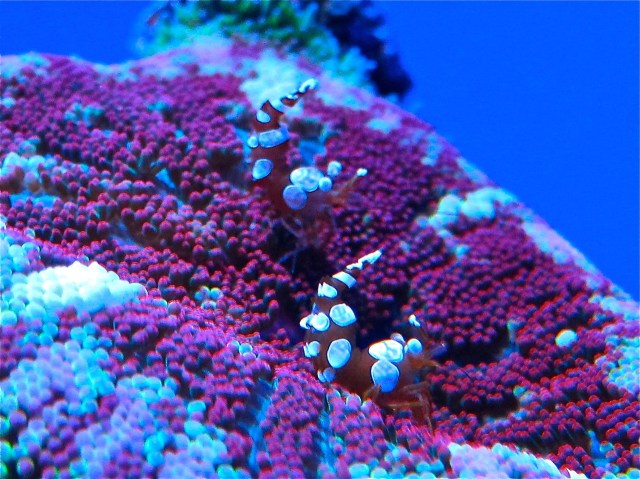
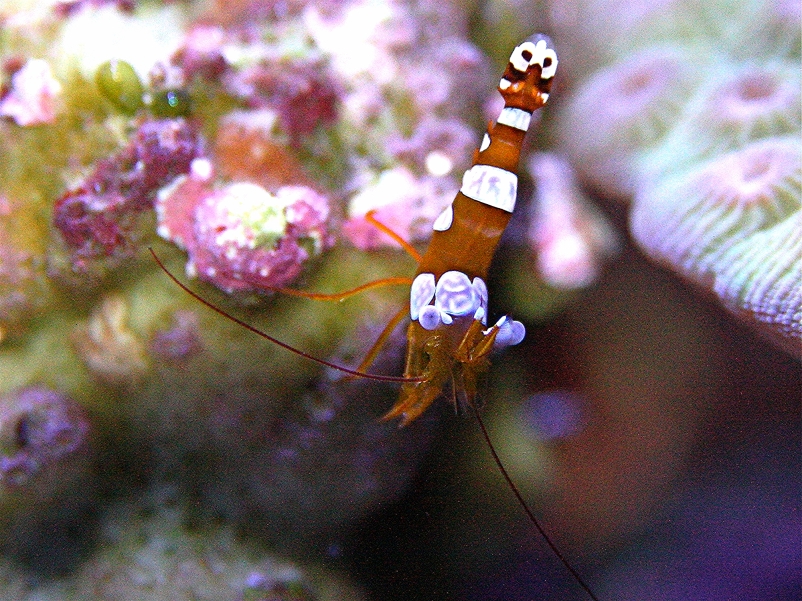
REMARKS:  They are not known to host clown fish, but they are attractive to anemone shrimp and anemone crabs. In the wild, they are favored by Sexy Shrimp (Thor amboinensis) and Periclimenes spp. commensal shrimps.

They can give a potent sting if touched.


References

California Academy of Sciences Steinhart Aquarium Hidden Reef 2018

Animal Diversity Web animaldiversity.org/accounts/Stichodactyla_tapetum/classi…

Ron’s flickr  https://www.flickr.com/photos/cas_docents/24745127802/in/album-72157659465376212/

Ron’s WordPress Shortlink  http://wp.me/p1DZ4b-iW

TAXONOMY
Kingdom: Animalia
Phylum: Chordata
Class: Actinopterygii
Order: Perciformes (Perch-likes)
Family: Gobiidae (Gobies)
Subfamily: Gobiinae

Genus/species: Stonogobiops yasha

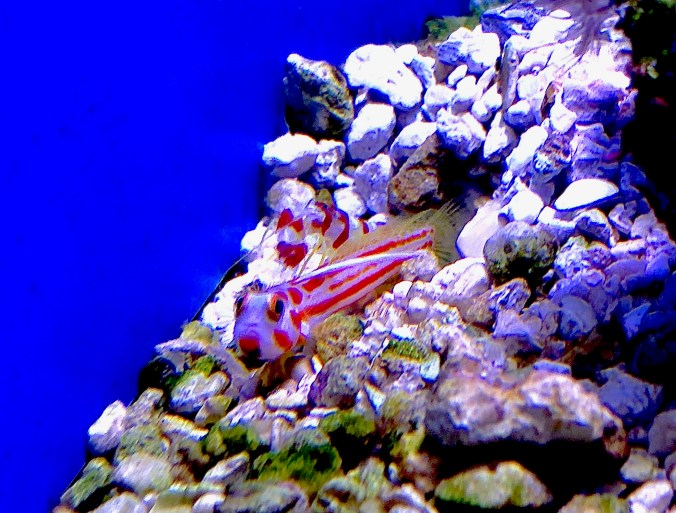
GENERAL CHARACTERISTICS: Body white, with 3 reddish-orange stripes.

Video links

DISTRIBUTION/HABITAT: They are found in Western Pacific in the outer reef slopes; often in pairs, hovering a few centimeters above the sandy bottom at the entrance of its burrow. Symbiotic with the red-and-white barred shrimp, Alpheus randalli

DIET IN THE WILD: The shrimp goby feeds on zooplankton and small benthic invertebrates.

Video link.  https://www.flickr.com/photos/cas_docents/39444680840/in/album-72157659465376212/

CONSERVATION: NOT EVALUATED
They are captive bred making them available to aquariums.

REMARKS: For a discussion of gobies and their commensal relationships (both parties in the relationship benefit). (see link below).
The goby benefits from the shrimp’s digging and construction skills, having access to a well-built burrow. Pistol shrimps have poor eyesight and they use gobies as an early warning system to detect predators. Gobies tend to hover just outside the shared burrow, catching passing zooplankton or small benthic invertebrates. In many cases the shrimps maintain contact with the gobies by using their long antennae.

Tropical Fish Mag.  www.tfhmagazine.com/saltwater-reef/feature-articles/pisto…

REFERENCES

California Academy of Sciences Steinhart Aquarium Hidden Reef 2018

Ron’s flickr https://www.flickr.com/photos/cas_docents/41253989801/in/album-72157659465376212/

fishbase.  www.fishbase.se/summary/Stonogobiops-yasha.html

Ron’s WordPress Shortlink wp.me/p1DZ4b-1W8

TAXONOMY
Kingdom: Animalia
Phylum: Arthropoda
Subphylum: Crustacea
Class: Malacostraca
Order: Decapoda
Infraorder: Caridea
Family: Hippolytidae

Genus/species: Thor amboinensis

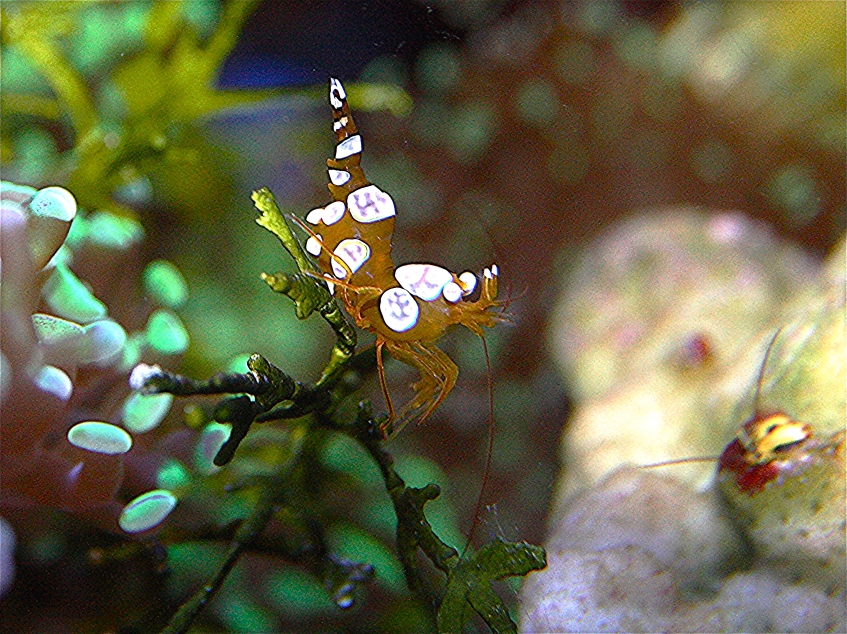
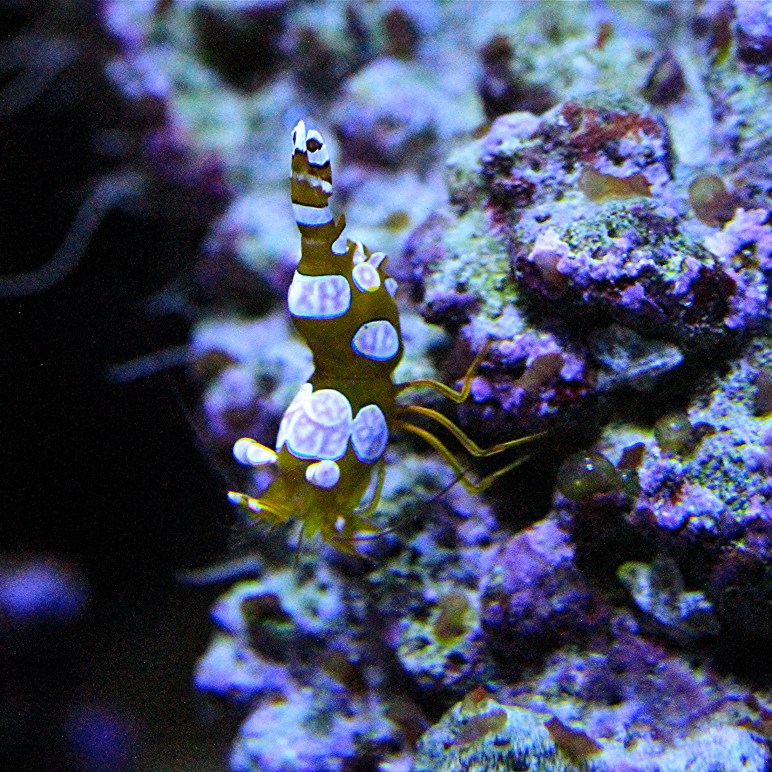
GENERAL CHARACTERISTICS: Base body color is drab (olive or brown), with iridescent yellow-white spots bordered by thin white and blue bands, symmetrically arranged over their bodies. The distinctive vertical position and movement of the abdomen earn this shrimp its common name of “sexy.”

Length up to 2 cm. (0.8 inches)


3574925860_fd0f1a8f63_o

Length up to 2 cm. (0.8 inches)

DISTRIBUTION/HABITAT: Common in tropical seas worldwide. Found in Coral reefs; in association with anemones such as form symbiotic relationships with anemones such as Entacmaea quadricolor, Macrodactyla doreensis, Stichodactyla tapetum, and Zoanthus sp., living on and around their oral discs, tentacles, or substrate very near to anemone bases.

Sexy shrimp4104005971_290c048ff2_o
DIET IN THE WILD: Sexy shrimp are carnivorous feeding on matter trapped in a host anemone’s mucus, including plankton. Their diet may also include other small crustaceans, such as brine shrimp and krill. When resources are scarce, shrimp may resort to feeding on the tentacles of their hosts.

REPRODUCTION: These shrimp are protandric hermaprhodites; they are born male and may change into females later in life.
Mating is polygynandrous (promiscuous) T. amboinensis are sexually dimorphic. Males are typically smaller than females and have white spots on their pleopods (appendages). During copulation, a male transfers sperm cells from his gonopores (located on his fifth pereopods) to a female’s gonopores (on her third pereopods).
Females carry, and oxygenate eggs under their forward tail section, on the pleopods. While bearing eggs, they hold their legs under the tail to protect them.

3288692919_9aa8f9db8a_o

Lifespan ave. 3.5 years

CONSERVATION: IUCN RED LIST Not Evaluated

REMARKS: Sexy shrimp are known to vibrate their abdomen to signal or warn others. They are capable of moving very quickly, at rates of 10-15 cm/s, to escape perceived threats.

They will endure the attacks from the anemones’ nematocysts. Some studies state that a shrimp acclimates to an anemone by collecting its mucus, which camouflages it from the anemone or other studies say that a shrimp acclimates by building up chemicals that inhibit the excretions of nematocysts from anemones.

References

California Academy of Sciences, Steinhart Aquarium, Hidden Reef 2018

Ron’s flickr  https://www.flickr.com/photos/cas_docents/3574925860/in/album-72157659465376212/

ADW animaldiversity.org/accounts/Thor_amboinensis/

Ron’s WordPress shortlink  http://wp.me/p1DZ4b-1Jv

TAXONOMY
Kingdom: Animalia
Phylum: Chordata
Class: Actinopterygii (ray-finned fishes)
Order: Perciformes (Perch-likes)
Family: Apogonidae (Cardinalfishes)

Genus/species: Sphaeramia orbicularis

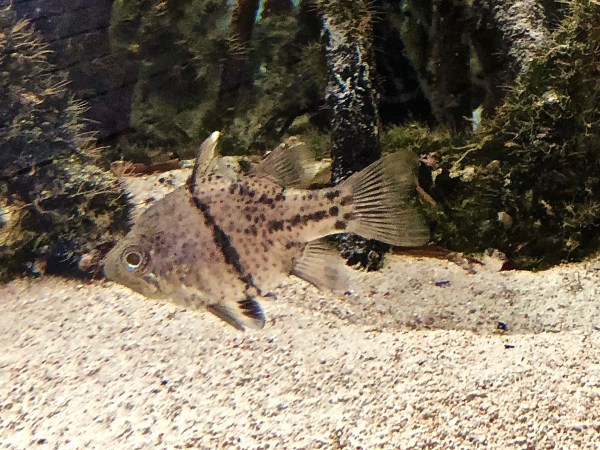
GENERAL CHARACTERISTICS: The Orbicular Cardinalfish color is greenish grey with silvery reflections. A narrow dark mid body vertical bar is present from the origin of spiny dorsal fin to just in front of anus. There are variable-sized scattered spots on rear of the body. The pelvic fins have a dark bar.

Length up to 11.5 cm (4.5 inches).

DISTRIBUTION/HABITAT: S.orbicularis is native to the Indo-Pacific, E. Africa to Figi, S.W. Japan to New Caledonia. Found in coastal waters among mangroves, rocks, debris and piers. Depth to 3 meters.

DIET IN THE WILD: It feeds at night on planktonic crustaceans.

REPRODUCTION: Like all cardinalfishes they are paternal mouthbrooders.

CONSERVATION: IUCN 2006 Red List; Not evaluated.

References:

California Academy of Sciences Steinhart Aquarium Mangrove Pop-Up, Main floor (level one) 2018

Ron’s flickr  https://www.flickr.com/photos/cas_docents/39777042992/in/album-72157675807621922/

fishbase www.fishbase.org/summary/4926

Encyclopedia of Life eol.org/pages/221177/details

Reef Fish ID Tropical Pacific, Allen et/al 2003, page 266.

Ron’sWordpress shortlink wp.me/p1DZ4b-1Uj

TAXONOMY
Kingdom:Animalia
Phylum: Chordata
Class: Actinopterygii (ray-finned fishes)
Order: Perciformes (Perch-likes)
Family: Cirrhitidae (Hawkfishes)

Genus/species: Neocirrhites armatus

GENERAL CHARACTERISTICS: Hawkfishes are bottom feeders without swim bladders usually found in coral branches. Cirri at the tips of their dorsal fins identifies them.

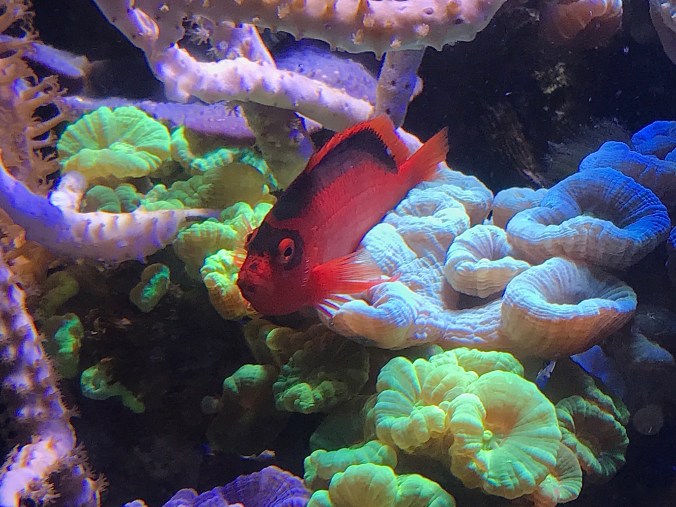
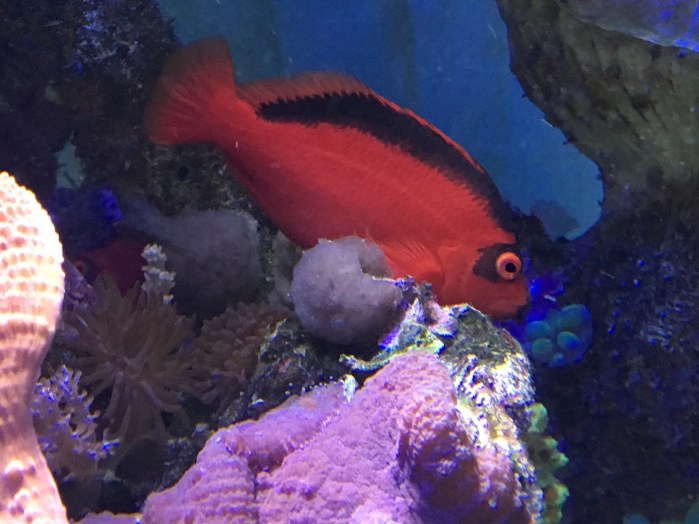
The Flame hawkfish has brilliant red color with a black stripe that runs along the base of their dorsal fin, as well as black circles around their eyes.

Length up to 9 cm (3.5 in)

DISTRIBUTION/HABITAT: Found in the Pacific Ocean: Great Barrier reef to Micronesia on corals.

DIET IN THE WILD: Small crustaceans

REPRODUCTION: Oviparous, monogamous

CONSERVATION: IUCN Not Evaluated

References

Ron’s flickr https://www.flickr.com/photos/cas_docents/32538479733/in/album-72157629304397467/

California Academy of Sciences Steinhart Aquarium Animal Attractions 2017

fishbase fishbase.org/summary/5832

EOL eol.org/pages/204618/details

reef keeping www.reefkeeping.com/issues/2002-06/hcs3/

Ron’s WordPress Shortlink http://wp.me/p1DZ4b-1QC


TAXONOMY
Kingdom: Animalia
Phylum: Cnidaria
Class: Anthozoa
Order: Actiniaria
Family: Stichodactylidae

Genus/species: Heteractis magnifica

GENERAL CHARACTERISTICS: H. magnifica is the second largest in size of all sea anemones. Disc to 1 m (3 ft) in diameter. Column which may be red, purple, or pink, grows to 20 cm (8 in). Tentacles (exceed 8 cm 3 in long) are of uniform thickness and do not taper at te tip; tentacles and oral disc are colored alike in shades of magenta-purple, blue, green , red, white or brown.


DISTRIBUTION/HABITAT: Found in the Indo-Pacific at 1–25 m (3-85 ft) often on prominent structures in strong currents or in strong surge locations.

DIET IN THE WILD: Most nutrition is from products of zooxanthellae. Also may eat fish and crustaceans using their stinging nematocysts.

REPRODUCTION: Asexual reproduction by longitudinal fission. The presence of the symbiotic clown fish Amphiprion chrysopterus can increase the amount of asexual reproduction and general growth.
Sexual reproduction, their fertilized eggs develop into a planula larvae which settles on the ocean floor and develops into a polyp.


PREDATION: Symbiotic clownfishes, chase away any nibbling predators, especially bristle worms.

LONGEVITY: in the wild. It is estimated that some of these anemones are hundreds of years old. In captivity, the longest lifespan is 80 years.

CONSERVATION: IUCN: Not Evaluated

REMARKS: Host to at least 12 anemonefish species. When disturbed, H. magifica “balls up,”showing only the column with only a few tentacles protruding.
The magnificent anemone is motile when trying to re-position itself to obtain more sunlight. This species moves by creeping on its basal disc, or by letting the tide carry it.
Anemones can be semi-aggressive and sting other anemones that invade their space.

References

California Academy of Sciences Water is Life Animal Attractions 2017

Ron’s flickr https://www.flickr.com/photos/cas_docents/32131406193/in/album-72157629304397467/

Animal Diversity Web animaldiversity.org/accounts/Heteractis_magnifica/

Ron’s WordPress Shortlink  http://wp.me/p1DZ4b-1PJ


TAXONOMY
Kingdom: Animalia
Phylum: Chordata
Class: Actinopterygii (ray-finned fishes)
Order: Syngnathiformes (Pipefishes and seahorses)
Family: Syngnathidae (Pipefishes and seahorses)

Genus/species: Haliichthys taeniophorus

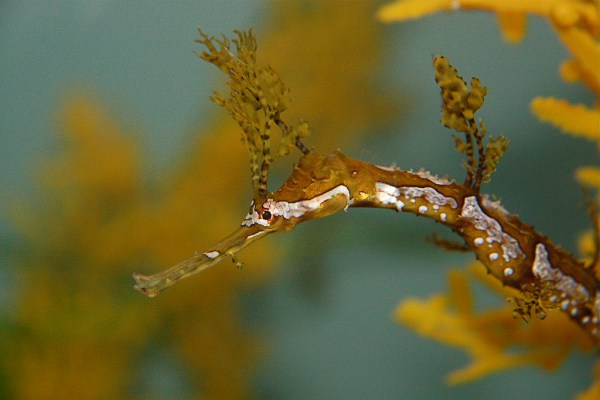
GENERAL CHARACTERISTICS: Ribboned Pipefish have elongate scaleless bodies with bony knobs above the eyes and spines on body with a series of bony rings. The body color consists of shades of brown, green and yellow; The snout is tube like with no jaw and a terminal mouth. H. taeniophorus has a single dorsal fin, and its head and body are adorned with leafy appendages. They possess a prehensile tail that is used to attach to seagrass while searching for nearby prey.

Length up to 30.0 cm (11.8 in)

DISTRIBUTION/HABITAT: Indo-Pacific: Indonesia south to Australia. Found in protected coastal shallows over or among algae, sea grasses, or floating weeds.

DIET IN THE WILD: Minute invertebrates and small planktonic crustaceans.

REPRODUCTION: They are ovoviviparous. The male carries the eggs in a brood pouch which is found under the tail.

CONSERVATION: IUCN Least Concern. This species may be susceptible to being caught as bycatch and/or targeted for use in trade, but this has not been documented. There are no other known threats to this species.

REMARKS: Pipefishes differ from seadragons which lack the brood pouch of seahorses and pipefishes.

References

California Academy of Sciences Animal Attractions

Ron’s flickr https://www.flickr.com/photos/cas_docents/3429248779/in/album-72157608441047857/

fishbase fishbase.org/summary/Haliichthys-taeniophorus.html

Arkive  www.arkive.org/ribboned-pipefish/haliichthys-taeniophorus/

IUCN www.iucnredlist.org/details/95882787/0

Ron’s WordPress Shortlink http://wp.me/p1DZ4b-1Pb

TAXONOMY
Kingdom: Animalia
Phylum: Cnidaria
Class: Anthozoa
Subclass: Hexacorallia
Order: Corallimorpharia
Family: Ricordeidae

Genus/sp. Rhodactis spp.

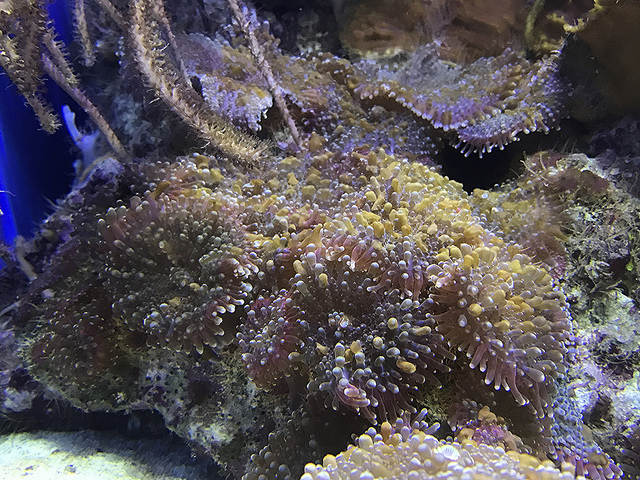
GENERAL CHARACTERISTICS: Rhodactis mushroom grow much larger than other mushroom genera, some attaining sizes of more than 10 inches across. The surface of their mushroom cap is covered with small tentacles (verrucae) or large warty knobs that are radially arranged. They are found attached to rock.

Rhodactus32905288196_ab8d24778a_z

DIET IN THE WILD: Ricordeidae feed both on the products of zooxanthellae, and on zooplankton or fish they catch with their tentacles and nematocysts as well as dissolved organic matter.

Rhodactus32774273105_54135cc7e6_z

REPRODUCTION: Asexual reproduction occurs by two mechanisms. Split or fission reproduction occurs when the coral splits along its mouth creating a clone. Alternatively, particulates released from the foot can develop into a new specimen, which is called laceration.

Sexual reproduction produces a larva called a Planula which once on the seabed develops into a new individual.

References

California Academy of Sciences Steinhart Aquarium Color on the Reef AQA12 2017

Aquarium Corals Eric Borneman TFH publications 2001 pages 206-209

EOL eol.org/pages/4680444/overview

Ron’s WordPress Shortlink http://wp.me/p1DZ4b-1M9

Ron’s flickr https://www.flickr.com/photos/cas_docents/32905288196/in/album-72157659465376212/


TAXONOMY
Kingdom: Animalia
Phylum: Cnidaria
Class: Anthozoa
Order: Alcyonacea
Family: Alcyoniidae

Genus/species: Lobophytum sp.

GENERAL CHARACTERISTICS: Typically colored yellowish brown, some ridged leather corals colored green by their algal endosymbionts. Lobed leather corals often encrusting or low and spreading. Upper surface with rounded or finger-like lobes. Usually no real stalk; colony often grows out from a low platform. Large polyps distinctly spaced from one another. Tentacles are retractile.

Tentacles retracted below

Lobophytum sp.32131393013_65a065d26a_k

DISTRIBUTION/HABITAT: Found in Indo-Pacific, Red Sea tropical coral reefs. Zonation varies by species, intertidal to 30 m. Notes apply to entire genus composed of at least 47 species.

Tentacles extended below

lobophytum sp.15794440950_f989b64b19_k

DIET IN THE WILD: They capture microscopic food particles from the water column, can absorb dissolved organic matter, and also use algal photosynthesis.

REPRODUCTION Typically reproduces asexually by budding or fragmentation.

REMARKS: Like Sarcophyton sp., to which it’s closely related, Lobophytum has two distinct types of polyps, one quite small, the other larger. Sinularia has only one.

References

California Academy of Sciences Steinhart Aquarium Color on the Reef AQA17 2017 Vetting Charles Delbeek

Aquarium Corals Eric Borneman TFH publications 2001 pages 127-129

Ron’s flickr https://www.flickr.com/photos/cas_docents/32131393013/in/album-72157659465376212/

Ron’s WordPress Shortlink  http://wp.me/p1DZ4b-1M0