Category: INDO-PACIFIC


TAXONOMY
Kingdom: Animalia
Phylum: Chordata
Class: Actinopterygii (ray-finned fishes) 
Order: Perciformes (Perch-likes) 
Family: Labridae (Wrasses)

Genus/species: Macropharyngodon meleagris
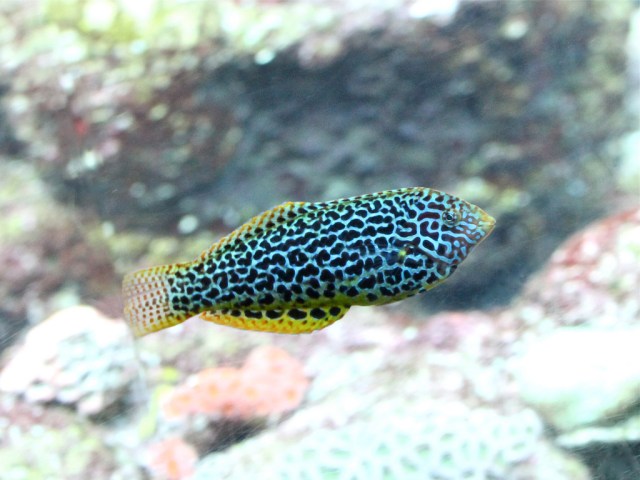
GENERAL CHARACTERISTICS: Sexual dichromism. Females are white with black or brown irregular spots with white to blue margins over the body. Males have orangey-red background with green mottling. Max. length: 15 cm (6 inches).

DISTRIBUTION/HABITAT: Indo Pacific: Eastern Indian Ocean to western Pacific and the islands of Oceania. Habitat: Subtidal reefs and outer lagoons, at depths of 0–30 meters (98 feet).

DIET IN THE WILD: Feed on gastropods, hard shelled prey and foraminiferans.

REMARKS: Wrasses are most easily identified by their pointed snouts and prominent canine teeth that protrude in front of the jaw. Other common characteristics include their form of propulsion, which depends mostly on the winglike motion of the pectoral fins with only an occasional burst of speed provided by the caudal fin. Color, markings and body shapes change during maturation.
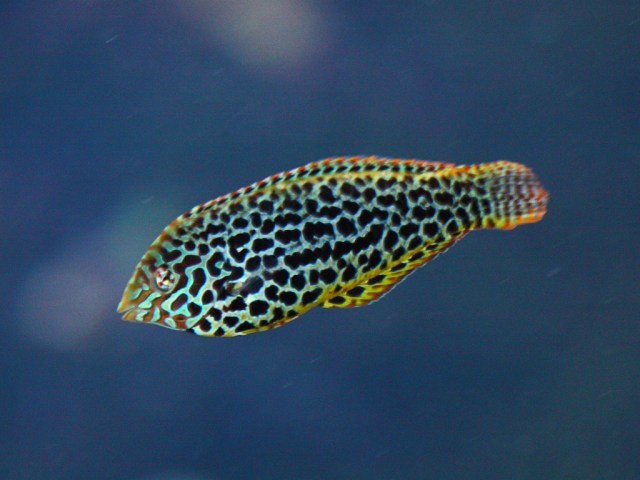
Philippine Coral Reef PR04

flickr http://www.flickr.com/photos/cas_docents/sets/72157608208133134/with/4770699386/

WordPress Shortlink  http://wp.me/p1DZ4b-KA
TAXONOMY

Kingdom:   Animalia

Phylum:     Chordata

Class:         Actinopterygii

Order:        Perciformes

Family:      Acanthuridae

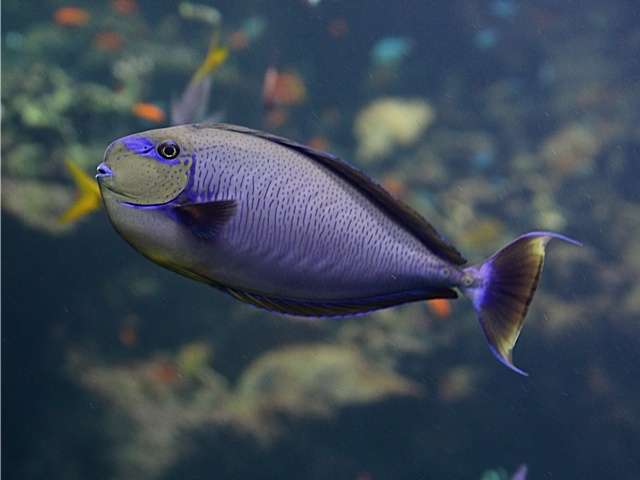
Genus/Species    Naso vlamingii

GENERAL CHARACTERISTICS

Length to 60 cm (23 in). Adults develop a convexly rounded prominent snout and extremely tall dorsal and anal fins. Gray ovate compressed body with bright blue markings. Tips of the tail fin are unusually long. Courting males are able to instantaneously turn iridescent blue.

DISTRIBUTIN/HABITAT


Indo-Pacific in deep lagoon and seaward reefs from 4–50 m (12-150 ft). Diurnally in conspecific groups midwater off steep slopes.

DIET IN THE WILD


Zooplankton.

REPRODUCTION


External fertilization. Egg scatterers, non-guarding. Remarks: Courting males are able to instantaneously turn iridescent blue.

Main Coral Reef Exhibit PR04

flickr www.flickr.com/photos/cas_docents/3120136472/in/set-72157625992053826

WordPress Shortlink http://wp.me/p1DZ4b-BI

PHYLUM  Chorada

CLASS     Actinopterygii (ray-finned fishes)

ORDER    Anguilliformes (Eels and morays)

FAMILY    Muraenidae (Moray eels)

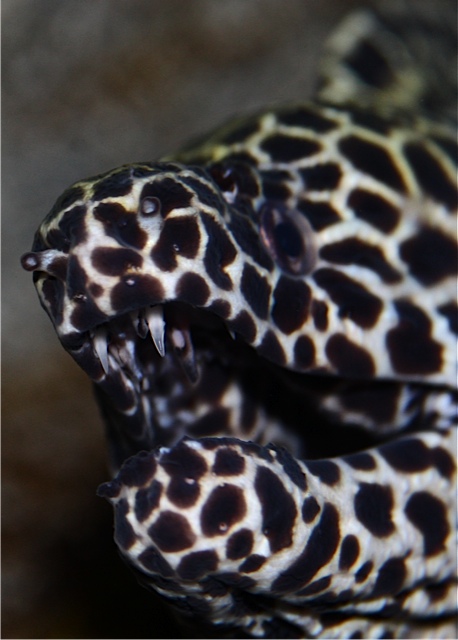
GENUS/SPECIES   Gymnothorax favagineus


GENERAL CHARACTERISTICS

This diverse group is noted for large mouths with numerous teeth, small gill openings, and the absence of pectoral and pelvic fins.  The anal and dorsal fins extend along much of the body and are continuous with the caudal fin. Gill openings are small and roundish and situated on the side of the head.

G. favagineus grows to 3 m, thus it is one of the two largest of Indo-Pacific moray eels. Spots variable between individuals and size.  The surface is covered with dark spots the size of their eye that form a honeycomb pattern. Some individuals colored almost totally black (those found in turbid water).    


DISTRIBUTION/HABITAT

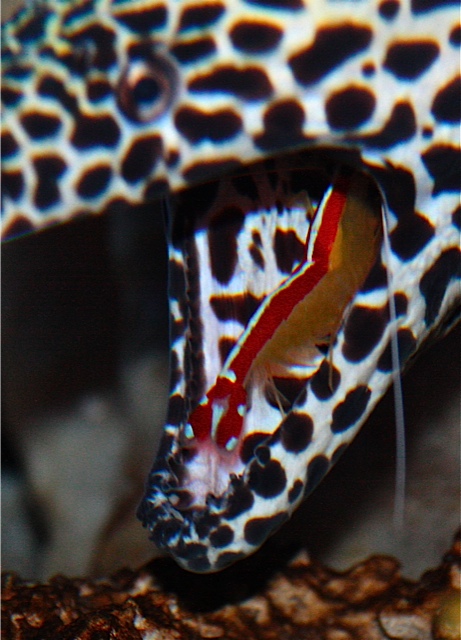
Red Sea, East. Africa to Papua, New Guinea and Great Barrier Reef.  Usually rests in  reef flat rubble and outer reef slopes of  continental reefs, 1–45 m (3-150) in depth. Often found in crevasses with cleaner wrasses or cleaner shrimps.

                                   PHOTO BELOW: Symbiotic relationship with a cleaner shrimp.  

DIET IN THE WILD

Predator upon cephalopods, crustaceans and small fishes.


REPRODUCTION

Leptocephalus larvae.


LOCATION

Dark Cluster  PR22  


WORDPRESS SHORTLINK  http://wp.me/p1DZ4b-AN

Flickr http://www.flickr.com/photos/cas_docents/sets/72157608402401040/

TAXONOMY

KINGDOM      Animalia

PHYLUM        Arthropoda  (External skeleton, segmented body and jointed appendages)

SUBPHYLUM  Crustacea

CLASS          Malacostraca

ORDER         Decapoda  (ten legged)

FAMILY        Hippidae  (mole crabs or sand crabs)

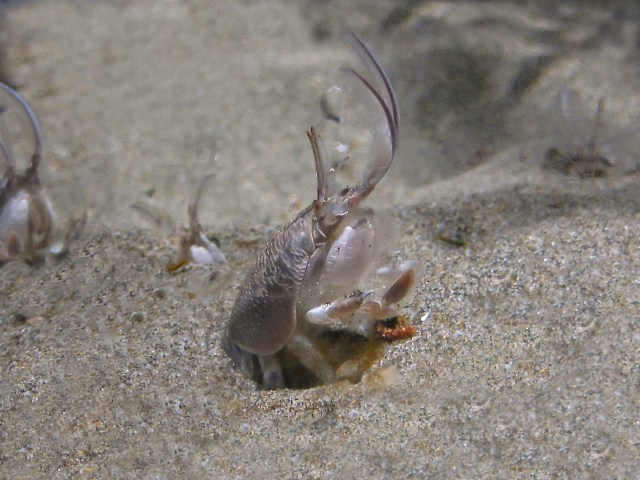
GENUS/SPECIES  Emerita analoga


GENERAL CHARACTERISTICS

 Grey or sand colored exoskeleton without spines or claws.  The eyes are on long stalks and the antennae are also elongated so as to project above the surface of the sand. The legs and uropods have hairy margins to assist in digging and for use in collecting food and transferring it to the mouth.  The first pair of antennae reach above the sand for respiration, and the second pair, resembling feathers, are extended when the crab feeds. The female is nearly twice as large as the male up to 35 mm  (1.4 in) long and 25 mm (1.0 in) wide.

The sand crab always moves backwards when burrowing or crawling.

DISTRIBUTION/HABITAT

Pacific coast from Alaska to Baja California in the northern hemisphere and between Ecuador and Argentina in the southern hemisphere. E. analoga live in the swash zone (area of breaking waves) of the sandy beach intertidal zone.

DIET IN THE WILD

Antennae collect small organisms, mostly dinoflagellates which are brought to the mouth and consumed.

 REPRODUCTION

During the reproductive season (February-October), females can produce one clutch per month of 50-45,000 eggs, which take approximately 30 days to develop. Once the eggs hatch, the larvae are planktonic for 4-5 months.

PREDATORS

Fish, water birds, and shorebirds.

The barred surfperch is a very common fish in the surf zone, and sand crabs have been found to make up 90% of its diet.

Emerita analoga are  also used as bait by fishermen.


REMARKS

Sand crabs are known to carry parasites. They are an intermediate host of parasitic worms which are passed on to the predators of sand crabs. Sea otters and birds can eat many crabs per day, and the ingested parasites have been known to kill these predators.

Researchers monitor levels of DDT and domoic acid (a diatome neurotoxin) on a regular basis to assess the health of the ocean.

LOCATION Tidepool

WordPress Shortlink  http://wp.me/p1DZ4b-zq

flickr  http://www.flickr.com/photos/cas_docents/sets/72157608602469734/

TAXONOMY

Phylum Chordata

Class Actinopterygii (Ray-finned fishes)

Order Tetraodontiformes (Puffers and filefishes)

Family Tetraodontidae (Puffers) 

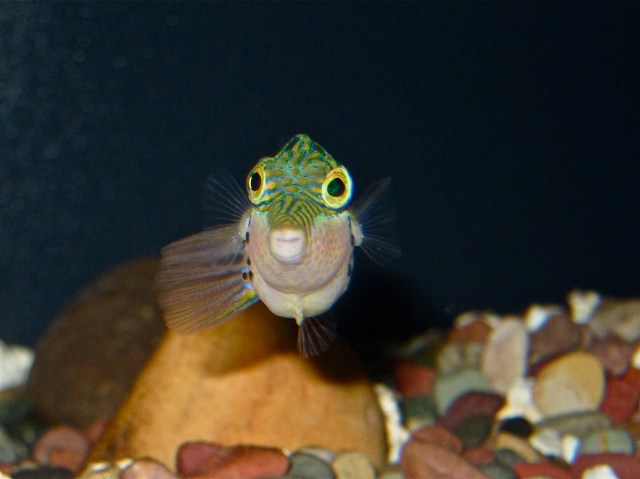
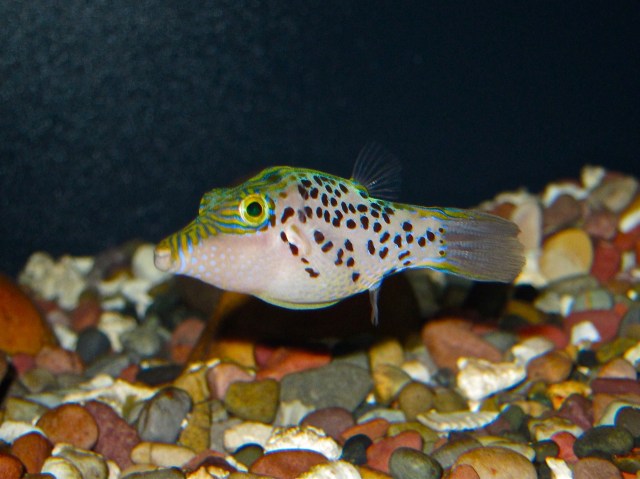
Canthigaster leoparda  

DISTRIBUTION: Eastern Indian Ocean: Christmas Island. Western Pacific: Philippines, Ambon, and Guam. 

 HABITAT: Lives in deep water, usually along deep drop-offs in caves at more than 30 meters depth.

 APPEARANCE: size to 7 cm. (2.75 in).  Topside of face and body are yellow with blue lines; the sides and underside are white with blue spots; the sides with several clusters of brown blotches. Fins clear, except tail.  

 PR11  Color Cluster11-29-11

WORDPRESS SHORTLINK  http://wp.me/p1DZ4b-iH

flickr LINK http://www.flickr.com/photos/cas_docents/5630165858/in/set-72157625020091079

TAXONOMY

KINGDOM   Animalia 

PHYLUM   Mollusca 

CLASS  Cephalopoda 

ORDER   Sepiida 

FAMILY  Sepiidae   

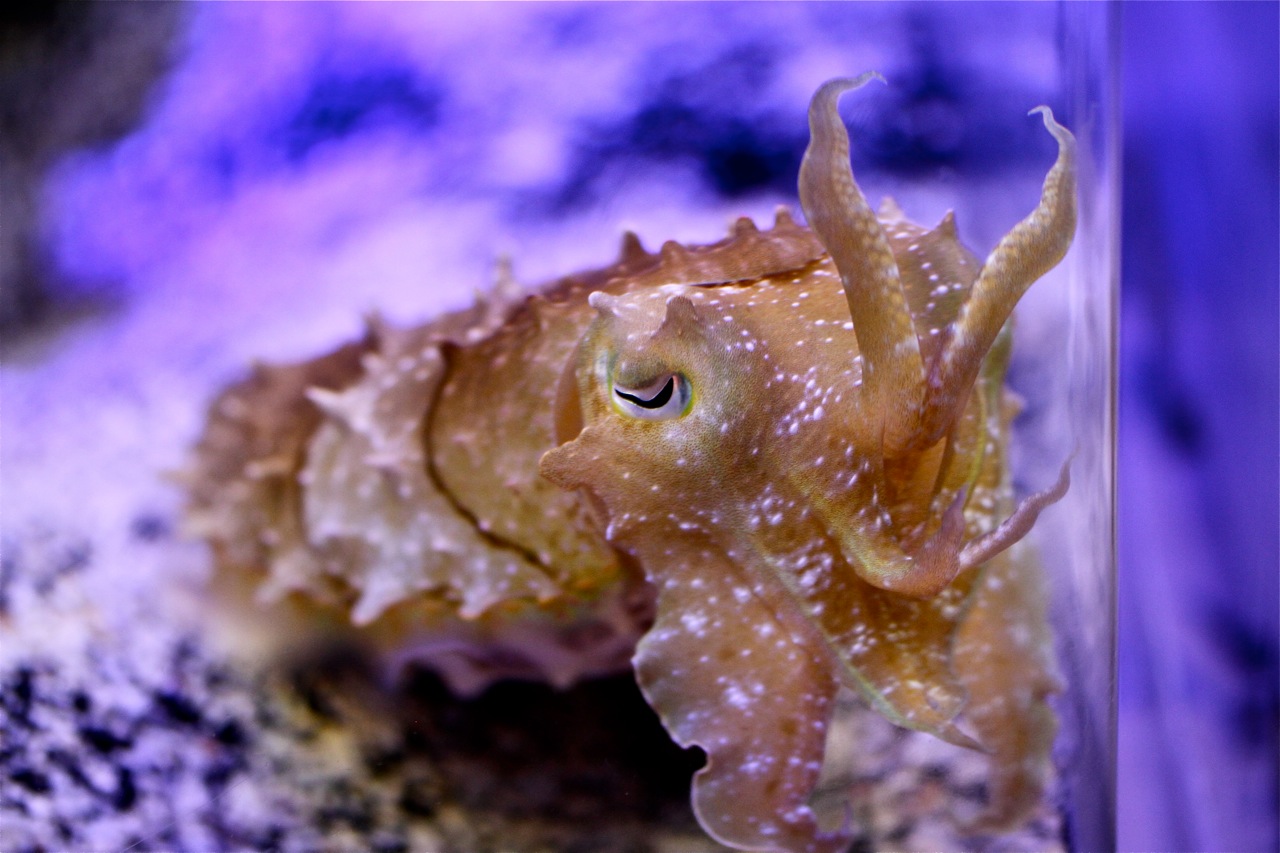
GENUS/SPECIES   Sepia latimanus 


DISTRIBUTION/HABITAT

Indo-Pacific

 They are found in waters up to 30 m near tropical coral reefs.

APPEARANCE

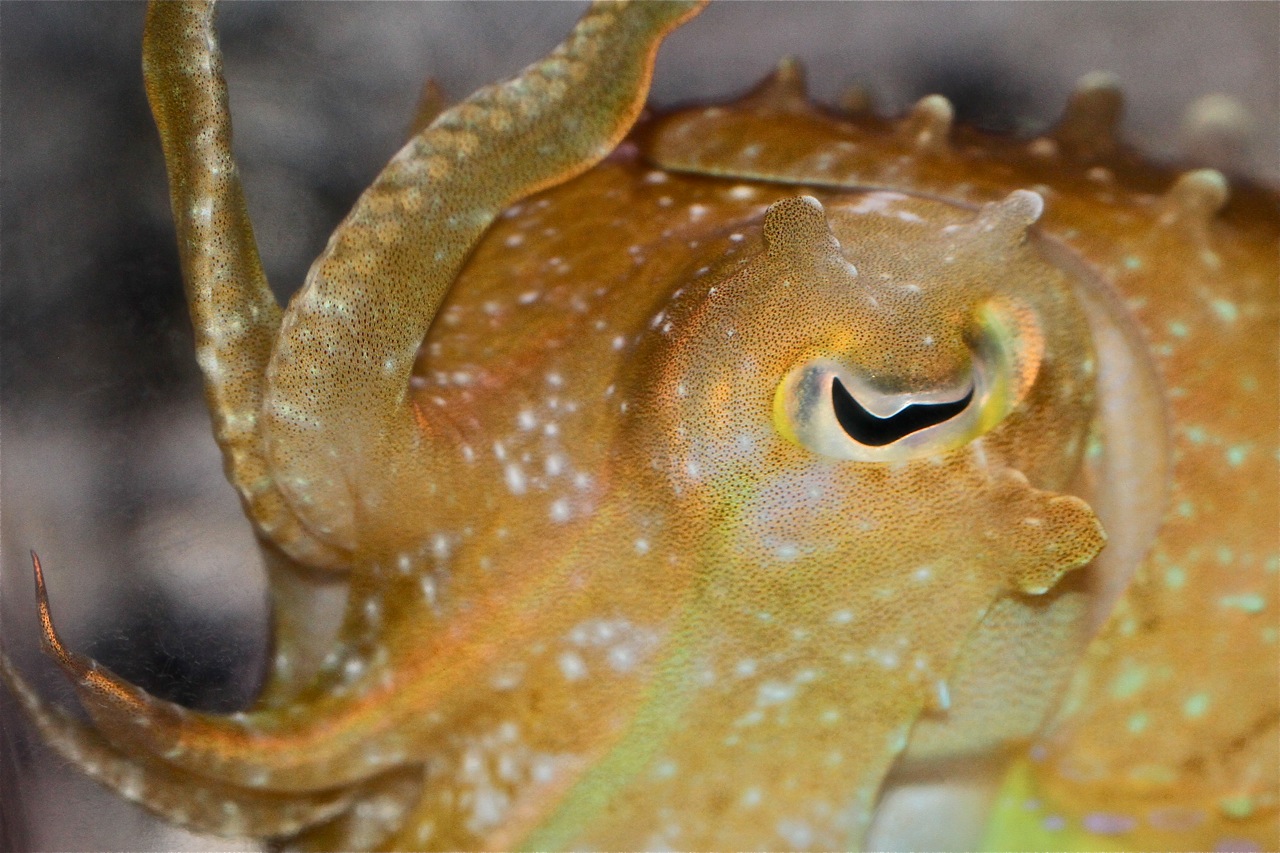
Large fascinating cephalopods with oval mantles  and crescent-shaped clubs .  This species can reach up to 50 cm in mantle length and weigh up to 10 kg. Like many cephalopods, broadclub cuttlefishes can be seen displaying a range of colors and textures. Commonly they are light brown or yellowish with white mottled markings. Males are sometimes dark brown, particularly during courtship and mating. Their arms have longitudinal white bands that appear as broad white blotches when extended. Some of their arms have longitudinal brown bands that extend to their heads. Their dorsal (upper) mantle can sometimes be seen with a saddle mark with small white and brown spots. Their dorsal mantle also has narrow brown transverse bands, and bold, white, transverse stripes and spots. Their eyes are yellow around the ventral (lower) margins and their fins are pale with white, transverse stripes extending onto their mantle and narrow, white bands along their outer margins.

Sepia latimanus  has a variety of different sucker sizes, some that are significantly larger than others. Their cuttlebone is bluntly rounded on either end, with a convex dorsal (curved upper) surface that flattens at the anterior (front) end. Their dorsal mantle is also covered with numerous large papillae and elongate papillae along the sides adjacent to base of each fin.

DIET IN THE WILD

Hunt during the day and appear to mesmerize prey with its rhythmic colored bands. They feed on small fishes and crustaceans.

REMARKS

 Sepia latimanus  is an important species to fisheries throughout their range and are taken by trawls, hand lines, and spears. They are also caught as bycatch in southeast Asian trawl fisheries.


 LOCATION: Not currently on exhibit 7-12-12

WORDPRESS SHORTLINK:    http://wp.me/p1DZ4b-8J