Category: FRESH WATER FISHES


TAXONOMY
Kingdom: Animalia
Phylum: Chordata
Class: Actinopterygii (Ray-finned fishes)
Order: Siluriformes (Catfishes)
Family: Doradidae (Thorny catfishes)

Genus/species: Oxydoras niger

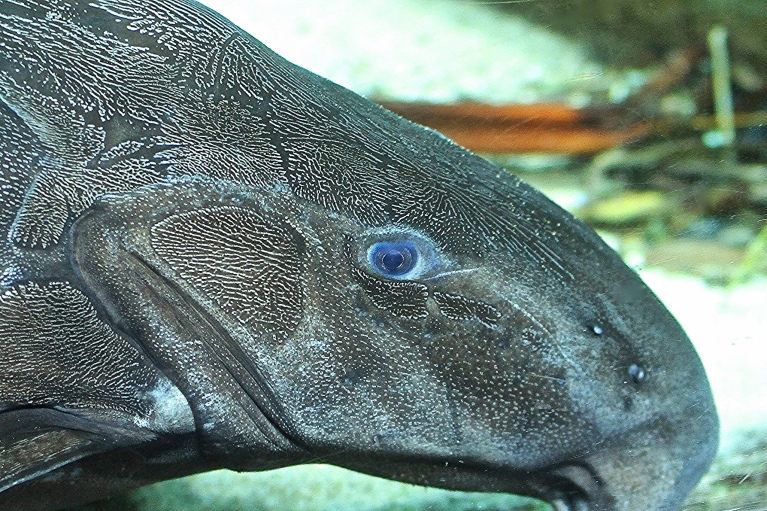
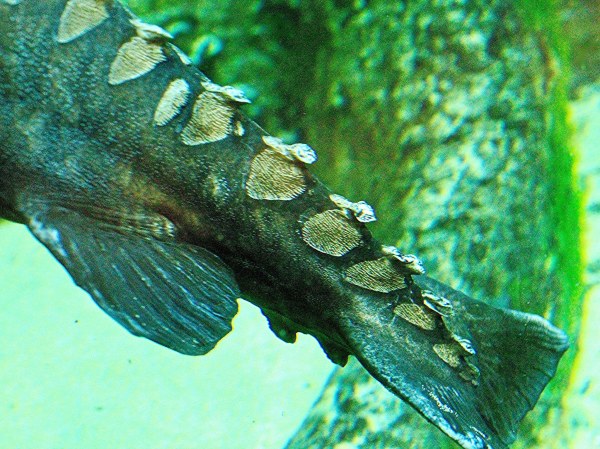
GENERAL CHARACTERISTICS:  A stocky brown catfish with three pairs of barbels.  Like all members of their family, have bony plates that protect the head and hook-like scutes that run along the lateral line. The Scutes on the O. niger are sharp and can cause significant lacerations.

Length up to 1 m (3.3 ft) in length and weigh up to 14 kg (30 lbs)

DISTRIBUTION/ HABITAT: South America: Amazon and possibly Orinoco River basins. Occur over mud in streams and lakes.
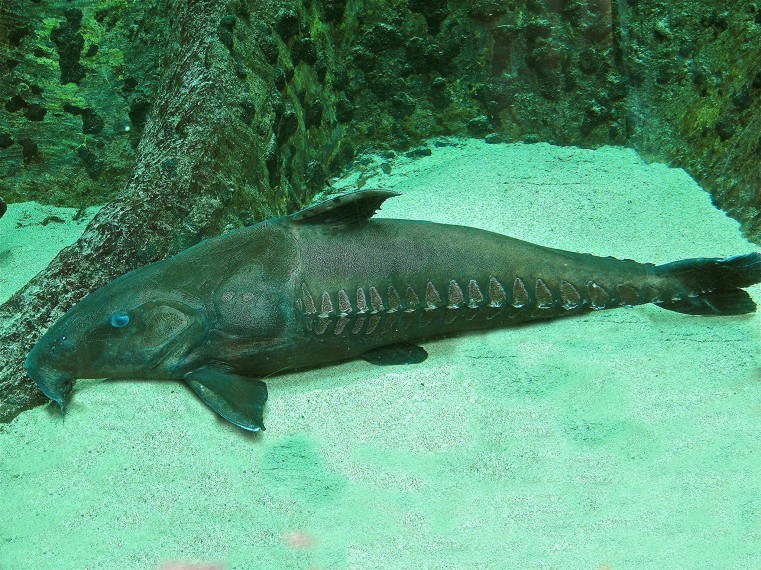
DIET IN THE WILD: The Ripsaw Catfishes large mouth creates a suction to vacuum up detritus, insect larvae, crustaceans, and plant material. When the forest is flooded, they feed exclusively on seeds and fruit.
REPRODUCTION: Sexes separate. Fertilization is external. Adults are non-guarders.

CONSERVATION: IUCN AND CITES: No special status.

REMARKS: Members of the family Doradidae are known as “talking catfishes” as they make a strange, creaking noise when removed from the water., a sound produced by movement of the pectoral spine within its socket and amplified by the swim bladder.
References

California Academy of Sciences Steinhart Aquarium Amazon Flooded Tunnel 2018

Animal Diversity Web ADW animaldiversity.ummz.umich.edu/accounts/Oxydoras_niger/

 fishbase www.fishbase.org/summary/Oxydoras-niger.html

 Ron’s flickr https://www.flickr.com/photos/cas_docents/6181844571/in/set-72157620568438047/

Ron’s WordPress Shortlink  http://wp.me/p1DZ4b-96


TAXONOMY
Kingdom: Animalia
Phylum: Chordata
Class: Actinopterygii (ray-finned fishes)
Order: Osteoglossiformes (Bony tongues)
Family: Arapaimidae (Bonytongues)

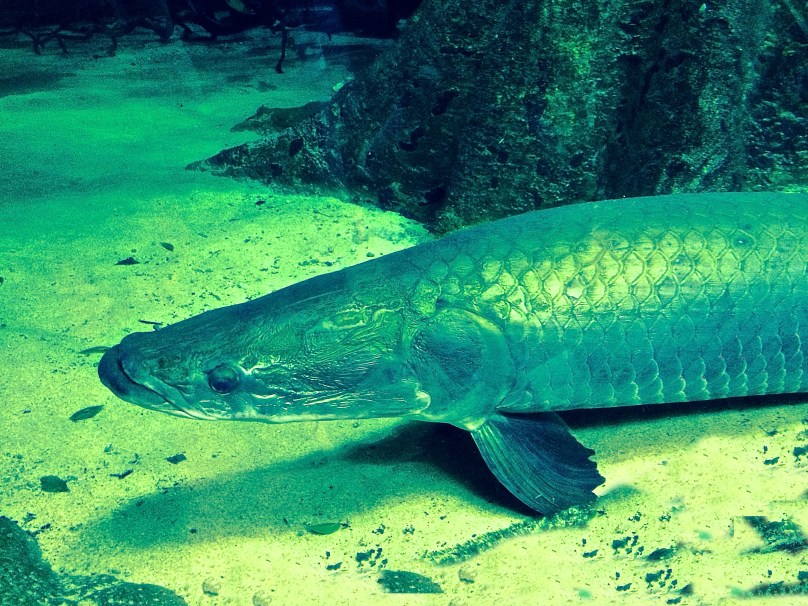
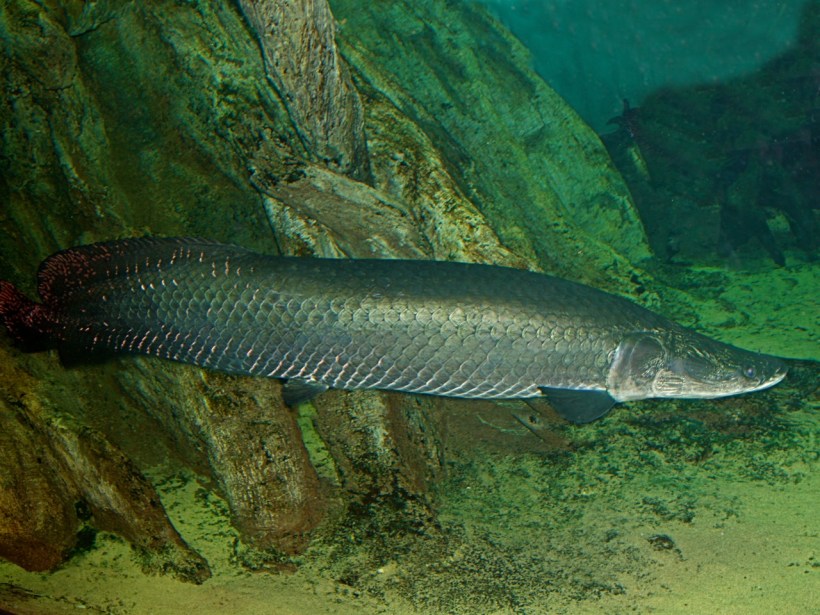
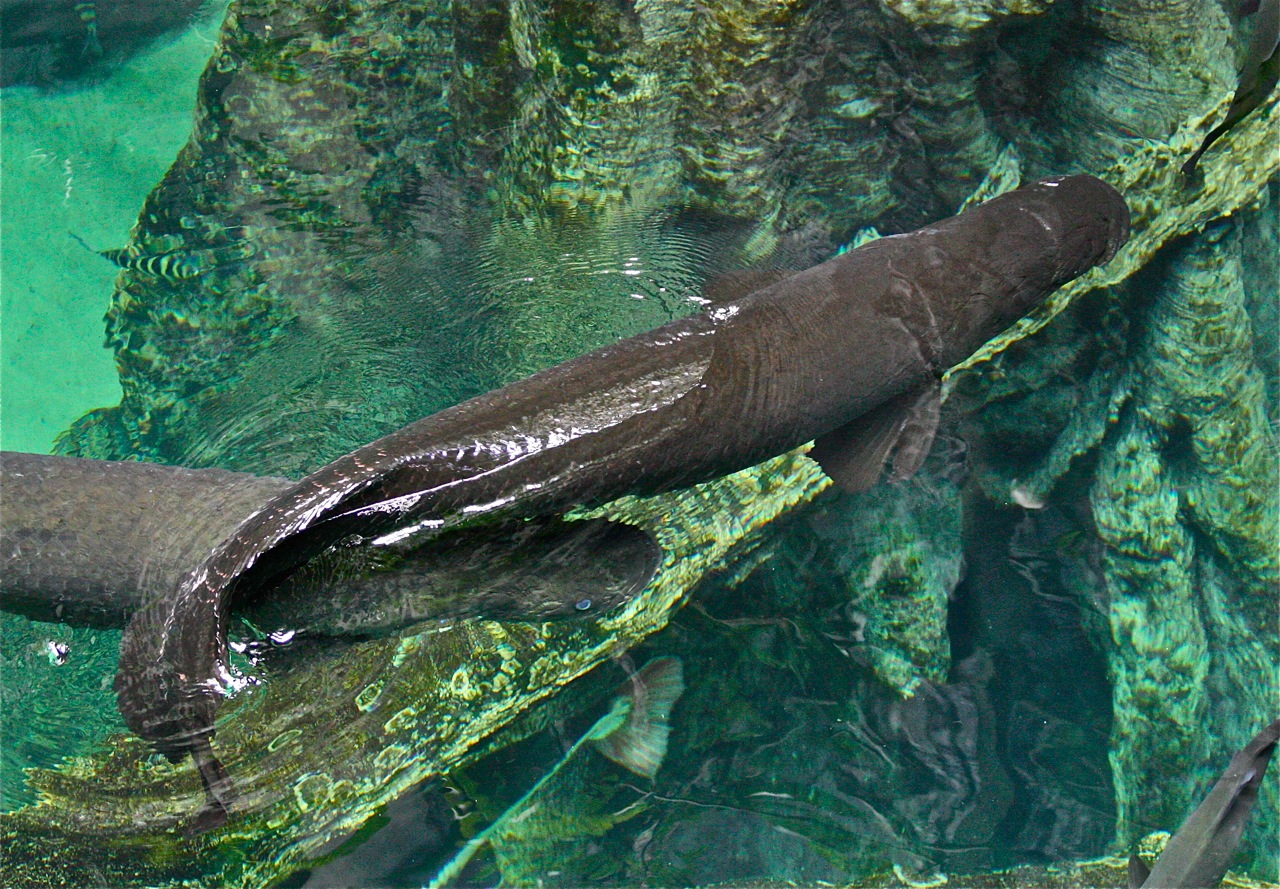
Genus/species: Arapaima gigas

GENERAL CHARACTERISTICS: Usually grey to green in color with red flecks on the scales towards the tail and reddish-orange color of the filleted flesh. They are heavy with an elongated body with very large scales. There are also two symmetrical fins on either side of the body at the posterior end. The arapaima has a tongue with sharp, bony teeth that together with teeth on the roof of its palate are involved in disabling and shredding prey

It is one of the largest freshwater fishes in the world (length up to 450cm (14 feet in the 1800’s) Common length 200 cm (6.75 feet). Weight up to 133 kg. (292 lbs) In the 1800s specimens to 200 kg (440 lbs) were reported. 

DISTRIBUTION/HABITAT: Tropical. Amazon River and its tributaries in freshwater flooded areas dense with aquatic vegetation and shore plants. Much of the water that comprises the pirarucu’s habitat is also oxygen deficient, as it is located in swampy areas of the rainforest.

DIET IN THE WILD: Specialized for surface feeding with their up turned mouths. Adults prey on fish at the surface; suck smaller fish into the mouth, then crush pre against the roof of its mouth using its tooth-covered bony tongue. Like its close relative the arawana, it can leap from the water to snatch a bird or even a monkey from an overhanging branch.

ArapaimaGigasIMG_2727

REPRODUCTION: Sexually mature at the age of five years old. Builds a nest of about 15 cm (6 inches) depth and 50 cm (20 inches) width in sandy bottoms. Guards the eggs and the young. Adults have the ability to exude a pheromone from their head to attract offspring and keep them in close proximity.

MORTALITY and LONGEVITY: Preyed upon by humans. Life spans of 15 to 20 years in captivity .

CONSERVATION: IUCV Red List Data deficient. CITES Appendix II. Heavily exploited as a commercial fish throughout the Amazon. Populations have been greatly reduced during the past 200 years Commercial fishing of arapaima was banned in Brazil outside of a limited number of sustainable reserves, but illegal fishing still continues.

REMARKS: Indigenous people utilize the scales and bones. The bony or toothed tongue was once used as a seed grater to make drink powders. Its scales were used as scrappers.

In addition to gills, it has a modified and enlarged swim bladder, composed of lung-like tissue, which enables it to extract oxygen from the air. It is an obligate air breather, well adapted to oxygen-deficient waters gulping air every 10–15 minutes when oxygen levels are low.

Often referred to as the largest freshwater fish; some freshwater catfishes and sturgeon may challenge this “record.”

References

California Academy of Sciences Steinhart Aquarium Amazon Flooded Tunnel, 2018

Ron’s WordPress shortlink  wp.me/p1DZ4b-a7

Ron’s flickr   https://www.flickr.com/photos/cas_docents/3258200203/in/album-72157620568438047/

 fishbase  www.fishbase.org/summary/Arapaima-gigas.html

Arkive www.arkive.org/arapaima/arapaima-gigas/

 U. of Michigan Animal Diversity Web  animaldiversity.ummz.umich.edu/accounts/Arapaima_gigas/

National Geographic. www.nationalgeographic.com/environment/freshwater/arapaima/

 Encyclopedia of Life  eol.org/pages/204868/details


TAXONOMY
Kingdom: Animalia
Phylum: Chordata
Class: Actinopterygii
Order: Perciformes
Family: Cichlidae

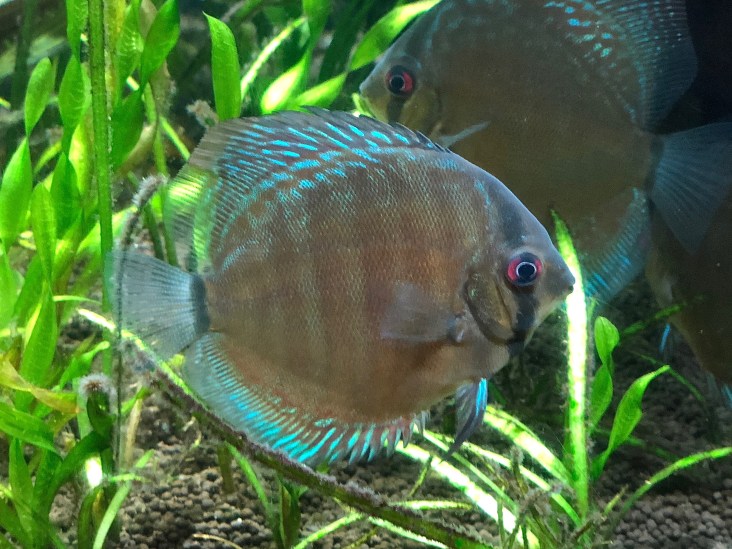
Genus: Symphysodon aequifasciatus

GENERAL CHARACTERISTICS: Color varies as they age. They present a dark brownish to green body. They have nine vertical bars along the body, but lack a bold centrally located bar. They have irregular metallic streaks along the belly, dorsal fin, anal fins, and on the dorsal area of the body of green, blue, or turquoise.

Length up to 5 inches (13.7 cm)

DISTRIBUTION/ HABITAT: Blue Discus are found in freshwater in the South America eastern Amazon River basin in Brazil In deep, rocky areas in crevices and among roots. Normally in schools.

DIET IN THE WILD: They feed on insect larvae, insects, and planktonic invertebrates.

REPRODUCTION: S. aequifasciatus eggs are deposited on stones or plants; both parents defend eggs and larvae; larvae feed on a skin mucus during their first few days.

CONSERVATION: IUCN Not Evaluated

References

California Academy of Sciences Steinhart Aquarium, Flooded Amazon 2018 (Vetted C Delbeek)

Ron’s Flickr  https://www.flickr.com/photos/cas_docents/27863424969/in/dateposted-public/

fishbase www.fishbase.org/summary/Symphysodon-aequifasciatus.html

Animal Diversity Web. animaldiversity.org/accounts/Symphysodon_aequifasciatus/c…

Ron’s WordPress Shortlink wp.me/p1DZ4b-1TF


TAXONOMY
Kingdom: Animalia
Phylum: Chordata
Class: Actinopterygii
Order: Perciformes
Family: Cichlidae
Tribe: Lamprologini

Genus/species: Neolamprologus species

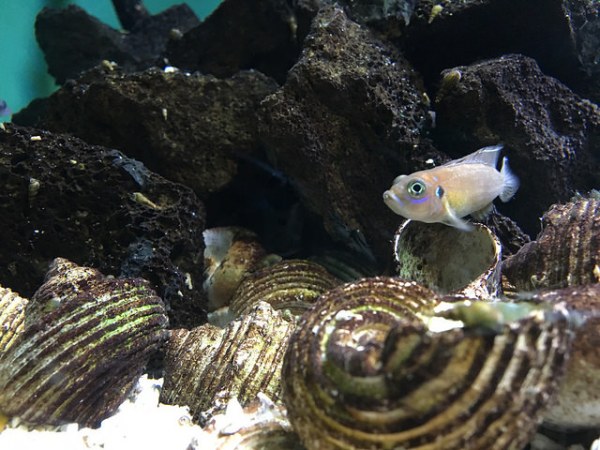
Male Neolamprologus brevis for example reach lengths of just 4.5 cm (1.75 inches) while females are even smaller, around 3 cm (1.25 inches) long. These cichlids probably evolved from fish that lived in rocky cave, but pressure from competition and the many predators of Lake

Lake Tanganyika has very high levels of carbonate hardness, and the calcium in the water ensures that empty shells dissolve much more slowly than they do in most rivers and lakes. In some places there are piles of shells more than 3 metres (10 feet) deep.

DIET IN THE WILD: Zooplankton and small invertebrates

REPRODUCTION: To protect their young eggs are laid by the female within a shell and fertilized as she lays them or immediately after by the male.The female protect the eggs within the shell by fanning her pectoral fins to keep the internal water oxygenated, and often rearranging the substrate to create barriers or to hide the shell from predators.

The eggs hatch within 48 hours, and the yolk sac is absorbed within five days. Fry typically emerge from the shell a week after spawning and they remain benthic for days or weeks after their emergence.

References

California Academy of Sciences Steinhart Aquarium Animal Attractions 2017

Ron’s flickr https://www.flickr.com/photos/cas_docents/15764972796/in/album-72157629304397467/

EOL eol.org/pages/5344/details

Conscientious Aquarium www.wetwebmedia.com/ca/volume_7/volume_7_1/shell_dwell.html

Ron’s WordPress Shortlink  http://wp.me/p1DZ4b-1PB

TAXONOMY
Kingdom: Animalia
Phylum: Chordata
Class: Actinopterygii
Order: Perciformes
Family: Cichlidae

Genus/species: Altolamprologus calvus

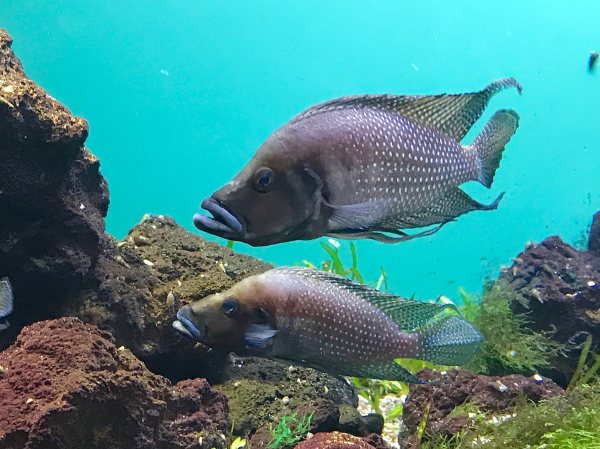
GENERAL CHARACTERISTICS: The body colors will vary between a black to a light whitish gray,and be with or without a yellow cast. They are laterally compressed body, a steep sloping forehead, stripes that are more apparent on the head and collar region, and brilliant white spots that decorate the posterior two-thirds of their flanks. Large dorsal fin running along the entire length of the back. It has a scaleless area on its forehead right between the eyes. Hence its species name “calvus” means “bald”

Length up to six inches, Males are about one-third larger than females.

DISTRIBUTION: One of 200 Cichlid species in Lake Tanganyika.
HABITAT: Rocky areas, particularly the reef-like structures in the lake.

DIET: Predator, and specializes in snatching young cichlids and tiny crustaceans found between rock crevices and rock piles.

Black Calvus  Altolamprologus calvus

REPRODUCTION: Spawning takes place in a cave, shell, or crevice too small for the male to enter. The male will release his milt at the entrance. The female will stay inside fanning the eggs and protecting them while the male guards outside. Typical spawns may number as many as 200 which take more than a week before they hatch and are mature enough to move out on their own.

Longevity: up to 8 years

IUCN Near Threatened                                                                                                                                                                        Excess sediment has its most severe effects on the rocky areas inhabited by Altolamprologus calvus, filling crevices and blanketing its food source. In addition there are rising levels of toxic heavy metals in the lake’s water.

References

California Academy of Sciences Steinhart Aquarium Animal Attractions 2017

Ron’s flickr https://www.flickr.com/photos/cas_docents/8393611475/in/album-72157629304397467/

Archive www.arkive.org/tanganyika-blackfin/altolamprologus-calvus/

 IUCN www.iucnredlist.org/details/60455/0

 Animal World  animal world.com/encyclo/fresh/cichlid/WhitePearlyCalvus.ph

 Ron’s WordPress Shortlink http://wp.me/p1DZ4b-qc


TAXONOMY
Kingdom: Animalia
Phylum: Chordata
Subphylum: Vertebrata
Class: Actinopterygii (ray-finned fishes)
Order: Tetraodontiformes (Puffers and filefishes)
Family: Tetraodontidae (Puffers)

Genus/species: Carinotetraodon travancoricus

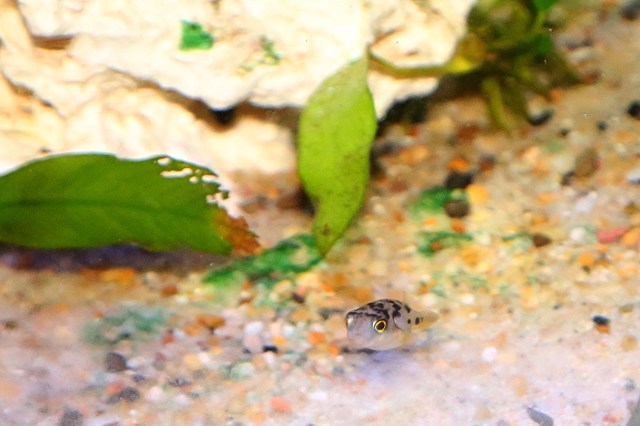
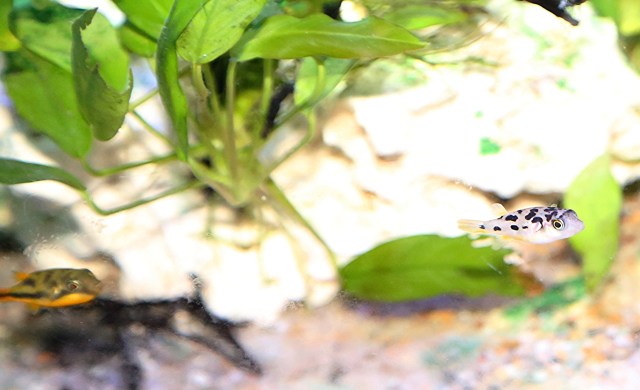
GENERAL CHARACTERISTICS: Both sexes are primarily yellow with dark green to black iridescent patches on the flanks and dorsal surface. Males can also have a dark stripe down the center of their pale belly and iridescent “eye wrinkle” patterns that females do not have. Females are more rounded, tend to be a bit larger than males, and may or may not show more smallish spots between their larger dark markings.
Length up to 2.5 cm (one inch)

24236155053_aaa17fd6c0_o
DISTRIBUTION/HABITAT: C. travancoricus  are found in freshwater rivers of Asia and India. Endemic to the Western Ghats of India

DIET IN THE WILD: The diet of dwarf pufferfish in the wild has not been reported, but other members of the genus feed on zooplankton and various benthic crustaceans and molluscs.

PeaPuffer24863009085_c71f422cfb_o

REPRODUCTION: Eggs are deposited and hidden in vegetation.

CONSERVATION: IUCN VULNERABLE VU
Results from habitat modifications caused by deforestation and conversion of lands in agricultural areas, increasing urbanization, and over harvesting for the pet trade.

References

California Academy of Sciences Steinhart Aquarium Water is life feeding

Ron’s flickr  https://www.flickr.com/photos/cas_docents/24236155053/in/album-72157662094208792/

fishbase www.fishbase.org/summary/Carinotetraodon-travancoricus.html

EOL www.eol.org/pages/222209/details

IUCN  www.iucnredlist.org/details/links/166591/0

Arkive www.arkive.org/malabar-pufferfish/carinotetraodon-travanc…

Ron’s WordPress Shortlink http://wp.me/p1DZ4b-1Jg


TAXONOMY
Kingdom: Animalia
Phylum: Chordata
Class: Actinopterygii (ray-finned fishes)
Order: Atheriniformes (Silversides)
Family: Melanotaeniidae (Rainbow fishes)

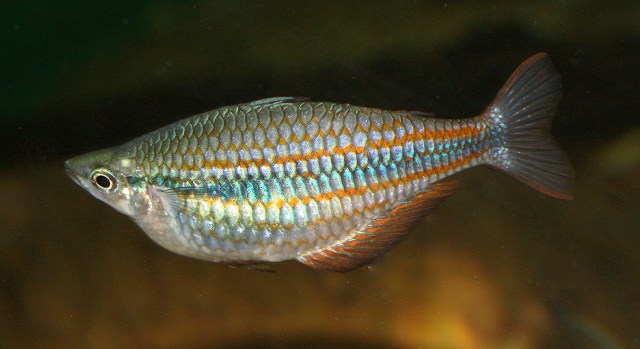
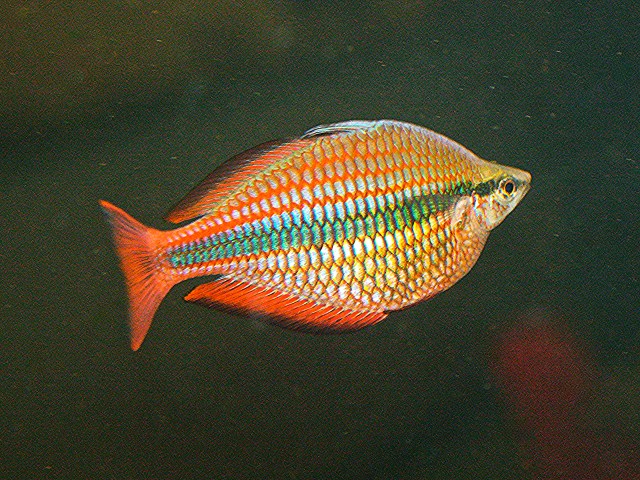
Genus/species: Melanotaenia trifasciata

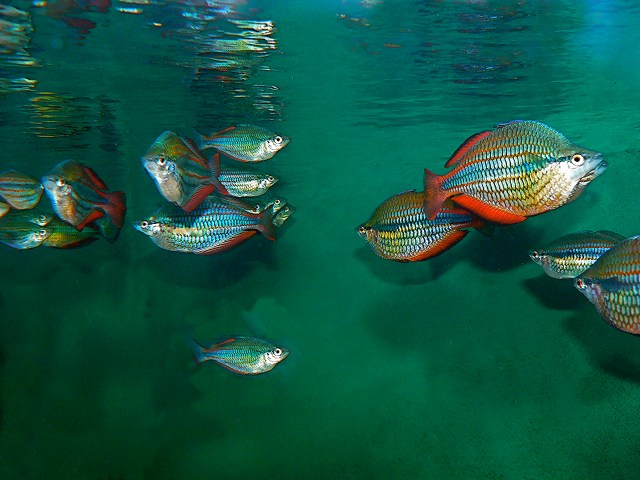
GENERAL CHARACTERISTICS: The coloration of Melanotaenia trifasciata is variable depending on location, water conditions and diet. Populations from almost every river system where they are found have their own distinctive body color with up to 30 varieties. They can be recognised by a very deep body, usually deeper than 1/3 of their body length, and an often discontinuous black mid-lateral band3059546344_bed3615034_o

Length up to 15 cm (6 in)

Rainbowfish3059546154_5f846da4d4_o

DISTRIBUTION/HABITAT: Northern Territories and Queensland, Australia. Found mainly in small streams and waterholes in clear to moderately turbid water. Occurs over rocky or gravel bottoms or in well vegetated areas, frequently around submerged logs and branches.
4360153723_b7a50ecda1_o
DIET IN THE WILD: Omnivore feeding in the surface and mid-water regions. The main food items are aquatic insects, algae and terrestrial insects such as green ants.

MORTALITY/LONGEVITY: Life span: 5–8 years.

IUCN RED LIST Not Evaluated

References

California Academy of Sciences Steinhart Aquarium Water Planet 2016

Fishbase http://www.fishbase.org/summary/Melanotaenia-trifasciata

Rainbowfish rainbowfish.angfaqld.org.au/Trifas.htm#Top_of_Page

Ron’s flickr https://www.flickr.com/photos/cas_docents/3059546154/in/album-72157662094208792/

Ron’s WordPress Shortlink http://wp.me/p1DZ4b-1J6


TAXONOMY
Kingdom: Animalia
Phylum: Chordata
Class: Sarcopterygii (lobe-finned fishes)
Order: Ceratodontiformes (Australian lungfishes)
Family: Ceratodontidae (Australian lungfish)

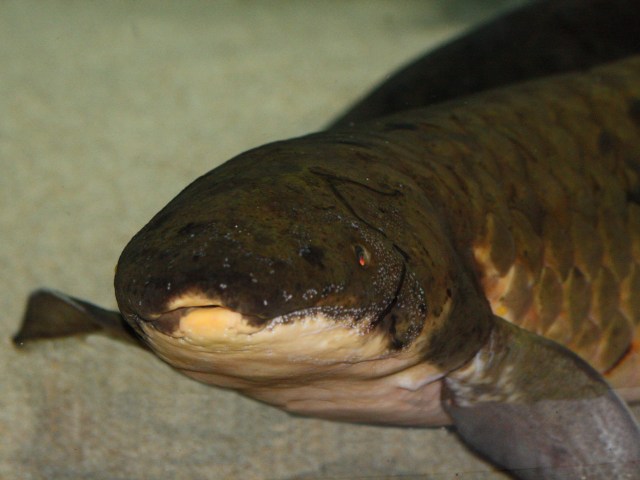
Genus/species: Neoceratodus forsteri

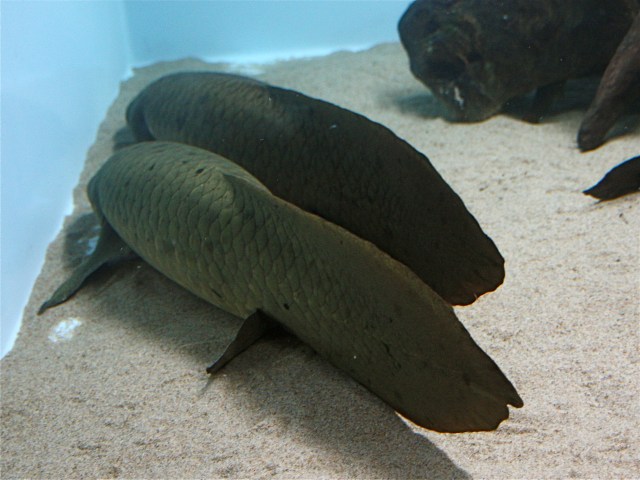
GENERAL CHARACTERISTICS: The brown or olive-brown body is covered with large, bony, overlapping scales. There is some whitish colour on the belly and underside of the head. The dorsal fin originating on the middle of the back is confluent with the caudal and anal fins. The pectoral fins are large and flipper-like just behind the head; the pelvic fins are also flipper-like, situated far back on the body.

3192737183_3ab00093a7_oLength up to nearly 2 m (6 feet)

DISTRIBUTION/HABITAT: Queensland, Australia in rivers with low flow in the austral summer, then restricted to pools that remain. During period of drought, it can tolerate stagnant conditions by breathing air, surfacing 1-2 times per hour; however, it lacks the ability to survive dry spells by aestivation; it is a facultative air-breather that will die if forced to depend on air-breathing.


3258189601_0fabe418bf_o

DIET IN THE WILD: Omnivorous. They use large, crushing teeth on the palate and lower jaw to feed on frogs, tadpoles, fishes, shrimp, earthworms, snails, aquatic plants and native fruits fallen from trees overhanging the creeks. It uses its electroreceptors on its head to pick up hidden mollusks, worms or crustaceans.

REPRODUCTION: First breeds at around 15 years of age in males and 20 years in females. Juveniles are vulnerable to predatory insect larvae, shrimps, fish and wood ducks. Adults have few or no natural predators

MORTALITY/LONGEVITY: Live to more than 65 years in captivity. Some individuals may live to 100 years. It is protected by law.

REMARKS: It is one of six extant representatives of the ancient air-breathing Dipnoi (lungfishes) that flourished during the Devonian period (about 413–365 million years ago) and is the most primitive surviving member of this lineage.

The oldest specimen at the California Academy of Sciences (“Methusela”) arrived from the Melbourne Zoo in 1938. It was half its current size at the time. This species most resembles lungfish fossil forms.

Unlike the African lungfish, this species cannot survive dry spells through estivation. Although the lung supplements the gills during times of oxygen stress, it cannot survive solely by breathing air. The Australian lungfish has only a single lung; the other two lungfish species have paired lungs.

References

California Academy of Sciences Steinhart Aquarium Water is life

Ron’s flickr https://www.flickr.com/photos/cas_docents/2996214117/in/album-72157662094208792/

Fishbase  fishbase.org/summary/4512

ADW animaldiversity.org/accounts/Neoceratodus_forsteri/classi…

EOL eol.org/pages/339109/details

Australian Government  www.environment.gov.au/cgi-bin/sprat/public/publicspecies…

Ron’s WordPress Shortlink  http://wp.me/p1DZ4b-1J0


TAXONOMY
Kingdom: Animalia
Phylum: Chordata
Class: Actinopterygii (ray-finned fishes)
Order: Cyprinodontiformes (Rivulines, killifishes and live bearers)
Family: Nothobranchiidae (African rivulines)

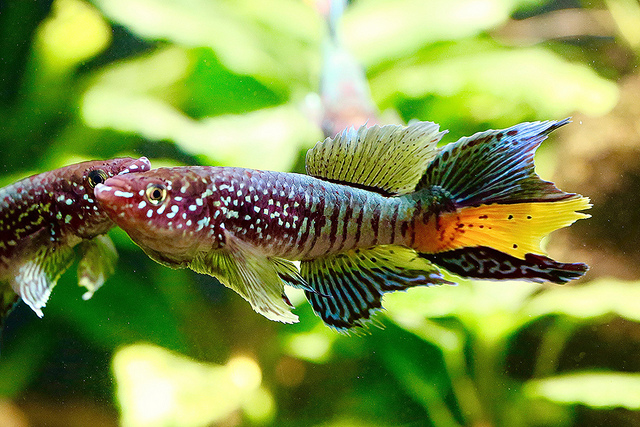
Genus/species: Fundulopanchax gardneri mamfensis

GENERAL CHARACTERISTICS: Max length : 6.0 cm (2.35 in).

Killifish20776631555_95cc874e24_kDISTRIBUTION/HABITAT: Africa; Equatorial Western Guinea. Found in temporary freshwater marshes and pools.
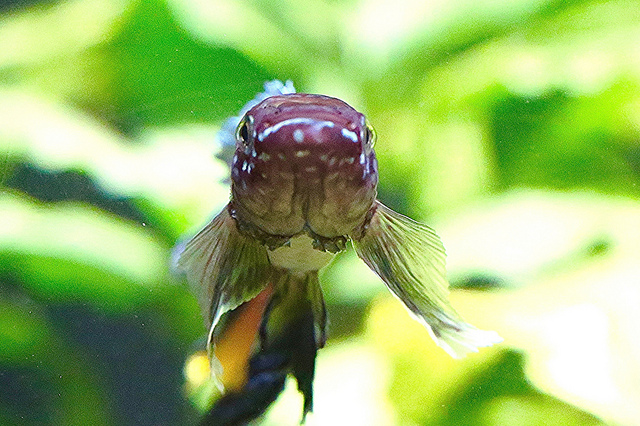
DIET IN THE WILD: This killifish feeds on aquatic insect larvae, and other small invertebrates.

REPRODUCTION: Mate and lay eggs in the water. The eggs remain dormant until seasonal rains return. The dormant eggs can be mailed to different locations and will hatch upon the addition of water.

CONSERVATION: IUCN Red List: Endangered (EN) 8-26-15
Threats: deforestation of Habitat.

References

California Academy of Sciences, Water is life 2015

fishbase  www.fishbase.org/summary/56567

IUCN Red List  www.iucnredlist.org/details/183140/0

Ron’s flickr https://www.flickr.com/photos/cas_docents/20776631555/in/photostream/

WordPress shortlink  http://wp.me/p1DZ4b-1Ac


TAXONOMY

Kingdom: Animalia
Phylum: Chordata
Class: Actinopterygii (ray-finned fishes)
Order: Cyprinodontiformes (Rivulines, killifishes and live bearers)
Family: Nothobranchiidae (African rivulines)

Genus/species: Fundulopanchax sjostedti

GENERAL CHARACTERISTICS: Brightly colored killifish.

Blue Gularis Killifish20750345676_f4b54fecfe_z

DISTRIBUTION/HABITAT: Africa: Niger delta in southern and southeastern Nigeria and southwestern Cameroon. Found in temporary swamps, raphia-swamps and swampy parts of slow flowing brooks in the swampy coastal rainforest.

DIET IN THE WILD: Insect Larvae

20767185002_4d90ae95ba_z

REPRODUCTION: Bottom spawner. It lays eggs in the mud which drys out during the dry season. The adults die but the eggs lie dormant and hatch when the rains return.

IUCN Red List: Least Concern (LC)

References

California Academy of Sciences, Water is life exhibit 2015)

fishbase fishbase.org/summary/9792

IUCN Red List www.iucnredlist.org/details/full/181696/0

Ron’s flickr  https://www.flickr.com/photos/cas_docents/20589851839/in/dateposted/

WordPress shortlink  http://wp.me/p1DZ4b-1zH