Category: CORAL REEF


TAXONOMY

Kingdom: Animalia

Phylum: Chordata

Subphylum: Vertebrata

Class: Actinopterygii

Order: Perciformes

Family: Labridae: (Wrasses)


Genus/species;   Choerodon fasciatus

GENERAL CHARACTERISTICS: 
C. fasciatus 
has vertical, broad, bright orange bands interspersed with blue bands. The caudal peduncle is black,  tail is white and dorsal as well as pelvic fins are orange. As it ages the back half of the body darkens to a dark blue/purple color. The mouth has large blue teeth is a very distinctive feature. 

Length up to 30 cm (12 in).
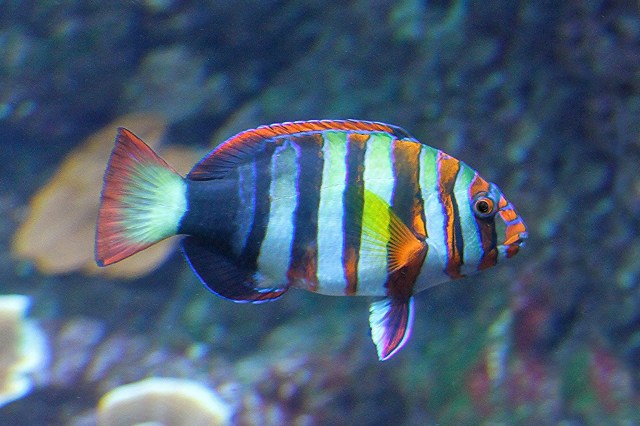
13468909953_41792a2c76_k

DISTRIBUTION/HABITAT: Found in the Western Pacific among seaward reefs, 5–35 m (15-100 ft). Usually solitary.

DIET IN THE WILD:
 Tuskfish have protruding canines used for moving rubble to expose invertebrate prey and prying mollusks from the substrate. Hard shelled prey crushed by pharyngeal teeth. Eats mollusks, echinoderms, crustaceans, worms.

REPRODUCTION
 Pelagic spawners, initial males spawn in large groups; terminal males are usually territorial and pair
 spawn with females of their choice. Females change sex into males for their terminal phase.

CONSERVATION: IUCN Least Concern

REMARKS: Wrasses are most easily identified by their pointed snouts and prominent canine teeth that protrude in front of the jaw. Other common characteristics include their form of propulsion, which depends mostly on the wing like motion of the pectoral fins with only an occasional burst of speed provided by the caudal fin. Color, markings and body shapes change during maturation.

References

California Academy of Sciences Philippine coral reef 2016

Ron’s flickr  https://www.flickr.com/photos/cas_docents/13468909953/in/album-72157608208133134/

Ron’s Wordpress Shortlink  http://wp.me/p1DZ4b-BV

EOL  http://eol.org/pages/206009/details

fishbase   http://www.fishbase.org/summary/Choerodon-fasciatus.html

TAXONOMY
Kingdom: Animalia
Phylum: Chordata
Class: Actinopterygii (ray-finned fishes)
Order: Perciformes (Perch-likes)
Family: Labridae (Wrasses)

Genus/species: Gomphosus varius

GENERAL CHARACTERISTICS: Wrasses vary greatly in size and body shape. All have terminal mouths, prominent canines, thick lips, and a single continuous dorsal fin.

The Bird Wrasse common name refers to the fish’s long snout, which is said to resemble a bird’s beak. This species, like many wrasses, changes appearance as it matures. During the juvenile phase it is green above and white below. The snout is short. In the next phase, called the initial phase, most or all are females, and they are white with a black spot on each scale. The top of the snout is orange, and the caudal fin is black with a white border. 

During the terminal phase, a dominant male becomes blue-green. The caudal fin has a bright blue crest.

Length of males up to 30 cm (12 inches) Females to about 20 cm (8 inches)

Initial Phase below

DISTRIBUTION/HABITAT: Indo-Pacific: East Africa to Hawaiian Islands, north to southern Japan, south to Australia. Found in lagoons and seaward reefs at depths 2–30 m (6-100 ft.).

DIET IN THE WILD: Unlike parrotfishes which scrape algae from rocks with fused beaks, most wrasses feed on hard-shelled invertebrates such as crabs, brittle stars and shrimps  They use scissored motions with protruding canines and crush with powerful pharyngeal teeth. 

REPRODUCTION: Anthias and most wrasses are protogynous hermaphrodites meaning they are born female but if a dominant male perishes, the largest female of the group will often change into a male to take its place. On the other hand, clown anemonefish are protandrous hermaphrodites. This means that they mature as males and the largest one will change into a female when the resident female dies.

REMARKS: Like other wrasses, the bird wrasse can be recognized by its characteristic swimming pattern: the pectoral fins move up and down in a “flying” motion”.

Terminal phase below

References

California Academy of Sciences Philippine coral reef 2016

Ron’s flickr  https://www.flickr.com/photos/cas_docents/3751456858/in/album-72157625992053826/

Australian Museum http://australianmuseum.net.au/Birdnose-Wrasse-Gomphosus-varius

EOL  http://eol.org/pages/224889/details

Ron’s WordPress shortlink http://wp.me/p1DZ4b-K8

TAXONOMY
Kingdom: Animalia
Phylum: Chordata
Class: Actinopterygii (ray-finned fishes)
Order: Tetraodontiformes (Puffers and filefishes)
Family: Balistidae (Triggerfishes)

Genus/species: Xanthichthys auromarginatus

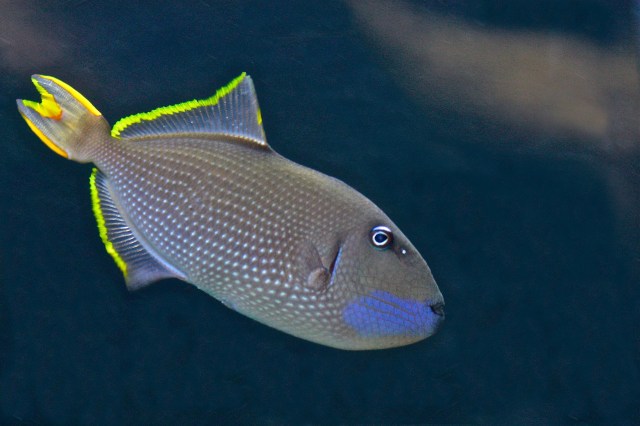
 Male belowBluechin Triggerfish aka Gilded Triggerfish (male) Xanthichthys auromarginatus (Balistidae)TriggerfishesIMG_1613

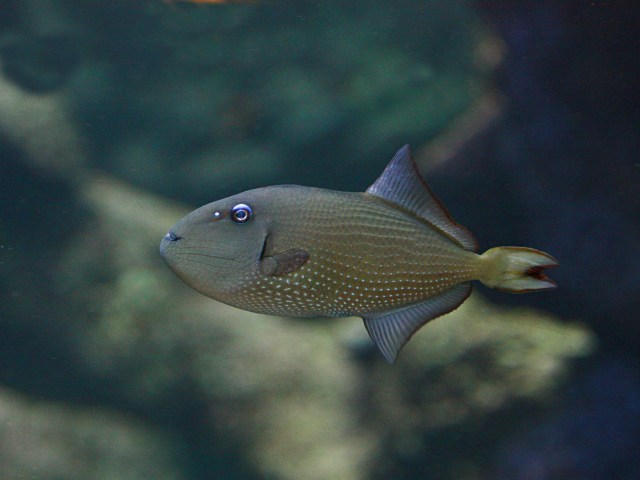
GENERAL CHARACTERISTICS: Steel blue with white spots. Males have blue chin patch and yellow margins on dorsal, anal, and caudal fins. Females lack chin patch, and have maroon stripe on base of dorsal and anal fins, and on outer margin of tail.

Their scales are plate-like and have no pelvic fins.

Length to up to 11.8 inches. (male above, female below)

Gilded Triggerfish (female) Xanthichthys auromarginatus _2

DISTRIBUTION/HABITAT: Indo-Pacific: East Africa to Hawaiian Islands, north to the Ryukyus, south to New Caledonia. Marine reefs 25 – 450 ft depths.

DIET IN THE WILD: Feeds a few meters above the bottom where it consumes zooplankton (prefers copepods).

REPRODUCTION: Distinct pairing, oviparous, external fertilization.

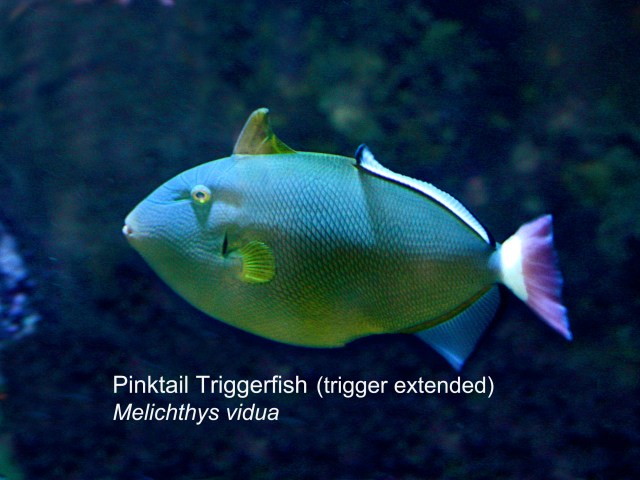
REMARKS: The common name comes a unique interaction between the large first dorsal spine and the smaller second one behind. When the posterior spine is erect, it locks the strong first spine vertically in place, allowing it to wedge itself into a protective space, perhaps a hole or under a rock, where a predator can rarely extract it. When the posterior spine is depressed, the anterior spine folds back easily, like taking a lock off a trigger.

Pink tail triggerfish with trigger erect below (not on exhibit)

PinkTail Triggerfish Erect trigger IMG_0863 copy

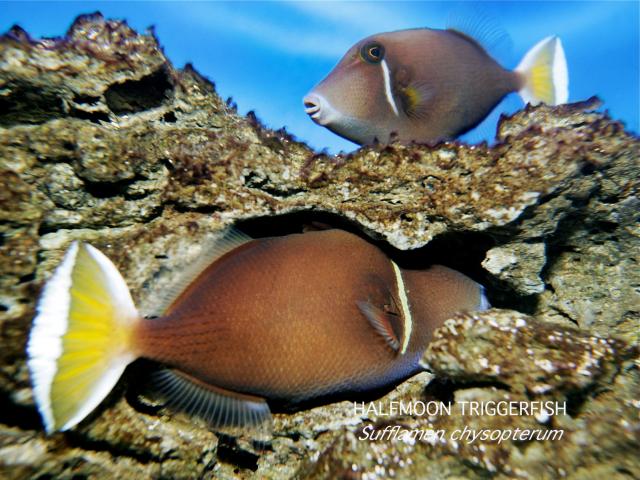
Halfmoon trigger hiding below (not on exhibit)

HALFMOON TRIGGERFISH

Like all triggerfishes, able to rotate eyeballs independently.

References

California Academy of Sciences Philippine coral reef 2016

Ron’s  flickr www.flickr.com/photos/cas_docents/2978997545/edit-details/

Ron’s  Wordpress shortlink http://wp.me/p1DZ4b-RX

 fishbase www.fishbase.us/summary/6030

 EOL eol.org/pages/204534/details

TAXONOMY
Kingdom: Animalia
Phylum: Chordata
Class: Actinopterygii
Order: Perciformes
Family: Scaridae

Genus/species: Scarus quoyi

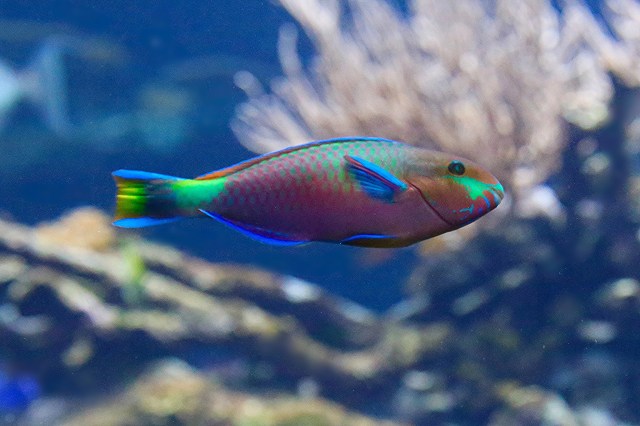
GENERAL CHARACTERISTICS: Parrotfishes are wrasse-shaped but more heavy-bodied. The main difference is the structure of their mouth. Wrasses have individual teeth, but parrot fish teeth are actually fused together, forming a beak. 

Mature males are blue-green with pinkish scale margins. The operculum is orange dorsally and violet ventrally. There is a patch of blue-green on the cheek and across the snout. – female Greenblotch Parrotfish are pale grey-brown with five or six faint white bars on the body.

Length up to 28 cm.

Quoy’s Parrotfish20793038334_af78ec0ed9_k

DISTRIBUTION/HABITAT: Found from the Maldives to Vanuatu, extending northwards to Ryukyu Islands, Japan and southwards to New Caledonia inhabiting coral-rich areas of outer channels and seaward reefs.

DIET IN THE WILD:  Herbivorous, feeds on algae from rocky substrates.

REPRODUCTION: Parrotfishes are pelagic spawners. They release buoyant eggs which become part of the plankton floating freely, eventually settling into the coral until hatching.

CONSERVATION: IUCN Least Concern (LC)

REMARKS: A recent study has discovered that the parrotfish is extremely important for the health of the Great Barrier Reef. It is the only one of thousands of reef fish species that regularly performs the task of scraping and cleaning inshore coral reefs.

Note: S. quoyi does not feed on coral algae thus does not destroy coral , which is why it can be present in the Philippine coral reef exhibit exhibit. (Charles Delbeek M.Sc. Assistant Curator, Steinhart Aquarium California Academy of Sciences)

References

California Academy of Sciences Steinhart Aquarium Philippine Coral Reef 2016 (Vetted, Charles Delbeek Academy assistant curator)

Ron’s flickr https://www.flickr.com/photos/cas_docents/20793038334/in/album-72157625992053826/

Ron’s WordPress Shortlink  http://wp.me/p1DZ4b-1HR

Australian Museum  australianmuseum.net.au/greenblotch-parrotfish-scarus-quoyi

Australian Geographic http://www.australiangeographic.com.au/news/2014/09/single-keystone-species-may-be-key-to-reef-health

Encyclopedia of Life:  eol.org/California Academy of Sciences Steinhart Aquarium Philippine Coral Reef 2016pages/1012771/details

fishbase  www.fishbase.org/Summary/SpeciesSummary.php?ID=5554&g…

TAXONOMY
Kingdom: Animalia
Phylum: Chordata
Class: Actinopterygii
Order: Perciformes (Perch-likes)
Family:  Haemulidae (Grunts) bottom-feeding predators, named for their ability to produce sound by grinding their teeth.

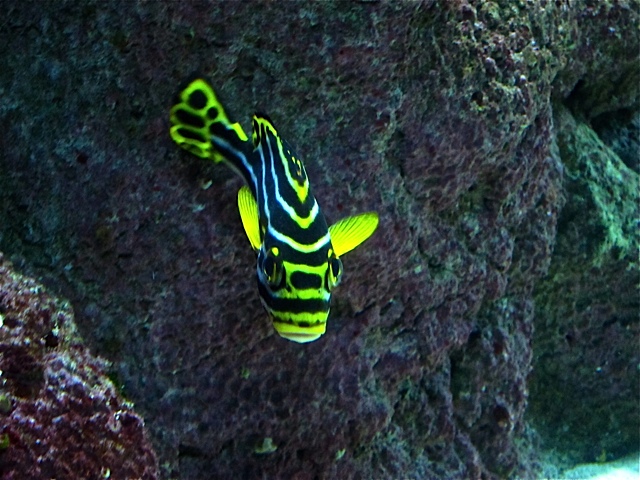
Genus/species  Plectorhinchus chaetodonoides  

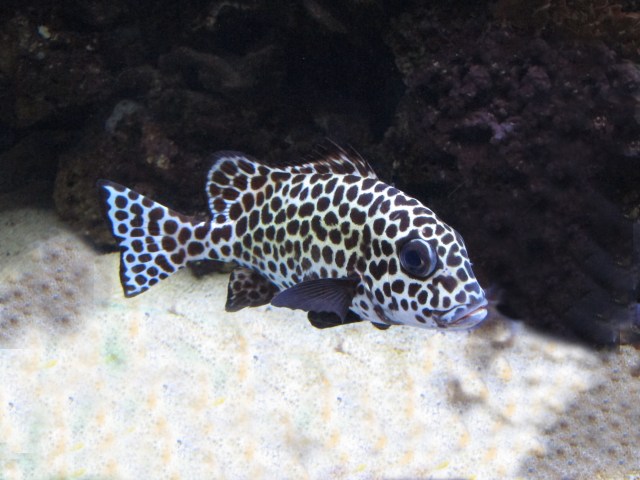
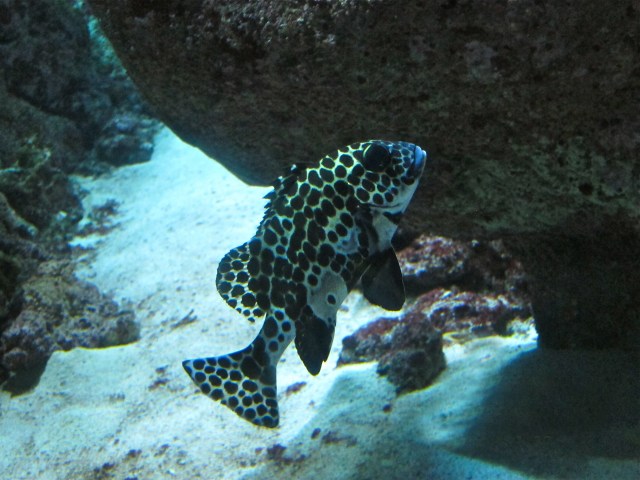
GENERAL CHARACTERISTICS: Juveniles brown with large white blotches. Becomes more spotted with age, reversing from white to black spotted in the process. Deeper bodies compared to most others in the genus

Length is up to 72 cm (29 inches) and weight to 7,000 g (15.5 pounds)

Spotted Sweetlips IMG_0501

 DISTRIBUTION/HABITAT Indo-West Pacific oceans. Inhabits coral-rich areas of clear lagoon and seaward reefs. 1 – 30 m (3-90 ft).


DIET IN THE WILD: Carnivore. Feeds on crustaceans, mollusks, and fishes at night.

CONSERVATION: IUCN Not evaluated

References

California Academy of Sciences Philippine coral reef 2016

Ron’s flickr http://www.flickr.com/photos/cas_docents/sets/72157625992053826/

Ron’s WordPress Shortlink    http://wp.me/p1DZ4b-nP

fishbase fishbase.org/summary/Plectorhinchus-chaetodonoides.html

TAXONOMY

Kingdom: Animalia
Phylum:  Chordata
Class:  Actinopterygii (ray-finned fishes)
Order: Perciformes (Perch-likes)
Family: Haemulidae (Grunts)

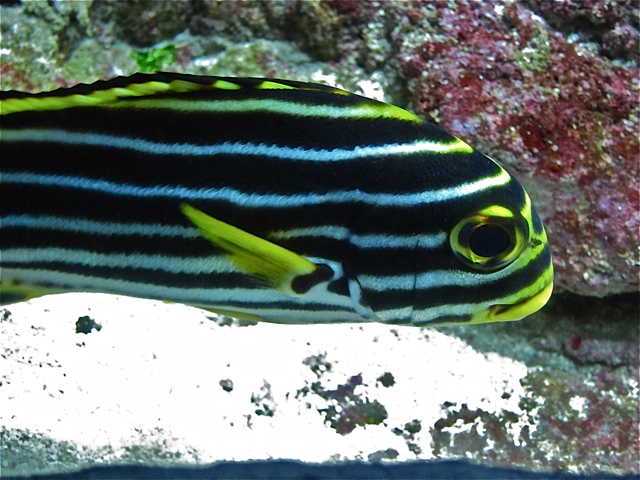
GENUS/SPECIES  Plectorhinchus vittatus


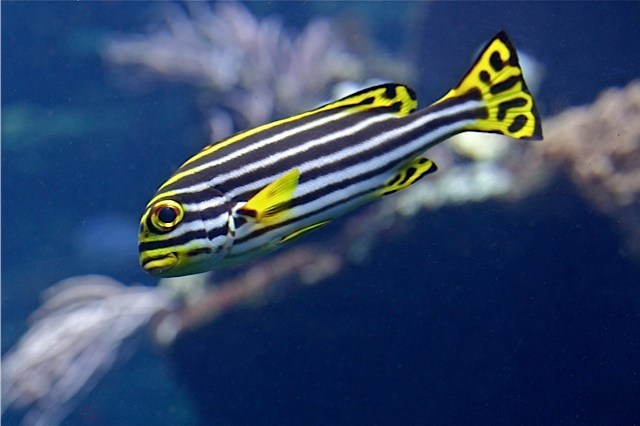
GENERAL CHARACTERISTICS; Juveniles are reddish-brown with white or cream-colored blotches at a size of less than 13 cm (5.1 inches). Adults have prominent lips and boldly patterned. White with black lines that extend onto the belly Lips and fins are yellow with spotted dorsal, anal and tail fins.

Length up to 86 cm (33.9 inches)


DISTRIBUTION/HABITAT: East Africa to Samoa, north to the Ryukus, south to Mauritius and New Caledonia.  Found in clear lagoons, reef channels, reef faces and slopes at depths of 5 to 80 feet.   

 DIET IN THE WILD:  P. vittatus  are bottom feeding carnivores preferring crustaceans, mollusks and small fish they can swallow whole. 

 REPRODUCTION: Oviparous

 CONSERVATION: IUCN Red List Not Evaluated


CONSERVATION: Not evaluated

References

 California Academy of Sciences Philippine coral reef 2016

 fishbase  www.fishbase.org/summary/Plectorhinchus-vittatus.html

 EOL  eol.org/pages/988173/details

 Ron’s flickr  http://www.flickr.com/photos/cas_docents/sets/72157625992053826/

Ron’sWordpress Shortlink  http://wp.me/p1DZ4b-Aq


TAXONOMY
Kingdom: Animalia
Phylum: Chordata
Class: Actinopterygii 
Order: Perciformes
Family: Siganidae (Rabbitfishes and Spinefoots) 

Genus/species: Siganus puellus


GENERAL CHARACTERISTICS:  Highly compressed body yellow with wavy, broken blue lines. Dark band from eyes to mouth. Dark dots extend from eyes to dorsal fin. Like all rabbitfishes, have small, rabbit-like mouths, large dark eyes, and a shy temperament, thus their common name.

Length up to 38 cm (15 inches)

DISTRIBUTION/HABITAT: Indo-West Pacific in shallow, coral-rich areas of lagoons
and seaward reefs to 30 m or 98 ft. Adults often in pairs; species forms large schools in shallows, lagoons and outer reef flats, particularly in areas dominated by luxurious growths of Acorpora coral.

DIET IN THE WILD: Juveniles feed on filamentous algae; adults on algae, tunicates, and sponges.

CONSERVATION: IUCN Red List Least Concern (LC)

REMARKS: Venomous spines, which can be flashed at any bothersome fish or hand.

References

California Academy of Sciences Steinhart Aquarium Philippine Coral Reef 2016 

fishbase  www.fishbase.org/summary/SpeciesSummary.php?id=4617

EOL eol.org/pages/203962/details

Australian Museum australianmuseum.net.au/masked-rabbitfish-siganus-puellus

IUCN www.iucnredlist.org/details/155025/0

Ron’s flickr  http://www.flickr.com/photos/cas_docents/sets/72157608339530941/with/3246996616/

Ron’s WordPress Shortlink  http://wp.me/p1DZ4b-Hh

TAXONOMY
Kingdom: Animalia
Phylum: Chordata
Class: Actinopterygii
Order: Perciformes
Family: Siganidae (Rabbitfishes and Spinefoots)

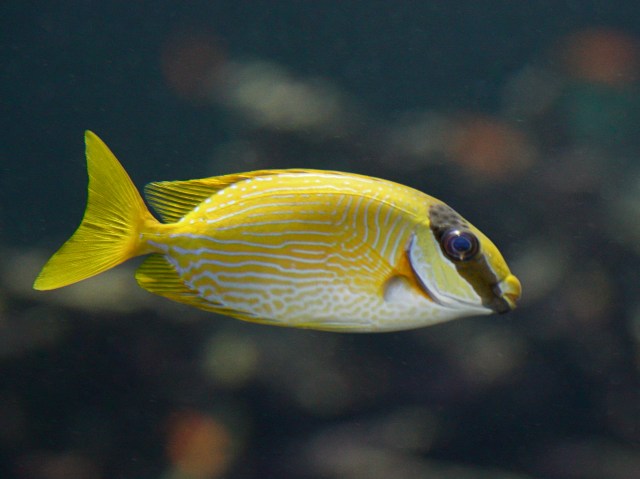
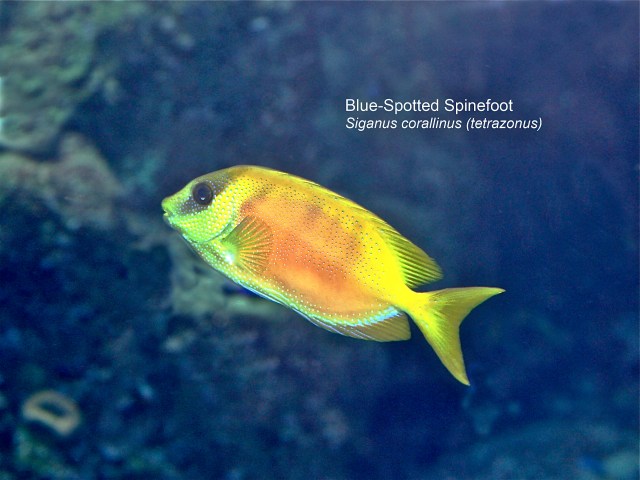
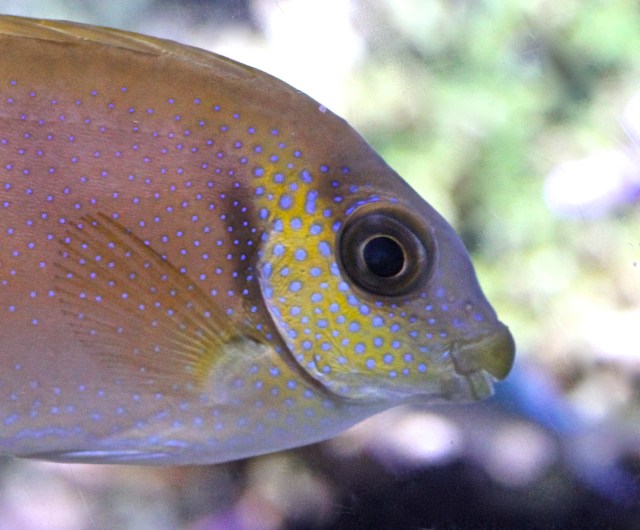
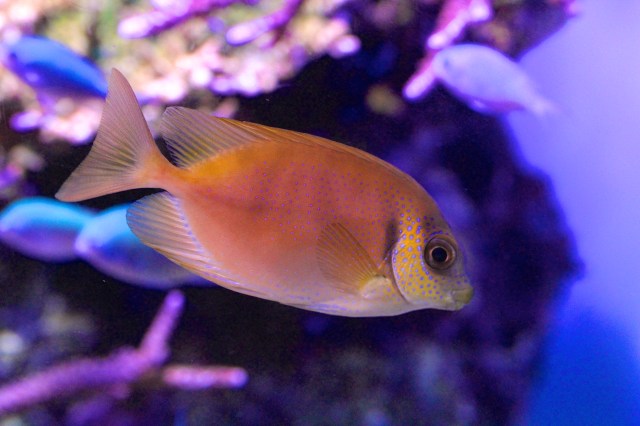
Genus/species: Siganus corallinus

GENERAL CHARACTERISTICS:  Color is yellow with numerous small blue spots on the head and body and a dark triangular area above and behind the eye.  Like all rabbitfishes, they have small, rabbit-like mouths, large dark eyes, and a shy temperament, thus their common name.

Length up to 30 cm (12 in)

Blue-Spotted Spinefoot Siganus corallinus (tetrazonus)

DISTRIBUTION/HABITAT: Indo-West Pacific among corals of lagoon and protected reefs at 3–30 m (10-100 ft).

IMG_9983

DIET IN THE WILD: Benthic algae.

IUCN RED LIST Not Evaluated

REMARKS: Rabbitfishes have fin spines with venom glands that can inflict painful, though not life-threatening wounds; aquarists should take care as the genus is easily frightened and readily takes defensive action.

IMG_9984

References

California Academy of Sciences Steinhart Aquarium Philippine Coral Reef 2016

fishbase:  www.fishbase.se/summary/4611

Australian Museum  australianmuseum.net.au/coral-rabbitfish-siganus-corallinus

Ron’s flickr http://www.flickr.com/photos/cas_docents/sets/72157608339530941/with/3222318704/

Ron’s WordPress Shortlink http://wp.me/p1DZ4b-Ow

TAXONOMY
Kingdom: Animalia
Phylum: Chordata
Class: Actinopterygii (ray-finned fishes)
Order: Perciformes (Perch-likes)
Family: Siganidae (Rabbitfishes and Spinefoots)

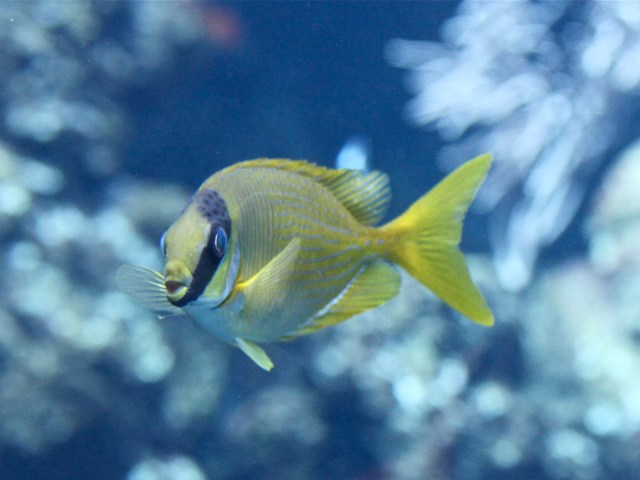
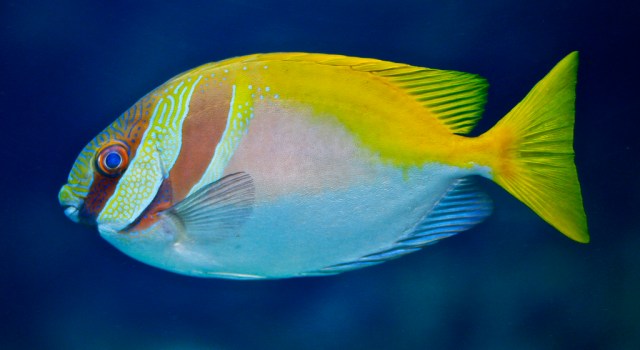
Genus/species: Siganus virgatus

Barhead Spinefoot 4533131275_6ac3dc18ab_b

GENERAL CHARACTERISTICS: Yellow above, white below with yellow dorsal and caudal fins; blue markings on head and back. The eyes are masked by a black stripe that extends from the bottom of the mouth to the top of the head, and a brown band running diagonally from nape to chin.

Length up to 11.8 inches

DISTRIBUTION/HABITAT: Tropical west Pacific in shallow coastal waters, around hard coral reefs and areas of sand with patches of rock and soft coral. Tolerant of murky waters. Depth 1–15 m (3-45 ft).

DIET IN THE WILD: Feeds on benthic seaweeds

REPRODUCTION: Pelagic spawner

MORTALITY: Stout venomous spines discourage would-be predators.

CONSERVATION: IUCN Red List  Not evaluated

REMARKS : Fins and spines are venomous. Caution must be used when handling. Reactions can range from mild to severe
Named rabbitfish due to their voracious appetite.

References

California Academy of Sciences Steinhart Aquarium Philippine Coral Reef 2016

Ron’s flickr https://www.flickr.com/photos/cas_docents/4533131275/

Ron’s WordPress shortlink  http://wp.me/p1DZ4b-1fn

EOL http://eol.org/pages/206659/details

fishbase http://www.fishbase.org/summary/4624

TAXONOMY
Kingdom: Animalia
Phylum: Chordata
Class: Actinopterygii (ray-finned fishes)
Order: Perciformes (Perch-likes)
Family: Siganidae (Rabbitfishes and Spinefoots) 

Genus/species: Siganus unimaculatus

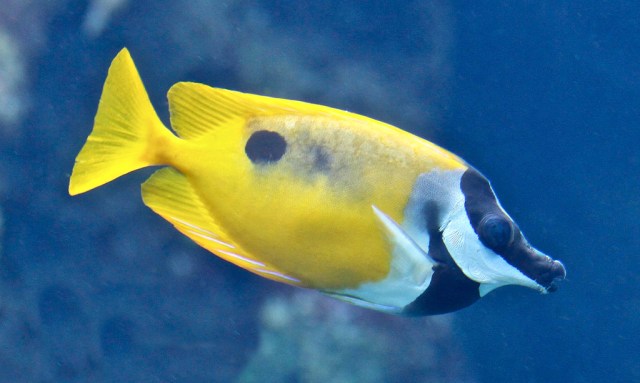
GENERAL CHARACTERISTICS:   A dark chocolate ocular band occurs in an arc from base of 1st dorsal spine to chin with a narrow white blaze on midline of head profile. The thorax is dark chocolate and thee remainder of body is yellow-orange. Same as the Foxface Rabbitfish (S. vulpinus) except for the black spot or ‘blotch” on posterior upper side of body on S. unimaculatus.

Length up to 24 cm (9.5 inches)

Blotched Foxface Rabbitfish 13717964414_50be7e63d0_b

DISTRIBUTION/HABITAT: Western Pacific: Ryukyu Islands of Japan, the Philippines, to western Australia. Found in coral rich areas of lagoon often among stag horn corals and seaward reefs to depth of 30 m (98 ft).

Blotched Foxface Rabbitfish13717573555_6773f7d8a1_b

 DIET IN THE WILD: Diurnal herbivore of algae and zooplankton

REPRODUCTION: Spawns during outgoing tides.

 CONSERVATION: IUCN Not Evaluated

REMARKS: Rabbitfishes are named for their voracious appetites. They have  venomous spines on dorsal and anal fins, as do all in the genus.

Also they are highly esteemed as a food fish

Some researchers believe S. unimaculatus and S. vulpinus are a single species. The color is the same as in except for the blackish spot posteriorly on the upper side of the body.

References

California Academy of Sciences Steinhart Aquarium Philippine Coral Reef 2016

Ron’s flickr www.flickr.com/photos/cas_docents/13717964414/

fishbase www.fishbase.org/summary/4630

EOL eol.org/pages/221694/hierarchy_entries/44731451/details

Ron’s WordPress shortlink http://wp.me/p1DZ4b-1fs