Category: CORAL REEF


TAXONOMY
Kingdom: Animalia
Phylum: Mollusca
Class: Cephalopoda (octopuses, squid, cuttlefish; and Nautiloidea)
Order: Octopoda
Family: Octopodidae (octopus species)

Genus/species: Octopus cyanea

GENERAL CHARACTERISTICS:  Dark eye-spots are only sometimes visible and depends upon the patterns being displayed by individual octopuses. Cryptic Coloration: they are able to change coloration, and texture of their skin, to resemble their environment (adaptive or active
camouflage).
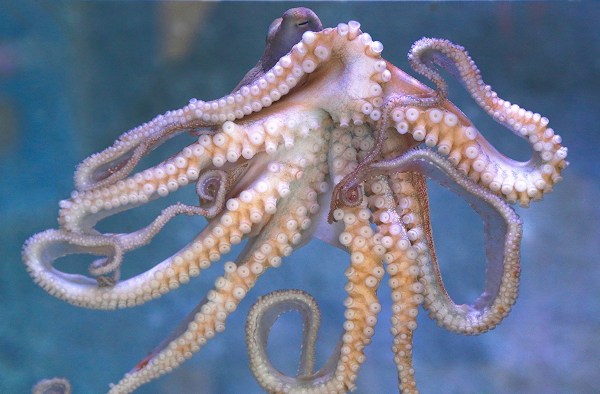

Bodies up to at least 16 cm (6 inches) and arms to at least 80 cm (30 inches).

DISTRIBUTION/HABITAT: Tropical reefs from Hawaii to East Africa. O. cyanea is found in excavated lairs in coral reefs and rubble which can be located by identifying remains of clams, crabs at the entrance.
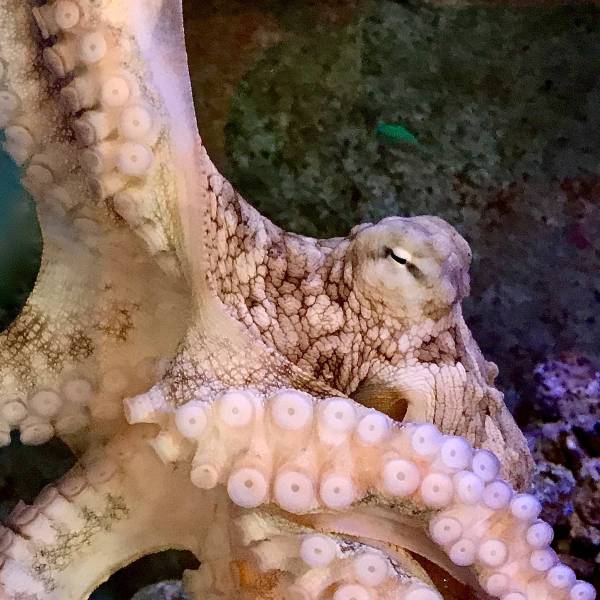
 

DIET IN THE WILD: Feeds during daylight hours requiring exceptional camouflage. Consumes crabs, clams and fishes.
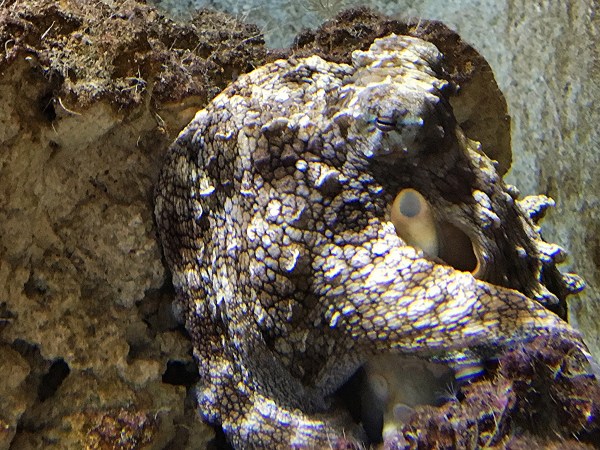
REPRODUCTION: Males have a long modified third right arm that they hold in an upright coiled position and wave toward the female. When the female is receptive to the signaling male, he inserts his arm into the female’s oviducts to pass her spermatophores keeping his distance to avoid being eaten by the female.

Day Octopus (aka Big Blue Octopus)
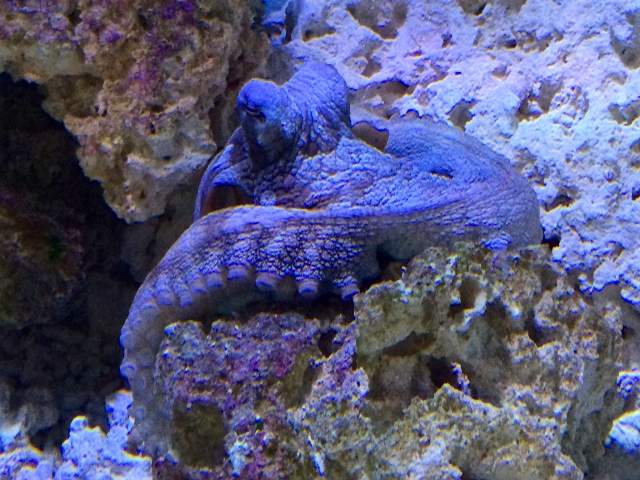
Day Octopus19111242362_db83003f76_k


PREDATORS: Seals and large fish.

CONSERVATION: IUCN Red List; not assessed 2015

References

California Academy of Sciences Color of Life Exhibit 2015

Ron’s flickr  https://www.flickr.com/photos/cas_docents/19111242362/in/album-72157652559028013/

Encyclopedia of Life  www.eol.org/pages/593207/details

Marinebio  marinebio.org/species.asp?id=553

Ron’s WordPress shortlink  http://wp.me/p1DZ4b-1xs

TAXONOMY
Kingdom: Animalia
Phylum: Chordata
Class: Actinopterygii (ray-finned fishes)
Order:Perciformes (Perch-likes)
Family: Pomacentridae (Damselfishes, Chromis, Aneomonefishes)
Subfamily: Amphiprioninae (anemonefishes)

Genus/species: Amphiprion ocellaris

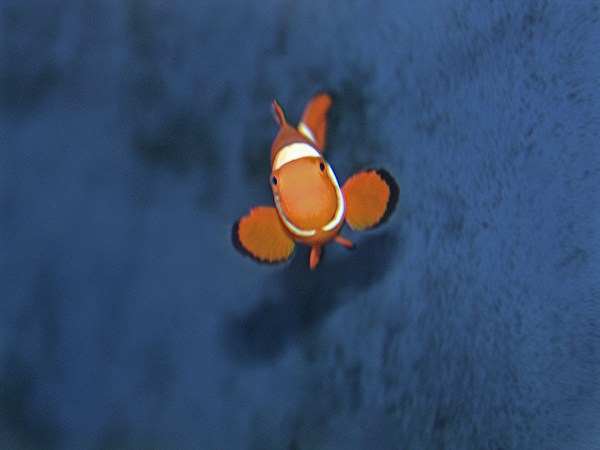
GENERAL CHARACTERISTICS: Adults are orange with three broad vertical white bands with thin black margins. Females are larger than males. Similar to the Clown Anemonefish (Amphiprion percula) but has 11 spines in the dorsal fin compared to 10, while the spiny part of the dorsal fin is also taller.

Length up to 9 cm (3.5 inches)

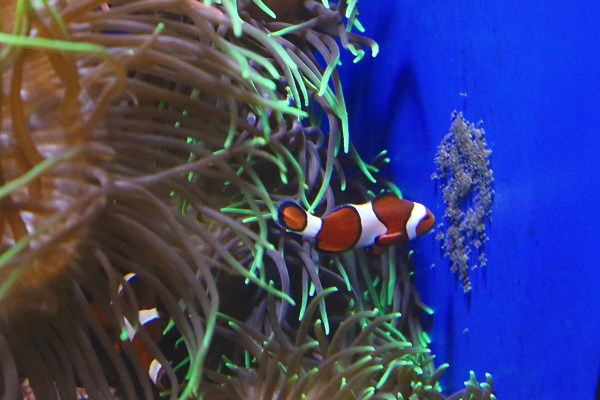
DISTRIBUTION/HABITAT: Found among tropical Pacific Ocean coral reefs. They sleep and feed among the tentacles of their host anemone. Stichodactyla gigantea, Stichodactyla mertensi, as well as the anemone Heteractis magnifica and others. The False Clownfish is usually found at depths of about 15 m (50 ft).

(Amphiprion ocellaris) aka FALSE CLOWNFISH

DIET IN THE WILD: Feeds primarily on zooplankton, especially copepods and also on filamentous algae.

REPRODUCTION: A. ocellaris breeds continuously at the Steinhart. Adhesive eggs are laid on a patch of cleared rock near the host anemone’s base and guarded by the male. Eggs hatch after 10 days. The tiny transparent planktonic larvae swim away from the anemone. Two weeks later the larvae metamorphose into small fish. As protandrous hermaphrodites; all individuals mature as males, and all females are sex-reversed males. In the absence of a female the largest male will turn into a female.

Longevity: Up to 12 years in captivity

REMARKS:  Clownfish and anemone display a classic case of mutualism. Clownfish become resistant to their host by gradually (matter of minutes to days) acquiring a covering of mucus
by brushing against the tentacles of their host. Once the fish has become chemosensorilly camouflaged, the host anemone’s nematocysts do not sting the clownfish.

Some of the anemone’s nutrition results from the clownfish’s activities; clownfish gain protection among the anemone’s nematocysts.

Nemo and his parents in Finding Nemo resemble this species. That said, Marlin, Nemo’s father, given the scenario would have changed into a female following the death of Nemo’s mother and remained near his host anemone, rather than swimming to Sydney. But then the film makers wouldn’t have a narrative to support this film! The name “Nemo” has found its way into FishBase (http://www.fishbase.org) as a common name for this species in the USA!        

References

California Academy of Sciences Steinhart Aquarium Philippine coral reef 2016

Animal Diversity Web  animaldiversity.org/accounts/Amphiprion_ocellaris/

fishbase  fishbase.org/summary/Amphiprion-ocellaris.html

Flickr  http://www.flickr.com/photos/cas_docents/sets/72157608339622313/

WordPress shortlink  http://wp.me/p1DZ4b-mp


TAXONOMY
Kingdom: Animalia
Phylum: Cnidaria
Class: Anthozoa
Subclass: Hexacorallia
Order: Corallimorpharia
Family: Ricordeidae

Genus/sp. Rhodactis spp.

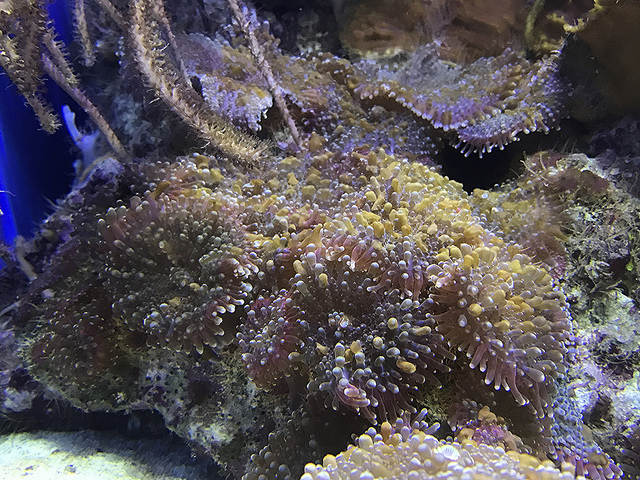
GENERAL CHARACTERISTICS: Rhodactis mushroom grow much larger than other mushroom genera, some attaining sizes of more than 10 inches across. The surface of their mushroom cap is covered with small tentacles (verrucae) or large warty knobs that are radially arranged. They are found attached to rock.

Rhodactus32905288196_ab8d24778a_z

DIET IN THE WILD: Ricordeidae feed both on the products of zooxanthellae, and on zooplankton or fish they catch with their tentacles and nematocysts as well as dissolved organic matter.

Rhodactus32774273105_54135cc7e6_z

REPRODUCTION: Asexual reproduction occurs by two mechanisms. Split or fission reproduction occurs when the coral splits along its mouth creating a clone. Alternatively, particulates released from the foot can develop into a new specimen, which is called laceration.

Sexual reproduction produces a larva called a Planula which once on the seabed develops into a new individual.

References

California Academy of Sciences Steinhart Aquarium Color on the Reef AQA12 2017

Aquarium Corals Eric Borneman TFH publications 2001 pages 206-209

EOL eol.org/pages/4680444/overview

Ron’s WordPress Shortlink http://wp.me/p1DZ4b-1M9

Ron’s flickr https://www.flickr.com/photos/cas_docents/32905288196/in/album-72157659465376212/


TAXONOMY
Kingdom: Animalia
Phylum: Cnidaria
Class: Anthozoa
Order: Alcyonacea
Family: Alcyoniidae

Genus/species: Lobophytum sp.

GENERAL CHARACTERISTICS: Typically colored yellowish brown, some ridged leather corals colored green by their algal endosymbionts. Lobed leather corals often encrusting or low and spreading. Upper surface with rounded or finger-like lobes. Usually no real stalk; colony often grows out from a low platform. Large polyps distinctly spaced from one another. Tentacles are retractile.

Tentacles retracted below

Lobophytum sp.32131393013_65a065d26a_k

DISTRIBUTION/HABITAT: Found in Indo-Pacific, Red Sea tropical coral reefs. Zonation varies by species, intertidal to 30 m. Notes apply to entire genus composed of at least 47 species.

Tentacles extended below

lobophytum sp.15794440950_f989b64b19_k

DIET IN THE WILD: They capture microscopic food particles from the water column, can absorb dissolved organic matter, and also use algal photosynthesis.

REPRODUCTION Typically reproduces asexually by budding or fragmentation.

REMARKS: Like Sarcophyton sp., to which it’s closely related, Lobophytum has two distinct types of polyps, one quite small, the other larger. Sinularia has only one.

References

California Academy of Sciences Steinhart Aquarium Color on the Reef AQA17 2017 Vetting Charles Delbeek

Aquarium Corals Eric Borneman TFH publications 2001 pages 127-129

Ron’s flickr https://www.flickr.com/photos/cas_docents/32131393013/in/album-72157659465376212/

Ron’s WordPress Shortlink  http://wp.me/p1DZ4b-1M0


TAXONOMY
Phylum: Cnidaria
Class: Anthozoa
Subclass: Hexacorallia
Order: Corallimorpharia
Family: Corallimorphidae

Genus/species: Corynactis sp.

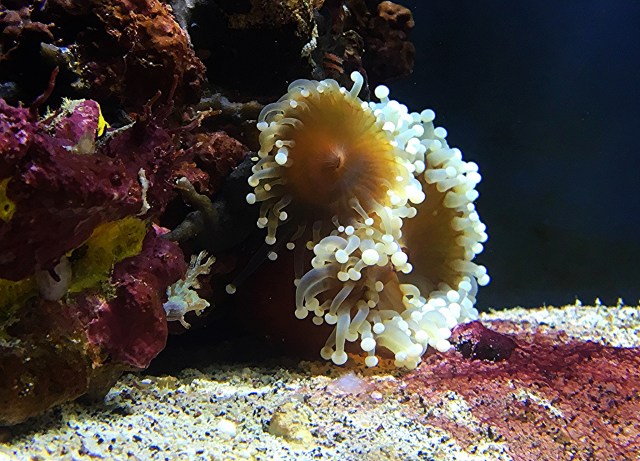
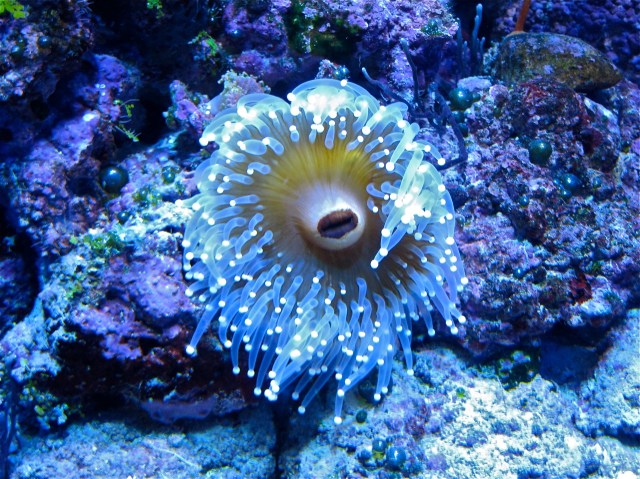
GENERAL CHARACTERISTICS: Note ball tipped tentacles. 

BallAnemone31690177025_2d4172bda6_k 


DISTRIBUTION: Tropical Indian, Central and Western Pacific Oceans

HABITAT: Reef associated

DIET: Small fish and zooplankton

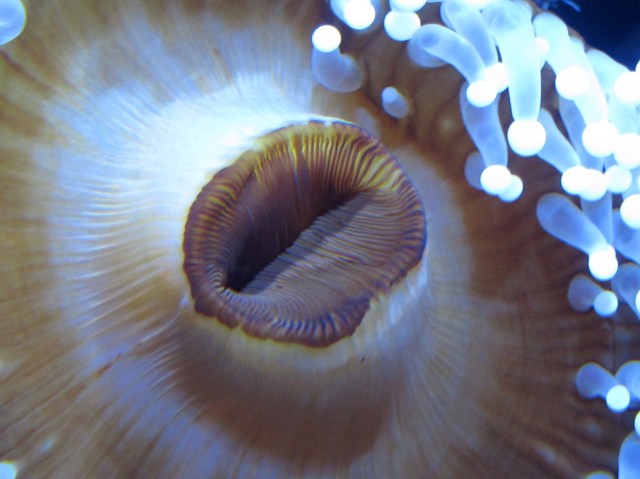
REMARKS: This close relative of sea anemones has sticky ball-tipped tentacles.  Some species of shrimps and fish are immune to the stickiness and live within the tentacles.

Corallimorpharia (Corallimorph) is an order of marine cnidarians closely related to the true sea anemones (Actiniaria). They are mostly tropical, with a narrow column topped with a wide oral disc. The tentacles are usually short or very short, arranged in rows radiating from the mouth. Many species occur together in large groups. In many respects, they resemble the stony corals, except for the absence of a stony skeleton. 

References

California Academy of Sciences Steinhart Aquarium Color on the Reef 2017 AQA17 Charles Delbeek

EOL eol.org/pages/75554/names

WordPress Shortlink  http://wp.me/p1DZ4b-ji

flickr https://www.flickr.com/photos/cas_docents/31690177025/in/album-72157659465376212/


TAXONOMY
Kingdom: Animalia
Phylum: Cnidaria
Class: Anthozoa
Order: Alcyonacea
Family: Nephtheidae

Genus: Capnella sp. (Tree-like soft coral)

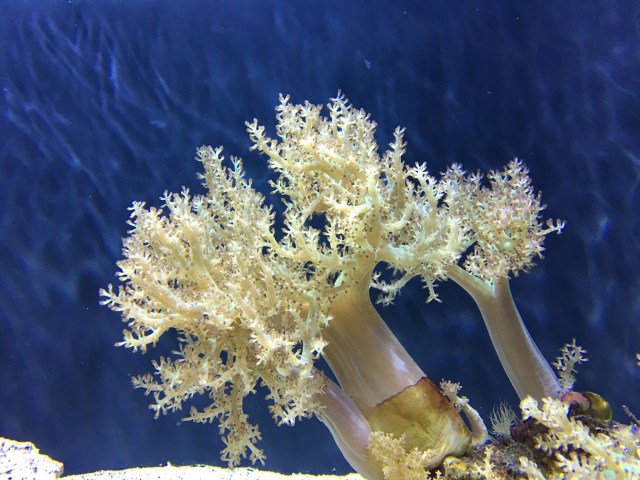
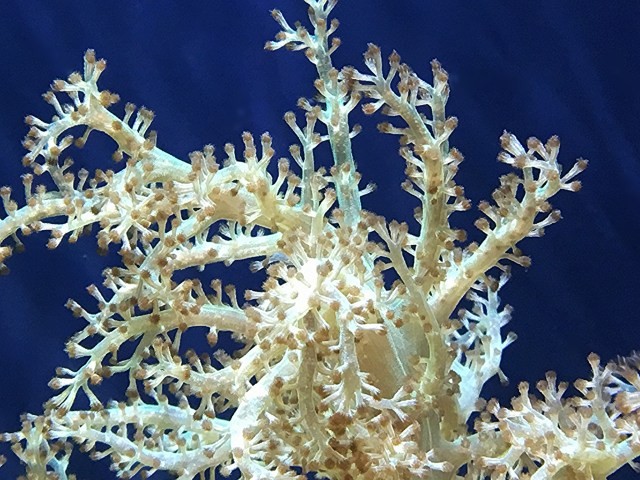
GENERAL CHARACTERISTICS: It has a stalk that is usually cream to brown, with some having a tint of green. Their color is usually cream to brown. The Capnella genus has an erect tree-like structure with lateral branches that are heavily forked. On the top of the branches there are clusters of non-retractable polyps. The base or stalk is without polyps and appears smooth.
(Sinularia spp polyps can retract fully)

Finger Leather Coral24467607171_d42dc69a98_k

DISTRIBUTION/HABITAT: Tropical Indo-West Pacific and Red Sea.
Tend to grow in clear water with stronger currents on deeper reef slopes.

Finger Leather Coral25692244975_89523fbc07_k

DIET IN THE WILD: They capture microscopic food particles from the water column, can absorb dissolved organic matter, and have a symbiotic relationship with a marine algae known as zooxanthellae, where they also receive some of their nutrients.

REPRODUCTION: By budding, fission, and dropping little branches

CONSERVATION: Not on IUCN Red List

References

California Academy of Sciences Steinhart Aquarium Color Cluster 2017 AQA17 Charles Delbeek

Ron’s flickr https://www.flickr.com/photos/cas_docents/24467607171/in/album-72157659465376212/

Aquarium Corals E H Borneman TFH Publications 2001 page 135

Ron’s WordPress shortlink http://wp.me/p1DZ4b-1Lu

EOL eol.org/pages/1761/details

TAXONOMY
Kingdom: Animalia
Phylum: Cnidaria
Class: Anthozoa
Order: Scleractinia
Family: Caryophylliidae (Hexacoral or stony polyped coral)

Genus/species: Plerogyra sinuosa

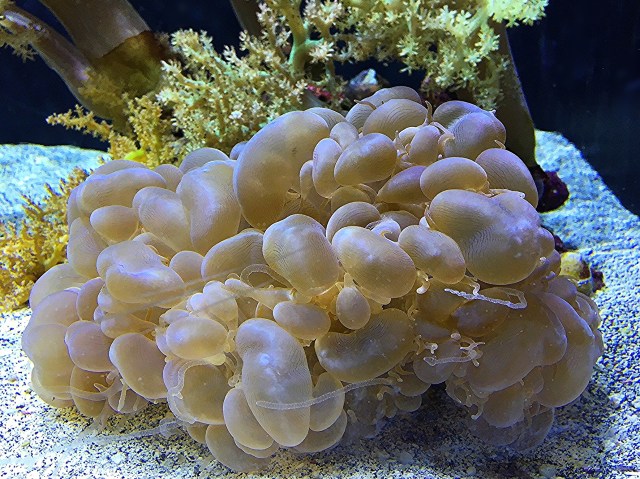
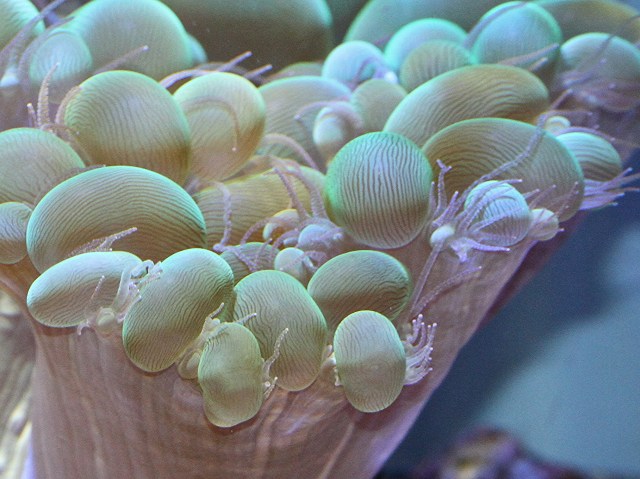
GENERAL CHARACTERISTICS: Colonial corals often covered
with clusters of bubble-like structures (thus the common name), each over 1 cm in length. Tentacles extend at night to capture small prey. Colored gray, bluish, greenish, brownish or rich cream. The skeleton is a mineral aragonite.

bubble coral23923123353_354a13e35d_o

DISTRIBUTION/HABITAT: Indo-Pacific and Australia region.Found in turbid bays and lagoons, on reefs in deep water or under overhangs.

DIET IN THE WILD: Light-capturing bubble-like vesicles extend during the day to support the photosynthesis of the algal symbionts. Tentacles extend at night to capture small prey.

Bubble Coral4561883874_27975403aa_o

CONSERVATION: IUCN Red List Near threatened (NT)

REMARKS: This is a stony coral, despite the soft appearance the “bubbles” give during the day.

References

California Academy of Sciences Steinhart Aquarium Color on the Reef AQA17  Charles Delbeek

Aquarium Corals E H Borneman TFH Publications 2001 Page 311

EOL  eol.org/pages/1006618/details

IUCN Red List www.iucnredlist.org/details/133258/0

WordPress shortlink http://wp.me/p1DZ4b-1Lo

Ron’s Flickr  https://www.flickr.com/photos/cas_docents/23923123353/in/album-72157659465376212/

TAXONOMY
Kingdom: Animalia
Phylum: Cnidaria
Class: Anthozoa
Order: Scleractinia
Family: Fungiidae

Genus/species: Herpolitha sp.

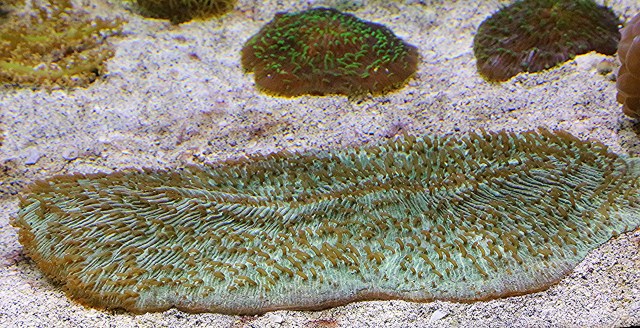
GENERAL CHARACTERISTICS: Color is usually brown, cream or green tones. The Herpolitha genus is noted for short, tapering tentacles with a very long grove with several mouths. The structure is home to a single polyp which sits in a calcareous cup, the corallite. Many septae stretch from the central groove. Form may be nearly circular but mainly elongate.
Length up to 1m (39 inches)

Slipper Coral25262228054_8ba6012bc8_o

DISTRIBUTION/HABITAT: Throughout the tropical Indo-Pacific: from Africa and the Red Sea to Polynesia.
Found among reef slopes and lagoons

DIET IN THE WILD: Herpolitha sp. obtains energy from sunlight via photosynthetic symbionts (zooxanthellae) and plankton captured using nematocysts

CONSERVATION: Minimal risk for over collection

REMARKS: Rather than forming colonies like most corals, Fungia corals are usually solitary and free-living. Because they are unattached, Fungia can be easily moved by waves, and so are most often found in protected places, often at depths where wave action is reduced.

References

California Academy of Sciences Steinhart Aquarium Water is life Color on the Reef 2016 AQA17

Aquarium Corals E H Borneman TFH Publications 2001 page 260

Ron’s flickr  https://www.flickr.com/photos/cas_docents/25262228054/in/album-72157659465376212/

Ron’s WordPress Shortlink  http://wp.me/p1DZ4b-1Lj


TAXONOMY
Kingdom: Animalia
Phylum: Cnidaria
Class: Anthozoa
Order: Scleractinia
Family: Fungiidae

Genus/species: Fungia sp.

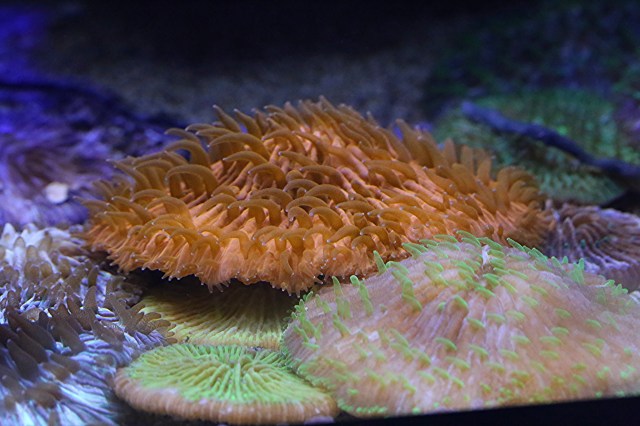
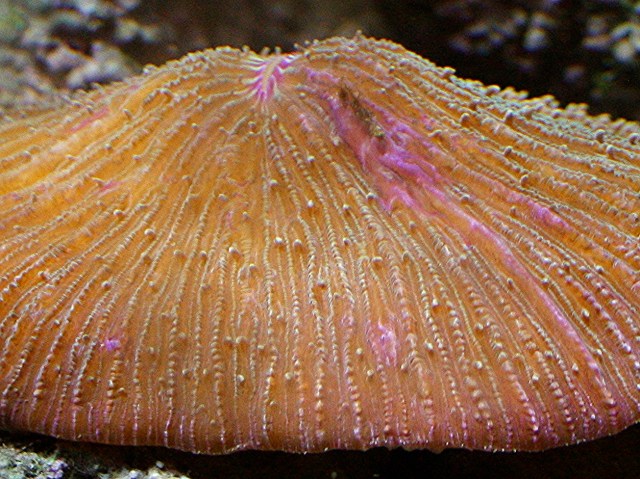
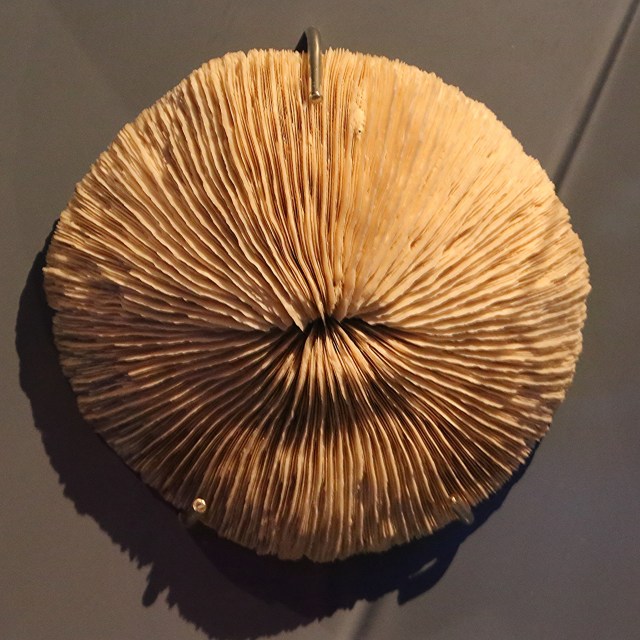
GENERAL CHARACTERISTICS: Hexacoral Genus noted for short, tapering tentacles and a very large mouth opening. The structure is home to a single polyp which sits in a calcareous cup, the corallite. Many septae stretch from the central mouth to sides of the polyp. Usually the form is nearly circular. 

This specimen has its tentacles retracted.

Diameter up to 28 cm (11 inches

Mushroom Coral24651024753_5ace92aaf6_k

DISTRIBUTION/HABITAT: Indo-Pacific from the Red Sea and east Africa, west to Hawaii in tropical and subtropical latitudes. Found among other coral, rubble, or on sand.

DIET IN THE WILD: Plankton, jellies (using nematocysts), proteins (using sticky cilia)

REPRODUCTION: Fungia corals can reproduce sexually or asexually. During sexual reproduction, eggs and sperm are released into the water where the egg is fertilised and develops into larvae. Juvenile Fungia are attached, but become free-living with age, Budding and fragmentation.also can occur.

This specimen has its tentacles retracted.

Mushroom Coral5064192598_beeff0e593_o

CONSERVATION: IUCN Red List Least Concern (LC)

REMARKS: Rather than forming colonies like most corals, Fungia corals are usually solitary and free-living. Because they are unattached, Fungia can be easily moved by waves, and so are most often found in protected places, often at depths where wave action is reduced.

By inflating the body cavity, mushroom corals are able to upright themselves after being overturned. They will travel by inflating their tissue and using current to move.

When Fungi are in immediate contact with other hard corals, they secrete a mucus that can damage coral tissues and prevents the over growth of these neighbouring corals.

Mushroom coral skeleton below


Mushroom Coral24929915125_850e98ad03_k

References

California Academy of Sciences Steinhart Aquarium Water is life Color on the Reef 2017

Aquarium Corals E H Borneman TFH Publications 2001 page253-257

Ron’s flickr  https://www.flickr.com/photos/cas_docents/5063580569/in/album-72157659465376212/

Ron’s WordPress shortlink http://wp.me/p1DZ4b-1Lb

Arkive www.arkive.org/mushroom-corals/fungia-spp/

Animal World animal-world.com/Aquarium-Coral-Reefs/Plate-Coral

TAXONOMY
Kingdom: Animalia
Phylum: Cnidaria
Class: Anthozoa
Order: Scleractinia
Family: Trachyphylliidae (Solitary stony Coral)

Genus/species: Trachyphyllia geoffroyi

GENERAL CHARACTERISTICS: Name comes from Gr: trachys (rough) and phylon (leaf) as it looks like a leaf lying on the substrate. Trachyphyllia are secondarily free-living, usually beginning growth as a single polyp attached to a hard surface. Later it breaks off, and is found detached on sandy or muddy bottoms. Color may vary with depth or substrate: pink to red,
brownish, gray, green, or blue, even multistreaked and iridescent. Fleshy polyps extend well beyond the margin of the stony skeleton.

Open Brain Coral30683128974_b9d9e4ba50_k

DISTRIBUTION/HABITAT: Found in the Indian and Western Pacific oceans on sandy bottoms among seagrass in the outer feel margins.

DIET IN THE WILD: Nutrition from photosynthetic zooxanthellae; also microplankton and other small food bits. Tentacles extended in low light or at night to capture plankton.

CONSERVATION: IUCN RED LIST Near Threatened (NT)

REMARKS: Tangs and angelfishes like to nip and feed on them.
At night their soft tissues may swell to remove debris and sand that accumulates during the day.

References

California Academy of Sciences Steinhart Aquarium Color on the Reef AQA17

Aquarium Corals E H Borneman TFH Publications 2001 pages 301-3

Ron’s flickr https://www.flickr.com/photos/cas_docents/30683128974/in/album-72157659465376212/

Australian Institute of Marine Science  coral.aims.gov.au/factsheet.jsp?speciesCode=0350

Arkive.org www.arkive.org/open-brain-coral/trachyphyllia-geoffroyi/

IUCN www.iucnredlist.org/details/133260/0

Ron’s WordPress Shortlink  http://wp.me/p1DZ4b-1L5