Category: CORAL REEF


TAXONOMY
Kingdom: Animalia
Phylum: Cordata
Class: Actinopterygii (ray-finned fishes
Order: Perciformes (Perch-likes)
Family: Zanclidae (Moorish idol)

Genus/species: Zanclus cornutus


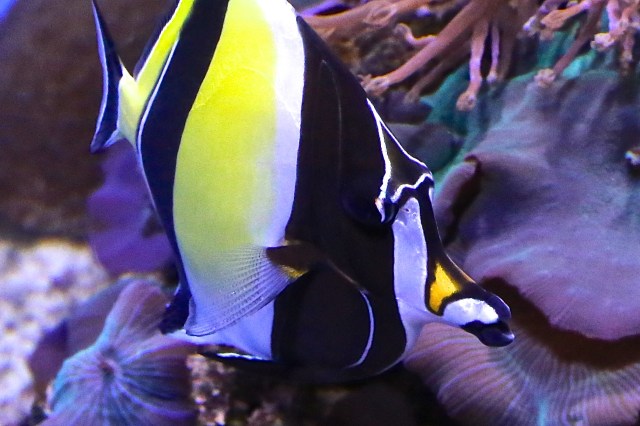
GENERAL CHARACTERISTICS: Discoid body, tubular snout, dorsal spines elongated into a very long white whip-like filament. Broad vertical white, black, white-yellow black, yellow banding. Tail black with white margin. Length to 23 cm (9 inches).

DISTRIBUTION/HABITAT: Indo-pan-Pacific. Southern Gulf of California found near hard substrates from turbid inner harbors and reef flats to clear seaward reefs as deep as 182 m (600 ft). Usually in small groups of conspecifics, occasionally in schools of more than 100.                 

 DIET IN THE WILD: Primarily sponges. Also consumes tunicates and algae.

 REPRODUCTION: It has a long larval phase and settles at a large size (6 cm or 2.4 in) resulting in its very wide geographic distribution.

 CONSERVATION: Not evaluated

REMARKS: The Moorish Idol was the icon of the Golden Gate Park Steinhart Aquarium.

Gill, was the leader of the tank fish in the movie Finding Nemo, with the voice of Willem Dafoe, is a Moorish idol.

Color of Life, Color on the Reef, Color Conceals, Hiding the eye.
Black stripes break up the body outline and hide the eye from predators.
IMG_3304

 Philippine Coral Reef  

 Ron’s flickr http://www.flickr.com/photos/cas_docents/sets/72157608440659805/

Ron’s  WordPress Shortlink  http://wp.me/p1DZ4b-Ax

fishbase: http://www.fishbase.org/summary/5950

EOL http://eol.org/pages/204516/hierarchy_entries/44696397/details
TAXONOMY

Kingdom: Animalia
Phylum: Chordata
Class: Actinopterygii (ray-finned fishes)
Order: Perciformes (Perch-likes)
Family: Callionymidae (Dragonets)

Genus/species: Synchiropus splendidus

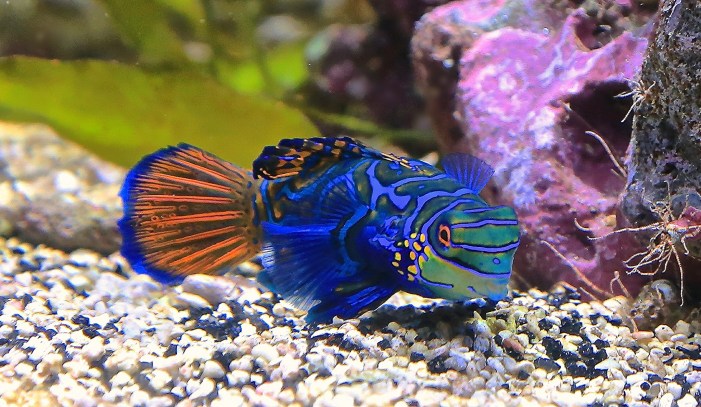
GENERAL CHARACTERISTICS: Body depressed, small head. Ground color green (rare individuals red). Body covered with dark blue blotches ringed with dark outlines. Pectoral fins, face yellow.
Length to 6 cm (2.36 in).

Synchiropus splendidus15148891995_e1b96e57d4_k

DISTRIBUTION/HABITAT: Western Pacific in shallow protected lagoons and inshore coral reefs with silty substrates 1 to 18 m
(3.28 to 59 ft).

DIET IN THE WILD: Small crustaceans such as amphipods and isopods, small worms and protozoans.

Green Mandarinfish aka Mandarin Dragonet3274882181_969702e800_b

REPRODUCTION: Polygynandrous (promiscuous). During spawning they are pelagic and are seen in the open ocean.

LIFESPAN: 10-15 years in the wild.

CONSERVATION: IUCN Not Evaluated

Color of Life: aposematic warning
S. splendidus have a vibrant display of colors. They secrete mucous that has an unpleasant smell with toxins and a bitter taste which is used as a repellent from predators.

References

California Academy of Sciences exhibit 2015

fishbase www.fishbase.org/summary/12644

Animal Diversity Web animaldiversity.org/accounts/Synchiropus_splendidus/

Ron’s flickr https://www.flickr.com/photos/cas_docents/15148891995/in/album-72157659465376212/

Ron’s WordPress shortlink http://wp.me/p1DZ4b-1Ba


TAXONOMY
Kingdom:Animalia
Phylum: Chordata
Class Actinopterygii (ray-finned fishes)
Order Perciformes (Perch likes)
Family Chaetodontidae (Butterflyfishes)

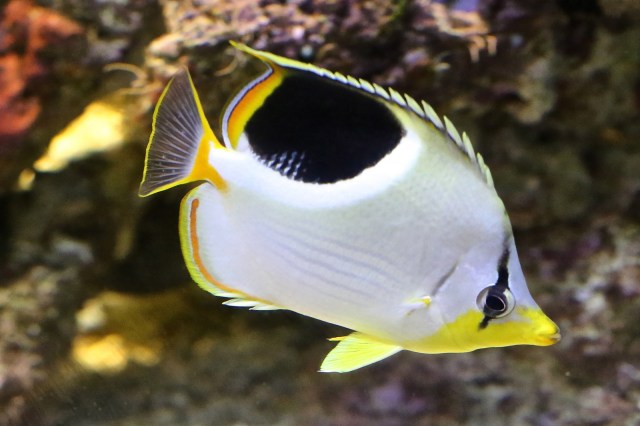
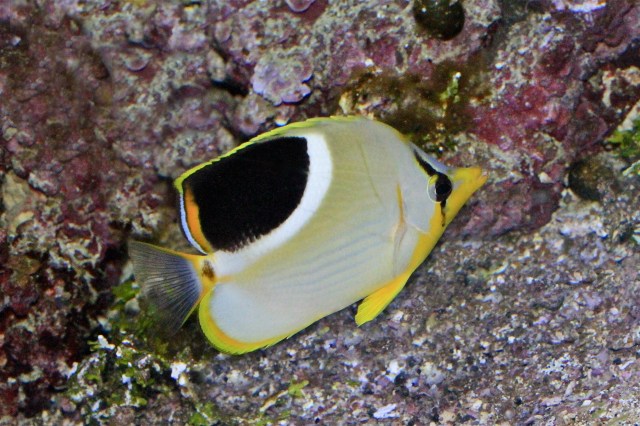
Genus/Species:  Chaetodon ephippium

Chaetodon ephippium 8410074954_fcdc073db2_h

GENERAL CHARACTERISTICS: Yellowish grey with a large black spot on the upper rear sides bordered below by a broad white band; orange area from snout to ventral fins, wavy blue lines on the lower sides. The breast and snout are yellow. Adults have a filament extending from the back of the dorsal fin.
Length to 23 cm (9 inches) in length.

DISTRIBUTION/HABITAT: Indo-Pacific. in lagoons and seaward reefs to 30 m (98 feet) in coral rich, clear waters.

DIET IN THE WILD: Filamentous algae, small invertebrates, sponges, coral polyps, and fish eggs.

REPRODUCTION: Oviparous

CONSERVATION: IUCN Least Concern (LC)

Color of Life, Color Conceals.
This Saddleback Butterflyfish helps conceals its head by having a vertical line through the eye and a large eve-like spot on its upper posterior less vital portion of its body confusing  predators.

Color Cluster

References

California Academy of Sciences Color of life docent training 2015

Ron’s WordPress Shortlink   http://wp.me/p1DZ4b-vi

Ron’s flickr  http://www.flickr.com/photos/cas_docents/sets/72157625119200613/
fishbase www.fishbase.org/summary/5562

EOL eol.org/pages/1012777/details

Australia Museum australianmuseum.net.au/Saddle-Butterflyfish-Chaetodon-ep…

https://www.flickr.com/photos/cas_docents/6427211687/in/album-72157652559028013/

TAXONOMY
Kingdom: Animalia
Phylum: Chordata
Class: Actinopterygii (Ray-finned fishes)
Order: Tetraodontiformes (Puffers and filefishes)
Family: Tetraodontidae (Puffers)

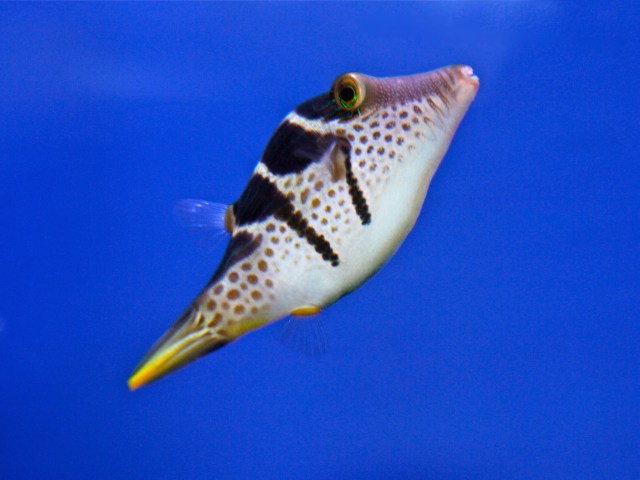
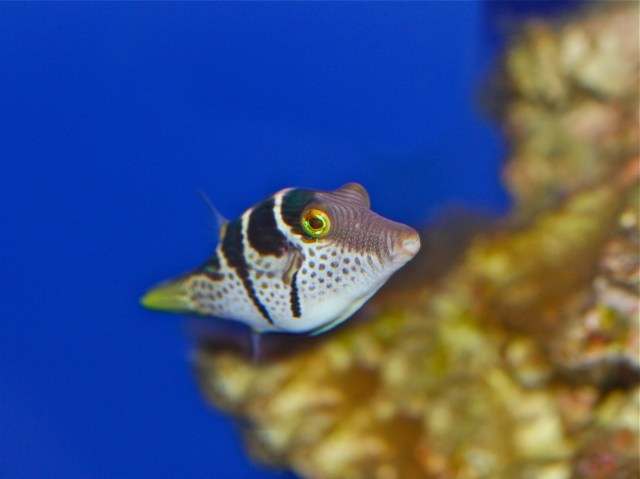
Genus/species: Canthigaster valentini

GENERAL CHARACTERISTICS: C. valentini has a white body with four distinct black stripes on the upper half. The body is also covered with brownish-orange dots. It has yellow fins, and blue striping running along the back. It lacks pelvic fins, but has learned to use the pectoral fins to move about the aquarium.
Males have blue-green lines radiating from the back of the eyes. They are also larger than females and may also have a light gray patch in front of the anus.

DISTRIBUTION/HABITAT: Occurs throughout the tropical, marine Indo-Pacific where it is common and locally abundant. It inhabits a wide range of coral reef and seagrass habitats at depths ranging from 1 to 55 metres.

DIET IN THE WILD: Forages on the benthos, feeding mainly on filamentous green and red algae, tunicates, and on smaller amounts of corals, bryozoans, polychaetes, echinoderms, mollusks.

CONSERVATION: IUCN Red List Least Concern (LC)

REMARKS: They are capable of inflating their abdomens with water when frightened or disturbed.
They can produce toxins such as tetrodotoxin and saxitoxin in the skin, gonads, and liver. Try not to use a net when handling this fish since it’s flesh is poisonous.The degree of toxicity varies by species, and also according to geographic area and season.

Color of Life:Color Communicates. The Mimic filefish (not shown here) evades predators by mimicking the Sharpnose Puffer (Canthigaster valentini).

The Mimic filefish can be distinguished from the Sharpnose Puffer (highly poisonous) by comparing their dorsal fins. The Mimic filefish has two dorsal fins, while the Sharpnose Puffer above has only one. – See more at: australianmuseum.net.au/blacksaddle-filefish-paraluteres-…

LOCATION:  COLOR CLUSTER   


References

California Academy of Sciences Color on the Reef exhibit 2015

Ron’s flickr https://www.flickr.com/photos/cas_docents/6427211687/in/album-72157652559028013/

Ron’s WordPress shortlink:  http://wp.me/p1DZ4b-iz

Australian Museum  australianmuseum.net.au/blacksaddle-toby-canthigaster-val…

Encyclopedia of life  eol.org/pages/225023/overview


TAXONOMY
Kingdom: Animalia
Phylum: Chordata
Class: Actinopterygii (ray-finned fishes)
Order: Perciformes (Perch-likes)
Family: Serranidae (Sea basses: groupers and fairy basslets)

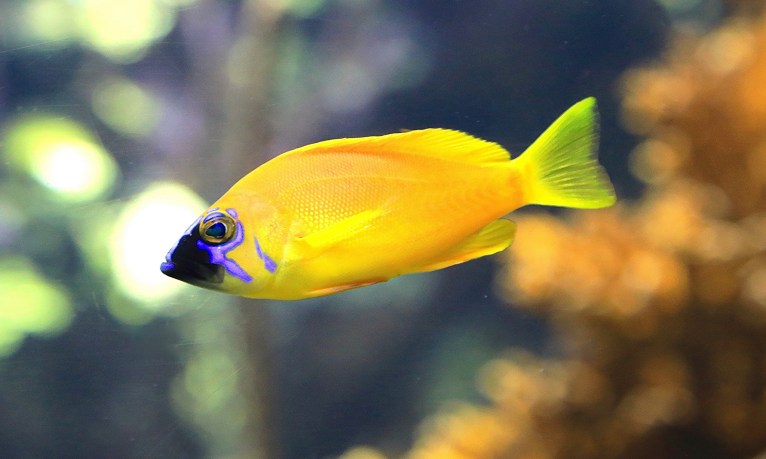
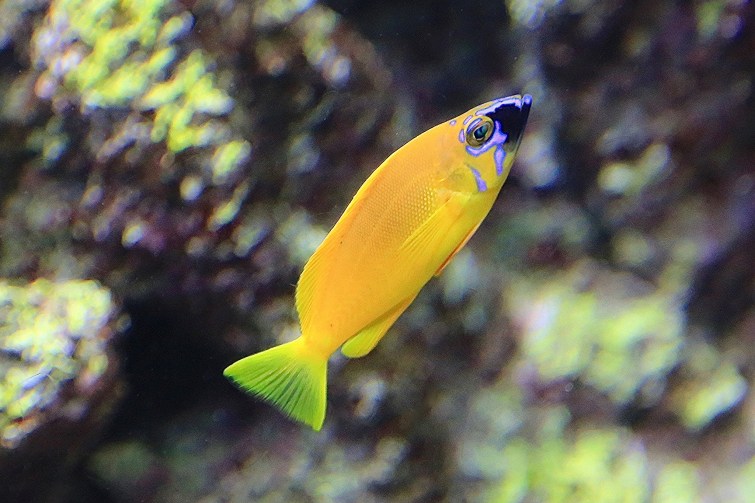
Genus/species: Hypoplectrus gummigutta

GENERAL CHARACTERISTICS: Body rich chrome-yellow in color. The snout is black bordered by an iridescent blue. Pectoral fins pigmented. Hamlet “species” are defined primarily on differences in color patterns. They are known to interbreed and hybridize freely with very little consistent genetic differentiation amongst them.

Golden Hamlet19442208331_9807a11d99_k

DISTRIBUTION/HABITAT: H. gummigutta is rare and found in the Western Central Atlantic. It is coral reef associated.

CONSERVATION: IUCN: Least Concern (LC)

No known major threat but juveniles are potentially a prey item of the invasive Lionfish.


Golden hamlet18815471474_4ab1413005_k

REPRODUCTION: The Golden Hamlet is a simultaneous hermaphrodite (possesses both male and female sex organs).  Successful spawning requires two individual fish.

Color of Life note: Brightly colored fish seem to jump into your sight. But underwater, these bright colors mingle with those of other fish, reef creatures, and the coral itself, to offer a mixtures of color and patterns in which no one individual stands out. Movement of the anemones and corals in the current also serve to obscure and protect the fish.
Ref: California Academy Academy of Sciences, Color of Life Exhibit 2015

References

Ron’s flickr  https://www.flickr.com/photos/cas_docents/19442208331/in/album-72157652559028013/

Ron’s WordPress shortlink  http://wp.me/p1DZ4b-1yL

Reef builders.com (an excellent description of the Caribbean reef exhibit at the California Academy of Sciences). http://reefbuilders.com/2015/03/24/steinhart-aquariums-caribbean-display-realistic-biotope-representation/#

fishbase  www.fishbase.org/summary/Hypoplectrus-gummigutta.html

IUCN Red List  www.iucnredlist.org/details/16751128/0

TAXONOMY
Kingdom: Animalia
Phylum: Echinodermata
Class: Echinoidea (Sea urchins)
Subclass: Cidaroidea
Order: Cidaroida
Family: Cidaridae

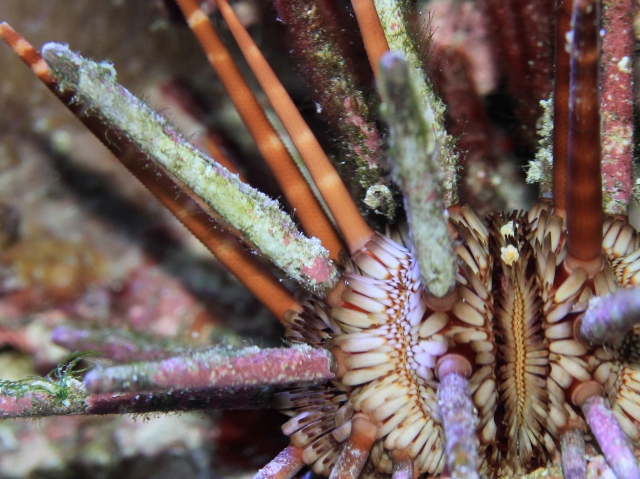
Genus/species: Eucidaris tribuloides

GENERAL CHARACTERISTICS: Brown body with thick spines in all directions. 

Slate Pencil UrchinIMG_1479

DISTRIBUTION/HABITAT: North Carolina through Brazil, Caribbean, Bahamas, Florida. Found in coral reef crevices, in turtle grass beds, or under rocks and rubble in back reef lagoon areas. Depth to 800 m (usually 50 m). 


Slate Pencil UrchinIMG_1478

DIET IN THE WILD: Nocturnal omnivore: algae and small invertebrates such as sea squirts and sponges.

Slate Pencil UrchinIMG_0664

REMARKS: The spines of pencil urchins, unlike other urchin groups, are not covered with epidermis. They are, however, often covered with algae and epizoans that provide excellent camouflage. Spines are also covered with barbs that can inflict serious pain to a predator. Seek shelter in rocky crevices by day, using the thick spines to maintain a protected position.

References

Encyclopedia of life eol.org/pages/600976/details

Smithsonian Tropical Research Institute 

biogeodb.stri.si.edu/bocas_database/search/species/1130

Animal Diversity Web animaldiversity.ummz.umich.edu/accounts/Eucidaris_tribulo…

Ron’s flickr https://www.flickr.com/photos/cas_docents/4330820247/in/set-72157608501343477

Ron’s WordPress shortlink  http://wp.me/p1DZ4b-1nk

Caribbean  PR36

TAXONOMY
Kingdom: Animalia – animals
Phylum: Echinodermata Klein – echinoderms
Subphylum: Eleutherozoa
Superclass: Cryptosyringida
Class: Ophiuroidea – basket stars, brittlestars, snake stars
Order: Ophiurida – basket stars, serpent stars, basket stars, serpent stars
Suborder: Iohiura incrassata
Family Ophiodermatidae

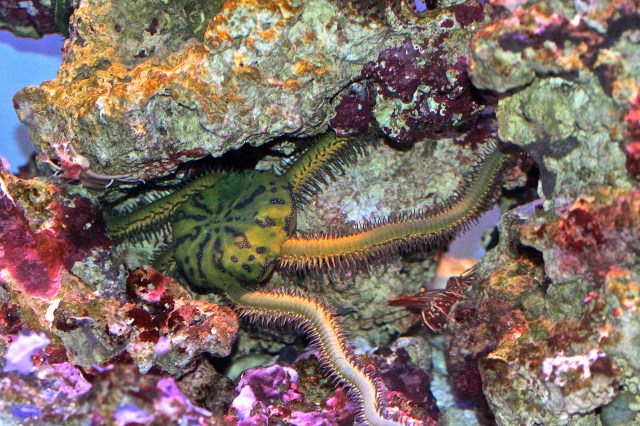
Genus/species: Ophiarachna incrassata

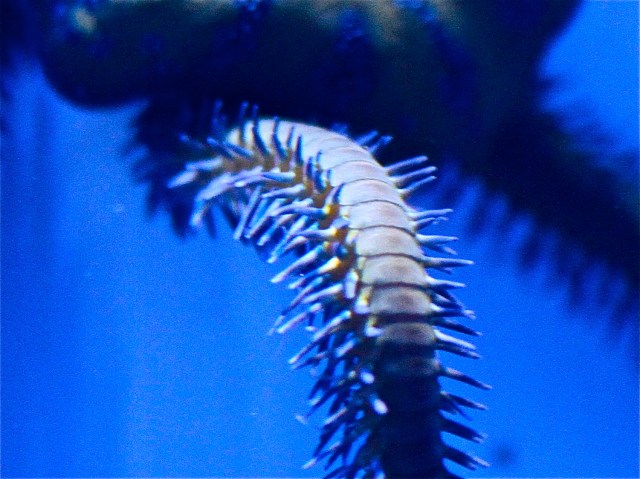
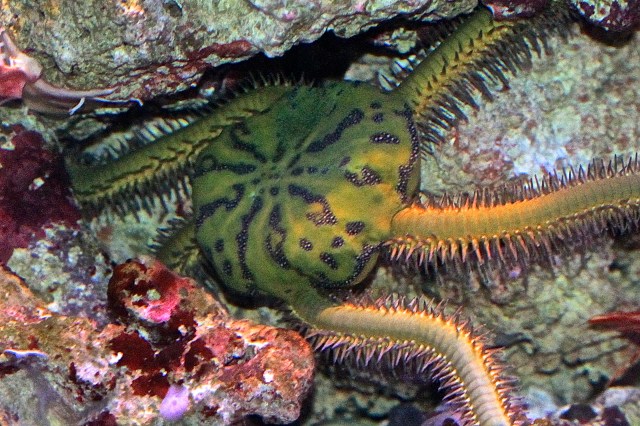
GENERAL CHARACTERISTICS: Green with yellow markings and dark-ringed white spots. Disc diameter to 5 cm (2 inches) and arm length to 20 cm (8 inches). Top of arms are wide and flat.

Stout Green Brittle Star8412648309_4004cdfca2_k

DIET IN THE WILD: Nocturnal feeder of  small organisms and detritus.

Stout Green Brittle Star4472769084_f4acdf93f2_o

DIET IN THE WILD: Small organisms and detritus. Nocturnal feeder.

Stout Green Brittle Star8282559749_1cb63a02d1_oReferences

Ron’s flickr  https://www.flickr.com/photos/cas_docents/8412648309/in/set-72157608501343477/

Encyclopedia of life  eol.org/pages/598310/details

Reef Creature Identification, Humann and Deloach 2010, page443

ADW animaldiversity.ummz.umich.edu/accounts/Ophiarachna_incra…

Ron’s WordPress shortlink  http://wp.me/p1DZ4b-1mb


TAXONOMY
Kingdom: Animalia
Phylum: Chordata
Class: Actinopterygii (ray-finned fishes),
Order: Perciformes (Perch-likes)
Family: Apogonidae (Cardinalfishes)

 Ostorhinchus sealei  (Apogon sealei) 


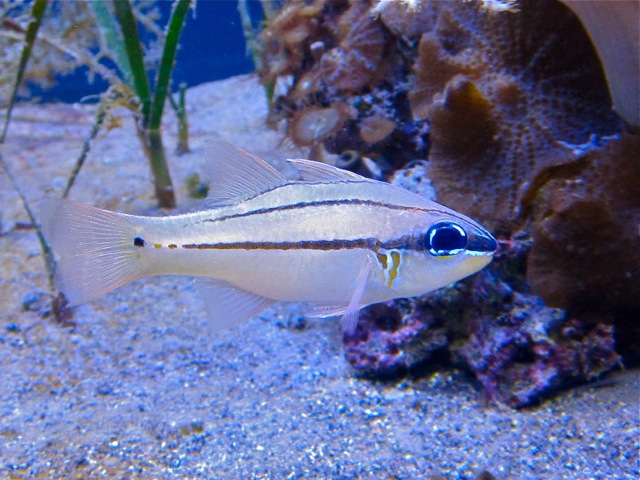
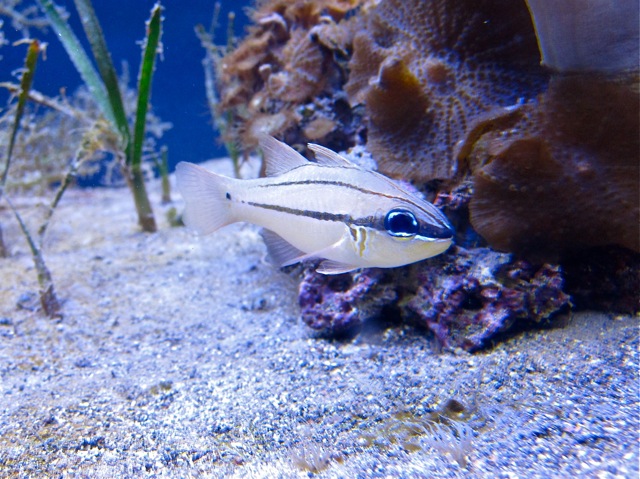
GENERAL CHARACTERISTICS:  Length 80mm, (3.15 inches). Pale yellow with a  pair of thin brown stripes on the upper side and a dark spot on mid tail base. Two short orange bars in bluish white patch on gill cover.

DISTRIBUTION/HABITAT: Malaysia to the Solomon Islands, north to the Philippines, Palau, and south to Ashmore Reef, Australia. Usually found on coastal fringing reefs or patch reefs to a depth of 25 m (80 feet). It is often found in pairs or in groups among branching corals such as Acropora. 

DIET IN THE WILD: Individuals shelter in amongst the coral during the day and come out to feed at night on zooplankton and benthic invertebrates.

REPRODUCTION and DEVELOPMENT: This species demonstrates distinct pairing during courtship. The males mouthbrood the fertilized eggs until hatching is ready to occur.

LOCATION:  Philippine Coral Reef

References

fishbase http://www.fishbase.org/summary/6230

WORDPRESS SHORTLINK  http://wp.me/p1DZ4b-ki

flickr  https://www.flickr.com/photos/cas_docents/6615915253/in/set-72157625992053826

eol  neol.org/pages/212483/details

Cardinalfish general information.  

Found in the Atlantic and Indo-Pacific oceans, cardinalfishes are primarily marine, though some are found in brackish waters and a few in freshwater streams. Many species inhabit reef flats, lagoons, and seaward reefs to 60 feet (18 m).
The family is characterized by two widely separated dorsal fins, large eyes, short snouts, double-edged preopercula and a moderately large oblique mouth. The name derives from the red coloration of some well-known species, though many are drab or striped.
Most remain hidden during the day, and then disperse over the reef at night to feed on zooplankton and small benthic invertebrates, always remaining close to the substrate. Males of many species are mouth brooders.

TAXONOMY
Kingdom: Animalia
Phylum: Chordata
Class: Actinopterygii (ray-finned fishes)
Order: Perciformes (Perch-likes)
Family: Labridae (Wrasses)

Genus/species: Labroides dimidiatu

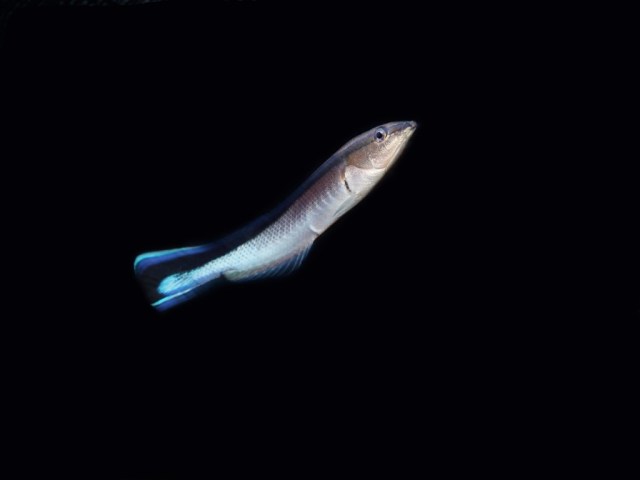
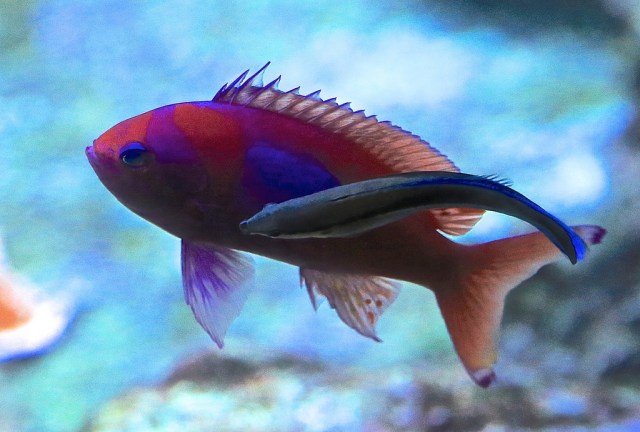
GENERAL CHARACTERISTICS: Length to 11.5 cm (4.5 inches). Elongate body, tubular mouth. Blue to yellow above fading to white or yellow below. There is a black stripe from the eye to the caudal fin margin. The stripe widens posteriorly.

DISTRIBUTION/HABITAT: Indo-Pacific in virtually all coral reef habitats: inner lagoons and subtidal reef flats to seaward reefs, 0.5-40 m (18 in to 125 ft), typically near branching corals. Active diurnally. Aggressively territorial. Nocturnally retires to small crevices in the reef, enclosing itself in a mucus cocoon. Remains in stations where other fish come to be cleaned.

DIET: The most common cleaner wrasse on reefs. Pick external parasites from other fishes. Also clean the wounds of other fishes by removing scar tissue. Clean the gills and even enter the mouth of the host.

REPRODUCTION: Monogamous. A protogynous hermaphrodite.
Open water/substratum egg scatterers, non guarders.

CONSERVATION: IUCN, Least concern

Cleaner Wrasse13298334135_9737aa3d26_b

Philippine Coral Reef PR04

flickr http://www.flickr.com/photos/cas_docents/sets/72157608208133134/with/2977676226/

WordPress Shortlink http://wp.me/p1DZ4b-Kp

fishbase fishbase.sinica.edu.tw/summary/SpeciesSummary.php?ID=5459

EOL eol.org/pages/204814/details

Australia Museum  australianmuseum.net.au/Common-Cleanerfish-Labroides-dimi…

TAXONOMY
Kingdom: Animalia
Phylum: Chordata
Class: Actinopterygii (ray-finned fishes)
Order: Perciformes (Perch-likes)
Family: Labridae (Wrasses)

Genus/species: Thalassoma hardwicke

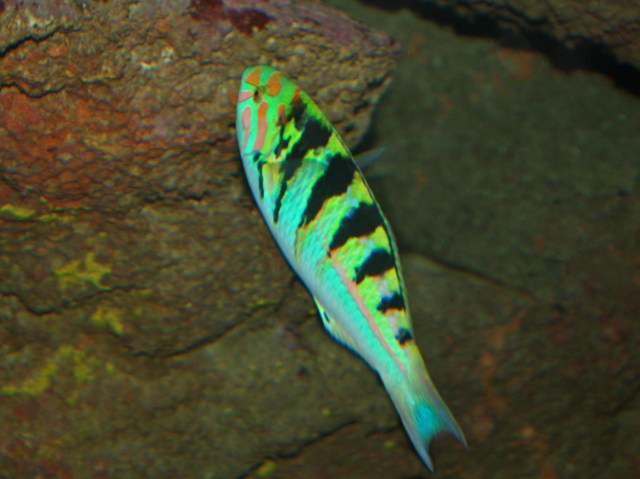
Sixbar Wrasse8410603333_678203e399_b

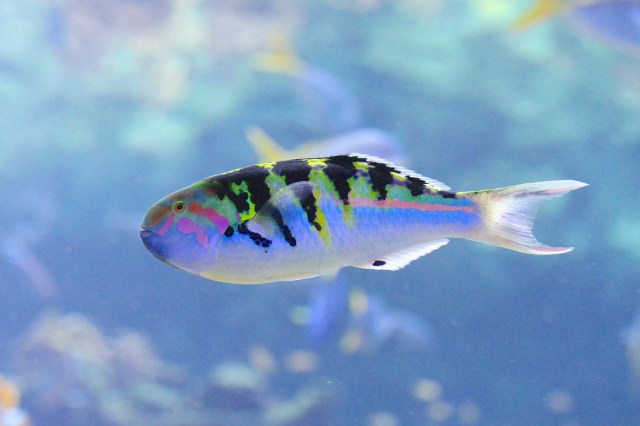
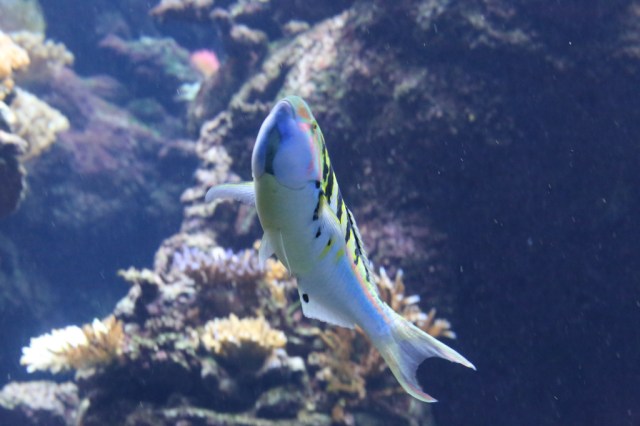
GENERAL CHARACTERISTICS: Adult is pastel blue to pale green with six dark, vertical bars on their body, the last two saddling the tail. The head has a distinct ‘daisy’ print around the eyes made of a few different pastel colors (e.g., pink bands radiating from the eye) in larger adults.  Max length: 20 cm (7.9 in).

DISTRIBUTION/HABITAT: Found in the tropical Indo-Pacific in shallow lagoons and seaward reefs. Depth to 15 m (50 ft.).

DIET IN THE WILD: Carnivore on benthic and planktonic crustaceans, invertebrates and small fishes.

Sixbar Wrasse8393609669_e1f3601c7c_b

REPRODUCTION: Protogynous hermaphrodite; Hermaphroditism occurs when a given individual in a species possesses both male and female reproductive organs, or can alternate between possessing first one, and then the other. The most common pattern is for a female to change into a male (protogyny). This often happens when a large dominant male is removed by a predator. Within a few days, the largest female in the harem becomes a dominant male and takes over the missing male’s function. This pattern is common in coral reef fishes, such as parrotfishes, wrasses, and groupers.
T.hardwicke is a pelagic spawner meaning water currents widely disperse the young. The eggs, embryos and larvae of pelagic spawners contain oil globules or have a high water content. As a result, they are buoyant and are widely dispersed by currents. The downside is that mortality is high, because they can be eaten so easily by pelagic predators. Pelagic spawners who live in or around coral reefs can spawn a small number of eggs almost daily over a period of months.

CONSERVATION: IUCN; least concern

REMARKS. Occur in small, loose groups.

References

flickr http://www.flickr.com/photos/cas_docents/4390962019/in/set-72157608208133134/

WordPress shortlink wp.me/p1DZ4b-nD

fishbase www.fishbase.org/summary/Thalassoma-hardwicke.html

EOL eol.org/pages/220102/details