Category: CORAL REEF


TAXONOMY
Kingdom: Animalia
Phylum: Chordata
Class: Actinopterygii (ray-finned fishes)
Order: Perciformes (Perch-likes)
Family: Acanthuridae (Surgeonfishes, tangs, unicornfishes)

Genus/species: Ctenochaetus strigosus

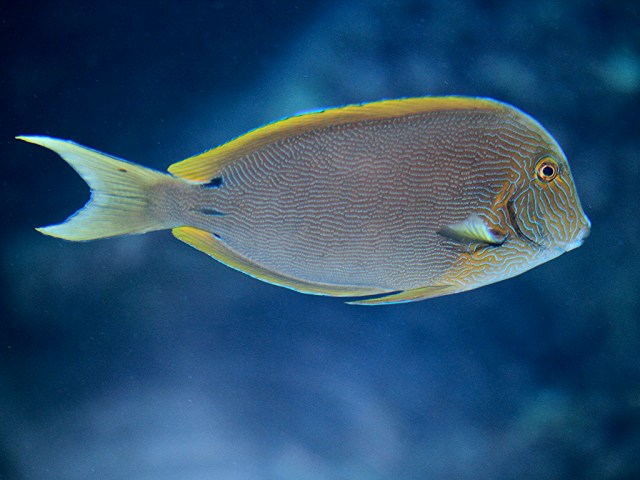
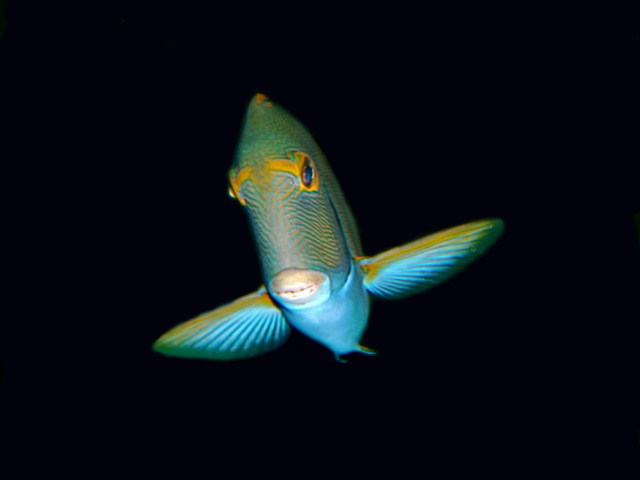
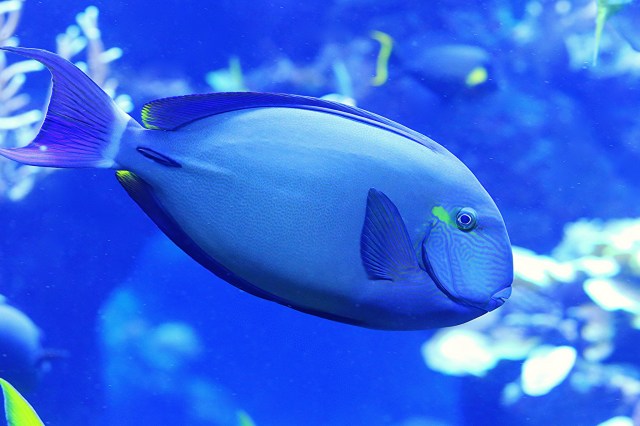
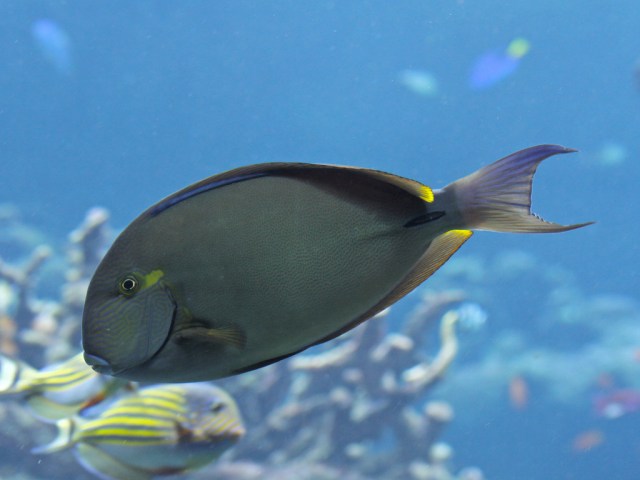
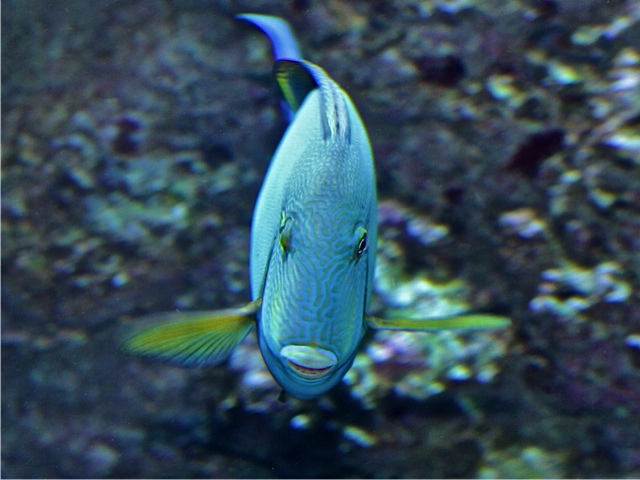
GENERAL CHARACTERISTICS: Brown as a juvenile and blue or burgundy as an adult with pale yellow spots on head and pale yellow pinstripes on body. Conspicuous, broad yellow ring around the eye.

Max. length: 15 cm (6 in).
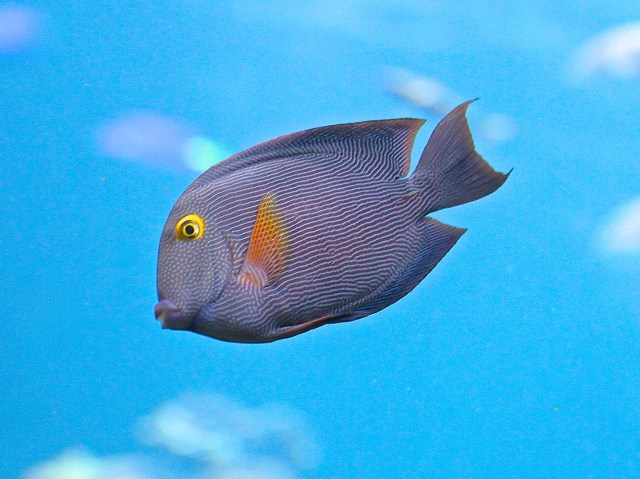
4295978629_a74cba2281_o

DISTRIBUTION/HABITAT: C. strigosus is found in the Central Pacific in coral-rich areas of deep lagoon and seaward reefs.

DIET IN THE WILD: Herbivore, grazing algae and detritus using its comb-like teeth. Their diet may contain high concentrations of the dinoflagellate that produces ciguatera toxin, and so bristletooths and their predators are known to sometimes concentrate sufficient toxin to cause illness in humans.

4770697730_79fe352a24_b

REPRODUCTION: Pelagic spawner. Lifespan 5 yrs or longer.
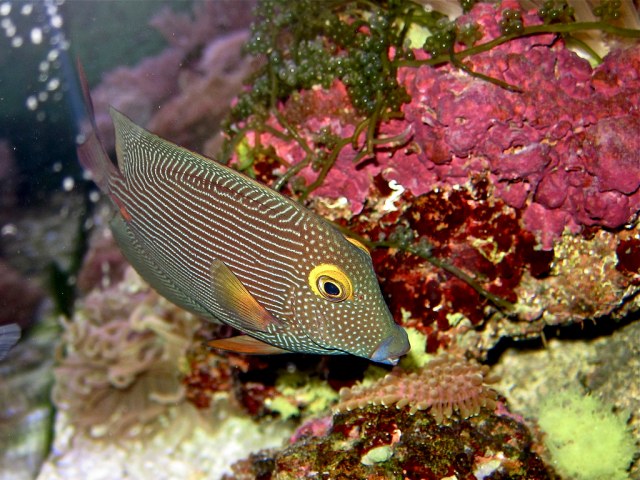
Goldring Bristletooth aka Spotted Surgeonfish (brown variant)13161055833_2f47ca36cb_b

CONSERVATION: IUCN Least concern

REMARKS: It has also been commonly observed to clean algal growths from the shells of sea turtles in Hawaiian waters.

References

California Academy of Sciences Steinhart Aquarium Philippine Coral Reef 2016

IUCN www.iucnredlist.org/details/177949/0

Ron’s flickr http://www.flickr.com/photos/cas_docents/8679225491/in/set-72157608332652056/  

EOL eol.org/pages/220815/details

fishbase www.fishbase.org/summary/6015

Ron’s WordPress Shortlink  http://wp.me/p1DZ4b-WG
TAXONOMY
Kingdom: Animalia
Phylum: Chordata
Class: Actinopterygii (ray-finned fishes)
Order: Perciformes (Perch-likes)
Family: Acanthuridae (Surgeonfishes, tangs, unicornfishes)

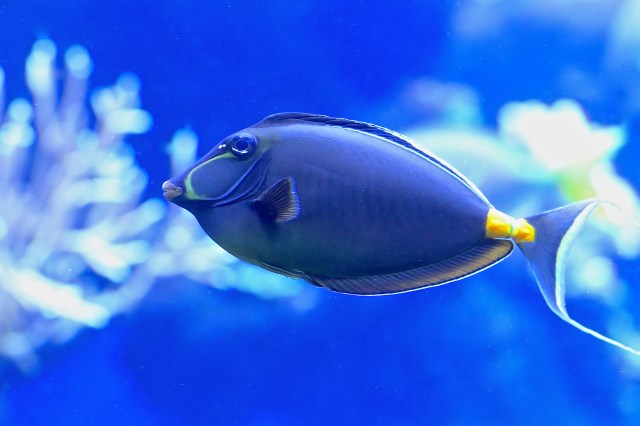
Genus/species: Naso lituratus

IMG_5124

Photo above Male


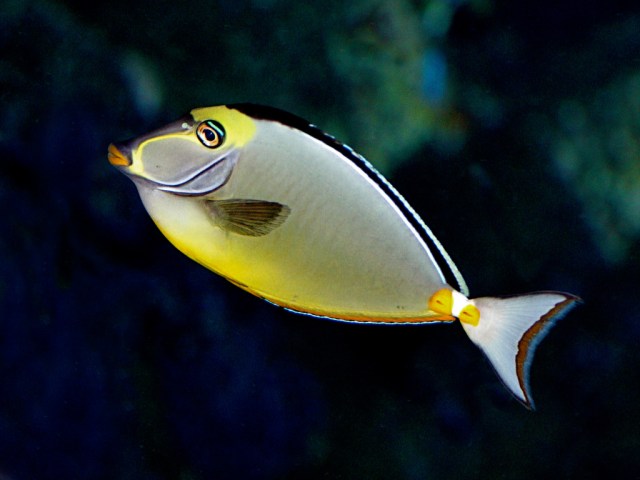
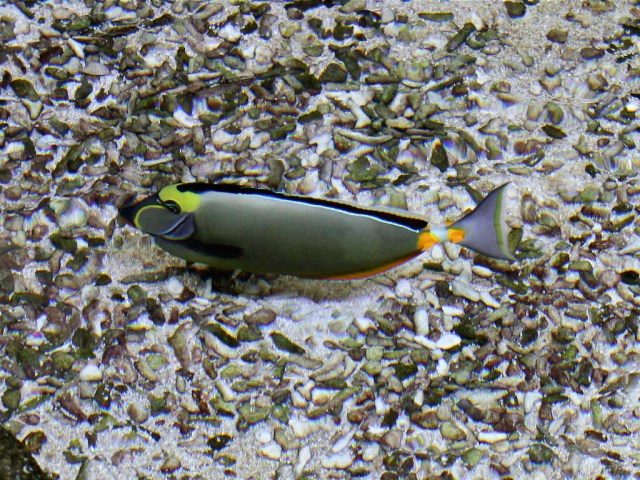
GENERAL CHARACTERISTICS: The Orange Spine Unicornfish is a hornless unicornfish. Coloration varies among populations. A prominent vertical black stripe from eyes to mouth is present on its face. The continuous unnotched dorsal fin is black with with a pale blue line at base and a broad outer white zone. The anal fin is orange.  The bright orange caudal peduncule has two forward-directed venomous knife-like keeled bony plates.   The caudal fin is emarginate (slight inward curve) with adult males having trailing filaments from each corner.

Length to 46 cm (18 inches)

DISTRIBUTION/HABITAT: Indo-Pacific over coral, rock or rubble of lagoon and seaward reefs from the lower surge zone to 90 m (300 ft). Introduced Florida and Georgia.

DIET IN THE WILD: Primarily leafy brown algae especially Sargassum spp.

REPRODUCTION: Fertilization is external with open water pair spawning. Nonguarders

CONSERVATION: IUCN Least Concern (LC)

References

California Academy of Sciences Steinhart Aquarium Philippine Coral Reef 2016

Rons flickr http://www.flickr.com/photos/cas_docents/2979734770/in/set 72157608332652056

Ron’s WordPress Shortlink   http://wp.me/p1DZ4b-HQ

fishbase  http://www.fishbase.org/summary/1264

USGS  http://nas.er.usgs.gov/queries/FactSheet.aspx?speciesID=2553

IUCN www.iucnredlist.org/details/177950/0

TAXONOMY

Kingdom: Animalia
Phylum: Chordata
Class: Actinopterygii (ray-finned fishes)
Order: Perciformes (Perch-likes)
Family: Acanthuridae  (Surgeonfishes, tangs, unicornfishes)

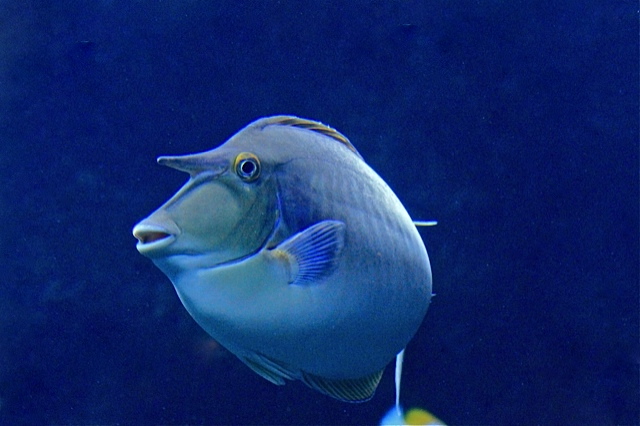
Genus/Species: Naso vlamingii

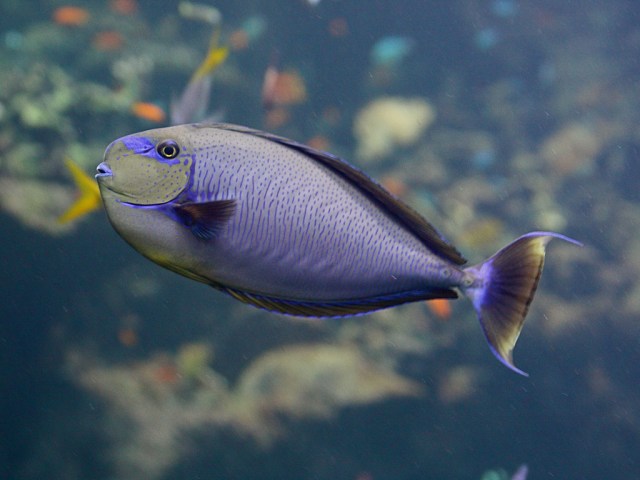
GENERAL CHARACTERISTICS: The Bignose Unicornfish has a convexly rounded prominent snout and extremely tall dorsal and anal fins. A broad blue band extends from eye to front of rostral protuberance. The body is gray, ovate and compressed with blue vertical lines which break up into small blue spots dorsally and ventrally. The tips of the tail fin are unusually long.

Length to 60 cm (23 in)

DISTRIBUTION/HABITAT: Found in the Indo-Pacific in deep lagoons and seaward reefs from 4–50 m (12-150 ft) off steep slopes.

DIET IN THE WILD: Omnivorous, feeds on zooplankton.

REPRODUCTION: External fertilization. Egg scatterers, non-guarding. Remarks: Courting males are able to instantaneously turn iridescent blue.

CONSERVATION: IUCN Least concern (LC)

References

California Academy of Sciences Steinhart Aquarium Philippine Coral Reef 2016

fishbase  www.fishbase.org/summary/6024

EOL eol.org/pages/213847/hierarchy_entries/44696490/details

Ron’s flickr http://www.flickr.com/photos/cas_docents/sets/72157608332652056/with/3120136472/

Ron’s WordPress Shortlink  http://wp.me/p1DZ4b-HF

TAXONOMY
Kingdom: Animalia
Phylum: Chordata
Class: Actinopterygii
Order: Perciformes
Family: Acanthuridae (Surgeonfishes, Tangs and Unicornfishes)

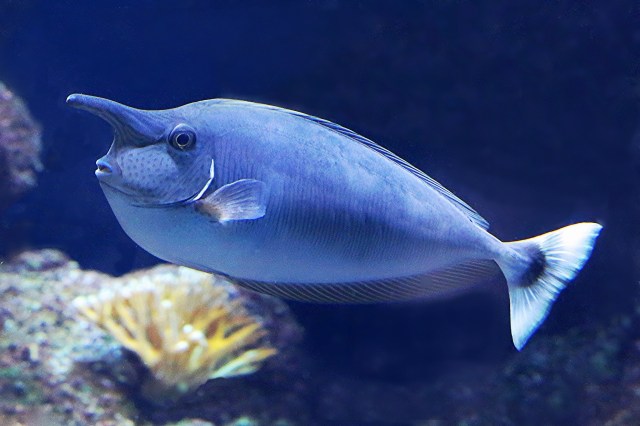
Genus/species: Naso unicornis

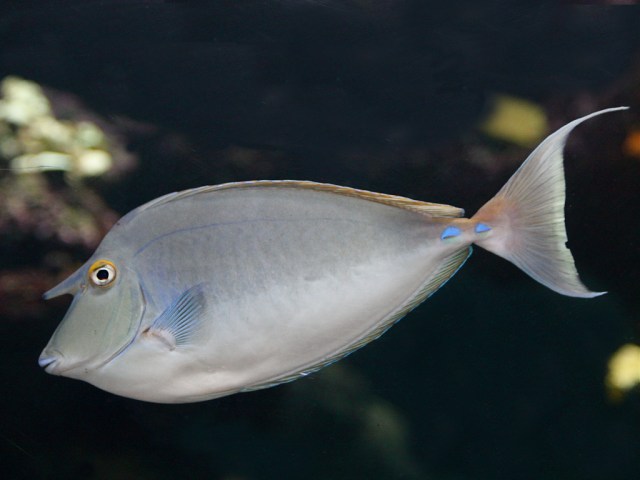
GENERAL CHARACTERISTICS: Naso unicornis is gray to olive with blue tail spines.  The short forehead horn does not project past mouth. The peduncular plates and spines are blue; dorsal and anal fins yellowish with narrow blue stripes. Adult males tend be larger and have a better developed horn, peduncular spines, and caudal filaments than females.

Length to 70 cm (27.5 in)

DISTRIBUTION/HABITAT: Indo-Pacific. The Bluespine Unicornfish inhabits channels, moats, lagoons and seaward reefs with strong surge. It typically occurs  in small groups at depths of 1–80 m (3-250 ft.).

DIET IN THE WILD: It is diurnal feeding on macro- and micr oalgae, including brown algae like Sargassum.

REPRODUCTION: External fertilization. Pair-spawning has been observed; pelagic larvae.

PREDATORS: An important food fish on most tropical islands. Long-lived, up to 35
years. Preyed upon by other fishes.

CONSERVATION: IUCN; least concern.

REMARKS: Rostral horn responsible for species’ common name. Surgeonfishes have a single scalpel-like peduncular spine which folds into a groove while unicornfishes have 1 or 2 sharp, fixed keel-like peduncular plates. The spines are used offensively and defensively.

References

California Academy of Sciences Steinhart Aquarium Philippine Coral Reef 2016

Ron’s flickr http://www.flickr.com/photos/cas_docents/sets/72157608332652056/with/3185901763/

Ron’s WordPress shortlink http://wp.me/p1DZ4b-Hx

fishbase http://www.fishbase.org/summary/1265

EOL  http://eol.org/pages/213498/details

TAXONOMY
Kingdom: Animalia
Phylum: Chordata
Class: Actinopterygii (ray-finned fishes)
Order: Perciformes (Perch-likes)
Family: Acanthuridae (Surgeonfishes, tangs, unicornfishes)

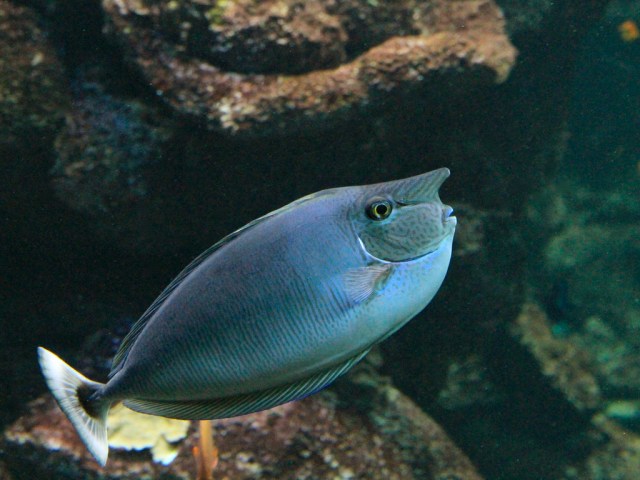
Genus/species: Naso brevirostris

GENERAL CHARACTERISTICS: The Spotted Unicornfish is olive-brown to blue-grey with dark spots on head and vertical rows of spots and lines on sides. The tail is whitish with a dark area at base. A long, tapering horn on forehead of adults is lacking in juveniles.

Max length: 60 cm (23.5 in)

25751114116_2f37d710be_k

DISTRIBUTION/HABITAT: Naso brevirostris is found in the Indo-Pacific: East Africa, the Hawaiian Islands, southern Japan and Australia  It prefers mid-waters along steep outer lagoon and seaward reef drop-offs, from 4–45 m (12-150 ft).

DIET IN THE WILD: Juveniles: benthic algae; adults: mainly zooplankton.

REPRODUCTION: Pelagic spawners

CONSERVATION: IUCN Red List Least Concern (LC)

REMARKS: Unicornfishes (Naso spp.) are characterized by 2 sharp, fixed (not moveable as in surgeonfishes), keel-like plates on the caudal peduncle. The skin is leathery with tiny non-overlapping scales, and teeth have finely serrate edges. Males of many Naso species are able to display spectacular iridescent markings during courtship.

References

California Academy of Sciences Steinhart Aquarium Philippine Coral Reef 2016

Ron’s flickr  http://www.flickr.com/photos/cas_docents/sets/72157608332652056/with/4332770529/

fishbase  fishbase.org/summary/SpeciesSummary.php?ID=6021&genus…

Encyclopedia of Life  eol.org/pages/213852/details

IUCN www.iucnredlist.org/details/177990/0

Ron’s WordPress Shortlink: http://wp.me/p1DZ4b-Ho

TAXONOMY
Kingdom: Animalia
Phylum: Chordata
Class: Actinopterygii
Order: Perciformes
Family: Acanthuridae (Surgeonfishes, Tangs, Unicornfishes)

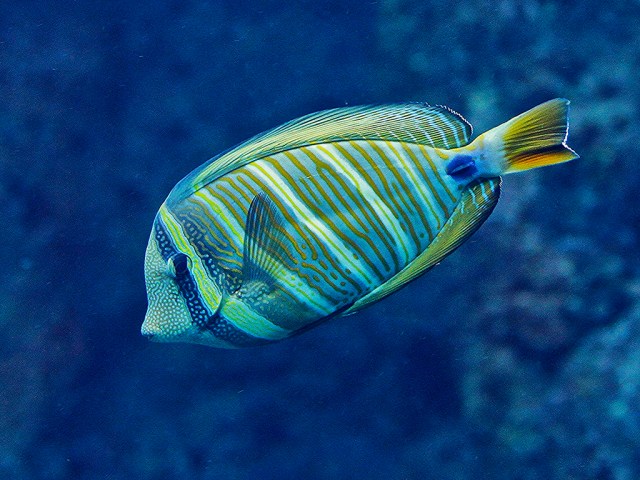
Genus/species: Zebrasoma veliferum 


GENERAL CHARACTERISTICS: Pointed snout, tall dorsal and anal fins. Body has white bars alternate with grey/brown bars with pale bands. Juveniles have alternating yellow and black bars.

Length up to 40 cm (15.75 inches).

Pacific Sailfin tang4714776743_4d5d4776b8_b

DISTRIBUTION/HABITAT: Western Pacific Ocean in Lagoons or outer reefs to 45 m (150 ft). Solitary or in small groups.

DIET IN THE WILD: Small leafy algae growing around rock and coral.

REPRODUCTION: Spawn in pairs and groups. Larvae drift.

PREDATORS: Relatively long-lived, to about 25 years; eaten by sharks and other fishes.

CONSERVATION: IUCN Least concern (LC)

REMARKS: The sharp spine on the caudal peduncle has the capability of inflicting deep, painful wounds to a person trying to grasp one of these fish live. Furthermore, this species is ciguatoxic and can be poisonous to humans if eaten. Finally, the mycobacterioses carried by Z. veliferum are potential zoonoses that can cause skin infections and lesions in humans.

References

California Academy of Sciences Steinhart Aquarium Philippine Coral Reef 2016

Ron’s WordPress shortlink wp.me/p1DZ4b-Ii

fishbase  www.fishbase.org/summary/1266

Australia Museum australianmuseum.net.au/Sailfin-Tang-Zebrasoma-veliferum-…

Encyclopedia of life eol.org/data_objects/26752733

Animal Diversity Web animaldiversity.org/accounts/Zebrasoma_veliferum/

Ron’s flickr https://www.flickr.com/photos/cas_docents/4714776743/in/album-72157625992053826/


TAXONOMY
Kingdom: Animalia
Phylum: Chordata
Class: Actinopterygii (ray-finned fishes)
Order: Perciformes (Perch-likes) 
Family: Acanthuridae (Surgeonfishes, tangs, unicornfishes)

Genus/species: Acanthurus nigroris

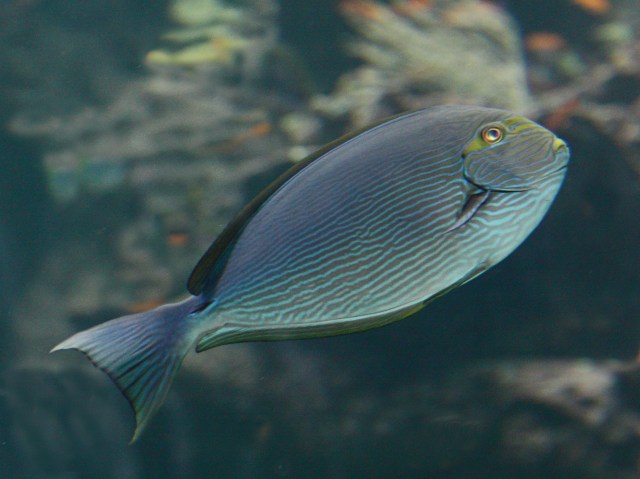
GENERAL CHARACTERISTICS: Dark brown body with numerous blue stripes in scroll patterns on face and chest, more horizontal on body. Dark peduncular spine and tail. Small but distinctive black spots on rear base of both dorsal and anal fins.

A small surgeonfish; max. size: 25 cm (10 inches)

Blue-lined Surgeonfish4405089188_0ed976bdfe_b

DISTRIBUTION/HABITAT: Indo-Pacific: East Africa to Hawaiian Islands in clear lagoons and outward reefs to 200 ft.

DIET IN THE WILD: Filamentous algae, diatoms, fine algal film.

REPRODUCTION; Pelagic spawner.

CONSERVATION: IUCN Least concern.

REMARKS: Solitary or form small groups.


References:

California Academy of Sciences Steinhart Aquarium Philippine Coral Reef 2016

EOL: eol.org/pages/211466/overview

fishbase www.fishbase.org/summary/ACANTHURUS-NIGRORIS.html

Ron’s flickr http://www.flickr.com/photos/cas_docents/4405089188/in/set-72157608332652056/

Ron’s WordPress Shortlink:  http://wp.me/p1DZ4b-1bk

TAXONOMY
Kingdom:Animalia
Phylum: Chordata
Class: Actinopterygii (ray-finned fishes)
Order: Perciformes (Perch-likes)
Family: Acanthuridae (Surgeonfishes, tangs, unicornfishes)

Genus/species: Acanthurus mata

Mata Tang Acanthurus mata (Acanthuridae) RJD_IMG_0 IMG_0726

GENERAL CHARACTERISTICS: Oval, compressed, pale to dark bluish body with numerous dark to blue horizontal lines. A longitudinal yellow stripe runs across the eye and splits in two lines extending anterior the eye. Yellow dorsal fin, upper lip and band across eyes. The caudal fin has a crescent shape.

Length up to 50 cm (20 inches)

DISTRIBUTION/HABITAT: Red Sea and East Africa to French Polynesia; southwest to Japan, Great Barrier Reef, New Caledonia. Frequently inshore in turbid water, as well as outer reefs in depths 5–100 m. or 16.5-330 ft. Usually in groups of conspecifics.

DIET IN THE WILD: The Mata Tang is a group grazer upon plankton.

REPRODUCTION: Form resident spawning aggregations mid-water.

CONSERVATION: IUCN Least concern

REMARKS: A. mata is marketed as a food fish.

References

California Academy of Sciences Steinhart Aquarium Philippine Coral Reef 2016

Ron’s flickr  http://www.flickr.com/photos/cas_docents/3201527871/in/set-72157608332652056

Ron’s WordPress Shortlink http://wp.me/p1DZ4b-1be

fishbase  www.fishbase.org/summary/speciessummary.php?genusname=Aca…

Encyclopedia of life  eol.org/pages/206880/details

IUCN www.iucnredlist.org/details/177967/0

TAXONOMY

Kingdom:Animalia
Phylum: Chordata
Class: Actinopterygii (ray-finned fishes)
Order: Perciformes (Perch-likes) 
Family: Acanthuridae (Surgeonfishes, tangs, unicornfishes)

Genus/species: Acanthurus dussumieri

Eyestripsurgeonfish3161438409_067c34e458_b

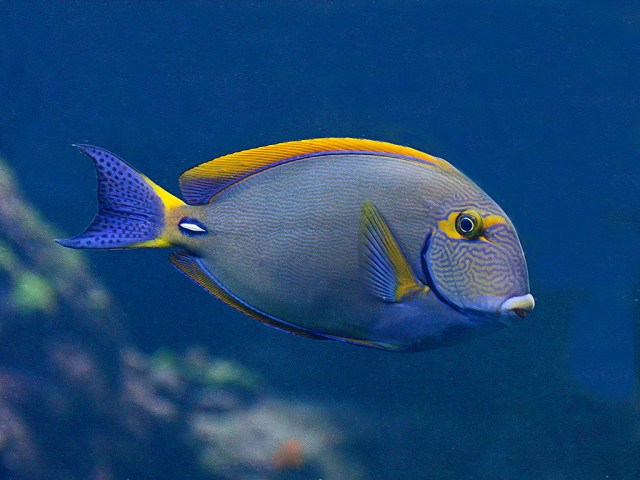
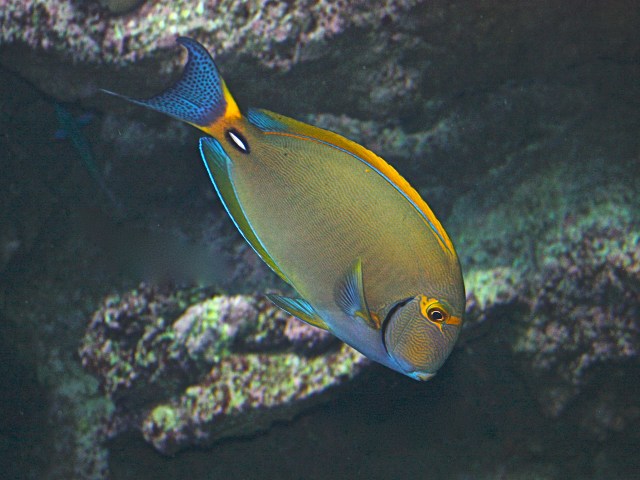
GENERAL CHARACTERISTICS: Bluish to brownish body with horizontal line markings; orange band between eyes, continued behind each eye to gill cover., blue tail with numerous black spots; white caudal spine with the socket edged in black. Typically seen as a solitary fish but may also occur in small groups.

Max. size: up to 50 cm (20 in).


3119304093_7eeabb9447_o

DISTRIBUTION/HABITAT: Indo-Pacific: from East Africa to Hawaii and the eastern Central Pacific. Also from Southwest Japan to the Great Barrier Reef. Absent from most of the Central Pacific. Adults are found mainly on deep coastal reef slopes and outer reef walls.

Depth ranges from 4–131 m (12-430 ft) and are usually found below 30 ft.

EYESTRIPE SURGEONFISH Acanthurus dussumieri

DIET IN THE WILD: Grazes algae from reefs and sand.

CONSERVATION: IUCN Least concern

REMARKS: The eyestripe surgeonfish reputedly has a strong odor when cooked. The Hawaiian name for this fish is palani and a Hawaiian riddle based on this name means “odor reaching to heaven.” This species can quickly change its coloration to a much darker shade that obscures the yellow and markings. 

References

California Academy of Sciences Steinhart Aquarium Philippine Coral Reef 2016

Ron’s WordPress shortlink  http://wp.me/p1DZ4b-1aY

Encyclopedia of life   eol.org/pages/206881/details
fishbase  www.fishbase.org/summary/1256

Ron’s WordPress Shortlink  https://fishoncomputer.wordpress.com/wp-admin/post-new.php

IUCN Red List  www.iucnredlist.org/details/177981/0

Australian Museum australianmuseum.net.au/eyestripe-surgeonfish-acanthurus-…

Ron’s flickr: http://www.flickr.com/photos/cas_docents/8375327580/in/set-72157608332652056/

TAXONOMY
Kingdom: Animalia
Phylum: Chordata
Class: Actinopterygii (ray-finned fishes)
Order: Perciformes (Perch-likes)
Family: Acanthuridae (Surgeonfishes, tangs, unicornfishes)

Genus/species: Acanthurus blochii

RingtailSurgeonfish8680230384_409ba2ee72_k

GENERAL CHARACTERISTICS


A. Bluish grey with numerous yellowish brown spots which tend to form irregular longitudinal lines.

B. Head with narrow irregular stripes

C. Behind eye a yellow spot

D. Brown pectoral fins

E. Base of caudal fin with white bar

F.  Caudal spine large.

Differs from A. dussumieri by having vertical stripes instead of spots on the blue central area of the caudal fin, from A. mata by having a lunate caudal fin, and from A. xanthopterus by having plain brown to blue-grey pectoral fins.

The white ring around the base of the tail varies in intensity and may occasionally be absent. 

Max size: up to 45 cm (18 in)

Ringtail Surgeonfish 4441603380_717ef654b8_b

DISTRIBUTION/HABITAT: Indo-Pacific: East Africa to the Hawaiian Islands, south to Australia in lagoons and shallow coral reefs.

Depth 2–15 m (6-50 ft)

DIET IN THE WILD: Graze on algae, diatoms and detritus

CONSERVATION; IUCN Red List Least Concern

References

California Academy of Sciences Steinhart Aquarium Philippine Coral Reef 2016

Ron’s flickr  http://www.flickr.com/photos/cas_docents/3320764840/in/set-72157625992053826

Ron’s WordPress shortlink  http://wp.me/p1DZ4b-C1

fishbase www.fishbase.se/summary/4750

Encyclopedia of life eol.org/pages/211484/details

IUCN www.iucnredlist.org/details/177971/0