Category: CNIDARIANS


TAXONOMY
Kingdom: Animalia
Phylum: Cnidaria
Class: Hydrozoa
Order: Anthomedusae
Family: Milleporidae

Genus/species: Millepora sp. 

3271264676_0c4fd03cd3_b

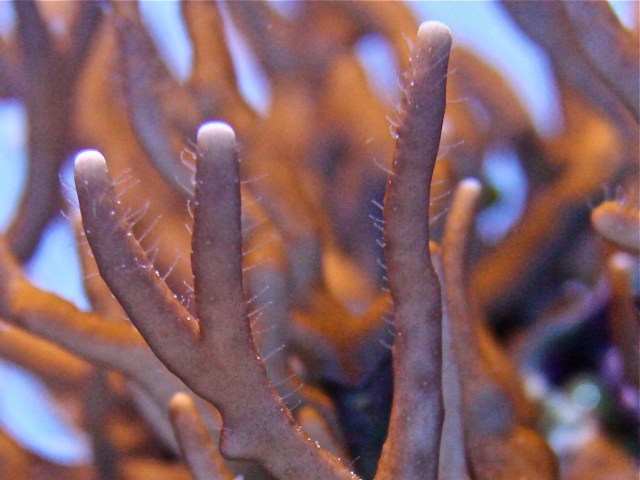
GENERAL CHARACTERISTICS: Colored brownish, greenish or
grayish, often with a yellow hue and light tips. Skeleton calcareous with diverse growth-forms from fine branching, to domes, encrusting, or sheet-like. May form extensive colonies to 2 m diameter.

DISTRIBUTION/HABITAT: Pantropical, shallow reefs.

DIET IN THE WILD: Microplankton; zooxanthellae also provide nutrition.

REPRODUCTION: Sexual reproduction, with both medusa and polyp
stages; asexual reproduction via budding. Note Anthozoan corals have only a polyp stage.
IMG_1517

CONSERVATION STATUS: All coral reef species are threatened due to global warming. 

REMARKS: Fire corals are important reef-building organisms, though they are not closely related to the most common group of reef-building hard corals (Scleractinians), which belong to an entirely different class (Anthozoa). Unlike octocorals or hexacorals, fire corals possess polyps so small they are almost microscopic. One type is armed with nematocysts for food-capture and defense; the other type are capable of sexual reproduction. Potent nematocysts are also used to clear the coral of organisms that might shade zooxanthellae and can inflict a painful, burning sting to humans, hence the common name. Fire corals can outcompete many other corals by growing large quickly. and dominating the available space.

Venoms Cluster

Fire Coral PR24

flickr  http://www.flickr.com/photos/cas_docents/sets/72157623828845591/with/3271264676/

WordPress Shortlink: http://wp.me/p1DZ4b-NT
TAXONOMY

KINGDOM Animalia

PHYLUM Cnidaria (possess cnidocytes)

CLASS Anthozoa (Sea Anemones and Corals)

SUBCLASS Hexacorallia (water-based organisms formed of colonial polyps generally with 6-fold symmetry)

ORDER Scleractinia (Stony Corals)

FAMILY Merulinidae

GENUS Hydnophora sp.

GENERAL CHARACTERISTICS
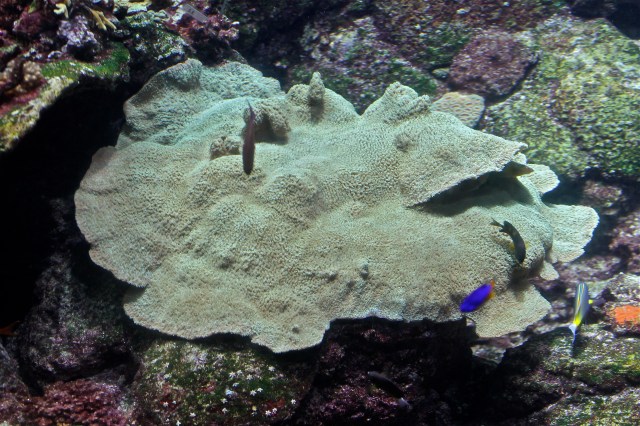
Hexacoral or stonycorals with colonies that may be massive, encrusting, or branched; usually brown, greenish, or yellowish. Conical protuberances over the entire colony’s surface. Tentacles often partially extended during the day.

DISTRIBUTION/HABITAT
Widely distributed in the Indo- Pacific. Common in variety of reef habitats.

DIET IN THE WILD
Nutrition mostly provided by symbiotic zooxanthellae, but also take other food sources, such as plankton.

REPRODUCTION: The small polyp stony (SPS) corals are male and female and can reproduce both sexually and asexually. They reproduce sexually by releasing eggs and sperm at the same time (spawning), resulting in a fertilized egg which then forms into a free-swimming planula larva. Eventually the planula larvae settles onto the substrate, becoming plankters. This then forms a tiny polyp which begins to excrete calcium carbonate and develops into a coral. Planula larvae are extremely vulnerable to predation, and very few survive. Hydnophoras reproduce asexually from breakage due to storms resulting in fragmentation.

REMARKS: Hydnophora are very aggressive and can extend sweeper polyps and sting or basically eat other corals it touches.

LOCATION; Main Philippine Coral Reef Tank PR04

flickr http://www.flickr.com/photos/cas_docents/4673421321/in/set-72157623778757037/

WORDPRESS SHORTLINK  http://wp.me/p1DZ4b-nP

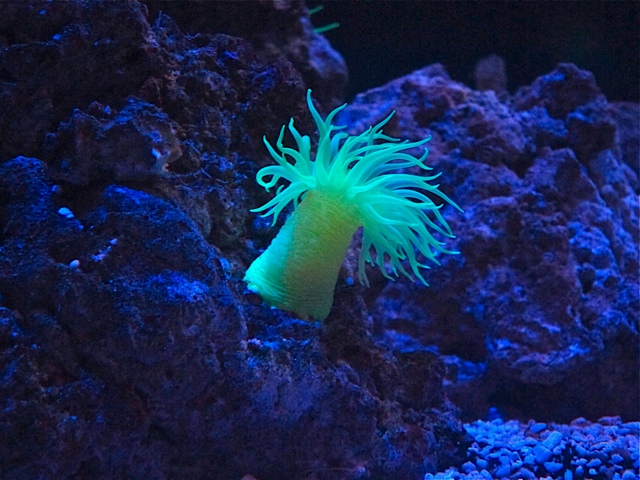
Kingdom Animalia, Phylum Cnidaria, Class Anthoza, Subclass Hexacorillia, Order Actiniara, Family Haluridae.

Halcurias carlgreni 

DISTRIBUTION: West North Pacific

HABITAT: From Japans deeper, cooler waters.

REMARKS:  From Rich Ross California Academy of Sciences Biologist.  http://packedhead.net/Last December when Koji Wada of the renowned Blue Harbor visited the Steinhart Aquarium he was kind enough to bring us two stunning Halcurias carlgreni anemones. From Japans deeper, cooler waters, these anemones are jaw droppingly bright and colorful. Currently, they are being kept at 66 degrees in our Nautilus exhibit and both animals seem to be getting along just fine with each other. The Halcurias are being fed thawed frozen mysis via ‘Julians Thing’ every other day, and we hope they will be so happy and full of food that we will have more of them in the near future. They are of course non-photosynthetic.

LOCATION: Nautilus Exhibit

WORDPRESS SHORTLINK  http://wp.me/p1DZ4b-pX


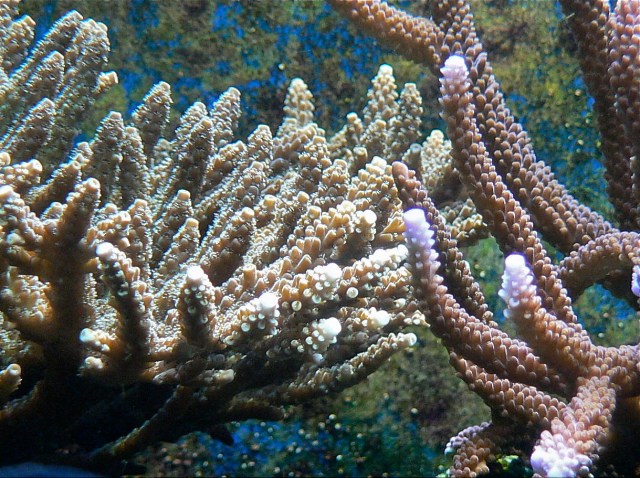
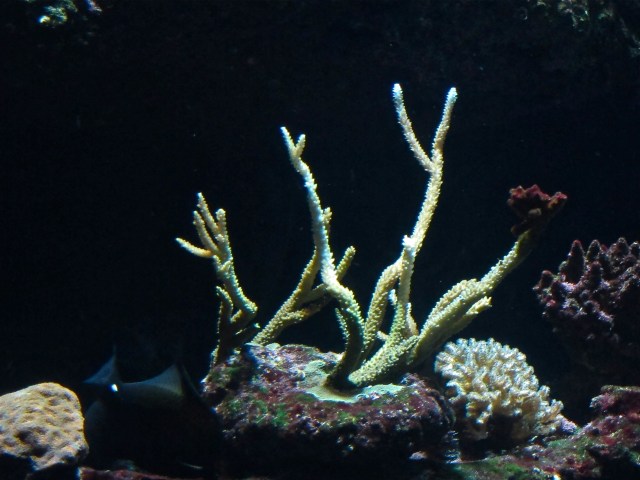
Phylum Cnidaria, Class Anthozoa, Order Scleractinia, Family Acroporidae,

Acropora spp.

DISTRIBUTION:  Indo-Pacific, Caribbean.

HABITAT: Habitat: Shallow reef environments with bright light and relatively strong currents. Often dominate shallow parts of the reef, especially the surf zone

APPEARANCE: Growth forms extremely variable: slender branched fingers, broad antlers, table-like plates are common. Among the most colorful of reef-building corals; may be cream, yellow, blue, green, purple, pink, even fluorescent. Polyps small; set along the branches.  Characterized by light-colored polyps at the tips of branches where budding and growth take place, fueled by the energy produced by zooxanthellae in lower parts of the branch that give it color

DIET: Feed on microplankton, mostly at night; significant nutrition provided by photosynthetic zooxanthellae

REPRODUCTION/DEVELOPMENT: These fragile corals usually reproduce without sex (asexually). As pieces break off, they grow on their own as clones (fragmentation). But spring and summer bring an orgy of sex. Warming waters and a full moon can stimulate hundreds of corals to release clouds of eggs and sperm into the water at the same time. Most Acropora species are broadcasters, a few are brooders.

REMARKS: A major contributor to reef structures worldwide.

flickr http://www.flickr.com/photos/cas_docents/2999925430/in/set-72157608597451452/

WORDPRESSSHORTLINK http://wp.me/p1DZ4b-p9


LOCATION: Animal Attractions, Philippine Coral Reef, and other tropical reef exhibits.


Ref: California Academy of Sciences Animal Attraction Exhibit 2012


THE STEINHART AQUARIUMA VIEW FOR AND BY DOCENTS AND GUIDES  2009  California Academy of Sciences

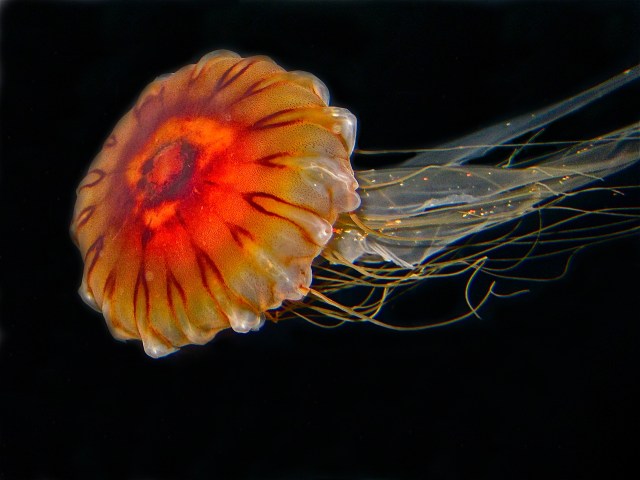
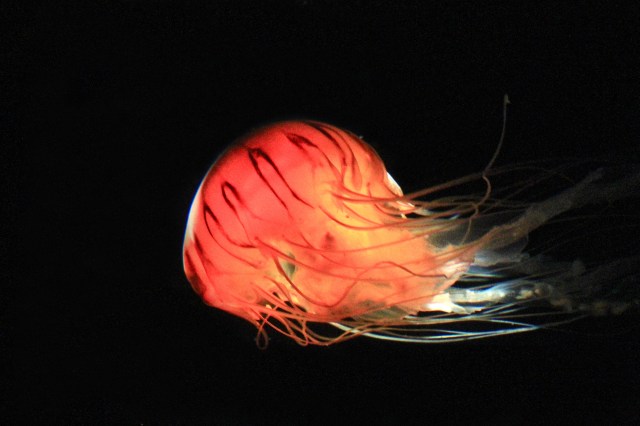
2-17-12 Japanese Sea Nettle from Ron’s Animal Attraction Series (Exhibit)

Phylum Cnidaria, Class Scyphozoa, Order Semaeostomea, Family Pelagiidae 

Chrysaora melanaster

DISTRIBUTION: Bering Sea, northern Atlantic, Pacific and Arctic oceans

HABITAT: Ocean surface to 200 meters below  the surface.

APPEARANCE: Their bells are 12 in across white with brown-to-orange stripes, containing up to 32 very long orange-red tentacles and four long lips. They have 16 brown stripes and eight stomach pouches.

DIET: Sea nettles snare prey (fishes, jellies, krill, other small invertebrates) with stinging tentacles that can stretch 6 m (20 ft).

REPRODUCTION: Alternation of life cycles—polyp, medusa.   The drifting jellies shown here represents just one phase of a sea nettle’s life. As adults pulsing through the water, these jellies reproduce sexually. But in another stage of life, on the seafloor, they reproduce without sex.

When spawning, adult sea nettles release clouds of sperm and tens of thousands of eggs a day. Their larvae sink and become polyps (like mini anemones) carpeting the seafloor. As they grow, each polyp buds off asexually producing scores of tiny identical jellies and will become sexual adults.

flickr   http://www.flickr.com/photos/cas_docents/6890184085/in/set-72157629304397467

WORDPRESS SHORTLINK http://wp.me/p1DZ4b-oN 


REF. 1. California academy of Sciences Animal Attractions Exhibit

         2. Shedd Aquarium Fact Sheet