Category: ANIMAL ATTRACTIONS


TAXONOMY
Class: Actinopterygii (Ray-finned fishes)
Order: Perciformes (Perch-likes)
Family: Serranidae (Sea basses: groupers and fairy basslets)
Subfamily: Anthiinae (Anthias)

On exhibit:

Pseudanthias dispar – Redfin anthias
P. lori – Lori’s anthias
P. randalli – Randall’s anthias* (not currently on exhibit 1-31-14)
P. tuka – Yellowstrip anthias
P. ventralis ­– Longfin anthias
Serranocirrhitus latus  – Sunburst anthias ( a closely related genus)
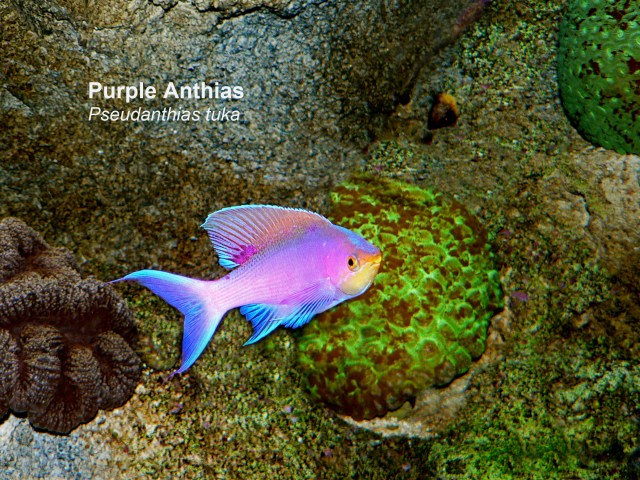
 

 DISTRIBUTION: Pseudanthias species are found throughout the Indo-Pacific region. Many of the some 64 species have fairly wide distribution.

 HABITAT: During the day, they are found along the upper reef face in areas of strong current. At night, when predators threaten, they seek shelter in the reef’s caves and crevices.

GENERAL CHARACTERISTICS: Pseudanthias are small, fast-moving, colorful fishes. The male and female pseudanthias, like many members of the family Serranidae display gender-specific body shape and/or color. The male of P. dispar, for example, has a bright red dorsal fin and more pink and blue on the head and sides than the generally yellow female. The male yellowstripe anthias is a deeper purple overall than the female that sports a bright yellow stripe on the back not seen in the male.

DIET IN THE WILD: Plankton and fish eggs.

REPRODUCTION: All are sequential protogynous hermaphrodites. Protogynous literally means “first female,” a reference to the fact that all individuals are born as females, but a few, usually the largest females, will in time will change sex and develop male sex organs. The sex change, which can be completed in only a few days, is triggered by the loss of the dominant male, usually to predation.

 This reproductive strategy may confer at least two benefits: first, many young, healthy females serviced by a few large males means that in a given aggregation of fish more eggs, which are larger and therefore more energetically expensive, are produced.  Sperm, especially that produced by a large male, is plentiful enough to fertilize the eggs of even a large group of females. Also, the large males are extremely territorial and protective of their harems.

PREDATORS: These small fish are snack food for many larger predators. Life span of most species is about 3­–5 years.


REMARKS: The Steinhart displays several other fish families besides serranids with members that practice protogynous hermaphoditism, including wrasses, angelfishes, gobies, found in a number of tanks. Bocalo, the giant sea bass, is the Steinhart’s most notable practitioner

flickr  http://www.flickr.com/photos/cas_docents/sets/72157608545590153/

WORDPRESS SHORTLINK  http://wp.me/p1DZ4b-rh
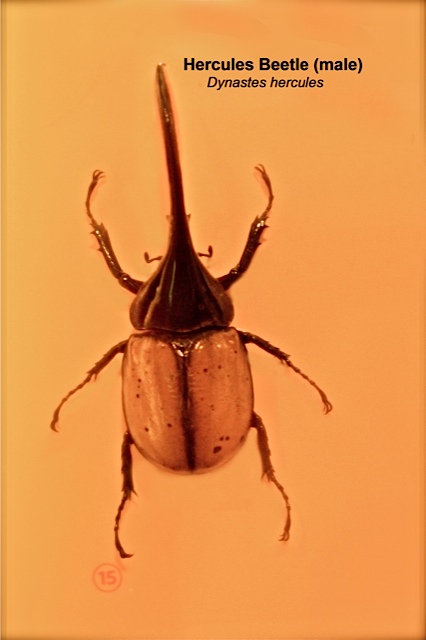
Order Coleoptera

The largest of insect orders, currently about 350,000 beetle species are known.  One of every five animals on earth is a beetle!  The name coleoptera or “sheath wings” derives from sheath-like wing cases, called elytra, that provide protection to a second, underlying pair of more delicate flight wings. The elytra are not used to power flight, but help stabilize the beetle as it flies.  Some beetles, such as various ground beetles, have lost the ability to fly.

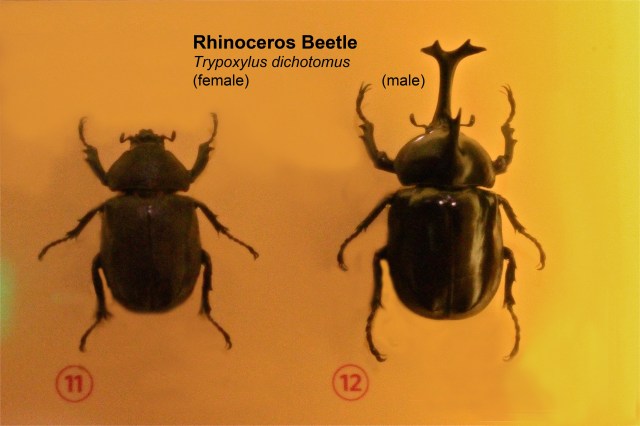
Stag, Hercules, and Rhinoceros Beetles

Family Lucanidae and Family Scarabaeidae (Subfamily Dynastinae)

DISTRIBUTION: Worldwide distribution.

HABITAT: Mostly woodlands. Adults live and breed in damp, rotting wood.

APPEARANCE:  Medium to large beetles, males of some species have spectacularly large jaws. Females are considerably smaller in size, and lack the impressive “horns.”

DIET: Larvae feed on decaying wood, probably getting nutrition not just from the cellulose, but from the fungi and microbes decomposing it. Adults of most species feed on sugary liquid food, such as sap from wounded trees, aphid ” honeydew” secretions, and ripe fruit. Adults are unable to chew.

REPRODUCTION/DEVELOPMENT: Males use their huge jaws to fight for access to females. Individual males play “king of the hill,” only in their case they are fighting to win access to control a dead stump or tree that a discriminating female will find highly suitable as a residence to feed and protect her offspring. The male-male contest involves each trying to maneuver his huge mandible underneath and overturning his competitor, ideally knocking him to the ground. Injuries are rare, but the victor, who is typically the largest and strongest, gains the female, or often multiple females, as he controls the best breeding property.

Stag beetles evolutionary development of sexual dimorphism, with males being significantly larger than females, repeats a miniature version of a sexual strategy familiar in the animal kingdom: to the victor (the largest male) belongs the spoils (reproductive rights to pass along his genes). Even better, this strategy is most often found in haremic groups, where the male wins not only one female, but many.

MORTALITY/LONGEVITY: Larvae live 3-5 years, adults a few months.

WORDPRESS SHORTLINK  http://wp.me/p1DZ4b-r7

Class Actinopterygii (ray-finned fishes,  Order Lophiiformes (Anglerfishes) > Ceratiidae (Seadevils)

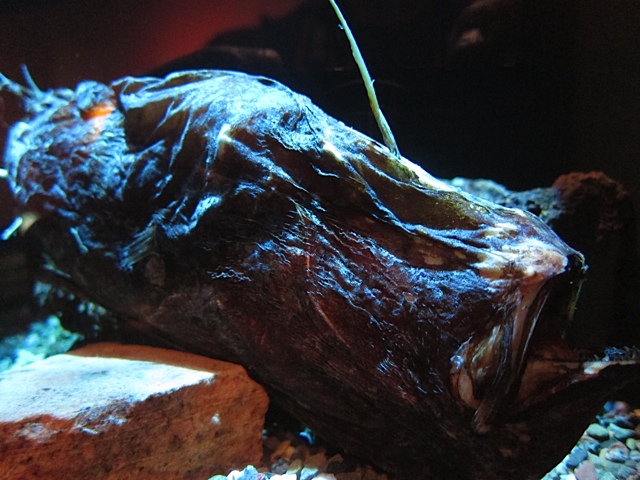
Cryptopsaras couesii  Warty Sea Devils

DISTRIBUTION: Deep tropical and subtropical oceans.

HABITAT: Deep ocean below 300 m (984 ft).

APPEARANCE:  The female triplewart sea devil is among the largest of the deepsea anglerfishes, reaching up to 1.5 m (5 ft) and weighing 10 kg (22 lb). Anglerfishes are characterized by a long filament, a modified first spine of the anterior dorsal fin, that extends over the eyes and is used to lure prey. In the ceratoid families, only the female  possesses  this lure. The male has no lure, is born small, and  remains so, weighing only about 150 g (5 oz). Most ceratoid anglerfishes have a bioluminescent lure; C. couesii is unusual in being luminescent over most of its body.

 DIET: Primarily on small cephalopods as well as fish and crustaceans. With their huge mouths and pliable bodies, anglerfishes are able to swallow prey up to twice their size.

 REPRODUCTION/DEVELOPMENT: As scientists began to explore the deep sea, they caught anglerfish and were surprised that all were females with what appeared to be parasites attached. More observation and experimentation revealed  that these “parasites” were actually male anglerfish of the same species.

 The male is equipped with a highly developed sense of smell, especially sensitive to pheromones emitted by the female. Triplewart sea devil males have large, forward-facing eyes, and are thought to rely both on vision and smell for their search and identification of a conspecific female. The male locates a female, attaches to her with a set of pincher-like teeth at the tip of his jaw. In the case of C. couesii and some other species, the epidermal tissues of male and female soon fuse and their circulatory systems unite. Shortly after attachment, the male organs atrophy; digestive organs, brain, heart, eyes are lost and little more than gonads remain.

 An extreme example of sexual dimorphism, the male may be as much as 30 times smaller than the female. Able to sense when the female is ready to spawn by detection of hormones in her bloodstream, he releases sperm as she releases eggs. A C. couesii female may have as many as eight males attached to various parts of her body.

WORDPRESS SHORTLINK    http://wp.me/p1DZ4b-qW

Phylum Arthropoda, Class Arachnida, Order Scorpiones, Family Scorpanidae, Scorpions

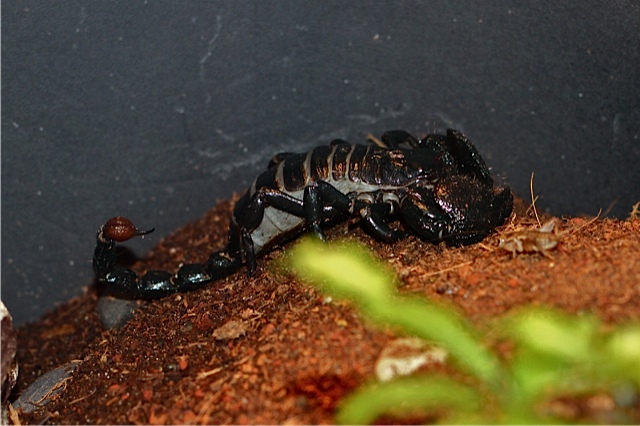
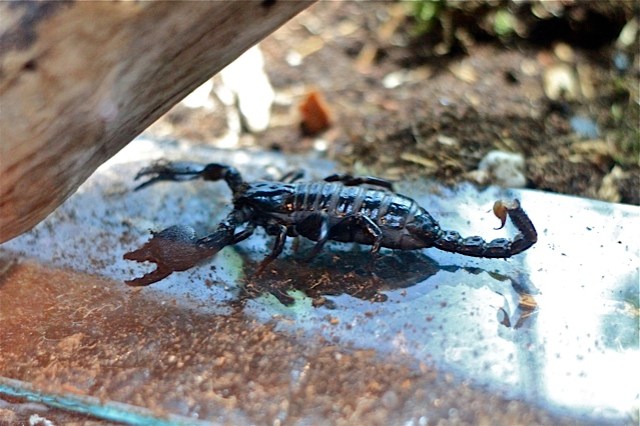
Pandinus imperator

DISTRIBUTION: West Africa

HABITAT: Tropical forest and open savanna where it hides under rocks, burrows beneath the soil, or cohabits termite mounds.

APPEARANCE: The largest scorpion known, (length to 20 cm (8 in); weight to 30 g (1 oz). Its black body bears large, blackish-red pincers with a granular appearance. The long tail, which arches back over the body, is tipped with a sharp curved stinger that delivers venom produced from a gland in the attached bulb.

DIET:  It preys upon ground-dwelling insects, spiders, and other invertebrates as well as an occasional baby lizard, snake, or mouse. These large scorpions rarely sting small prey; instead they grasp the prey in powerful pincers and tear it apart. The venom is reserved for larger prey or defense.

REPRODUCTION/DEVELOPMENT:  During mating, the male finds a suitable spot where he deposits his sperm packet, called a spermatophore. He then engages the female in an elaborate mating dance above the spermatophore with the male holding up the pincers of the female with his own, and carefully maneuvering her over the spermatophore, which she draws up into her genital pore. The eggs are fertilized, and the female carries them internally. After a 7 to 9 month gestation period, she gives birth to between 9 to 32 live young. The newborn climb onto the mother’s back, protected from predators by her size and aggressive behavior. Until the young are capable of hunting on their own, the mother feeds them by killing insects which are left on the floor of the burrow or other enclosure where the young can climb down and feed in safety.

MORTALITY/LONGEVITY:  Predators include birds, bats, small mammals, large spiders, centipedes, large lizards, and other scorpions. Life span: 5 to 8 years.

REMARKS: Sensory hairs on the pincers and tail enable the scorpion to detect prey and danger through vibrations from the air and ground. Like all scorpions, it has poor eyesight (despite having 6 to 12 eyes), good hearing, and a good sense of touch.

flickr http://www.flickr.com/photos/cas_docents/6976512905/in/set-72157629304397467/

WORDPRESS SHORTLINK http://wp.me/p1DZ4b-qK

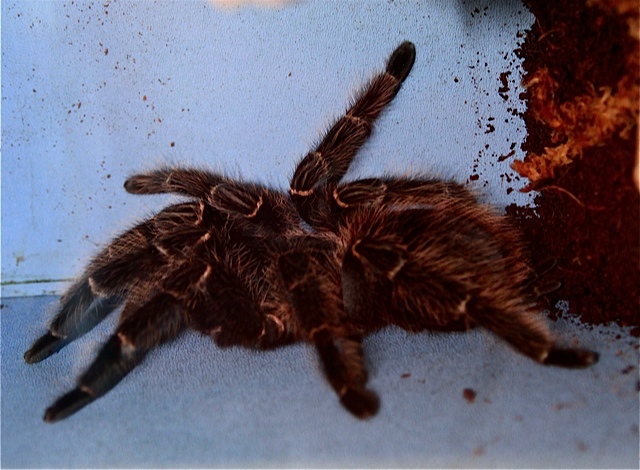
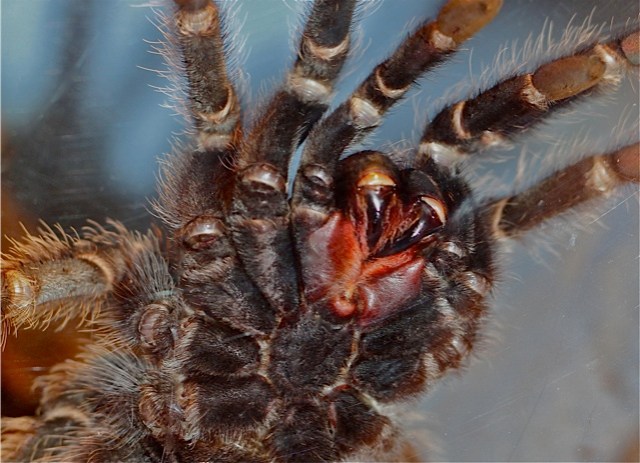
Phylum Arthropoda, Class Arachnida, Order Araneae, Family Theraphosidae

Lasiodora parahybana

DISTRIBUTION: Throughout northeastern Brazil.

HABITAT:  Tropical forest floor

APPEARANCE: Said to be the third largest spider in the world, this is a large-bodied tarantula with abdomen and legs covered with sensitive, long, and partially pink or salmon-colored hairs.   Maximum size: body, 9-10 cm (3.5–4 in); leg span, 20-25 cm (8–10 in).

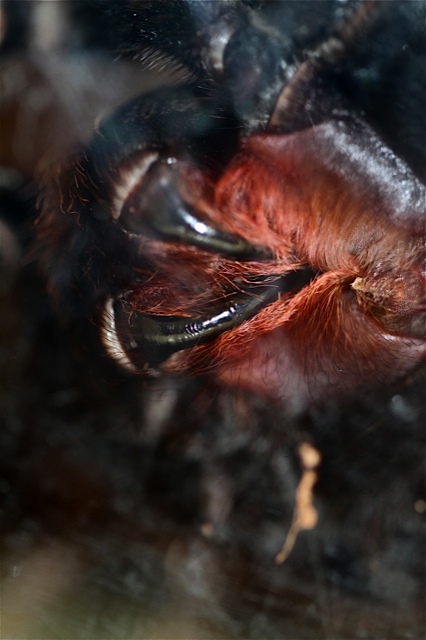
DIET: Lie and wait carnivore, eating large crawling insects and other invertebrates, small rodents, lizards, and frogs rarely seen eating birds like newly hatched chicks of ground-dwelling birds. Venom injected by chelicerae that liquefy the kill, which is then sucked in by the mouthparts.

REPRODUCTION and DEVELOPMENT: The male spins a small area of silk onto which he deposits his sperm. The sperm is then absorbed into the pedipalps, which during mating are inserted into the genital opening of the female, transferring the sperm, which remains viable. After insemination, the male makes a swift retreat as the much smaller males occasionally become a sacrifice to the female’s need to maintain the nutritional viability of a mother-to-be. The female lays up to 2000 fertilized eggs in a thick, silken sac which she guards fiercely. Young spiderlings are born about 3 weeks later. Voracious feeders, they grow quickly.

MORTALITY/LONGEVITY: Tarantulas have few enemies except tarantula hawk wasps. Members of this wasp family use their sting to paralyze species specific tarantulas. The wasp lays an egg on the tarantula’s abdomen and then seals the spider in its burrow. The wasp larva hatches and feeds on the immobile and doomed tarantula. Males usually die shortly after maturity and mating. Females can live over 20 years in the wild, perhaps significantly longer.

REMARKS: Like most tarantulas and some other spiders, if this spider loses one of its legs and is still in a growth stage, it can regrow the lost appendage,

While not highly aggressive and bites are not fatal to humans (most tarantula bites are similar to a bee sting in toxicity), this big bruiser, because of its long fangs, can inflict a serious wound which one researcher defined as “capable of medically significant mechanical damage”!

If pursued by a potential foe, the spider rubs its legs against its abdomen, throwing tiny, barbed hairs that become imbedded in the attacker. The barbs can cause significant irritation, especially if lodged in the eyes or nasal passages.

flickr http://www.flickr.com/photos/cas_docents/6962229021/in/set-72157608653175263/

WORDPRESS SHORTLINK  http://wp.me/p1DZ4b-qx

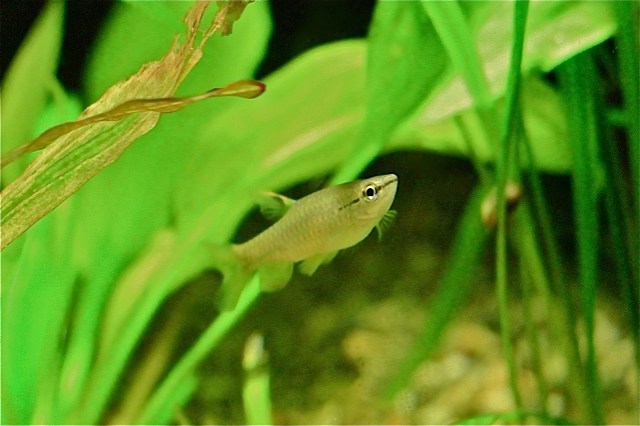
Actinopterygii (Ray-finned fishes) > Characiformes (Characins) > Lebiasinidae (Pencilfishes)

Copella arnoldi

 DISTRIBUTION: Amazon Basin.

 HABITAT: Slow-moving fresh water.

 APPEARANCE: Males tend to be larger and more colorful than females and have more elaborate fins. Max. length: 3.4 cm. 

 DIET: Worms, insects, and crustaceans.

 REPRODUCTION/DEVELOPMENT: The unusual behavior of the splashing tetra provides a unique strategy that keeps aquatic predators away from progeny: The male and female will leap out of the water as a pair, both remaining together while the female attaches her eggs to the leaves of plants at the water’s edge and the male then immediately fertilizes them. This procedure is repeated several times until 50 to 200 eggs have been laid. After attachment, the male, now in the water, faithfully flicks his tail every few minutes, shedding droplets of water onto the eggs to keep them moist. After 2 to 3 days the eggs hatch and the fry fall into the water below. The male’s attention then abates and the young tetras are on their own.

MORTALITY/LONGEVITY: Life span: about 3 years.

 REMARKS: In spite of their common name, they are not closely related to true tetras of the family Characidae found in a variety of other Steinhart exhibits.

Flickr http://www.flickr.com/photos/cas_docents/6939753715/in/set-72157629304397467

WORDPRESS SHORTLINK   http://wp.me/p1DZ4b-pP

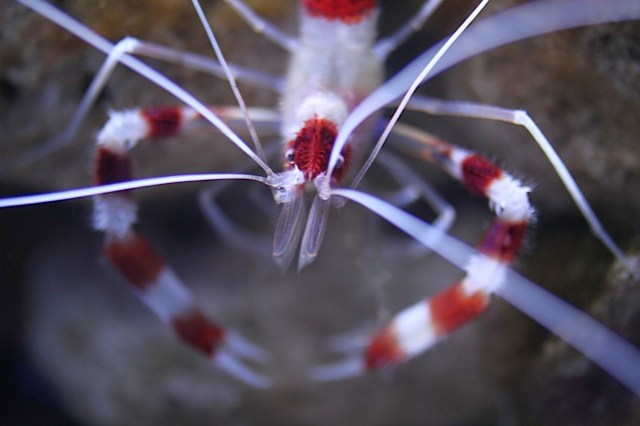
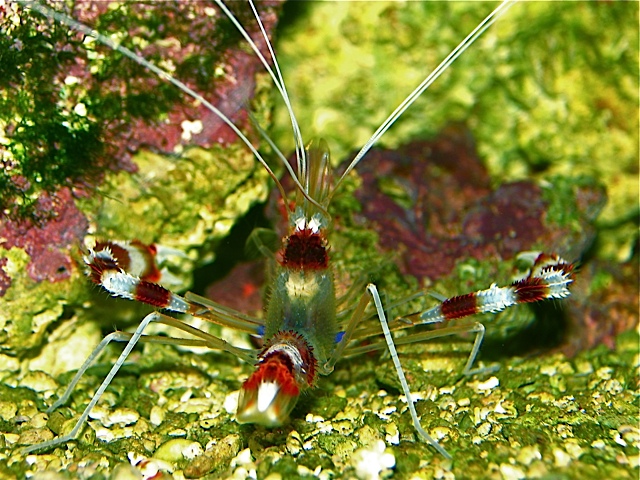
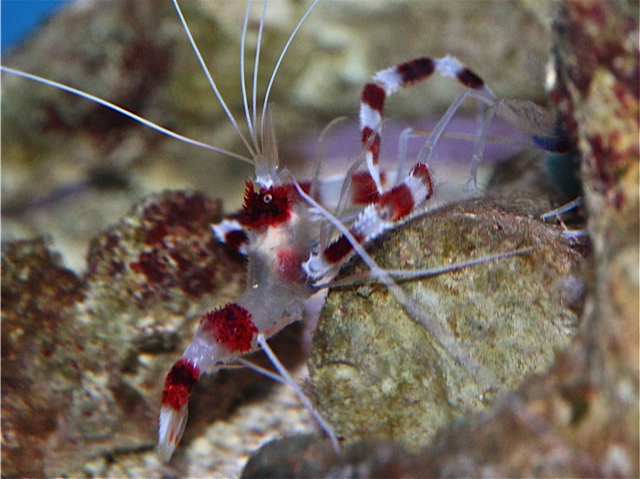
Phylum Arthropoda,  Subphylum Crustacea, Class Malacostraca, Order Decapoda, Family Stenopodidae

Stenopus sp.

DISTRIBUTION: tropical coral reefs worldwide

HABITAT: Male and female coral banded shrimp pair up when young, claim a territory, and never travel outside the small patch of reef they call home.

APPEARANCE: Strikingly colorful, they have a white body with contrasting red and white bands, bluish legs, slender pincers, and extremely long white antennae. Short spines cover the body and are used for defense. Males are smaller, more slender than females.

DIET: A cleaner shrimp, it removes dead tissue, algae and parasites from fish waving their long antennae to advertise their services. They are known to perform a dancing behavior, perched on a conspicuous spot near their home and whipping the antennae while swaying from side to side.  A fish ready for cleaning remains still in the water, allowing the shrimp to clean the scales and even enter the mouth and gills. They have been known to clean under the fingernails of divers’ hands!

REPRODUCTION: They are committed monogamists mating for life, a breeding strategy rare among most animal groups. Stenopus sp. defend their territory aggressively attacking and sometimes killing intruding shrimps. Mating occurs when the female is receptive. The male approaches her and transfers a packet of sperm to a specialized receptacle on her abdomen. With a few hours, the female begins to produce eggs, which are fertilized as released and then carried on her abdomen until they hatch into larvae, become part of the plankton, and eventually settle.

flickr http://www.flickr.com/photos/cas_docents/3067708530/in/set-72157608602469734/

 WORDPRESS SHORTLINK  http://wp.me/p1DZ4b-pj

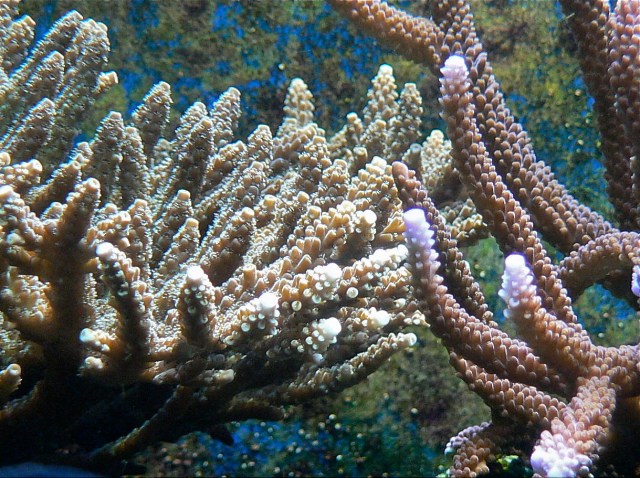
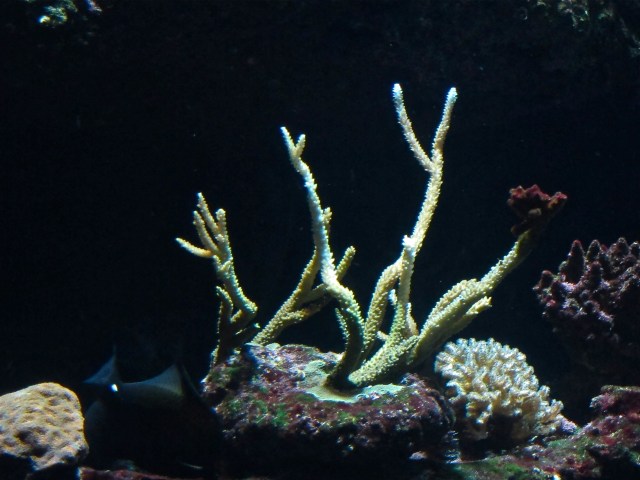
Phylum Cnidaria, Class Anthozoa, Order Scleractinia, Family Acroporidae,

Acropora spp.

DISTRIBUTION:  Indo-Pacific, Caribbean.

HABITAT: Habitat: Shallow reef environments with bright light and relatively strong currents. Often dominate shallow parts of the reef, especially the surf zone

APPEARANCE: Growth forms extremely variable: slender branched fingers, broad antlers, table-like plates are common. Among the most colorful of reef-building corals; may be cream, yellow, blue, green, purple, pink, even fluorescent. Polyps small; set along the branches.  Characterized by light-colored polyps at the tips of branches where budding and growth take place, fueled by the energy produced by zooxanthellae in lower parts of the branch that give it color

DIET: Feed on microplankton, mostly at night; significant nutrition provided by photosynthetic zooxanthellae

REPRODUCTION/DEVELOPMENT: These fragile corals usually reproduce without sex (asexually). As pieces break off, they grow on their own as clones (fragmentation). But spring and summer bring an orgy of sex. Warming waters and a full moon can stimulate hundreds of corals to release clouds of eggs and sperm into the water at the same time. Most Acropora species are broadcasters, a few are brooders.

REMARKS: A major contributor to reef structures worldwide.

flickr http://www.flickr.com/photos/cas_docents/2999925430/in/set-72157608597451452/

WORDPRESSSHORTLINK http://wp.me/p1DZ4b-p9


LOCATION: Animal Attractions, Philippine Coral Reef, and other tropical reef exhibits.


Ref: California Academy of Sciences Animal Attraction Exhibit 2012


THE STEINHART AQUARIUMA VIEW FOR AND BY DOCENTS AND GUIDES  2009  California Academy of Sciences

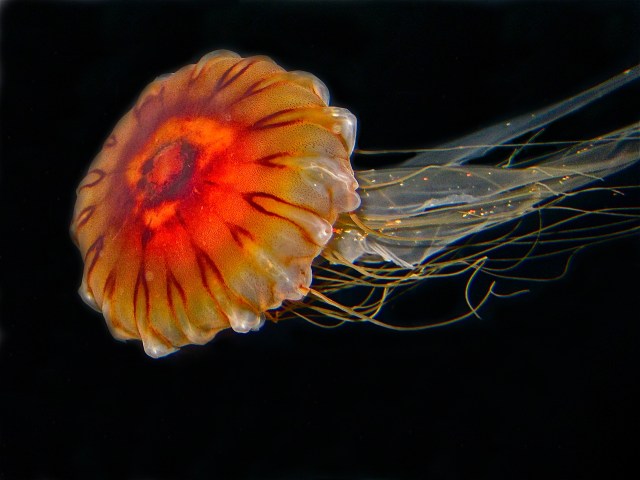
2-17-12 Japanese Sea Nettle from Ron’s Animal Attraction Series (Exhibit)

Phylum Cnidaria, Class Scyphozoa, Order Semaeostomea, Family Pelagiidae 

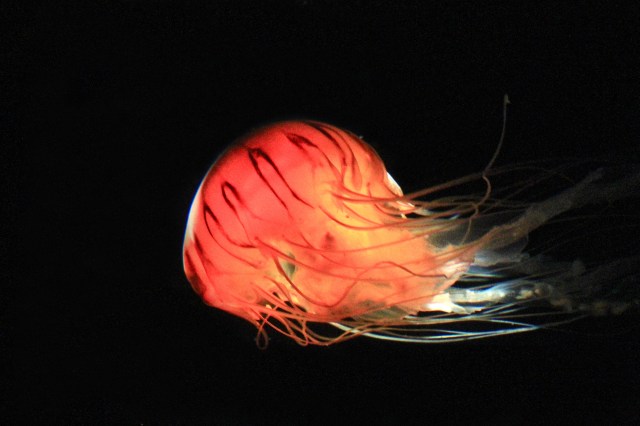
Chrysaora melanaster

DISTRIBUTION: Bering Sea, northern Atlantic, Pacific and Arctic oceans

HABITAT: Ocean surface to 200 meters below  the surface.

APPEARANCE: Their bells are 12 in across white with brown-to-orange stripes, containing up to 32 very long orange-red tentacles and four long lips. They have 16 brown stripes and eight stomach pouches.

DIET: Sea nettles snare prey (fishes, jellies, krill, other small invertebrates) with stinging tentacles that can stretch 6 m (20 ft).

REPRODUCTION: Alternation of life cycles—polyp, medusa.   The drifting jellies shown here represents just one phase of a sea nettle’s life. As adults pulsing through the water, these jellies reproduce sexually. But in another stage of life, on the seafloor, they reproduce without sex.

When spawning, adult sea nettles release clouds of sperm and tens of thousands of eggs a day. Their larvae sink and become polyps (like mini anemones) carpeting the seafloor. As they grow, each polyp buds off asexually producing scores of tiny identical jellies and will become sexual adults.

flickr   http://www.flickr.com/photos/cas_docents/6890184085/in/set-72157629304397467

WORDPRESS SHORTLINK http://wp.me/p1DZ4b-oN 


REF. 1. California academy of Sciences Animal Attractions Exhibit

         2. Shedd Aquarium Fact Sheet

Actinopterygii (ray-finned fishes),  Perciformes (Perch-likes), Cichlidae (Cichlids)

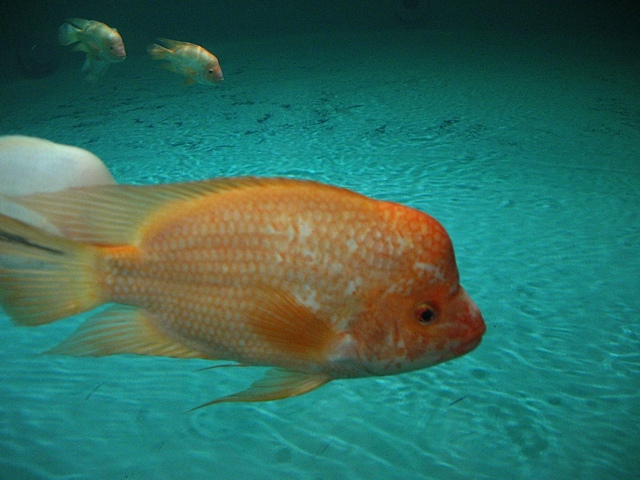
Amphilophus labiatus

FEMALE WITH BROOD BELOW

DISTRIBUTION: Atlantic slope of Mexico and Nicaragua; in Lakes Nicaragua and Managua.

HABITAT: Lakes; rarely enters streams or rivers.

APPEARANCE: The body of the Red Devil is robust and stocky. It has a great deal of variability in its structure and coloration. Some are bright red while others are white or yellow.  Males will develop an impressive nuchal hump as they grow. Length to 24 cm or approximately 10 in.

DIET: Small fishes, snails, insect larvae, worms and other bottom-dwelling organisms.

REPRODUCTION/DEVELOPMENT: Fertilization is external.  A. labiatus a substrate spawner prefers to spawn on flat surfaces.  Female lays 600–700 eggs and guards the clutch. The larvae hatch after about 3 days. After another 5-7 days they become free swimming.

MALE BELOW

flickr http://www.flickr.com/photos/cas_docents/6885205471/in/set-72157627952093337

WORDPRESS SHORTLINK http://wp.me/p1DZ4b-oC

Ref. Fishbase and Animal World