Tag Archive: tropical marine


TAXONOMY
Kingdom: Animalia
Phylum: Chordata
Class: Actinopterygii (ray-finned fishes)
Order: Anguilliformes (Eels and morays)
Family: Congridae (Conger and garden eels)
Subfamily: Heterocongrinae

Genus/species: Gorgasia preclara

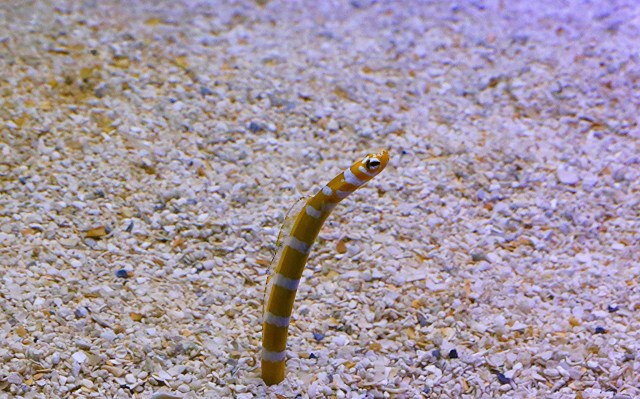
GENERAL CHARACTERISTICS: Its yellow to orange with characteristic white bands body has a circular shape with a diameter of about 10 mm (0.4 in). Length up to 40 cm (15.75 in) maximum.
Typically, only its head and upper body protrudes from the sand where the garden eel lives in a buried tube in the sand either alone or in small groups.

Garden Eel20776620435_68e152af6d_k

DISTRIBUTION/HABITAT: Found in the Indo-West Pacific in sandy areas exposed to currents at depths between 18 and 75 m (60-245 ft), but is usually observed at an average depth of 30 m (100 ft).

DIET IN THE WILD: Plankton

CONSERVATION: Not Evaluated

References

fishbase  fishbase.org/summary/Gorgasia-preclara.html

California Academy of Sciences Water is life Exhibit 8-20-15

Ron’s flickr  https://www.flickr.com/photos/cas_docents/20776620435/in/dateposted/

WordPress shortlink http://wp.me/p1DZ4b-1zP

TAXONOMY
Kingdom: Animalia
Phylum: Chordata
Class: Actinopterygii (ray-finned fishes)
Order: Perciformes (Perch-likes)
Family: Serranidae (Sea basses: groupers and fairy basslets)

Genus/species: Hypoplectrus gummigutta

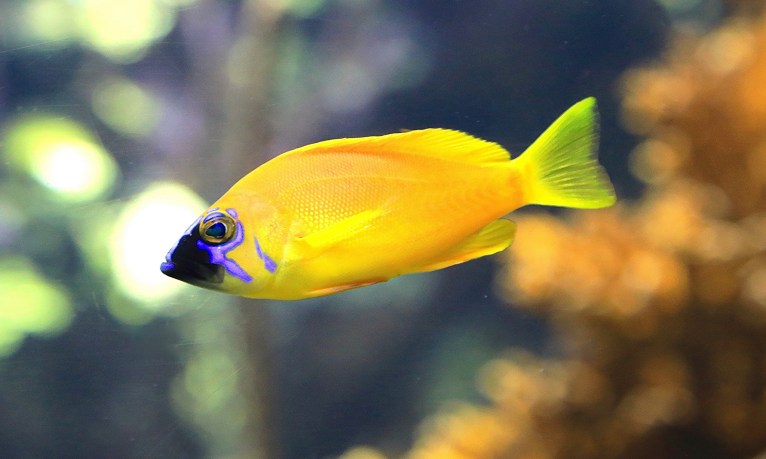
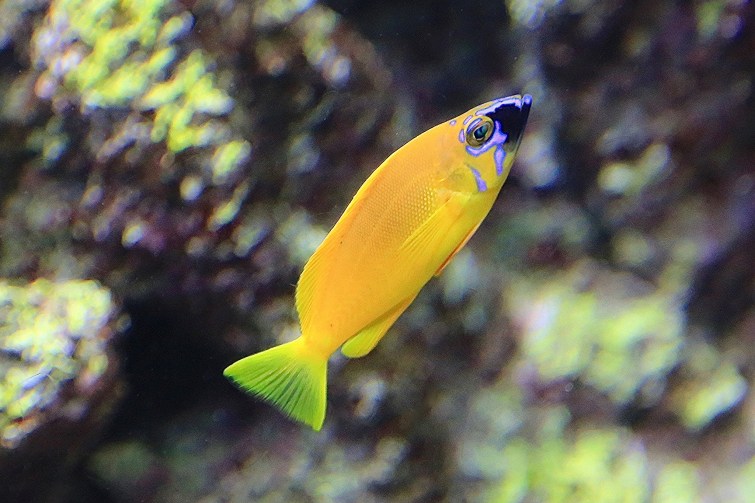
GENERAL CHARACTERISTICS: Body rich chrome-yellow in color. The snout is black bordered by an iridescent blue. Pectoral fins pigmented. Hamlet “species” are defined primarily on differences in color patterns. They are known to interbreed and hybridize freely with very little consistent genetic differentiation amongst them.

Golden Hamlet19442208331_9807a11d99_k

DISTRIBUTION/HABITAT: H. gummigutta is rare and found in the Western Central Atlantic. It is coral reef associated.

CONSERVATION: IUCN: Least Concern (LC)

No known major threat but juveniles are potentially a prey item of the invasive Lionfish.


Golden hamlet18815471474_4ab1413005_k

REPRODUCTION: The Golden Hamlet is a simultaneous hermaphrodite (possesses both male and female sex organs).  Successful spawning requires two individual fish.

Color of Life note: Brightly colored fish seem to jump into your sight. But underwater, these bright colors mingle with those of other fish, reef creatures, and the coral itself, to offer a mixtures of color and patterns in which no one individual stands out. Movement of the anemones and corals in the current also serve to obscure and protect the fish.
Ref: California Academy Academy of Sciences, Color of Life Exhibit 2015

References

Ron’s flickr  https://www.flickr.com/photos/cas_docents/19442208331/in/album-72157652559028013/

Ron’s WordPress shortlink  http://wp.me/p1DZ4b-1yL

Reef builders.com (an excellent description of the Caribbean reef exhibit at the California Academy of Sciences). http://reefbuilders.com/2015/03/24/steinhart-aquariums-caribbean-display-realistic-biotope-representation/#

fishbase  www.fishbase.org/summary/Hypoplectrus-gummigutta.html

IUCN Red List  www.iucnredlist.org/details/16751128/0

TAXONOMY
Kingdom: Animalia
Phylum: Chordata
Class: Actinopterygii (ray-finned fishes)
Order: Perciformes (Perch-likes)
Family: Chaetodontidae (Butterflyfishes)

Genus/species: Chaetodon ulietensis

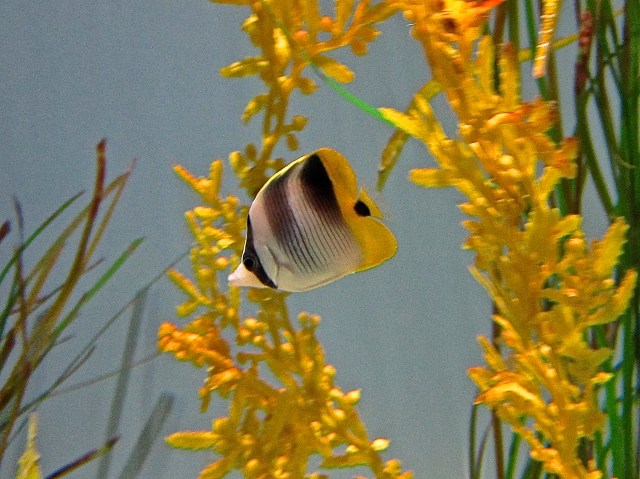
IMG_0142

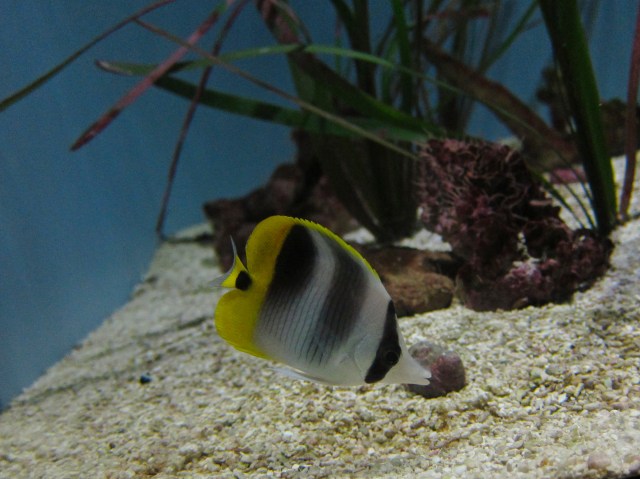
GENERAL CHARACTERISTICS White for and mid-body and a bright yellow rear. A pair of diffuse dark saddles are across the back with a black spot on the base of the tail and black bar through the eye. Size to 15 cm (6 in).

DISTRIBUTION/HABITAT: Central and Western Pacific in coral-rich areas of lagoons and seaward reefs to 30 m (100 ft).

DIET IN THE WILD Wide range of foods including invertebrates and algae.

REPRODUCTION Monogamous usually seen in pairs.. Oviparous.

CONSERVATION: IUCN, Least Concern (LC)

IMG_0161

Color Cluster

WordPress shortlink http://wp.me/p1DZ4b-Uf

flickr http://www.flickr.com/photos/cas_docents/sets/72157625119200613/with/8599840724/

flickr www.flickr.com/photos/cas_docents/sets/72157625119200613/…

Australian Museum australianmuseum.net.au/Doublesaddle-Butterflyfish-Chaeto…

EOL eol.org/pages/1012794/details

TAXONOMY
Kingdom: Animalia
Phylum: Chordata
Class: Actinopterygii (ray-finned fishes)
Order: Perciformes (Perch-likes)
Family: Pomacentridae (Damselfish)

Genus/species: Chrysiptera parasema

GENERAL APPEARANCES:: Small, blue-bodied fish with a yellow tail; 7–9 cm (2.75 – 3.5 inches) long. Colors become less contrasting with age.

Yellow-tail Blue Damselfish 4533756786_58d0151ab2_o

DISTRIBUTION/HABITAT: Western Pacific in coral-rich areas of sheltered lagoon and inshore coral reefs. Inhabits rubble beds on lagoon reefs to 16 meters (52 feet) deep. Occurs in small groups on Acropora patches.

DIET IN THE WILD: Omnivore.

REPRODUCTION: Oviparous, distinct pairing during breeding. Eggs are demersal and adhere to the substrate.

Ref: fishbase, EOL, Reef Fish Identification, Tropical pacific, Allen et al. 2003

Philippine Coral Reef PR04

flickr http://www.flickr.com/photos/cas_docents/sets/72157608339622313/with/4533756786/

WordPress Shortlink  http://wp.me/p1DZ4b-19h

TAXONOMY
Class: Actinopterygii (Ray-finned fishes)
Order: Perciformes (Perch-likes)
Family: Serranidae (Sea basses: groupers and fairy basslets)
Subfamily: Anthiinae (Anthias)

On exhibit:

Pseudanthias dispar – Redfin anthias
P. lori – Lori’s anthias
P. randalli – Randall’s anthias* (not currently on exhibit 1-31-14)
P. tuka – Yellowstrip anthias
P. ventralis ­– Longfin anthias
Serranocirrhitus latus  – Sunburst anthias ( a closely related genus)
 

 DISTRIBUTION: Pseudanthias species are found throughout the Indo-Pacific region. Many of the some 64 species have fairly wide distribution.

 HABITAT: During the day, they are found along the upper reef face in areas of strong current. At night, when predators threaten, they seek shelter in the reef’s caves and crevices.

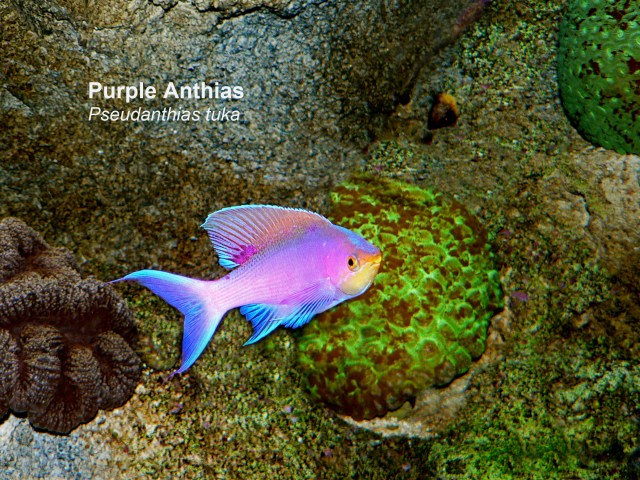
GENERAL CHARACTERISTICS: Pseudanthias are small, fast-moving, colorful fishes. The male and female pseudanthias, like many members of the family Serranidae display gender-specific body shape and/or color. The male of P. dispar, for example, has a bright red dorsal fin and more pink and blue on the head and sides than the generally yellow female. The male yellowstripe anthias is a deeper purple overall than the female that sports a bright yellow stripe on the back not seen in the male.

DIET IN THE WILD: Plankton and fish eggs.

REPRODUCTION: All are sequential protogynous hermaphrodites. Protogynous literally means “first female,” a reference to the fact that all individuals are born as females, but a few, usually the largest females, will in time will change sex and develop male sex organs. The sex change, which can be completed in only a few days, is triggered by the loss of the dominant male, usually to predation.

 This reproductive strategy may confer at least two benefits: first, many young, healthy females serviced by a few large males means that in a given aggregation of fish more eggs, which are larger and therefore more energetically expensive, are produced.  Sperm, especially that produced by a large male, is plentiful enough to fertilize the eggs of even a large group of females. Also, the large males are extremely territorial and protective of their harems.

PREDATORS: These small fish are snack food for many larger predators. Life span of most species is about 3­–5 years.


REMARKS: The Steinhart displays several other fish families besides serranids with members that practice protogynous hermaphoditism, including wrasses, angelfishes, gobies, found in a number of tanks. Bocalo, the giant sea bass, is the Steinhart’s most notable practitioner

flickr  http://www.flickr.com/photos/cas_docents/sets/72157608545590153/

WORDPRESS SHORTLINK  http://wp.me/p1DZ4b-rh