Tag Archive: temperate marine


TAXONOMY
Kingdom: Animalia
Phylum: Chordata
Class: Actinopterygii (ray-finned fishes)
Order: Scorpaeniformes (Scorpionfishes and flatheads)
Family: Hemitripteridae (Sea ravens or sailfin sculpins)

Genus/species: Blepsias cirrhosis

GENERAL CHARACTERISTICS: There is a depression at the back of the head and some long cirri hang from the chin. The front edge of the first dorsal fin is high, the second dorsal and anal fins are long and approximately the same size. Coloration is usually brown mottled above with a light spot near the pectoral fins and pale below. Max length : 20.0 cm (8 inches)

 DISTRIBUTION AND HABITAT: North Pacific: Sea of Japan to the Bering Sea and to San Simeon, central California, USA.  Temperate Marine  Occurs in intertidal areas and to 37 m (120 ft) depth, but more common in subtidal areas. Often found among algae.

DIET IN THE WILD: Nekton and benthic crustaceans.

REPRODUCTION: Fecundity is low, 234–404 eggs. Adult B. cirrhosus  inject eggs into the tissue near the gastral cavity of  the sponge Mycale adhaerens  using it as a spawning bed.  The eggs are hidden by the sponge which is minimally damaged with the sponge also providing constant oxygen and an environment free of most bacteria.

CONSERVATION: IUCN; Not evaluated

LOCATION: Rocky Reef Cluster Sculpins

eol eol.org/pages/206919/details

 fishbase www.fishbase.us/summary/4054

 Ron’s flickr  www.flickr.com/photos/cas_docents/7207822582/in/photolist…

Ron’s WordPress shortlink:  http://wp.me/p1DZ4b-wY


TAXONOMY
Kingdom: Animalia, animals
Phylum: Chordata, chordates
Class: Actinopterygii (ray-finned fishes)
Order: Scorpaeniformes (Scorpionfishes and flatheads)
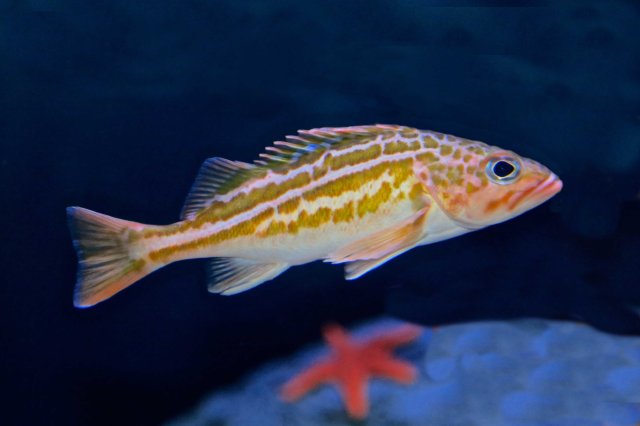
Family: Sebastidae (Rockfishes, rockcods and thornyheads)

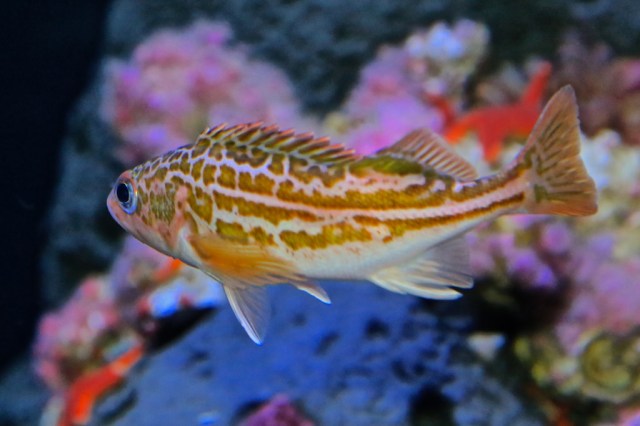
Genus/species: Sebastes elongatus

SebastesElongatus

GENERAL CHARACTERISTICS: Underwater they are white to reddish with four very distinct horizontal green stripes and light ventrally; green streaks on caudal fin membranes. After capture the entire body often becomes red or orange. Max. length 39.0 cm (15 inches). max. published weight: 630 g (1.3 pounds); max. reported age: 46 years.

GreenstripedRockfish14475489192_5dbe5d96ff_b


DISTRIBUTION/HABITAT: Eastern Pacific from Puget sound to Baja California. This is a solitary species that is often found resting on the bottom on rocky as well as soft bottoms. Temperate Marine demersal 25-425 meters (80-1400 feet).

DIET IN THE WILD: Small fishes, octopuses, shrimps.

REPRODUCTION: Viviparous

CONSERVATION: IUCN 2006 red list of threatened species.

REMARKS: Good eating fish but rarely caught by sports anglers.

LOCATION: California Coast

References:

WordPress Shortlink: http://wp.me/p1DZ4b-1hF

fishbase www.fishbase.org/summary/3965

 eol eol.org/pages/209601/details

 Washington Dept. of Fish and Wildlife. wdfw.wa.gov/fishing/bottomfish/identification/rockfish/s_…


fishbase www.fishbase.org/summary/3965


eol eol.org/pages/209601/details


Washington Dept. of Fish and Wildlife.wdfw.wa.gov/fishing/bottomfish/identification/rockfish/s_…

TAXONOMY
Kingdom: Animalia
Phylum: Chordata
Class: Actinopterygii (Ray-finned or Bony Fishes)
Order: Batrachoidformes (Only family is below)
Family: Batrachoididae (Toadfishes)

Genus/species: Porichthys notatus

Humming Toadfish 8413703014_a4877b2eaa_o

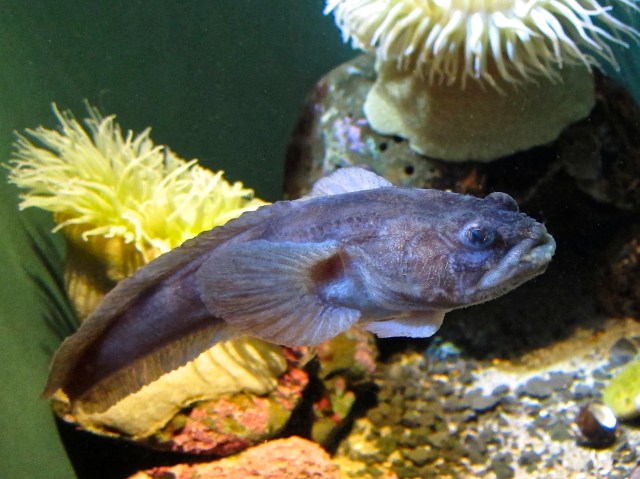
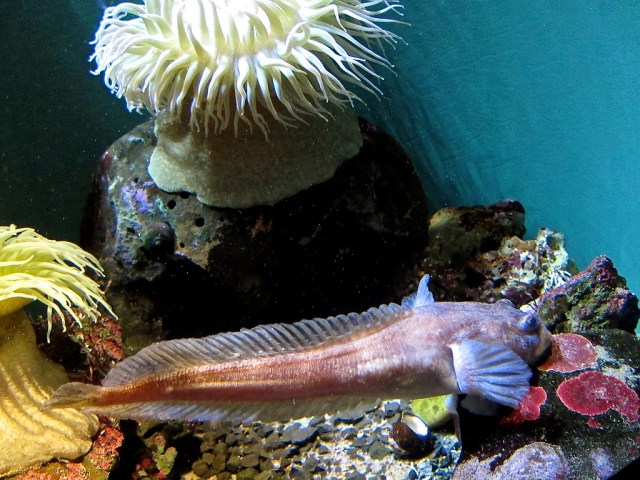
GENERAL CHARACTERISTICS Toadfishes have large flattened heads and tapered bodies and are the only family in the order. The humming toadfish (aka plainfin midshipman) is scaleless with four lateral lines and eyes high on a large head with a large mouth. The toadfish can be up to 30 cm (1 ft) long; the dorsal fin holds a mild poison. The toadfish possesses photophores (light organs), which are arranged on the underside of the head in a U-shape and are used primarily to attract prey.

DISTRIBUTION/HABITAT Found from Alaska to the Gulf of California. Its habitat ranges from intertidal areas to deeper water over sand and mud bottoms. The toadfish returns to shallow intertidal waters to reproduce and is seasonally common in San Francisco, Suisun, and San Pablo Bays.

Humming Toadfish 2984289639_0f3b1556df_b

DIET IN THE WILD Omnivore: eats worms, crustaceans, mollusks and other fish. Hides in rock crevices among bottom vegetation, or digs dens in bottom sediments to ambush prey. Diet provides the ingredients for fluorescence.

PREDATORS They are prey for seals and sea lions.

REPRODUCTION After building and guarding a nest of rocks, the male entices females by humming his “love song,” a loud sound produced by vibrating a set of sonic muscles on its air bladder 6,000
times a minute for more than an hour at a time. The female chooses her mate, deposits her eggs in the nest, and the male fertilizes and guards them. Males try to attract several females to the same nest.

CONSERVATION Toadfish are not endangered though they are taken by local fishermen as a food fish and by trawlers as a source of fish meal and oil. They are prey for seals and sea lions.

Humming Toadfish 8412481779_4cbf3f513b_b

REMARKS For many years Sausalito residents complained of an annoying noise that kept them awake at night during the summer months. The cause was uncertain, but theories were rampant: underwater surveillance equipment, secret weapons testing, extraterrestrial intrusions were all put forth. Then in the early 1990s the Academy’s Senior Curator and then Director of Steinhart Aquarium, John McCosker, investigated and ultimately reassured irritated residents that the sound had no destructive intent, only a reproductive one.
The remarkable endurance of the toadfish’s sonic muscles are the subject of ongoing research and may lead to clues to fighting human muscle disease as well as general insights into muscle structure and function.

Water planet Senses Cluster Sound WP40

flickr  http://www.flickr.com/photos/cas_docents/sets/72157625020091079/with/8412481695/

WordPress Shortlink  http://wp.me/p1DZ4b-11t

TAXONOMY
Kingdom: Animalia
Phylum: Chordata
Class: Actinopterygii (ray-finned fishes)
Order: Perciformes (Perch-likes)
Family: (Labridae) Wrasses

Genus/speces: Halichoeres semicinctus

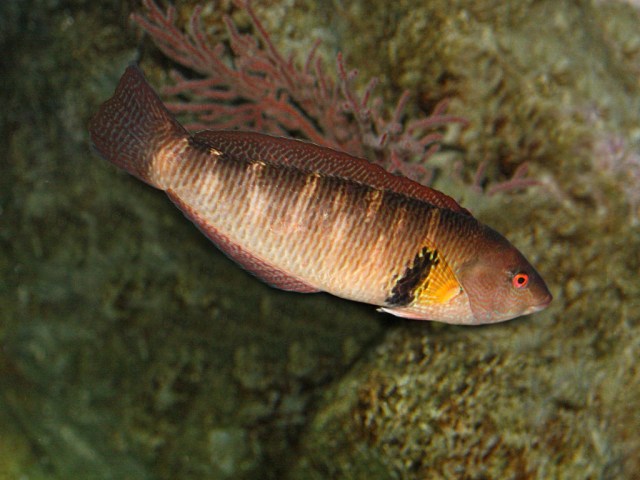
Rock Wrasse (male) below:

Rock Wrasse Male 3995256931_9e14b0f8ab_b

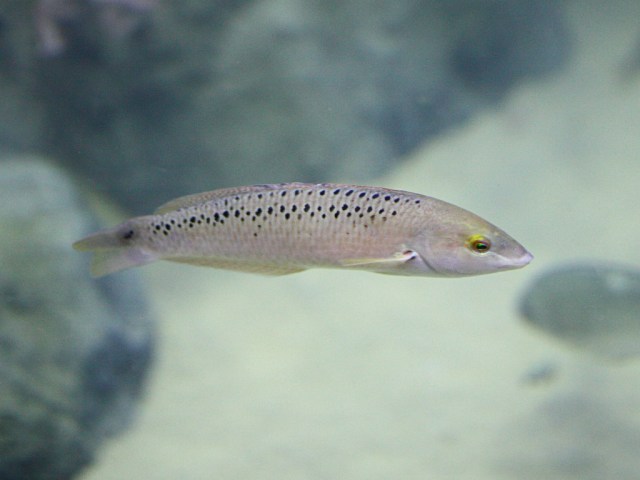
GENERAL CHARACTERISTICS: Length to 38 cm (15 inches). Terminal phase males are characterized by a partial dark stripe behind yellow pectoral fins and pink eyes, while females and immature male rock wrasses are similar in appearance having ranging from brown to yellow to orange. 

Rock Wrasse (female or immature male) below:

Rock Wrasse (female or immature male)  3995255809_8f686dbab8_b

DISTRIBUTION/HABITAT: Pt. Conception, California to Guadalupe Island off central Baja California, Mexico. Habitat: Close to rocks near patches of sand; tidepools and down to 24 m (79 feet).

DIET IN THE WILD: Small invertebrates, taken during the day.

REPRODUCTION: Each individual starts as female then changes to a male at length of about 30 cm. Pelagic spawners

CONSERVATION: IUCN: Least concern.

REMARKS : Sleeps at night buried in sand, with head protruding, and will dart to a sandy refuge during the day if startled.

Rock Wrasse (female or immature male) below:

Rock Wrasse (female or immature male)  2972940984_0ce80884d9_b

Southern California Kelp Tank CC14

WordPress Shortlink http://wp.me/p1DZ4b-Yk

flickr http://www.flickr.com/photos/cas_docents/sets/72157633391356187/with/3995255809/

TAXONOMY
Class: Actinopterygii (ray-finned fishes)
Order: Perciformes (Perch-likes)
Family: Labridae (Wrasses)

Genus/species: Oxyjulis californica

Senorita Wrasse 3995255581_88e76a0033_b

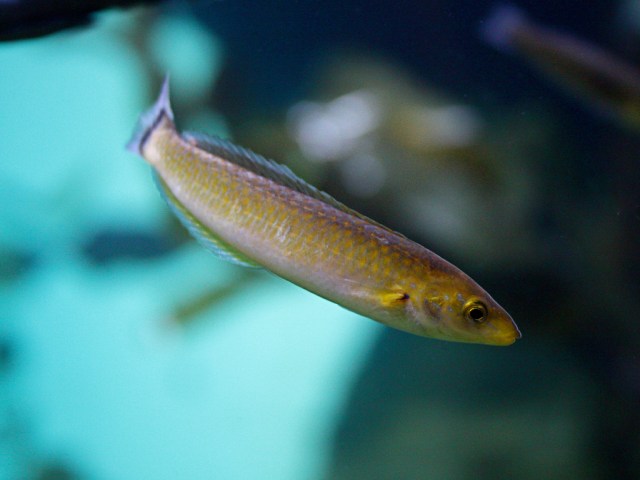
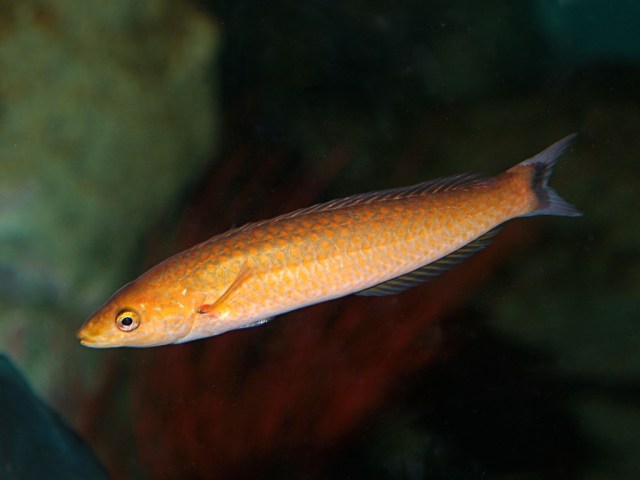
GENERAL CHARACTERISTICS Length to 10 inches (25 cm). Cigar-shaped fish with large scales and protruding teeth. Orange to brownish, a few are more pink or yellow. Large black marking at base of caudal fin.

DISTRIBUTION/HABITAT: Salt Point, northern California to south-central Baja California. Habitat: Found in kelp and other seaweeds and over rocky reefs, usually at shallow depths. Five to 240 feet (1.5 m-76 m) deep.

DIET IN THE WILD: Hydroids, bryozoans, amphipods, parasitic copepods, and isopods

REMARKS: Popular in the aquarium trade. At night, señoritas seek out a nearby sandy area and bury themselves with a headfirst dive into the sand, ultimately sleeping with head protruding.
Señoritas cleaner fish. picking external parasites and copepods from the skin of other fishes.

Senorita Wrasse 3996018576_6967b7abb5_b-1

Southern California Kelp Exhibit CC14

WordPress Shortlink http://wp.me/p1DZ4b-Y8

flickr http://www.flickr.com/photos/cas_docents/sets/72157633391356187/

TAXONOMY
Kingdom: Animalia
Phylum: Chordata
Class: Actinopterygii (ray-finned fishes)
Order: Perciformes (Perch-likes)
Family: Pomacentridae (Damselfishes)

Genus/species: Chromis punctipinnis

Blacksmith  4020282794_5437a61f15_b

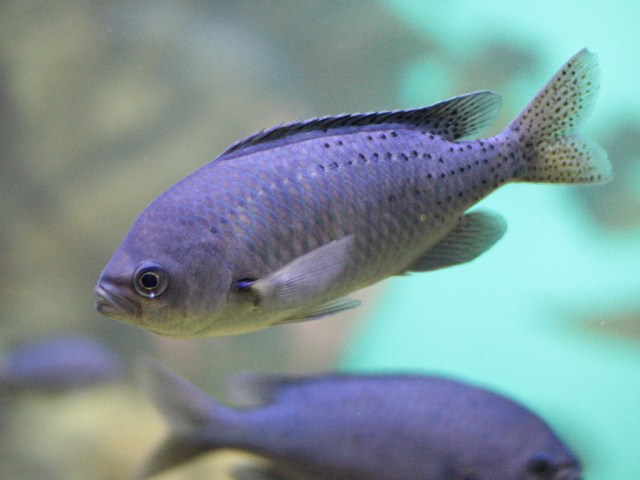
GENERAL CHARACTERISTICS: Gray-blue or gray on sides with black spots on rear of body. Length about 30 cm or 12 inches.

DISTRIBUTION/HABITAT: Monterey Bay to central Baja California, most common from Pt. Conception south. Habitat: Large schools of hundreds of individuals are common during the day above nearshore rocky reefs to 45 m or 150 feet. Shelters night on or near crevices, again often in large groups.

DIET IN THE WILD: Zooplankton (copepods and other crustacean larvae and eggs).

REPRODUCTION: Males prepare nest sites in overhangs or small caves of reefs, and guard eggs. Females oviparous. Spawn summer or fall.

PREDATORS: Other fishes (including kelp bass, moray eels, and lingcod), marine mammals (harbor seals, California sea lions), and birds.

REMARKS: Turns until it is perpendicular to the ground. Senorita fish will then commence cleaning the blacksmith. Not only does the senorita get a meal, but the blacksmith gets groomed in this symbiotic relationship.

3399374199_3ffcf124b8_b

Southern California Kelp Forest CC14

WordPress Shortlink  http://wp.me/p1DZ4b-Xj

flickr http://www.flickr.com/photos/cas_docents/sets/72157608359804936/with/3399374199/