
TAXONOMY
Kingdom: Animalia
Phylum: Chordata
Class: Actinopterygii (ray-finned fishes)
Order: Perciformes (Perch-likes)
Family: Acanthuridae (Surgeonfishes, Tangs, and Unicornfishes)
Genus/species: Paracanthurus hepatus
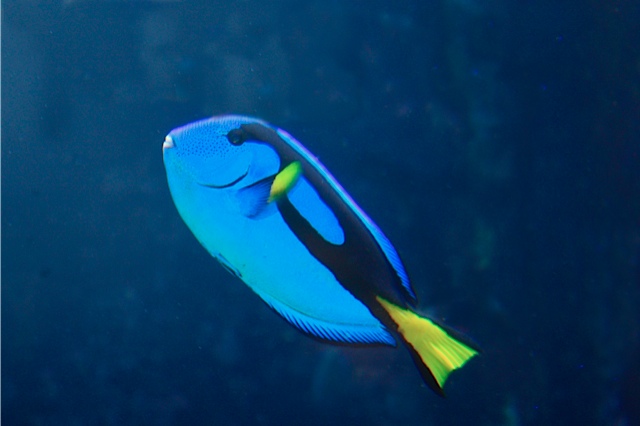
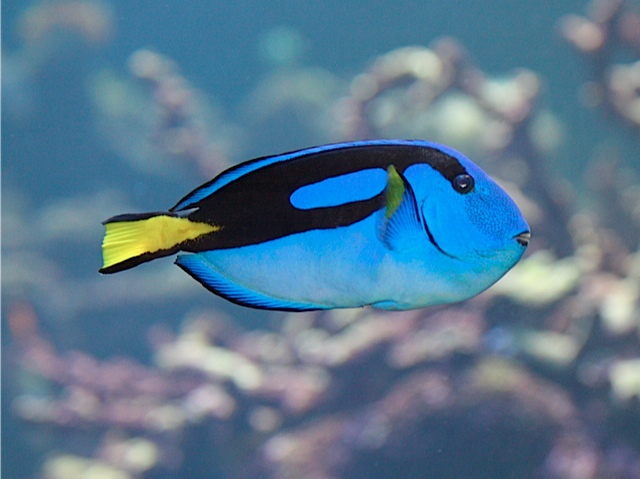
GENERAL CHARACTERISTICS: The color of their oval-shaped bodies is sky blue enhanced by reflective pigment cells called iridophores. The tail fin is yellow extending into a “V” shape from the caudal fin to a point just beyond the caudal spine. A black oval extends under dorsal fin to caudal peduncle. Color changes as they mature; juveniles are bright yellow with blue spots near their eyes, and their dorsal and anal fins are tipped in light blue. Their body becomes blue as they mature.
Length up to 31 cm (12 in)
Weigh on average 600 g. (1.3 pounds)
DISTRIBUTION/HABITAT: Indo-Pacific in clear, current-swept terraces of seaward reefs, 2–40 m (6-120ft). Typically in loose groups 1–3 m (3-9 ft) above substrate. Shelters among branches of Procillopora corals or in crevices of rocks.
DIET IN THE WILD: Zooplankton.
REPRODUCTION: P. hepatus is oviparous with external fertilization. They are open water egg scatterers on substrate and are nonguarders.
CONSERVATION: IUCN Least concern
REMARKS: P. hepatus like other surgeonfishes has a razor-sharp caudal spine located at the base of their caudal fin. This spine contains toxins that can cause a debilitating pain to small predators and uncomfortable irritation and pain in humans. This spine is in a groove below the surface of the skin and can be extended from the body for defensive purposes.
Dory, the co-star of Finding Nemo, with the voice of Ellen DeGeneres’ “spaced-out” fish, is a hepatus tang. Most kids now recognize this fish as Dory.
References
California Academy of Sciences Steinhart Aquarium Philippine Coral reef 2016
Ron’s WordPress shortlink wp.me/p1DZ4b-Ab
Ron’s flickr http://www.flickr.com/photos/cas_docents/sets/72157608332652056/
Encyclopedia of Life http://eol.org/pages/222042/details
Animal Diversity Web: http://animaldiversity.ummz.umich.edu/accounts/Paracanthurus_hepatus/
fishbase: http://www.fishbase.org/summary/6017
 Ron's Critter of the Day