Tag Archive: reptiles


TAXONOMY
Kingdom: Animalia
Phylum: Chordata
Class: Reptilia
Order: Squamata
Family: Varanidae

Genus/species: Varanus salvator (melanistic color form)

GENERAL CHARACTERISTICS: Color is usually dark brown or blackish.  The neck is  long with an elongated snout and the nostrils close to the end of the nose. The tail is laterally compressed and has a dorsal keel. Scales on the top of the head are relatively large, while those on the back are smaller in size and are keeled. Length to 2 meters (6.6 ft), but most adults are 1.5 meters (4.9 ft) long. Average weight is 19.5 kg (43 lb). As of 2014 the Academy Water Monitor is aprox. 7 years old and 4 feet long (California Academy of Sciences, Eric Hupperts, Biologist)
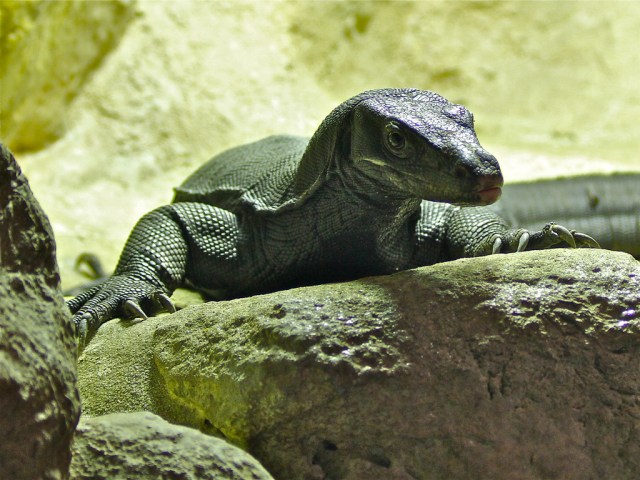
Water Monitor


DISTRIBUTION/HABITAT: Found throughout much of southern Asia, from India in the west to the Philippines and the Indo-Australian islands in the east. They are semi-aquatic and has a wide range of habitats. Also found on flat land, a typical burrow is in a river bank. The entrance starts on a downward slope but then increases forming a shallow pool of water.

DIET IN THE WILD: The lizard is very fast and is an ‘open pursuit’ hunter, rather than stalking and ambushing. V. salvator is an extreme carnivore: birds, eggs, mammals, fishes, other reptiles and carrion.
Academy diet: Rodents.

REPRODUCTION: Males are normally larger than the females, usually twice as large in mass.. Eggs are usually deposited along rotting logs or stumps.

LIFESPAN: 10.6 years in captivity.

Water Monitor

CONSERVATION: IUCN Redlist: Least Concern. CITES: appendix II. It is abundant in parts of its range, despite large levels of harvesting.

REMARKS:They are excellent swimmers known to cross large stretches of water, explaining its wide distribution. Known to dig up corpses of human and devour them.

Skins of  V. salvator are used for dietary protein, ceremonies, medicine, and leather goods. Annual trade in these skins may reach more than 1 million whole skins a year, mostly in Indonesia for the leather trade. Medium-sized individual are preferred because the skin of large animals is too tough and thick to shape.

References:

Encyclopedia of Life  http://eol.org/pages/1055072/details

Animal Diversity Web animaldiversity.ummz.umich.edu/accounts/Varanus_salvator/

Ron’s WordPress Shortlink  http://wp.me/p1DZ4b-TY

Ron’s flickr http://www.flickr.com/photos/cas_docents/sets/72157625194985646/with/5492305677/

TAXONOMY
Kingdom: Animalia
Phylum: Chordata
Class: Reptilia
Order: Testudines
Suborder: Pleurodira (side-necked turtles)
Family: Chelidae (“snake-necked turtles”)

Genus/species: Chelus fimbriata

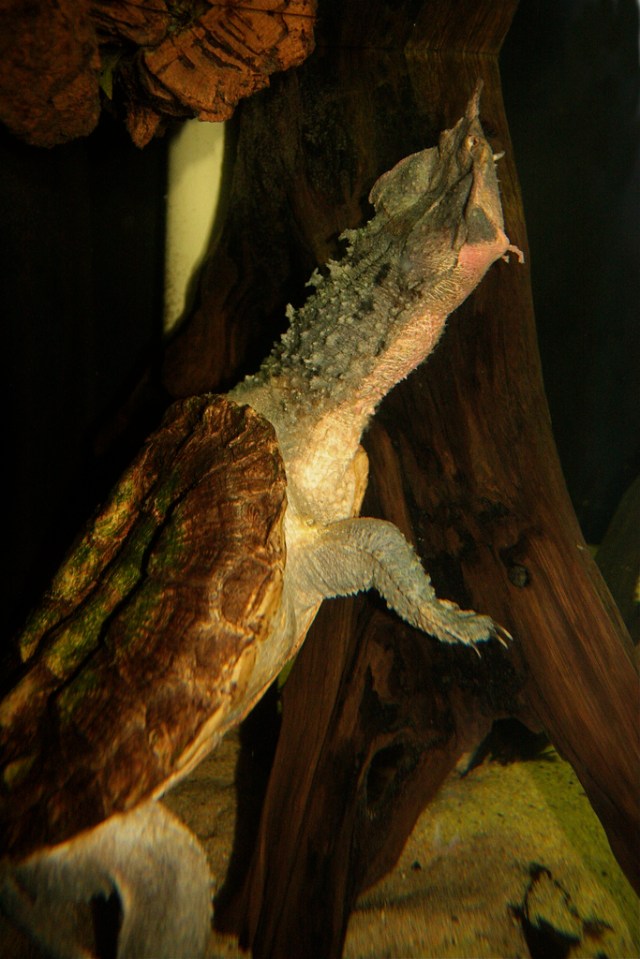
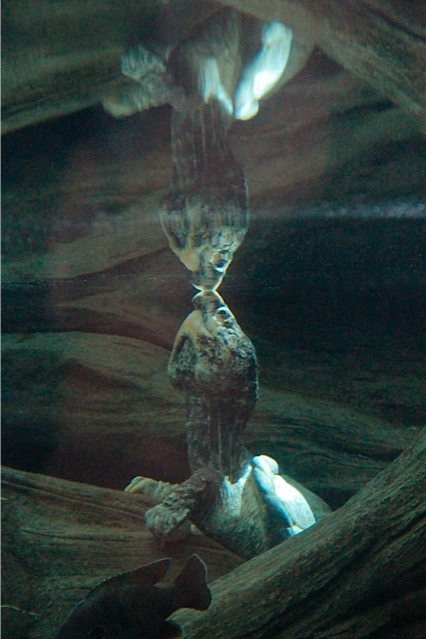
GENERAL CHARACTERISTICS: Color is faded yellow, washed out browns, oranges, and greys. The carapace has three lengthwise knobby keels with algae covering much of the carapace resembling a piece of bark, camouflaging it from possible predators. The head is widely triangular with large lateral flaps of skin and three barbels on the chin and four additional filamentous barbels at the upper jaw, The snout is a long protuberance used as a snorkel.  Carapace length to up to 45 cm (18 inches). Weight to 15 kg (33 lb).

DISTRIBUTION/HABITAT: Tropical. Amazon Basin, South America. Found near the bottom of turbid waterways in lakes, ponds and sluggish creeks. Rarely leaves the water.

DIET IN THE WILD: Carnivore. A “lay-in-wait” predator. Fishes and aquatic invertebrates are captured with the “gape and suck” technique. The opening of its mouth creates a vacuum to draw in prey with the mouth snaping shut, expelling the water and the fish swallowed whole.


REPRODUCTION: Fertilization is internal. They excavate their nests in decaying vegetation at the forest edge laying 12 to 28 eggs with an incubation periods of around 200 days.

LIFESPAN: To 15 years in captivity.

CONSERVATION: IUCN and CITES No special status.


3449612144_afdc85b508_b

REMARKS: The common name “matamata” is said to have the meaning “I kill” in one of the South American native languages.
C.fimbriatus has extremely poor eyesight. It can sense sound through a well developed tympanum on both sides of the head.

References

Ron’s WordPress shortlink  http://wp.me/p1DZ4b-bJ 

 U. of Michigan ADW animaldiversity.ummz.umich.edu/accounts/Chelus_fimbriatus/

Encyclopedia of Life  eol.org/pages/795410/details

Ron’s flickr  http://www.flickr.com/photos/cas_docents/sets/72157608449490716/


TAXONOMY
Kingdom: Animalia
Phylum: Chordata
Subphylum: Vertebrata
Class: Reptilia
Order: Squamata
Suborder: Serpentes
Family: Boidae

Genus/species: Python reticulatus


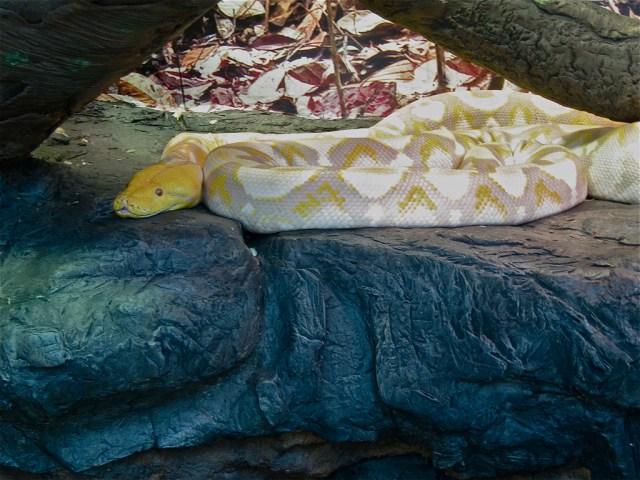
Albino Reticulated Python  6196134316_755d730e34_b

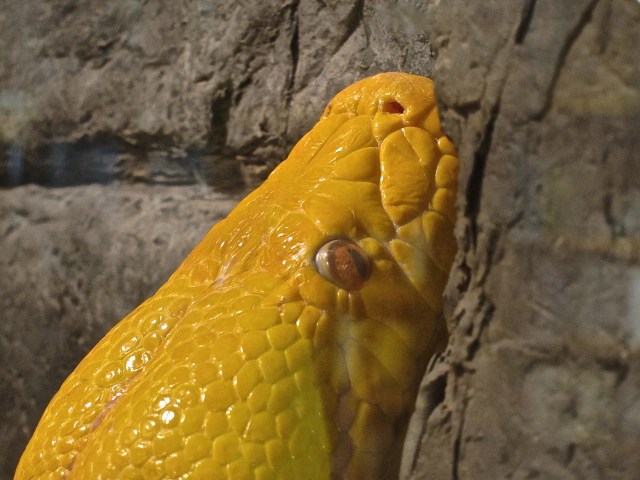
GENERAL CHARACTERISTICS: Largest species of python.  The giant South American Anaconda may grow  heavier ( 29 feet long & 550 pounds), but the longest snake in the world is the reticulated pythons (33 feet). Normally colored reticulated pythons have several pigments: melanin (blacks), and xanthins (yellows) amongst other more subtle colors. Lemondrop is a “lavender albino” which is the same thing as a “tyrosinase positive albino” (t-positive) which have the inability to complete the synthesis of melanin but can produce other melanin related pigments such as various shades of brown grey and red resulting the “lavender” color. A “normal albino” (t-negative) reticulated python is yellow and white with pink/red eyes. Melanin and other melanin pigments areas are pure white but non-melanin pigments are present giving alternate colors (xanthines produce yellows). To make matters more complicated different albino snakes may have mutations giving them additional color morphs.
Our albino American Alligator, (Claude) Alligator mississippiensis is a “normal albino” (t-negative) with no melanin or non-melanin pigments making him pure white. If you google “t-positive albino” or “tyrosinase positive albino” you can find more information on this condition. (Albino Appearance Ref. Nicole Chaney Biologist II, California Academy of Sciences for basic albino information).

DISTRIBUTION/HABITAT: Reticulated pythons can be found throughout Southeast Asia. Their range includes the Nicobar Islands, Burma through Indochina, and Borneo, Sulawesi, Ceram and Timor in the Malay archipelago. Found in steamy tropical rainforests near small rivers or ponds in tropical environments.

Albino Reticulated Python,  Python reticulatus  IMG_0184

DIET IN THE WILD   P. reticulatus is strictly carnivorous typically feeding on birds and mammals. This diet extends however to dogs, large deer, pigs and very rarely humans. Usually ambush predators, waiting in trees for unsuspecting prey.  They use their 100 curved teeth to capture their prey by biting then holding prey and they kill  by wrapping around them and squeezing them until the prey is unable to breath and its heart is unable to pump blood swallowing them whole.  The entire animal is digested in the snake’s stomach except for fur or feathers, which are passed with the snakes waste.

REPRODUCTION   Lays 25-80 eggs and guards nest but not hatched young.

REMARKS  Reticulated Pythons are heavily sold for their skin and meat. Also tourists visiting these areas often buy materials made from these snakes.
The largest P. reticulatus ever caught was 33 feet long in 1912 in Indonesia. The largest in captivity was from Thailand reaching a length of 28½ feet long with a girth of 37.5 inches and  weighed apron. 320 pounds.

This specimen below is a male, 14.5 ft long 60 lbs, 6 yrs old (6-22-12).

Albino Reticulated Python IMG_0182

WordPress Shortlink   http://wp.me/p1DZ4b-Vi

flickr  http://www.flickr.com/photos/cas_docents/sets/72157608449603666/

TAXONOMY
Kingdom: Animalia
Phylum: Chordata
Class: Reptilia
Order: Squamata
Suborder: Sauria
Family: Gekkonidae (Geckos)

Genus/species: Ptychozoon kuhlii

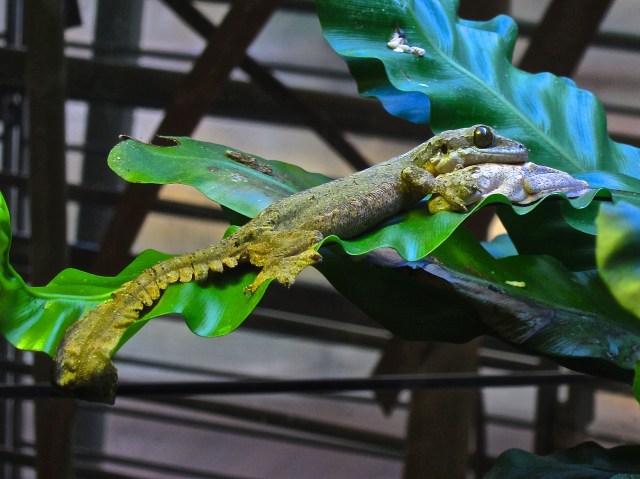
Kuhl's Flying Gecko IMG_9599

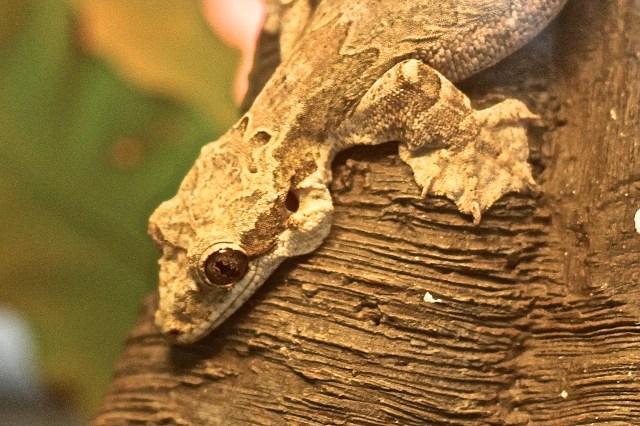
GENERAL CHARACTERISTICS Weird looking with big heads, bulging lidless eyes, and elaborate webbed feet. Gliding apparatus is composed of a large flap of skin along the flank. These flaps remain rolled across the belly until the lizard jumps off a tree. Then the flaps open passively in the air, acting as a parachute during descent. Additional flaps lie along the sides of the head, neck, and tail. These geckos are nocturnal and cryptic, and often go unnoticed in their natural habitat.

DISTRIBUTION/HABITAT Southeast Asia, including southern Thailand, Malaysia, Borneo, Indonesia, and Singapore. Nocturnal arboreal animals, found in lowland and mid-level rainforests.

Kuhl's Flying Gecko IMG_9650

DIET IN THE WILD Insects and arthropods.

MORTALITY Can live up to 7–9 years.

REPRODUCTION In captivity, breeding occurs when the animals are exposed to about 12 hours of daylight. The female will lay two eggs about once a month. She can lay five or six clutches per season. Eggs will hatch in 2–3 months.

Kuhl's Flying Gecko

Rainforest Borneo BO11

WordPress Shortlink  http://wp.me/p1DZ4b-UA

flickr  http://www.flickr.com/photos/cas_docents/sets/72157620567930293/

TAXONOMY
Kingdom: Animalia
Phylum: Chordata
Subphylum: Vertebrata
Class: Reptilia
Order: Testudines
Suborder: Cryptodira
Family: Carettochelyidae

Genus/species: Carettochelys insculpta

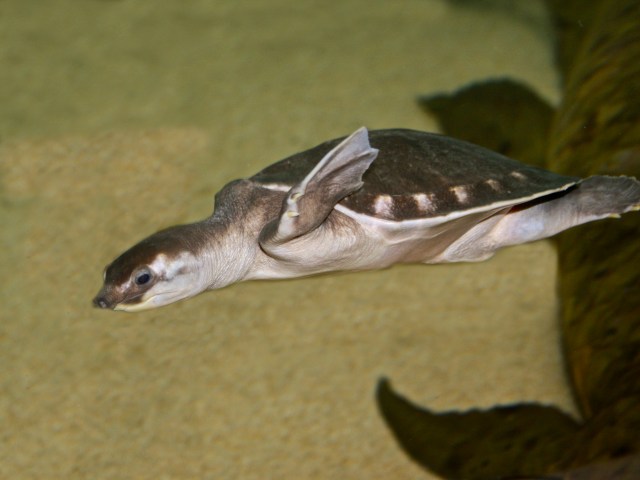
Pignose Turtle aka Fly River Turtle Carettochelys insculpta (Carettochelyidae) Pig-nose Turtles IMG_1388

GENERAL CHARACTERISTICS: Length ave. 46 cm (18 inches). Weight ave. 22 kg (49 lbs). Pitted, leathery,gray-green carapace and a white plastron. Limbs are clawed and paddlelike. Short head terminating in a broad, tubular, “piglike” snout. Carapaces of juveniles have serrated perimeters and a central keel. They have flat, broad limbs that have two claws each, with their enlarged pectoral flippers having a similar appearance to those of sea turtles.

DISTRIBUTION/HABITAT: Southern New Guinea and Kimberly Plateau of Australia in shallow, slow-moving rivers, lagoons, lakes and swamps with sandy or silty bottoms. Also in estuaries. Active nocturnally. Emerges from water only in order to nest.

DIET IN THE WILD: Opportunistic omnivores. Principal food is the fruits of shoreline trees. Eat other plant material: leaves, flowers that fall into river from banks, and aquatic algae. Also take insect larvae, mollusks and crustaceans. Scavenge fishes and mammals as carrion.

PREDATORS: Water monitors and humans. Eggs and adults taken for food by Papua New Guineans. Australian aborigines eat adults of this species. Have been reported to live 38.4 years in captivity.

REPRODUCTION: Oviparous laying two clutches of eggs, every two years. Males never come out of the water and females only come out when they are about to lay eggs. They don’t return to land until the next nesting season.

CONSERVATION: Vulnerable by the IUCN due to overharvest as a food source.

REMARKS: The only freshwater turtle to have limbs modified into flippers and swim via synchronous forelimb motions that resemble dorsoventral flapping, that evolved independently from their presence in sea turtles.

Secretive animals. Use forelimbs to burrow by scooping sand substrate over their carapace. Adults may thermoregulate underwater by lying over small thermal springs. Only extant species in its family.

 pignose-turtle-aka-fly-river-turtle- IMG_0316

Water Planet WP25

WordPress Shortlink  http://wp.me/p1DZ4b-SE

flickr http://www.flickr.com/photos/cas_docents/sets/72157608449490716/with/8547862948/

KINGDOM  Animalia

PHYLUM    Chordata

CLASS    Reptilia

ORDER    Testudines

FAMILY    Chelydridae  (Snapping Turtles)

GENUS/SPECIES  Macrochelys temminckii


GENERAL CHARACTERISTICS

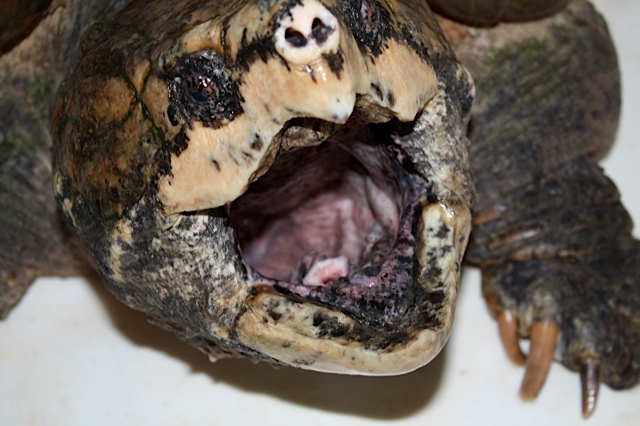
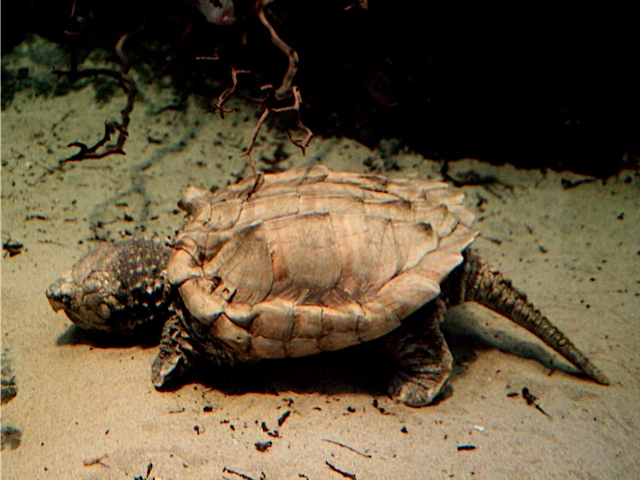
Largest freshwater turtle in the world weighing 70-80 kg (155-175 lb) with a shell length up to 79 cm (32 in). Their  big head can be over 9 in wide with three ridge keels on the broad carapace rising to knobby keels. They usually have algae covering their backs since they spend most of their time under water coming to the surface sometimes as little as 50 min between breaths.

The largest individual turtle in the exhibit is over 55 kgs (121) pounds. The rest are likely ~45 kg (100 pounds)


DISTRIBUTION/HABITAT

Southeastern United States in primarily quiet, muddy freshwater rivers, streams, lakes and ponds that drain into  the Gulf of Mexico. Females leave water only to deposit eggs and male occasionally will bask in the sun.


DIET IN THE WILD

Lie-in-wait predator. Rests on substrate with its mouth open and lures fish to its mouth with a movable, pink wormlike tongue appendage. Also takes crayfish, crabs, snails, freshwater mussels, salamanders, snakes, very small alligators, small mammals, water birds, briar roots, wild grapes, acorns, and scavenges as well.  


ACADEMY DIET

They are fed cut trout 2-3 times per week.


 REPRODUCTION

Males climb onto the female’s carapace from behind. As in all reptiles, fertilization is internal. Female’s terrestrial nest is approximately within 50m (160 ft). of water. A single clutch of 8-52 eggs (35 average) is laid per year with a 3.5 to 4.5 month incubation period.  Warm and low incubation temperatures result in all female neonates. Intermediate incubation temperatures produce mostly males.  They mature in 11-13 years and can live to 70 years of age in captivity.


Swamp SW02


flickr  http://www.flickr.com/photos/cas_docents/2776238200/in/set-72157608449490716/

WORDPRESS SHORTLINK  http://wp.me/p1DZ4b-B3

TAXONOMY

KINGDOM   Animalia

PHYLUM   Chordata

CLASS   Reptilia

ORDER   Squamata

FAMILY    Chamaeleonidae

GENUS/SPECIES  Furcifer  oustaleti


GENERAL CHARACTERISTICS

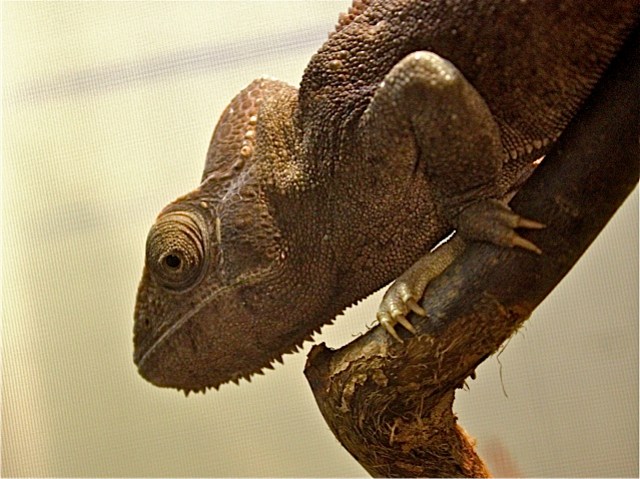
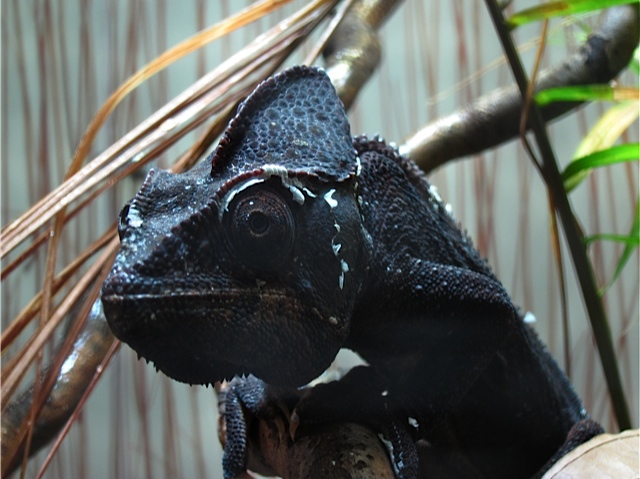
With a maximum length of 68.5 cm (27 in), it is often considered the largest species of chameleon.  Oustalet’s Chameleons are sandy brown and grey in color but, like most chameleons, they can change color depending on mood and temperature, or as a mode of communication.

Distinctive features of a chameleon lizard are its long tongue, its separately mobile eyes, its parrot-like feet and in many species, the ability to change color.       


DISTRIBUTION/HABITAT

 Widespread in Madagascar in the warm and humid coastal lowlands.  Has been introduced near Nairobi in Kenya.

REPRODUCTION

One to 2 clutches of up to 60 eggs per year taking 7 months to hatch.

Chameleons may live more than 10 years in captivity.


 Rainforest Madagascar MA10

 Flickr http://www.flickr.com/photos/cas_docents/sets/72157608449603666/with/5356254468/

WordPress Shortlink  http://wp.me/p1DZ4b-zV


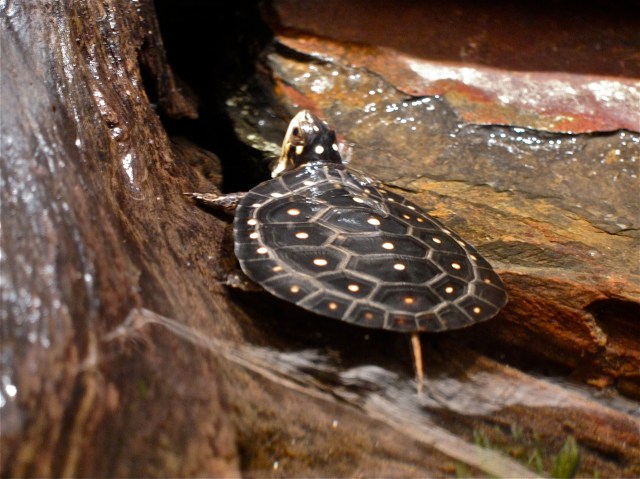
Class: Reptilia, Order: Testudines. Family: Emdidae, Clemmys guttata  

DISTRIBUTION: Southern Maine west to extreme northeastern Illinois and south along the coastal plain to northern Florida. 

HABITAT: Swamps, bogs, fens, marshes, woodland streams, and wet pastures.  

APPEARANCE: Carapaces are overall black with a few, to many scattered yellow spots. Their faces are adorned with splotches of orange and yellow. Adults, especially males, have orange coloration on the legs. Adults will reach an overall length of approximately 12 cm (5 in). 

DIET: Omnivorous and eats exclusively in the water, consuming plant material including aquatic vegetation, green algae.  Animal food includes aquatic insect larvae, worms, slugs, milipedes, spiders, crustaceans, tadpoles, salamanders and small fish. 

REMARKS:  Spotted turtles shed their scutes in small pieces occasionally resulting in completely smooth shelled specimens. C. guttata are very intelligent turtles and have been tested like the Wood Turtles in mazes and have been proven to have the brain capacity of a mouse.

Swamp SW05  11-10-11

flickr LINK  http://www.flickr.com/photos/cas_docents/sets/72157608449490716/

WORDPRESS SHORTLINK: http://wp.me/p1DZ4b-fE

TAXONOMY

Kingdom: Animalia

Phylum: Chordata

Class: Reptilia

Family: Iguanidae.

Genus/species: Iguana iguana

DISTRIBUTION: Widely distributed from Mexico to southern Brazil and Paraguay, as well as on Caribbean Islands.

HABITAT: Tropical rainforests at low altitudes. Is arboreal and spends most of its time in the low canopy, 12–15 m (40–50 ft) above ground, coming down only to mate, lay eggs, and change trees.

APPEARANCE: Green iguanas are among the largest lizards in the Americas: 2 m (6.5 ft) in length, 5 kg (11 lbs) in weight. They can be various shades of green, ranging from bright green to a dull gray-green. The skin is rough with a set of pointy scales along the back. They have long fingers and claws to help them climb and grasp branches. Males have a flap of skin, called a dewlap, on the ventral side of the neck. It can be inflated to make them seem larger, to attract females, and to adjust their body temperature. The tail is almost half their length, and can be used as a whip to drive off predators. They can detach their tail if caught, and it will grow back.

DIET: Primarily herbivores, eating plants, especially leaves and fruit.

REPRODUCTION and DEVELOPMENT: Iguanas reach sexual maturity in 2–3 years. Green iguanas breed at the onset of the dry season. A month or two later, the females lay a clutch of 14–76 eggs in burrows excavated in communal nesting sites. At the end of a three month Incubation period, the newly hatched iguanas emerge. Because hatching takes place during the rainy season, food is plentiful.

MORTALITY/LONGEVITY: Reptiles, birds and mammals prey upon the hatchlings. Less than 3% live to adulthood. Adults are highly prized for their meat, and are hunted by humans. They are also captured for the pet trade.

CONSERVATION: The green iguana has become extinct in some countries and is endangered in others because of excessive hunting and habitat loss. In Costa Rica a program is being developed to breed and raise green iguanas in semi-captivity. After successful breeding, the hatchlings are maintained for 6–10 months, then released into the surrounding area with supplemental food and protection. When they are adults, some are harvested for food and to generate income by supplying leather for handicrafts. Such programs have decreased forest destruction and helped to protected wild iguanas.

REMARKS: In parts of Central America where iguanas are eaten for food, they are called “bamboo chickens” or “chicken of the trees.”

*Not currently on Display

WORDPRESS SHORTLINK  http://wp.me/p1DZ4b-bB