Tag Archive: rainforest


TAXONOMY

Kingdom: Animalia
Phylum: Chordata
Class: Actinopterygii (ray-finned fishes)
Order: Perciformes (Perch-likes)
Family: Osphronemidae (Gouramies)

Genus/species: Trichogaster trichopterus
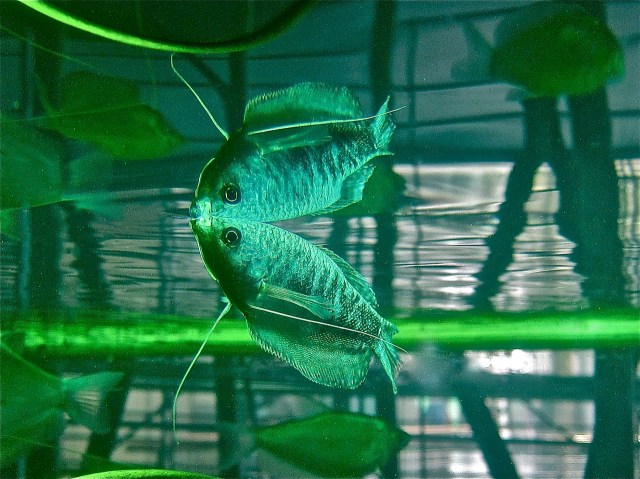

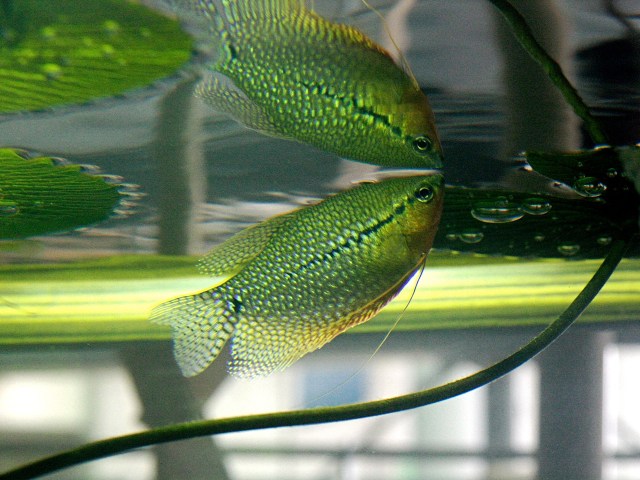
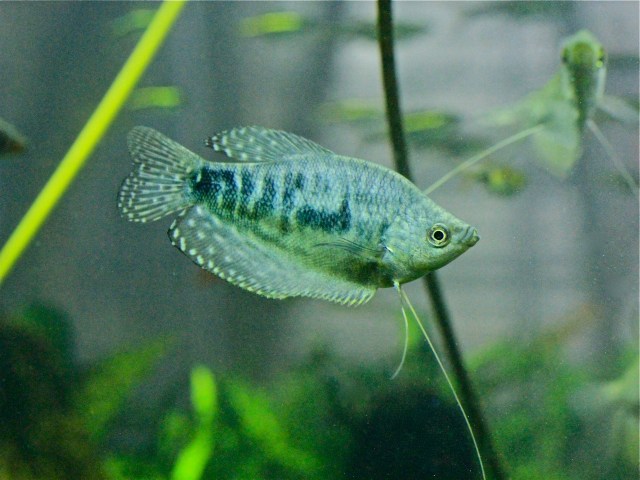
GENERAL CHARACTERISTICS: Usually silvery blue in color but their colors can change significantly with their moods, as well as during spawning, when they obtain a much deeper blue hue.The three-spot gourami displays only two spots, one in the center of the body and a second on the caudal peduncle. The eye is actually the third “spot”. T. trichopterus has many different colour forms and varieties, all of which have been selectively bred for the aquarium trade. These are seen much more often than the natural form, which is the blue-grey three spotted fish. They include gold, opaline, cosby, marbled and silver forms. Length to 15 cm (6 inches).

DISTRIBUTION/HABITAT: Southeast Asia: Mekong River basin in Laos, Yunnan, Thailand, Cambodia, and Viet Nam. Preference is thickly vegetated fresh water in ditches, canals, ponds, swamps, rivers or lakes.

DIET IN THE WILD: Omnivore. Eats insects, crustaceans, and zooplankton.

REPRODUCTION and DEVELOPMENT: Typical of gouramis, male builds bubble nest, usually under a large leaf, after which he displays to female. Their courtship ends with her releasing eggs, which the male fertilizes and then collects in his mouth and “spits” into the bubble nest, where he guards them until they hatch in 2–3 days.

CONSERVATION: IUCN Red List; Least Concern (LC) Abundant to common in suitable habitats throughout its range.

REMARKS: Like all labyrinth fish, the moonlight gourami has a special lung-like organ that allows it to breathe air directly from above the water line. This allows gouramis to survive in pools with a low oxygen.

Processed into salted, dried fish in Java.
LOCATION: BO09 Rainforest Borneo, Southeast Asia Community 

References

fishbase  www.fishbase.org/summary/Trichopodus-trichopterus.html

Encyclopedia of Life  eol.org/pages/222297/details

Ron’s flickr  http://www.flickr.com/photos/cas_docents/6287701586/in/set-72157627795872023

Ron’s WordPress shortlink  http://wp.me/p1DZ4b-dJ
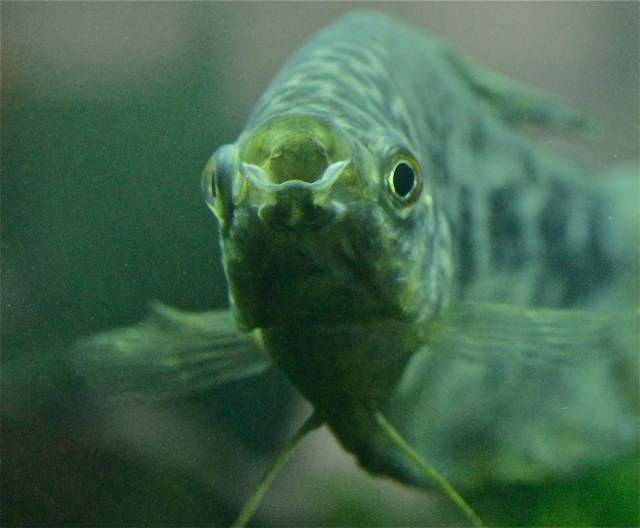
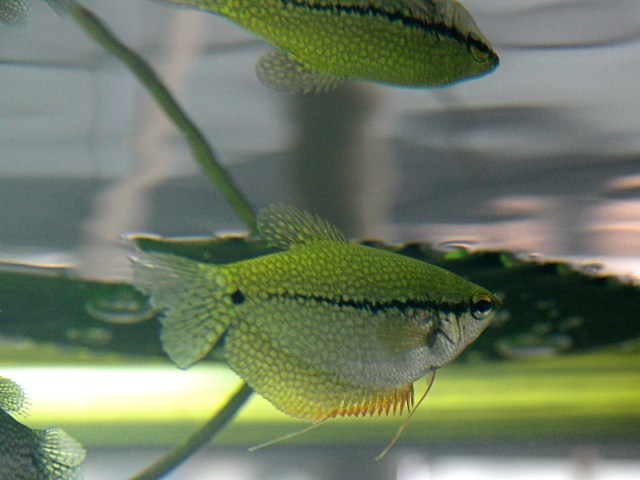
TAXONOMY Kingdom: Animalia Phylum: Chordata Class: Actinopterygii (ray-finned fishes) Order: Perciformes (Perch-likes) Family: Osphronemidae (Gouramies) Genus/species: Trichogaster leeri GENERAL CHARACTERISTICS: Brownish-silver color, covered in a pearl-like pattern with a distinct black line running from the fish’s eye thinning towards the caudal fin.Has filamentous pelvic fins. Large anal fin extends from just behind the pelvic fins almost to the caudal fin. Length to 12 cm (4.7 in). Common name comes from the small, light spots that cover the body like iridescent “pearls. DISTRIBUTION/HABITAT: Asia: Malay Peninsula, Thailand and Indonesia, including Borneo. Found in small flowing rivers and lakes in areas of dense vegetation. DIET IN THE WILD: Omnivorous; small invertebrates and plants. REPRODUCTION: All gouramis build nests of small air bubbles that vary in size, shape, and position depending on the species. Some may incorporate plants; others are only bubbles. CONSERVATION: IUCN, Near Threatened (NT) REMARKS: Common name comes from the small, light spots that cover the body like iridescent “pearls. Like all gouramis, has a lung-like organ that allows it to breathe air directly by gulping at the surface, an ability that increases survival in low oxygen situations. BO09 Rainforest Borneo, Southeast Asia community. References fishbase www.fishbase.org/summary/4674  California Academy of Sciences Docent Rainforest training manual. 2014 Ron’s flickr http://www.flickr.com/photos/cas_docents/3627206078/in/set-72157627795872023/ Ron’s WordPress short-link  http://wp.me/p1DZ4b-bZ

TAXONOMY
Kingdom: Animalia
Phylum: Chordata
Class: Actinoptergii
Order: Pecifomes
Family: Osphronemidae (Gouramis)

Genus/species: Trichogaster microlepis

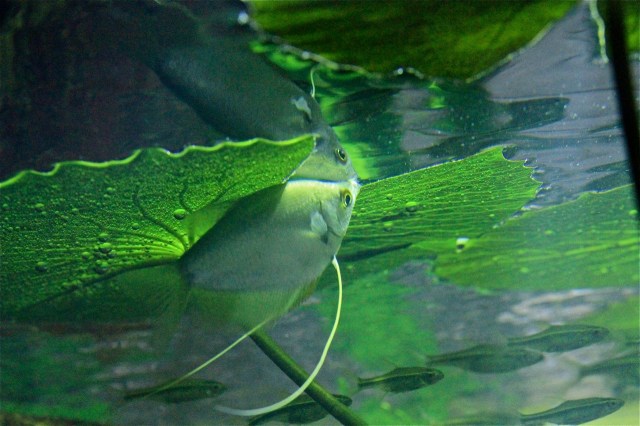
GENERAL CHARACTERISTICS: It has a greenish hue similar to moonlight glow, hence its name, and a distinctive concave head. Males can be identified by the orange to red color of the pelvic fins and the long, pointed dorsal fins. The female’s pelvic fins are colorless to yellow, while the dorsal fins are shorter and rounder. Length: 12–15 cm  (4.66 – 6 inches)

DISTRIBUTION/HABITAT: Thailand and Cambodia. Found in ponds, lakes and swamps with shallow, sluggish or standing water and abundant vegetation.

DIET IN THE WILD: Omnivorous. Eats insects, crustaceans, and zooplankton.

REPRODUCTION: Oviparous; a bubble nest builder. The bubble nest does not contain much plant matter so the bubbles float around freely. The male performs a courtship dance beneath the nest, culminating with the male wrapping itself around the female and turning her on her back as she releases her eggs. Up to 2000 eggs may be laid during the spawning. The male fertilizes the eggs as they float up to the prepared bubble nest. Eggs incubate in the nest for 2–3 days before hatching.

CONSERVATION: IUCN: Least Concern (LC)  No major threats to this species have been reported, however, pollution in wetlands, infrastructure and draining water may impact the species.

REMARKS: Like all labyrinth fish, T. microlepis has a special lung-like organ that allows it to breathe air directly from above the water line. This allows gouramis to survive in pools with a low oxygen.

LOCATION: BO09 Rainforest Borneo, Southeast Asia Community 

References 

fishbase www.fishbase.org/summary/4729

 Encyclopedia of Life  eol.org/pages/203969/details

flickr http://www.flickr.com/photos/cas_docents/sets/72157627795872023/

WordPress shortlink   http://wp.me/p1DZ4b-dB


TAXONOMY:
Kingdom: Animalia
Phylum: Chordata
Class: Actinopterygii
Order: Cypriniformes
Family: Cyprinidae (Minnows or Carps)

Genus/species: Epalzeorhynchos bicolor

Redtail Black Shark Minnow 4472041343_d9431913da_b

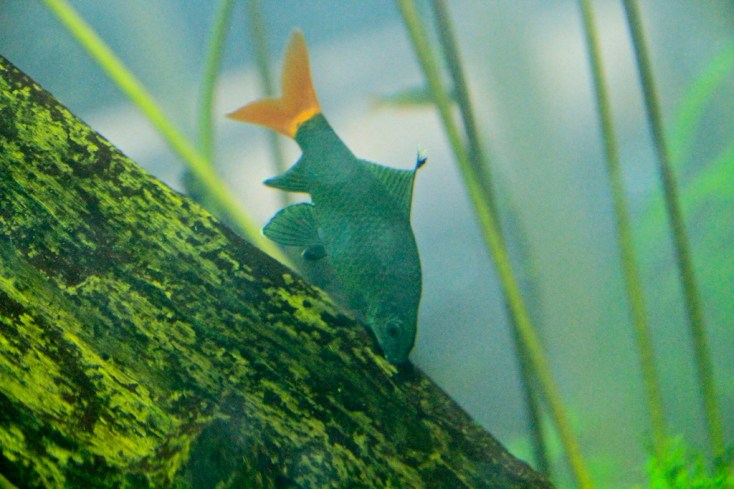
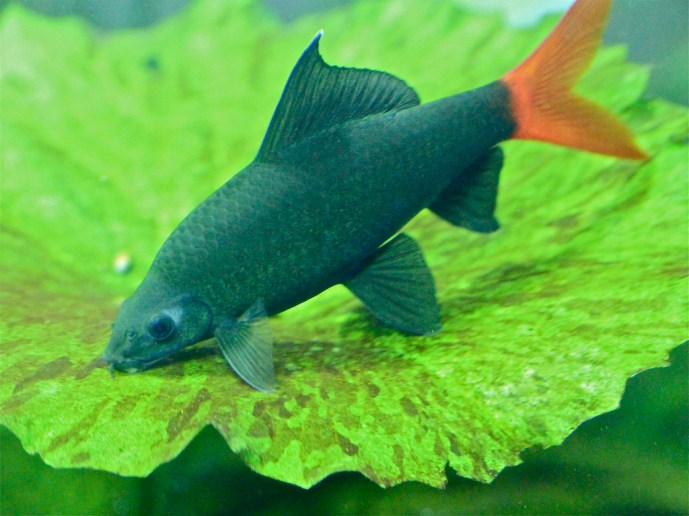
GENERAL CHARACTERISTICS: Deep velvet-black body and bright red caudal fin. Two fleshy projections (barbels) extend from the edges of the mouth Max. length: 15 cm (6 inches).

DISTRIBUTION/HABITAT: Originally from the Mae Klong River in Thailand. Found in the middle and bottom levels of freshwater streams and rivers, especially areas with rocks and/or plants for resting and hiding.

Redtail Black Shark Minnow  5170275837_91ba6445e9_b

DIET IN THE WILD: Omnivorous, primarily a bottom-feeding scavenger.

REPRODUCTION: E. bicolor spawns in rocky caves, and the young hatch after 30 to 60 hours. Four days after hatching, the young are free-swimming, but do not develop the characteristic red tail until seven to ten weeks old.

CONSERVATION: IUCN: Critically Endangered (CR)
Habitat alteration; during the 1970s contributed to its decline. Captive bred in Thailand for aquarium export trade.

LONGEVITY: 5-8 years.

REMARKS: In spite of its common name, most likely a reference to its streamlined, torpedo shape, it is not a shark. Related to carp.

Location: Borneo

References

fishbase www.fishbase.org/summary/Epalzeorhynchos-bicolor.html

Encyclopedia of life  eol.org/pages/1015624/details

 ARKIVE  http://www.arkive.org/redtailed-black-shark/epalzeorhynchos-bicolor/

Ron’s flickr  http://www.flickr.com/photos/cas_docents/sets/72157608614099673/

Ron’s WordPress shortlink  http://wp.me/p1DZ4b-16X

Kingdom: Animalia
Phylum: Chordata
Class: Aves
Order: Passeriformes
Family: Thraupidae

Genus/species: Tersina viridis

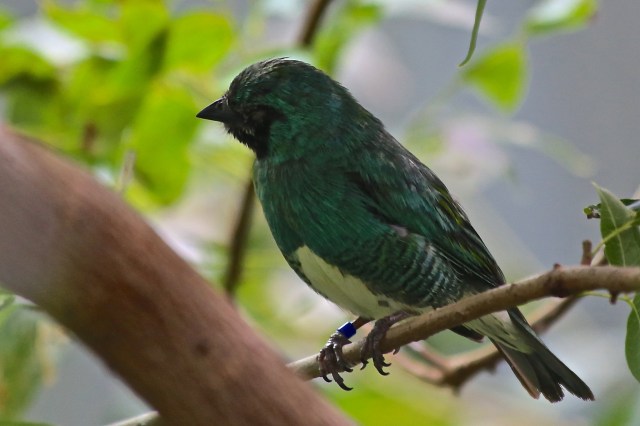
 GENERAL CHARACTERISTICS: Female Swallow Tanagers are a dull green overall with buffy yellow underparts. The male is light emerald-green, with a small deep black face and upper throat patch.  Length about 15 cm (6 inches).

Female below

Female Swallow Tanager15964984390_dcf5ecf5ad_k

DISTRIBUTION/HABITAT: South America, south to southern Brazil. Found in the humid forest edge and second-growth forest.

Male below

Male Swallow Tanager15529954514_08efef15f5_k

DIET IN THE WILD: Fruit and insects (insects are captured in sallying flight).

REPRODUCTION: Nest singly or in loose colonies in burrows in dirt banks, or in cavities in buildings.

CONSERVATION: IUCN: Least Concern (LC)

References: 

Cornell Lab of Ornithology neotropical.birds.cornell.edu/portal/species/overview?p_p…

Encyclopedia of life  eol.org/pages/1052941/details

Ron’s flickr  https://www.flickr.com/photos/cas_docents/15964984390/in/photostream/

Ron’s WordPress shortlink http://wp.me/p1DZ4b-1qj

TAXONOMY
Kingdom: Animalia
Phylum: Chordata
Subphylum: Vertebrata
Class: Reptilia  (turtles, snakes, lizards, and relatives)
Order: Squamata
Suborder: Serpentes
Family: Viperidae (Vipers)

Genus/species: Tropidolaemus wagleri

GENERAL CHARACTERISTICS: Males are green in color. Females have 4 color phases. In the Malaysian phase seen here, the snake has a black background with yellow bars across it’s back, a yellow belly and green spots, one on each scale. Length to 4 ft. 

Wagler's Pit Viper 8324403992_9febc37327_b

DISTRIBUTION/HABITAT: They are arboreal living in the lowland tropical rainforests of Southeast Asia, including southern Thailand, Malaysia, Singapore, Borneo, Sumatra, Sulawesi and southern Philippines.

DIET IN THE WILD: Ambush nocturnal predator. Like all pit vipers, T. wagleri has heat-sensing organs (called loreal pits) on its head below and in front of their eyes which are used to sense prey, even when they can’t see it. Juveniles and adult males prefer lizards, especially geckos. Females eat a more varied diet, including rats, birds, frogs and lizards, Needs only 3 meals a month.

REPRODUCTION: Viviparous (bears young alive). Litters contain 6-50 young.

PREDATORS: King Cobra.

Wagler's Pit Viper  3506502014_96d97cbdb9_b

CONSERVATION: IUCN Red list; Least Concern (LC)

REMARKS: They have hemotoxic, venom, preventing blood from clotting. Bites can cause local pain, swelling, bruising, and bleeding but bites are rarely fatal to humans.

The Temple of the Azure Cloud in Penang Island, Malaysia is known as Snake Temple. It was once filled with hundreds of Wagler’s pit vipers. Tourists would be photographed with the snakes. Locals collected the snakes, and, fortunately, the ones used for photography had their fangs removed.

Borneo Cave Cluster B005

References

Encyclopedia of Life  eol.org/pages/790394/details

Ron’s flickr https://www.flickr.com/photos/cas_docents/8324403992/in/set-72157620567930293

California Academy of Sciences Docent Rainforest Training class 2014

Ron’s WordPress shortlink http://wp.me/p1DZ4b-Vu

 Borneo Cave Cluster B005


TAXONOMY
Kingdom: Animalia
Phylum: Chordata
Class: Reptilia
Order: Squamata
Family: Varanidae

Genus/species: Varanus salvator (melanistic color form)

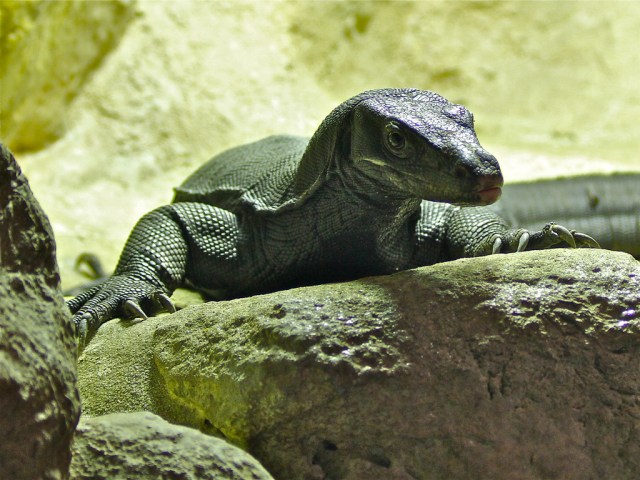
GENERAL CHARACTERISTICS: Color is usually dark brown or blackish.  The neck is  long with an elongated snout and the nostrils close to the end of the nose. The tail is laterally compressed and has a dorsal keel. Scales on the top of the head are relatively large, while those on the back are smaller in size and are keeled. Length to 2 meters (6.6 ft), but most adults are 1.5 meters (4.9 ft) long. Average weight is 19.5 kg (43 lb). As of 2014 the Academy Water Monitor is aprox. 7 years old and 4 feet long (California Academy of Sciences, Eric Hupperts, Biologist)

Water Monitor


DISTRIBUTION/HABITAT: Found throughout much of southern Asia, from India in the west to the Philippines and the Indo-Australian islands in the east. They are semi-aquatic and has a wide range of habitats. Also found on flat land, a typical burrow is in a river bank. The entrance starts on a downward slope but then increases forming a shallow pool of water.

DIET IN THE WILD: The lizard is very fast and is an ‘open pursuit’ hunter, rather than stalking and ambushing. V. salvator is an extreme carnivore: birds, eggs, mammals, fishes, other reptiles and carrion.
Academy diet: Rodents.

REPRODUCTION: Males are normally larger than the females, usually twice as large in mass.. Eggs are usually deposited along rotting logs or stumps.

LIFESPAN: 10.6 years in captivity.

Water Monitor

CONSERVATION: IUCN Redlist: Least Concern. CITES: appendix II. It is abundant in parts of its range, despite large levels of harvesting.

REMARKS:They are excellent swimmers known to cross large stretches of water, explaining its wide distribution. Known to dig up corpses of human and devour them.

Skins of  V. salvator are used for dietary protein, ceremonies, medicine, and leather goods. Annual trade in these skins may reach more than 1 million whole skins a year, mostly in Indonesia for the leather trade. Medium-sized individual are preferred because the skin of large animals is too tough and thick to shape.

References:

Encyclopedia of Life  http://eol.org/pages/1055072/details

Animal Diversity Web animaldiversity.ummz.umich.edu/accounts/Varanus_salvator/

Ron’s WordPress Shortlink  http://wp.me/p1DZ4b-TY

Ron’s flickr http://www.flickr.com/photos/cas_docents/sets/72157625194985646/with/5492305677/

TAXONOMY
Kingdom: Animalia
Phylum: Chordata
Subphylum: Vertebrata
Class: Reptilia
Order: Squamata
Suborder: Serpentes
Family: Boidae
Subfamily: Boinae

Genus/species: Epicrates cenchria

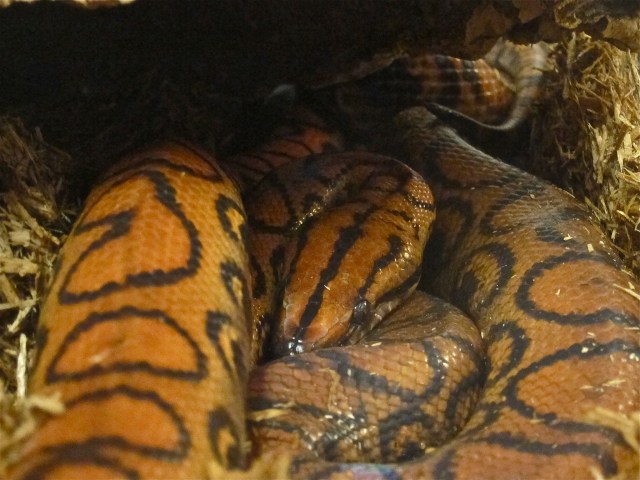
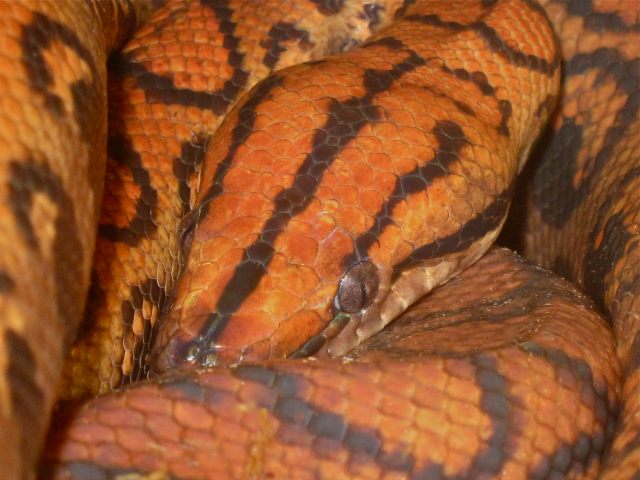
GENERAL CHARACTERISTICS: The Brazilian rainbow boa is one of about 12 named subspecies of rainbow boa. Color is brown or reddish brown with three parallel black stripes on the top of the head and large black rings down the back that give the appearance of dorsal blotches. There is a great deal of variation in color and marking among individuals of this species. Length is four to six feet (1.2 to 1.8 m).

Brazilian Rainbow Boa15580871426_15f0f85863_k


DISTRIBUTION/HABITAT: Found in the Amazon Basin, and in coastal Guiana, French Guyana, and Suriname and southern Venezuela most often in humid forests.

DIET IN THE WILD: Rodents, birds, and possibly some forms of aquatic life and lizards.

REPRODUCTION: Babies are born live in litters of two to 35 (viviparous). They are usually 15 to 20 inches (38 to 51 cm) long.

LIFESPAN: To 20 years in capativity.

REMARKS: E. cenchria is named because of the iridescent sheen imparted by microscopic ridges on their scales, which act like prisms to refract light into rainbows.

Brazilian Rainbow Boa15580871146_3fc18628e1_k


References

 National Zoo http://nationalzoo.si.edu/Animals/ReptilesAmphibians/Facts/FactSheets/Brazilianrainbowboa.cfm

The Reptile Database  http://reptile-database.reptarium.cz/species?genus=Epicrates&species=cenchria

Ron’s WordPress shortlink  http://wp.me/p1DZ4b-1nJ

Ron’s flickr  https://www.flickr.com/photos/cas_docents/15580871426/

TAXONOMY
Kingdom: Animalia
Phylum: Chordata
Class: Aves
Order: Passeriformes
Family: Thraupidae

Genus/species: Tangara velia

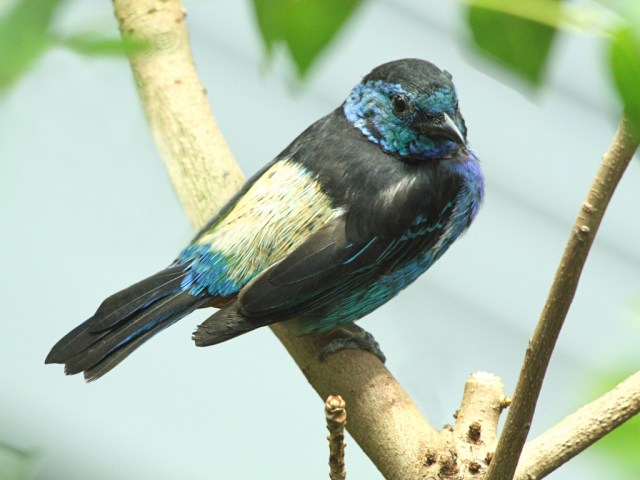
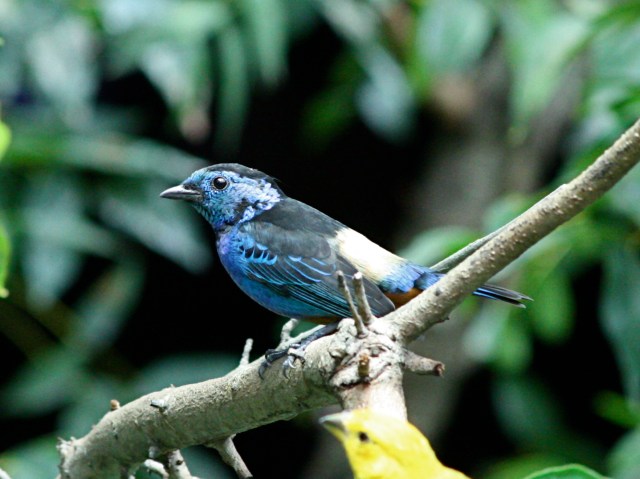
3161169099_3a0b56ac4b_b

GENERAL CHARACTERISTICS: Medium sized predominately blue and black. The crown and back are black, with a bright opalescent rump. The head and underparts are deep iridescent blue and the lower belly is reddish chestnut and crissum. Sexes are similar in both size and plumage with the female being duller.

3168879341_57e5d64036_o

DISTRIBUTION/HABITAT: Bolivia, Ecuador, French Guiana, Guyana, Peru, Suriname, and Venezuela.
Found in tropical forests, from emergent to shrub layer, especially lowland rainforests and the forest edge, though found in some areas up to 1200 m (4000 feet).

DIET: Omnivorous

CONSERVATION: IUCN, Least Concern (LC)

3162005686_869f46bd04_o

REMARKS: Generally seen in pairs and/or small groups of mixed species. Emit a high-pitched twitter in flight.

Ron’s flickr  http://www.flickr.com/photos/cas_docents/sets/72157608454346681/with/3161783604/

Ron’s WordPress shortlink  http://wp.me/p1DZ4b-15Y


TAXONOMY
Kingdom:  Animalia
Phylum:  Chordata
Subphylum:  Vertebrata
Class:  Amphibia
Order:  Anura
Family:  Megophryidae

Genus/species: Megophrys nasuta

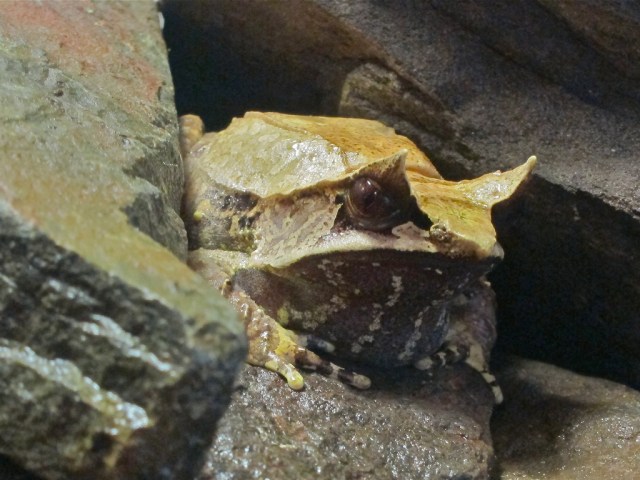
4427840755_184d36bab6_b

GENERAL CHARACTERISTICS: Have projections above each eye and nasal area, hence the name Horned Frog. Designed for camouflage; back is gray, tan, russet, or brown and darkens toward the side making the frog almost invisible among the forest leaf litter. The smooth skin resembles dead leaves.

4329887255_429231e129_b

DISTRIBUTION/HABITAT: Borneo, Malay Peninsula, Sumatra. Lives in relatively cool damp environs. Optimal temperature is between 22–24° C. Found on the rainforest floors, usually near small streams.

DIET IN THE WILD: Crabs and scorpions are their main food; also take arachnids, nestling rodents, lizards and other frogs that live on the forest floor.5536565600_f6c87f37ec_b-1


REMARKS: Call is unmistakable: a loud, resonating, metallic honk or henk, somewhat reminiscent of an air horn. The Jahai, an aboriginal group from northern Peninsular Malaysia, call this frog “Kengkang,” onomatopoeic after its call.

Rainforest Borneo  BO08

flickr  http://www.flickr.com/photos/cas_docents/sets/72157608456457315/with/4427840755/

WordPress Shortlink  http://wp.me/p1DZ4b-Mb