Tag Archive: Rainforest Madagascar


TAXONOMY
Kingdom: Animalia
Phylum: Chordata
Class: Reptilia
Order: Squamata
Family: Colubridae (Colubrids)

Genus/species: Langaha madagascariensis

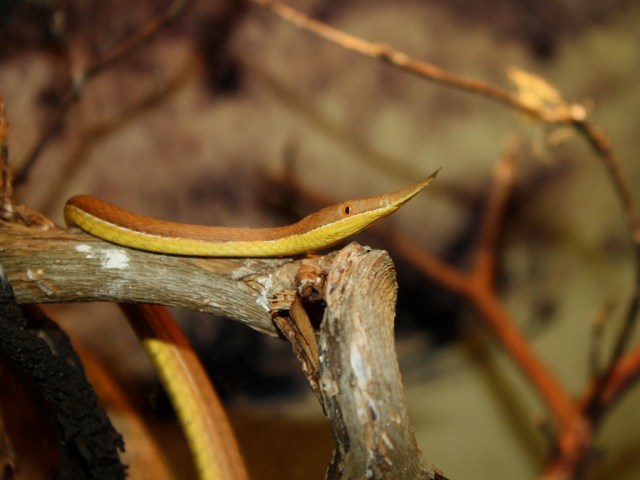
GENERAL CHARACTERISTICS: Displays striking sexual dimorphism: male has a pointed snout and body with contrasting coloration; female has leaf-shaped snout and is uniformly dark brown. 

                    female belowLangaha madagascariensis8599840662_312f136ba9_k

DISTRIBUTION/HABITAT: Endemic to Madagascar. Found at low elevations in much of the island. It is arboreal, living on and in vines. 

                    female belowLangaha madagascariensis3268009379_b359b1da8b_o
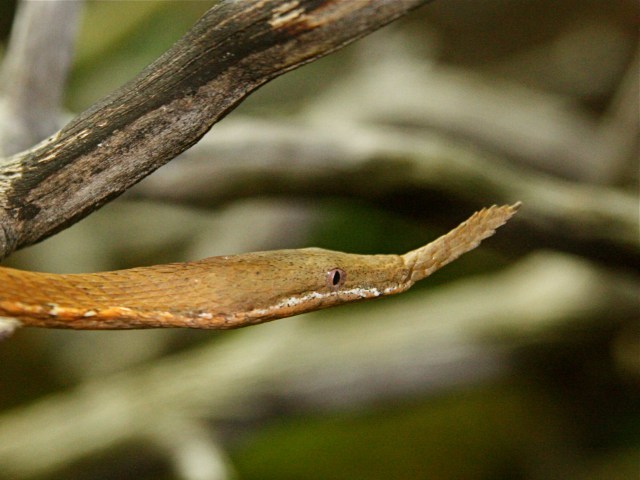
DIET IN THE WILD: Lizards Primarily ambush predators, rather than active foragers although it has been observed chasing skinks on the ground. Usually vertical ‘hanging’ behavior as adults, mimicking the seed pods of Malagasy plants (and perhaps deter predation, though by what predator is unclear).

                     male belowLangaha madagascariensis2981271735_2d1bf7df0f_b-2
REPRODUCTION: Egg laying.

CONSERVATION: ICUN Red list Least Concern (LC) 

Wide distribution and presumed large overall population, make it unlikely to decline fast enough to qualify for a more threatened category.

REMARKS: Venomous; bites can produce severe local pain and swelling that may last for several days. Colubrids tend to chew when they bite, further envenomating and infecting the site. 

Madagascar Rainforest MA03

References 

California Academy of Sciences Rainforest Docent Training Manual 2014

Encyclopedia of Life  eol.org/pages/794161/details

Ron’s flickr https://www.flickr.com/photos/cas_docents/8599840662/in/set-72157620708610230/

Ron’s WordPress shortlink  http://wp.me/p1DZ4b-1rx
 

TAXONOMY
Kingdom: Animalia
Phylum: Chordata
Class: Amphibia
Order: Anura
Family: Microhylidae

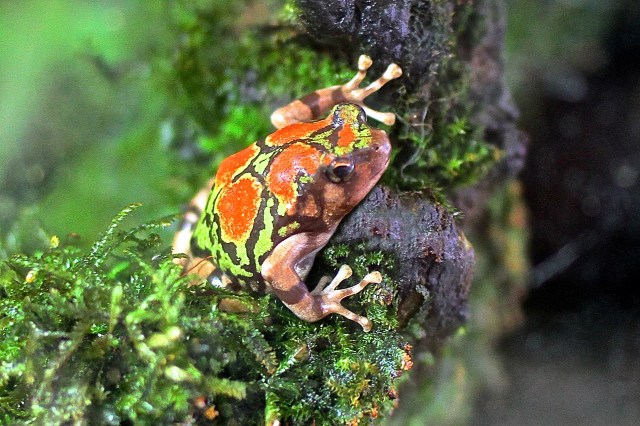
Genus /species: Scaphriophryne gottlebei


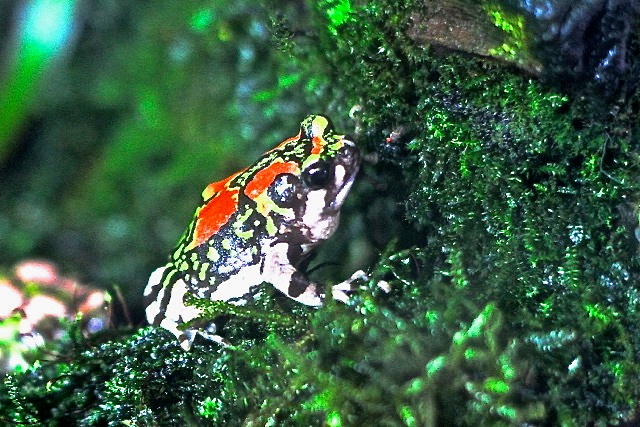
GENERAL CHARACTERISTICS: Roundish, with a distinctive white, red, green and black pattern on the back and a grey belly. Adapted for both the underground and climbing lifestyles,S. gottlebei has horny tubercles on the underside of the hind feet for burrowing, and claws on the forefeet for clinging to vertical canyon walls. Length 20mm (7/8 inches) to 30mm (1.2 inches).

DISTRIBUTION/HABITAT: Madagascar in open rocky dry forest and canyons amongst stone crevices. Despite its webbed hind feet, the painted burrowing frog is a poor swimmer. S. gottlebei is thought to climb only to escape drowning in flash flood water by finding small holes to rest in within the canyon walls of its habitat.

DIET IN THE WILD: Insects.

REPRODUCTION: Tadpoles mature in rocky pools eating detritus.


Madagascar rainforest

References

Encyclopedia of Life  eol.org/pages/1019833/details

IUCN Red List www.iucnredlist.org/details/57998/0

Ron’s flickr  http://www.flickr.com/photos/cas_docents/sets/72157608456457315/

Ron’s WordPress Shortlink http://wp.me/p1DZ4b-I4


TAXONOMY
Kingdom: Animalia
Phylum: Arthropoda
Class: Arachnida
Order: Araneae
Suborder: Araneomorphae (fangs slope towards each other in a pinching action)
Family: Nephilidae

Genus/species: Nephila madagascariensis

3707840635_437d069402_b

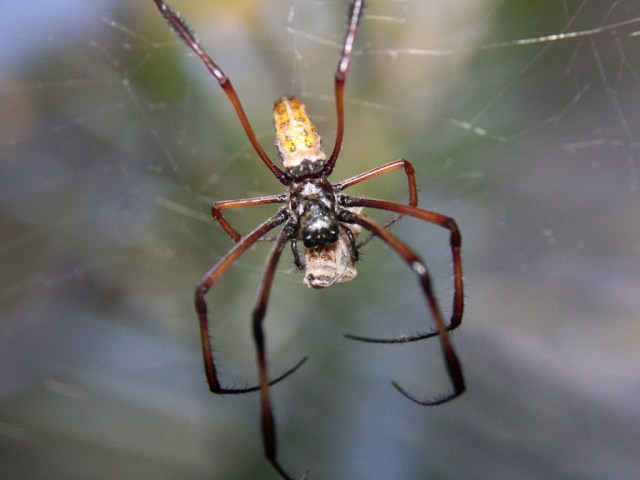
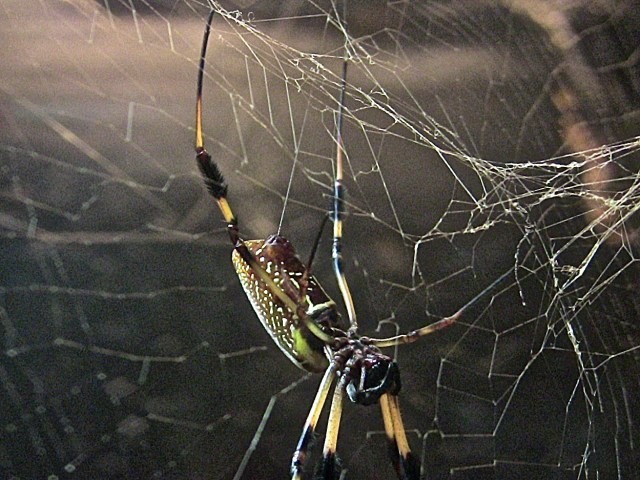
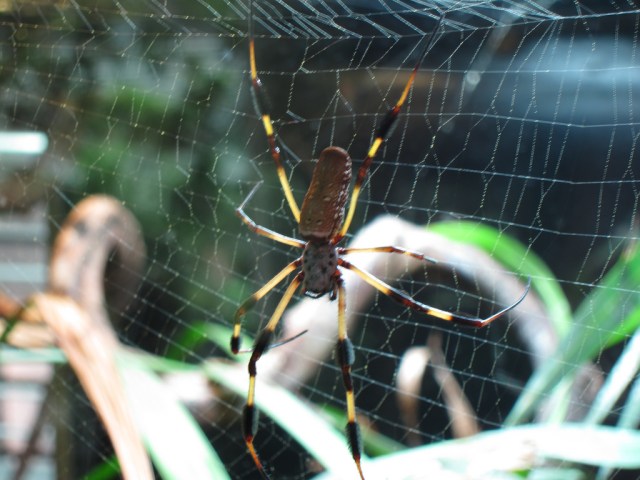
GENERAL CHARACTERISTICS: They have striped legs specialized for weaving (where their tips point inward, rather than outward as is the case with many wandering spiders). In females, the dorsal side of the abdomen has bright yellow markings surrounded by a light gray border. The rest of the body and legs are black with patches of brown. 4.8 – 5.1 cm (1.5 – 2 in) in females, not including leg span, with males being usually 2/3 smaller (less than 2.5 cm, 1 in). Named for yellow threads of their web shine like gold in sunlight not the color of the spider.

DISTRIBUTION/HABITAT: Various species of orb weaving spiders are widely distributed. They exist in the southern United States, Central and South America, Southeast Asia, and the South Pacific. Nephila madagascariensis madagascariensis is found on the island of Madagascar and certain parts of Southern Africa. 

Spinning web below

Golden Orb16121279421_89d739a11a_o

DIET IN THE WILD: Eat insects that get caught in their webs, primarily flying insects. They kill their prey with a venomous bite. While painful, a bite from this spider would not seriously hurt humans.

Golden Orb Weaver

LONGEVITY:: Females usually live about a year, and males about 6 mos.

REMARKS: Golden orb spiders weave large, strong webs out of golden-colored silk which can be as big as 2 m across. The silk strands are reputed to be five times stronger than steel and three times more elastic than Kevlar.
The oldest surviving genus of spiders, with a fossilized specimen known from 165 million years ago.

Rainforest, Madagascar

References

Ron’s WordPress Shortlink: http://wp.me/p1DZ4b-TC

Ron’s flickr http://www.flickr.com/photos/cas_docents/sets/72157608653175263/with/3707840635/

California Academy of Sciences: Madagascar Golden Orb Spider exhibit 2014

 iNaturalist www.inaturalist.org/taxa/49758-Nephila

TAXONOMY
Kingdom: Animalia
Phylum: Chordata
Class: Reptilia
Order: Squamata
Family: Gerrhosauridae

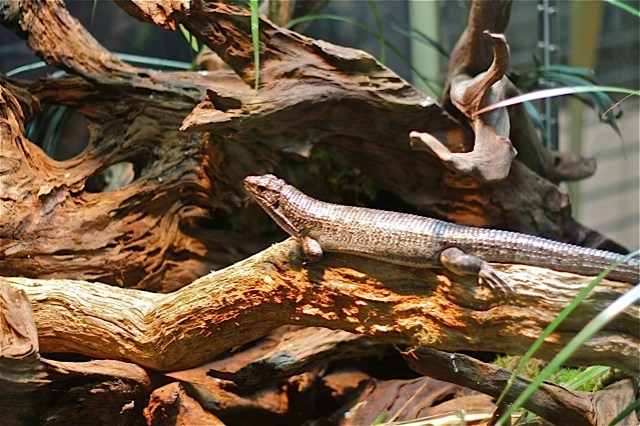
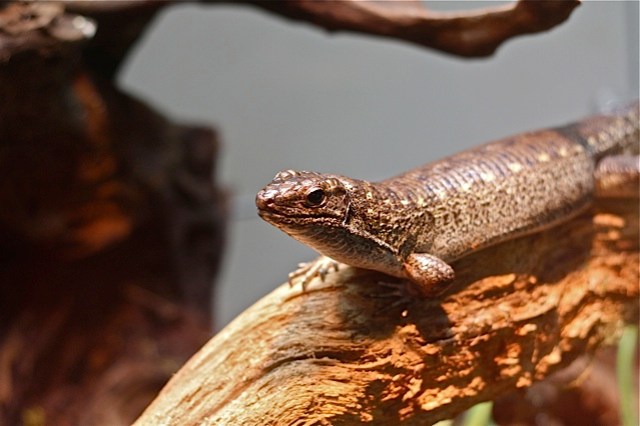
Genus: Zonosaurus maximus

 GENERAL CHARACTERISTICS: Relatively flattened body with a long, pointed snout. The body is covered with heavy armor of large, bony, keeled scales, especially on the dorsal surface. The scaleless area along the sides functions as expansion joints for gravid females that allow distention after feeding. Length is up to 70 cm (28 inches).


DISTRIBUTION/HABITAT: Endemic to Madagascar, this species is found in lowland humid forest associated with rivers and streams as well as non-forested riparian areas where it builds dens close to water. When disturbed, it seeks shelter in water and can stay submerged for several minutes.

DIET IN THE WILD: Plant matter, invertebrates, small rodents, other reptiles.

PREDATORS: Predators are primarily snakes.

REPRODUCTION: Oviparous. Life span: about 20 years.


CONSERVATION: IUCN Red List Vulnerable (VU)
Populations are severely fragmented and declining because of the reduced size and quality of habitat due to agricultural activities. Mature animals may also be over-collected for the pet trade. Some sites where this plated lizard occurs are fortunately under conservation management, including newly protected areas.

LOCATION:  Madagascar Rainforest  MA13

References

California Academy of Sciences, Docent Rainforest Training Manuel 2014

Encyclopedia of Life eol.org/pages/462210/details

IUCN Red List www.iucnredlist.org/details/172865/0

Ron’s flickr  https://www.flickr.com/photos/cas_docents/7423084566/in/set-72157620708610230/

Ron’s WordPress Shortlink  http://wp.me/p1DZ4b-xI