Tag Archive: Philippine Coral Reef


TAXONOMY
Kingdom:Animalia
Phylum: Chordata
Class: Actinopterygii (ray-finned fishes)
Order: Perciformes (Perch-likes)
Family: Microdesmidae (Wormfishes)

Genus/species: Ptereleotris zebra
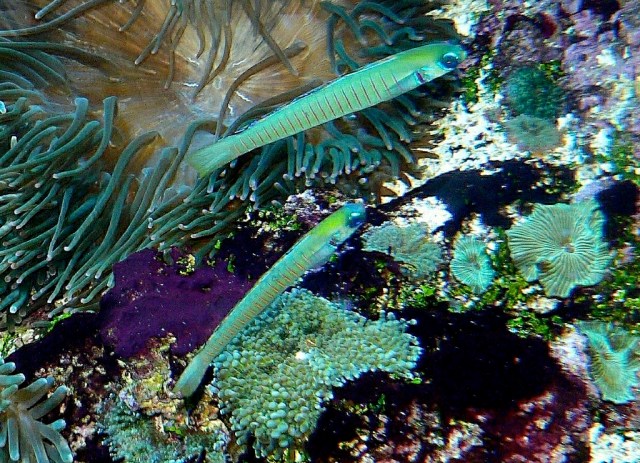
Zebra Gobie2985357026_450274646b_b

GENERAL CHARACTERISTICS: Elongated and compressed body with a Yellowish to greenish gray color and a series of narrow orange to pinkish bars edged with blue or purple along the sides A broad blue-edged dark reddish to purple area is below the eye. A chin barbel is
followed by a median longitudinal fold. Max length: 4.7 inches.

DISTRIBUTION/HABITAT: Tropical Indo-Pacific: Red Sea and islands in the western Indian Ocean to the Line and Marquesan Islands, south to the southern Great Barrier Reef. Found over exposed seaward reefs in relatively shallow water. Depth range 2 – 31 m (6-100 feet).

DIET: Zooplankton. Small schools hover several feet above the substrate capturing morsels the current carries to them.

CONSERVATION: Not evaluated

REMARKS: The common name of the genus is “dartfish,” derived from the group’s habit of darting between rocks or into rubble when frightened.

Philippine Coral Reef PR04

References

fishbase  http://www.fishbase.org/summary/4384

WordPress shortlink http://wp.me/p1DZ4b-1fF

flickr https://www.flickr.com/photos/cas_docents/2985357026/in/set-72157625992053826/

TAXONOMY
Kingdom:Animalia
Phylum:Chordata
Class:Actinopterygii (ray-finned fishes)
Order:Perciformes (Perch-likes)
Family:Labridae (Wrasses)

Genus/species: Pseudocheilinus hexataenia

Six-line Wrasse3237047032_23cc672a39_b

GENERAL CHARACTERISTICS: To 7.5 cm (3 inches). Violet with six horizontal orange stripes on side. Small black dot on upper tail base.

DISTRIBUTION/HABITAT: Indo-Pacific among seaward reefs in coral branches. Depth 20 meters (65 feet).

DIET IN THE WILD: Primarily small crustaceans, snails, and flatworms.

PREDATORS: Preyed upon by grouper and other finfish.

Philippine Coral reef PR04

References

flickr https://www.flickr.com/photos/cas_docents/3237047032/

WordPress shortlink  http://wp.me/p1DZ4b-1f9

fishbasewww.fishbase.de/summary/Pseudocheilinus-hexataenia.html

EOLwww.flickr.com/photos/cas_docents/3237047032/edit-details/


TAXONOMY
Kingdom: Animalia
Phylum: Chordata
Class: Actinopterygii (ray-finned fishes)
Order: Perciformes (Perch-likes)
Family: Labridae (Wrasses)

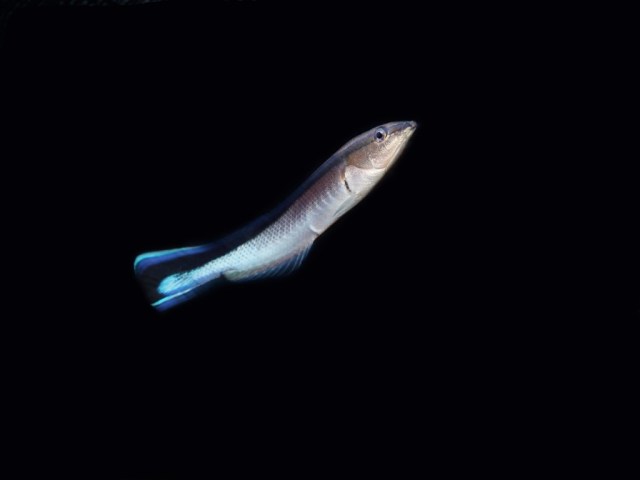
Genus/species: Labroides dimidiatu

GENERAL CHARACTERISTICS: Length to 11.5 cm (4.5 inches). Elongate body, tubular mouth. Blue to yellow above fading to white or yellow below. There is a black stripe from the eye to the caudal fin margin. The stripe widens posteriorly.

DISTRIBUTION/HABITAT: Indo-Pacific in virtually all coral reef habitats: inner lagoons and subtidal reef flats to seaward reefs, 0.5-40 m (18 in to 125 ft), typically near branching corals. Active diurnally. Aggressively territorial. Nocturnally retires to small crevices in the reef, enclosing itself in a mucus cocoon. Remains in stations where other fish come to be cleaned.

DIET: The most common cleaner wrasse on reefs. Pick external parasites from other fishes. Also clean the wounds of other fishes by removing scar tissue. Clean the gills and even enter the mouth of the host.

REPRODUCTION: Monogamous. A protogynous hermaphrodite.
Open water/substratum egg scatterers, non guarders.

CONSERVATION: IUCN, Least concern

Cleaner Wrasse13298334135_9737aa3d26_b

Philippine Coral Reef PR04

flickr http://www.flickr.com/photos/cas_docents/sets/72157608208133134/with/2977676226/

WordPress Shortlink http://wp.me/p1DZ4b-Kp

fishbase fishbase.sinica.edu.tw/summary/SpeciesSummary.php?ID=5459

EOL eol.org/pages/204814/details

Australia Museum  australianmuseum.net.au/Common-Cleanerfish-Labroides-dimi…

TAXONOMY
Kingdom: Animalia
Phylum: Chordata
Class: Actinopterygii (ray-finned fishes)
Order: Perciformes (Perch-likes)
Family: Labridae (Wrasses)

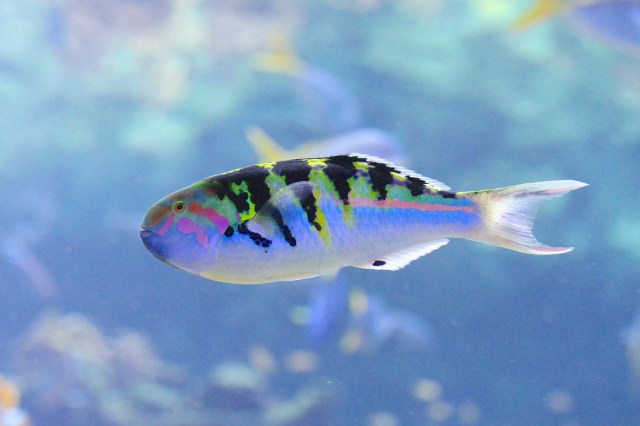
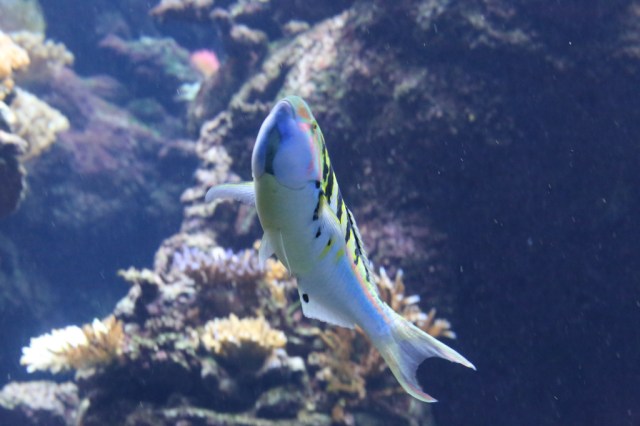
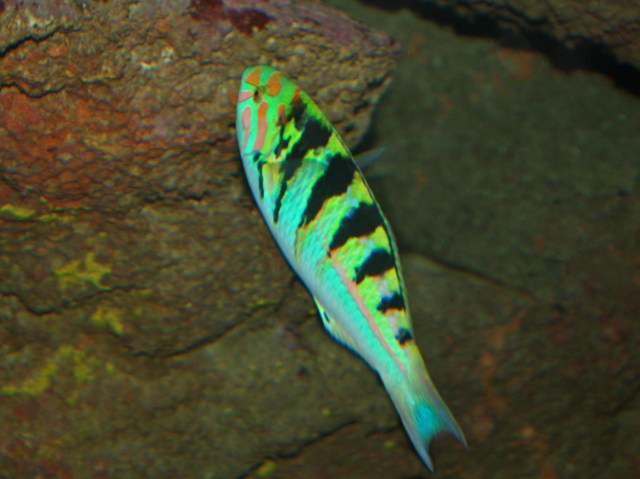
Genus/species: Thalassoma hardwicke

Sixbar Wrasse8410603333_678203e399_b

GENERAL CHARACTERISTICS: Adult is pastel blue to pale green with six dark, vertical bars on their body, the last two saddling the tail. The head has a distinct ‘daisy’ print around the eyes made of a few different pastel colors (e.g., pink bands radiating from the eye) in larger adults.  Max length: 20 cm (7.9 in).

DISTRIBUTION/HABITAT: Found in the tropical Indo-Pacific in shallow lagoons and seaward reefs. Depth to 15 m (50 ft.).

DIET IN THE WILD: Carnivore on benthic and planktonic crustaceans, invertebrates and small fishes.

Sixbar Wrasse8393609669_e1f3601c7c_b

REPRODUCTION: Protogynous hermaphrodite; Hermaphroditism occurs when a given individual in a species possesses both male and female reproductive organs, or can alternate between possessing first one, and then the other. The most common pattern is for a female to change into a male (protogyny). This often happens when a large dominant male is removed by a predator. Within a few days, the largest female in the harem becomes a dominant male and takes over the missing male’s function. This pattern is common in coral reef fishes, such as parrotfishes, wrasses, and groupers.
T.hardwicke is a pelagic spawner meaning water currents widely disperse the young. The eggs, embryos and larvae of pelagic spawners contain oil globules or have a high water content. As a result, they are buoyant and are widely dispersed by currents. The downside is that mortality is high, because they can be eaten so easily by pelagic predators. Pelagic spawners who live in or around coral reefs can spawn a small number of eggs almost daily over a period of months.

CONSERVATION: IUCN; least concern

REMARKS. Occur in small, loose groups.

References

flickr http://www.flickr.com/photos/cas_docents/4390962019/in/set-72157608208133134/

WordPress shortlink wp.me/p1DZ4b-nD

fishbase www.fishbase.org/summary/Thalassoma-hardwicke.html

EOL eol.org/pages/220102/details

Kingdom: Animalia
Phylum: Chordata
Class: Actinopterygii (ray-finned fishes)
Order: Perciformes (Perch-likes)
Family: Pomacanthidae (Angelfishes)

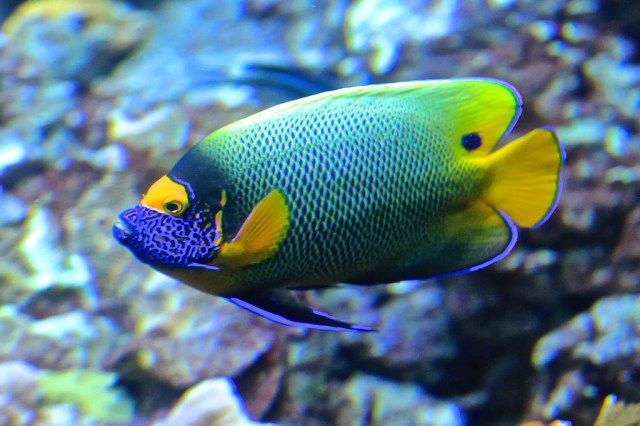
Genus/species:  Pomacanthus xanthometopon

Yellow Mask Angelfish13298710574_515d270046_b

GENERAL CHARACTERISTICS: The head is blue with a yellow eye mask. Scales are blue with a yellow margin creating a network pattern. The yellow dorsal fin has a spot black large posteriorly and the caudal fin is also yellow. Body depth 1.7-1.9 in. Length 6-9 inches.

DISTRIBUTION/HABITAT: Indo-Asian Pacific. Found in lagoons and coral reefs 5-30 meters (16-100 feet).

Yellow Mask Angelfish13298332785_879178297f_b

DIET IN THE WILD: Encrusting organisms such as sponges and tunicates.

CONSERVATION: IUCN Least concern

On exhibit at the Long Beach Aquarium 2016

References

California Academy of Sciences Steinhart Aquarium Philippine coral reef 2016

WordPress shortlink  http://wp.me/p1DZ4b-1et

fishbase www.fishbase.org/summary/Pomacanthus-xanthometopon.html

EOL eol.org/pages/994431/overview

Australian museum australianmuseum.net.au/Blueface-Angelfish-Pomacanthus-xa…

TAXONOMY
Kingdom:Animalia
Phylum: Chordata
Class: Actinopterygii (ray-finned fishes)
Order: Perciformes (Perch-likes)
Family: Serranidae (Sea basses: groupers and fairy basslets)

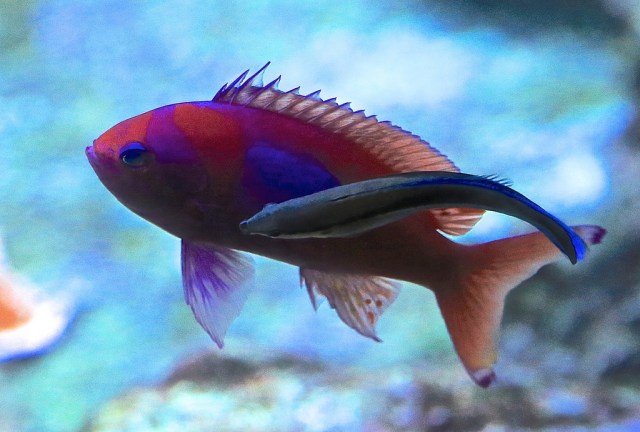
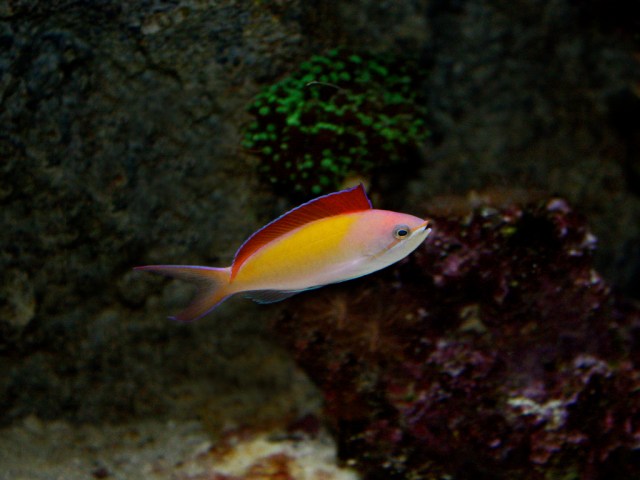
Genus/species: Pseudanthias dispar

Peach Fairy Basslet aka Redfin Anthias 2989036131_c7b264ace3_b

GENERAL CHARACTERISTICS: Sexes dichromatic. Male: orange to yellow body, lavender to pink head and bright red dorsal fin. Female: orange to peach upper head, body, and fins; pink line from the tip of the snout angling down, passing through the lower part of the eye .. Max. size: 9.5 cm (3.75 inches).

DISTRIBUTION: East Indo-Pacific along upper edge of steep reef slopes 1 – 15 m (3.25 – 50 feet) .

DIET IN THE WILD: Zooplankton. Occur in large feeding aggregations.

REPRODUCTION: Protogynous hermaphrodites. If a dominant male dies, the largest female of the group will change sex to take its place.   Males erect dorsal fin as courtship display.
Anthias gather in huge schools of hundreds. Schools are made up of smaller “harems” consisting of a single dominant male, a few less dominant males, and many females.

PREDATORS: Taken by many larger predators.

CONSERVATION: Not evaluated.

Philippine Coral Reef PR04 5-22-13

Animal Attractions SP14 3-15-12

Ref: Fishbase , EOL.

TAXONOMY
Kingdom: Animalia
Phylum: Chordata
Class: Actinopterygii (ray-finned fishes) 
Order: Perciformes (Perch-likes) 
Family: Labridae (Wrasses)

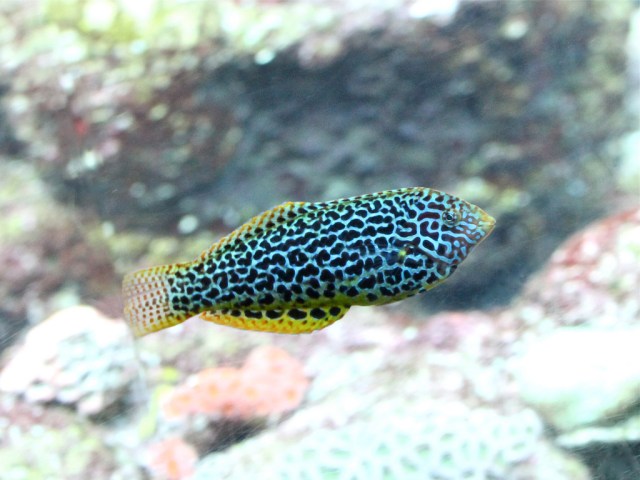
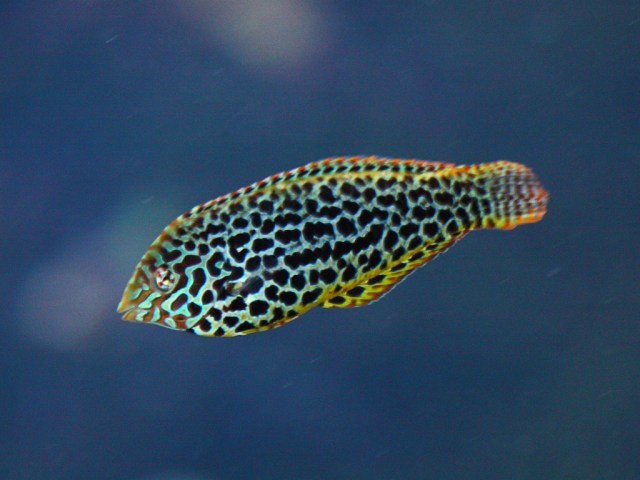
Genus/species: Macropharyngodon meleagris

GENERAL CHARACTERISTICS: Sexual dichromism. Females are white with black or brown irregular spots with white to blue margins over the body. Males have orangey-red background with green mottling. Max. length: 15 cm (6 inches).

DISTRIBUTION/HABITAT: Indo Pacific: Eastern Indian Ocean to western Pacific and the islands of Oceania. Habitat: Subtidal reefs and outer lagoons, at depths of 0–30 meters (98 feet).

DIET IN THE WILD: Feed on gastropods, hard shelled prey and foraminiferans.

REMARKS: Wrasses are most easily identified by their pointed snouts and prominent canine teeth that protrude in front of the jaw. Other common characteristics include their form of propulsion, which depends mostly on the winglike motion of the pectoral fins with only an occasional burst of speed provided by the caudal fin. Color, markings and body shapes change during maturation.

Philippine Coral Reef PR04

flickr http://www.flickr.com/photos/cas_docents/sets/72157608208133134/with/4770699386/

WordPress Shortlink  http://wp.me/p1DZ4b-KA

TAXONOMY
Kingdom: Animalia
Phylum: Chordata
Class: Actinopterygii (ray-finned fishes)
Order: Perciformes (Perch-likes)
Family: Labridae (Wrasses)

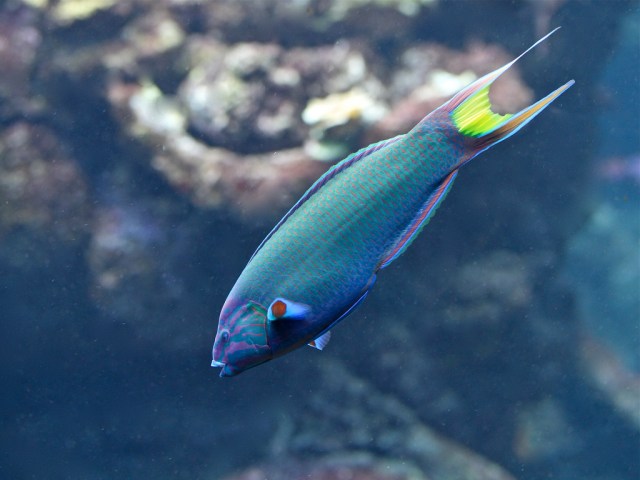
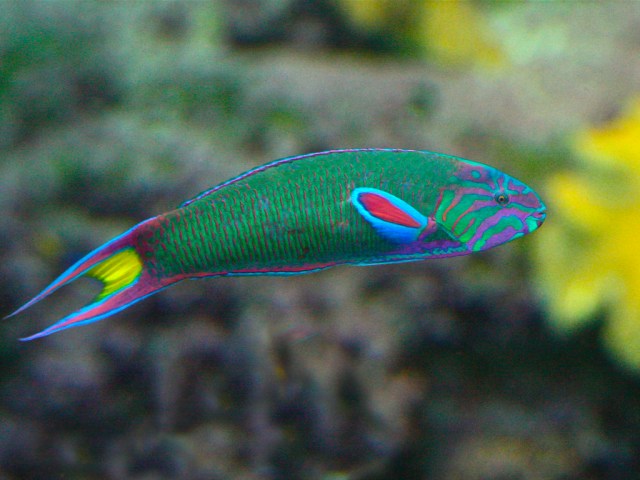
Genus/species: Thalassoma lunare

GENERAL CHACTERISTICS: Adult’s caudal fin is a large yellow crescent edged in purple and blue, the source of the species common name. Body dark green to blue with vertical red lines on scales; pectoral fins a bright pink surrounded by neon blue. The head is distinctive for its bright irregular pink and violet bands radiating from the mouth towards the body, a kind of fluorescent camouflage. Max. length: 25 cm or 10 inches.

DISTRIBUTION/HABITAT: Indo-Pacific; Red Sea to East Africa to the Line Islands, northwest to southern Japan, and southwest to northern New Zealand. Found on marine reefs to a depth of 20 m or 65.5 ft. Also lagoons, coastal reefs, protected seaward reefs, and estuaries.

DIET IN THE WILD: Feeds mainly on small benthic invertebrates and fish eggs

REPRODUCTION: Protogynous hermaphrodite

REMARKS: When frightened this fish will hide in the reef or bury itself in the sand; also buries in sand to sleep.

Philippine Coral Reef PR04

flickr http://www.flickr.com/photos/cas_docents/sets/72157608208133134/with/2989886808/

WORDPRESS SHORTLINK:  http://wp.me/p1DZ4b-Is

TAXONOMY
Kingdom: Animalia
Phylum: Chordata
Class: Actinopterygii 
Order: Perciformes
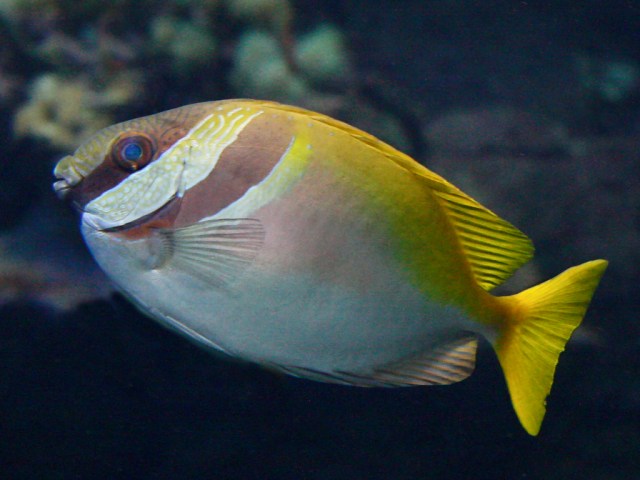
Family: Siganidae (Rabbitfishes and Spinefoots)

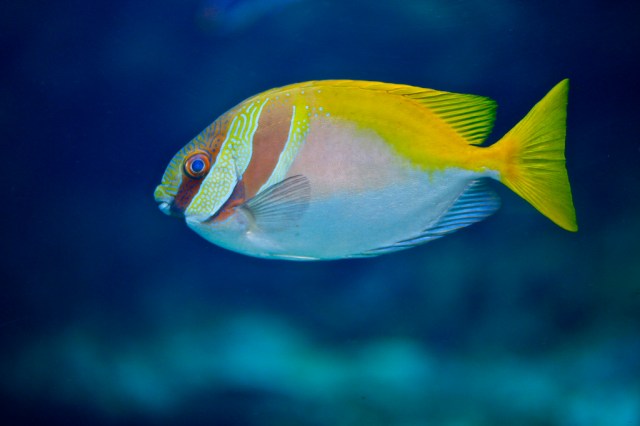
Genus/species: Siganus doliatus

GENERAL CHARACTERISTICS: Length to 25 cm (9.5 in). Light blue body above, silvery below with intricate patterns of thin blue and yellow lines; pair of brown bars on head and forebody; yellow tail.

DISTRIBUTION/HABITAT: Tropical west Pacific in coral rich areas of channels and lagoon slopes, reef flats and seaward reefs. Depth 1–15 m (3-45 ft).

DIET IN THE WILD: Feeds on benthic seaweeds Reproduction and Development: Pelagic spawner. Mortality/Longevity: Stout venomous spines discourage would-be predators.

REPRODUCTION: Pelagic spawner. Juveniles form schools. Pairs form at 7 cm (2.75 inches) which continue to form loose schools to feed in areas being flooded by the tide.

REMARKS : Fins and spines are venomous. Caution must be used when handling. Reactions can range from mild to severe
Named rabbitfish due to their voracious appetite.

Phillipine Coral Reef PR04

flickr http://www.flickr.com/photos/cas_docents/sets/72157608339530941/with/4533131275/

WordPress Shortlink http://wp.me/p1DZ4b-H6

Kingdom: Animalia
Phylum: Chordata
Class: Actinopterygii
Order: Perciformes
Family: Pomacentridae  Damselfishes

Amphiprion clarkii  

GENERAL CHARACTERISTICS:  To 12 cm (4.75 in). Black to entirely orange with pair of white or pale blue bars. Second bar wide; tail white or yellowish; other fins variably black to yellow-orange. There is also an orange variation: some are entirely pale orange, other than the two white bands; others have a dark patch on rear body.  (See remarks)

DISTRIBUTION/HABITAT: Indo-Pacific: Persian Gulf to Micronesia, New Caledonia and Fiji. Also Southwest Japan to northern Australia. Depth 1–55 meters (3-180 ft.) in outer reef slopes, less typically inhabit lagoons. Symbiotic with 10 species of sea anemones. Non-migratory.

DIET IN THE WILD:  Primarily planktonic copepods and benthic algae.

REPRODUCTION:  Monogamous; oviparous. Fertilization is external; benthic spawners; parents create a nest and male guards eggs. Are protandrous hermaphrodites; all mature as males In the absence of a female, the largest juvenile will mature within 5–6 months into the breeding male. The maturation of the smaller (all male) juveniles is stunted by the adult pair’s presence.

REMARKS: Coloration is apparently influenced by the host sea anemone species. Symbiotic with several anemones found in the Steinhart including Entacmaea quadricolor, Heteractis crispa, H. magnifica.

Philippine Coral Reef PR04 and Water Planet

flickr  http://www.flickr.com/photos/cas_docents/3057754480/in/set-72157608339622313/

WORDPRESS SHORTLINK: http://wp.me/p1DZ4b-Fn