Tag Archive: fishes


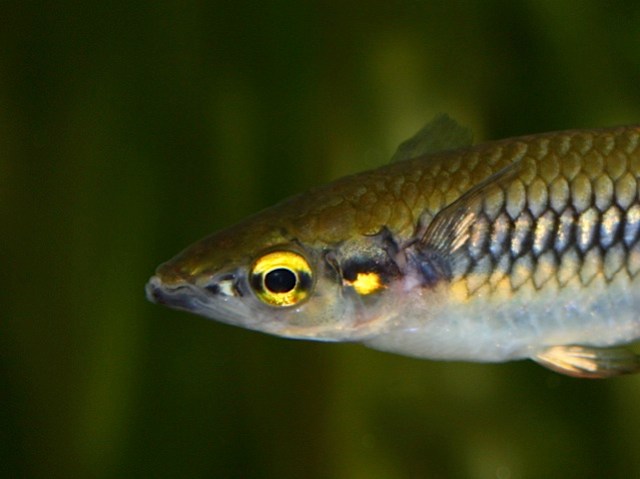
TAXONOMY
Kingdom: Animalia
Phylum: Chordata
Class: Actinopterygii (ray-finned fishes)
Order: Cyprinodontiformes (Rivulines, killifishes and live bearers)
Family: Aplocheilidae (Killifishes)

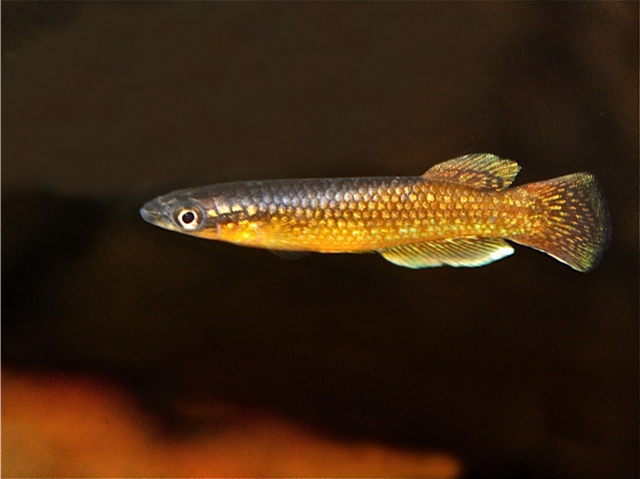
Genius/species: Pachypanchax patriciae

GENERAL CHARACTERISTICS: Dark longitudinal stripe, ca. one scale row deep, extending from posterior margin of eye to origin of pectorals. Males display two color morphs: red and blue. Red males become less common and disappear completely as one moves from north to south. Length to 5.2 cm (2 inches)

DISTRIBUTION/HABITAT: Madagascar small tropical rivers and streams. Tolerates conditions from water deficient in dissolved substances to water with high concentrations of dissolved minerals, pH values from acidic to slightly alkaline. Bottom dweller.

DIET IN THE WILD: Terrestrial and aquatic insects

PREDATORS: Mostly by birds, dragonfly nymphs and other predatory insects as well as piscivorous fishes.
 

CONSERVATION: IUCN AND CITES Not Evaluated

LOCATIONRainforest Madagascar MA05

References

fishbase  www.fishbase.us/summary/63019

arkive  www.arkive.org/pachypanchax/pachypanchax-patriciae/image-…

EOL  eol.org/pages/993340/details

Ron’s flickr http://www.flickr.com/photos/cas_docents/sets/72157627949403670/

Ron’s WordPress shortlink  http://wp.me/p1DZ4b-z6

TAXONOMY
Kingdom: Animalia
Phylum: Chordata
Class: Actinopterygii (ray-finned fishes)
Order: Atheriniformes (Silversides)
Family: Bedotiidae (Madagascar rainbowfishes)

Genus/species: Bedotia madagascarensis

GENERAL CHARACTERISTICS: Second dorsal fin is golden-yellow basally, with a dark red margin and broad black submarginal band. Anal fin similarly colored, but a golden-yellow zone is sandwiched between a narrow black basal and a broader black submarginal band. Males are conspicuously more colorful than females with more distinct markings and redder tails. Length to 9 cm (3.5in).


DISTRIBUTION/HABITAT: Endemic to Madagascar’s coastal rivers. Found in well-shaded slow-flowing streams at altitudes up to 30 meters (100 feet) above sea level.

DIET IN THE WILD: Insects and their larvae, crustaceans and other small invertebrates.

REPRODUCTION: Sexes are separate. Fertilization is external. Eggs are broadcast in open water and not guarded.
Mortality/Longevity: Lifespan about 5 years.

CONSERVATION: IUCN Red List Near Threatened (NT)
Limited range, habitat degradation and exotic predators such as (Gambusia holbrooki) and competitors (Xiphophorus spp.).

Sexes are separate. Fertilization is external. Eggs are broadcast in open water and not guarded.
Mortality/Longevity: Lifespan about 5 years.

LOCATION: Rainbowfish of  Madagascar  MD05

References

Encyclopedia of Life  eol.org/pages/343730/details

arkive  www.arkive.org/zono/bedotia-madagascariensis/image-G52355…

fishbase www.fishbase.org/summary/Bedotia-madagascariensis.html

IUCN  www.iucnredlist.org/details/2721/0

Ron’s flickr http://www.flickr.com/photos/cas_docents/sets/72157627949403670/

Ron’s WordPress shortlink  http://wp.me/p1DZ4b-yY


TAXONOMY
Kindom: Animalia
Phylum: Chordata
Class: Actinoptergii
Order: Perciformes
Family: Cichlidae (cichlids)
Subfamily: Etroplinae

Genus/species: Paretroplus menarambo

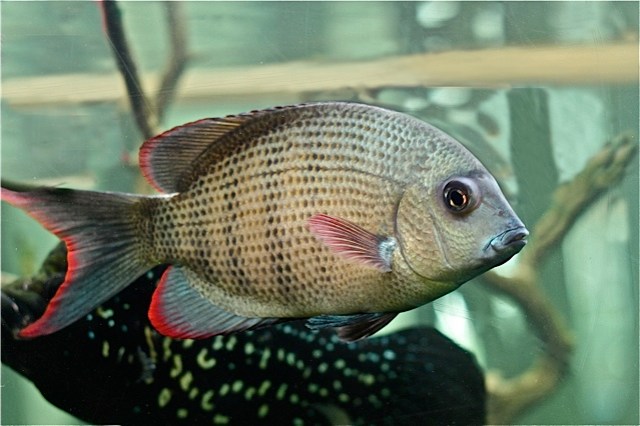
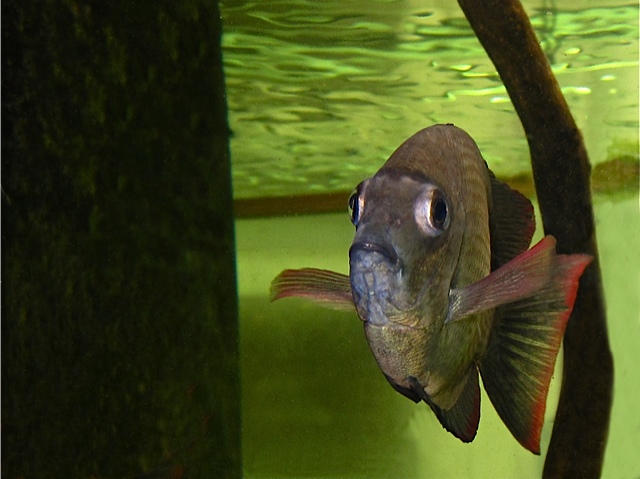
GENERAL CHARACTERISTICS: When young, Mearambos are a pale gold with black dots in a pin stripe pattern. As they reach adulthood, around 4 inches or 3 years of age, they are blue/gray to almost white with black dot pin stripes. The fins are edged in red, especially the tail. Max length : 12.8 cm (5 in).

DISTRIBUTION/HABITAT: Endemic to Madagascar. Present in the freshwater flood plain lakes of the Bemarivo River, the major northwards-flowing tributary of the Sofia River in northwestern Madagascar. The species is now known to occur in a single lake of that system: Lac Tseny.

DIET IN THE WILD: Have teeth specially designed for crushing snail shells.

REPRODUCTION: Substrate spawner. Eggs are laid in a pit and will adhere to surfaces such as driftwood.

PREDATORS: Critically endangered species threatened by invasive species and over-fishing.

CONSERVATION: IUCN Red list: Critically Endangered (CR)
No data are available on the wild population; previously it was thought to have disappeared from its native range, but more recent surveys rediscovered the species in Lac Tseny Habitat degradation, the presence of invasive exotic species and overfishing account for its Critically Endangered status. Breeding populations of this species are maintained in captivity.

LOCATION Madagascar MA04

References

fishbase www.fishbase.org/summary/SpeciesSummary.php?id=57958

IUCN www.iucnredlist.org/details/44492/0

Encyclopedia of Life eol.org/pages/211122/details

Ron’s flickr http://www.flickr.com/photos/cas_docents/sets/72157627949403670/

Ron’s WordPress shortlink  http://wp.me/p1DZ4b-yp


TAXONOMY
Kingdom: Animalia
Phylum:Chordata
Class: Actinopterygii
Order: Cypriniformes
Family: Cyprinidae (carps, true minnows, and their relatives (as the barbs and barbels).
Subfamily: Barbinae (Barbs)

Genus/species: Pethia padamya

GENERAL CHARACTERISTICS: This species exhibits sexual dimorphism. The male has a beige to light brown background with a bright red stripe running the length of the body. The dorsal, anal, and pelvic fins of the male are yellowish-green in color with contrasting black spots.

The female is light beige with a silvery sheen on the scales. The fins are a light yellowish-green; however, only the dorsal fin contains the contrasting black spots, which are fainter than those of the male. Both sexes have a black and prominent spot in the dorsal area, as well as a smaller spot in the caudal area. Average length is 4.5cm or about 2 inches.

 OdessaBarb9830844836_7a262035df_k

DISTRIBUTION/HABITAT: Central Myanmar in one pond (Toe Gyi village) and one river.

DIET IN THE WILD: Not well-studied, omnivores. Cyprinids are stomachless fish with toothless jaws. Even so, food can be effectively chewed by the pharyngeal teeth the gill rakers of the specialized last gill bow.

CONSERVATION: IUCN; Data Deficient (DD) Has a restricted range in wild. It is known only from two locations in central Myanmar, but more research is needed to find the exact distribution, population and threats, and it appears to be widely available in the aquarium trade.

REMARKS: Named “Odessa barb” because it was said to have first appeared in pet enthusiast’s circles in Odessa, Ukraine in the early 1970s.

Location: Southeast Asia Community (Borneo).

References

fishbase  www.fishbase.org/summary/Puntius-padamya.html

Encyclopedia of Life  eol.org/pages/4627441/details

Ron’s WordPress shortlink  http://wp.me/p1DZ4b-1r0

Ron’s flickr  https://www.flickr.com/photos/cas_docents/5518559419/in/set-72157627795872023/

TAXONOMY
Kingdom: Animalia
Phylum: Chordata
Class: Actinopterygii (ray-finned fishes)
Order: Cypriniformes (Carps)
Family: Cyprinidae (Minnows or carps) 

Genus/species: Systomus rhomboocellatus

Snakeskin Barb IMG_7888

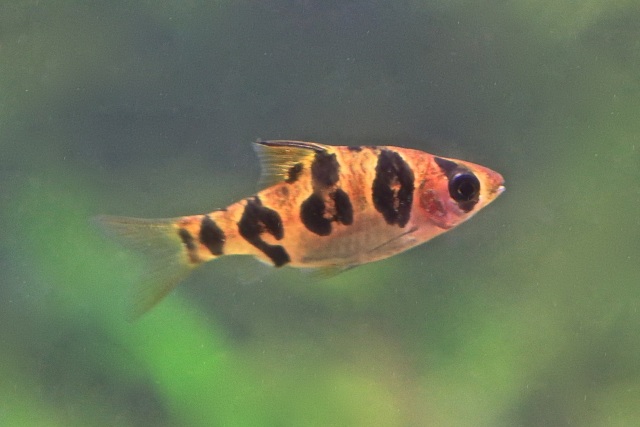
GENERAL CHARACTERISTICS: Diamond-shaped markings on their body, giving them a snake-skin appearance. Length 5-8 cm (2-3 inches).

DISTRIBUTION/HABITAT: West and Central Kalimantan in Borneo, Indonesia in black water streams in forested areas.

DIET IN THE WILD: Omnivorous; eats insects and worms.

REPRODUCTION: Egg scatter within areas of dense plant growth.

CONSERVATION: IUCN and CITES Not Evaluated

References

fishbase www.fishbase.org/summary/Puntius-rhomboocellatus.html

 Encyclopedia of Life eol.org/pages/224467/details

Ron’s flickr http://www.flickr.com/photos/cas_docents/sets/72157608614099673/

Ron’s WordPress Shortlink http://wp.me/p1DZ4b-16F

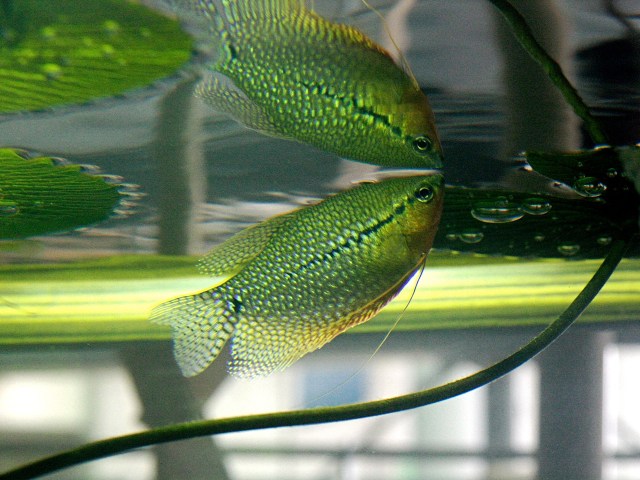
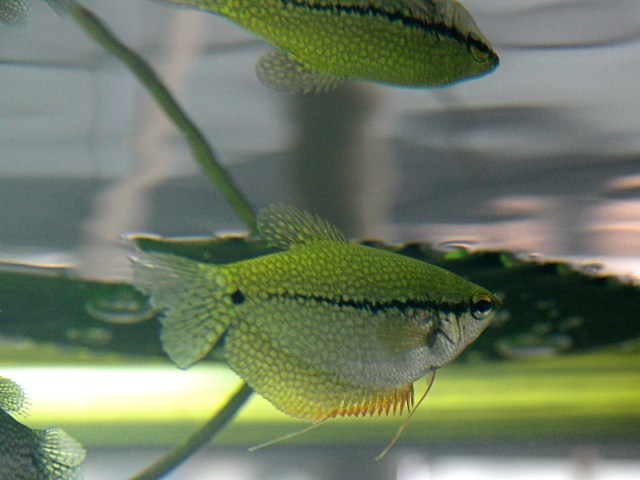
TAXONOMY Kingdom: Animalia Phylum: Chordata Class: Actinopterygii (ray-finned fishes) Order: Perciformes (Perch-likes) Family: Osphronemidae (Gouramies) Genus/species: Trichogaster leeri GENERAL CHARACTERISTICS: Brownish-silver color, covered in a pearl-like pattern with a distinct black line running from the fish’s eye thinning towards the caudal fin.Has filamentous pelvic fins. Large anal fin extends from just behind the pelvic fins almost to the caudal fin. Length to 12 cm (4.7 in). Common name comes from the small, light spots that cover the body like iridescent “pearls. DISTRIBUTION/HABITAT: Asia: Malay Peninsula, Thailand and Indonesia, including Borneo. Found in small flowing rivers and lakes in areas of dense vegetation. DIET IN THE WILD: Omnivorous; small invertebrates and plants. REPRODUCTION: All gouramis build nests of small air bubbles that vary in size, shape, and position depending on the species. Some may incorporate plants; others are only bubbles. CONSERVATION: IUCN, Near Threatened (NT) REMARKS: Common name comes from the small, light spots that cover the body like iridescent “pearls. Like all gouramis, has a lung-like organ that allows it to breathe air directly by gulping at the surface, an ability that increases survival in low oxygen situations. BO09 Rainforest Borneo, Southeast Asia community. References fishbase www.fishbase.org/summary/4674  California Academy of Sciences Docent Rainforest training manual. 2014 Ron’s flickr http://www.flickr.com/photos/cas_docents/3627206078/in/set-72157627795872023/ Ron’s WordPress short-link  http://wp.me/p1DZ4b-bZ

TAXONOMY
Kingdom: Animalia
Phylum: Chordata
Class: Actinoptergii
Order: Pecifomes
Family: Osphronemidae (Gouramis)

Genus/species: Trichogaster microlepis

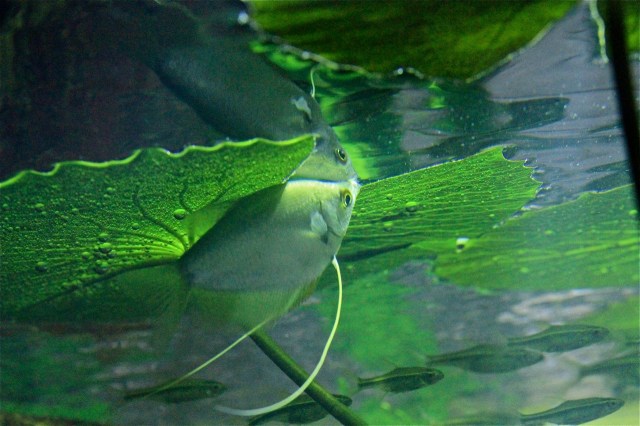
GENERAL CHARACTERISTICS: It has a greenish hue similar to moonlight glow, hence its name, and a distinctive concave head. Males can be identified by the orange to red color of the pelvic fins and the long, pointed dorsal fins. The female’s pelvic fins are colorless to yellow, while the dorsal fins are shorter and rounder. Length: 12–15 cm  (4.66 – 6 inches)

DISTRIBUTION/HABITAT: Thailand and Cambodia. Found in ponds, lakes and swamps with shallow, sluggish or standing water and abundant vegetation.

DIET IN THE WILD: Omnivorous. Eats insects, crustaceans, and zooplankton.

REPRODUCTION: Oviparous; a bubble nest builder. The bubble nest does not contain much plant matter so the bubbles float around freely. The male performs a courtship dance beneath the nest, culminating with the male wrapping itself around the female and turning her on her back as she releases her eggs. Up to 2000 eggs may be laid during the spawning. The male fertilizes the eggs as they float up to the prepared bubble nest. Eggs incubate in the nest for 2–3 days before hatching.

CONSERVATION: IUCN: Least Concern (LC)  No major threats to this species have been reported, however, pollution in wetlands, infrastructure and draining water may impact the species.

REMARKS: Like all labyrinth fish, T. microlepis has a special lung-like organ that allows it to breathe air directly from above the water line. This allows gouramis to survive in pools with a low oxygen.

LOCATION: BO09 Rainforest Borneo, Southeast Asia Community 

References 

fishbase www.fishbase.org/summary/4729

 Encyclopedia of Life  eol.org/pages/203969/details

flickr http://www.flickr.com/photos/cas_docents/sets/72157627795872023/

WordPress shortlink   http://wp.me/p1DZ4b-dB


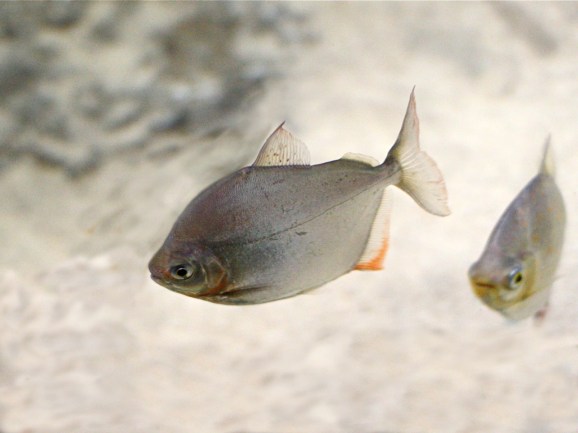
TAXONOMY
Kingdom: Animalia
Phylum: Chordata
Class: Actinopterygii (ray-finned fishes)
Order: Characiformes (Characins)
Family: Serrasalmidae

Genus/species: Metynnis hypsauchen

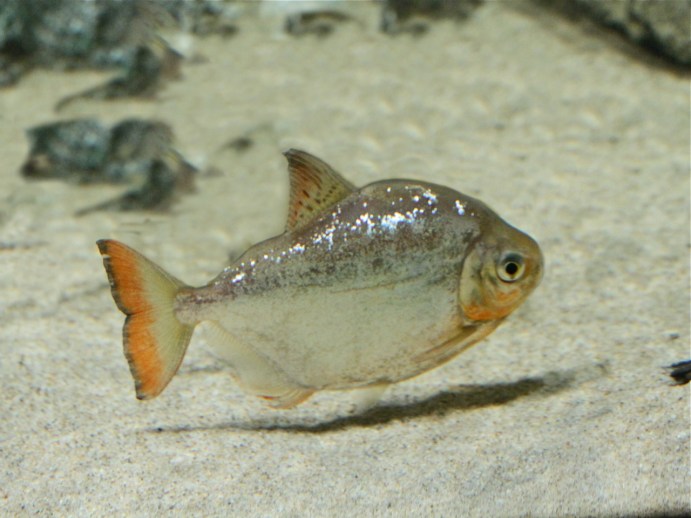
GENERAL CHARACTERISTICS: Almost circular in profile; juveniles may be spotted or striped; adults solidly silver with anal and caudal fins edged in red or orange. Length : 15.0 cm (6 inches).

DISTRIBUTION/HABITAT: Tropical South America primarily Amazon and Orinoco basins. Found in calm river reaches overhung by foliage.

DIET IN THE WILD: Generally herbivorous, eating leaves of river plants; occasionally eats worms and small insects.

REPRODUCTION: Group spawners. Eggs hatch in 3 days.

CONSERVATION: IUCN Red List, CITIES, Not Evaluated

REMARKS: A schooling species related to piranhas.
Possesses powerful dentition that can cause serious bites.

Amazon Flooded Tunnel AM11

References

Ron’s flickr  https://www.flickr.com/photos/cas_docents/6343628168/in/set-72157620568438047/

fishbase  fishbase.org/summary/Metynnis-hypsauchen.html

Encyclopedia of Life  eol.org/pages/217649/details

Ron’sWordpress shortlink  http://wp.me/p1DZ4b-cl


TAXONOMY
Kingdom: Animalia
Phylum: Chordata
Class: Actinopterygii (ray-finned fishes)
Order: Scorpaeniformes (Scorpionfishes and flatheads)
Family: Hemitripteridae (Sea ravens or sailfin sculpins)

Genus/species: Blepsias cirrhosis

GENERAL CHARACTERISTICS: There is a depression at the back of the head and some long cirri hang from the chin. The front edge of the first dorsal fin is high, the second dorsal and anal fins are long and approximately the same size. Coloration is usually brown mottled above with a light spot near the pectoral fins and pale below. Max length : 20.0 cm (8 inches)

 DISTRIBUTION AND HABITAT: North Pacific: Sea of Japan to the Bering Sea and to San Simeon, central California, USA.  Temperate Marine  Occurs in intertidal areas and to 37 m (120 ft) depth, but more common in subtidal areas. Often found among algae.

DIET IN THE WILD: Nekton and benthic crustaceans.

REPRODUCTION: Fecundity is low, 234–404 eggs. Adult B. cirrhosus  inject eggs into the tissue near the gastral cavity of  the sponge Mycale adhaerens  using it as a spawning bed.  The eggs are hidden by the sponge which is minimally damaged with the sponge also providing constant oxygen and an environment free of most bacteria.

CONSERVATION: IUCN; Not evaluated

LOCATION: Rocky Reef Cluster Sculpins

eol eol.org/pages/206919/details

 fishbase www.fishbase.us/summary/4054

 Ron’s flickr  www.flickr.com/photos/cas_docents/7207822582/in/photolist…

Ron’s WordPress shortlink:  http://wp.me/p1DZ4b-wY


TAXONOMY
Kingdom: Animalia
Phylum: Chordata
Class: Actinopterygii (ray-finned fishes),
Order: Perciformes (Perch-likes)
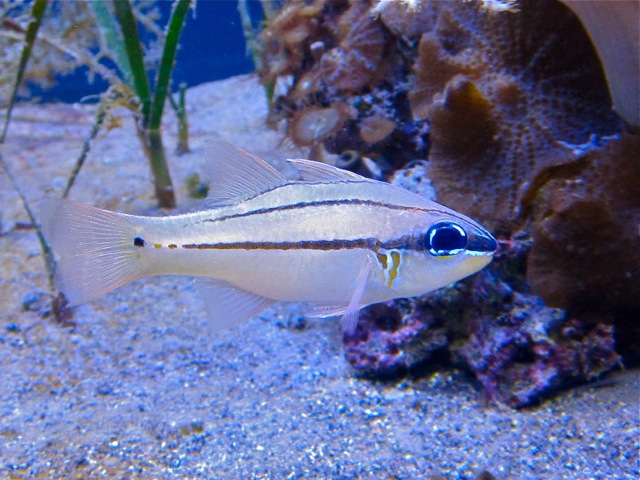
Family: Apogonidae (Cardinalfishes)

 Ostorhinchus sealei  (Apogon sealei) 


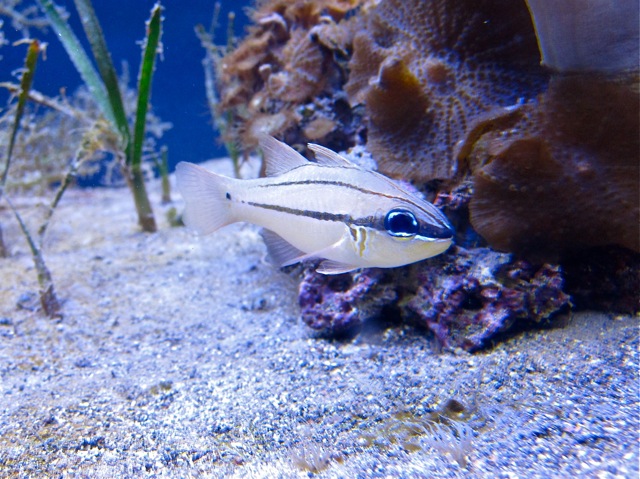
GENERAL CHARACTERISTICS:  Length 80mm, (3.15 inches). Pale yellow with a  pair of thin brown stripes on the upper side and a dark spot on mid tail base. Two short orange bars in bluish white patch on gill cover.

DISTRIBUTION/HABITAT: Malaysia to the Solomon Islands, north to the Philippines, Palau, and south to Ashmore Reef, Australia. Usually found on coastal fringing reefs or patch reefs to a depth of 25 m (80 feet). It is often found in pairs or in groups among branching corals such as Acropora. 

DIET IN THE WILD: Individuals shelter in amongst the coral during the day and come out to feed at night on zooplankton and benthic invertebrates.

REPRODUCTION and DEVELOPMENT: This species demonstrates distinct pairing during courtship. The males mouthbrood the fertilized eggs until hatching is ready to occur.

LOCATION:  Philippine Coral Reef

References

fishbase http://www.fishbase.org/summary/6230

WORDPRESS SHORTLINK  http://wp.me/p1DZ4b-ki

flickr  https://www.flickr.com/photos/cas_docents/6615915253/in/set-72157625992053826

eol  neol.org/pages/212483/details

Cardinalfish general information.  

Found in the Atlantic and Indo-Pacific oceans, cardinalfishes are primarily marine, though some are found in brackish waters and a few in freshwater streams. Many species inhabit reef flats, lagoons, and seaward reefs to 60 feet (18 m).
The family is characterized by two widely separated dorsal fins, large eyes, short snouts, double-edged preopercula and a moderately large oblique mouth. The name derives from the red coloration of some well-known species, though many are drab or striped.
Most remain hidden during the day, and then disperse over the reef at night to feed on zooplankton and small benthic invertebrates, always remaining close to the substrate. Males of many species are mouth brooders.