Latest Entries »

TAXONOMY
Kingdom:  Animalia
Phylum:  Chordata
Class:  Actinopterygii (ray-finned fishes)
Order:  Perciformes (Perch-likes)
Family:  Anarhichadidae (Wolffishes)

Genus/Species:  Anarrhichthys ocellatus
GENERALCHARACTERISTICS
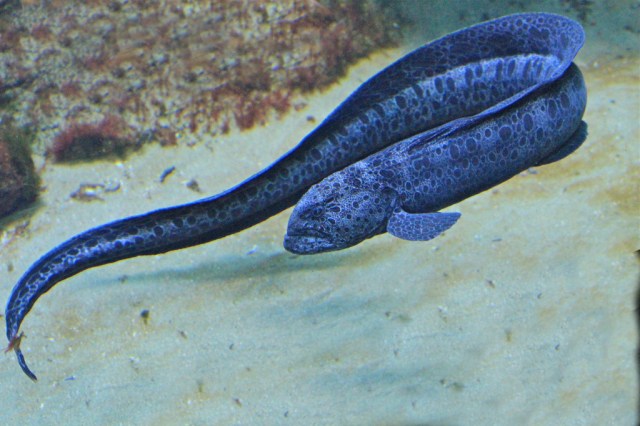
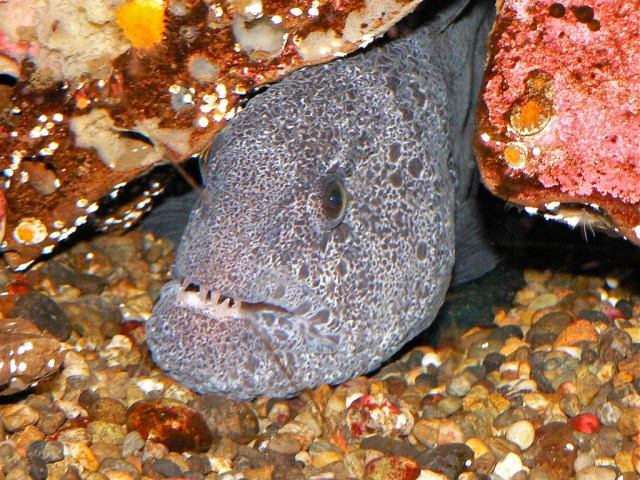
An eel-like fish (large, elongate, compressed body) with no pelvic fins. Large pectoral fins. Colored mostly gray to brown, occasionally greenish. Round dark spots with pale rings on body and fins. Length to 2.4 m (7.2 ft). Weight to 18 kg 41 lb. Not a true eel of the Order Anguilliformes.

DISTRIBUTION/HABITAT
Sea of Japan and Aleutian Islands to Imperial Beach, California. Adults live on bottom, usually among rocks in subtidal locations; often in dens.

DIET IN THE WILD
Crabs, sand dollars, marine snails and fishes.

REPRODUCTION
Both male and female wrap their body around the egg mass to keep the eggs in place and to deter predators .
PREDATORS
Predators of eggs include benthic rockfish and kelp greenlings.

REMARKS: Can inflict a painful bite. An edible food fish

LOCATION: California Rocky Coast CC06

flickr http://www.flickr.com/photos/cas_docents/4673324895/in/set-72157608359804936/

WORDPRESS SHORTLINK  http://wp.me/p1DZ4b-Ff
TAXONOMY

Kingdom:   Animalia

Phylum:     Chordata

Class:         Actinopterygii

Order:        Perciformes

Family:      Acanthuridae

Genus/Species    Naso vlamingii

GENERAL CHARACTERISTICS

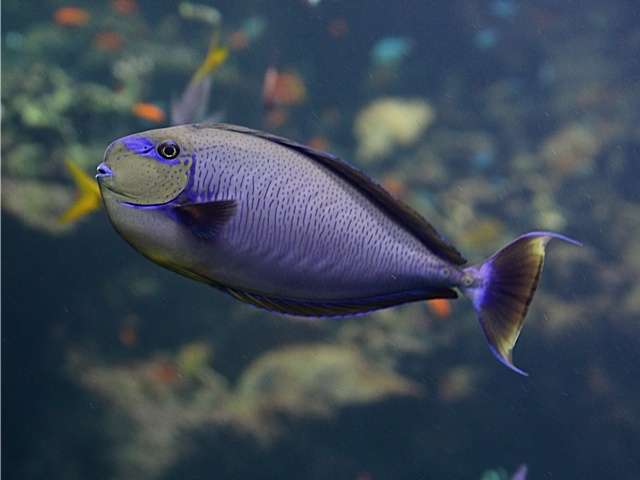
Length to 60 cm (23 in). Adults develop a convexly rounded prominent snout and extremely tall dorsal and anal fins. Gray ovate compressed body with bright blue markings. Tips of the tail fin are unusually long. Courting males are able to instantaneously turn iridescent blue.

DISTRIBUTIN/HABITAT


Indo-Pacific in deep lagoon and seaward reefs from 4–50 m (12-150 ft). Diurnally in conspecific groups midwater off steep slopes.

DIET IN THE WILD


Zooplankton.

REPRODUCTION


External fertilization. Egg scatterers, non-guarding. Remarks: Courting males are able to instantaneously turn iridescent blue.

Main Coral Reef Exhibit PR04

flickr www.flickr.com/photos/cas_docents/3120136472/in/set-72157625992053826

WordPress Shortlink http://wp.me/p1DZ4b-BI

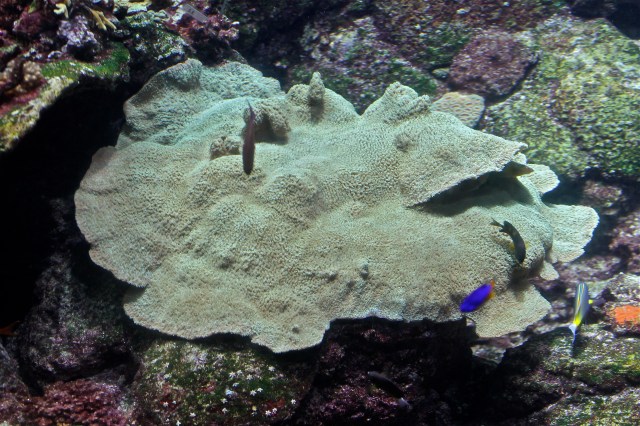
TAXONOMY

KINGDOM Animalia

PHYLUM Cnidaria (possess cnidocytes)

CLASS Anthozoa (Sea Anemones and Corals)

SUBCLASS Hexacorallia (water-based organisms formed of colonial polyps generally with 6-fold symmetry)

ORDER Scleractinia (Stony Corals)

FAMILY Merulinidae

GENUS Hydnophora sp.

GENERAL CHARACTERISTICS
Hexacoral or stonycorals with colonies that may be massive, encrusting, or branched; usually brown, greenish, or yellowish. Conical protuberances over the entire colony’s surface. Tentacles often partially extended during the day.

DISTRIBUTION/HABITAT
Widely distributed in the Indo- Pacific. Common in variety of reef habitats.

DIET IN THE WILD
Nutrition mostly provided by symbiotic zooxanthellae, but also take other food sources, such as plankton.

REPRODUCTION: The small polyp stony (SPS) corals are male and female and can reproduce both sexually and asexually. They reproduce sexually by releasing eggs and sperm at the same time (spawning), resulting in a fertilized egg which then forms into a free-swimming planula larva. Eventually the planula larvae settles onto the substrate, becoming plankters. This then forms a tiny polyp which begins to excrete calcium carbonate and develops into a coral. Planula larvae are extremely vulnerable to predation, and very few survive. Hydnophoras reproduce asexually from breakage due to storms resulting in fragmentation.

REMARKS: Hydnophora are very aggressive and can extend sweeper polyps and sting or basically eat other corals it touches.

LOCATION; Main Philippine Coral Reef Tank PR04

flickr http://www.flickr.com/photos/cas_docents/4673421321/in/set-72157623778757037/

WORDPRESS SHORTLINK  http://wp.me/p1DZ4b-nP

KINGDOM  Animalia

PHYLUM    Chordata

CLASS    Reptilia

ORDER    Testudines

FAMILY    Chelydridae  (Snapping Turtles)

GENUS/SPECIES  Macrochelys temminckii


GENERAL CHARACTERISTICS

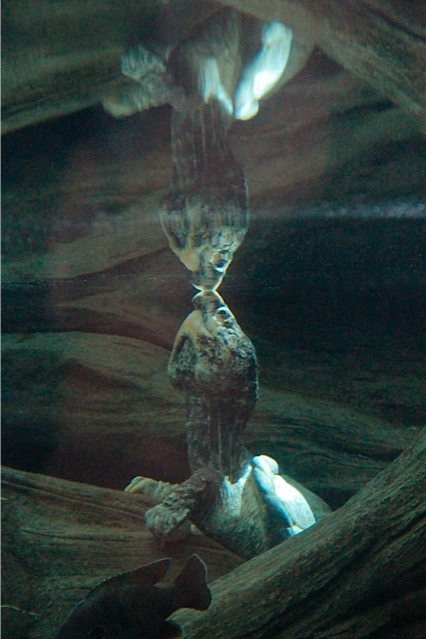
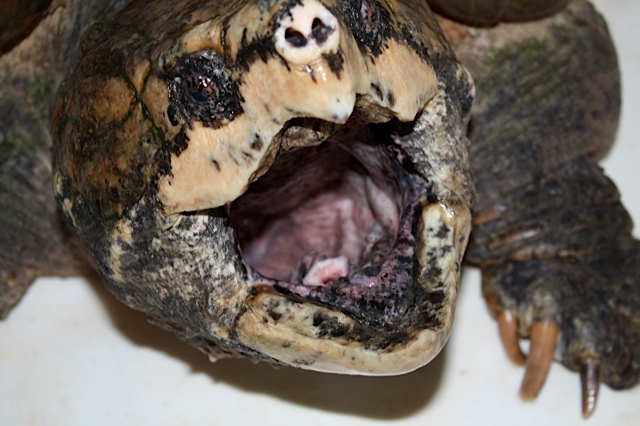
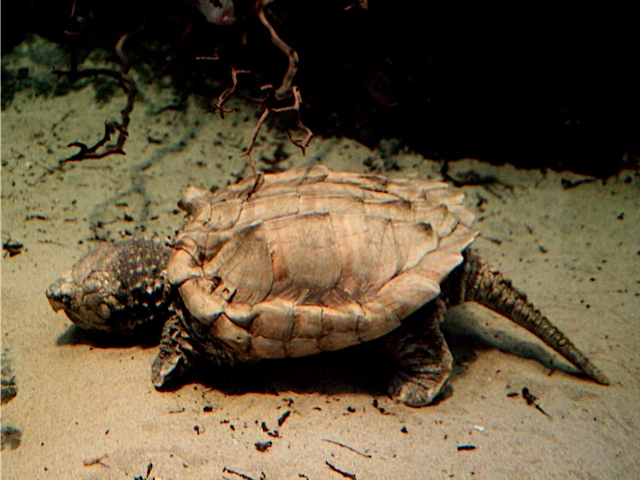
Largest freshwater turtle in the world weighing 70-80 kg (155-175 lb) with a shell length up to 79 cm (32 in). Their  big head can be over 9 in wide with three ridge keels on the broad carapace rising to knobby keels. They usually have algae covering their backs since they spend most of their time under water coming to the surface sometimes as little as 50 min between breaths.

The largest individual turtle in the exhibit is over 55 kgs (121) pounds. The rest are likely ~45 kg (100 pounds)


DISTRIBUTION/HABITAT

Southeastern United States in primarily quiet, muddy freshwater rivers, streams, lakes and ponds that drain into  the Gulf of Mexico. Females leave water only to deposit eggs and male occasionally will bask in the sun.


DIET IN THE WILD

Lie-in-wait predator. Rests on substrate with its mouth open and lures fish to its mouth with a movable, pink wormlike tongue appendage. Also takes crayfish, crabs, snails, freshwater mussels, salamanders, snakes, very small alligators, small mammals, water birds, briar roots, wild grapes, acorns, and scavenges as well.  


ACADEMY DIET

They are fed cut trout 2-3 times per week.


 REPRODUCTION

Males climb onto the female’s carapace from behind. As in all reptiles, fertilization is internal. Female’s terrestrial nest is approximately within 50m (160 ft). of water. A single clutch of 8-52 eggs (35 average) is laid per year with a 3.5 to 4.5 month incubation period.  Warm and low incubation temperatures result in all female neonates. Intermediate incubation temperatures produce mostly males.  They mature in 11-13 years and can live to 70 years of age in captivity.


Swamp SW02


flickr  http://www.flickr.com/photos/cas_docents/2776238200/in/set-72157608449490716/

WORDPRESS SHORTLINK  http://wp.me/p1DZ4b-B3

PHYLUM  Chorada

CLASS     Actinopterygii (ray-finned fishes)

ORDER    Anguilliformes (Eels and morays)

FAMILY    Muraenidae (Moray eels)

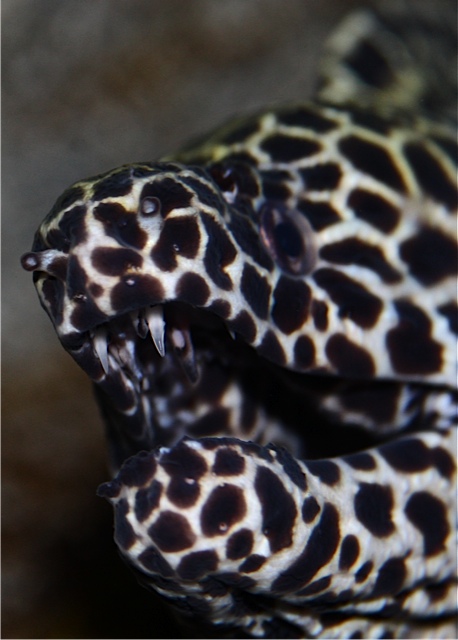
GENUS/SPECIES   Gymnothorax favagineus


GENERAL CHARACTERISTICS

This diverse group is noted for large mouths with numerous teeth, small gill openings, and the absence of pectoral and pelvic fins.  The anal and dorsal fins extend along much of the body and are continuous with the caudal fin. Gill openings are small and roundish and situated on the side of the head.

G. favagineus grows to 3 m, thus it is one of the two largest of Indo-Pacific moray eels. Spots variable between individuals and size.  The surface is covered with dark spots the size of their eye that form a honeycomb pattern. Some individuals colored almost totally black (those found in turbid water).    


DISTRIBUTION/HABITAT

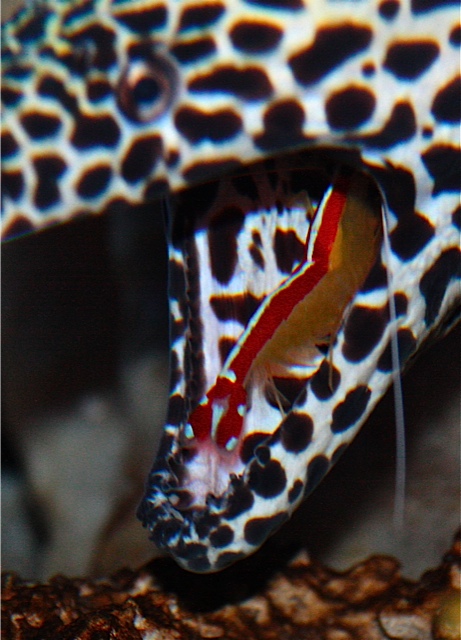
Red Sea, East. Africa to Papua, New Guinea and Great Barrier Reef.  Usually rests in  reef flat rubble and outer reef slopes of  continental reefs, 1–45 m (3-150) in depth. Often found in crevasses with cleaner wrasses or cleaner shrimps.

                                   PHOTO BELOW: Symbiotic relationship with a cleaner shrimp.  

DIET IN THE WILD

Predator upon cephalopods, crustaceans and small fishes.


REPRODUCTION

Leptocephalus larvae.


LOCATION

Dark Cluster  PR22  


WORDPRESS SHORTLINK  http://wp.me/p1DZ4b-AN

Flickr http://www.flickr.com/photos/cas_docents/sets/72157608402401040/

PHYLUM    Chordata

CLASS        Actinopterygii   (ray-finned fishes)

ORDER    Perciformes   (Perch-likes)

FAMILY   Cichlidae (Cichlids)

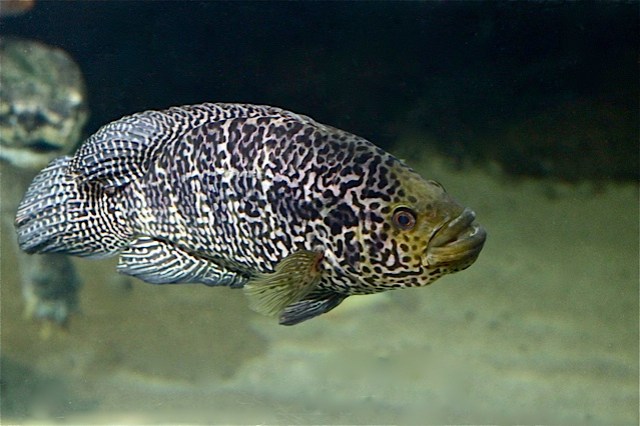
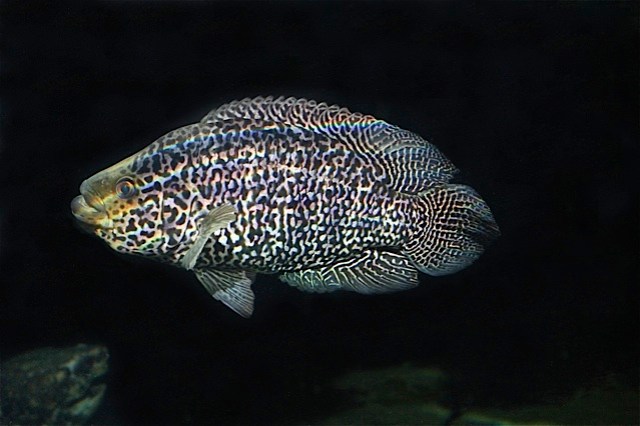
GENUS/SPECIES    Parachromis (Nandopsis) managuensis


GENERAL CHARACTERISTICS

Body has a light background with black markings all over; series of large black spots on along the sides.   Males will constantly dig and defend their territory. They will usually have brighter coloring to the body than females.    Size:  32.5–35 cm (13–14 in).


DISTRIBUTION/HABITAT

Central America: Honduras to Costa Rica preferring lakes, with  turbid warm water depleted of oxygen. Likes mud bottoms but also found in springs and ponds over detritus and sand bottoms.    


DIET IN THE WILD

Small fishes and invertebrates; a voracious predator that makes a meal of any fish small enough to fit into its unusually large mouth.           


Swamp SW02

 Flickr  http://www.flickr.com/photos/cas_docents/sets/72157625017923579/

WORDPRESS SHORTLINK  http://wp.me/p1DZ4b-AF

TAXONOMY

Class:  Actinopterygii (ray-finned fishes)

Order:   Perciformes (Perch-likes)

Family: Labridae (Wrasses)

Genus/species:   Epibulus insidiator


GENERAL CHARACTERICS

Max length : 54.0 cm. The mouth of this species is protrusible and unfolds into a tube easily half the body length. The jaws swing forward into a long tube that strong suction to catch prey. When not in use, the entire apparatus is conveniently folded under the head.

Small juveniles are brown with thin white bars. Color varies with age and sex, but adult color is variable, including with an all-yellow xanthic form. Terminal males are dark with a white head and a dark streak extending horizontally through the eye. Male becomes ornamented with orange and yellow over the back. Juveniles dark with fine vertical white lines. Intermediates with yellow blotches, pale tail and sometimes with black pectoral fins.


DISTRIBUTION/HABITAT

Tropical marine waters of the Indo-Pacific, from the Red Sea, throughout South-east Asia and Micronesia, north to Japan, south to Australia and east to the Tuamoto Islands. In Australia it is known from the north-western coast of Western Australia, around the tropical north of the country, and from the entire length of the Great Barrier Reef, Queensland.  E. insidiator inhabits coral-rich areas of lagoon and seaward reefs


DIET IN THE WILD

Small coral-dwelling crustaceans and fishes.


Location: Venoms Cluster PR 27

Flickr http://www.flickr.com/photos/cas_docents/sets/72157608208133134/

 WordPress Shortlink  http://wp.me/p1DZ4b-A3


TAXONOMY

KINGDOM   Animalia

PHYLUM   Chordata

CLASS   Reptilia

ORDER   Squamata

FAMILY    Chamaeleonidae

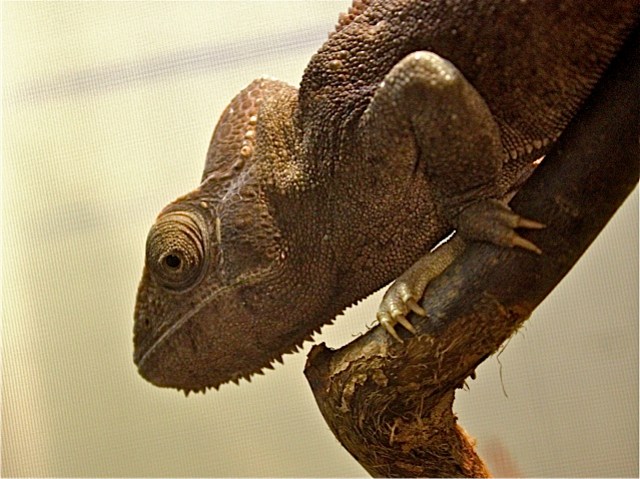
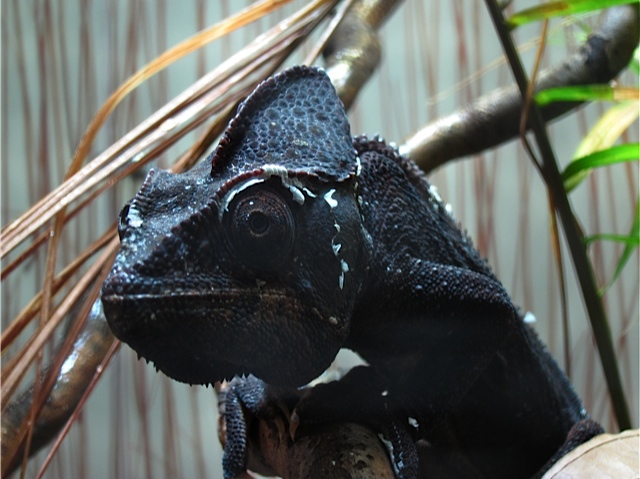
GENUS/SPECIES  Furcifer  oustaleti


GENERAL CHARACTERISTICS

With a maximum length of 68.5 cm (27 in), it is often considered the largest species of chameleon.  Oustalet’s Chameleons are sandy brown and grey in color but, like most chameleons, they can change color depending on mood and temperature, or as a mode of communication.

Distinctive features of a chameleon lizard are its long tongue, its separately mobile eyes, its parrot-like feet and in many species, the ability to change color.       


DISTRIBUTION/HABITAT

 Widespread in Madagascar in the warm and humid coastal lowlands.  Has been introduced near Nairobi in Kenya.

REPRODUCTION

One to 2 clutches of up to 60 eggs per year taking 7 months to hatch.

Chameleons may live more than 10 years in captivity.


 Rainforest Madagascar MA10

 Flickr http://www.flickr.com/photos/cas_docents/sets/72157608449603666/with/5356254468/

WordPress Shortlink  http://wp.me/p1DZ4b-zV


TAXONOMY

KINGDOM      Animalia

PHYLUM        Arthropoda  (External skeleton, segmented body and jointed appendages)

SUBPHYLUM  Crustacea

CLASS          Malacostraca

ORDER         Decapoda  (ten legged)

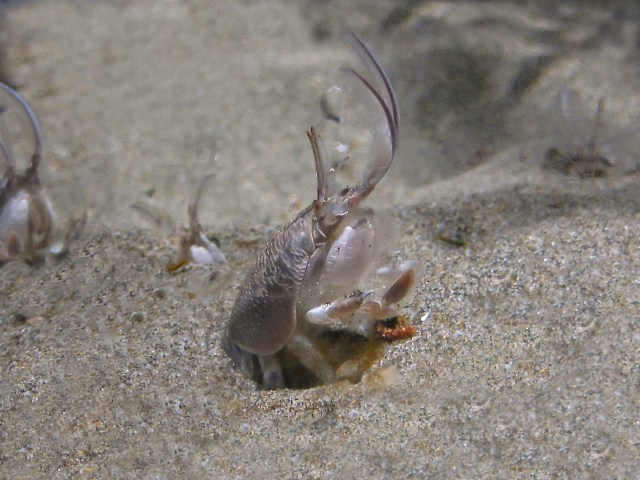
FAMILY        Hippidae  (mole crabs or sand crabs)

GENUS/SPECIES  Emerita analoga


GENERAL CHARACTERISTICS

 Grey or sand colored exoskeleton without spines or claws.  The eyes are on long stalks and the antennae are also elongated so as to project above the surface of the sand. The legs and uropods have hairy margins to assist in digging and for use in collecting food and transferring it to the mouth.  The first pair of antennae reach above the sand for respiration, and the second pair, resembling feathers, are extended when the crab feeds. The female is nearly twice as large as the male up to 35 mm  (1.4 in) long and 25 mm (1.0 in) wide.

The sand crab always moves backwards when burrowing or crawling.

DISTRIBUTION/HABITAT

Pacific coast from Alaska to Baja California in the northern hemisphere and between Ecuador and Argentina in the southern hemisphere. E. analoga live in the swash zone (area of breaking waves) of the sandy beach intertidal zone.

DIET IN THE WILD

Antennae collect small organisms, mostly dinoflagellates which are brought to the mouth and consumed.

 REPRODUCTION

During the reproductive season (February-October), females can produce one clutch per month of 50-45,000 eggs, which take approximately 30 days to develop. Once the eggs hatch, the larvae are planktonic for 4-5 months.

PREDATORS

Fish, water birds, and shorebirds.

The barred surfperch is a very common fish in the surf zone, and sand crabs have been found to make up 90% of its diet.

Emerita analoga are  also used as bait by fishermen.


REMARKS

Sand crabs are known to carry parasites. They are an intermediate host of parasitic worms which are passed on to the predators of sand crabs. Sea otters and birds can eat many crabs per day, and the ingested parasites have been known to kill these predators.

Researchers monitor levels of DDT and domoic acid (a diatome neurotoxin) on a regular basis to assess the health of the ocean.

LOCATION Tidepool

WordPress Shortlink  http://wp.me/p1DZ4b-zq

flickr  http://www.flickr.com/photos/cas_docents/sets/72157608602469734/

TAXONOMY

KINGDOM      Animalia

PHYLUM        Chordata

CLASS           Actinopterygii  (ray-finned fishes)

ORDER          Percifomes  (Perch-likes)

FAMILY         Cichlidae  (Cichlids)

GENUS/SPECIES  Katria katria


GENERAL CHARACTERISTICS

Katria katria  has a unique pattern of two prominent black vertical bars on an iridescent golden background. Max length: 5.5 cm (2 in).


DISTRIBUTION/HABITAT

One of 17 cichlid species indigenous to Madagascar.

Lives in freshwater pools, slow flowing runs and rapids with predominantly sand and gravel substrate, with a few very large rocks.


DIET IN THE WILD

Omnivorous.

 REPRODUCTION

Substrate spawner. Pairs of Katria have been observed guarding either eggs or small juveniles close to the top of the rocks in the Nosivolo Rver in November, 2005.


CONSERVATION STATUS

IUCN List: Vulnerable.

This species has a restricted distribution within the Nosivolo and Mangoro rivers, but its habitat is in very good condition and it does not have to deal with either exotic predators or competitors. Given the lack of evidence for decline in quality of habitat or population size (it is a very common species within its range), this species is assessed as vulnerable on account of its restriction to a single location.


LOCATION

Rainforest Madagascar MA04

Flickr  http://www.flickr.com/photos/cas_docents/sets/72157627949403670/

WordPress Shortlink http://wp.me/p1DZ4b-yS