Latest Entries »

TAXONOMY
Kingdom:Animalia
Phylum: Chordata
Class: Actinopterygii (ray-finned fishes)
Order: Perciformes (Perch-likes)
Family: Apogonidae (Cardinalfishes)

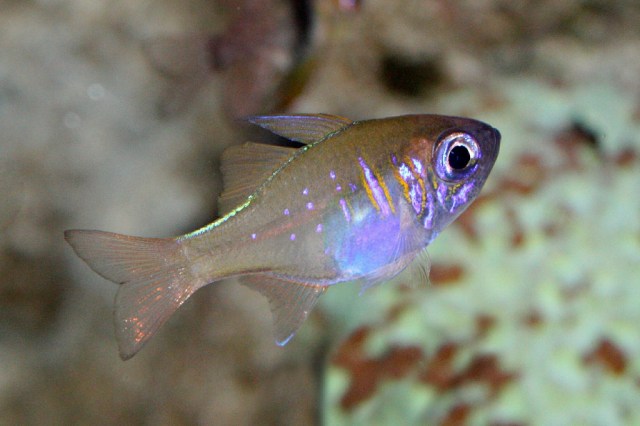
Genus/species: Zoramia leptacantha

ThreadfinCardinalfish4335618020_27ea998a8d_b

GENERAL CHARACTERISTICS: Elongate first dorsal fin. Whitish, semi-transparent with frosty iridescence on back; iris is luminous blue. Yellow-edged blue bands and bars on rear of head and front of body. Long first dorsal fin tip. Length to 6 cm (2.4 inches).

ThreadfinCardinalfish2990748320_4b0c6286dc_b

DISTRIBUTION/HABITAT: Tropical marine Indo-Pacific. Found in huge groups at 1–20 m (3.2 feet – 65 feet) depth in sheltered lagoons and protected reefs.

DIET IN THE WILD: Nocturnally feeds on benthic crustaceans.

REPRODUCTION: Mouth brooders; pair for courtship and spawning.

CONSERVATION: Not evaluated.

Philippine coral reef PR04

References

fishbase www.fishbase.org/summary/5773

eol eol.org/pages/211570/details

flickr www.flickr.com/photos/cas_docents/2990748320/in/set-72157…

WordPress shortlik http://wp.me/p1DZ4b-1h5

TAXONOMY
Kingdom:Animalia
Phylum: Chordata
Class:Actinopterygii (ray-finned fishes)
Order: Perciformes (Perch-likes)
Family: Apogonidae (Cardinalfishes)

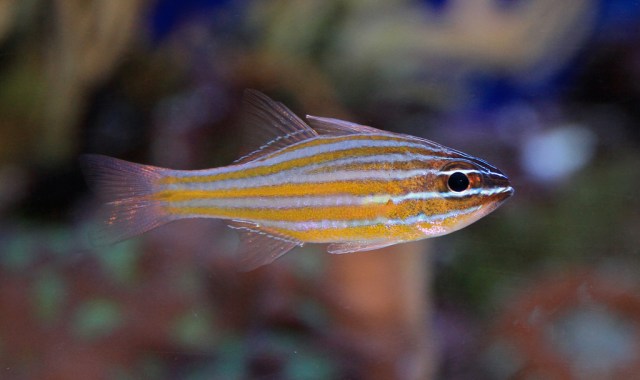
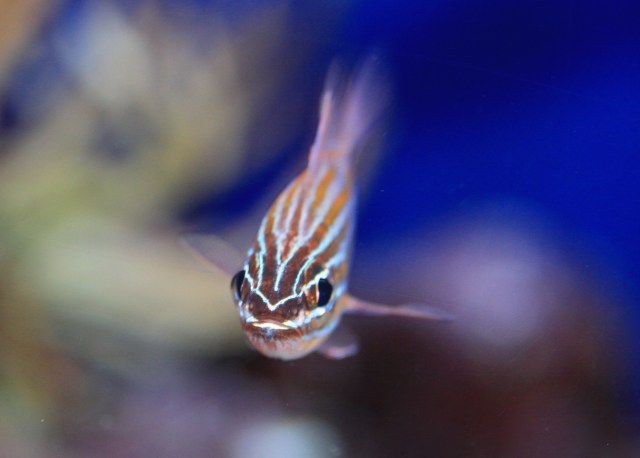
Genus/species: Apogon cyanosoma

YellowstripedCardinalfish4184514661_35a0a5c254_b

GENERAL CHARACTERISTICS : Silver body highlighted with 6 orange-gold horizontal stripes including a short post ocular stripe.. Pinkish to orange spot on base of caudal fin. Max. length: 8 cm.

YellowstripedCardinalfishApogon cyanosoma, PR24

DISTRIBUTION/HABITAT: Indo-west Pacific. Common from Australia to the Red Sea Inhabiting sheltered clear water areas of lagoon and seaward reefs. Associates in small to large aggregations under ledges, in holes, or even among long spines of sea urchins.

DIET IN THE WILD: Planktonic crustaceans and small invertebrates.

REPRODUCTION: Like all cardinalfishes, a paternal mouthbrooder.

CONSERVATION: IUCN; Not Evaluated.

REMARKS: Like all cardinalfishes, active at night, with large eyes adapted to gathering low light.


References:

fishbase http://www.fishbase.org/summary/4600

flickr https://www.flickr.com/photos/cas_docents/4184514661/in/set-72157…

eol eol.org/pages/985736/details

TAXONOMY
Kingdom: Animalia
Phylum: Chordata
Class: Actinopterygii (ray-finned fishes)
Order: Perciformes (Perch-likes) Family: Apogonidae (Cardinalfishes)

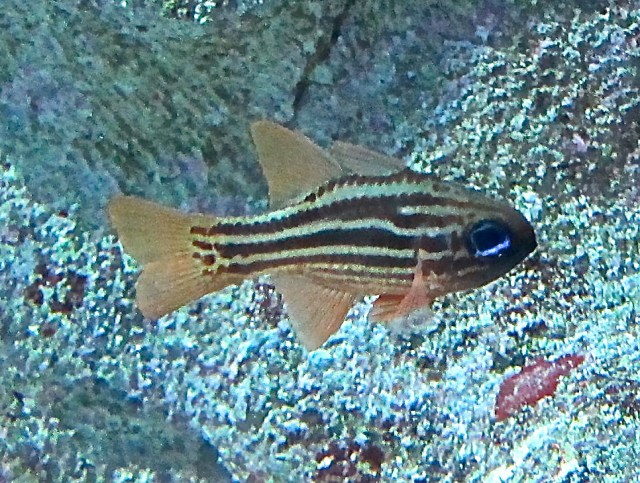
Genus/species: Apogon compressus

Ostorhinchus compressus

GENERAL CHARACTERISTICS: White or pinkish with about six red-brown stripes on side; 3-4 dark spots at the base of the caudal fin. Eyes iridescent blue. Length ave. 8.5 cm (3.3 inches).

DISTRIBUTION/HABITAT: Indo-West Pacific found among near branching corals.

CONSERVATION: Least concern.

References

flickr https://www.flickr.com/photos/organize

eol http://eol.org/pages/204398/hierarchy_entries/44696143/details

fishbase http://www.fishbase.org/summary/5769

WordPress shortlink: http://wp.me/p1DZ4b-1gE

TAXONOMY
Kingdom: Animalia
Phylum: Chordata
Class: Actinopterygii (Ray-finned fishes)
Order: Perciformes (Perch-likes)
Family: Apogonidae (Cardinalfishes)

Genus/species: Ostorhinchus aureus (Apogon aureus)

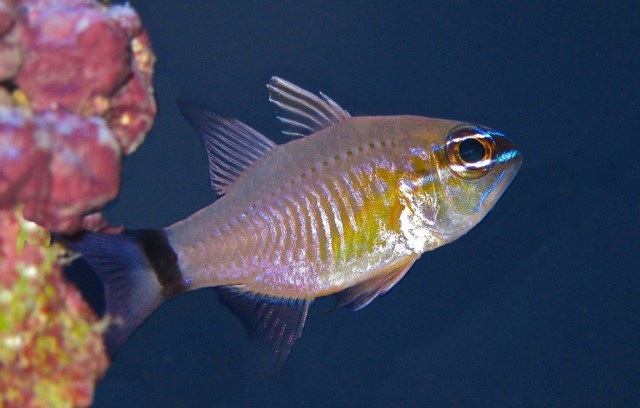
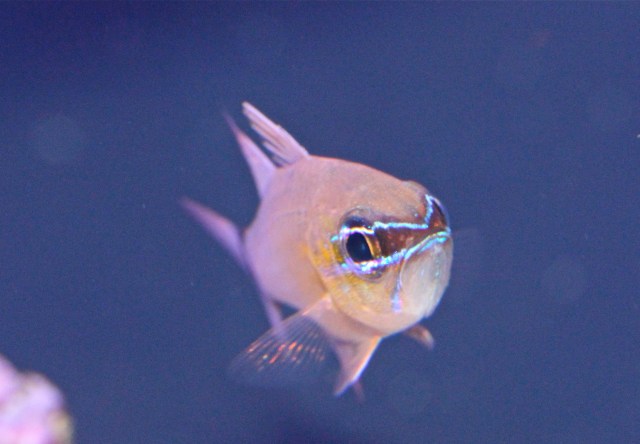
Ring-Tail Cardinalfish Ostorhinchus aureus13924803567_e8eb47a0af_b

GENERAL CHARACTERISTICS: Coppery with iridescence, paler posteriorly; a blackish stripe, bordered by a blue line, running from front of snout through eye and beyond; a narrow blue streak on maxilla. Black bar encircling caudal peduncle present in both young and adult phases.Length 4.4-14.7 cm (1.75-5.8 inches).

IMG_5514

DISTRIBUTION/HABITAT: Tropical Indo-West Pacific. Inhabits holes in rocks or under ledges in shallow waters. Depth range 1 – 40 m (3.2 to 130 feet).

DIET IN THE WILD: Benth crustaceans, zoobenthos, mobile invertebrates and small fishes.

REPRODUCTION: External fertilization, mouthbrooders.

CONSERVATION: IUCN; not evaluated.

References:

eol eol.org/pages/224893/details

flickr  www.flickr.com/photos/cas_docents/13924803567/in/set-7215…

fishbase.kaust.edu.sa/summary/Ostorhinchus-aureus.html

WordPress shortlink  http://wp.me/p1DZ4b-1gu

TAXONOMY
Kingdom: Animalia
Phylum: Chordata
Class: Actinopterygii (ray-finned fishes),
Order: Perciformes (Perch-likes)
Family: Apogonidae (Cardinalfishes)

 Ostorhinchus sealei  (Apogon sealei) 
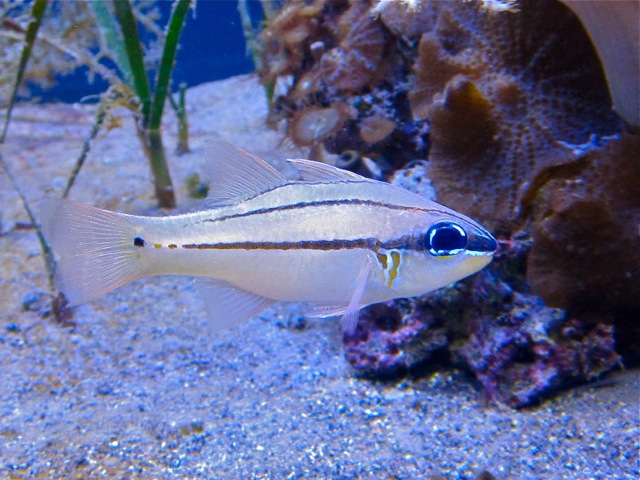
 

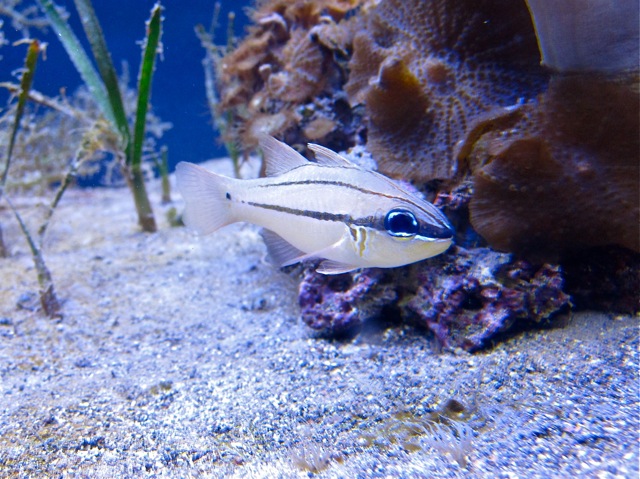
GENERAL CHARACTERISTICS:  Length 80mm, (3.15 inches). Pale yellow with a  pair of thin brown stripes on the upper side and a dark spot on mid tail base. Two short orange bars in bluish white patch on gill cover.

DISTRIBUTION/HABITAT: Malaysia to the Solomon Islands, north to the Philippines, Palau, and south to Ashmore Reef, Australia. Usually found on coastal fringing reefs or patch reefs to a depth of 25 m (80 feet). It is often found in pairs or in groups among branching corals such as Acropora. 

DIET IN THE WILD: Individuals shelter in amongst the coral during the day and come out to feed at night on zooplankton and benthic invertebrates.

REPRODUCTION and DEVELOPMENT: This species demonstrates distinct pairing during courtship. The males mouthbrood the fertilized eggs until hatching is ready to occur.

LOCATION:  Philippine Coral Reef
References

fishbase http://www.fishbase.org/summary/6230

WORDPRESS SHORTLINK  http://wp.me/p1DZ4b-ki

flickr  https://www.flickr.com/photos/cas_docents/6615915253/in/set-72157625992053826

eol  neol.org/pages/212483/details

Cardinalfish general information.  

Found in the Atlantic and Indo-Pacific oceans, cardinalfishes are primarily marine, though some are found in brackish waters and a few in freshwater streams. Many species inhabit reef flats, lagoons, and seaward reefs to 60 feet (18 m).
The family is characterized by two widely separated dorsal fins, large eyes, short snouts, double-edged preopercula and a moderately large oblique mouth. The name derives from the red coloration of some well-known species, though many are drab or striped.
Most remain hidden during the day, and then disperse over the reef at night to feed on zooplankton and small benthic invertebrates, always remaining close to the substrate. Males of many species are mouth brooders.

TAXONOMY
Kingdom: Animalia
Phylum: Chordata
Class: Actinopterygii
Order: Perciformes
Suborder: Gobioidei
Family: Gobiidae

Genus/species: Amblygobius phalaena

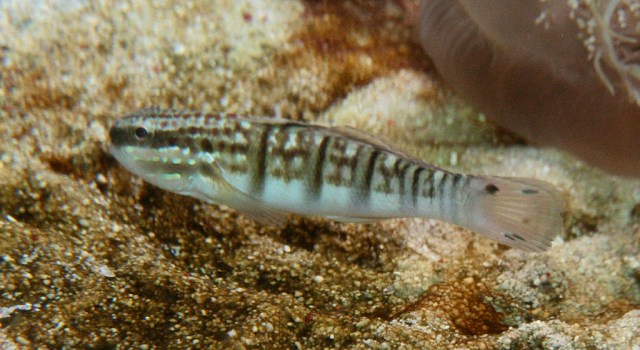
3632254969_6c5fc1fee8_b

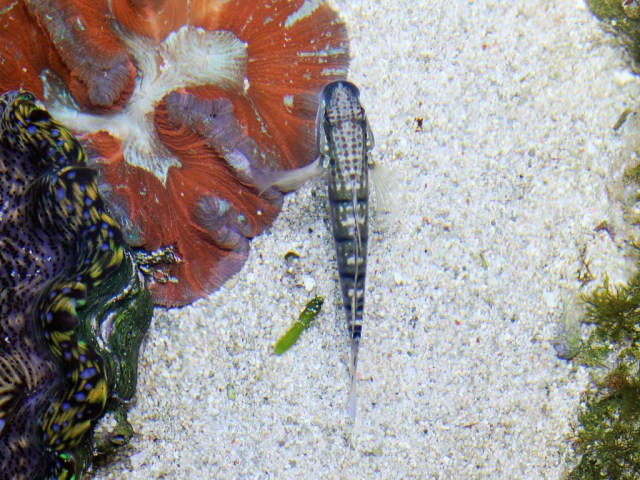
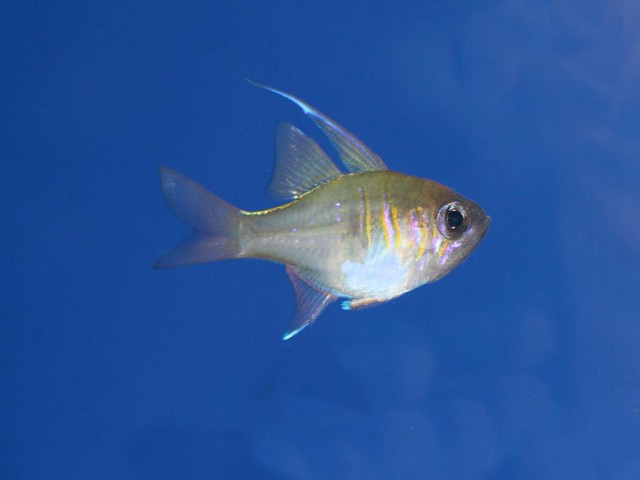
GENERAL CHARACTERISTICS: Overall greenish brown body with five dark brown to blackish vertical bars. Has pale edged dark stripe through eye and another across cheek; head with white streaks; small white spots in 3-4 horizontal rows on body.

4540473291_f2ecc7c3a8_b

DISTRIBUTION/HABITAT: Indo-Pacific region and has been recorded from the Cocos-Keeling Islands, Marquesas and French Polynesia across to Australia and southern Japan. Found on reef flats and sheltered coral reefs to depths of 20 metres.

DIET IN THE WILD: Feeds by sifting mouthfuls of sand and expelling it through the gills, to capture small invertebrates, organic matter, and large quantities of algae.

CONSERVATION: IUCN; not evaluated.

REMARKS: Unlike other gobies, it spends most of its time, swimming along with other fish in water column. Will grow up to 6 inches long.

Upside-down Jellyfish tank PR35 in past, Philippine coral reef tank PR04 and shallows PR03a

References

flickr www.flickr.com/photos/cas_docents/3632254969/in/photolist…

WordPress shortlink http://wp.me/p1DZ4b-1gi

fishbase www.fishbase.org/summary/AMBLYGOBIUS-PHALAENA.html

TAXONOMY
Kingdom:Animalia
Phylum: Chordata
Class: Actinopterygii (ray-finned fishes)
Order: Perciformes (Perch-likes)
Family: Microdesmidae (Wormfishes)

Genus/species: Ptereleotris zebra

Zebra Gobie2985357026_450274646b_b

GENERAL CHARACTERISTICS: Elongated and compressed body with a Yellowish to greenish gray color and a series of narrow orange to pinkish bars edged with blue or purple along the sides A broad blue-edged dark reddish to purple area is below the eye. A chin barbel is
followed by a median longitudinal fold. Max length: 4.7 inches.

DISTRIBUTION/HABITAT: Tropical Indo-Pacific: Red Sea and islands in the western Indian Ocean to the Line and Marquesan Islands, south to the southern Great Barrier Reef. Found over exposed seaward reefs in relatively shallow water. Depth range 2 – 31 m (6-100 feet).

DIET: Zooplankton. Small schools hover several feet above the substrate capturing morsels the current carries to them.

CONSERVATION: Not evaluated

REMARKS: The common name of the genus is “dartfish,” derived from the group’s habit of darting between rocks or into rubble when frightened.

Philippine Coral Reef PR04

References

fishbase  http://www.fishbase.org/summary/4384

WordPress shortlink http://wp.me/p1DZ4b-1fF

flickr https://www.flickr.com/photos/cas_docents/2985357026/in/set-72157625992053826/

TAXONOMY
Kingdom:Animalia
Phylum:Chordata
Class:Actinopterygii (ray-finned fishes)
Order:Perciformes (Perch-likes)
Family:Labridae (Wrasses)

Genus/species: Pseudocheilinus hexataenia

Six-line Wrasse3237047032_23cc672a39_b

GENERAL CHARACTERISTICS: To 7.5 cm (3 inches). Violet with six horizontal orange stripes on side. Small black dot on upper tail base.

DISTRIBUTION/HABITAT: Indo-Pacific among seaward reefs in coral branches. Depth 20 meters (65 feet).

DIET IN THE WILD: Primarily small crustaceans, snails, and flatworms.

PREDATORS: Preyed upon by grouper and other finfish.

Philippine Coral reef PR04

References

flickr https://www.flickr.com/photos/cas_docents/3237047032/

WordPress shortlink  http://wp.me/p1DZ4b-1f9

fishbasewww.fishbase.de/summary/Pseudocheilinus-hexataenia.html

EOLwww.flickr.com/photos/cas_docents/3237047032/edit-details/


TAXONOMY
Kingdom: Animalia
Phylum: Chordata
Class: Actinopterygii (ray-finned fishes)
Order: Perciformes (Perch-likes)

Family: Labridae (Wrasses)

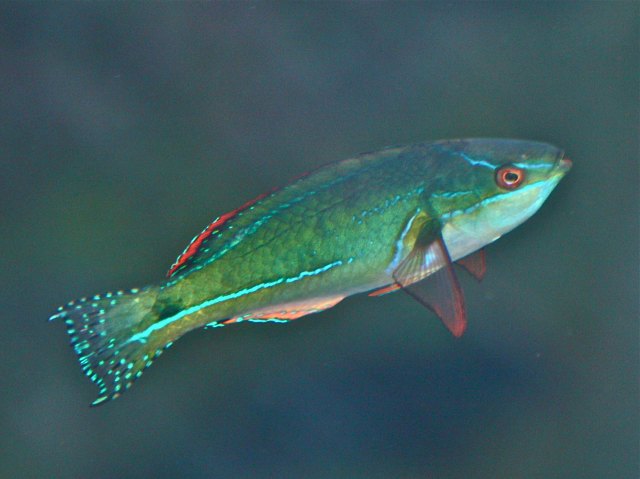
Genus/species: Cirrhilabrus exquisitus

Specimen below is a male

ExquisitefairywrasseCirrhilabrusexquisitusIMG_0091


GENERAL CHARACTERISTICS: Body shape is fusiform. Mouth is terminal.  Post-juvenile initial phase to 7 cm and colored shades of brown; large black spot on base of upper tail. Terminal phase individuals colored shades of green, bright red margins on dorsal and anal fins, narrow blue stripe from mid-body to tail, large black spot on base of upper tail, two or three blue line marks on head.  Maximum length 12cm (4.75 inches)

DISTRIBUTION/HABITAT: East Africa to Tuamotus, north to Izus, southern Japan and south to Great BarrierReef, Australia over rubble or low patch reefs in areas of current, also on reef edges and near rubble zones in 5–35 m. (16-115 feet)

DIET IN THE WILD: Zooplankton in the water column, well above the substrate.

CONSERVATION: Data deficient (DD) Philippine Coral Reef PR04

References

WordPress shortlink http://wp.me/p1DZ4b-1eS

flickr http://www.flickr.com/photos/cas_docents/4563757962/in/set-72157608208133134/

fishbase  http://www.fishbase.de/summary/Cirrhilabrus-exquistius.html

EOL  http://eol.org/pages/357163/details

Taken on January 8, 2009, 3-20-14

TAXONOMY
Kingdom: Animalia
Phylum: Chordata
Class: Actinopterygii (ray-finned fishes)
Order: Perciformes (Perch-likes)
Family: Labridae (Wrasses)

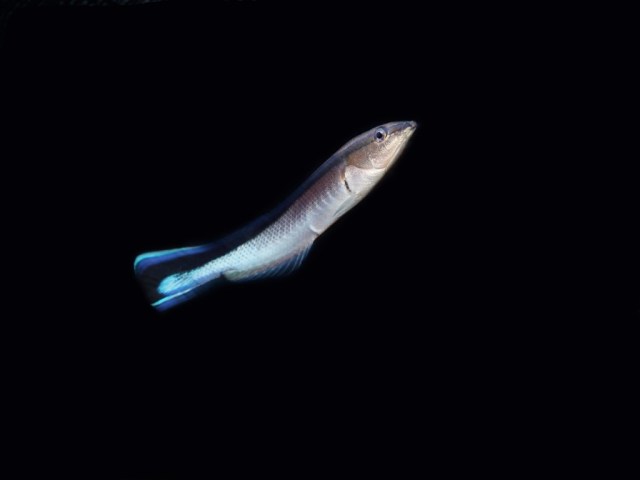
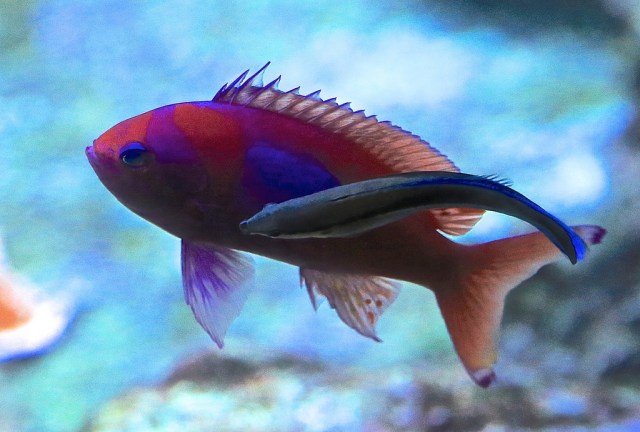
Genus/species: Labroides dimidiatu

GENERAL CHARACTERISTICS: Length to 11.5 cm (4.5 inches). Elongate body, tubular mouth. Blue to yellow above fading to white or yellow below. There is a black stripe from the eye to the caudal fin margin. The stripe widens posteriorly.

DISTRIBUTION/HABITAT: Indo-Pacific in virtually all coral reef habitats: inner lagoons and subtidal reef flats to seaward reefs, 0.5-40 m (18 in to 125 ft), typically near branching corals. Active diurnally. Aggressively territorial. Nocturnally retires to small crevices in the reef, enclosing itself in a mucus cocoon. Remains in stations where other fish come to be cleaned.

DIET: The most common cleaner wrasse on reefs. Pick external parasites from other fishes. Also clean the wounds of other fishes by removing scar tissue. Clean the gills and even enter the mouth of the host.

REPRODUCTION: Monogamous. A protogynous hermaphrodite.
Open water/substratum egg scatterers, non guarders.

CONSERVATION: IUCN, Least concern

Cleaner Wrasse13298334135_9737aa3d26_b

Philippine Coral Reef PR04

flickr http://www.flickr.com/photos/cas_docents/sets/72157608208133134/with/2977676226/

WordPress Shortlink http://wp.me/p1DZ4b-Kp

fishbase fishbase.sinica.edu.tw/summary/SpeciesSummary.php?ID=5459

EOL eol.org/pages/204814/details

Australia Museum  australianmuseum.net.au/Common-Cleanerfish-Labroides-dimi…