Latest Entries »

TAXONOMY
Kingdom:Animalia (animals)
Phylum; Chordata (chordates)
Class: Actinopterygii (ray-finned fishes)
Order: Perciformes (Perch-likes)
Family: Gobiidae (Gobies)

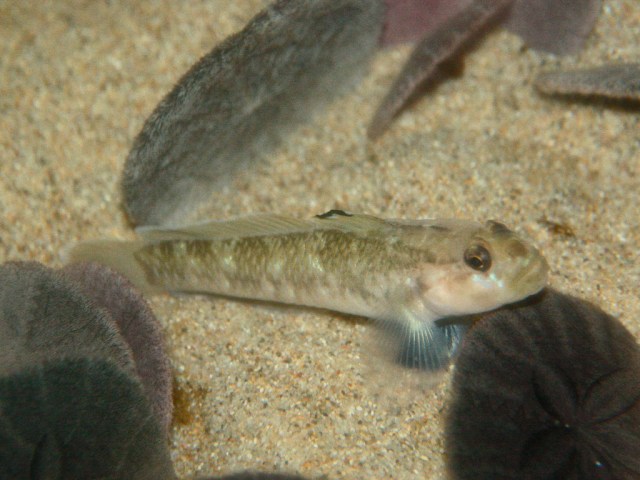
Genus/species: Coryphopterus nicholsii


DISTRIBUTION/HABITAT: Northern British Columbia to central Baja. Habitat: Subtropical quiet water, usually in sandy areas near rocks. Intertidal to 100 m (260 feet).

 Blackeye Goby3156957770_6f372fc8f5_b

GENERAL CHARACTERISTICS: Eye and tip of first dorsal fin black. Large scales. Fleshy ridge extending from area between the eyes to dorsal fin. Pale tan overall with small blue spot below the eye. Max. length: 15 cm (6 inches).

 Blackeye Goby3968321166_3e2284847f_b

DIET IN THE WILD: Small crustaceans and mollusks including amphipods, copepods, isopods, decapods (particularly hermit crabs), snails, and clams.
Blackeye Goby3707835699_7a6d5047ff_b

REPRODUCTION: A protogynous hermaphrodite (born female and change sex to male). Forms permanent harem groups composed of a single male and several smaller females Oviparous, Male cleans spawning site under rock, then attracts female by rising from bottom to display his black pelvic disk. Male guards nest after female lays eggs.

CONSERVATION: Not Evaluated

REMARKS: Defensive strategy is to freeze on the bottom but if a predator comes too close, the goby dashes for safety under a rock or to another protective spot.

References

fishbase www.fishbase.org/summary/3847

eol eol.org/pages/340388/overview

Ron’s flickr https://www.flickr.com/photos/cas_docents/3156957770/in/set-72157623764848303/

Ron’s WordPress shortlink  http://wp.me/p1DZ4b-1kp
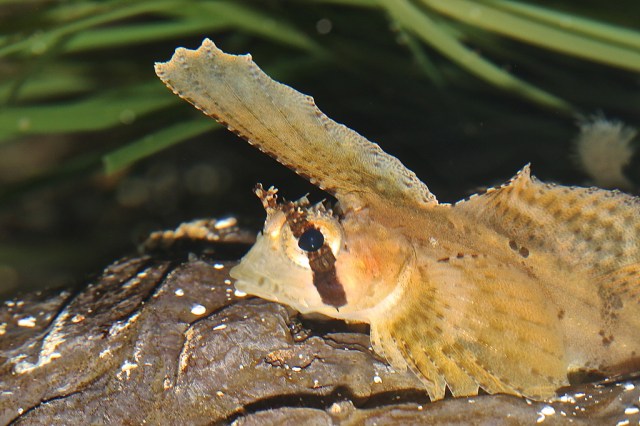
 

TAXONOMY
Kingdom:Animalia (animals)
Phylum; Chordata (chordates)
Class: Actinopterygii (ray-finned fishes)
Order: Scorpaeniformes (Scorpionfishes and flatheads)
Family: Hemitripteridae (Sea ravens or sailfin sculpins)

Genus/species: Nautichthys oculofasciatus

8552927419_f503e4fa76_b

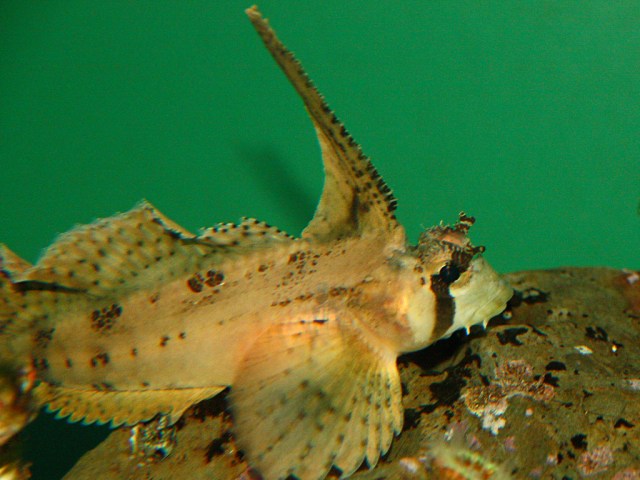
GENERAL CHARACTERISTICS:  The tall, first dorsal fin is extended in front of the head as the fish swims  which resembles a sail. Color varies, grayish on top with variously hued markings and occasionally red markings on dorsal fin. Caudal fin rounded, directed upward. A black band runs diagonally down and back through eye . To 20 cm (8 inches).

Sailfin Sculpin14972884586_258b21dea7_h

DISTRIBUTION/HABITAT: Alaska to San Miguel Island, southern California. Habitat: Found at about 90 m (300 ft) most often on rocky bottoms with algae; occasionally seen hanging upside down in rock crevices.

DIET IN THE WILD: Small invertebrates

REPRODUCTION: Female spawns in winter and spring, when eggs are laid on rocks and often among mussel beds. The male guards the eggs.

Sailfin Sculpin

CONSERVATION: IUCN; not evaluated

Remarks: Common derived from the tall anterior dorsal fin which is extended in front of the head as the fish swims  which resembles a sail. Often the sailfin moves back and forth in the same rhythm as the movement of nearby seaweeds. Coupled with its cryptic coloration, this behavior disguises it from predators.

References

fishbase www.fishbase.org/summary/Nautichthys-oculofasciatus.html

 eol eol.org/pages/204301/hierarchy_entries/44730883/details

Ron’s WordPress Shortlink  http://wp.me/p1DZ4b-Tg

Ron’s flickr  http://www.flickr.com/photos/cas_docents/sets/72157608359804936/with/8552927419/

TAXONOMY
Kingdom: Animalia
Phylum: Chordata
Class: Actinopterygii (ray-finned fishes)
Order: Scorpaeniformes (Scorpionfishes and flatheads)
Family: Hemitripteridae (Sea ravens or sailfin sculpins)

Genus/species: Blepsias cirrhosis

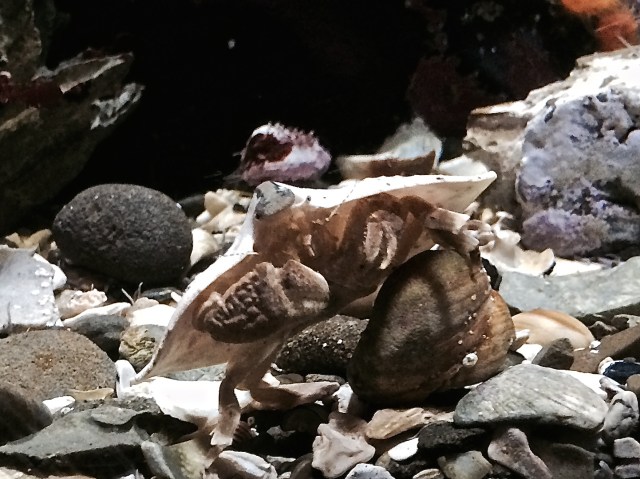
GENERAL CHARACTERISTICS: There is a depression at the back of the head and some long cirri hang from the chin. The front edge of the first dorsal fin is high, the second dorsal and anal fins are long and approximately the same size. Coloration is usually brown mottled above with a light spot near the pectoral fins and pale below. Max length : 20.0 cm (8 inches)

 DISTRIBUTION AND HABITAT: North Pacific: Sea of Japan to the Bering Sea and to San Simeon, central California, USA.  Temperate Marine  Occurs in intertidal areas and to 37 m (120 ft) depth, but more common in subtidal areas. Often found among algae.

DIET IN THE WILD: Nekton and benthic crustaceans.

REPRODUCTION: Fecundity is low, 234–404 eggs. Adult B. cirrhosus  inject eggs into the tissue near the gastral cavity of  the sponge Mycale adhaerens  using it as a spawning bed.  The eggs are hidden by the sponge which is minimally damaged with the sponge also providing constant oxygen and an environment free of most bacteria.

CONSERVATION: IUCN; Not evaluated

LOCATION: Rocky Reef Cluster Sculpins

eol eol.org/pages/206919/details

 fishbase www.fishbase.us/summary/4054

 Ron’s flickr  www.flickr.com/photos/cas_docents/7207822582/in/photolist…

Ron’s WordPress shortlink:  http://wp.me/p1DZ4b-wY


TAXONOMY
Kingdom: Animalia
Phylum: Arthropoda (invertebrate animal having an exoskeleton (external skeleton), a segmented body, and jointed appendages
Subphylum: Crustacea (crabslobsterscrayfishshrimpkrill and barnacles). Distinguished from other groups of arthropods, such as insectsmyriapods and chelicerates, by the possession of biramous (two-parted) limbs
Class: Malacostraca  (crabslobsterscrayfishshrimpkrillwoodlice, scuds (Amphipoda), mantis shrimp and less familiar animals)
Subclass: Eumalacostraca
Superorder: Eucarida  (decapodskrill and Amphionides)
Order: Decapoda (literally “ten-footed”)  Includes crayfishcrabslobstersprawns and shrimp.
Suborder: Pleocyemata;  members of the Reptantia (including crabs, lobsters, crayfish, and others)
Infraorder: Anomura
Superfamily: Paguroidea (hermit crabs)
Family: Lithodidae (stone crabs)

Genus/species: Cryptolithodes typicus

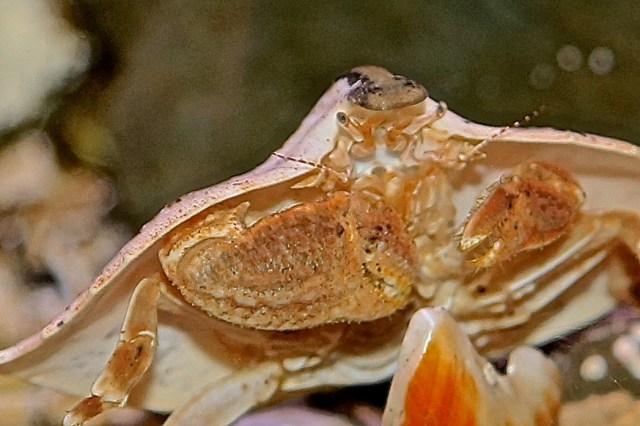
 GENERAL CHARACTERISTICS: The carapace covers the thoracic segments extending so far out covering the tips of the legs. The rostrum is widest at the base and narrower at the tip. Chelipeds are covered with rough tubercles. Carapace color is variable, from dark gray-blue to bright orange, white (especially in small individuals), or red (especially in males). The central part of the carapace is often a different color than the “wings”. Carapace width to 8 cm (3 inches).

Cryptolothodes sitchensis has a similar carapace but its rostrum is widest at the tip and its chelae are smooth.

 Butterfly Crab14453583299_3d6be76343_oDISTRIBUTION/HABITAT: Marine from Amchitka Island, Alaska to Santa Rosa Island, CA. Found in Rocky banks, shell rubble near rocky cliffs in open coast or inland waters, Depth Range: Low intertidal to 45 m (150 feet).

Butterfly Crab14453618558_e56e0e248d_o

DIET IN THE WILD: Feeds on bryozoans, coralline algae.

REFERENCES:

wallawalla.edu/academics/;  www.wallawalla.edu/academics/departments/biology/rosario/…

 eol eol.org/pages/342506/details

Ron’s WordPress shortlink  http://wp.me/p1DZ4b-1k8

Ron’s flickr  https://www.flickr.com/photos/cas_docents/14453618558/in/set-72157608602469734/

 Photo vetted, Margarita Upton Biologist II Steinhart Aquarium California Academy of Sciences

TAXONOMY
Kingdom: Animalia
Phylum: Chordata
Class: Actinopterygii (ray-finned fishes)
Order: Scorpaeniformes (Scorpionfishes and flatheads)
Family: Sebastidae (Rockfishes, rockcods and thornyheads)

Genus/species: Sebastes maliger

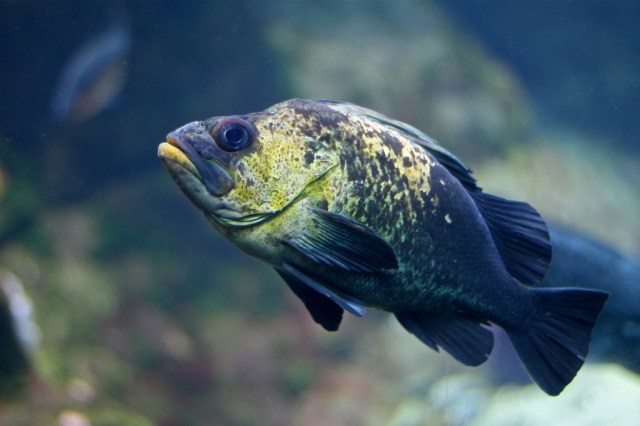
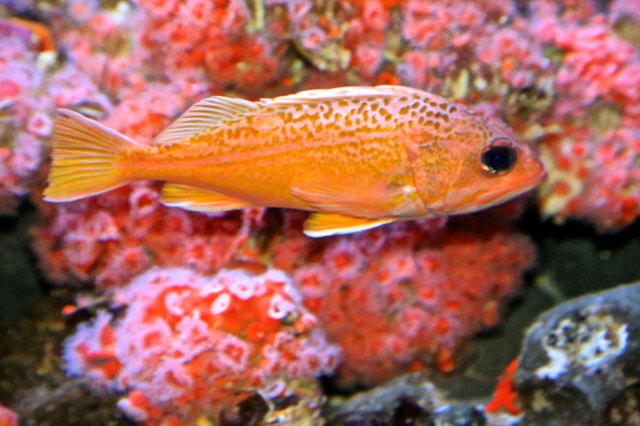
GENERAL CHARACTERISTICS: Brown, with yellow to orange ventral mottling. They have light-colored dorsal saddle patches on the anterior part of the body with vague bands over the head and through the dorsal fin. Often have freckles on head. The dorsal fin spines have deeply incised membranes and are very long.  All fins are dark brown to black except for the first dorsal fin, which has a yellow streak. Length To 61 cm (24 in).

DISTRIBUTION/HABITAT: Gulf of Alaska to Anacapa Passage in southern California. Bottom dwellers perching on rocks or hiding in rock crevices in subtidal waters to depths of 274 m (900 ft).

DIET IN THE WILD: Herring, demersal, pelagic crustaceans, crabs, amphipods, euphasiids, and copepods.

REPRODUCTION: Viviparous as in other Sebastes sp.

LONGEVITY: Live to 95 years.

PREDATORS: Larger fish such as sharks.

CONSERVATION: IUCN Not evaluated

California Rocky Coast CC06

References

 fishbase www.fishbase.org/summary/Sebastes-maliger.html

 eol Encyclopedia of Life eol.org/pages/211614/details 

Washington Dept of Fish and Wildlifewdfw.wa.gov/fishing/bottomfish/identification/rockfish/s_…

flickr http://www.flickr.com/photos/cas_docents/sets/72157608359804936/with/7793249686/

WORDPRESS SHORTLINK  http://wp.me/p1DZ4b-Eu

TAXONOMY
Kingdom: Animalia
Phylum: Chordata
Class: Actinopterygii (ray-finned fishes)
Order: Perciformes (Perch-likes)
Family: Labridae (Wrasses)

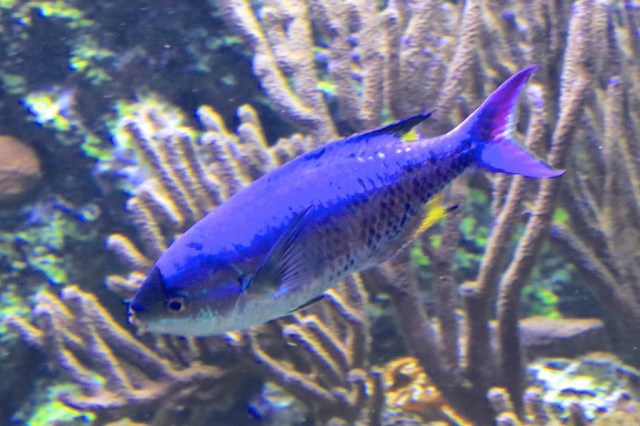
Genus/species: Clepticus parrae

ClepticusParrae14582664694_eb0ac408f1_b

GENERAL/CHARACTERISTICS: Color primarily violet or purple; large individuals with a wash of yellow on lower two-thirds of body; prolonged portions of dorsal and anal fins and tips of pelvic fins blackish. Max length : 30.0 cm (1 foot).

DISTRIBUTION/HABITAT: Western Atlantic: Bermuda, southern Florida (USA), and Bahamas to northern South America. Found in seaward reef slopes; occasionally on shallow patch reefs.
Depth 10-30 meters (33-100feet).

DIET IN THE WILD: Plankton small jellyfishes, pteropods, pelagic tunicates and various invertebrate larvae

REPRODUCTION: Form leks during breeding (a place where males assemble during the mating season and engage in competitive displays that attract females). Protogynous hermaphrodite The largest fish in a group is a dominant breeding male, while smaller fish remain female. If the dominant male dies, the largest female changes sex.

CONSERVATION: IUCN; Least Concern.

REMARKS: Like many wrasse, it changes color markedly during its lifetime, with juveniles being almost completely violet-purple. As it matures, it develops a yellow patch on the rear part of its body.

REFERENCES:

fishbase www.fishbase.org/summary/3656

eol eol.org/pages/218105/details

flickr www.flickr.com/photos/cas_docents/14290169509/

WordPress Shortlink  http://wp.me/p1DZ4b-1ic

TAXONOMY

Kingdom: Animalia
Phylum: Chordata
Class: Actinopterygii (ray-finned fishes)
Order: Perciformes (Perch-likes)
Family: Serranidae (Sea basses: groupers and fairy basslets)
Subfamily: Epinephelinae (groupers)

Genus/species: Gonioplectrus hispanus

Gonioplectrus hispanusIMG_9063


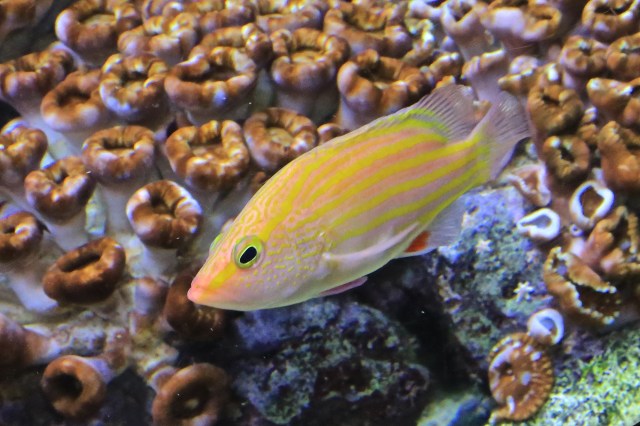
GENERAL CHARACTERISTICS: Head, body, dorsal and caudal fins yellow; 6-7 salmon-colored stripes from the head to the dorsal and caudal fins; blood-red blotch on the front half of anal fin; white blotch on the side of belly; pinkish purple pelvic fins. Max. length 30 cm (12 inches).

DISTRIBUTION/HABITAT: Western Atlantic: off North Carolina to the Gulf of Mexico, Caribbean, and south to Vitoria, Brazil Found in deepwater on sandy bottoms and reefs. Demersal; depth range 35 – 365 m (115-1200 feet).

DIET IN THE WILD: Piscivores (feeds on fish)

CONSERVATION: IUCN; Least Concern

REFERENCES:

fishbase www.fishbase.org/summary/3323

filickr  www.flickr.com/photos/cas_docents/14473428691/in/photostr…

WordPress shortlink  http://wp.me/p1DZ4b-1i3

Vetted Matt Wandell,  Biologist California Academy of Sciences


TAXONOMY
Kingdom: Animalia
Phylum: Chordata
Class: Actinopterygii (ray-finned fishes)
Order: Scorpaeniformes (Scorpionfishes and flatheads)
Family: Sebastidae (Rockfishes, rockcods and thornyheads)

Genus/species: Sebastes chlorostictus

Greenspotted Rockfish14475518222_405daf78f0_b

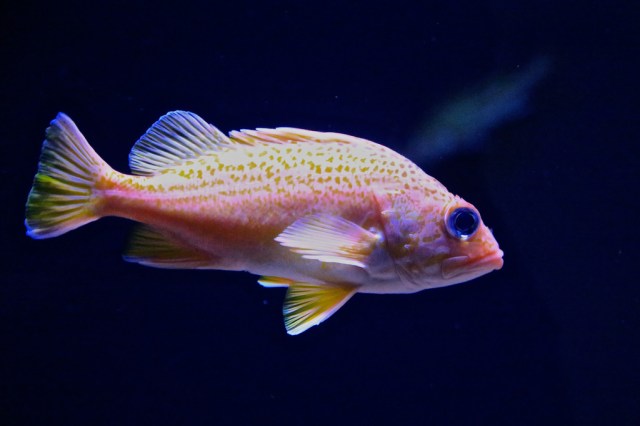
GENERAL CHARACTERISTICS: Spiny fish that varies in color from green-brown dorsally to yellow bottom with green spots above the lateral line and on top of the head which give rise to its common name. Fins are green and fringed in pink and usually there are three to five white rectangular blotches on the back above the lateral line. Max length 50 cm. (20 inches) wt. 1.0 kg (2.2 lbs).

Greenspotted Rockfish14453711206_335de07037_b

DISTRIBUTION/HABITAT: Eastern Pacific Washington USA to Baja California. Found 49-200 meters, demersal (feed on or near the bottom) subtropical marine.

DIET IN THE WILD: Little is known about the diet of S.chlorostictus but it is assumed that it consumes copepods, krill, and a variety of zooplankton.

REPRODUCTION: Viviparous as other Sebastes sp. Life span 33 years.

CONSERVATION: IUCN Not evaluated

LOCATION: California Coast

REFERENCES

fishbase: www.fishbase.org/summary/3958

 eol eol.org/pages/215480/details

WordPress shortlink: https://fishoncomputer.wordpress.com/wp-admin/post-new.php

flickr https://www.flickr.com/photos/cas_docents/14475518222/

TAXONOMY
Kingdom: Animalia, animals
Phylum: Chordata, chordates
Class: Actinopterygii (ray-finned fishes)
Order: Scorpaeniformes (Scorpionfishes and flatheads)
Family: Sebastidae (Rockfishes, rockcods and thornyheads)

Genus/species: Sebastes elongatus

SebastesElongatus

GENERAL CHARACTERISTICS: Underwater they are white to reddish with four very distinct horizontal green stripes and light ventrally; green streaks on caudal fin membranes. After capture the entire body often becomes red or orange. Max. length 39.0 cm (15 inches). max. published weight: 630 g (1.3 pounds); max. reported age: 46 years.

GreenstripedRockfish14475489192_5dbe5d96ff_b


DISTRIBUTION/HABITAT: Eastern Pacific from Puget sound to Baja California. This is a solitary species that is often found resting on the bottom on rocky as well as soft bottoms. Temperate Marine demersal 25-425 meters (80-1400 feet).

DIET IN THE WILD: Small fishes, octopuses, shrimps.

REPRODUCTION: Viviparous

CONSERVATION: IUCN 2006 red list of threatened species.

REMARKS: Good eating fish but rarely caught by sports anglers.

LOCATION: California Coast

References:

WordPress Shortlink: http://wp.me/p1DZ4b-1hF

fishbase www.fishbase.org/summary/3965

 eol eol.org/pages/209601/details

 Washington Dept. of Fish and Wildlife. wdfw.wa.gov/fishing/bottomfish/identification/rockfish/s_…


fishbase www.fishbase.org/summary/3965


eol eol.org/pages/209601/details


Washington Dept. of Fish and Wildlife.wdfw.wa.gov/fishing/bottomfish/identification/rockfish/s_…

TAXONOMY
Kingdom : Animalia
Phylum: Chordata
Class: Actinopterygii (ray-finned fishes)
Order: Perciformes (Perch-likes)
Family: Gobiidae (Gobies)

Genus/species: Valenciennea puellaris

Maiden GobyIMG_8532

GENERAL CHARACTERISTICS: Pale grey body color for Pacific fish with row of large orange spots on side, a series of dash-like markings below, oblong pale blue spots on cheek and opercle.  Length : 20.0 cm (7.8 inches).

DISTRIBUTION/HABITAT: Tropical marine Indo-Pacific: red Sea to Samoa, north to southern Japan, south to the Great Barrier Reef.
Inhabits sandy areas of clear lagoon and seaward reefs.

DIET IN THE WILD: Carnivore feedings off the bottom sifting through the sand. Once the fish has a mouthful of sand, it begins to slowly expel the sand out the gills for any small invertebrates.

REPRODUCTION: Monogamous

CONSERVATION: IUCN; Not evaluated

REMARKS: Occurs in pairs and use burrows as refuge.

References

WordPress shortlink  http://wp.me/p1DZ4b-1hc

flickr  https://www.flickr.com/photos/cas_docents/14047101767/

fishbase www.fishbase.org/summary/Valenciennea-puellaris.html

eol eol.org/pages/207103/details