Latest Entries »

TAXONOMY

Kingdom: Animalia
Phylum: Chordata
Class: Reptilia
Order: Squamata
Family: Boidae (Boas; non-venomous, constricting snakes)

Genus/species: Sanzinia madagascariensis
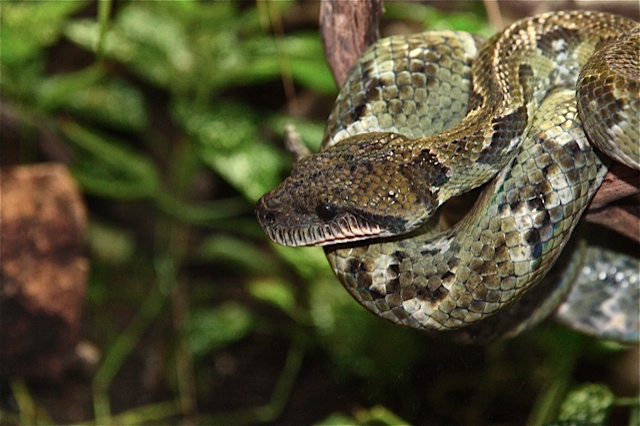
 

GENERAL CHARACTERISTICS: Endemic throughout the island of Madagascar, excluding the very southwest corner. Occurs in 2 color variations; those in the eastern part of the range are green to grayish-green, while in some parts of the western range they are yellow, orange, and brown. The green variety is somewhat smaller than the western form. Max length: about 2 m or 6 ft. Females are larger than males.

DISTRIBUTION/HABITAT: Endemic throughout the island of Madagascar, excluding the very southwest corner. Live in a variety of forest habitats, ranging from lowland tropical forests, to humid upland forests, to dry forests.

DIET IN THE WILD: It is a nocturnal snake, feeding on small mammals (including bats!) and birds, seeking them out using the heat-sensitive pits around its mouth that enable it to hunt for warm-blooded prey in complete darkness. Prey are constricted by the powerful coils of the boa which tighten as the prey struggles, restricting the blood flow to the heart and ultimately causing circulatory failure. Not venomous.

REPRODUCTION: Like all boas, females give birth to live young.Reach maturity at 3 years old, giving usually gives birth to fewer than 12  living young, which are red-colored to deter predators.
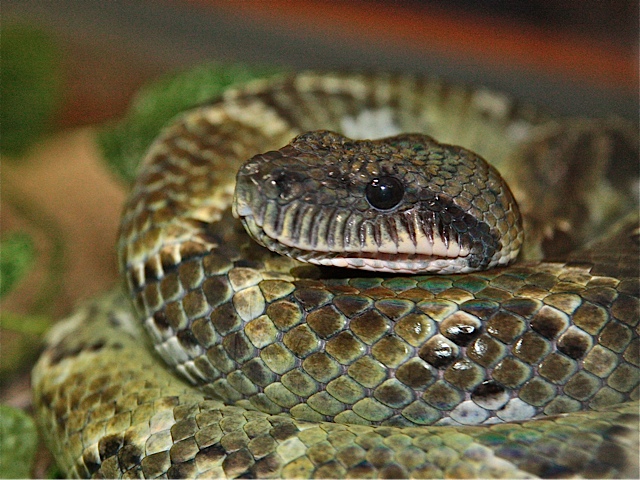
 
CONSERVATION:  IUCN Red List; Least Concern (LC)   Appendix I of CITES. Habitat loss through deforestation for agriculture and human settlement has restricted these boas mostly to protected areas of Madagascar. 

LOCATION: Rainforest  Madagascar MA06

References

Encyclopedia of Life  eol.org/pages/795591/details

ARKive http://www.arkive.org/madagascar-tree-boa/sanzinia-madagascariensis/

California Academy of Sciences Docent Training Manual on Rainforests 2014

Ron’s flickr http://www.flickr.com/photos/cas_docents/sets/72157625194985646/

Ron’s WordPress shortlink   http://wp.me/p1DZ4b-zd
 

TAXONOMY
Kindom: Animalia
Phylum: Chordata
Class: Actinoptergii
Order: Perciformes
Family: Cichlidae (cichlids)
Subfamily: Etroplinae

Genus/species: Paretroplus menarambo

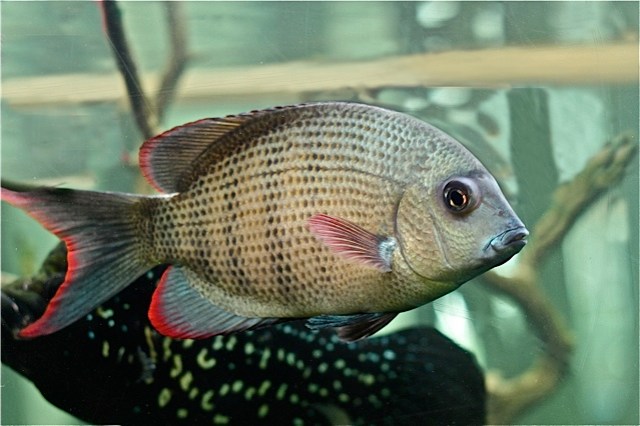
GENERAL CHARACTERISTICS: When young, Mearambos are a pale gold with black dots in a pin stripe pattern. As they reach adulthood, around 4 inches or 3 years of age, they are blue/gray to almost white with black dot pin stripes. The fins are edged in red, especially the tail. Max length : 12.8 cm (5 in).

DISTRIBUTION/HABITAT: Endemic to Madagascar. Present in the freshwater flood plain lakes of the Bemarivo River, the major northwards-flowing tributary of the Sofia River in northwestern Madagascar. The species is now known to occur in a single lake of that system: Lac Tseny.

DIET IN THE WILD: Have teeth specially designed for crushing snail shells.

REPRODUCTION: Substrate spawner. Eggs are laid in a pit and will adhere to surfaces such as driftwood.

PREDATORS: Critically endangered species threatened by invasive species and over-fishing.

CONSERVATION: IUCN Red list: Critically Endangered (CR)
No data are available on the wild population; previously it was thought to have disappeared from its native range, but more recent surveys rediscovered the species in Lac Tseny Habitat degradation, the presence of invasive exotic species and overfishing account for its Critically Endangered status. Breeding populations of this species are maintained in captivity.

LOCATION Madagascar MA04

References

fishbase www.fishbase.org/summary/SpeciesSummary.php?id=57958

IUCN www.iucnredlist.org/details/44492/0

Encyclopedia of Life eol.org/pages/211122/details

Ron’s flickr http://www.flickr.com/photos/cas_docents/sets/72157627949403670/

Ron’s WordPress shortlink  http://wp.me/p1DZ4b-yp


TAXONOMY
Kingdom: Animalia
Phylum: Chordata
Class: Actinopterygii (ray-finned fishes)
Order: Percifomes (Perch-likes)
Family: Cichlidae (Cichlids)

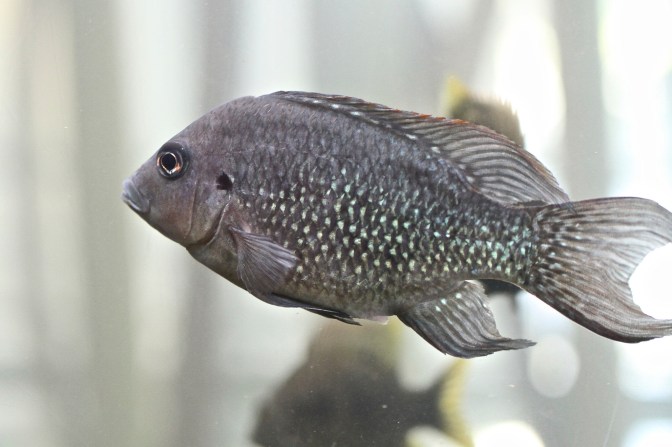
Genus/species: Ptychochromis sp. “Tarantsy”

GENERAL CHARACTERISTICS: Males are generally silver with a faint black strip mid-body and a spot on the gill plate. Females are darker in color overall, especially when breeding.
Length to 16cm (6.5 inches).

Tarantsy8342758012_95170c71b4_k

DISTRIBUTION/HABITAT: Tarantsy River and Lake Tarantsy, near Amboasary and Fort Duaphin, Madagascar.

DIET IN THE WILD: Omnivores

REPRODUCTION: Substrate spawning egg layers.

REMARKS; Little information is available.

Madagascar MA04

References

Greater Chicago Cichlid Association:  www.gcca.net/madagascan-cichlids/139-ptychochromis-sp-nor…

Ron’s flickr  https://www.flickr.com/photos/cas_docents/8342758012/in/set-72157620708610230

Ron’s WordPress Shortlink  http://wp.me/p1DZ4b-yH

Vetted Jenoh Gonzales Biologist, Steinhart Aquarium
California Academy of Sciences 1-7-15

TAXONOMY
Phylum: Chordata
Class: Actinoptgerygii
Order: Periciformes
Family: Chichlidae (Cichlids)

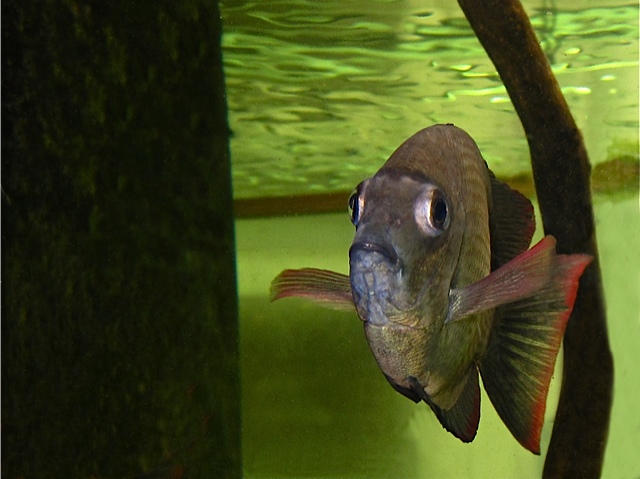
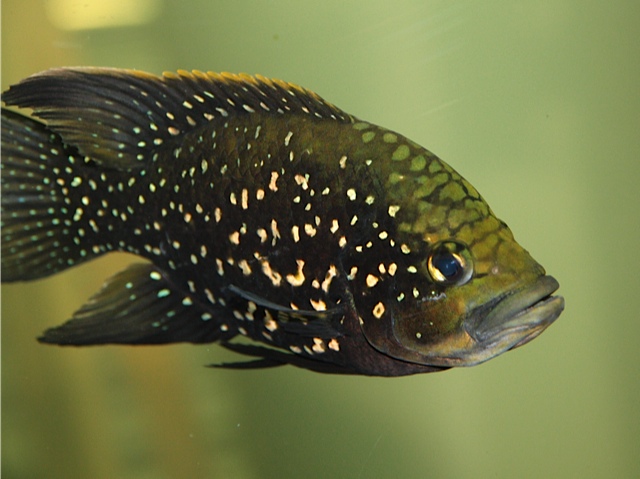
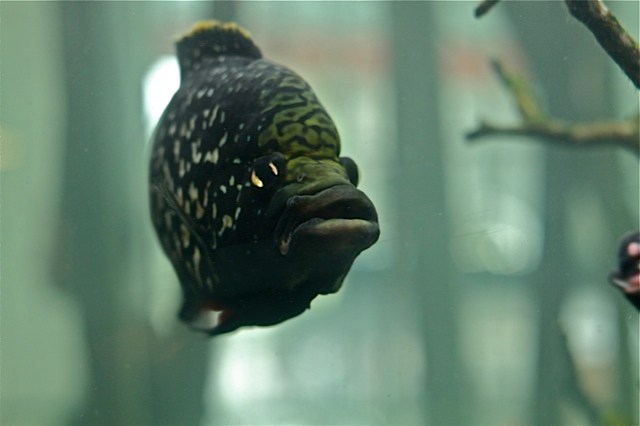
Genus/species: Paratilapia polleni

GENERAL CHARACTERISTICS: Mid-sized cichlid, growing to 30 cm (12 in) in length; males grow up to a third again as large as females; black velvet basic coloration with pattern of blue and gold spangling. Distinct spot present in dorsal fin of juveniles and sexually quiescent adults.
Adult male fish are much larger than females and develop longer extensions on the dorsal and anal fins. They also tend to have a more rounded head shape.


DISTRIBUTION/HABITAT: Endemic to Madagascar found in freshwater at altitudes up to 1,500 m (5000 ft) and exhibit tolerance for a broad temperature range.

DIET IN THE WILD: Carnivorous, juveniles feed chiefly on planktonic crustaceans and insect larvae; larger fish are crepuscular predators with a preference for small fishes, but also take invertebrates as opportunity presents.

REPRODUCTION: Marakely parenting is a two-fish job. They are monogamous, biparentally custodial substrate spawners. Pairs defend a territory and both sexes assume a velvety black base coloration as spawning approaches. They excavate a gravel pit and spawn in it excluding other fish from area. Each egg has a long adhesive fiber that adheres to other egg fibers, forming a rope of eggs (up to a thousand) rolled into an egg mass. The male patrols the perimeter of the territory as the fry become mobile four days post-hatching. Both parents follow the school of fry, retrieving stragglers by mouth and spitting them back into the school. Parental care continues for about three weeks. These protective behaviors promote reproductive success common to many cichlid species.

PREDATORS: In the southern part of its range, the exotic spotted snakehead is both a competitor and predator. Paratilapia polleni have lived for up to 15 years in aquariums.

CONSERVATION: IUCN Red List; Vulnerable (VU)   Qualifies as Vulnerable on account of its limited distribution and fragmented habitat (mainly due to deforestation of river catchments) which are causing a continued decline in available habitat and the number of mature individuals in the population. 

A Marakely captive breeding program is supported by many aquariums and zoos.

REMARKS. The most primitive living representatives of the large Cichlidae family.  Some of Madagascar’s freshwater fish species have ancestors dating back to the Jurassic period.

Madagascar MA04

References

fishbase  www.fishbase.org/summary/Paratilapia-polleni.html

IUCN  www.iucnredlist.org/details/16199/0

California Academy of Sciences Rainforest Docent Training Manual 2014

Ron’s flickr  https://www.flickr.com/photos/cas_docents/3637198814/in/set-72157620708610230/

WordPress Shortlink wp.me/p1DZ4b-yh

TAXONOMY
Kingdom: Animalia
Phylum: Chordata
Class: Actinopterygii (ray-finned fishes)
Order: Perciformes (Perch-likes)
Family: Cichlidae (Cichlids)
Subfamily: Ptychochrominae

Genus/species: Ptychochromis grandidieri

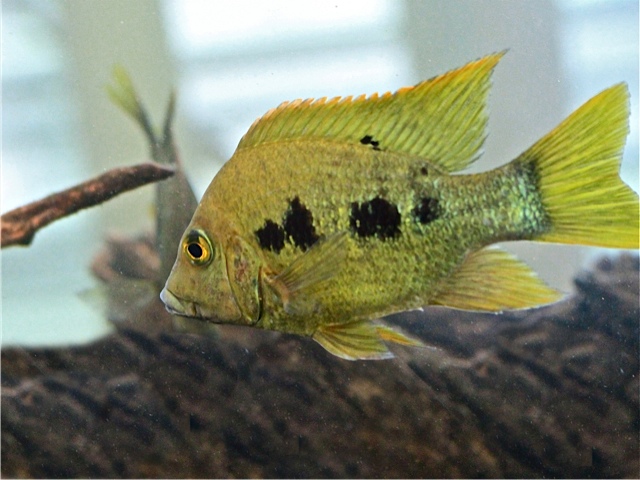
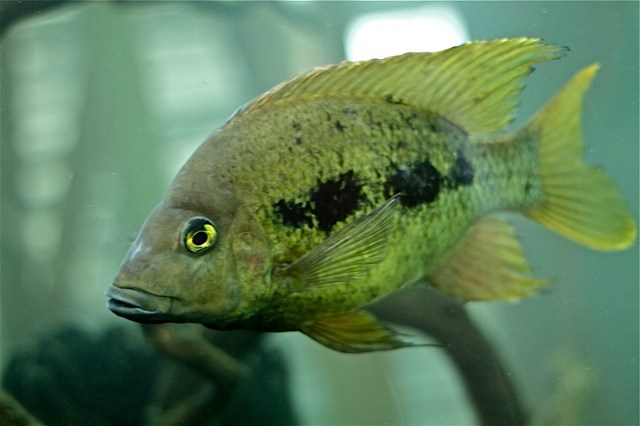
GENERAL CHARACTERISTICS: Yellowish to golden base coloration with a horizontal series of well-defined black blotches situated mid-laterally on the flank. Length to 21 cm (8.25 inches).

DISTRIBUTION/HABITAT: Eastern drainages of Madagascar. Found in fresh water in areas of high forest as well as brackish water.

DIET IN THE WILD: Invertebrates, plant materials.

REPRODUCTION: Egg layers; both male and female care for fry. The rate of breeding would allow the population to double in less than 15 months.

CONSERVATION: IUCN Red List Least concern (LC)  Common throughout its range, which extends along much of eastern coastal Madagascar. Vulnerable to introduced Asian snakehead fish.


LOCATION: Rainforest Madagascar MA04 

References

fishbase fishbase.sinica.edu.tw/summary/Ptychochromis-grandidieri….

Encyclopedia of Life eol.org/pages/210956/details

IUCN Red List Least concern (LC) www.iucnredlist.org/details/44502/0

Ron’s flickr http://www.flickr.com/photos/cas_docents/sets/72157627949403670/

Ron’s WordPress Shortlink  http://wp.me/p1DZ4b-yz

TAXONOMY
Kingdom: Animalia
Phylum: Chordata
Class: Reptilia
Order: Squamata
Family: Colubridae (Colubrids)

Genus/species: Langaha madagascariensis

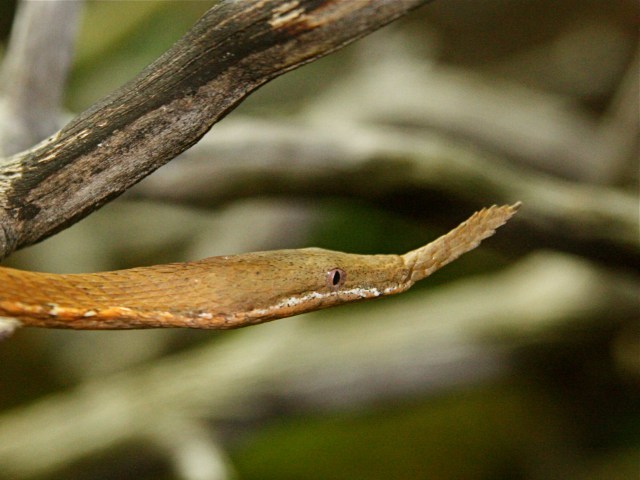
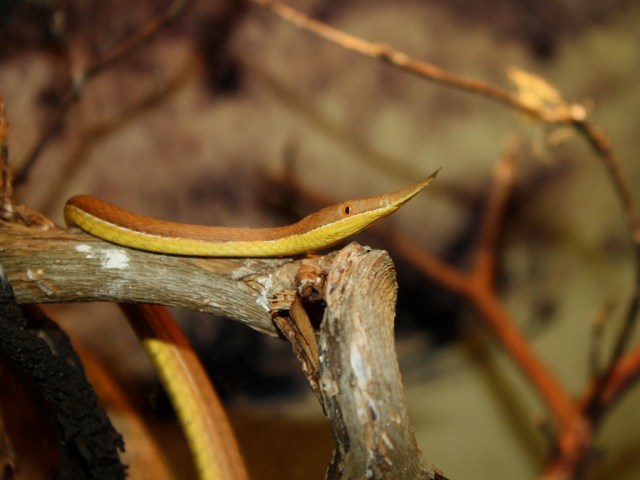
GENERAL CHARACTERISTICS: Displays striking sexual dimorphism: male has a pointed snout and body with contrasting coloration; female has leaf-shaped snout and is uniformly dark brown. 

                    female belowLangaha madagascariensis8599840662_312f136ba9_k

DISTRIBUTION/HABITAT: Endemic to Madagascar. Found at low elevations in much of the island. It is arboreal, living on and in vines. 

                    female belowLangaha madagascariensis3268009379_b359b1da8b_o

DIET IN THE WILD: Lizards Primarily ambush predators, rather than active foragers although it has been observed chasing skinks on the ground. Usually vertical ‘hanging’ behavior as adults, mimicking the seed pods of Malagasy plants (and perhaps deter predation, though by what predator is unclear).

                     male belowLangaha madagascariensis2981271735_2d1bf7df0f_b-2

REPRODUCTION: Egg laying.

CONSERVATION: ICUN Red list Least Concern (LC) 

Wide distribution and presumed large overall population, make it unlikely to decline fast enough to qualify for a more threatened category.

REMARKS: Venomous; bites can produce severe local pain and swelling that may last for several days. Colubrids tend to chew when they bite, further envenomating and infecting the site. 

Madagascar Rainforest MA03

References 

California Academy of Sciences Rainforest Docent Training Manual 2014

Encyclopedia of Life  eol.org/pages/794161/details

Ron’s flickr https://www.flickr.com/photos/cas_docents/8599840662/in/set-72157620708610230/

Ron’s WordPress shortlink  http://wp.me/p1DZ4b-1rx


TAXONOMY
Kingdom: Animalia
Phylum: Chordata
Class: Amphibia
Order: Anura
Family: Microhylidae

Genus /species: Scaphriophryne gottlebei


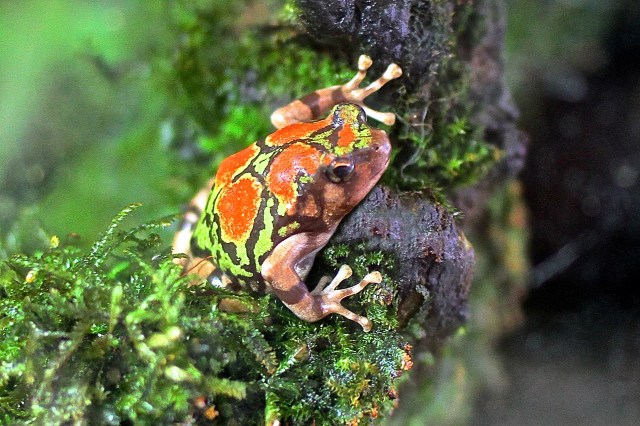
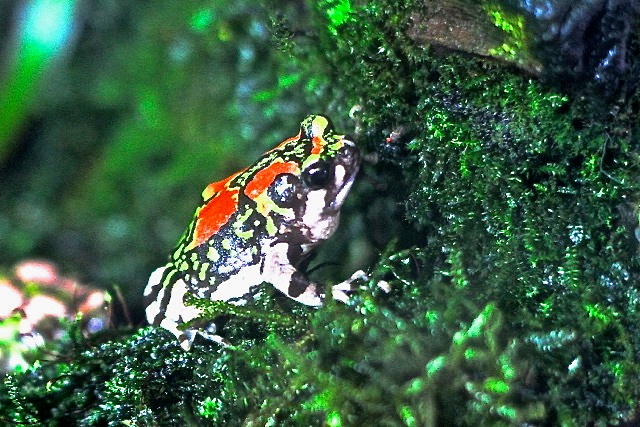
GENERAL CHARACTERISTICS: Roundish, with a distinctive white, red, green and black pattern on the back and a grey belly. Adapted for both the underground and climbing lifestyles,S. gottlebei has horny tubercles on the underside of the hind feet for burrowing, and claws on the forefeet for clinging to vertical canyon walls. Length 20mm (7/8 inches) to 30mm (1.2 inches).

DISTRIBUTION/HABITAT: Madagascar in open rocky dry forest and canyons amongst stone crevices. Despite its webbed hind feet, the painted burrowing frog is a poor swimmer. S. gottlebei is thought to climb only to escape drowning in flash flood water by finding small holes to rest in within the canyon walls of its habitat.

DIET IN THE WILD: Insects.

REPRODUCTION: Tadpoles mature in rocky pools eating detritus.


Madagascar rainforest

References

Encyclopedia of Life  eol.org/pages/1019833/details

IUCN Red List www.iucnredlist.org/details/57998/0

Ron’s flickr  http://www.flickr.com/photos/cas_docents/sets/72157608456457315/

Ron’s WordPress Shortlink http://wp.me/p1DZ4b-I4


TAXONOMY
Kingdom: Animalia
Phylum: Arthropoda
Class: Arachnida
Order: Araneae
Suborder: Araneomorphae (fangs slope towards each other in a pinching action)
Family: Nephilidae

Genus/species: Nephila madagascariensis

3707840635_437d069402_b

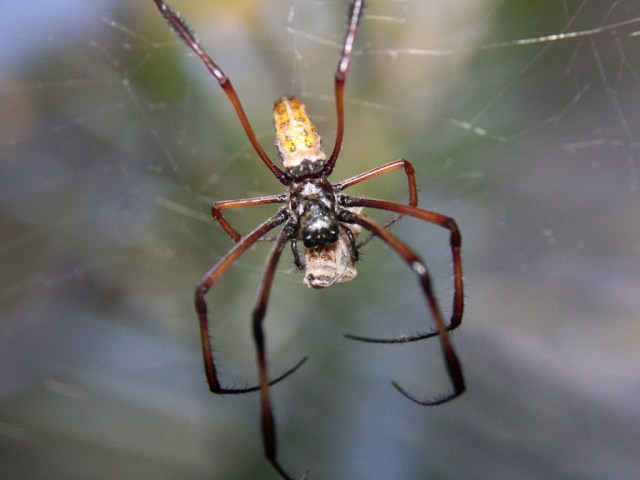
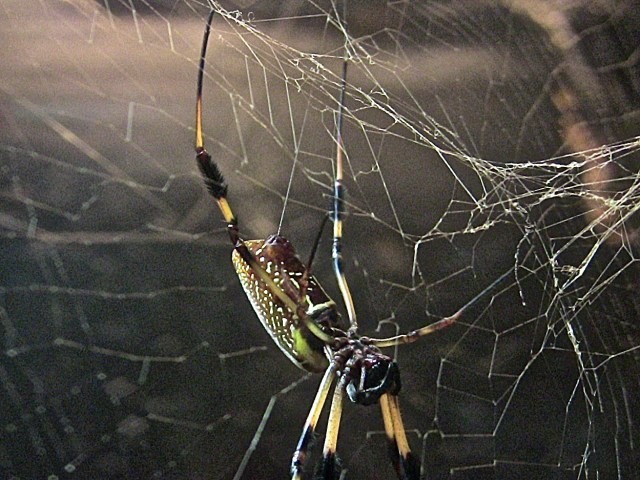
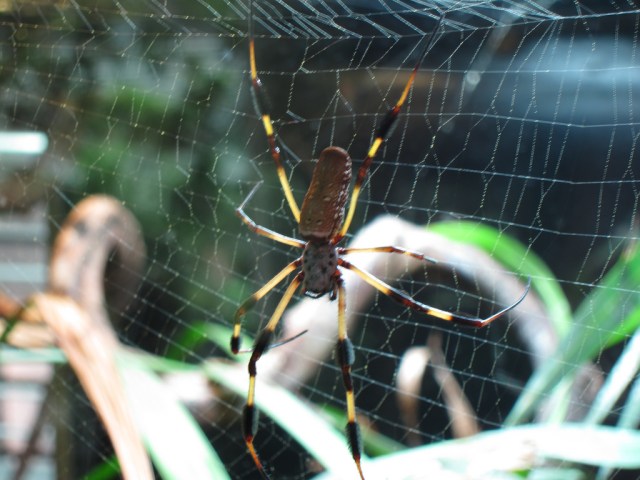
GENERAL CHARACTERISTICS: They have striped legs specialized for weaving (where their tips point inward, rather than outward as is the case with many wandering spiders). In females, the dorsal side of the abdomen has bright yellow markings surrounded by a light gray border. The rest of the body and legs are black with patches of brown. 4.8 – 5.1 cm (1.5 – 2 in) in females, not including leg span, with males being usually 2/3 smaller (less than 2.5 cm, 1 in). Named for yellow threads of their web shine like gold in sunlight not the color of the spider.

DISTRIBUTION/HABITAT: Various species of orb weaving spiders are widely distributed. They exist in the southern United States, Central and South America, Southeast Asia, and the South Pacific. Nephila madagascariensis madagascariensis is found on the island of Madagascar and certain parts of Southern Africa. 

Spinning web below

Golden Orb16121279421_89d739a11a_o

DIET IN THE WILD: Eat insects that get caught in their webs, primarily flying insects. They kill their prey with a venomous bite. While painful, a bite from this spider would not seriously hurt humans.

Golden Orb Weaver

LONGEVITY:: Females usually live about a year, and males about 6 mos.

REMARKS: Golden orb spiders weave large, strong webs out of golden-colored silk which can be as big as 2 m across. The silk strands are reputed to be five times stronger than steel and three times more elastic than Kevlar.
The oldest surviving genus of spiders, with a fossilized specimen known from 165 million years ago.

Rainforest, Madagascar

References

Ron’s WordPress Shortlink: http://wp.me/p1DZ4b-TC

Ron’s flickr http://www.flickr.com/photos/cas_docents/sets/72157608653175263/with/3707840635/

California Academy of Sciences: Madagascar Golden Orb Spider exhibit 2014

 iNaturalist www.inaturalist.org/taxa/49758-Nephila

TAXONOMY
Kingdom: Animalia
Phylum: Chordata
Class: Reptilia
Order: Squamata
Family: Gerrhosauridae

Genus: Zonosaurus maximus

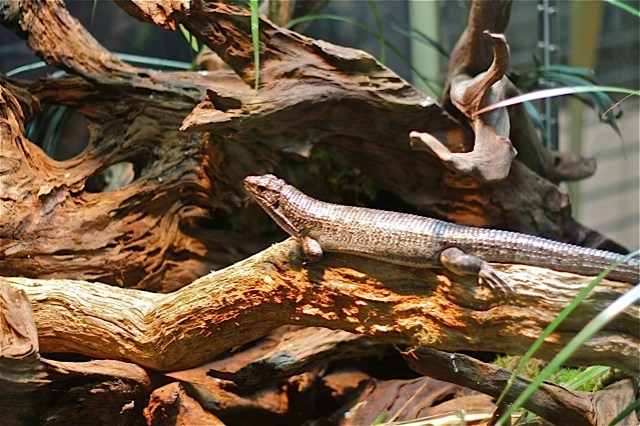
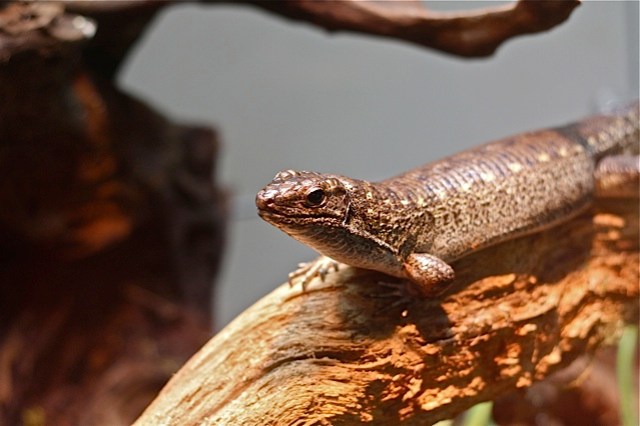
 GENERAL CHARACTERISTICS: Relatively flattened body with a long, pointed snout. The body is covered with heavy armor of large, bony, keeled scales, especially on the dorsal surface. The scaleless area along the sides functions as expansion joints for gravid females that allow distention after feeding. Length is up to 70 cm (28 inches).


DISTRIBUTION/HABITAT: Endemic to Madagascar, this species is found in lowland humid forest associated with rivers and streams as well as non-forested riparian areas where it builds dens close to water. When disturbed, it seeks shelter in water and can stay submerged for several minutes.

DIET IN THE WILD: Plant matter, invertebrates, small rodents, other reptiles.

PREDATORS: Predators are primarily snakes.

REPRODUCTION: Oviparous. Life span: about 20 years.


CONSERVATION: IUCN Red List Vulnerable (VU)
Populations are severely fragmented and declining because of the reduced size and quality of habitat due to agricultural activities. Mature animals may also be over-collected for the pet trade. Some sites where this plated lizard occurs are fortunately under conservation management, including newly protected areas.

LOCATION:  Madagascar Rainforest  MA13

References

California Academy of Sciences, Docent Rainforest Training Manuel 2014

Encyclopedia of Life eol.org/pages/462210/details

IUCN Red List www.iucnredlist.org/details/172865/0

Ron’s flickr  https://www.flickr.com/photos/cas_docents/7423084566/in/set-72157620708610230/

Ron’s WordPress Shortlink  http://wp.me/p1DZ4b-xI


TAXONOMY:
Kingdom: Animalia
Phylum: Chordata
Class: Actinopterygii (ray-finned fishes)
Order: Cypriniformes (Carps)
Family: Cyprinidae (Minnows or Carps)

Genus/species: Puntius titteya

3729700826_694a261026_b

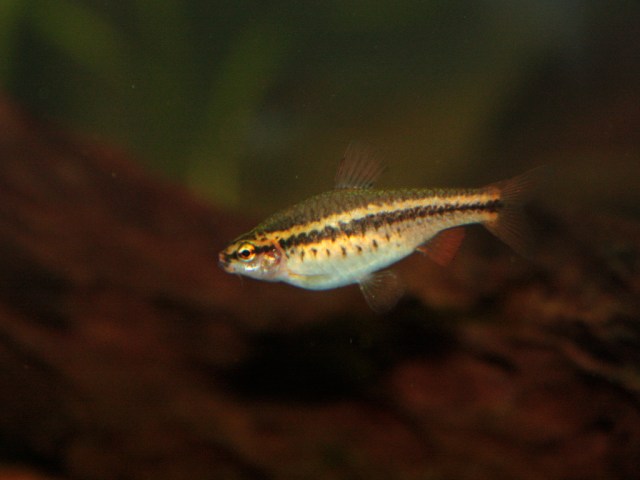
GENERAL CHARACTERISTICS: An elongated fish with a compressed body, fawn-colored on top with a slight greenish sheen. Sides and belly have silver highlights with a horizontal stripe extending from the tip of the snout through the eye to the base of the caudal fin, with an iridescent, metallic line above it. Males are redder than females and attain a deeper red color at breeding time. Females are usually yellow and they are much lighter in color, usually just with some yellow and a light orange/black horizontal band. The female is also a lot plumper than the male. Cherry refers to the fish’s red color. Max. length: 5 cm (2 inches).

Male above and female below.

Cherry Barb (female)  3750942153_ca01fdd6c8_b

DISTRIBUTION/HABITAT: Native to Sri Lanka with introduced populations established in Mexico
and Colombia. Found in heavily shaded streams and rivulets, preferring shallow, slow-moving water with silt substrate and leaf cover.

DIET IN THE WILD: Omnivorous, detritus, green algae, diatoms, dipterans and animal matter.

REPRODUCTION: Most small cyprinids Puntius spp. are egg-scattering free spawners exhibiting no parental care.

CONSERVATION IUCN: Least concern

BO09 Rainforest Borneo Southeast Asia Community

References

fishbase www.fishbase.org/summary/Puntius-titteya.html

Encyclopedia of Life eol.org/pages/212437/details

Ron’s flickr  http://www.flickr.com/photos/cas_docents/3729700826/in/set-72157620567930293/

Ron’s WordPress shortlink  http://wp.me/p1DZ4b-17f